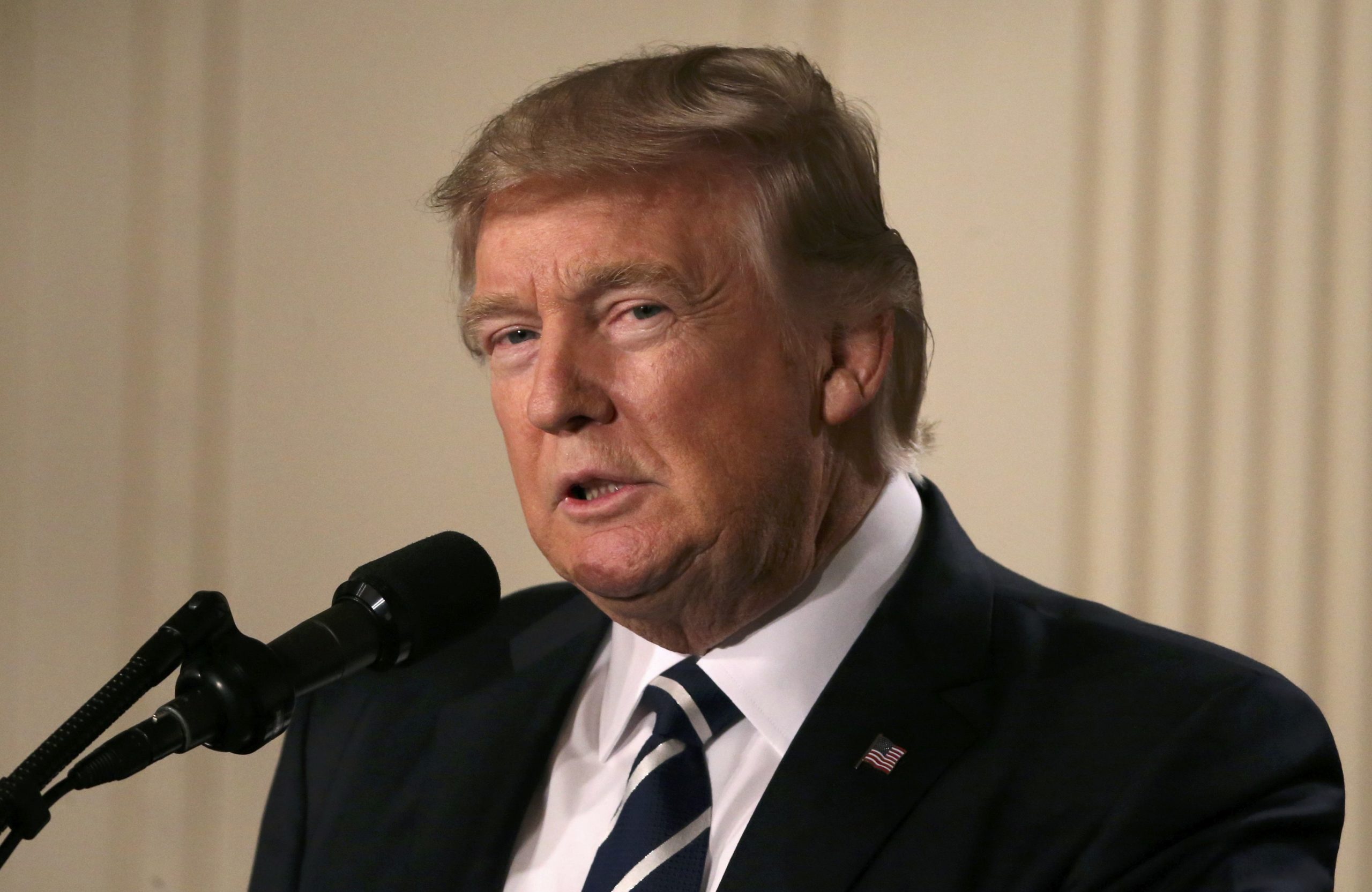
Condemnation of President Donald Trump excluding Jews in his Jan. 27 statement for International Holocaust Remembrance Day was across-the-board, with organizations including the Anti-Defamation League, which has been critical of Trump from the time of his candidacy, to the Republican Jewish Coalition, which has been supportive of him, criticizing the omission.
“It is with a heavy heart and somber mind that we remember and honor the victims, survivors, heroes of the Holocaust,” the U.S. President’s Jan. 27 statement says, excluding “Jews.” “It is impossible to fully fathom the depravity and horror inflicted on innocent people by Nazi terror.”
In the wake of the statement’s release as well as confirmation from the Trump administration’s spokesperson, Hope Hicks, that the exclusion was intentional, the Simon Wiesenthal Center (SWC)—whose founder and dean, Rabbi Marvin Hier, delivered the invocation at Trump’s inauguration—issued a statement calling on the White House to update the statement.
“The Simon Wiesenthal Center reiterates its call for Friday’s Presidential statement on International Holocaust Remembrance Day to be updated to specifically mention the 6 million Jewish victims of the Nazis,” the Jan. 29 statement says.
That update never came, much to the chagrin of Jewish leaders. In a Tuesday phone interview, SWC Associate Dean Rabbi Abraham Cooper said because the Holocaust was focused on the systematic murder of Jews, any International Holocaust Remembrance Day statement neglecting Jews is not just wrongheaded, but dangerous.
“It has real implications in places like Europe, where, as we speak, in the last 10 days there were Muslims in a German [high school] who didn’t want to participate in a Holocaust memorial and one of their professors said we have to listen to their side and be sensitive to it,” Cooper said.
It is fine to remember non-Jewish victims, according to Cooper. In fact, Wiesenthal, himself, was committed to memorializing non-Jewish victims of the Shoah. The famed Nazi hunter and survivor’s insistence on doing so, however, did not detract from his devotion to remembering the primary victims, Jews.
“A generation ago, Simon Wiesenthal was basically the only major Jewish figure to also talk about non-Jewish victims of the Nazis. In fact, when the Roma [gypsies] were initially left off the [then-] new U.S. Holocaust Memorial Council [the governing body of the U.S. Holocaust Memorial Museum] it was Wiesenthal who enforced the issue, saying they were also victims of the Nazis and they have to be on there,” Cooper said. “He spoke about it with great passion in those years … In the same breath he would also say it’s also important to remember the Final Solution…the only target of that genocidal policy were the Jews,” Cooper said.
In an interview, Former Los Angeles County Supervisor Zev Yaroslavsky, who was active in the free Soviet Jewry movement in the 1960s and 1970s, which, experts say, was a cause American-Jews took on, in part, out of guilt of not doing enough to rescue European Jews during the Shoah, says Jews are “sensitive” when it comes to Holocaust remembrance.
“We’re sensitive. The Jewish community is sensitive to this. It’s not our egos that’s driving this. It’s the motive behind white-washing the name, white-washing the Jews out of the Holocaust experience,” he said.
“Meet the Press” moderator Chuck Todd used the term “White-wash” when, this past Sunday on his show, he asked White House Chief of Staff Reince Priebus if the Trump administration regretted not including “Jews” in his Jan. 27 statement.
“I don’t regret the words, Chuck,” Priebus said, as quoted by a transcript of the broadcast, available at nbcnews.com.
Priebus was not the only Trump administration official to defend the exclusion. On Monday, during a news conference, White House Press Secretary Sean Spicer told reporters that the “nitpicking” that has been done to the statement is “pathetic.” Additionally, Spicer said a Jewish individual with relatives who were in the Holocaust helped craft the statement. He declined to name the person when a reporter asked if it was Jared Kushner, Trump’s Orthodox son-in-law, who drafted the statement.
On Monday evening, Politico identified Boris Epshteyn, a special assistant to the president of Russian-Jewish descent, as the person behind the statement.
Cooper, for his part, said the Jewish “nitpicking,” to borrow Spicer’s words, is not demonstrative of Jews being overly-sensitive. The anger over the exclusion, he said, is about getting the facts straight.
“It’s not about being oversensitive; the Shoah is the Shoah. We would prefer if we weren’t the target but we were and if you’re going to make a statement and going to memorialize it,” he said, “you need to get it right.”