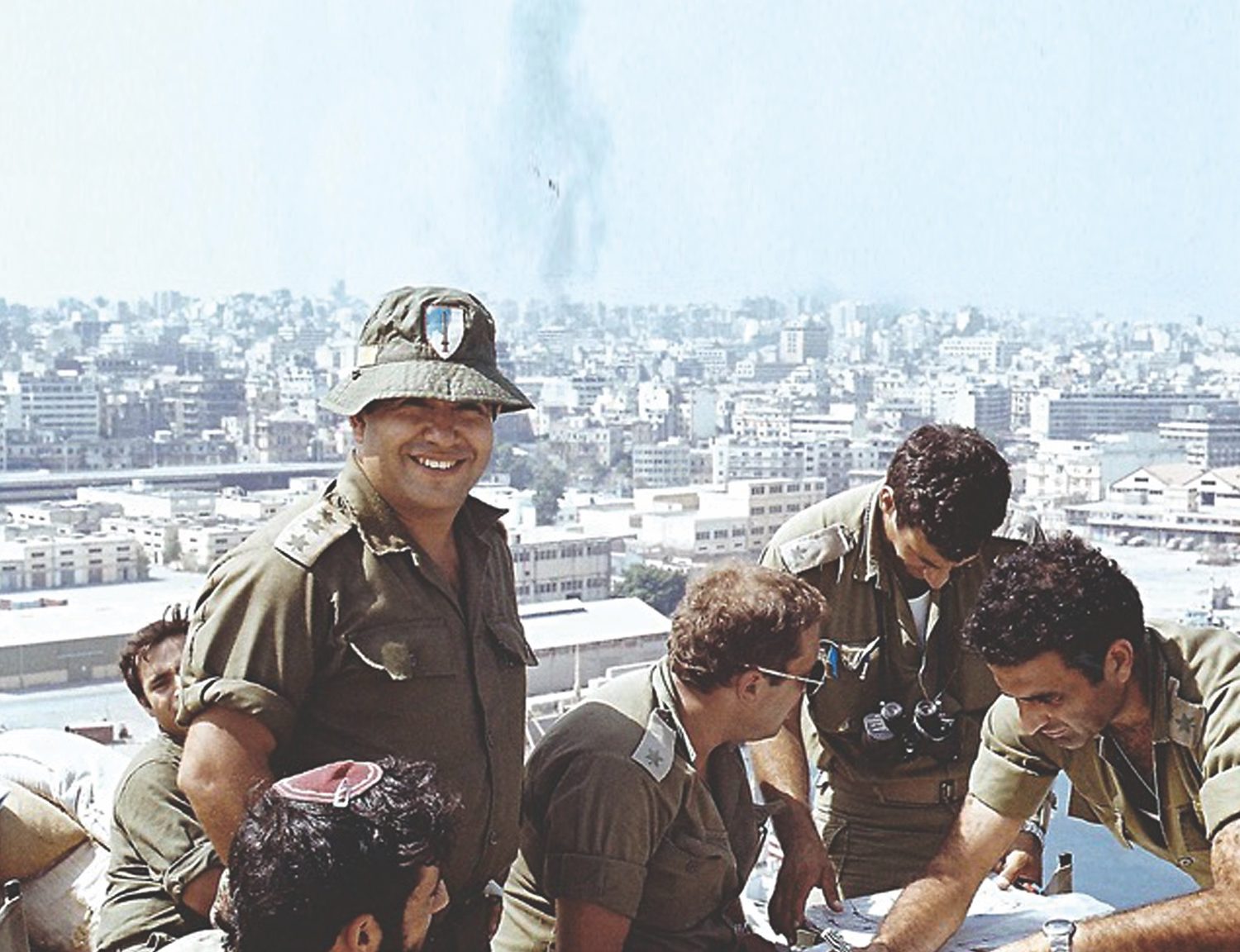
 Dagan in Beirut in 1982.
 The 188th, along with infantrymen from the Golani Brigade, fought in the battle of Kfar Sil, a close-quarter bare-knuckle brawl against well-entrenched Syrian commandos who were propping up Hezbollah’s forces; the battle was described by many as the toughest of the war. There were cease-fires and skirmishes, and sometimes all-out hellacious fighting. At the end of July the brigade was ordered to get ready to enter Beirut. It was the first time that Israeli forces were poised to seize an Arab capital. Days later, the 188th brigade advanced on Beirut International Airport. The control tower became [Col. Meir] Dagan’s headquarters. From there, according to one of his battalion commanders, he conducted and choreographed the opera of war.
The battle for the airport was hard fought. At dawn on the morning of August 4, Syrian commandos unleashed a lethal barrage of antitank missiles against one of Dagan’s battalions near the main terminal. Later that day, toward afternoon, Palestinian and Syrian artillery poured a deadly and pinpointed rain of fire onto the Israeli positions. Thirteen soldiers were killed in the barrage, including Captain Tuval Gvirtzman, the commander of a company of tanks codenamed “Crusher”; he had been killed rushing to the aid of an armored personnel carrier that had suffered a direct hit and had burst into flames.
Gvirtzman, known by the nickname of “Tuli,” was Dagan’s favorite officer in the brigade. “Dagan loved Tuli very much,” a former officer in the brigade remembered. “He was the most beloved officer in his command.” Lieutenant Colonel Eyal Ben-Reuven was Tuli’s commanding officer and had to break the news to Dagan. Under fire, Ben-Reuven climbed up the stairs leading to the control tower toward the brigade command post. Dagan was peering through high-powered field glasses; marked‑up maps were strewn about the floor amid broken glass. When Dagan heard that Tuli had been killed, he stopped what he was doing and his body slumped inward. He broke down in a loud and gut-wrenching cry that could be heard amid the gunfire. No one had ever seen Dagan cry before news of Tuli’s death reached him. Even though Dagan’s brigade lost twenty-five men in the conflict, and he had seen his men killed and wounded before, Tuli’s death changed Dagan forever.
Other events during his service in Lebanon made a lasting impression as well. Upon Dagan’s return home on leave in 1985, he informed his wife, Bina, that as a result of the fierce carnage he had witnessed in the fighting he no longer felt able to eat meat. It simply disgusted him, brought up difficult memories and images, and he insisted that he and his family become vegetarians. Just like that he swore off meat forever.
Thirty years had passed since the battle for Beirut International Airport. Israel endured numerous intifadas and suicide bombing campaigns, SCUD missiles from Iraq, and a second war in Lebanon against Hezbollah. The country also endured a ceaseless terrorist campaign of attrition in between. But the biggest threat Israel had to face now was Iran.
Meir Dagan hated war and wanted to do whatever he could to avoid it; this was part of the genius behind Harpoon — an effort to shock and awe the bankbooks of terror and not the crowded refugee camps where the perpetrators hid shielded by women and children. This revolutionized how nations waged war on terror. There were some in Israel pounding war drums to keep Iran from becoming a nuclear power. Israelis well understood that much of the terrorism being waged against them was being funded directly by the mullahs in Tehran, and they had no illusions what kind of threat the Islamic Republic would pose with nuclear capabilities. Dagan knew when war was necessary and when it could be avoided. In the eighth year of his tenure as Mossad director, Dagan was in a position to put actions in motion that could prevent war — even if it meant that some had to die as part of a larger and more important policy of preemptive deterrence.
Excerpted from the book “Harpoon: Inside the Covert War Against Terrorism’s Money Masters” by Nitsana Darshan-Leitner and Samuel M. Katz, published on Nov. 7 by Hachette Books, a division of Hachette Book Group. Copyright 2017 Nitsana Darshan-Leitner and Samuel M. Katz.


















 More news and opinions than at a Shabbat dinner, right in your inbox.