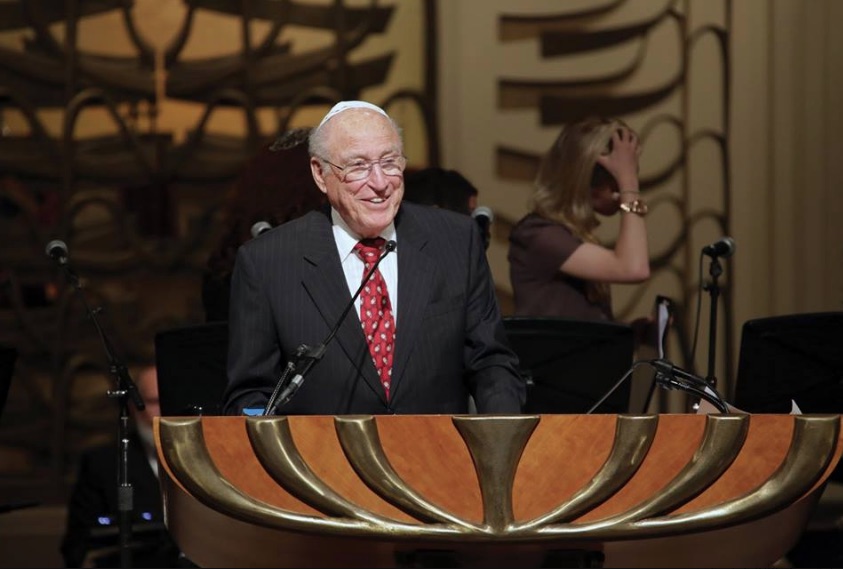
Congregants at Stephen S. Wise Temple will remember Rabbi Isaiah Zeldin, who died last week at 97, as the rabbi who celebrated with them, mourned with them, officiated at their weddings, presided at b’nai mitzvah, and was present at countless moments in their religious lives. Indeed, he was a rabbi who was larger than life and whose generosity of spirit, time and love permeated his entire being. Family members will remember him as Grandpa Shy, the grandfather who lovingly listened, cared, gave sage advice, adored and was filled with pride. And many remember his legacy of Judaism and Jewish education.
I was neither a congregant nor a student. I may have been one of the few people at Zeldin’s funeral who was neither a relative, friend, nor someone with a personal connection to the glorious institutions he built. I’m a historian and, for the past three years, have devoted my research to the history of Jewish education in Los Angeles. My doctoral dissertation focused on the development of day schools in Los Angeles. And in that story, Zeldin stands out as one of the greatest figures.
Many people are familiar with the almost mythical story of how Zeldin took 35 families from Temple Emanuel to form a new congregation. While people describe that journey in matter-of-fact terms — from first using space in a church, then eventually making their way to the hilltop where Stephen S. Wise Temple sits today.
But it wasn’t only a remarkable feat, but the manifestation of a vision. This new institution would bridge the city’s Jews by being a midway point between the city and the San Fernando Valley. It would offer much more than just prayer services. The “shul with a pool” would provide programming for the youngest children, the elderly, and every age group in between.
Perhaps most importantly to Zeldin, it educated thousands of students in its day schools (not to mention its religious schools and other educational programs) at a time when Reform day schools were just starting to emerge and few non-Orthodox day schools existed in Los Angeles. That the Reform movement did not officially support day schools until 1985 did not hinder Zeldin’s determination.
Zeldin was a pioneer, a social entrepreneur before the phrase even existed. He saw a need and he filled it. He had a conviction and he made it a reality. And yet Zeldin was no wizard. He did not hide behind curtains. He was present at the board meetings, the staff meetings, the dinner meetings and everything else. He delivered reports, shared his dreams and offered words of Torah. He lived and breathed not only his institution but everything he believed it stood for.
The grandeur that Zeldin built cannot be measured in acreage or in dollars raised. It cannot be understood even through the staff he hired or the educators he trained. Using the word visionary to describe him isn’t an exaggeration, nor is it cliché. And while there is plenty of evidence to describe Zeldin’s success, there is little evidence to aid in understanding it. As Rabbi Yoshi Zweiback said in his eulogy, Zeldin simply willed institutions into being, whether it was his synagogue, the West Coast branch of Hebrew Union College or his many schools.
Zeldin was the last of a generation of giants — rabbis who transformed the face and the fate of the Los Angeles Jewish community and whose commitment to, and passion for, Jewish education drove their every move. These leaders — among them Rabbi Jacob Pressman and Rabbi Harold Schulweis — dismissed denominational differences in the interest of Jewish continuity. They collaborated on projects, sought advice from one another and built the institutions that anchor Los Angeles’ Jewish community today.
Zeldin was a pioneer, a social entrepreneur before the phrase even existed. He saw a need and he filled it.
In the late 1980s, one of the city’s two non-Orthodox Jewish high schools, Golda Meir Academy, was struggling. In contrast, Zeldin’s elementary and nursery schools had been flourishing for over ten years. When the Golda Meir board and the Bureau of Jewish Education brought Zeldin into the discussions about the future of the school, he became a partner in the communal effort, eventually bringing the school under the umbrella of Stephen S. Wise’s Temple, which even assumed its financial burden. Within a few years, he had turned around the fate of the school, today known as Milken Community Schools. The politics (denominational and otherwise) were almost irrelevant. He had secured his own dream of educating Jewish children in a day school from nursery through twelfth grade.
So while congregants and family will hold memories of Zeldin near, this historian will also remember Zeldin as larger than life. Truly, Zeldin was an institution builder, a risk taker and change maker, a giant with a prescient ability to understand a community.
Yehi Zichrono Baruch. May his memory be a blessing.
Sara Smith is Assistant Dean of the Graduate Center for Jewish Education at American Jewish University.