This week marks the first global International Holocaust Remembrance Day observed in the shadow of the October 7 massacres. My most recent visit to “Kikar Ha-Hatufim – Hostage Square” in Tel Aviv was Sunday January 14, marking the 100th day since the October 7 massacre, the 100th day of this war, and the 100th day of inhumane captivity for the hostages still in Gaza. One sign caught my eye, pictured here:
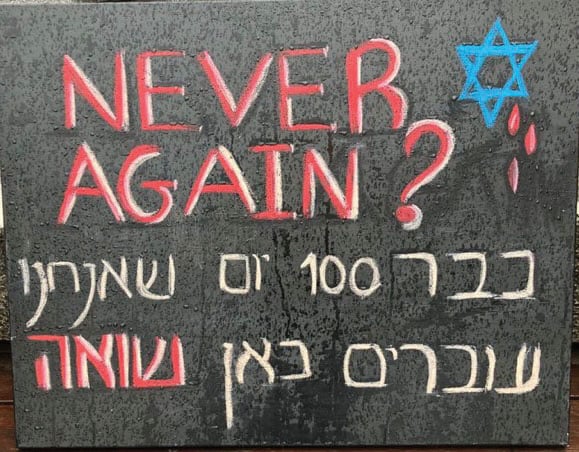
It reads: “Never Again? It’s been 100 days that we’ve been going through a Holocaust here.”
While Holocaust scholars and Israeli politicians debate the use of classic Holocaust language and imagery in discussing October 7, it’s clear to every Israeli that the trauma of the Hamas massacres has revived the trauma of the Shoah in Israeli society.
“We thought that after the Holocaust we’d never see such massacres of Jews again” commented a Holocaust survivor I met in Hostage Square, “yet right before our very eyes, in our own country, on our own land, southern Israel became Babi Yar on October 7.”
These words – “we thought we’d never see” – are reminiscent of similar words spoken 104 years ago in Israel:
“We thought our post-war world would never see such images again. Who would have believed that so shortly after this war, our world would again be witness to evil forces behaving with no empathy towards the elderly and no pity towards children, torturing and violating women while pillaging the property of the innocent. We are filled with pain by the saddening and disgraceful images of innocent souls whose bodies were as prey to the sharp teeth of the dark forces of evil. As human beings, we are filled with shame and disgrace as strange beasts disguised as ‘human created in the image of God’ behave this way.”
These images evoke the Holocaust, but they are Rabbi Uziel’s words on May 31, 1919, in response to the brutal pogroms against Jews in Ukraine. These pogroms are what historian Jeffrey Veidlinger calls “The Onset of the Holocaust.”
The parallels to October 7 are haunting, including the disturbing fact that many Israelis fear that the Hamas massacres are, indeed, “the onset” of more massacres to come.
Many different dates mark the Holocaust – January 27 (International Holocaust Remembrance Day), 27 Nissan (Yom Hashoah) and 10 Tevet (Yom Ha-Kaddish Ha-Klali), to name just a few.
But for this generation in Israel, there is only one date – October 7. That day is not “Holocaust Day,” rather “The Day that Revived the Holocaust.”
Never Again?
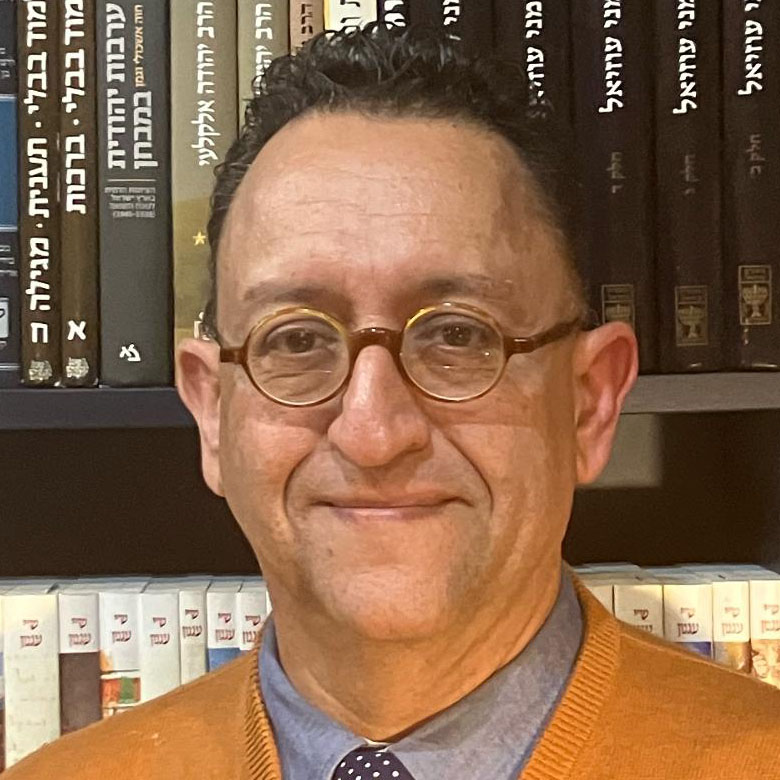
Rabbi Daniel Bouskila is the international director of the Sephardic Educational Center.