
Each period of history has a title bestowed by historians, one meant to reveal some key characteristic of that age. Thus, the medieval period is the Age of Faith; the Enlightenment is the Age of Reason; and the 19th century is the Age of Progress. The name for our age, I would venture to guess, is the Age of Busyness.
Everybody is busy. Americans routinely complain that they work too many hours — and they do. They complain that they have too little time to spend with their children — and they’re right. They complain that they have little time left for quiet reflection, for learning and for celebrating.
Well, actually, they don’t complain about that — because they don’t have enough time to notice its absence, or because they’re so busy that they no longer miss it.
But part of being human, part of living our lives fully, is the inner need to grow and to explore and to play. Contemporary psychology tells us that people continue to grow throughout every phase of their lives, and that the playfulness of children continues into adulthood, as well. To be human is to play, to change and to grow.
Where, in our serious culture of business, work and productivity — or in its flip side of infantile recreation and foolish escapism — do we make room for adult play, adult study and adult growth? America’s Achilles’ heel is its excessive busyness, which spawns equally excessive foolishness to blow off steam.
We’ve lost our balance.
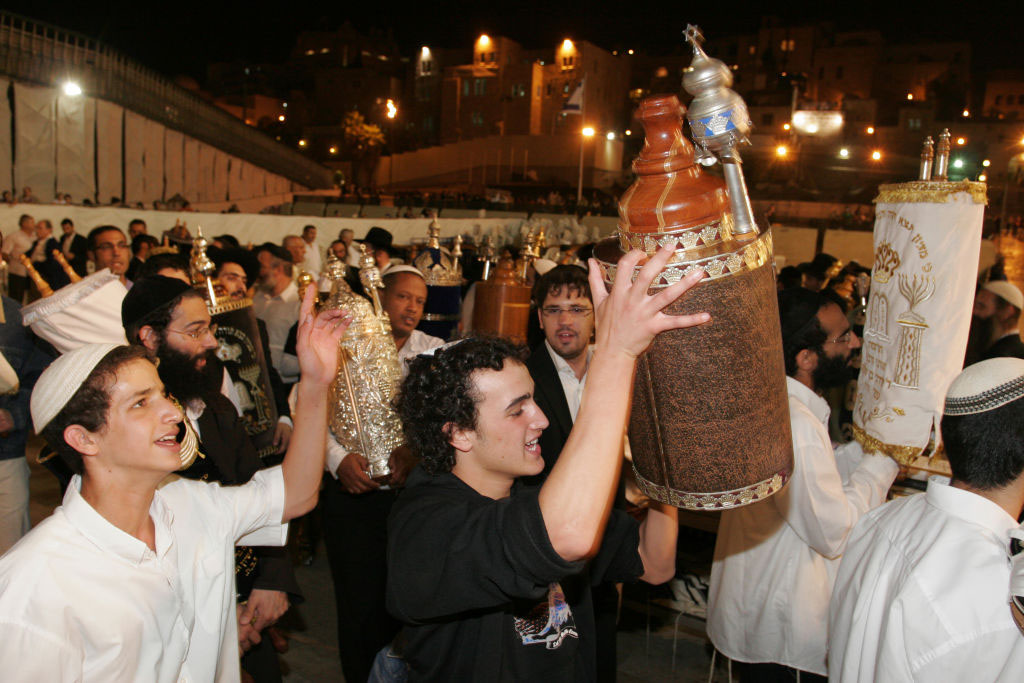
The place to recapture what we have lost is to be found in Judaism’s unparalleled ability to sanctify time. Through the observance of Shabbat, of holy days and festivals, our tradition provides a timeout for adults — not to lose ourselves in fantasies or escape, but to rediscover ourselves and the depths of our own creativity and love. We immerse ourselves in sacred time in order to live better and more fully during the rest of our days.
Now that the holy days of Rosh Hashanah and Yom Kippur are behind us and we emerge out of our sukkah booths back into our busy, contemporary lives, our immersion in rest, renewal and community is our passport back into a better way of living our lives. Instead of “spending time,” Judaism gives us the gift of learning to savor it.
The Talmud teaches that “rejoicing on a festival is a religious duty.” What a remarkable idea! A day devoted to a special kind of joy. The rejoicing of the festival has little in common with sitting in a dark room staring passively at an on-screen fantasy, or risking life and limb to thrill ourselves into forgetting what drones we’ve become. The rejoicing of the festival is not one of escaping, but one of returning to our own centers — our own families, friends, community and God.
As it says in the Talmud: “Rabbi Eliezer said, ‘One has nothing else to do on a festival except to eat, drink, sit and study.’ Rabbi Joshua said, ‘Divide it — devote half the day to eating and drinking, and half of it to the house of prayer and study.’”
Our sense of self emerges in cultivating our character, our curiosity and our relationships.
What a fascinating way to rejoice. Recall that the word “recreation” involves creating something anew — in this case, our own souls. By spending part of the day together in prayer, song and Torah study, we rebuild our identities as messengers of God and as bearers of God’s covenant. We restore our sense of belonging in a specific synagogue community and in the Jewish people worldwide. Having restored that essential base, the rabbis of the Talmud then tell us to take the rest of the day for feasting and spending time with those we love.
What a marvelous blend of devotion and relaxation, of heightened identity and then simply being.
What this regimen of holy days and festivals makes clear is that mastery of our work — rather than allowing our work to master us — requires setting clear boundaries and limits to our chores and our work. Our sense of self emerges in cultivating our character, our curiosity and our relationships. By rejoicing with one another on these holy days, festivals and on Shabbat, we declare ourselves to be free in the service of holiness and goodness, of Torah and togetherness.
After the end of the fall holy days, take the lessons of the shofar, the fast and the sukkah with you into our busy world. Remember that we each are children of royalty, and we thrive best when we thrive together.
Rabbi Bradley Shavit Artson holds the Abner and Roslyn Goldstine Dean’s Chair at the Ziegler School of Rabbinic Studies at American Jewish University.