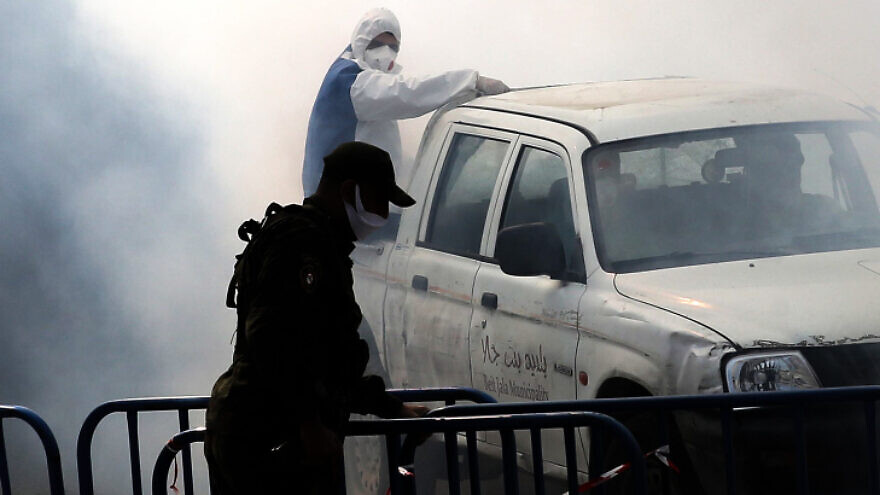
The Palestinian Authority wasted no time when seven staff members of a Beit Jala hotel tested positive on March 5 for the COVID-19 virus, contracted from of a group of Greek pilgrims who had stayed at the hotel and some of whom were diagnosed with the virus when they returned to Greece.
Beit Jala is a traditionally Christian Palestinian town adjacent to the western border of Bethlehem.
The infected staff members along with the rest of the staff—and a group of 13 American pilgrims who had just checked out of the Angel Hotel—were immediately quarantined in the hotel and police cordoned off the area. The Palestinian Authority sent a doctor to the hotel for daily check-ups and local restaurants sent in food for those quarantined.
On the same day the cases were identified, Palestinian President Mahmoud Abbas declared a state of emergency and ordered the closure of the Bethlehem area to all tourist groups but those that were already there were permitted to remain until the end of their planned stay. Nobody was allowed in or out of the area. All schools, universities, shops, restaurants and group activities were ordered closed as were all mosques and churches, including the Church of the Nativity, revered by Christians as marking the birthplace of Jesus.
As of March 20 the Palestinian Ministry of Health had reported 48 confirmed cases of the virus, all defined as non-critical—with 901 people quarantined in government facilities, 8778 people in self-quarantine and zero deaths. Seventeen people have already recovered, they said. Most of the cases have been in the Bethlehem area, with two cases in Tulkarem and one in Ramallah. Palestinians have largely applauded the PA’s handling of the coronavirus crisis.
“The first three days people here were in trauma; how can we deal with this situation? We couldn’t believe what happened, we are [always] busy living our lives 24-hours-a day,” said Arwa Hodaly, a PA-employed social worker who counsels women survivors of domestic abuse. “But then we started seeing our Palestinian Authority was containing the situation. We are committed to our PA quarantine and we don’t go out. Our government is working in a perfect way and that strengthens the relationship between our people and the Palestinian Authority.”
But while the people understand the need for a strictly enforced lock-down, which prevents them from visiting with family in their close-knit community, and going out other than for essential needs, their biggest concern now lies with what will came afterwards and they wonder when, and if tourists will return to the area.
“Bethlehem has been through a lot of setbacks, difficulties, wars, obstacles, many hard times during the first and second Intifada, but [none like] the current situation we are having nowadays with the COVID-19.” — Diana Babish
With between 17,000 and 20,000 people from the three sister towns of Bethlehem, Beit Jala and Beit Sahour employed in the tourism sector and another 15,000 employed in Israeli construction (the majority as day laborers), Bethlehem’s economy has been dealt a hard blow, said Samir Hazboun, chairman of the Bethlehem Chamber of Commerce.
“Tourism is the most important branch for our economy and basically for all the Palestinian territory. We also have financial obligations for factories,” he said. “In the coming weeks we will feel the impact.”
Israel also closed off all checkpoints, preventing movement between Israel and the Palestinian territories. But Major Yotam Shefet, head of the international department of the Civil Administration in the West Bank, said Israel has issued permits for several thousand Palestinian workers to enter into Israel—but not from the Bethlehem area. These permits allow them to work in the construction and agricultural sectors as well as in a Jerusalem industrial zone right outside of Ramallah, with the condition their Israeli employers provide them with lodging in Israel during the current 30-day lockdown also being enforced in Israel.
Diana Babish, who runs the Animal and Environmental Association Bethlehem animal shelter in neighboring Beit Sahour, had just started a new job as the manager of the Bethlehem’s bus station, which saw hundreds of tourist buses coming in every day just before the outbreak of the crisis.
“I had a lot of hope to change the bus station to better condition[s], but was disappointed because with the virus…tourism will not be back as before,” she said. “We don’t know when tourists will visit Bethlehem or Jerusalem or Palestine again. We don’t know when this nightmare will end. Many families are…now living [with] the fear of [not] having tourists back.”
The closure, which also prevents movement between the three towns, is also making it difficult to run her shelter, which is challenging even in normal times, she said.
“Bethlehem has been through a lot of setbacks, difficulties, wars, obstacles, many hard times during the first and second Intifada, but [none like] the current situation we are having nowadays with the COVID-19,” she said.
Dr. Gerald Rockenschaub, who lists his title as head of office, World Health Organization occupied Palestinian Territory, said the PA has “put the right measures in place” with assistance from WHO and noted that Israel, the PA and neighboring countries of Jordan and Egypt have been coordinating behind the scenes to contain the virus.
Palestinian journalist Daoud Kattab wrote that the coronavirus has managed to do what politicians and activists have not.
“It has sparked an extraordinarily high level of cooperation and coordination between Palestinians and Israelis,” Kattab said, noting that Palestinian officials told him the relationship has improved as both governments struggle in a joint effort to contain the outbreak and that the cooperation is “necessary and important” because it is serving a humanitarian purpose.
Nonetheless, Hodaly said the talk of collaboration cannot gloss over the fact the Palestinians are under occupation, and, she believes many of the conditions are being dictated by Israel.
“There is a constant dialogue between Palestinians and Israel. Both are aware the virus doesn’t respect any borders,” Rockenschaub said. “We are in this jointly so we will jointly succeed or we will jointly even have a bigger problem.”
Judith Sudilovsky is a veteran freelance journalist covering Israel and the Palestinian territories.