fbpx

June 29, 2026

Happy Unrequited Birthday, America!

Happy 250th, America! What a gangbuster quarter-millennium of a resume you have assembled. Much to be proud of, and, yet . . . far too few Americans are lining up to blow out the candles.

A revolutionary war brought independence from the British Empire, self-governance and the adoption of natural law. A war with Mexico enlarged the nation by a third. A Civil War put an end to the scourge of slavery. A Trail of Tears was the price of Manifest Destiny, but only Native Americans shed them. The United States became a global superpower after prevailing in two World Wars and outlasting the Cold one.

Along the way the world’s oldest democracy advanced freedom around the world, accelerated the riches of Western Civilization, sought to perfect Judeo-Christian values, launched scientific discoveries and explored the universe. Meanwhile, in other parts of the globe, hundreds of millions of people living under the Sharia of Islam seemed contentedly stuck in the Stone Age—stoning women, refusing to educate them, killing apostates and hanging homosexuals.

The world’s oldest democracy advanced freedom around the world, accelerated the riches of Western Civilization, sought to perfect Judeo-Christian values, launched scientific discoveries and explored the universe. Meanwhile, in other parts of the globe, hundreds of millions of people living under the Sharia of Islam seemed contentedly stuck in the Stone Age—stoning women, refusing to educate them, killing apostates and hanging homosexuals.

With all those cinematic fireworks as backdrop, and with the milestone of July 4th imminent, there’s an appalling amount of doom and gloom about America by its own citizenry—even elected officials. The celebratory mood is mixed, if not altogether nihilistic. In lieu of a national pep rally, we’re forced to vicariously love America through the fanfare and eyes of FIFA fans who are in the United States for the World Cup.

Thank God. At least these surrogates—estimated at 1.25 million, and counting—appreciate America’s greatness even as Americans themselves take their country for granted. Bashing the homeland has become a new national ethic. We could learn a great deal from Scottish fans in Boston, playing bagpipes in celebration at 6:30 a.m. Germans and other foreigners are touring the country sampling neighborhood hot-spots and the dizzying array of fast food options as if awarding Michelin stars for Shake Shack.

Along the way they are feted by friendly Americans.

Walmart has become a tourist destination for Japanese. Norwegians gravitate to Bass Pro Shops. Soccer fans from Ireland and Holland can’t get enough of Tex-Mex barbecue. Brazilians are gaily dancing across the Brooklyn Bridge.

American abundance, which was once regarded as a cliché for the country’s crassness, today seems to have captivated the world. Giant retail stores, 24-hour diners, free soda refills, oversized portions are big draws of Americana on its 250th birthday. FIFA’s visitors may never leave now that they’ve gotten a taste of America’s excesses and pizazz.

American abundance, which was once regarded as a cliché for the country’s crassness, today seems to have captivated the world.

Here’s an idea: Maybe we can swap out unpatriotic Americans and trade them for these far more appreciative surrogates? Let’s see how homegrown, and naturalized, American ingrates—disgruntled bashers of the land of the free—will fare living among the “grooming gangs” and “no-go zones” of Western Europe.

Sexual assault and antisemitic violence have become the bread and circuses of some of Europe’s once great capital cities. For American Islamists, it will be a blast from the past. Native-born Americans disenchanted with their nation will find the contrast at first illuminating, followed by menacing, and then terrifying.

Recent polling reveals that while 92 percent of Republicans report that they are “extremely” or “very” proud to be Americans, only 35 percent of Democrats are similarly enamored—a steep drop from 62 percent in 2024. The Democratic Party sure knows how to party-poop on America’s 250th birthday. Only 27 percent display the American flag, as compared with 64 percent of Republican households. Sixty-five percent of Republicans intend to celebrate July 4th cognizant of its special meaning this year, as compared with 24 percent of Democrats, who place a higher priority on holiday sales for outdoor grills and air conditioners.

Sixty-two percent of Republicans agree with the statement: “The U.S. is the greatest country.” Fewer than 11 percent of Democrats would be caught dead saying the same thing.

Not surprising, after all the anti-American dogma they’ve been spoon-fed by their teachers, who denounce the United States as an irredeemably racist, Islamophobic nation—one unsafe for budding terrorists and their fandom. Purple-haired, mask-wearing, fist-pumping, know-nothing cohorts of Gen Z despise America most of all.

Public officials and candidates for elective office have been especially contemptuous of the red, white and blue. Senatorial candidate from Maine Graham Platner has said that he “stopped believing in any of the patriotic nonsense.”

Aber Kawas, who just notched the Democratic nomination for New York State Senate, once intimated that “America deserved 9/11” and “brought it on itself.” Similarly, a Democratic Socialist congressional candidate from Colorado, Melat Kiros, said that the terrorist attack on 9/11 (and, naturally, 10/7, too), was “inevitable” given America’s foreign policy in the Middle East.

This was similar to when Squad member Congresswoman Ilhan Omar trivialized 9/11 by referring to it as merely, “Some people did something.” She came one vote shy of being censured by Congress. Fellow Squad member Congresswoman Rashida Tlaib has accused the United States of enabling Israel’s “genocide” in Gaza. Sam Rasoul, who sits in the Virginia state House, also holds America accountable for what is a libelous and baseless charge against the Jewish state.

Meanwhile, in last week’s congressional primaries in New York, three Democratic Party candidates, who will inevitably be elected in November, each faulted the United States for the “genocide” in Gaza. Darializa Avila Chevalier called America a “f—ing disgrace” and once boasted that, “I forgot to get napkins, so I just wiped my hand on the American flag behind me.”

Lovely. Benedict Arnold is calling for her to join his ranks.

Michigan U.S. Senate candidate Abdul El‑Sayed justified acts of terrorism with the defense “hurt people hurt people.” Maine’s U.S. Senate candidate Graham Platner, professed to be mystified by the fuss over the Nazi tattoo he wore on his chest for well over a decade, took a similar stance on America’s complicity in genocide.

In their victory speeches, it was remarkable how many listed “Free Palestine” as either the first or second takeaway from their campaign. What on Earth does a fictitious country like Palestine have to do with the constituent needs of American citizens?

Mayor Zohran Mamdani, the cheerleader for New York’s expanding delegation of giddy antisemitic, anti-American socialists, has long said that, “My support for BDS is consistent with the core of my politics.” Is BDS somehow linked to improving the municipal affairs of New York City? How did obsessing over Palestine become an indispensable policy plank of the Democratic Party?

How did obsessing over Palestine become an indispensable policy plank of the Democratic Party?

July 4th is for kosher hot dogs, not halal food.

Before blowing out the candles on the nation’s 250th birthday, let’s hope there’s a new generation of Americans willing to liberate the nation once again. This time from a different insidious monarchy—comprised of university professors immersed in Marx and co-opted by Qatar, mainstream media with its contempt for the First Amendment if it means reporting the truth, and terrorist-loving elected officials who feel that July 4th’s fireworks would be better spent burning down the nation.

Absent Paul Revere, might a game FIFA visitor undertake another go at a Midnight Ride?

Absent Paul Revere, might a game FIFA visitor undertake another go at a Midnight Ride? This time, however, we’re thrilled that “the British are here!”

We just want some discontented Americans to go!


Thane Rosenbaum is a novelist, essayist, law professor and Distinguished University Professor at Touro University, where he directs the Forum on Life, Culture & Society. He is a contributing writer for White Rose magazine. His most recent book is titled, “Beyond Proportionality: Israel’s Just War in Gaza.

Happy Unrequited Birthday, America! Read More »

250 Reasons to Thank America

We are two Jews in love with America. We’re also friends. We’re also writers.

We bond over many things, one of them being an aversion to whining.

We can always find reasons to whine about anything. There are a million reasons, for example, to whine about America, just as there are a million reasons to whine about France, Spain, Israel or Greece.

Given that America is celebrating its 250th birthday this year, we thought we’d offer you a whine-free zone and share 250 of our favorite reasons to be thankful for America

We picked reasons that move us. You’ll have your own. The point is not to have an exhaustive list but to take a time-out to thank our country.

You can read about America’s faults everywhere.

In this book you’ll find nothing but gratitude, sometimes hard-earned, always well-deserved.

That is our birthday present, 250 years in the making.

CLICK HERE FOR FULLSCREEN VERSION

250 Reasons to Thank America Read More »

How Democratic Socialists Are Killing the American Dream

It’s a bad day for American Jewry when being anti-Israel helps candidates get elected.

Jews are up in arms at this development, as they should be. When three Israel-hating Democratic Socialist candidates win hotly contested House primaries in New York City, backed by Israel-hating Mayor Zohran Mamdani, we should be alarmed.

But if all we do is focus on the assault on Israel, we’ll be making a big mistake.

That’s because the Democratic Socialist assault is, above all, on America.

Attacking Israel these days is low risk. It’s a lot riskier to admit that your policies undermine the American Dream.

How so?

However cleverly they are masked, socialist policies are the antithesis of the American creed. This was artfully displayed by Mayor Mamdani in his inaugural message: To “replace the frigidity of rugged individualism with the warmth of collectivism.”

That sounds so warm and cuddly, doesn’t it?

What Mamdani will never tell you is that it was rugged individualism that propelled his own rise to the top of New York politics. It was raw ambition and hard work and relentless networking — pillars of American liberty — that made him a winner.

Had he relied on the “warmth of collectivism,” he’d still be making hip-hop videos. The savvy mayor knows that cuddly collectivism may help him get votes, but it’s his drive and tenacity that gave him his American Dream.

Socialists don’t want you to know that. Admitting that “rugged individualism” fires up dreams would only undermine their own dreams.

It’s not cuddly collectivism that helped these socialists achieve their dreams. It’s moxie. It’s agency. It’s the American creed of making things happen. It’s everything their policies discourage.

It’s not cuddly collectivism that helped Bernie Sanders buy his private homes and travel in luxury. It’s the freedom to take advantage of opportunities, knowing that he lives in a country that rewards hard work.

Of course, “hard work” is not an idea that works on the campaign trail. You’re better off promising a sexy Marxist revolution that demands nothing of voters. Hang out at Starbucks all day while we give you free groceries and freeze your rent. What’s not to like?

A radical socialist like Darializa Avila Chevalier indeed hates Israel, but it’s much worse than that. When she says “No. more. police. at. all. Ever,” insisting that “a world without borders — just like a world without prisons or police — is possible, necessary and the only moral way forward,” or brags that “I forgot to get napkins so I just wiped my face on the American flag behind me,” that is blatant, shameless anti-Americanism.

As Noah Rothman writes in National Review Online, “What tethers these [Democratic Socialists of America] candidates is not their shared hatred of the Jews or the banks or the moneyed and propertied classes. They hate America and the West … Marxian revolutionaries do not stop. They must consume continually, find new enemies to demonize and scapegoat … It is a hate group masquerading as a political movement.”

Their hatred of Israel is making all the noise, but it’s their hatred of America that is most dangerous.

Jews are left in an awkward position. Our natural reflex is to defend Israel against lies and call out the antisemitism spreading throughout the country. While that is obviously important, it would be a blunder to stop there. This is a moment when America itself is under siege. For Jews, it’s a chance not just to help our tribe but to help our country.

Maybe it’s not a coincidence that we’re celebrating America’s 250th anniversary this week. There’s no bigger priority today for American Jewry than to repair the fraying U.S.-Israel relationship. And there’s no better way to begin that process than by showing how much we care for America.

When we take on Democratic Socialists like Chevalier and Mamdani, our message must be: “You’re not just anti-Israel, you’re anti-America.” When we take on their hypocrisy, our message must be:  “The American Dream has been good for you, but why not for your voters?”

In short, when we see anyone—right or left—undermine America and its founding ideals, the Jewish message must be: “We’re here to keep the American Dream alive.”

How Democratic Socialists Are Killing the American Dream Read More »

Prizmah and Jewish New Teacher Project Join Together to Strengthen Jewish Day Schools

Jewish New Teacher Project (JNTP), which helps Jewish day school educators gain and maintain their classroom skills, is becoming part of Prizmah, an organization that unites Jewish day schools and yeshivas in North America.

“This is a pivotal moment for Jewish day schools,” said Paul Bernstein, CEO of Prizmah. “Strengthening the educator pipeline is central to Prizmah’s strategy and to the success of the Jewish day school field, and bringing JNTP’s proven, research-based programs into our platform allows us to grow talent at scale. Together, we can better recruit, develop, and retain the educators and leaders our schools need. This step not only advances Prizmah’s work. It strengthens the entire field.”

Formerly, JNTP was part of the New Teacher Center, for more than two decades. While there was a Jewish day school division, the work mostly focused on public schools. According to Nina Bruder, JNTP’s CEO, after leaving the New Teacher Center in 2025, they wanted to find a new home in the Jewish community.

“From the beginning, Prizmah was the top and most obvious partner,” she said. “We used this year to really dig deep and have a very thorough process. We concluded that this makes the most sense, and the best home for the work we do, which is supporting day schools all across the country.”

“From the beginning, Prizmah was the top and most obvious partner,” – Nina Bruder

JNTP works with people who are new to teaching and the administration side of day schools. They train in-school mentors who meet weekly with the teachers, help them develop skills, conduct biweekly classroom observations, do goalsetting, and observe student work, lesson planning, and parent-teacher conferences. The organization also assists people who have been promoted for the first time and have to now supervise staff members.

“No amount of grad school training can prepare anyone for the day in, day out of working in a school,” said Bruder. “What our work does is help people think and react and plan for what work is like on a daily basis. We individualize it for each teacher or administrator.”

The organization’s training can help teachers and administrators stay in their roles—and thrive.

“There is a high rate of burnout in education in general in America, and an entire generation of teachers are expected to retire soon,” said Bruder. “With economy the way it is, and job opportunities that allow you to work from home, fewer people are going into teaching. [With our help], they can be supported and have positive experiences.”

JNTP is in 22 states and Canada as well. Locally, they have worked with Pressman Academy, Wilshire Boulevard Temple’s Brawerman school, Sinai Akiba, Wise School, and Yeshivat Yavneh.

According to Bruder, her organization’s goal is to make teachers and administrators feel supported every step of the way.

“My dream is to make sure every school has trained mentors, and all new teachers and administrators get the support they need in their careers,” she said. “When you make a change and you’re doing something for the first time, it can be scary. Rather than make it up as you go, you can get the research-based support and be successful.”

The JNTP-Prizmah partnership is taking place when Jewish day school enrollment is up; according to a new report from Prizmah, Jewish day school enrollment across the organization’s network in North America has grown to 101,000 students in the 2025-26 school year, which is an overall increase of 7,000 students over the past five years.

“Day schools create communities of belonging, growth, and inspiration,” said Bruder. “Nothing is more influential on the life of student than their teacher, and second to that is their administrator. Creating joyful, purposeful, and inspiring environments where people spend most of their waking hours is so important. Day schools help people grapple and grow and ground in the Jewish community and world they face when they leave school.”

Bruder is looking forward to starting critical work with Prizmah schools.

“Prizmah brings a national platform, a vast network of Jewish day schools, and the infrastructure to scale impact,” she said. “The sum will be greater than its parts. We are excited to amplify our respective and combined strengths in supporting the teacher pipeline and educational and leadership excellence.”

Prizmah and Jewish New Teacher Project Join Together to Strengthen Jewish Day Schools Read More »

The Antisemitism We Keep Missing

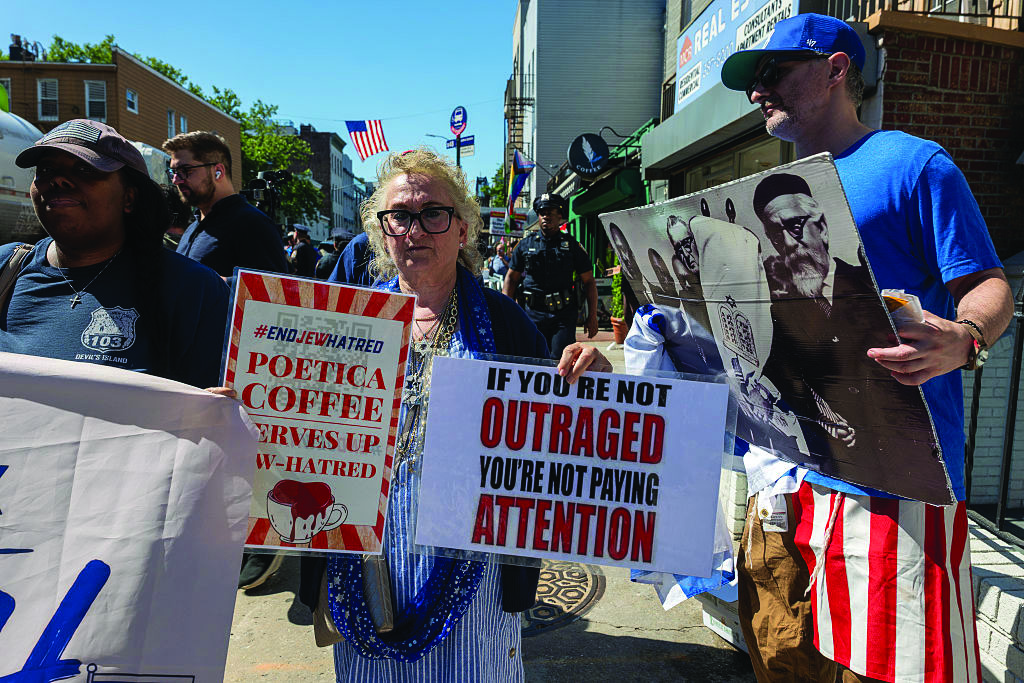
Poetica Coffee, a Brooklyn café, promises anyone who walks through its door “unconditional dignity.” Not as a customer and not as a transaction, the website explains, but as someone who arrived and deserves to be welcomed.

Recently the same business posted a photograph of Rep. Dan Goldman, who had stopped in for a coffee, and announced that it does not serve “genocide enablers.” Staff would have turned him away, the post said, had they recognized him in time. For good measure, it speculated that his money was “probably coming from AIPAC.”

The controversy matters not because of one congressman or one café. It matters because of the gap between those two statements—and because the people who wrote the second one clearly saw no contradiction with the first. That confidence is the real story.

For nearly three years since October 7th, the Jewish community’s attention has focused on elite institutions: presidents, provosts, trustees, editorial boards, elected officials. Those battles matter. Universities should protect Jewish students, public officials should condemn antisemitism, and institutions should enforce their own rules. But even when they do, a deeper problem remains. Antisemitism is no longer something many Jews encounter only from activists with megaphones or radicals occupying campus buildings. It is becoming socially acceptable among ordinary people in ordinary places.

That is what makes the Poetica incident worth more than a news cycle. The owners did not merely criticize Goldman; politicians are criticized every day. They publicly celebrated the idea that someone who supports Israel was unworthy of service, and they did so while presenting their business as a model of inclusion. The casual reference to money “probably coming from AIPAC” is especially revealing. That is not a policy disagreement about Gaza. It is the oldest insinuation about Jewish money resurfacing almost reflexively in a place that imagines itself progressive.

For years, Jewish organizations have measured progress through elite signals. Has the president spoken? Has the board acted? Has the governor issued a statement? Has the company adopted a policy? These questions are valid and carry weight, but they tell us surprisingly little about the culture beneath them. A university president can condemn antisemitism while Jewish students are quietly ostracized by their peers. A mayor can issue a supportive statement while local businesses signal that Zionists are unwelcome. A corporation can celebrate inclusion while employees quietly learn which identities are protected and which beliefs place a person outside the circle of acceptable opinion. The gap between official rhetoric and social reality has become impossible to ignore.

The gap between official rhetoric and social reality has become impossible to ignore.

What many Jews increasingly encounter is not formal discrimination but social exclusion. They are not denied admission to institutions, but they are told they do not belong in particular communities. They are not silenced by authorities, but they are shunned by peers. And they are not excluded for being Jewish in the old sense. They are excluded for being Zionists, a category that happens to include the overwhelming majority of American Jews. That distinction is presented as morally decisive. In practice it rarely is.

The effect is often the same: A Jewish student, professor, neighbor, or congressman discovers that support for the existence of the world’s only Jewish state is enough to place him beyond the bounds of polite society.

That is not political disagreement. It is social stigmatization, harassment and exclusion, and it is becoming normalized. Many people who would never tolerate the exclusion of a Muslim, a Black American, a gay neighbor, or an immigrant have convinced themselves that excluding Zionists is not only acceptable but also virtuous. The language of inclusion has been repurposed to justify exclusion; the language of tolerance has become a rationale for intolerance. The contradiction is obvious and increasingly ignored.

This is why elite responses, however necessary, are not enough. A congressional hearing cannot fix a culture. A university policy cannot repair a social norm. A presidential statement cannot persuade millions of people that their neighbors deserve dignity even when they disagree.

The challenge facing American Jews is not only institutional but cultural, and it lives not just in faculty lounges and encampments but in coffee shops, community groups, workplaces, and ordinary social circles. That is the uncomfortable part, because institutions can change rules far faster than people change attitudes.

Poetica later deleted its account, saying it had received threats. Threats are wrong, and they are also beside the point; they do not make the original boast any less revealing.

Goldman’s response is worth lingering over. He recalled that a barista had let his seven-year-old daughter use the restroom without buying anything. He bought a coffee in return and later said he hoped she would still receive her tip. Whatever one thinks of his politics, it was a response grounded in ordinary reciprocity rather than retaliation.

Whatever one thinks of his politics, it was a response grounded in ordinary reciprocity rather than retaliation.

That is the whole tension in miniature. The young woman behind the counter extended the ordinary decency that holds a society together. The owners chose, deliberately and publicly, to advertise exclusion as a virtue. The first instinct is quiet and deeply civic. The second now expects applause.

The struggle against antisemitism will not be won solely in courtrooms, boardrooms, or university offices. It will be won, or lost, in the everyday spaces where people decide who belongs: the coffee shops, the community groups, the professional networks, the social circles. The most revealing incidents are often the smallest ones. They show what people are willing to say when they believe the room agrees. By the time organizations acknowledge a problem, the culture beneath them may already have shifted to a place from which it may be difficult to come back from.


Samuel J. Abrams is a Professor of Politics at Sarah Lawrence College and a Nonresident Senior Fellow at the American Enterprise Institute.

The Antisemitism We Keep Missing Read More »