fbpx

May 8, 2026

Michigan Mischief

It has been a busy time for combatants and spectators in the campus free speech wars. As I was drafting a comment about the University of Michigan, we got word that Northwestern University President Emeritus Morton Schapiro canceled his plan to deliver an invited address and receive an honorary degree from Georgetown University Law School, after protestors made clear in a circulated petition that he was unwelcome because of his pro-Israel views (he has written eloquent commentaries on a range of topics, not all about Israel and the Middle East, for this magazine). The irony is thick: the University’s chosen substitute, former National Legal Director of the ACLU, is known for defending campus speech rights of people with antisemitic views. So it seems it’s not really about free speech in any pure or absolutist sense, but rather about protecting some speech some of the time, an odd interpretation of the First Amendment if I ever saw one. I’ve known Morty Schapiro a long time. The Georgetown graduates are missing a rare opportunity to hear from someone special. Hopefully some of them will go on to careers defending the Constitution and will remember this episode as evidence of how liberal democracy can buckle under the toxicity of ignorance and hypocrisy.

What happened in Michigan raises other complexities.

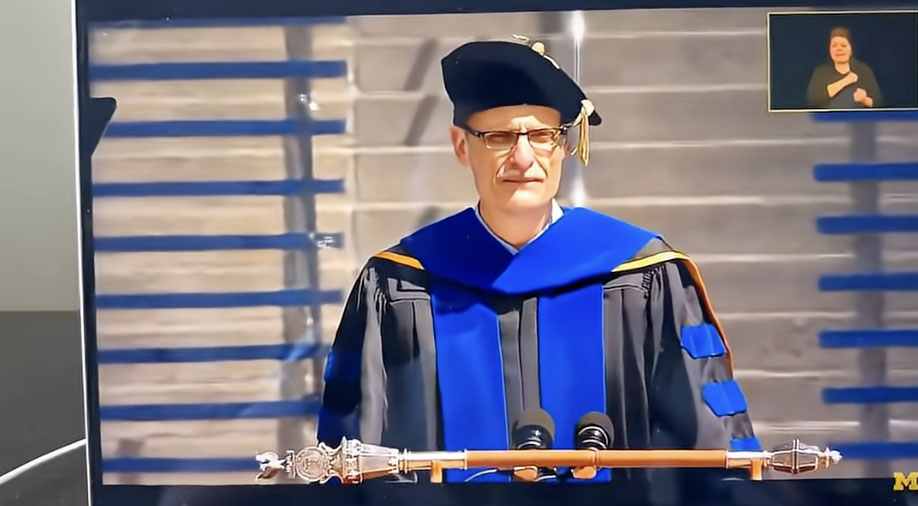
As reported in Inside Higher Education, history Professor Derek Peterson began his commencement address by doing what good history teachers are supposed to do: show how the past can help us better understand the present and think about the future. Peterson cited the denial of admission to women back in 1859 and celebrated one valiant dissenter and other suffragettes whose courage led eventually to the end of the university’s history of bigotry and misogyny. He correctly noted that freedoms we now take for granted were “hard won,” adding with some literary license that Michigan became “the greatest public university in the world” because people “refused to accept the enclosures and orthodoxies of the time.” He rose in praise of protest, worthy of remembrance especially as we celebrate our nation’s 250th anniversary.

And then he went off script. After acknowledging the fine decision of his University to admit Jews starting at the turn of the 20th century, and progress made over the decades since then to educate students on the “experience and identity of Black people in this country,” he called on the audience to “sing” for the “pro-Palestinian student activists who have over these past two years opened our hearts to the injustice and inhumanity of Israel’s war in Gaza.”

Not surprisingly, along with what was reported as “long and loud applause” Peterson’s remark prompted local and public backlash, although I suspect he wouldn’t cite those protestations in his next oration on the virtues of protest. In any case, it didn’t take long for attention to shift to Peterson’s right to speak and away from the content of his remarks. Let’s consider both those issues.

As heirs to the liberal tradition, we are often reminded of our obligation to defend people’s right to say even things we abhor. On the other hand, as the former Chancellor of the University of California at Berkeley once noted, “just because you have the right to say something doesn’t mean it’s right to say.” It is disappointing, to say the least, that someone like Peterson, crowned as a Macarthur “genius” in 2017, would place defenders of barbarous antisemitism, homophobia and misogyny in the same category with women, Black and Jewish civil rights heroes. Instead of fulfilling his professional obligation to challenge fashionable narratives, he encouraged more of what I’d call “the incredible lightness of being” unencumbered with evidence. He slid into mud that is usually the province of fanatics on social media, which raises a question much on the minds of many higher education leaders today: if we don’t provide something better than what’s on TikTok and Truth Social, how will we justify charging students $100,000 a year to get a bachelor’s degree?

As heirs to the liberal tradition, we are often reminded of our obligation to defend people’s right to say even things we abhor. On the other hand, as the former Chancellor of the University of California at Berkeley once noted, “just because you have the right to say something doesn’t mean it’s right to say.”

A related issue is Peterson’s deviation from the approved version of his remarks. Now, one might wonder if such vetting is in itself a violation of academic freedom. That’s a complicated question, although one wouldn’t know it from reading commentators with absolutist views. Academics are accustomed to having their words and ideas screened: anyone who has submitted an article to a reputable scholarly journal (not to mention to the op-ed pages of major newspapers) knows something about the three R’s: review, revision and rejection. Peterson breached his community’s trust: in exchange for a place on the commencement podium, he agreed to have his speech cleared in advance. That’s an implied social contract, which maybe as a historian, not a lawyer or economist, Peterson didn’t understand. Or maybe, like certain others these days who are overwhelmed by their own greatness, he just doesn’t think those rules of conduct apply to people of his rank and stature. (According to some reports, Peterson claimed that university officials knew he would mention pro-Palestinian protests, although he had agreed to remove the word “genocide” to “make it less provocative.” His perhaps extemporaneous remark, which he slipped in post-review, was certainly provocative enough.)

There is another ironic twist to this fuss. Many who remained silent or applauded Peterson quickly rose to protest U of M President Grasso’s dissent, which came in the form of an apology on behalf of the university. It brings to mind Winston Churchill’s wry observation that “some people’s idea is that they are free to say what they like, but if anyone else says anything back, that is an outrage.”

Finally, on Peterson’s gratuitous reference to the war in Gaza. I’m not trained as a historian, but I believe that history, like most disciplines, has (or used to have) standards of evidence. Peterson violated them in a short phrase about Israel that he packed with glaring errors of omission and commission: there is no mention of the possible “injustice and inhumanity” of the Oct. 7, 2023, attack that triggered the war, no mention of Palestinians and other Arabs who oppose the tyrannous barbarism of Hamas (including its vigilante executions of gays in Gaza), no mention of Israel’s efforts to protect civilian noncombatants (unprecedented in the history of modern warfare), no mention of the criteria used to judge Israel’s actions as “unjust,” no mention of Israel’s success in inoculating against polio more than 90% of Gazans under age 10, and no mention of Jewish students and faculty at Michigan and elsewhere who defended their right to a safe educational environment amid enraged demonstrators calling for dismantling of the Jewish State and global intifada. That would have been a lot to cram into a commencement speech; but if you can’t tell the whole story then you should be extra careful with half-baked ones.

No wonder the University wanted to review Peterson’s speech: maybe they feared that, yet again, factual knowledge might be displaced by trendy slogans, and they wanted to preempt further erosion to the integrity and reputation of their institution. If I were a parent paying big bucks for my child to attend Michigan, I would want to know if Peterson is an outlier (what I believe) or if his malpractice is more widespread (what we should all fear). I would want to know if and how the university is continuing to facilitate needed self-evaluation of its campus culture. Maybe we should thank Peterson for unintentionally alerting us to these issues? Regardless, we owe the University of Michigan leadership a real debt of gratitude for standing against such moral and intellectual inversions. Only such determination will save our truly great institutions of higher learning.


Michael Feuer is the Immediate Past Dean of the Graduate School of Education and Human Development and Professor of Education Policy at the George Washington University, past president of the National Academy of Education, and nonresident senior fellow at the Brookings Institution. The views expressed here are his own, and do not necessarily represent the school, the university, or its leadership.


Michigan Mischief Read More »

Jews of Morocco: Beauty, Memory and Loss

We arrived in Morocco feeling a bit anxious. With everything happening with Iran and throughout the region, many of us wondered: was it safe to be here now?

Yet the StandWithUs Jewish Heritage Mission to Morocco generated tremendous interest and filled up almost immediately. In fact, there were additional people who wanted to come, who were placed on the list for the mission to Morocco next year.

It’s understandable. Who wouldn’t want to visit Marrakesh, with its colorful markets, fragrant spices and unforgettable couscous?  Who wouldn’t enjoy staying in the beautiful hotels of Fez and Casablanca while exploring centuries of Jewish history? Who wouldn’t look forward to visiting the synagogues still in use, pray at the grave of Rabbi Pinto the Kabbalist, visit the synagogue he built and meet members of Morocco’s remaining Jewish community?

The participants on this trip became close very quickly, as we absorbed the history of the Jews who lived here during the last 1,800 years.  We also realized we were not the only Jews drawn to Morocco. Along the way, we encountered other groups, including a Jewish Heritage mission from New York and a delegation organized by the Utah Jewish Federation. We all ended up having a beautiful Shabbat dinner together at an active synagogue in Marrakesh.

For security reasons, we hired two bodyguards who remained in close contact with local authorities. As it turned out, armed Moroccan police officers accompanied us throughout our travels. Despite regional tensions, Morocco itself felt vibrant, colorful, safe and welcoming. And we were incredibly fortunate to have a most knowledgeable and interesting guide: Jacob Shoshan.

Jacob enriched our journey and opened up extraordinary, inspiring doors. He showed us that beneath the beauty of Morocco, lies a complicated, often tragic and familiar Jewish history.

Jewish people first arrived in Morocco approximately 1,800 years ago. As recently as 1948, approximately 250,000 Jews lived throughout the country, creating thriving communities rich in scholarship, commerce, music and religious life. Today, however, only a little more than 1,000 Jews remain.

What happened?

Like Jewish communities throughout the Arab world, Moroccan Jews lived at the mercy of changing rulers and political climates. There were periods of relative coexistence and prosperity, but also devastating waves of violence, persecution, forced conversions, discrimination and expulsions.

Fez, once a great center of Jewish learning, also became the site of repeated massacres. In 1033, thousands of Jews were murdered during attacks led by a Muslim Berber ruler. In later centuries, Jews again faced riots, forced conversions and deadly violence. Entire Jewish communities were sometimes wiped out.

Rumors, libels and accusations against Jews repeatedly fueled persecution. As happened elsewhere throughout Jewish history, periods of instability often became dangerous for Jewish communities.

And yet, despite everything, Jews kept rebuilding.

Again and again, Jewish families returned, reopened businesses, restored synagogues, rebuilt schools and attempted to create stable lives. Morocco became home to generations of rabbis, scholars, merchants, musicians and ordinary families who deeply loved the country while maintaining their Jewish identity.

During World War II, King Mohammed V became a rare and courageous figure in the Arab world when he resisted pressure from the Vichy regime and refused to fully cooperate with anti-Jewish measures targeting Moroccan Jews. He refused to send his Jewish citizens to France to later be transferred to concentration camps.

Then came 1948 and the rebirth of the State of Israel.

Like Jews throughout the Arab world, Moroccan Jews increasingly faced riots, hostility, fear and uncertainty. Many lost homes, businesses and possessions. Over time, the overwhelming majority left.  Some fled persecution, others left because they no longer believed there was a future for Jews in Arab lands.

Today, walking through Morocco evokes mixed emotions.

The streets are colorful and alive. The markets are truly exciting. The hospitality is warm. The architecture is breathtaking. Jewish history is visible everywhere: in synagogues that are in use and those that are not, Jewish cemeteries and stories passed down through generations.

And yet underneath the beauty is a deep sense of loss.

One cannot help but wonder: why did Jewish communities continue returning after each tragedy, always hoping that this time would be different? Perhaps because Jews are, by nature, optimists and builders. Wherever they went, they planted roots, built communities, created scholarship, raised families and contributed to society with hope and resilience.

That spirit is part of the Jewish story everywhere.

Our trip to Morocco was not simply a tour. It was an encounter with both the beauty and fragility of Jewish life in exile. It reminded us how ancient Jewish history is, how vulnerable Jewish communities have been and how extraordinary it is that the Jewish people continue not only to survive, but we always choose to rebuild, contribute and thrive. It also reminds us how important the State of Israel is for the survival of the Jewish people.

And perhaps that’s the real lesson of Morocco. Not only what was lost, but the remarkable resilience of a people who never stopped believing in the possibility of renewal.

Today, the majority of the descendants of Morocco’s Jewish community have carried their energy, traditions, creativity and entrepreneurial spirit to Israel, where they have helped build and strengthen a thriving society and nation. Moroccan Jews have contributed enormously to Israel’s culture, music, scholarship, politics, business, military and spiritual life. Their story is ultimately not only one of exile and survival, but of renewal, contribution and hope.

In many ways, the story of Moroccan Jewry is also the story of the Jewish people themselves: enduring hardship, preserving identity, rebuilding after loss and continuing to create vibrant communities wherever the opportunity exists to live freely and proudly as Jews.


Roz Rothstein is co-founder and CEO of StandWithUs, a 24 year-old international nonpartisan education organization that supports Israel and fights antisemitism 

Jews of Morocco: Beauty, Memory and Loss Read More »

Voting with Sanders, Padilla and Schiff Abandoned Principle and Our Ally

So many in the local Jewish community, including countless dear members of my synagogue, are deeply concerned after Senators Alex Padilla and Adam Schiff voted with Bernie Sanders to block arms sales to Israel. Our friends and family in Israel have been under relentless attack from rockets, missiles, and drones launched by Iran and Hezbollah, sworn enemies of Israel and of the US. And yet these senators voted to prevent Israel from purchasing American weapons that would protect families and citizens in Israel. I consider this vote to be a grievous mistake, a worrying lapse in judgment, one which undermined our close ally, and which weakened the world’s resolve against tyranny and towards the flourishing of democracy.

To be clear, I believe that our senators have been true friends; their track records and past statements demonstrate just that. But these votes were deeply disappointing.  Not only disappointing, but also dangerous.

In justifying their position, Senators Padilla and Schiff wrote that “being a stalwart friend of Israel…does not mean agreeing with all decisions of the Israeli Government or Prime Minister Benjamin Netanyahu, just like being a patriot of the United States does not require unquestioning agreement with the policy decisions of President Donald Trump and his administration.”

I agree wholeheartedly. But no one is asking our senators to agree with every decision that Israeli leaders make.  We are asking them not to defend Netanyahu, but rather to defend Israeli citizens. We are asking them not to agree to policy decisions of President Trump, but rather to agree with the notion that Israeli citizens deserve protection from bloodthirsty enemies who seek Israel’s destruction, and who, when given the chance, kill and murder wantonly.  This vote by Senators Padilla and Schiff posed no threat to President Trump or Prime Minister Netanyahu–but the vote did make Israel and her citizens more vulnerable.

Our senators are certainly not the only ones disagreeing with Israel’s prime minister. When Yair Lapid, Israel’s Opposition Leader, had a chance to respond to Bernie Sanders’ effort last year to stop military sales to Israel, he warned: “Calling to block essential arms sales to Israel is a call to abandon the people of Israel in the face of Iranian sponsored Islamic terrorism…Whatever you think of the Israeli government, calling to abandon the people of Israel is irresponsible and dangerous.”

Members of the United States Senate, especially those very politicians who have called for a more centrist leader to lead Israel’s government, should heed Lapid’s words. There are many ways to voice disagreement with Israel’s leadership, but actions that hinder Israel’s ability to protect its citizens, or drive a wedge between the United States and Israel at this consequential moment, send the wrong message – both to friends and adversaries alike.

This is a time to stand on principle, support our allies in the face of ruthless terrorist regimes, and reject extremists who want to see the U.S.-Israel partnership destroyed.

Sanders and his allies aren’t done working to erode American support for Israel. More critical votes like these are still to come, and our community is paying close attention.


Rabbi Adam Kligfeld is Senior Rabbi of Temple Beth Am in Los Angeles, CA.

Voting with Sanders, Padilla and Schiff Abandoned Principle and Our Ally Read More »

What’s Worse Than Sticks and Stones?

In 1835, the Chatam Sofer, Rabbi Moses Sofer, received the following question:

Regarding the shochet (ritual slaughterer) Michael Raab, who serves in a local village. He met a well-respected man, the honorable Rabbi Michael Pashkez from your esteemed congregation. Raab mocked Rabbi Pashkez by telling him that his wife had given birth to a son, and that he would like to honor Rabbi Pashkez with performing his son’s circumcision. The mocker (Raab) knew very well that the honorable Rabbi Michael (Pashkez) was extremely devoted to this commandment. So last Sunday, Rabbi Michael (Pashkez) traveled four hours from his community to that village to do the circumcision. And behold, Raab had lied to him; Raab’s wife had given birth to a girl. So Rabbi Pashkez was a laughingstock in front of everyone in that village.

And, (Rabbi Pashkez,) ‘his soul is wrapped up in this question,’ and likewise does the respected head of the beit din (religious court) come to ask, whether the shochet should be removed from his job because of the deed mentioned above or what else can be done to punish him?

Raab’s hurtful and mean-spirited prank humiliated Pashkez; but he didn’t suffer financial damages. It was unclear what sort of redress Pashkez could demand. While Halakha makes ethical demands that go beyond those of most legal codes, these too are generally not actionable.

But in this case Rabbi Sofer agreed that the beit din should sanction Raab, who as a shochet was a communal religious official. Raab’s behavior violated the prohibition of onaat devarim or verbal exploitation; and Rabbi Sofer directed the community to remove Raab from his job until he appeased Rabbi Pashkez.

In Parshat Behar, the Torah prohibits onaah, financial exploitation: “And if you sell anything to your neighbor or buy from your neighbor’s hand, you shall not oppress one another.” This prohibits predatory pricing. A seller may not charge a naive customer substantially more than the market price.

A few verses later, the Torah repeats this prohibition in more general terms, and says, “Do not oppress one another, but you shall fear your God; for I am the Lord your God.”

The Talmud interprets this second verse as prohibiting onaat devarim, verbal exploitation. There are multiple forms of onaat devarim. One form of onaat devarim involves misleading others about your intentions, such as asking questions of a salesperson when you have no interest in making a purchase. Another is playing a practical joke and sending buyers to a non-existent store. Or giving self-serving advice to others that helps you more than it helps them.

Other forms of onaat devarim cause emotional pain. The Talmud writes that, “If torments are afflicting a person, or illnesses are afflicting him, or if he is burying his children, one may not speak to him in the manner that the friends of Job spoke to him…” Job’s friends came to justify God; but when they said to Job that he must have sinned ‌to deserve his afflictions, they themselves became sinners. The road to hell is paved with good intentions.

One must not embarrass a repentant person by bringing up their criminal past. Similarly, it is forbidden to embarrass a convert by treating them as unworthy of studying Torah, for how can “the mouth that ate all forms of unkosher food read the words of the divine Torah?”

What is puzzling is why price gouging and hurling insults are both called onaah. They are categorized as one sin; but what connection do they share?

Samson Raphael Hirsch offers a fascinating answer:

In both, one abuses a weak side of the other person to their detriment. In one, his ignorance about merchandise; in the other, the vulnerability of his emotions.

Onaah is defined as when one exploits the weakness of others, either in business or conversation. Financial exploitation feeds off taking advantage of the buyer’s ignorance or desperation. Verbal exploitation takes advantage of what embarrasses the other person.

We cannot understate the impact of onaat devarim. What makes bullying so dangerous is that it identifies the other person’s psychological weaknesses and weaponizes them. It finds what a person is most uncomfortable with, and exposes it.

Brené Brown has written extensively about how shame profoundly distorts one’s self-image. Shame, which often hides in secrecy and silence, is when a person believes they are “flawed and unworthy of love and belonging.”  Onaat devarim manipulates that shame and sends the other person spiraling.

This is why, when discussing the prohibition of onaat devarim, the Talmud emphasizes the severity of verbal abuse. It goes so far as to say that, “Anyone who humiliates another in public, it is as though he were spilling blood.” Verbal abuse can be soul-crushing. It targets a person’s identity, leaving them feeling ashamed and alone.

Words can leave behind the deepest scars and wounds that never heal.

But even onaat devarim has its limitations.

The Aruch HaShulchan allows one to speak harshly to a wicked person if they believe this might persuade them to change their ways.

The Sefer HaChinuch offers a lengthy defense of the right to verbally respond, when insulted, to those who have insulted you; he explains that “it is not possible for a man to be like a stone that cannot be moved” in the face of an insult. Perhaps the saintly can absorb insults in silence; but ordinary people are not expected to.

Several medieval sources mention another exception: there is no prohibition to verbally exploit someone who verbally “exploits themselves.” What this means is unclear; some understand it as meaning a person who treats themselves with disrespect in certain areas cannot demand others to offer them respect.

One fascinating interpretation of this phrase is that it refers to people who take offense too quickly. Rabbi Moshe Feinstein was asked about a case where the younger of two brothers wants to get engaged. However, his still single older brother will be upset if the younger one marries first. Rabbi Feinstein responded that the problem isn’t the younger brother’s insensitivity; it is the older brother’s envy. Otherwise, Rabbi Feinstein explains, it would be wrong for anyone to be a success; after all, there are others who can claim they are embarrassed by not being equally successful!

Sensitive language is not a simple topic. On the one hand, there is the absolute obligation to speak thoughtfully to others. The old children’s rhyme, “sticks and stones may break my bones, but words will never harm me” simply isn’t true. Words of insult can send people spiraling, and can destroy reputations and marriages. But on the other hand, this rhyme has the right attitude. Children must learn resilience; and all of us need to ignore the daily influx of foolishness that comes our way.

Sometimes we end up demanding a bit too much sensitivity.

In The Coddling of the American Mind, Greg Lukianoff and Jonathan Haidt describe an overprotective culture of “safetyism” that prevents young people from grappling with even minor challenges. Even mildly offensive people are immediately cancelled, lest they trigger delicate young souls. They explain how they see this as a formula for cultivating anxiety in young people. They explain that:

To Greg, who had suffered from bouts of depression throughout his life, this seemed like a terrible approach. In seeking treatment for his depression, he—along with millions of others around the world—had found that cognitive-behavioral therapy (CBT) was the most effective solution. CBT teaches you to notice when you are engaging in various “cognitive distortions,” such as “catastrophizing” (If I fail this quiz, I’ll fail the class and be kicked out of school, and then I’ll never get a job . . .) and “negative filtering” (only paying attention to negative feedback instead of noticing praise as well). These distorted and irrational thought patterns are hallmarks of depression and anxiety disorders…. For this reason, Greg was troubled when he noticed that some students’ reactions to speech on college campuses exhibited exactly the same distortions that he had learned to rebut in his own therapy.  

Where had the students learned these bad mental habits? Wouldn’t these cognitive distortions make students more anxious and depressed?

Fixating on language that offends us undermines resilience.

For this reason, I find myself grappling with the limits of empathetic speech. Lukianoff and Haidt have identified a real problem: too many institutions are teaching young people to notice every slight and, in turn, be less resilient. They can accurately be described as training people to “verbally exploit themselves” and take offense at microscopic and unintended insults.

At the same time, there is a powerful moral imperative of how we must treat others. The Talmud quotes a common saying, that “you shouldn’t say to a friend ‘Hang a fish for me’ if someone in his family had been hanged.” One must always try to anticipate the feelings of others.

Like in many such issues, we have to demand more of ourselves than of others. We have to train ourselves to ignore insults and be resilient; at the same time, we need to consider the pain that others carry in their hearts, and not just expect them to tough things out.

We need to be resilient in our own lives. But we must remember that words can inflict far greater harm than sticks and stones.


Rabbi Chaim Steinmetz is the Senior Rabbi of Congregation Kehilath Jeshurun in New York.

What’s Worse Than Sticks and Stones? Read More »

Exclusive: The Commencement Address I Was Supposed to Give at Georgetown Law

Graduations are fraught times.  Just look up the recent debacle at Michigan.  I’m disappointed to add a story of my own.

David Suissa summarized the key facts in his article, “Georgetown Commencement Speaker Mort Schapiro Withdraws After Firestorm Caused by his Jewish Journal Columns.” As he wrote, my supportive view of Israel “was a bridge too far for a group of law students.”

I have written seventy columns in the JJ over the past three years, and while most have nothing to do with politics (last week’s, for example, was about sports), some have expressed my outrage at the way educational and other institutions have reacted to the extraordinary increase in anti-Jewish hatred on college campuses and in the larger world.

When Georgetown administrators invited me to accept an honorary degree and to give the commencement address at its law school, I suggested that they first read my columns before I agreed.  They did, and replied that Georgetown is a place that cherishes dialogue and debate, and that they wanted me to speak there.  I believed them.

Receiving an honorary degree meant little to me – I already have ten.  But I thought the opportunity to share some thoughts with Georgetown Law graduates would be rewarding for them and for me.

As the JJ article mentioned, after I learned about a petition from law students decrying my presence at their ceremony, I withdrew.  I have presided over dozens of commencements, and those ceremonies are about celebrating the graduates and their supporters.  I didn’t want potential protestors to distract from the day’s festivities.

Georgetown Law quickly replaced me, announcing that the new speaker will be one of their law school professors.  As David wrote in his column, this professor “has been outspoken in recent years, in particular for defending the right to express antisemitic views.”

So much for keeping politics out of the commencement ceremony.

Georgetown asked for my talk in advance, and I was about to send it to them on the day I discussed the petition with the dean.

It draws on several of my JJ columns about humility, gratitude, and, ironically, the urgent need for dialogue in our polarized society.

A number of people have asked to see it.  So, here is the talk I was going to give at Georgetown Law on Sunday, May 17th:

“Thank you for allowing me to participate in these momentous proceedings.  Over the years, I’ve seen dozens of my most talented students attend Georgetown Law, and I’ve followed their subsequent careers with pride and appreciation.

While professors are trained to speak for at least fifty minutes at a time, I’ve been told to keep my remarks under ten.  I’ll try my best!

What can I possibly share with some of the world’s most promising legal minds?

I looked up the pre-enrollment numbers for today’s graduates.  You entered Georgetown with formidable test scores, almost perfect college GPAs, and, for many, remarkable law school and work experience.  You have brought astonishing skills to this amazing place, and from what I’ve heard, you have inspired your professors and each other.

That gives me hope for the future, because those skills are needed now more than ever.  We are all aware that disrespect and distrust have increasingly plagued this country and the world.  Dialogue seems to have become a lost art, and a curse of moral certainty has infected many of our minds.  The American university, which is supposed to serve as an example of how to pursue the truth while engaging in mutual respect and understanding, has all too frequently been torn apart by forces both inside and outside the campus gates.  I’m not wise enough to figure out how exactly we can move forward in academe and beyond.  But I know that when Dean Teitelbaum says that Georgetown Law is deeply committed to free and open inquiry, deliberation and debate in all matters, and the untrammeled expression of ideas, he means it.  May this school serve as an exemplar for all institutions, academic and otherwise, to emulate.  And may your legal training position you to be at the forefront of restoring civility in all that we do.  It’s a broken world, and we need your help to fix it.

And that isn’t the only thing you can offer.

As an economist, I have studied how human capital accumulation, among other investments, leads to economic growth and prosperity.  Nations have long been searching for a magic formula that is guaranteed to foster widespread wealth creation, and, while I wish economists figured out such a formula, we have not.  You can study success stories like Singapore and South Korea in great detail, without understanding all that much about how to replicate their experience.

My Northwestern University colleague and friend, Joel Mokyr, has devoted his professional career to figuring out the determinants of economic growth.  In recognition of his extraordinary contributions as a scholar, he was awarded a Nobel Prize in Economics this past fall.  Professor Mokyr has argued that while no single factor guarantees prosperity, there are certain critical ingredients.  Included on his list are an independent judiciary, and an adherence to the rule of law.  Without them, history suggests, long-term economic growth is next to impossible to sustain.

That’s why our world desperately needs your abilities.  Your training has situated you brilliantly to contribute to the greater good, and with the values imbued in a Jesuit education, I’m convinced that you will embrace this responsibility with care and with grace.  Let me remind you of the beautifully crafted words on the Georgetown webpage:  “You’re an individual.  With unique talents, dreams and passions.”  “Here, a focus on justice for all, means that whatever you study, you’ll question narratives and understand different perspectives, learning to shape a better future for everyone.”

Just as critically, the expertise you have gained here has prepared you for a lifetime of learning.  When I’m asked what is the most valuable skill our students need, I don’t say any of the obvious ones such as quantitative proficiency or an ability to work with others.  Not that those aren’t important, they are, but in my view the key to a successful education is to provide not just the tools that enable you to educate yourself, but the humility to realize how much there still is to learn.

Don’t get me wrong – humility isn’t a lack of confidence.  And given your accomplishments, you have every reason to be confident.  But in the inspiring words of the writer and theologian C.S. Lewis, “humility isn’t thinking less of yourself, it’s thinking of yourself less.”  The world didn’t begin with you, and it isn’t going to end with you.

And whatever you do, never let your confidence lead to a sense of superiority.  When I was president of Williams College, a commencement speaker, the choreographer Chuck Davis, said something I haven’t forgotten:  “the only time it’s acceptable to look down on someone, is when you are reaching out your hands to lift that person up.”  Words to live by.

With humility comes gratitude.  I suspect that not a single one of you would be here without the investment of time and money that has been made by so many on your behalf.  Who hasn’t had a family member, friend, teacher, coach, neighbor, or member of the clergy who helped set you forth on your life’s journey?

Be sure to acknowledge all those who assisted you, some of whom I bet are celebrating with you today, and others who are cheering you on from afar.

And I ask you to do something else.  Seek out someone who helped you along the way, but with whom you have lost touch, and tell them that you are graduating from Georgetown Law.  Allow them to share in your success.

There’s no reason not to try to search for such a person.  The bad news about social media and the internet is that anybody can find you; the good news is that you can find anyone else.

I’ll conclude with a story of my own.  Unlike all of you, I was, at best, an indifferent student before enrolling in college.  It never occurred to me that I would ever have any academic future until the professor in one of my first college courses – The Romantic Poets – took me aside and told me that I had talent as a writer and as a thinker.  I was shocked.  Nobody had ever said that to me before.

Fifty-five years later I don’t remember all that much about the poems of Wordsworth, Keats, and Coleridge.  I ultimately became a professor of economics, not literature.  But what mattered was that someone made an effort to encourage me when I needed it most.

Fifteen years ago, I searched on the internet for that long, lost professor and discovered that he was still teaching the joys of Blake, this time through a college in Canada.

I found his email address and wrote to him, saying that I bet he didn’t remember me, but that he had changed my life.  I lit up when a reply showed up almost immediately in my inbox.  The professor said that he did remember me!  But I think he was just being kind.

The point wasn’t to make me feel better.  It was to let him know that his kindness had a profound impact on me.

So please take my advice and reach out to someone who would be thrilled to learn that you are now a graduate of one of the world’s preeminent academic institutions, Georgetown Law.

Who knows, maybe one day someone will surprise you by reaching out in return, as your dean, my former Williams student, so thoughtfully did to me.

Thank you for listening.  Congratulations and best of luck.  It’s time to change the world for the better.”


Morton Schapiro served for more than 22 years as President of Northwestern University and Williams College. He taught almost 7,000 undergraduates over his more than 40 years as an economics professor.

Exclusive: The Commencement Address I Was Supposed to Give at Georgetown Law Read More »