fbpx

February 27, 2026

An Unfinished Film About an Unfinished Grief

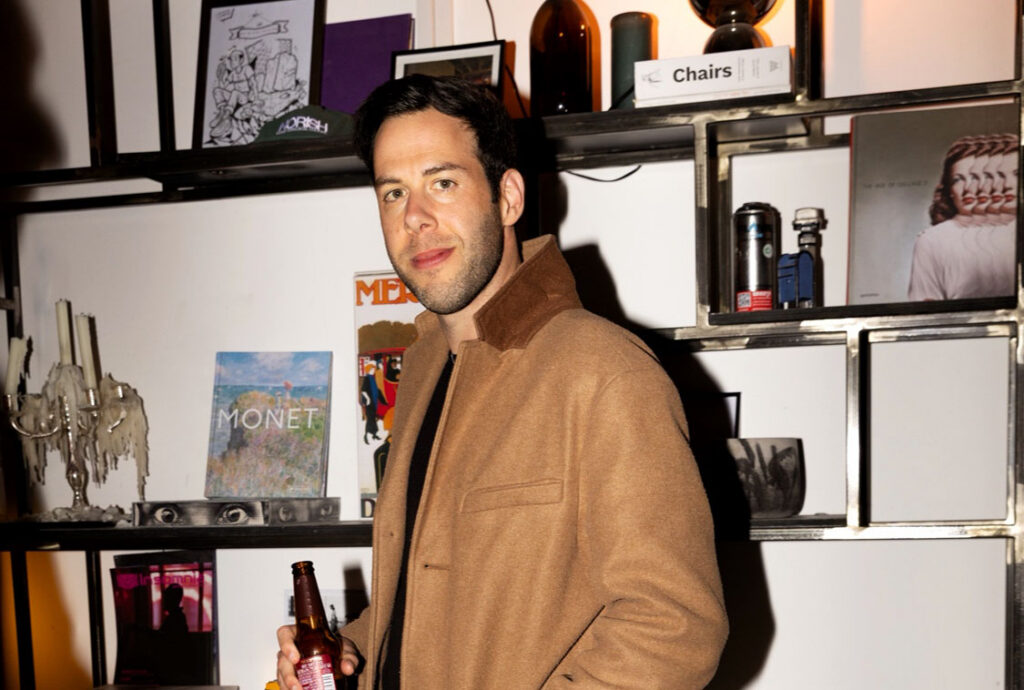
Ari Frenkel is in the middle of making a feature film titled “See You on the Other Side” that grew out of grief that has not been resolved. The film is unfinished. The production is ongoing. The fundraising continues. Frenkel describes the project as something that began while he was mourning his father and has continued without waiting for clarity or closure. As the lead actor, he wrote the character for himself.

The New Jersey-born actor and writer grew up in a family of Israeli scientists. His father was a plant biologist and longtime professor at Rutgers University. His mother is a flavor chemist who runs her own flavor and vanilla extract company in New Jersey. Both of his parents were born in Israel.

“We live in a world where the audiences respond best to authenticity, and this is my authentic representation and I’m going to unapologetically tell that story,” Frenkel told the Journal. “It’s really important to me that their heritage and my heritage is represented in a positive and joyful light because I think Israel desperately needs that. And I love Israel. I love being Jewish. My father, who this is based on, was Israeli, he was born there and so was my mother.”


View this post on Instagram


A post shared by Ari Frenkel (@arifrenkel)

Frenkel said the film did not begin as a film. After his father died, he began writing scenes each morning as a way to move through grief. He said the writing was not structured as a narrative and was not meant for an audience at first.

“I would write scenes every morning as I was going through grief,” Frenkel said. “And then I had a hundred scenes after a hundred days, and then I knew there’s a story in here.”

Those scenes were drawn from the mundane “new normal” moments he experienced after his father passed, not from a planned plot. Frenkel said the scenes reflect the year after his father’s death and the daily acceptance of loss. Only later did he shape the material into a feature-length script.

“Over years of working on the script and developing with my producers and the casting director and a dramaturg, it’s developed into a fiction and a more cohesive story for an actual audience,” Frenkel said. The pace of the current film’s development mattered to him. Frenkel said an earlier version of the project would not have been as strong if it had been rushed into production.

“Things take as long as they need to,” Frenkel said. “You can rush it all you want, but it’s going to take as long as it needs to.”

That approach has shaped the production itself. Frenkel said the film has been shot in separate phases rather than a six to eight week shoot.

“It’s unorthodox to be breaking up your film shoot,” Frenkel said. “I have leaned into the idea that this is for the benefit of the film.”

The story covers one year after his father’s death. Frenkel said continuity concerns are reduced because he is the only actor who appears across all shooting periods and because the story allows for change.

Dialogue includes lines taken from real emails his father wrote to him.

“I literally pulled quotes from emails he wrote me,” Frenkel said. “A lot of real things he said to me are said in the movie.”

Frenkel spent a year living in Israel during seventh grade while his father was on sabbatical at the Technion. His family returned often while he was growing up. He was most recently in Israel as part of the Birthright Israel Onward Storytellers Program. He describes his father as a scientist who was proud of his work, his Israeli background, and Jewish culture. Frenkel said his parents were born in Israel and that Israel has always felt central to his identity.
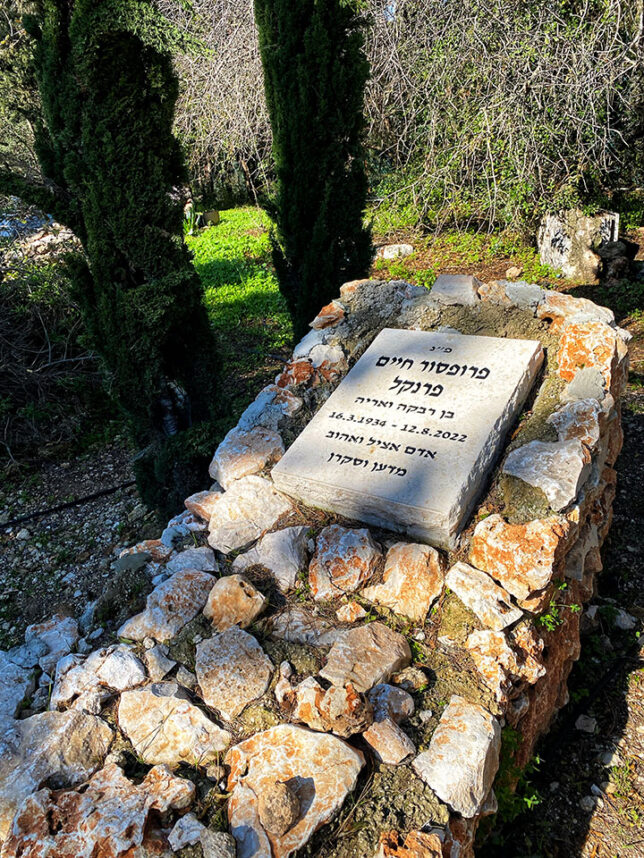
Chaim Frenkel gravesite in Israel

Frenkel said he refused advice from some filmmakers to change the family away from being Israeli to cater to a broader audience.

“This movie has nothing to do with anything political,” Frenkel said. “It is about a family that is from Israel. It is an authentic story about a family that is truly from Israel.”

Frenkel said grief, not politics, is the core of the story.

“Grief is universal. Loss is universal,” Frenkel said.

He said the film exists because his father died and because the act of making it gave him direction during periods when work felt uncertain.

“Without him dying, I wouldn’t be making this,” Frenkel said. “I think about how proud he would be. My goal is that the movie is something that ten years from now someone gives to someone because they lost a family member and it makes them feel better for an hour and a half.”

He described the production as communal, with many people involved bringing their own experiences of loss to the work.

“My producer said, ‘You’re not making a film. You’re building a community around it,’” Frenkel said.

Frenkel did not confirm how much of the film has been completed and no distribution plan or release date has been announced.

“We are still fundraising for it,” Frenkel said. “I don’t care if it’s five dollars or ten thousand dollars. Once it’s done, it belongs to the audience. But right now we are still in process.”

Frenkel did not describe a timeline for completion or release. He spoke instead about continuing to work while answers remain open.

“‘See You on the Other Side’ — this movie’s getting made,” Frenkel said.

An Unfinished Film About an Unfinished Grief Read More »

In The War Against Antizionism, Help Is On The Way

According to Adam Louis-Klein, Jew-hatred cloaked as political expression in the form of antizionism is a hate movement and should not be accepted. The founder of Movement Against Antizionism told The Journal that Jews have been on the defensive and have to stop getting into endless debates with people who are either bad faith actors or haters.

“No one would believe the blood libels of years past that Jews are murdering Christian children to use their blood to bake matzah,” Louis-Klein said. “But the key libels of colonization, apartheid and genocide, these are what people are quick to accept with no scrutiny.”

Call It Out As Racism

“We should view antizionism as racism,” Louis-Klein said. “Antizionists say Israel is a white colonizing and apartheid and genocidal state. The current discourse claims this is a political opinion. This is the evolution of Jew-hatred. Instead of saying the Jews control all the banks or Hollywood, it’s this. We need to recognize antizionism as its own bigotry and stop trying to make it fit into past forms of antisemitism. It’s a new form of antisemitism.” He defines antizionism as “a hatred of Jewish peoplehood embodied in Israel.”

Louis-Klein, 32, said the effort to brand Zionists as evil includes propaganda  plans from the Soviet Union in 1967. He is calling on all world Jewish organizations to go on a messaging offensive describing antizionism as a hate movement.

“We’d love to put ourselves out of business,” he said. “Not to explain how great Zionism is but to explain antizionism and its harm and specific libels.  Antizionism is different and its crucial that it be taught correctly. Antizionism’s Achilles’ heel is to be objectified and talked about as a hate movement. It’s goal is to put Jews under the spotlight and force them to always defend themselves.”

Louis-Klein said antizionists thrive by being given permission slips to hate and the word “Zionist” has wrongly come to be understood as someone who supports colonization, apartheid and genocide. In addition, the Holocaust inversion of calling Zionists Nazis puts Jews in the role of  oppressors.

Don’t Give Power To The Libels

Louis-Klein said it is way overdue that legacy organizations stop holding debates about whether or not antizionism is antisemitism. While it is important to attack both, the scheme to legitimize antizionism works if it is not called out.

“There is an inability to draw boundaries,” he said. “We’re debating with people who are not coming in good faith and they’re not honest. They spread libels. They don’t care about demonstrating strength of claims. They care about the power of the mob and the ability to spread the libel so it is accepted in the news. You keep repeating these slanders. When we debate these claims we legitimize a show-trial.”

He said antizionism is what we are seeing on college campuses, much of it following the Soviet Union’s propaganda from the 1960s that was passed to the Middle East and can be seen today in Tucker Carslon and Candace Owens.

A great irony, he said, is that Israeli media is highly critical of its own country, yet American figures who are obsessed with Israel and repeatedly criticize the Jewish state claim they are not allowed to criticize Israel. B

ecause Jew-haters are in the majority, they can use libel to galvanize others to jump on the bandwagon. It has also taken the form of calling Israelis white, ignoring the many that have dark skin.

Why Younger Jews Accept The Libels

Why have so many Jewish Gen Z-ers been swept up by this? Recent polls showed a majority of Jews believe Israel has the right to exist but fewer identify as Zionists.

“This ideology is fit to the moral codes of our time,” Louis-Klein said. “Everyone has internalized the colonialism, racism and genocide are the great evils of our time. When you construct Israel as a colonizer, an apartheid state committing genocide, it fits too smoothly into the moral grooves of how people view the world. It’s almost too cognitively satisfying, especially for younger people to see Israel as evil.”

“When you construct Israel as a colonizer, an apartheid state committing genocide, it fits too smoothly into the moral grooves of how people view the world. It’s almost too cognitively satisfying, especially for younger people to see Israel as evil.”

He also said that things don’t happen by accident, and media figures can see which way the wind is blowing.

“Tucker Carlson’s rise as an antisemite has resulted from the Gaza genocide libel,” he said. “He’s rode the wave to try to legitimize himself. He’s an antisemite and an antizionist.”

Why Carlson Might Be Scapegoating Israel Due To His Guilt

On the podcast of the Comedy Cellar, Louis Klein said Carlson may have guilt over supporting the Iraq war, which he has apologized for, and may make himself feel better by attacking Israel.

Jews, he said, have an attachment to the phrase “antisemitism” but it is a failure to recognize that it must explain how antizionism is not a legitimate political notion, but a set of slanders.

“When we say it’s antisemitism, it’s ambiguous, and it’s not working when we speak to non-Jews,” he said, “because antizionists believe they’re doing something different. In some way they are.”

Part of the reason antizionism is effective, he says, is that those who use the word can’t define it.

The Goal is Word-Salad

“They don’t really know what a colonizer is, because if you look at history, America took over land, Muslims spread Islam by colonizing and Europeans took over land,” he said. “Almost every country did, so how is Israel the distinct colonizer, while ignoring a war in which it improbably defeating numerous armies that sought its complete destruction? There’s only one country, South Africa, that was charged with apartheid and Israel doesn’t legally discriminate based on race.  Genocide is a legal term that requires intent to destroy a people, which Israel has not had, but so called “experts” throw away that definition so they can smear Israel.

Online, many don’t care they don’t know the meaning of terms, he said.

“They need to be flexible enough that you can stain Zionists with them but never have to actually define them,” he said. “We have to show we won’t accept it.”

He said some antizionists have been flummoxed when they tried to engage him in debate and he lambasted them for being part of a hate movement and don’t know how to respond, as they are used to instilling fear and getting Jews to grasp at straws to defend themselves.

A legal concept of antizionist discrimination is needed, he said. He defines antizionism as “a hatred of Jewish peoplehood embodied in Israel.

Is that likely to happen?

“We’re going to make it happen,” he said.

The Movement Is Helped By Token Jews

He said there are some “token antizionist Jews” like Ezra Klein of The New York Times and Peter Beinart who “just participate in this hate mob to gaslight Jews, and that violence against Jews must be a zero sum game equivalent to Palestinian suffering.

Antizionists have seen they can get under the skin of Jews with posts like “When are you getting your $7,000 from Israel?” or “this message was promised 3,000 years ago.’ He advised people to respond to these posts with a simple “libel card declined.”

They Came After Him

On his way to a Ph.D. in anthropology at McGill University, he said antizionists sought to destroy his career.

He was proud of editing a journal but said he was “purged as a Zionist.”

Most hurtful, he said, was what was done by his intellectual hero, Eduardo Viveiros de Castro.

“He publicly disowned me and tried to humiliate me to his 10,000 Twitter followers,” Louis-Klein said. “I was deeply betrayed by him. I went into Amazonian Anthropology in large part because I was inspired by his work and was trying to bring it to the next level. It’s a prestige economy and showing yourself as an antizionist bigot means others will come and support you as a mob. A lot of people who were my friends and colleagues began to abuse me as well.”

He spent time in the Amazon with the Desana people in Brazil and Colombia who are undergoing forced assimilation, he told The Times of Israel’s Haviv Rettig Gur on Gur’s podcast, adding that after Oct. 7, 2023, he saw that there is an effort to force Jews to distance themselves from their identity.

“They’re trying to force us to disappear because they see us as a threat,” he told Gur.

He is aware this is happening in other industries as well.

Louis-Klein who has written for The Free Press, Tablet and numerous podcasts, said a major part of the propaganda of antizionism relies on Jews not to call out and get bogged down by endless arguments.

“It’s a clever dynamic where antizionism is posed as a valid critique that has to be answered,” he said. Their hope is Jews will say ‘well, we’re not so bad.’ Unfortunately, many Jews have fallen for false framing and it’s time for a giant correction.”

In The War Against Antizionism, Help Is On The Way Read More »

Yes, We Have a Drinking Problem

“It was the greatest rarity to see a Jew drunk.” This quote, from a late 19th-century Polish observer, reflects a commonly held truth. And in the early and middle 20th-century, multiple studies confirmed Jews drank far less than their non-Jewish neighbors.

Nahum Glazer, in his influential 1952 essay Why Jews Stay Sober cites multiple theories why this is so. Some base themselves on Emil Durkheim’s observation that people who live in tight-knit communities have fewer social problems. They theorize that the strong communal bonds in the Jewish community prevent the vulnerable from falling into despair; and as a result, Jews have lower rates of alcoholism. Robert Bales, a Harvard sociologist who wrote his PhD on the topic of Jewish drinking, points to ritual as the critical element. Jews incorporate wine into multiple rituals, from Friday night dinners to weddings and circumcisions. This changes one’s relationship to alcohol. Bales calls this a “fixation factor,” in which ritual frames alcohol as a sacred substance rather than a tool for personal escape.

Glazer prefers a theory first offered by Immanuel Kant. He saw Jewish temperance as an expression of vulnerability. He wrote that, “Women, ministers, and Jews do not get drunk…because their civic position is weak and they need to be reserved.” Jews attract a lot of negative attention; as a result, they are careful not to look bad in public. Glazer says this lesson had become so ingrained that even after Jews were made to feel at home in America, they remained relative teetotalers.

Werner Sombart takes a more direct approach. In his book The Jews and Modern Capitalism, Sombart argues that Judaism’s comprehensive system of religious discipline transformed Jewish culture; and this regimen played a large role in fostering Jewish economic success. Sombart declares that “it can be proved with great certainty that the Jew’s freedom from the evil effects of alcohol (as also from syphilis) is due to his religion.” Jews drink less because of Judaism.

Without question, Judaism discourages excessive drinking. In the Tanakh, Noah and Lot were sexually exposed and humiliated while they were drunk. The Kohanim are forbidden to drink while serving in the Temple. This stands in stark contrast to Ancient Egypt, which held a “Tekh Festival” or “Feast of Drunkenness”, whose ritual is described by one Egyptologist as this: “it seems that in the Hall of Drunkenness, worshippers got drunk, slept, and then were woken by drummers to commune with the goddess Mut”. Divine service has nothing to do with the imaginary inspiration of intoxication; and Halakha forbids praying when one is drunk.

Yet, there is one instance where drinking is encouraged in Judaism: Purim. The Talmud says that “Rava said: A person is obligated to become intoxicated on Purim until they don’t know the difference between “Cursed is Haman” and “Blessed is Mordechai.” Inebriation is the order of the day.

This clashes with the general Jewish attitude towards excessive drinking and demands an explanation. One common resolution is to simply reinterpret this ruling. Rabbeinu Ephraim, a 12th-century author, cited a story the Talmud tells after Rava’s statement: 

Rabbah and Rabbi Zeira made the Purim feast together. They became intoxicated. Rabbah arose and slaughtered Rabbi Zeira. The next day, he prayed for mercy and revived him. 

The following year, Rabbah said to Rabbi Zeira: “Let the Master come and we will make the Purim feast together.”

Rabbi Zeira said back to him: “Not at every hour and hour does a miracle occur.”

This story seems mythical. But its purpose is clear: to demonstrate the evils of excessive drinking on Purim. Rabbeinu Ephraim argued that this story indicates the Talmud rescinded the obligation to drink on Purim.

In a similar fashion, a 13th-century writer, the Orchot Chaim, reinterprets this law:

A person is obligated to become ‘intoxicated’ on Purim. This does not mean that he should become drunk, for drunkenness is an absolute prohibition. There is no greater sin than this, for it leads to sexual immorality, bloodshed, and many other transgressions besides. Rather, he should drink a little more than his usual habit.

One must drink moderately, even on Purim.

Another way of resolving this riddle is to treat Purim as an exception. Jeffrey Rubenstein points out that the stricture against excessive drinking is not the only religious norm ignored on Purim. A Purim rabbi would hold office, and their sole duty would be to mock the year-round Rabbi. The Rama offers an additional list of changes:

There are those who have the custom …that a man wears a woman’s garment and a woman a man’s clothing, and there is no prohibition in this matter, since their intention is solely for the sake of joy. Similarly, regarding wearing mixtures (sha’atnez) that are rabbinically prohibited…the custom is that it is permitted. Likewise, when people snatch from one another in a spirit of merriment, this does not violate the prohibition of “You shall not steal,” and this is the prevailing custom…..

Rubenstein compares Purim’s celebrations to Victor Turner’s concept of communitas, festive events during which people suspend hierarchical distinctions and experience a direct, unmediated human connection. On Purim, when we recognize how lucky we were to survive Haman’s decree, we embrace an upside-down world where the gift of life comes first and rules and social distinctions last. Drinking until one doesn’t know the difference between “Cursed is Haman” and “Blessed is Mordechai” truly allows one to imagine a world without distinction and without strife, with all the people living together in peace.

According to this interpretation, drinking on Purim is the exception that proves the rule. Apart from Purim, Jews don’t get drunk.

Except they do.

Rabbi Eliyahu Guttmacher (1796-1874) was the Tsadik of Grätz, a brilliant Talmudic scholar and mystic to whom thousands of Jews flocked ‌for blessings and advice. The archives of the YIVO Institute for Jewish Research contain a collection of prayer notes (kvitlach) addressed to him. Glenn Dynner, in his article ‘‘A Jewish Drunk Is Hard to Find’’: Jewish Drinking Practices and the Sobriety Stereotype in Eastern Europe, cites several that relate to drinking problems. One note, from Solomon ben Reizel, includes the admission that he “drinks a lot of liquor  to the point it makes him drunk, and because of this he has no domestic tranquility.” He asked for a prayer that God “have mercy on him and guard him so that he doesn’t drink anymore.” Another, from Isaac Eizik ben Rachel, describes how he “drinks more liquor than he needs, and so he beats his children, so he asks for a cure for this.” Sarah bat Leah asked for the rabbi to pray that there be “peace between husband and wife, for her husband is always drunk, and he comes home and quarrels with his wife. And he causes damages and [financial] losses, and she has no rest when he comes home. And he also hit his eldest son for nothing.”

These notes tell the tragic tales of families turned upside down by alcoholism. And problem drinking was not restricted to scattered individuals; a popular Mussar work from the late 1600s, Kav Hayashar, condemns those who drink early in the morning and show up to synagogue drunk.

These problems cropped up when one could still honestly say that “a Jewish drunk is hard to find.” And they are more significant today, when that adage is no longer true. Recent studies have shown ‌a sharp rise in alcoholism and addiction in the Jewish community.

But the old myth that “Jews never get drunk” is getting in the way. Jewish alcoholics are loath to come forward; they are ashamed of their drinking problems, feeling as though they have failed their entire community. And communal leadership can hold tight to an irrelevant myth and ignore the problems before their eyes.

Yet the problems are pretty obvious. There are men who drink excessively at Shabbat Kiddush and then are unable to eat lunch with their families. There are high school students who buy opioids to “cope” with the stress of schoolwork. And we have ever-increasing numbers of people with gambling addictions, fed by constant ads during sporting events.

Yes, we have a drinking problem, right here in the Jewish community.

The first step to solving any problem is to admit that you have a problem. And that is what our community must do. We need to look in the mirror and stop playing make-believe.

We need to admit that our community has a problem, and start looking for solutions.


Rabbi Chaim Steinmetz is the Senior Rabbi of Congregation Kehilath Jeshurun in New York.  

Yes, We Have a Drinking Problem Read More »

Jewish Teens Want a Seat at the Table. After Oct. 7, They’ve Earned It.

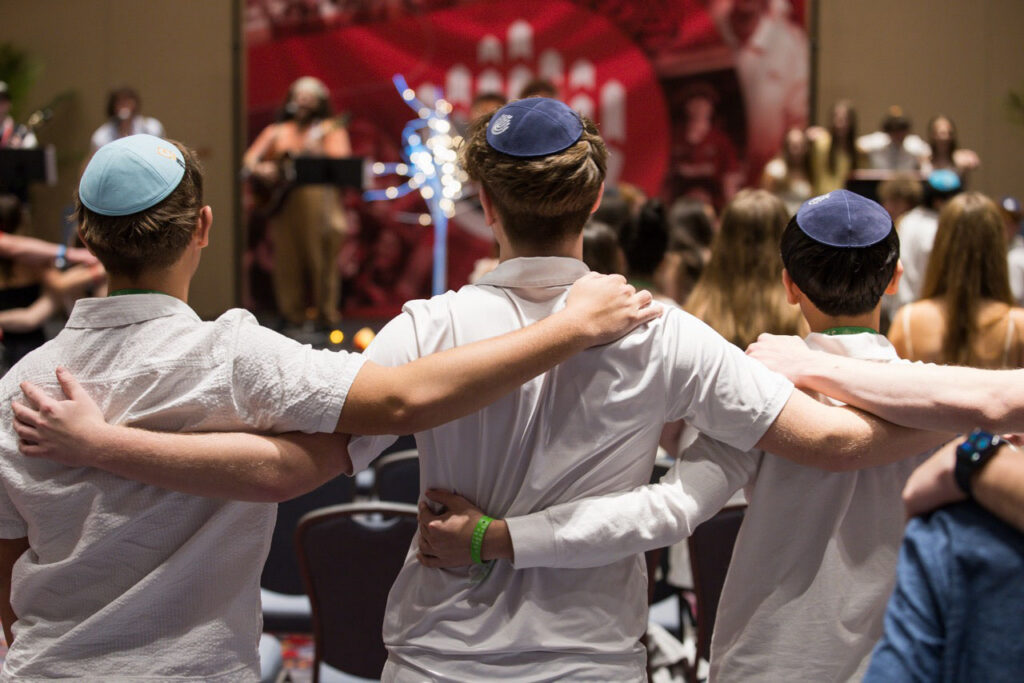
At BBYO’s International Convention this month, thousands of Jewish teenagers didn’t just gather. They stood up and insisted on a role in Jewish life and Jewish leadership that no one had offered them.

In Philadelphia, 3,400 teens from 52 countries drafted a resolution through the Jewish Youth Assembly, an initiative of the World Jewish Congress, addressing antisemitism, polarization, and online hate and sent it directly to the WJC’s network of global Jewish leaders. Meanwhile, BBYO’s international co-presidents launched “Seat for the Future,” a campaign calling on organizations like the ADL and Jewish Federations of North America to install teens on their boards. No national organization has yet accepted.

This was not youthful boosterism. It was a moral summons.

After Oct. 7, the organized Jewish community has been tested not only by external threats, but also by internal responses that too often resemble risk management rather than moral clarity. Legacy institutions met the greatest rupture in Jewish life in generations with careful statements, endless process, and reputational choreography, when what Jewish families and students needed was speed, backbone and resolve.

We have become a community that confuses process for protection. And our teens see that more clearly than many adults.

They have watched campuses slide into open hostility toward Jews, excused as “activism.” They have watched fashionable moral frameworks romanticize barbarism while demanding Jewish self-erasure as the price of acceptance. They have watched Jewish as students are pressured to denounce Zionism simply to remain socially legitimate. They have watched slogans that flatten Jews into villains laundered through the language of justice.

And they have watched institutions respond the same way: convene, listen, workshop, “build bridges.”

Antisemitism is not a misunderstanding that can be resolved through facilitated dialogue. It is a civic and communal emergency. Some institutions have begun to act.  Campus encampments dropped 92 percent after universities started enforcing their own codes of conduct, and some schools revised policies and strengthened Hillel and Chabad partnerships. That progress is real, and it proves the point: When institutions show backbone, conditions improve. The question is why it took a historic crisis to produce even partial accountability.

When institutions show backbone, conditions improve. The question is why it took a historic crisis to produce even partial accountability.

The deeper problem is one that can be felt across Jewish institutional life right now: a leadership class that has learned to recognize some forms of hatred instantly and to proceduralize others into oblivion. The result is a community with impressive infrastructure and insufficient confidence, as well as organizations that can raise money, host galas, issue statements and still struggle to do the first duty of communal life: defend our people without apology.

So when BBYO teens say they want a seat at the table, they are not asking politely for inclusion. They are saying: We cannot afford your timidity anymore. That is not youthful impertinence. It is Jewish responsibility.

Judaism is not built on spectatorship. It is built on obligation—arevut, mutual responsibility; pikuach nefesh, the seriousness of life and safety; and the basic dignity of a people that refuses to be shamed out of its identity. In that sense, BBYO is not merely a youth convention. It is a formation space—one of the few places in American Jewish life where young Jews are being trained not just to “feel Jewish,” but also to act Jewish: to lead, argue, build, defend, and sustain.

There is reason for hope here and not only from the teens.

Pennsylvania Governor Josh Shapiro, whose home was firebombed on Passover last spring by an attacker who cited hostility toward Jews and Israel, opened the convention. He told the crowd: “You are the future, and you are the power to shape it. And don’t wait. The future is right now. Do not look for others to do the work. This is not an opportunity. This is your responsibility.” The teens recognized the echo of Rabbi Tarfon in Pirkei Avot—“It is not your duty to finish the work, but neither are you free to neglect it”—and they roared. That is what moral clarity sounds like from leadership. Not a statement. Not a task force. A Jewish governor, targeted for being Jewish, standing before Jewish teenagers and telling them their obligation is now.

That is the standard these teens are asking the rest of Jewish institutional life to meet.

For years, Jewish organizational life has been dominated by professionalized hesitation: donor anxiety, institutional branding, consensus politics. That model was already weakening Jewish belonging before Oct. 7. After Oct. 7, it became untenable.

This generation does not want vague metaphors about “building bridges.” They want leaders who will name antisemitism plainly. Who will defend Jewish students unapologetically. Who will affirm that Jewish peoplehood is not a political inconvenience but a civilizational fact. Who will stop outsourcing Jewish moral confidence to the approval of others.

This generation does not want vague metaphors about “building bridges.”

So, yes: Give them their seat.

But do not pretend that is the whole story. Their demand is also a warning. BBYO’s international co-presidents told the Forward that they have seen a “disconnect” between Jewish organizations and what Jewish youth actually want from leadership, and that when teens are included, it has felt “tokenized.” That is why they are now going organization by organization, asking for board seats. They are not waiting to be invited. If adult institutions cannot recover moral clarity, young Jews will build structures that can. They will invest their loyalty where they see courage, seriousness, and pride.

The lesson is not merely that Jewish teens are inspiring. The lesson is that they are right. And moral confidence begins with naming reality: Hate against Jews is hate. Say it. Mean it. Enforce it.

Jewish federations cannot fundraise endlessly while hesitating to confront the institutions where Jewish students are being degraded. Campus professionals cannot hide behind neutrality while Jewish identity is treated as uniquely suspect. Donors who write seven-figure checks to universities should be conditioning those gifts on measurable enforcement of anti-harassment policies—not accepting task forces and listening sessions as substitutes for action.

Oct. 7 shattered the illusion that Jewish life can be sustained by prestige, branding or institutional inertia. The teenagers in Philadelphia understand what the rest of Jewish institutional life has forgotten: Jewish continuity is not maintained through statements. It is maintained by those who refuse to whisper.


Samuel J. Abrams is a professor of politics at Sarah Lawrence College, a senior fellow at the American Enterprise Institute, and a scholar with the Sutherland Institute. 

Jewish Teens Want a Seat at the Table. After Oct. 7, They’ve Earned It. Read More »