fbpx

January 30, 2026

Ran Gvili: A Lesson in Jewish Courage

Parshat Beshalach offers a seminar on courage. It begins by declaring that, “God did not lead them by way of the land of the Philistines, although it was nearer; for God said, ‘The people may have a change of heart when they see war, and return to Egypt.’” The newly freed slaves were not ready for war.

Later in the parsha, the Torah confirms this concern. When Pharaoh’s army gives chase and reaches the Jews at the Red Sea, the Jews cry out, and then assail Moses for redeeming them:

“The children of Israel lifted their eyes, and behold, the Egyptians marched after them. So they were very afraid, and the children of Israel cried out to the Lord. And they said to Moses, ‘Was it for want of graves in Egypt that you brought us to die in the wilderness? What have you done to us, taking us out of Egypt?  Is this not the very thing we told you in Egypt, saying, ‘Let us be, and we will serve the Egyptians, for it is better for us to serve the Egyptians than to die in the wilderness?’”

Then, at the end of the parsha, the text tells us how Amalek unexpectedly attacked the Jews in the desert. Joshua leads the Jews into battle, and they emerge victorious.

Rabbi Jonathan Sacks wonders what had changed. At the beginning of the parsha, the Jews were not ready for war. Now, just a few weeks later, they field an army and battle with Amalek. What is the source of their newfound courage?

Sacks explains that crossing the Red Sea left the Jews with no path of retreat, and their survival now depended entirely on whether they could achieve victory. They no longer could be cowards; to survive, they would have to fight.

Desperate people can find a great deal of courage within.

Ibn Ezra arrives at a very different conclusion. He says the war against Amalek required very little courage. The Jews far outnumbered Amalek, and the actual victory was a miracle, the product of Moses’s prayers during the war.

Instead, Ibn Ezra argues that “this generation that went out of Egypt had learned from its youth to bear the yoke of Egypt, and its spirit was low.” The former slaves had a slave mentality; and they never would become brave enough to fight for their destiny.

The evidence is in Ibn Ezra’s favor. During the episode of the spies a year later, the Jews once again showed their lack of courage. Right after hearing the spies’ report, the Jews began organizing their return to Egypt.

Rabbinic literature adds another lesson about courage. Perhaps much of the community was cowardly. But what matters is that one man was a hero. And it is right at the edge of the Red Sea that we meet a man who will become a role model of Jewish courage.

As the Egyptians approach the Jews camped on the Red Sea, chaos ensues. Based on inconsistencies in the text, the Mekhilta, a second-century midrash, explains that the Jews split into multiple groups:

“Israel stood by the sea in four groups.

One said, ‘Let us fall into the sea’ [i.e., give up and drown].

One said, ‘Let us return to Egypt.’

One said, ‘Let us make war.’

And one said, ‘Let us cry out’ [in prayer].”

Competing factions choose the paths of despair, cowardice, faith and defiance. Panicked and fearful, no one knows what to do next.

God tells Moses, “Tell the children of Israel to go forward.” They are to march right into the Red Sea. According to the Talmud, everyone refuses to do so; an entire people are stuck in limbo. Only one man, Nachshon ben Aminadav, jumps into the depths of the sea.

Nachshon exemplifies Jewish courage. There is a modern Hebrew idiom that translates as “taking a Nachshon jump.” During the years before Israel’s War of Independence, this phrase became popular. That too was a time of uncertainty and crisis; there was a realization that the only way forward would be to be like Nachshon and jump right into creating a state, despite the risks.

People usually see courage as a matter of either mental attitude or willpower. For the Stoics, mental preparation allows a person to overcome fear. Seneca wrote that “he who is brave is fearless.” It makes no difference what one faces, even death and torture; all that matters is one’s inner attitude. To have courage means to have the proper wisdom about life, to accept the ”commands of reason.” When that happens, you recognize that even the worst threats “are not evils, but only seem to be.”

To have courage means to have the proper wisdom about life, to accept the ”commands of reason.”

Many Jewish thinkers also adopt this view of courage as well. Bahya ibn Pakuda writes in his Chovot Halevavot: “One who trusts God does not fear any man on account of his trust. On the contrary, it is a source of pride, as King David said: ‘In God I trust. I am not afraid; what can mere humans do to me?’”

Another theory is that courage is a matter of willpower. Fear is an instinct we can never banish; we simply need to force ourselves to overcome our fears. Nelson Mandela, when reflecting on his own life, remarked, “The brave man is not he who does not feel afraid, but he who conquers that fear.” Courage is imposing your will on your fears.

In Nachshon, we see a different paradigm of courage. Rabbi Menachem Mendel Schneerson, the Lubavitcher Rebbe, asks a simple question about this passage: Why didn’t Moses jump into the sea before Nachshon?

He explains it was far from clear on a rational level what the correct course of action was. Moses was a man of intellect, but in this case there was no logical solution. Nachshon followed the path of mesirat nefesh, self-sacrifice; he plunged forward without asking, without deliberations and without calculations.

Nachshon offers a new type of courage, built of pure devotion. This courage will lead one to embrace the absurd and leap into the abyss, much like Nachshon did. When you are filled with passion, nothing seems too difficult.

This courage is the secret to Jewish survival. Rabbi Joseph B. Soloveitchik offers a powerful description of its impact:

“There are situations in life with which clear-cut logical processes and utilitarian approaches fail to cope, while the sudden spontaneous leap into the absurd (to use a Kierkegaardian phrase) may save man when he finds himself in utter distress. This non-rational and impractical action is heroic … Is it not in fact the story of Knesset Israel, an entity which is engaged in an ‘absurd’ struggle for survival for thousands of years?”

We are here by virtue of generations of Jews who, against all odds, made that jump.

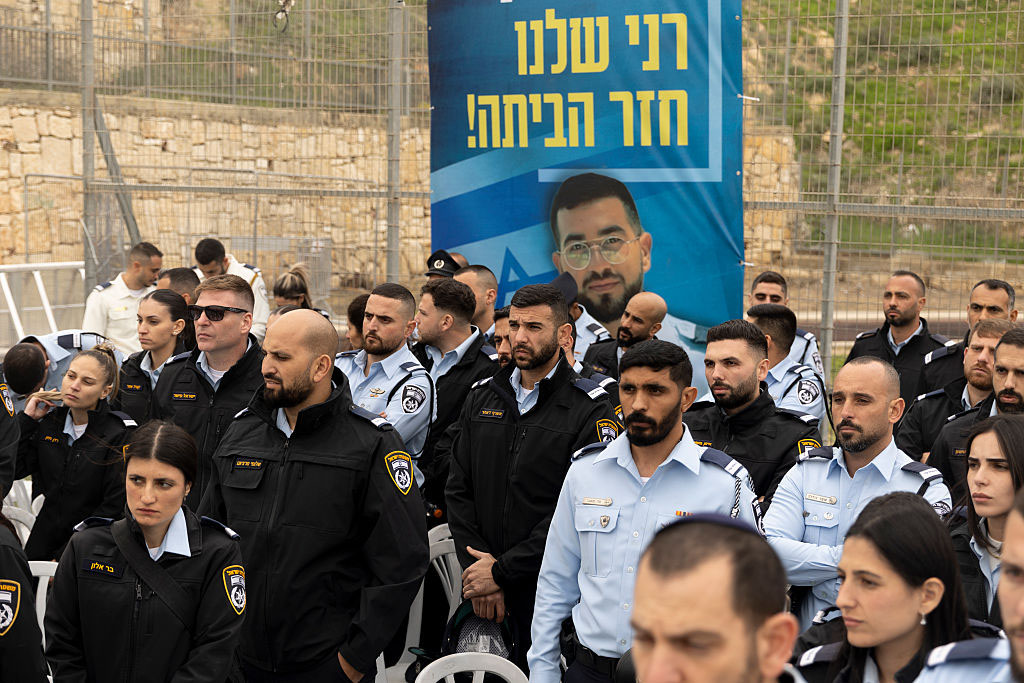
Ran Gvili was the last hostage to come home from Gaza. The 24-year-old was in an elite Yasam unit. Despite still recovering from a broken shoulder sustained in a motorcycle accident, Gvili rushed to the Gaza border communities in southern Israel, fighting first at Kibbutz Alumim and then rescuing survivors at the Sa’ad Junction. After evacuating victims of the Nova massacre, he returned to fight at Kibbutz Alumim, where Hamas killed him. Hamas took his body to Gaza and held him hostage for 843 days.

On Wednesday morning he was laid to rest.

At the funeral, Gvili’s father Itzik addressed his eulogy to his son. With a slight smile, he said: “You dummy, you had every chance to stay at home. But you said, ‘Dad.’ What did you tell me? ‘I won’t leave my friends to fight alone.’”

Ran and tens of thousands like him ran to the front after Oct. 7th. They did not think. Had they done so, they might have stayed home. But like Nachshon, they leaped into the abyss in an act of pure self-sacrifice.

It is because of them that the State of Israel survived this horrible attack.

May their memory be a blessing.


Rabbi Chaim Steinmetz is the Senior Rabbi of Congregation Kehilath Jeshurun in New York.  

Ran Gvili: A Lesson in Jewish Courage Read More »
Rabbis of LA | Rabbi Sochet Was Born to Be a Rabbi

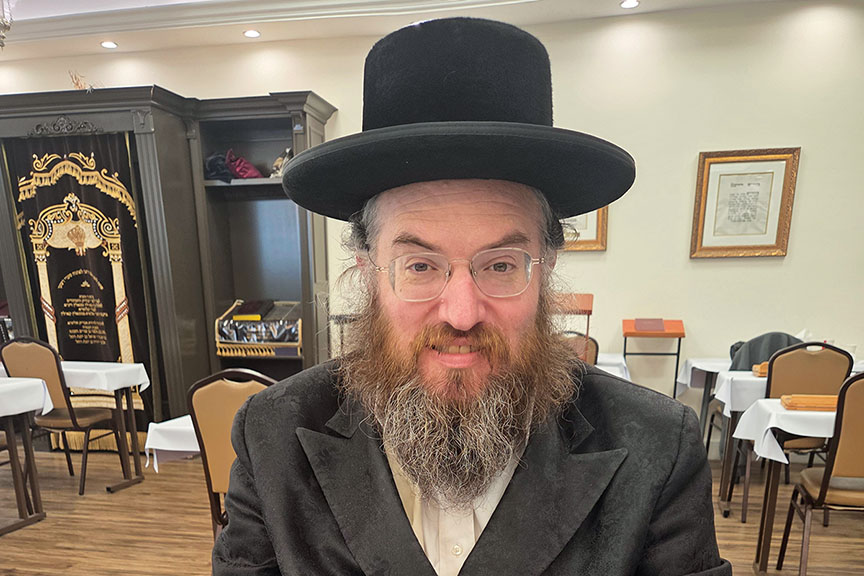
Rabbi Dovid Yehoshua Sochet is a serious and learned man and a member of one of the oldest Chasidic dynasties but he’s as accessible as the village grocer.

“My father is the Stoliner Rebbe in Eretz Israel,” Rabbi Sochet explained. “He didn’t always live there. He has been there for the last 35 years. He lives in Givat Ze’ev. Before that, he lived in Jerusalem and before that in Brooklyn.”

The Stoliner dynasty is about 250 years old, and one of the oldest Chassidic dynasties. “That is something I knew practically my entire life. I am descended from the Baal Shem Tov through my great-grandmother. My great-grandfather was a descendant of the Baal Shem Tov. This I knew practically my entire childhood. My wife is a descendant of the Baal Shem Tov, but from a different line, about an eighth cousin.

There never was a doubt how Dovid Sochet would spend his life, professionally and personally. He was born in Brooklyn, and until he was about 7, he lived in Los Angeles. He moved to the Rockaway Beach neighborhood of New York, and grew up there and in Brooklyn.

He started to say “I am the oldest of …” but he wanted to clarify that. “My parents are divorced,” he said. “My father had 15 children, aside from me, and my mother had five aside from me. I was a baby when my parents divorced. I knew my father. We visited him and he visited me.”

Growing up, who was the primary influence on Rabbi Sochet? “It’s really a bit of everyone,” he said. “Everyone had his or her influence at some point. Also my grandfather – on my mother’s side – actually both of my grandfathers – my mother and father happened to be first cousins, their fathers were brothers – so it’s all in the family.

“Both of my grandfathers were born in Los Angeles in the 1920s and ‘30s. When they reached bar mitzvah ages, they went to the East Coast to yeshiva.  They ended up staying there and later married there. About 1969, my mother’s father moved back to Los Angeles. Therefore my mother, when she was about 10, moved to Los Angeles.”

But there were times when the rabbinate was not central to his career thoughts. “As a child, I enjoyed not architecture as an art, but I thought about anthropology – and I still say that because I find humans the most interesting of all things possible.”

Although he lived in New York for many years, he regularly visited LA until his mother’s father passed away in 2001. “For about 10 years after he passed away, I was not in California. Then I started coming back here because I had a lot of acquaintances here, especially in Hancock Park, which used to be called West Hollywood, but it’s more prestigious to be known as Hancock Park.”

Rabbi Sochet explained how he came to settle in Pico-Robertson. “I had a few close friends in La Brea who suggested that there was need for something Chassidish in the Pico-Robertson community,” he said. “There was nothing of that sort here for many years. This is about 2011, 2012. I was introduced to certain people – both from La Brea and also with an acquaintance, a follower of my father’s in Eretz Israel – he introduced me to a man who now is a close friend, Mr. Harry Nelson. I spent a few Shabossim in this area, got to know a few people, and — this is all with the vision of trying to start something here. But you can’t just want to start something and it happens.”

He started making preliminary plans for Kahal Chasidim She’aris Yaako in 2010. “There’s a lot of competition in Pico from other shuls,” the rabbi said, “but really there is no shul doing what we are. No two shuls are the same. You might have similarities, but there is no shul similar to this in various different aspects. I am not saying that as a selling pitch but as a fact.”

Rabbi Sochet insisted he is “not a very good recruiter because I am not good at PR. I try to be nice to people, hospitable, to greet people nicely. I don’t enjoy bothering people to come although – this is normal — here and there I have done it.”

There is a natural shyness about Rabbi Sochet that Pico residents of a certain stripe have found appealing. “I very much don’t enjoy recruiting,” he said, “and I don’t want to bother people.  God-willing, most of the time, Shabbos never has been a problem. Weekdays, though, that’s a whole different beast.”

His biography identifies him as a mohel, and he explained why it doesn’t keep him busy. “In Los Angeles, I have not had many calls,” he said – for an intriguing reason. “I don’t advertise so much, and there is a lot of competition. I am not really interested in taking away anyone’s business.”

Distinctions between New York and Los Angeles are very Dovid Sochet. “In New York, I have a lot of relatives, and they use me. I have a few relatives here who use me. Some of them never knew I was a mohel.”

Modest to the end.

Fast Takes with Rabbi Sochet

Jewish Journal: Your favorite moment of the week?

Rabbi Sochet: Walking on the Coney Island Boardwalk with my father.

J.J.: Your favorite daily moment?

RS: Currently, when we have a shiur (learning) by night and get to learn with other people. During the day, I study by myself, which is important. When I learn with others, I gain much more than I give.

J.J.: Do you have any unmet goals?

RS: I would like to purchase an old motel and help older people who are unfortunately homeless.

Rabbis of LA | Rabbi Sochet Was Born to Be a Rabbi Read More »

Repair the World’s MLK Service Weekend, Mayim Bialik at de Toledo, Rabbi Angela Buchdahl

Repair the World’s MLK Weekend of Service activated Jewish communities through service and learning programs designed to honor Martin Luther King Jr.’s legacy, highlight Jewish perspectives on justice and equality, build bridges between Jewish and Black communities, and deepen our understanding of how Jewish values intersect with civil rights.

MLK Weekend of Service is one of three annual National Days of Jewish Service (NDJS) activations powered by Repair the World, bringing together thousands of volunteers in impactful service and learning that celebrates our shared values while tackling today’s most urgent issues. Centered around key moments in the Jewish calendar, NDJS offers the framework, funding, educational tools, and community-building activities to inspire volunteers in meaningful experiences that strengthen local communities and foster global Jewish unity.

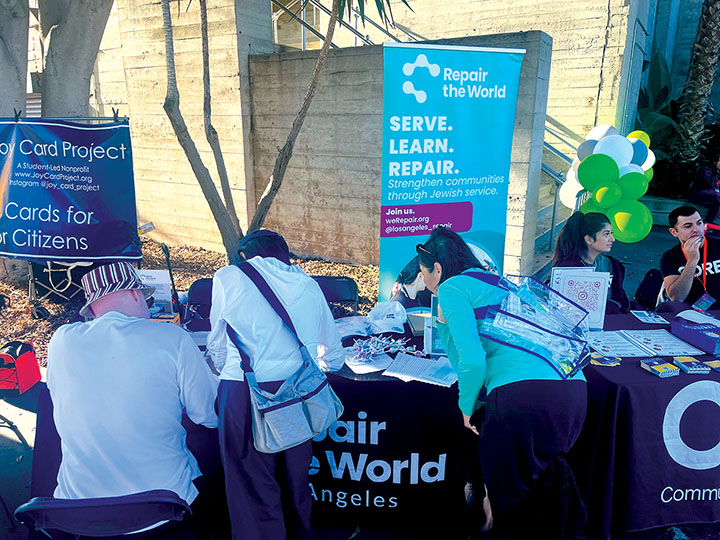
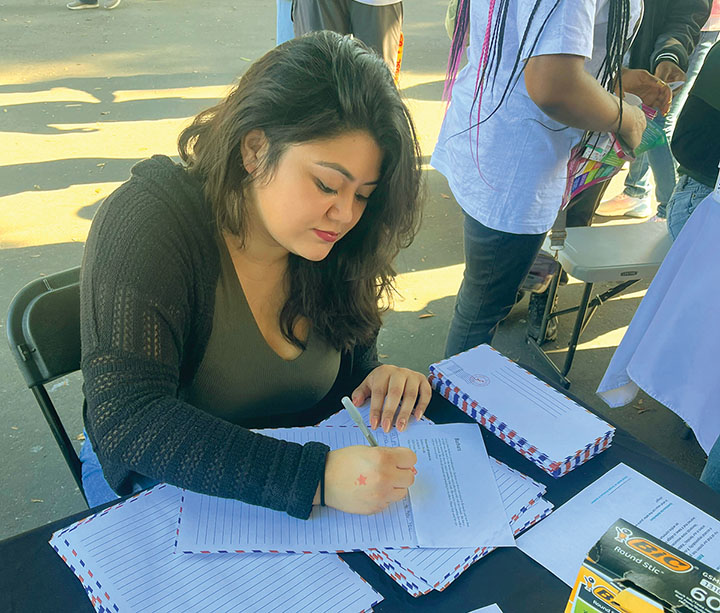
A volunteer turns out to Repair the World’s MLK Weekend of Service. Courtesy of Repair the World

The Weekend of Service included more than 100 programs in over 40 cities across 15 states, with over 63 Jewish communal partners microgranted. More than 18,000 volunteers engaged in the Weekend of Service.

In Los Angeles, Repair the World partnered with LA Works for their annual MLK Day at the Coliseum, where hundreds of Angelenos came together to honor King’s legacy in community with one another. More than 70 volunteers joined Repair’s service opportunity to address isolation in senior communities through writing handwritten letters. The volunteers engaged in meaningful learning and wrote letters to distribute through Love For Our Elders, a local service partner.


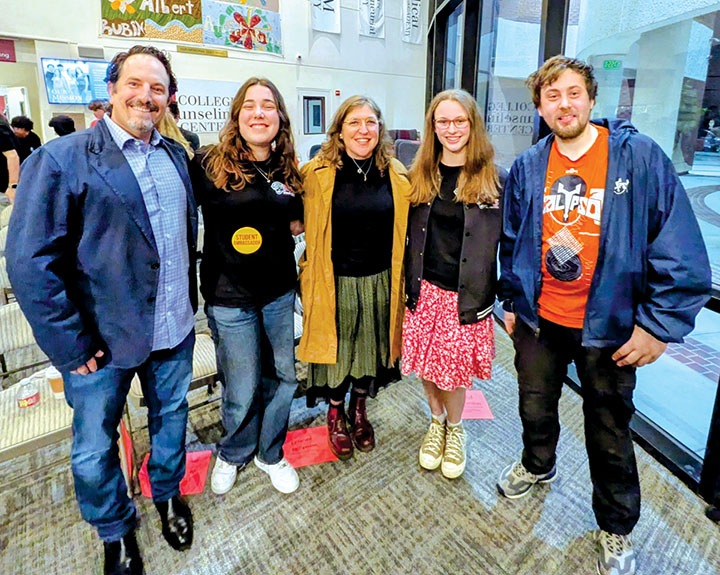
Actress Mayim Bialik (center) joins students at de Toledo High School as part of the school’s STEM Night. Courtesy of Miller Ink

Actress, author and neuroscientist Mayim Bialik traded the soundstage for the science lab on Jan. 22 when she shared her personal story at de Toledo High School STEM Night. Bialik was welcomed with over 250 guests including current and prospective students and parents.

In addition to her extensive entertainment career, Bialik earned a PhD in neuroscience from UCLA, and shared her scientific experience with de Toledo students.

This event introduced teens interested in STEM fields to the wealth of academic, lab, research, internship, and international study opportunities at de Toledo school’s highly innovative Science Department.

De Toledo High School is a Jewish day school in West Hills. The school serves grades 9-12.


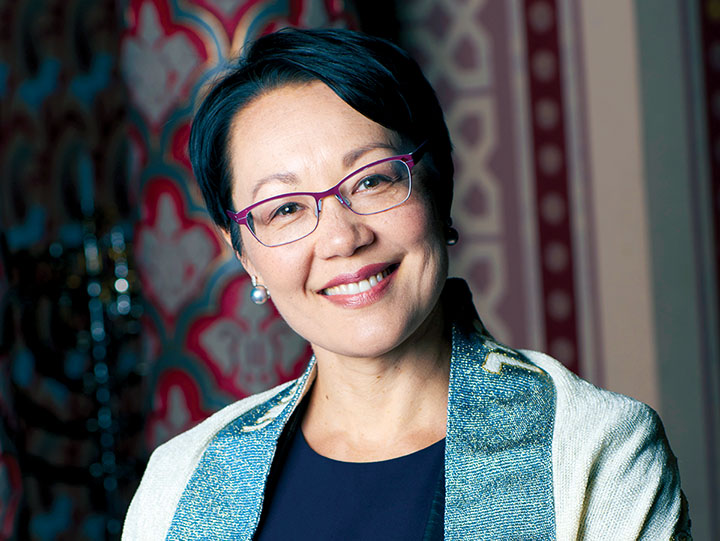
Central Synagogue Senior Rabbi Angela Buchdahl, author of “Heart of a Stranger.”
Courtesy of Buchdahl

Rabbi Angela Buchdahl, senior rabbi of New York’s Central Synagogue, arrived in Los Angeles last month for a multiday speaking tour that included appearances at Sinai Temple Dec. 4; Wilshire Boulevard Temple, Dec. 5; and IKAR, on Dec. 6.

At 53, Buchdahl has spent nearly two decades leading one of the nation’s largest Reform congregations, all while navigating the complexities of being the first Asian-American rabbi in North America—a journey she explores in her new memoir, “Heart of a Stranger: An Unlikely Rabbi’s Story of Faith, Identity, and Belonging.”

Born in South Korea to a Jewish American father and a Korean Buddhist mother, Buchdah writes candidly about growing up “outside of every community I was a part of,” and the radical compassion that ultimately shaped her rabbinate. Her career has spanned the White House Hanukkah lighting – “something the founding fathers never could have imagined,” she quipped, standing alongside then-U.S. President Barack Obama – to the recent political flashpoints that have tested her community’s expectations of moral leadership, including the election of New York City Mayor Zohran Mamdani, who has repeatedly expressed anti-Israel rhetoric.

Before she appeared in-person before L.A. audiences, Buchdahl spoke to the Journal about her new book, which wrestles with questions of identity, responsibility and the spiritual work of belonging.

“I started this writing project with the goal of making the Jewish wisdom tradition accessible for all people, to be a crossover spirituality book… I was aware that I was not just writing my own story, but my family’s story and the story of people close to me, and I took that as a sacred responsibility,’ she said.

Asked what she sees as the Jewish community’s biggest spiritual or communal challenge right now, she spoke about the rise of antisemitism in the aftermath of Oct. 7.

“I think the Jewish community feels more misunderstood and fearful than I have ever experienced in my lifetime. The rise in antisemitism, the normalization of demonizing rhetoric against the State of Israel—not just criticism of the Israeli government or the war—and the fissures we are feeling within the community are real threats,” Buchdahl said. “I think we need to recognize where the real dangers are and come together as a community to address them.”

Repair the World’s MLK Service Weekend, Mayim Bialik at de Toledo, Rabbi Angela Buchdahl Read More »