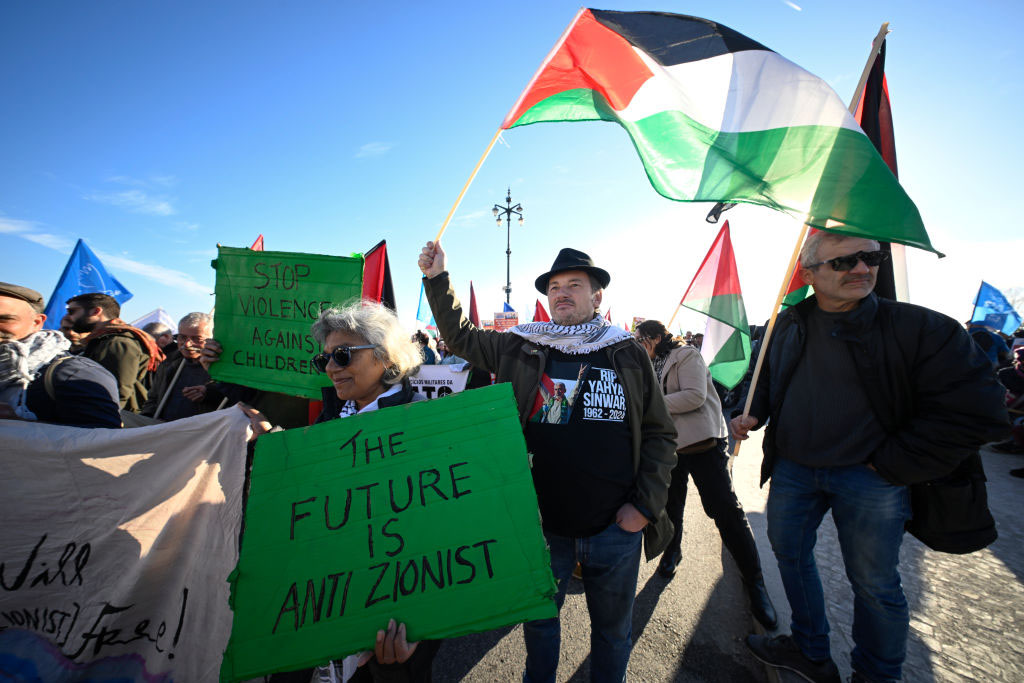
I recently spoke in the U.S. about the “red-green alliance” — the growing cooperation between Islamists in the West and the radical left, which has become a major driver of Israel’s delegitimization and rising antisemitism. I argued that its most damaging effect is the creation of an imagined anti-Israel majority, a perception that leaves many Jews feeling overwhelmed. Yet this sense of crisis rests on a fundamental misperception — one we urgently need to correct.
Mass media exposure and Gaza imagery have created intense, one-sided scrutiny of Israel. In our ADHD-driven world with no room for nuance, Israel was put alone on trial. Anti-Israel activists exploited the vulnerability of liberal democracies, turning Israel into a wedge issue in Western polarization. The result: Israel became victim to a global zeitgeist where ignorant celebrities publicly denounce it and rumors of genocide persist.
While many Jews feel that “the whole world is against us,” the anti-Israel camp believes it is “on the right side of history.” When these are the common perceptions, anti-Israel groups enjoy a cultural environment where notorious accusations become “common knowledge.” This zeitgeist could only exist based on the perception that it represents majority opinion. But it doesn’t.
The support for Israel is decreasing, especially among the young generation. But US polls consistently show that support for Israel still exceeds opposition. Recent Harvard-Harris polls (October 25) demonstrate that more Americans hold favorable views of Israel than those who hold unfavorable ones, that Israel is significantly more popular than Hamas or the PA, and that even among young Democrats—considered Israel’s most challenging demographic—the majority still supports Israel (55%).
The data clearly shows the zeitgeist around Israel is based on an imagined majority. Since this data is publicly available and often quoted, why does this false perception persist?
Three major constructs explain this phenomenon. First is the hijacking of relevance: anti-Israel groups have reframed the conflict as a domestic American issue, recasting the Palestinian cause as part of local anti-racist struggles and turning anti-Zionism into a marker of “good progressive” identity. As a result, even though their base of actual supporters is relatively small, they convert a far higher share of that support into visible activism — giving the impression of a much larger movement.
Second, social media dynamics imprison us in echo chambers where radical voices are amplified and moderates self-censor, fearing social consequences for dissenting against what they wrongly perceive as consensus.
Third, there’s the silence of the Jewish majority. While Hillel and ADL’s data shows that most Jews (83%) have experienced or witnessed antisemitism on campus, the vast majority remain unengaged in meaningful Jewish communal frameworks. This “long tail” of the Jewish constituency stays silent, perpetuating the feeling that antisemites dominate the field.
Hate that is perceived as the majority opinion poses a far greater threat. It becomes more aggressive and self-assured, creating strange alliances between right-wing and left-wing antisemitism on social media. This perception erodes the Jewish community’s ability to respond while emboldening our adversaries.
Thus, if there is one strategic imperative that supersedes all others when fighting today’s antisemitism, it is exposing the falsehood of the imagined anti-Israel majority. This is the way to challenge the zeitgeist. We must dismantle the abovementioned three artificial mechanisms that frame antisemitism as the majority view. Community leaders and philanthropists must shift focus from abstract “pro-Israel” advocacy toward dismantling these false zeitgeist mechanisms.
There is more than one way to do it. We at Astarta (Atchalta), in partnership with The Gevura Fund and the Tina Snider Foundation, are going to launch our Dome Initiative—comprising Student Dome for higher education and Parent Dome for K-12—to directly address this challenge. Rather than creating another reporting mechanism, these AI-powered platforms empower the silent majority of Jewish students and parents with strategic clarity, personalized action plans, and the confidence to challenge antisemitism at scale. This a systematic approach to activating the majority of Jews who currently remain disengaged, transforming helplessness into strategic action and challenging the false narrative that antisemitism represents majority opinion.
The numbers are on our side. History is on our side. The only thing defeating us is the illusion that we have already lost.
Eran Shayshon is Founder of Astarta (atchalta.com), and the lead author of the Playbook to Fight Antisemitism in America.
Dec. 13th is Taylor Swift’sbirthday, and this year she turns 36, which in Hebrew numerology, or gematria, is double chai or double life.
In gematria, each Hebrew letter has a number: aleph (1), bet (2), gimmel (3), and so on. The value of chai, which means life, is 18, from chet (8) and yud (10). So what does 36 mean? It is life, doubled. Or maybe, if you are Taylor Swift, it is the life you live and the one you write songs about.
You do not have to be a Swiftie to know Taylor Swift. Even if you only follow pop culture from a distance, she has become one of the defining artists of her generation and a surprisingly profound chronicler of what it means to grow up, fall in love and begin again.
She has lived many lives already: teenage country prodigy, global pop icon, indie-folk poet, and now the mastermind of her own musical empire. More than that, she has become a storyteller in a very Jewish sense, turning emotion into meaning and pain into poetry.
And like the best of Jewish tradition, her work centers on ahavah, love. Not just romantic love, but parental love (“The Best Day”), the ache of childhood (“Fifteen”), the pain of friendships lost (“Breathe”), the enduring love of a grandparent (“Marjorie”), and the love of team and community (“Long Live”). The kinds of love that root us, stretch us and sometimes leave marks that never fully fade.
Her fans do not just listen. They interpret. Every lyric is decoded, every symbol unpacked. It is not unlike Torah study. Just swap Rashi for a Reddit thread.
As I prepared this reflection, something struck me. The Hebrew word ahavah, love, has a gematria of 13.
Aleph (1) + Hey (5) + Bet (2) + Hey (5) = 13.
And 13 has always been Taylor’s lucky number. It appears in release dates, secret Easter eggs,and, of course, it is her birthday.
Enter Travis Kelce, her fiancé. His jersey number is 87.
Add them together, and you get 100.
In Jewish thought, 100 represents fullness. Not perfection, but a sense of spiritual completeness. Together, they create a whole equation: two lives balancing each other. Two very different people who found they complement each other.
But these themes, love, waiting and emotional courage, appear in our tradition from the very beginning.
When Isaac marries Rebekah, we read: “He took Rebekah, she became his wife, and he loved her.” One of the Torah’s first mentions of romantic love, and it comes after the commitment, not before. Almost like Isaac is quietly saying, “go ahead and pick out a white dress” (“Love Story”).
When Jacob falls for Rachel, the Torah tells us: “He served seven years for her, but they felt like only a few days, because of his love for her.” A love that bends time. Almost as if Jacob were saying, “I know you were meant to be timeless” (“Timeless”).
And beyond romance, we are commanded: “Love your neighbor as yourself.” A moral compass. A choice to see others not as threats but as reflections of our shared humanity. Or in Taylor’s language: “And control your urges to scream about all the people you hate” (“You Need to Calm Down”).
And then there is tzedakah, one of the most important Jewish values. A couple of months ago, Taylor heard about a two-year-old girl named Lilah battling a rare brain cancer, so she quietly donated $100,000 to her family. Her fans followed with gifts of $13 each. A harmony of compassion. Ahavah lived.
Because in the end, we are all trying to tell our own love story, whether written in a Torah scroll or sung on a stage, a story that helps us hold on even when we remember it all too well.
Maybe that is what double chai really means: taking the life we are given and doubling down to turn it into something that sings, something a little enchanted.
Eric B. Kingsley is a founding partner at Kingsley Szamet Employment Lawyers and is board president of Valley Beth Shalom in Los Angeles.
I have a vivid memory of how one home in my middle-class suburban New Jersey hometown was decorated at this time of the year: half of it was decked out in red and green with the typical Christmas fare and the other half was adorned with blue and white lights encircling a huge Star of David. As I recall, the “Jewish” side of the home looked very much like the flag of Israel.
The home was not in my immediate neighborhood, and I did not know the family who lived there, but I was always very intrigued every year when the decorations surfaced. My innate assumption was that it was an interfaith household despite intermarriage being far less common back then. Although my high school class probably was at least 25% Jewish, personally I knew only two kids whose parents were intermarried.
Over the years, I have written a lot about how both Jewish families, and partially Jewish families, can deepen their celebrations of Jewish traditions, including during the period when the “December dilemma” surfaces and many Jewish families struggle to keep Hanukkah front and center. Although I always find myself thinking back to this house during this time of the year, my thoughts about it today have taken on a new dimension. I am now focused less on who lived inside the home and more on how this family chose to signal their Jewish identity.Specifically, they chose the colors and symbols of the State of Israel.
Despite America’s legal separation of church and state, the United States is a culturally Christian nation. This reality is on full display during the winter holiday season. More than 20 years ago, Professor Samuel Freedman painted an apt picture of the cultural contrast between Israel and America in his book “Jew vs. Jew” when he quoted American journalist Ze’ev Chafets discussing his son’s experience in Israel:
“My 16-year-old, who hasn’t set foot in a synagogue for years, is more knowledgeable than anyone in a Reform temple. … What’s here for him is Hebrew. An inborn Jewish life cycle. An attachment to the land. A baseline of knowledge. He can read any religious text he wants. There are high school graduation exams on the Bible and the Oral Law, on Jewish history, on Israeli history.You hear daily words that are from the Talmud. Even the pop culture — the way the TV weatherman dresses in a costume on Purim.”
This comparison still rings true. As compared to Israeli Jews, including secular Israelis, most American Jews are not exposed to anything remotely close to this level of Jewish cultural capital. Recently, the son of my closest friend in Israel celebrated his bar mitzvah, which I attended on Zoom.It was held mid-day on a Friday, and a Reform rabbi in Israel officiated. When this young man chanted his portion from the Torah, he understood every word. He is surrounded by Jewishness every day without having to make any major effort.As just one example, unlike most American Jews, he knows when it is Tisha b’Av, the saddest day in the Jewish calendar, even if he does not fast or go to synagogue.This is true for all the Jewish holidays, including those that are completely unfamiliar to many Americans Jews.In short, it is impossible to compare the baseline Jewish knowledge of Israelis with most religiously liberal American Jews.
Today, the “Israeli” Christmas house I recall from my childhood serves as a much-needed reminder that Israel is a vital piece of American Jewish identity. Unfortunately, we are now contending with the reality that there are growing numbers of American Jews, particularly among younger generations, who no longer believe this. There is a burgeoning movement to normalize anti-Zionism even in Jewish spaces. With increasing frequency, we hear of Jews attempting to persuade other Jews that they can still maintain a strong Jewish identity here absent a connection to the historic homeland of the Jewish people, where half of the world’s Jewish population lives. I strongly disagree. Absent a love of, and appreciation for, the only Jewish state in the world, the strength of Jewish communities everywhere else will be vastly diminished.
Roberta Rosenthal Kwall is law professor, author and Jewish educator with a focus on American Judaism. Her latest book is “Polarized: Why American Jews are Divided and What to do About It” (forthcoming 2026, Bloomsbury Press).
After seeing two newly-released films, I was not surprised that one of them caused deep reflections about the tragedy of the Holocaust. What surprised me is which one.
The first of the two movies was “Nuremberg,” an unusual take on an excruciatingly familiar story. But for most of the film, the Holocaust is merely a backdrop for the main plotline of the intellectual and psychological byplay between Jewish psychiatrist Douglas Kelley and Nazi war criminal Hermann Göering. We learn nothing of Kelley’s religious beliefs or cultural heritage, or whether or how he was affected when assigned to interrogate and psychoanalyze an antisemitic mass murderer. Nor do we gain insight into what allowed a powerful leader like Göering to rationalize and emotionally distance himself from such ghastly crimes.
The most Jewish moment of the movie comes from a supporting character by the name of Howie Triest, a German Jew who escaped to America as a child and returns as an adult to serve as a military interpreter. “Do you want to know why it happened here?”he asks Kelley. “Because people let it happen.”
Triest reminds us that genocide and atrocity don’t happen in a vacuum, but occur when ordinary people stay silent. While that lesson is achingly familiar to American Jews, “Nuremberg” provides a platform to deliver that necessary message to a larger audience when antisemitism is again spreading so rapidly.
The film’s producers also deserve credit for including historical footage of the concentration camps. Most of us are familiar with these unbearable scenes. But much of the audience is seeing those images for the first time. So at least briefly, they are forced to confront the extent of the Nazis’ depravity.
Any book or movie that reminds contemporary audiences of the genocide of the Shoah deserves our gratitude, as it forces the uninitiated to fathom the harsh reality of the slaughter of 6 million Jews. In an almost post-Gaza world, it helps them understand what genocide really looks like.
But the movie that forced me to think more deeply about the lessons of Hitler’s Germany was not a film expressly about holding the Nazis accountable for their crimes, but rather a fantasy musical about witches, wizards and talking animals.
Before seeing the newest installment of “Wicked,” I thought that the idea that even a dramatically remade version of Munchkin-land would evoke troubling parallels to Weimar Germany sounded ridiculous, even blasphemous. (Admittedly, I was prepared in advance for the comparison by reading a strong review from the Forward’s P.J. Grisar.)But underneath the new twists on our childhood memories of Dorothy and Oz is an effort toward more challenging and disturbing questions about fear, propaganda and misinformation that turn a frightened people against an imagined threat.
Grisar writes about how Oz’s fictional demonization and prejudice against animals and Munchkins carried uncomfortable echoes of the treatment that German Jews like Howie Triest’s parents faced. And the often-lighthearted tone of a classic children’s story leaves us unprepared for the anger and hatred that an oppressed underclass must endure. But the lessons are still there nonetheless.
The first “Wicked” movie effectively explained this type of bigotry, using the Wizard to tell Elphaba that “the best way to bring folks together is to give them a really good enemy.” But the sequel goes much deeper and darker, including scenes of the victimized being forcibly removed from departing trains and even held in cages.
The film’s Jewish producer Marc Platt has said that the metaphor of a leader scapegoating a marginalized group deliberately parallels real historical episodes like the Holocaust. Platt believes that the theme of demonizing outsiders in “Wicked” is deeply rooted in Jewish history and memory of persecution. He frames his movie’s themes not as a vague fantasy allegory, but as intentionally resonant with real history of antisemitism.
I have found that the most meaningful nearby location to consider these lessons is the excellent Holocaust Museum of Los Angeles. How improbable that another place to consider the same unfortunate history is a talented Jewish man’s reimagined version of what he saw beyond a yellow brick road.
Dan Schnur is the U.S. Politics Editor for the Jewish Journal. He teaches courses in politics, communications, and leadership at UC Berkeley, USC and Pepperdine. He hosts the monthly webinar “The Dan Schnur Political Report” for the Los Angeles World Affairs Council & Town Hall. Follow Dan’s work at www.danschnurpolitics.com.
Now, in my seventh decade, I’ve experienced a drastic change — both physically and mentally. Funny thing is that I’m usually the last to know it. My wife knew years before I got hearing aids that I needed them.
One Sunday, my wife and I went to our five-year-old grandson’s soccer game. Sitting comfortably in a chair was his sister, our three-year-old granddaughter, eating a fruit roll-up.
Isn’t it nice not to have a mortgage?I said to her, “Please get up.You can sit on Zayde’s lap.”
She gave me the exact look you might get if you asked someone on the New York City subway to get up and sit on your lap.
My son said to her, “Let Zayde sit down. He’s old and can’t stand too long.” I knew he was joking, but I still barked back, “I just walked on my treadmill at a 10-degree incline at 3 mph for 30 minutes.”He ignored me.
You know you’re old when you see a 14-year-old on a skateboard and think, “If they’re not careful, they might break a hip.”
At shul recently, I asked a friend in his early 90s how he was doing. He said, “I’m here. You know, Mark, they keep moving the goalposts, so I make the best of it.” It wasn’t too long ago that I saw him bouncing around on his own, but now he uses a walker.
The older, feisty folks — and I know many of them — who fight to remain independent are often the ones who seem to do the best. They’re the ones who pull their arm away when you politely try to help them.
Then there are the folks who live to 100 and do nothing but eat ice cream and watch TV. I hate those people.
During a recent physical therapy session, my trainer asked me to stand on one foot, then the other, for 30 seconds each. If you watched me, you’d think I was drunk walking a tightrope. There was a time when I could hop an entire NYC block on one foot. My fantasies of beating the hell out of a mugger are long gone.
My mother used to say to me, “Where are you always running to?” My wife now says, “Why are you walking so slowly?” I envy the young people who run by like young gazelles. A few times, unbeknownst to them, I’ve taken off after them and within seconds, I was left choking behind in the dust.
I used to pop out of bed like a Jack-in-the-box. Now I want to lie there. I creakily stand, then hobble off to the bathroom, hoping everything still flows the way it’s supposed to. My wife once yelled to me in the bathroom, “Is the sink dripping?” Oy Vey.FYI: never stand behind me at a urinal—you’ll miss the first act of the play.
I recently told my wife we should put a safety bar in the shower — not because we need one yet, but in case we slip. Young people don’t need a bar; they grab hold of the person with them — ah, the good old days when a shower was not just a shower but glorious entertainment.
My friend George Stanley, who passed a few weeks short of 100, used to say, “Everything changes and everything ends.” Not a pleasant thought, but undoubtedly true.
These days I try extra hard not to hurt myself, because I know how long it takes to heal — if, in fact, I’m going to heal at all. My index finger on my right hand has been hurting for months. Every time I think it’s better, it starts to hurt again. Age brings an awareness that we are fragile.
Something that has helped the aging process is cultivating an attitude of gratitude for my life and all that I have been given. I know with all my heart that I have been overpaid. I know how deeply my family loves me. I hope that when I pass, they know how deeply I loved them.If so, my life has been a success.
Mark Schiff is a comedian, actor and writer, and hosts, along with Danny Lobell, the “We Think It’s Funny” podcast. His new book is “Why Not? Lessons on Comedy, Courage and Chutzpah.”
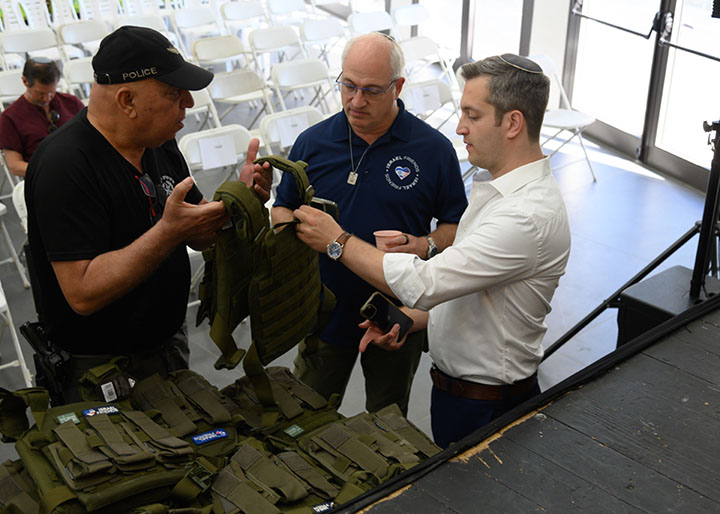
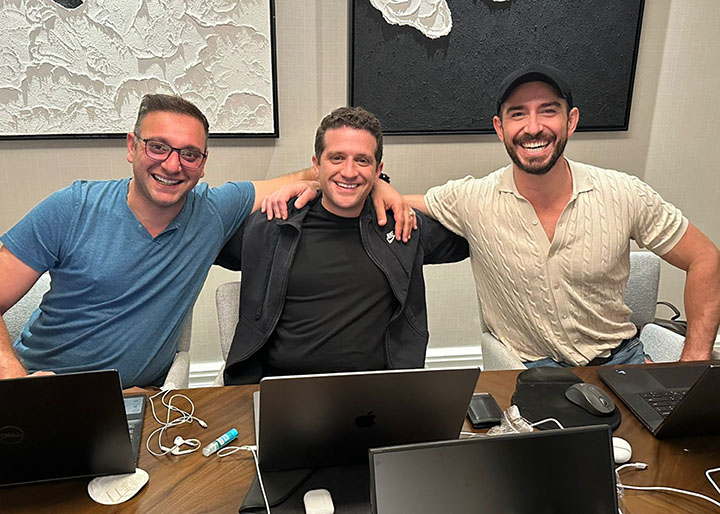
Just days after Hamas invaded Israel, a few friends gathered in a Los Angeles hotel room, joined by others over FaceTime, creating a makeshift “situation room.” Their goal was simple but urgent: get help where it was needed most. With commercial flights to Israel grounded, they refused to sit idle. Instead, they chartered a jet out of LAX to Tel Aviv, packed with hundreds of reservists and tons of critical protective gear bound for the frontlines.
These seasoned entrepreneurs, among them David Malka and Michael Sinensky, had watched in horror as the news unfolded on October 7th, revealing the atrocities of that dark day. They knew immediately that they had no other choice but to take action. They came together to co-found a new nonprofit, simply called “Israel Friends,” with a singular mission: to protect Israel’s soldiers and support its civilians, in whatever way they needed.
“We didn’t know the extent of what was happening yet in those early hours, but it was already clear that Israel’s existence was being threatened in unfathomable ways,” said Malka. “We didn’t set out to build a nonprofit. But in that moment, we knew we had to act, and we believed we could.”
Today, the team is made up of just eleven employees, spread across Israel and the United States, working closely with government agencies, partners and a global network of supporters to maximize every dollar. To date, Israel Friends has delivered $55 million in aid, with 95% of all donations going straight to the front lines.
The founders’ conviction stemmed from their profound love for Israel and pride in being Jewish. They also had experience: during the COVID-19 pandemic, when traditional supply chains were under extraordinary strain, they leveraged their logistics expertise and entrepreneurial grit to deliver over 72 million units of lifesaving supplies and PPE directly to hospitals. Even then, their goal was never profit – it was only to get through the pandemic and help as many people as their skills and resources would allow.
When Ukraine was invaded in 2022, that same instinct for action surfaced again. For Sinensky, the crisis felt especially personal: “As Jews, we know how it feels when one’s home is under attack.”
The team mobilized, channeling their networks and know-how into a new grassroots effort. They had access to critical medical supplies, but no infrastructure, so they built one. They launched a 501c3 called the The Worldwide Friends Foundation – a name inspired by the WhatsApp group where they first began outreach – and flew to Poland themselves to personally oversee the first delivery of one thousand life-saving first aid kits into Ukraine. Days later, videos from the front lines showed those kits in use.
Donations surged, and within months, they had directed over $35 million in aid. In partnership with Airbnb, they even helped refugees evacuate. That project was like “chewing glass,” according to another cofounder, Teddy Raskin. It was that innovation and determination that would soon define their next mission.
So when October 7 happened, there was no hesitation. It was impossible to focus on business as usual in their day-to-day lives when they knew they could make a difference. Once again, they put their lives and businesses on hold, investing their own funds at the start to get equipment to Israel as quickly as possible.
Cargo Plane October 10, 2023
None of them imagined Israel would ever need this kind of urgent, grassroots support. And none of them came from the nonprofit world. But with their collective corporate backgrounds, logistics leadership, military service, and connections and relationships within the Israeli government and military, they understood what was needed to move critical aid under pressure.
“History has made it painfully clear that without Israel, the Jewish people are not safe,” said Kyle Blank, Executive Director of Israel Friends. “And right now, Israeli soldiers are risking everything to defend that truth and protect us all. We felt deep in our bones that it was our turn to stand up for our people, for our heroes on the front lines, for the brothers, sisters and cousins fighting for our collective futures.”
They could have simply donated to existing humanitarian organizations. However, in the early days of the war, as they witnessed soldiers’ needs changing constantly, they quickly realized that many lacked the agility necessary to support them effectively. Israel Friends’ ability to move quickly, remain flexible, and communicate with their colleagues and contacts in Israel allowed them to make a real difference and deliver essential aid in real-time.
“My friend was critically wounded in battle. I grabbed the IFAK Israel Friends gave me — tourniquet, quick clot, everything we needed — and used it right there. It saved his life. Without that kit, he wouldn’t be here today,” said Moti*, an IDF soldier.
In just two years, Israel Friends has achieved what many organizations take decades to build. The organization has delivered more than $55 million and 500 tons of life-saving aid to Israel’s front lines, all while maintaining an overhead of less than 5%. Their impact spans 25,000 cutting-edge 3D-printed pieces of equipment, 15,000 IFAKs, 10,000 technology systems, and 36,000 hours of PTSD care.
Kyle Blank handing protective gear to civilian guards in June 2024
“We were clearing houses on foot when our drone broke. It felt like walking blind into danger. Within days, Israel Friends sent us a new drone. That same day, it exposed terrorists waiting to ambush us. We neutralized them and made it back alive. That drone saved my unit,” said Avi*, a reservist.
Throughout the last two years, Israel Friends has not wavered in its mission of getting the right vital aid to the defenders on the frontlines and caring for Israel’s civilians. Initially, this involved providing critical defense aid and technology to the front lines. Today, Israel Friends is devoting more time, energy and resources to mental health initiatives – an urgent aspect of recovery that is often overlooked.
One of their key partners is Healthy Mind, Israel’s leading telehealth psychiatric platform for PTSD and trauma care. Through this partnership, patients can receive treatment from licensed psychiatrists in just three days, compared to the national average wait of 6 to 9 months.
“With soldiers and civilians facing relentless trauma in the wake of October 7, waiting months for mental health treatment is not an option,” said Adiel Levin, Manager at Healthy Mind. “Getting the care they need gives them hope that there is light at the end of the dark tunnel of PTSD and trauma, and that they can function and live once again.”
For survivors like Tamar, that care has been life-changing.
“After surviving the October 7 attack on my kibbutz in the Gaza Envelope, I felt my life unravel into sleepless nights, anxiety, and despair. Within days of reaching out, I was speaking with a kind and professional psychiatrist who truly listened and gave me hope,” said Tamar*. “That care was more than therapy; it was the first step back to myself.”
They also power Matanya Farm, a nature-based recovery space in Northern Israel for survivors and soldiers. The space, founded by former IDF soldier Sendi Ben-Zaken, offers therapeutic programs with social workers and therapists, land-based activities, and peer support for participants living with PTSD to help them gain both emotional stability and the practical skills needed to reintegrate into society. Recently, Matanya Farms was approved by the Ministry of Defense for treatment, and soldiers will begin to be referred there.
“Since October 7, we’ve been wired with adrenaline, always replaying what we saw. At Matanya Farm, during a yoga workshop, it was the first time I felt grounded. It gave us space to breathe, reconnect, and open up about things we usually keep locked inside. For us, healing is as vital as fighting,” said Soldier J*.
Israel Friends also empowers individuals, families, and communities in Israel and abroad through its affiliate campaigns. These initiatives provide supporters with a meaningful way to raise critical funds for life-saving missions, while Israel Friends manages all logistics and backend support. Each partner can choose to focus on a specific mission or unit, ensuring transparency and a direct connection to their impact.
Building on the momentum of these grassroots efforts, Israel Friends reached another significant milestone in May with its first mission trip to Israel. The organization brought its ambassadors—volunteers who had raised funds through everything from cookie sales to fitness challenges—to the front lines to witness the impact of their donations firsthand. On the ground, they met with partners, security leaders, and defenders. They even donated a drone that, within 36 hours of delivery, helped prevent an ambush for an active unit in Gaza.
“Seeing the look in their eyes as they told us they’d be using that drone in combat that very night… it was maybe the most rewarding experience of my life,” said Lauren Cherkas and Simon Wasserberger, two Israel Friends ambassadors from New York.
In another instance, Israeli forces used advanced drones and underground camera systems supplied by Israel Friends to map Hamas tunnels in real time to rescue a 52-year-old hostage held in southern Gaza, bringing him safely home.
Looking forward, Israel Friends hopes to expand their mental health impact further with initiatives such as building recovery centers, ensuring that anyone in need has access to care.
Situation room hotel in LA on October 9. 2023 (L-R) co-founders Amichai Gabai, Jordan Fried, David Malka
“This work isn’t easy, but it is the most fulfilling thing we have ever been a part of,” said Raskin. “Every day, we are inspired and motivated by our brothers and sisters in Israel and on the front lines. So we will continue to show up day in and day out for them, until the job is done.”
For Malka, Sinensky, Raskin, and the rest of their team, this work is deeply personal. The cofounders hope, of course, that one day Israel will be safe and secure. In the meantime, as the war’s frontlines shift, the mission of Israel Friends endures: to strengthen Israel in body and spirit and to ensure that, with the help of its friends throughout the United States and beyond, it will never stand alone.
*To protect their identity, only first names are used.