fbpx

November 27, 2025

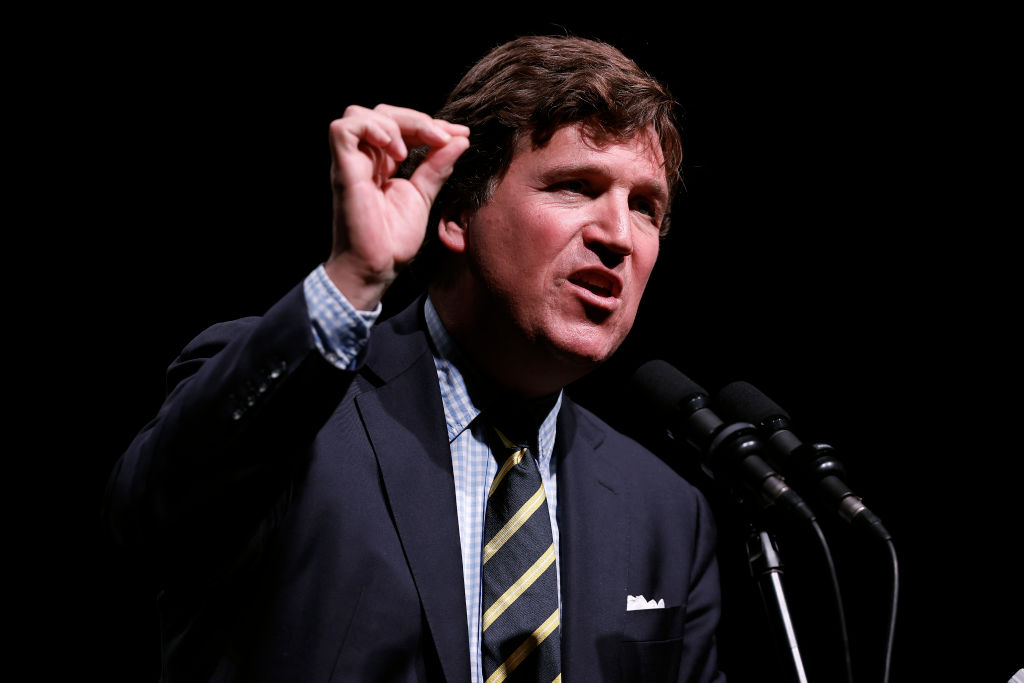
Chip Somodevilla/Getty Images

Tucker Carlson’s New ‘West’: A Civilization with No Room for Mainstream Jews

Tucker Carlson has spent years sanding down the edges of old antisemitic narratives and repackaging them as elevated commentary about “Western civilization.” But last week, on the Shawn Ryan Show, he aggressively abandoned the polish. What emerged was not just his open hostility toward Israel. It was an attempt to evict Jews from the very civilization they helped create.

In an alarming monologue, Carlson declared that “identity politics,” “tribalism,” and “group supremacy” are the enemies of the West — and he then added a new villain (at least for most self-described “conservatives”) to the list:

It’s DEI, it’s tribalism… it’s Zionism. Netanyahu says he defends Western civilization. No. He’s its enemy — literally its main enemy.”

He went further:

Why are the Nazis bad? Because they said we’re fighting these people based on who they are… and Netanyahu believes the same thing.”

This was not analysis.
It was moral derangement — the leader of the world’s only Jewish state cast as indistinguishable from Hitler, and Zionism smeared as the twin of Nazism.

It is the oldest hatred dressed up in pseudo-philosophy.
And Carlson is now its most visible American salesman.

Carlson’s “West”: A Civilization with Judaism Removed

Carlson cloaks his argument in talk about “the individual soul,” claiming Zionism violates Western values by affirming Jewish peoplehood. This may resonate with those unfamiliar with history, but it collapses instantly under scrutiny.

Judaism has always existed as both a faith and a people tethered to the land of Israel. And the West, itself, does not exist without Judaism.

The ideas of a moral universe governed by law, of human dignity rooted in a divine source, of covenant and equality — these are Jewish innovations. Christianity’s intellectual framework is built directly on Jewish scripture and philosophy. The American Founders repeatedly cited Hebrew texts as the basis for natural rights and the inherent worth of the individual.

To claim Zionism — the modern expression of Jewish self-determination — is anti-Western is like claiming the spine is anti-body. It is not merely false. It is an erasure.

And it echoes Charles Lindbergh’s 1941 assertion that Jews “distort American policy” and threaten Western civilization — a narrative Carlson now repeats almost word for word.

Projection Disguised as Principle

Carlson accuses Zionism of “tribalism,” “group supremacy,” and “identity politics.” But these traits define the “woke right” movement he has helped empower.

Nick Fuentes openly advocates stripping Jews of civil rights.
Marjorie Taylor Greene promotes Christian nationalism.
The “National Conservative” sphere defends ethnic hierarchy.
White nationalist rhetoric about Jewish “control” now circulates across the digital landscape Carlson helped cultivate.

These are not champions of universal individualism. Along with the far-left, they are among the most identity-obsessed factions in American politics. Carlson’s charge against Jews is not simply hypocritical — it is psychological projection.

He sees in mainstream Jews what the “woke right” and the far-left are both championing: a politics of grievance, fear, and internal enemies. And, as history shows, it is always the Jews who get cast in the internal enemy role.

Manufactured Disloyalty

A few weeks ago, Carlson railed against Jewish commentators like Ben Shapiro and Mark Levin:

Give us the money for our preferred little country… You’re flirting with real backlash. Like a real one.

“Backlash” is not an observation.
It is a threat.

And it follows the same script used by Lindbergh: Jews are steering America to ruin, and if people turn on them — well, they brought it on themselves.

Now Carlson has escalated from warning of “backlash” to labeling Jews who support Israel — meaning the overwhelming majority — as enemies of the West itself.

This is how demagogues test the boundaries of acceptable discourse.
And then push them.

No, Zionism Is Not Racism

And Carlson’s Chosenness Smear Is Either Ignorant or Malicious

Carlson’s newest accusation is that Zionism is racist and premised on harming people “for the way they were born.” This is wrong on every level.

Zionism is not a racial ideology. It is a national liberation movement — no different from Greek, Irish, or Armenian self-determination. Jewish identity predates European racial categories, and Jews come in every pigmentation known to humankind. Israel’s Jewish population is majority “non-white” by American standards, and Arab Israelis serve across government, the judiciary, the military, and the police.

There is nothing racist about Jewish self-rule — any more than Japanese or Latvian self-rule is racist.

Carlson’s dog whistle about Jewish “chosenness” — paired with his attacks on Christian Zionists — is equally dishonest. Chosenness in Judaism is not a claim of ethnic or racial superiority. It is a burden of obligation: a mandate to follow moral law, not a license to dominate others. And unlike Christianity or Islam, Judaism does not claim that one must join the Jewish people to merit salvation. It is the only Abrahamic faith that does not require membership for a place in heaven — hardly the posture of a people obsessed with supremacy.

What Carlson presents as proof of Jewish exclusivity is actually one of the most inclusive theological frameworks in Western religion.

His smear relies on twisting a complex religious idea into something sinister, recasting Jews — and the Christians who support Israel — as zealots driven by visions of innate superiority. It is a distortion as old as antisemitism itself, repackaged for a new audience.

Why Carlson Needs Jews as the Villain

The far-left claims Israel “controls” America.
The woke-right claims Jews “subvert” America.

This is the political horseshoe closed into a circle: the oldest hatred meeting itself on the other side.

And Carlson is working to become its most effective megaphone.

He needs a villain that unites both fringes.
He needs a target requiring no evidence.
He needs a narrative that flatters resentment.

And history has shown which group fills that role.
It is always the same group — the one that rhymes with “news.”

The Real Threat to the West

Carlson insists the West is built on the dignity of the individual — and that Zionism contradicts it. But what he promotes violates Western values far more clearly:

  • Declaring a minority’s political participation illegitimate.
  • Warning Jews of “backlash” if they do not alter their politics.
  • Comparing Jewish self-defense to Nazism.
  • Erasing Judaism’s foundational role in Western civilization.
  • Suggesting Jews who support a democratic ally are disloyal.
  • Dressing conspiracy rhetoric in philosophical language.

This is not Western civilization.
It is its dark mirror.

Carlson wants Americans to mistake that mirror for the real thing.

The Real Threat to the West

At a time when truly anti-Western forces — Iran’s theocrats, their fascist militias, and the campus radicals cheering them on — proudly chant for America’s decline, Tucker Carlson has chosen to target the people who helped articulate the ideals the West is built on.

Not the ones burning American flags.
The ones who helped write the ideas those flags represent.

Carlson is not defending Western civilization.
He is trying to redefine it into something smaller, harsher, and hostile to the very people who shaped it.

Because the West he claims to champion was built on Jewish ideas, Jewish texts, and Jewish moral philosophy.

If he wants a civilization without Jews, he is not defending the West — he is abandoning it.

Tucker Carlson’s New ‘West’: A Civilization with No Room for Mainstream Jews Read More »
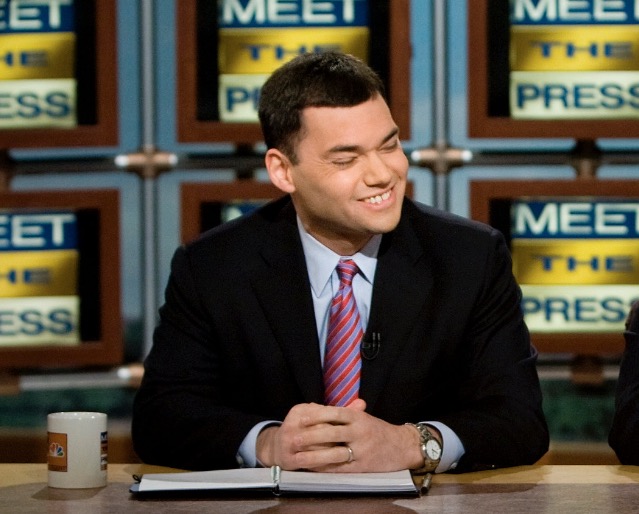
Brendan Smialowski/Getty Images for Meet the Press

Peter Beinart’s Embrace of Jewish Powerlessness and anti-Zionism

Peter Beinart has emerged as a major leader of the cult of ostensibly Jewish critics of Israel and Zionism. Or professional apologist might be a better description, after he spoke recently at Tel Aviv University (“to speak to Israelis about Israel’s crimes”) and was condemned by the chorus of socialmedia influencers for violating the holy boycott Israel movement. Beinart responded “I made a serious mistake. In the past, when formulating my views about Israel-Palestine, I’ve sought out Palestinian friends and interlocutors and listened carefully to their views. In this case, I did not.”

In contrast to his loyal followers in groups calling themselves “Jewish Voice for Peace” and “IfNotNow” Beinart has more than a trivial familiarity with Jewish tradition and texts, which he displays in presenting his views.

For example, In his mini anti-Zionist polemic, Being Jewish after the destruction of Gaza: A reckoning, Beinart selectively deploys Jewish texts and tradition in making his case. Chapter titles like “They Tried to Kill Us, We Survived, Let’s Eat” and “Korach’s Children” reflect a deep cynicism and snark. He spins the end of Book of Esther, when the Jews, led by Mordechai, attack and slaughter their opponents, or, in Beinart’s version: “with the blood of their enemies barely dry, the Jews feast and make merry.” In a side comment, he asserts “That’s the origin of Purim” – as opposed to the usual rabbinical interpretation emphasizing Jewish survival in the face of a genocidal enemy. This leads directly to the blood libel that belittles the October 7 Hamas atrocities in order to condemn the IDF response.

Similarly, he claims the mantles of earlier Jewish dissidents, including Korach, who led a rebellion against Moses under the banner of democracy; and of the mishnaic sage Elisha Ben Abuya, who was ostracized for, in Beinart’s version, disobeying rabbinical limits on the distance one is allowed to travel on Shabbat – “just as I have crossed boundaries…” A more accurate comparison is with Howard Jacobson’s “ASHamed Jews” in The Finkler Question, or the Yevsektsiya the Jewish Bolsheviks used to liquidate Jewish existence, and were later liquidated themselves.

Beinart’s claim to fame (and well compensated employment, including via the foundation that supports Jewish Currents) is based on his “as a Jew” dismissal of Zionism, which he presents as “the very idea of a state that favors Jews over Palestinians.” Instead, he embraces Palestinian victimhood, which, in his invented history, results from a “single-minded focus on Israeli security,” which is “immoral and self-defeating.” Like some other Jews from South Africa and Israeli diplomats who have served there and are critics of Israeli policy, Beinart equates the Jewish state to the apartheid regime and turns Zionists into Jewish supremacists – a mockery that appears, in different forms, more than 30 times. As the apartheid regime was brought down and replaced, Beinart proclaims: “We [by which he means the Jewish people] need a new story – based on equality rather than supremacy.”

On the other side of the coin, Beinart describes terrorism, including the October 7 atrocities, as an inherently morally justified response. He also adopts the vocabulary of terror organizations and propaganda groups with terms like “armed resistance,” arguing that Palestinian Arab dispossession (ie Zionism) including “56 years of suffocating occupation” after the 1967 war, and “violent resistance are intertwined.” The life stories recited by Palestinian terrorists and Hamas propagandists are presented as evidence that they had no alternative.

In his imagined version of the Oslo disaster, Arafat and the PLO “renounced armed resistance,” including trading the goal of replacing Israel “from the Jordan river to the Mediterranean sea,” for creating a Palestinian Arab state next to Israel. This is complete fiction, as reflected in Arafat’s repeated bombastic declarations of imminent victory over the Jews, and the detailed planning of the suicide mass bombings known as the Second Intifada. Beinart also repeats the myth that the bombings were spontaneous violence triggered by Prime Minister Sharon’s visit to Jerusalem’s Temple Mount in September 2000.

Similarly, Beinart erases the Arab rejection of the 1947 UN Partition plan and the war to “push the Jews into the sea” and 78 years of incitement and rejectionism. He makes no mention of the 1975 UN General Assembly resolution labeling Zionism and racism or the infamous and antisemitic 2001 UN Durban conference where his NGO allies launched the BDS movement through the labels of apartheid, genocide and war crimes.

In considering the deficiencies in Beinart’s argument, the critique by Professor Ruth Wisse is essential — particularly her book on Jews and Power (2007), on the contradictions between moral leadership in an ideal world and the reality of Jewish powerlessness in 2000 years of exile. With no means to defend themselves, some Jews made a virtue of an imaginary secular universalist messianism based on the mirage of universal justice.

Beinart ends his “reckoning” by telling Jews to liberate ourselves “from supremacy so, as partners with the Palestinians, we can help liberate the world.” The fact that the Palestinian Arabs and their antisemitic cheering section have no interest in a partnership with the Jews, or in Beinart’s twisted apologetica, is irrelevant.

Peter Beinart’s Embrace of Jewish Powerlessness and anti-Zionism Read More »

Grateful for the Stories We Create

My sister met her future husband when he rang the wrong doorbell to our Montreal duplex some fifty years ago– and she answered. Eventually, they fell in love, got married, he got transferred to California and I followed them.

Had he not rung the wrong doorbell, I most likely would never have moved to Los Angeles.

Why do I share that story?

Because I’ve learned over the years that every family has its own memorable stories. We usually know the big ones, like those connected to dark moments like the Holocaust.

I’m referring to quirky stories that tend to get lost in the passage of time. Those stories only come out when we do a little digging, and Thanksgiving is an ideal time to do that digging.

As an added bonus, it turns out that seeking out family stories tends to create happier families.

“The single most important thing you can do for your family may be the simplest of all: develop a strong family narrative,” author Bruce Feiler wrote in 2013.

Feiler did years of research on the subject, talking to families and experts in the field. He reports on a study that used a measure called the “Do You Know?” scale that asked children to answer 20 questions.

Examples included: Do you know where your grandparents grew up? Do you know where your mom and dad went to high school? Do you know where your parents met? Do you know an illness or something really terrible that happened in your family? Do you know the story of your birth?

The study concluded that “The more children knew about their family’s history, the stronger their sense of control over their lives, the higher their self-esteem and the more successfully they believed their families functioned.”

What gets in the way of digging up those family stories?

For starters, they have to compete with a whole other category of stories—those that assault us every hour on social media and news sites. Those stories appeal to our “need to know what’s going on” and our fascination with bad news in general. They tend to dominate our conversations, and that includes our Thanksgiving and Shabbat conversations.

But here’s the thing about those stories– they require little effort on our part, except perhaps the outrage we often express when we read them. We just regurgitate what the profit-driven media algorithms are feeding us.

Family stories are different. They belong to us, the good and the bad. We gather them. We create them. We pass them down. They require intention and effort.

We can gather those stories at any time, not just at Thanksgiving. Even if we think we already know plenty of them, it’s fascinating to imagine that there may be other great family stories out there just waiting to be plucked.

Like that story many years ago of the man who rang the wrong doorbell and changed my life.

Happy storytelling.

Grateful for the Stories We Create Read More »

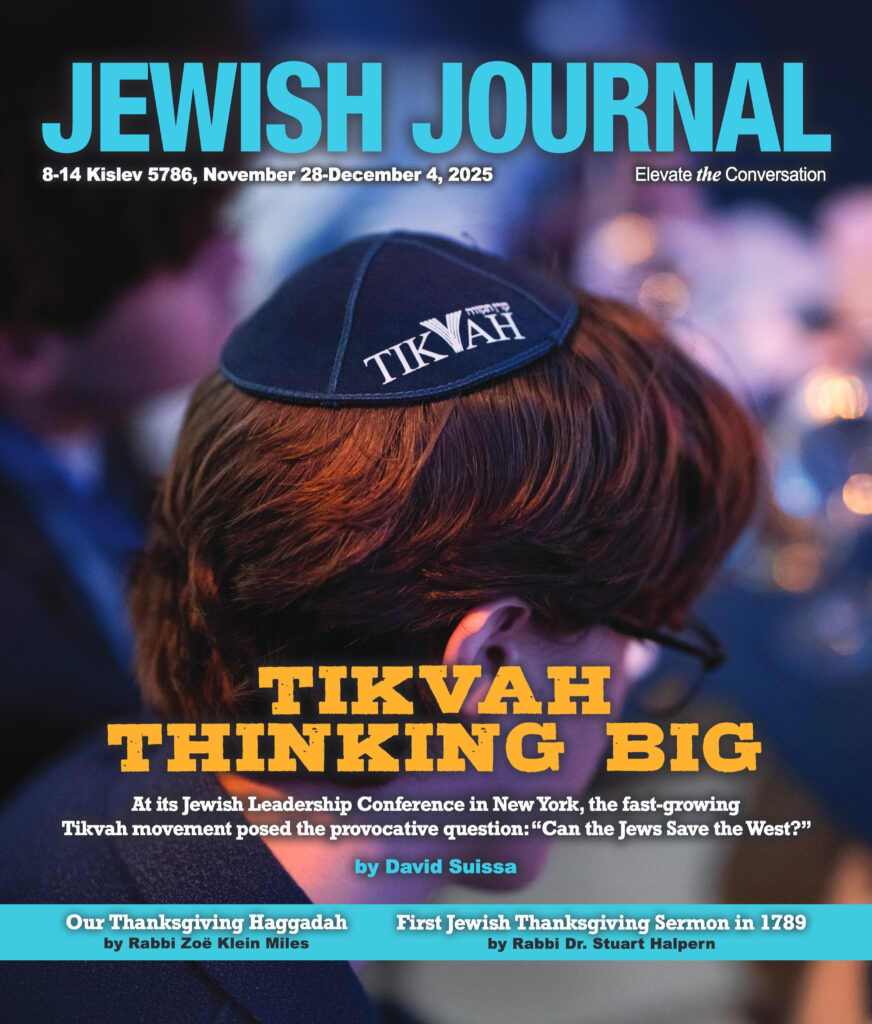
Print Issue: Tikvah Thinking Big | November 28, 2025

CLICK HERE FOR FULLSCREEN VERSION

Print Issue: Tikvah Thinking Big | November 28, 2025 Read More »

Sheep for sale.

Comings and Goings – A poem for Parsha Vayetzei

Vayetzei — And he went out (Genesis 28:10–32:3)

And he went out from his home
with his stolen birthright and blessing

And I went out from the East Coast
with golf pants and no particular direction.

And he went out from an angry brother
and was saved by divine intervention.

And I never wanted to go, but
tweens have no choice in the matter.

And he went out to the wilderness
and slept on a stone and saw angels.

And I find camping insulting, and if there aren’t
at least three pillows, it’s a disaster.

And he suffered his own deception and married
the wrong sister at the price of seven years.

And I married the right one, and it
wasn’t even a decision.

And he went out with two wives and two handmaids
and that led to a baker’s dozen of children.

And I just had the one, and he operates
the motor vehicle now.

And he had to go out again because
his uncle had run out of daughters.

And I settled in for this sheepless life
for this cushy mountainside joie de vivre.

And had he not gone out, none of this would
be written…we might be roadside sheep salespeople.

And he did go out, so here I am interpreting this
wondering if I’ve already met the angels.


Rick Lupert, a poet, songleader and graphic designer, is the author of 29 books including “God Wrestler: A Poem for Every Torah Portion.” Visit him at www.JewishPoetry.net

Comings and Goings – A poem for Parsha Vayetzei Read More »