fbpx

November 13, 2025

Rabbis of LA | Rabbi Bernstein and Kehillat Israel Adjusting to Life After the Palisades Fire

Ten months after the Palisades Fires destroyed the homes of many of the 934 families who comprise the 75-year-old community Kehillat Israel, in the heart of the Palisades, many remain dazed. 

Senior Rabbi Amy Bernstein sought to explain where the close community is 300 days into the disaster.  “It starts to feel normal-ish,” she said, drawing out each syllable. “That is kind of frightening. But we human beings are adaptable, so it feels normal.”

One-third of the congregation lost their homes, including the rabbi. Going to regularly scheduled meetings used to be easy – same place and time each week. No more. “It feels very hard to keep up with where you are supposed to be, at what time and the location,” Rabbi Bernstein said. “And, how long is it going to take me to get there?”

She met with The Journal in Kehillat Israel’s temporary offices, in a building that is close to the border between Westwood and Santa Monica.

“The most difficult part of this transition period,” the rabbi said, “is that we have to meet in so many different locations for many different activities. We don’t have our kids here. Our littlest ones are at Beth Shir Shalom in Santa Monica, and they have been incredibly gracious and generous. Shabbat services are at the Cayton Children’s Museum at The Promenade, and (numerous) offices are here.”

There’s more: “Our Religious School is at an LAUSD school that doesn’t use it on Sundays. We also have bar and bat mitzvah services. They happen wherever the families want them to happen. Either the venue is where the party will be – sometimes we use [the chapel at]Wilshire Boulevard Temple. We also use Sinai Temple’s chapel. And Beth Shir Shalom when we can.”

Her calendar has been Rabbi Bernstein’s most important possession since last January. “We are everywhere all the time,” she said. “And of course our people are dispersed. We often have to drive to see a bunch of folks who are living in the Valley, or in the South.”

The Kehillat Israel community’s response has been “really incredible,” said the rabbi. “It was massively important to be together at the High Holy Days. I think we all knew it, but you couldn’t anticipate the incredible power of all of us being together. Usually, we have services both at the synagogue and offsite for the Holy Days.” 

 In a normal year on the High Holy Days, Rabbi Bernstein explained, “we usually split.” About 500 members daven at K.I. and the balance in Barnum Hall on the Santa Monica High School campus. “But this year, since the synagogue was not open, we were all at Barnum. It was really lovely to have everyone together at Barnum.”

Personally, the rabbi said it took her “probably six months to really feel like I could put one foot in front of the other without really thinking hard about it.”

For her and the Kehillat Israel community, the seasons of this year have been like no other. Rabbi Bernstein’s home burned to the ground. And “personally,” the rabbi admitted, “I am a homebody.” The most difficult aspect of transitioning – doing everything every day in a new setting —“was not having a home, not having my kitchen, not being able to putter around in it with my plants. Sometimes you don’t understand how important some things are for your own nervous system to calm down.”

Normalcy remains months away. The latest plan is for the K.I. sanctuary to be restored by March, and the rabbi hopes to return to K.I.’s offices in May.

Will people be wary about stepping inside the rebuild? “I think some will be wary,” said the rabbi. “Others will trust that we have done remediation, and they will be okay with it. Some people have expressed they are not ready to go back to see the rest of the [destroyed] Palisades. They are struggling with that. But it’s not coming back to our building. It’s about driving through the Palisades.” The rabbi advises “they should do whatever they feel they need to do. When they are ready, we will be there.”

Part of the problem, said the rabbi, “is that we were centrally located for people. Now we are in four or five different places. For some people we are closer, for others farther away. They can’t keep up with where we are doing stuff.”

The synagogue rebuild is on schedule, but for community members the calendar is sharply different. “People are struggling with how long it is taking to figure out their own living situations,” the rabbi noted. “Some have moved seven times, from hotel to Airbnb to another hotel. It’s been really challenging for people.”

She does not intend to buy a new home. “My situation is like that of many who were in condominiums,” said Rabbi Bernstein. “I was in a townhouse, and the insurance goes through the homeowners’ association. The HOA decides whether to rebuild – if it’s a rebuild, you don’t get insurance money for the structure. If the HOA decides not to rebuild, then you get insurance money and sale of the property. Right now I am living with very generous congregants.”

Fast Takes with Rabbi Bernstein

Jewish Journal: Has this changed your living or eating habits?

Rabbi Bernstein: Yes. At first, I wasn’t eating. It wasn’t my kitchen. I wasn’t grocery-shopping the same way. I didn’t know where anything was. So I wasn’t looking forward to cooking. That was one of the ways I used to relax. I loved puttering around in the kitchen. I didn’t eat for a while. Having your routines completely disrupted was difficult.

J.J.: Have you returned to those earlier habits?

RB: Partway. I have returned to pickleball, which was a very important part of my life in the Highlands. Yoga, too. K.I. has been doing yoga as a staff for 10 years with the same instructor twice a week. We are part way back, once a week in the park.

J.J.: What about inveterate habits?

RB: Pickleball is the big one. I was playing three times a week.

Rabbis of LA | Rabbi Bernstein and Kehillat Israel Adjusting to Life After the Palisades Fire Read More »

If You Heard What I Heard ‘Night of Resilience’ Gala, Idan Raichel Performs at VBS

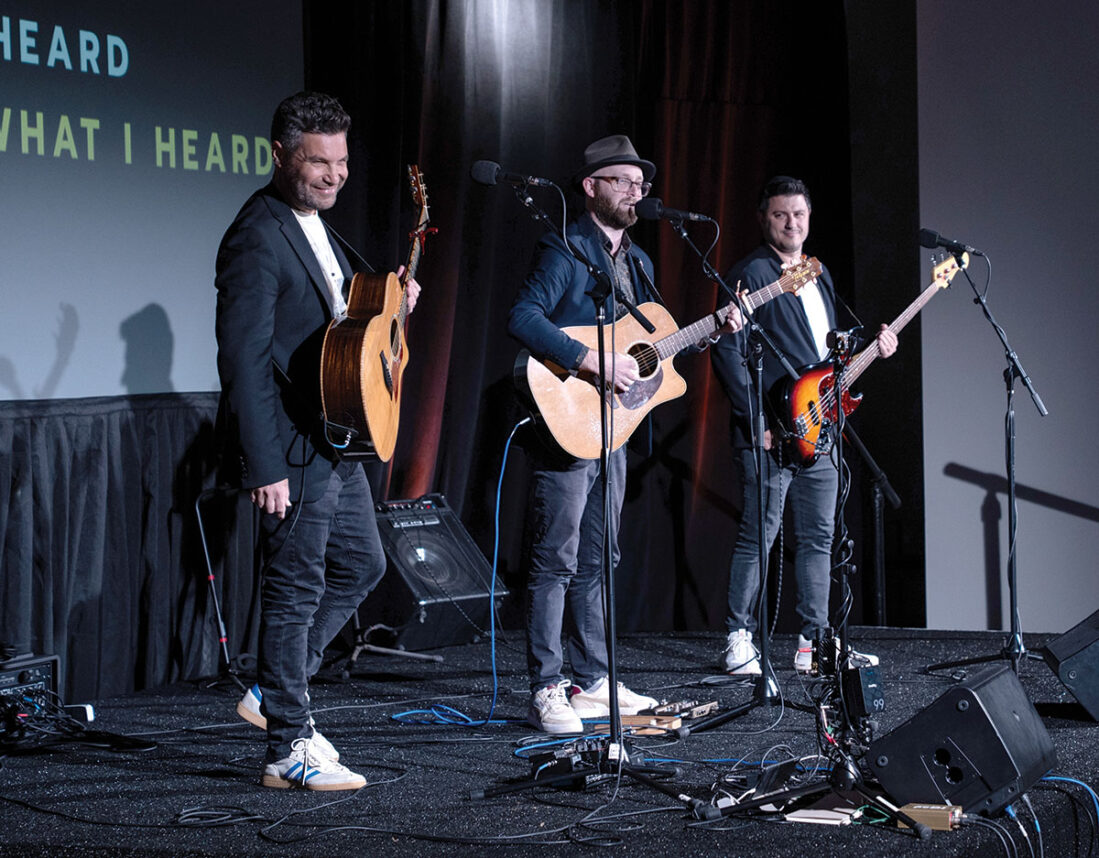
The If You Heard What I Heard (IYH) “Night of Resilience” gala, a glitzy affair drawing adults of all ages committed to the work of remembrance, was held Nov. 2 at Peterson Automotive Museum.

The evening honored IYH Board Member Aaron Aftergood for his leadership and commitment to the organization’s mission while recognizing Holocaust survivor Andrew Stern—“whose courage reminds us why our work matters so profoundly,” the group’s founder and executive director, Carolyn Siegel, said.

Temple Beth Am Senior Rabbi Adam Kligfeld presented the award to Aftergood.

Actor Mark Feuerstein (“Guns and Moses”) emceed the event, billed as a night of comedy, live music and unity that featured comedians Dan Levy and Moshe Kasher, magician Justin Willman and Jewish folk-pop band Distant Cousins, which filled the room with Jewish joy through their music. Levy had the audience in stitches as he riffed on his overbearing Jewish mother, and Willman wowed the crowd with mentalist-like shtick that left everyone scratching their heads and pondering just how he did it.

Folk-pop band Distant Cousins performs at If You Heard What I Heard’s “Night of Resilience.” Photo by Zusha Goldin

The event kicked off with attendees gathering in the museum for appetizers and cocktails, including grilled cheese sandwiches prepared by chef Eric Greenspan. Also preparing food for the evening was Chef Yoav Schverd. Then, everyone found their seats for the evening’s main program, which highlighted the important work IYH has been doing. Stern, who was born in a basement in a Jewish ghetto in Budapest in 1944, appeared onstage with his granddaughter. He was presented with a certificate that had been signed by State Assemblyman Jesse Gabriel.

Founded by Siegel in April 2021 in response to an antisemitic incident targeting a Los Angeles synagogue, IYH gathers recorded testimonies from grandchildren of Holocaust survivors—the last generation to hear survivors’ histories firsthand. To date, the organization has recorded nearly 70 interviews, which are available on the group’s website.

IYH also offers a summer education series, which brings its interviewees—grandchildren of survivors—to summer camps throughout California to share their stories. Additionally, the organization brings young adults together for events intended to foster community, including a recent havdalah in West Hollywood that featured schmoozing, cocktails and a plated dinner.

At a time when studies show knowledge gaps about the Shoah, the organization is having a lasting impact on Holocaust education.


Israeli musician Idan Raichel performs at Valley Beth Shalom as part of the synagogue’s 2025-2026 annual concert series. Raichel’s performance kicked off the series, which continues through the summer of 2026. Photo by Cinthya Silverstein

 On Nov. 5, Encino-based Valley Beth Shalom (VBS) hosted renowned Israeli singer Idan Raichel as part of its concert series, produced by VBS Cantor Jacqueline Rafii.

Raichel performed many of his well-known songs, accompanying himself on piano and guitar. The VBS Youth Choir joined him for a moving rendition of “Bo’i” (“Come with Me”) and Cantor Rafii shared the stage with him for the heartfelt “Im Telech” (If You Go”).

The concert series has proven to be a great success, drawing not only VBS members but also music lovers from across the community. The synagogue’s next concert, “Africa to Israel: Our Bridge to Zion,” takes place on Feb. 1, at 7 p.m., featuring artist JoDavi and Pastor Dumisani Washington, founder of the Institute for Black Solidarity with Israel, appearing alongside VBS Senior Rabbi Nolan Lebovitz, Cantor Rafii, and guest musicians.

By Ayala Or-El, Contributing Writer

If You Heard What I Heard ‘Night of Resilience’ Gala, Idan Raichel Performs at VBS Read More »

First Mother – A poem for Parsha Chayei Sara

Chayei Sarah — The Life of Sarah (Genesis 23:1–25:18)

When the main character dies
in the second sentence, you hope,
at least, for a feature-length flashback
showing how we got here.

This is not what we get. Instead
life goes on. A cave is purchased
for her rest. The children marry.
There is much begetting.

I’d give you the details but
this homework is your obligation.
At the risk of a major spoiler I’ll tell you this –
her husband doesn’t make it.

But we still say their names.
Sarah, Abraham – thousands of years
after their final rest, every week
or every day depending on

how you were raised or what
tradition you found. Our lives are
the things we do, but our legacy
is what happens after we’re gone.

We are the promise made to her.
We are the stars in the sky.
We carry her name in every breath.
We are the life of Sarah.


Rick Lupert, a poet, songleader and graphic designer, is the author of 29 books including “God Wrestler: A Poem for Every Torah Portion.” Visit him at www.JewishPoetry.net

First Mother – A poem for Parsha Chayei Sara Read More »

Print Issue: Anti-Zionism: The Hate We Missed | November 14, 2025

CLICK HERE FOR FULLSCREEN VERSION

Print Issue: Anti-Zionism: The Hate We Missed | November 14, 2025 Read More »

A Moment in Time: When Things Get too Hot

Dear all,

Earlier this week, my phone overheated.

A message appeared on the screen: “iPhone needs to cool down before you can use it.”

So I waited.

Ten minutes later, it worked again.

It struck me that sometimes our conversations are like that phone—too hot to handle. When emotions flare, communication shuts down.

It happens in our relationships.

It happens in our workplaces.

And it happens far too easily in social media.

The Psalmist wrote regarding God, “Do not reprove us in Your anger” (Psalm 6:1). My Bible professor paraphrased it this way: “Don’t go shopping when you’re hungry.”

In other words, when our actions come from heat instead of thought, we risk saying—or buying—the wrong thing.

Of course, there are times when we must speak up—when silence itself causes harm. But even then, it helps to pause, to breathe, to count to ten – to take a moment in time –  before we do.

Maybe we all need a built-in warning light, reminding us: “Cool down before you speak.”

With love and shalom,

Rabbi Zachary R. Shapiro

A Moment in Time: When Things Get too Hot Read More »