fbpx

October 16, 2025

An Exploration of German Exiles in Hollywood in ‘Weimar Under the Palms’

A story is told about a day when motion picture director Otto Preminger, who sought a safe haven from the Nazis and achieved fame and fortune in the American movie industry, overheard a conversation that was conducted in Hungarian.

“Don’t you guys know you’re in Hollywood?” he quipped. “Speak German.”

The point is made in “Weimar Under the Palms: Pacific Palisades, German Exiles, and the Invention of Hollywood” by Thomas Blubacher (Brandeis University Press), translated from German by Elisabeth Lauffer, a lively and deeply informed account of the era when Los Angeles served as a place of refuge for German, Austrian and Eastern European artists, writers, scholars and intellectuals who fled from the Third Reich. 

For the Jews among them, of course, California was not merely a place to live and work but literally a matter of life and death. As Blubacher explains in fascinating detail, the immigrants richly repaid the debt by their enduring contribution to the arts and letters of America and, in particular, the motion picture industry.

Then as now, entering the United States from a foreign country was not easy. A fortunate refugee might be successful in securing the signature of a patron on an affidavit in support of a visa application.  MGM’s Louis B. Mayer and Harry Warner, one of the four Warner brothers, did so for film composer Hans Sommer, who was barred from working in the German movie industry after he refused to divorce his Jewish wife and abandon their “mischling” children. They arrived on a tourist visa, and when it expired, they were forced to flee to Nogales, Mexico, where “Hans gigged in bars to pay the bills.” Even when the Sommer family was finally allowed to take up residence in America, they were categorized as “enemy aliens,” which meant an 8:00 p.m. curfew and a restriction to a five-mile radius around their home in Hollywood.

Perhaps the most distinguished refugee was the novelist Thomas Mann, the 1929 Nobel Prize laureate in literature, whose residence on San Remo Drive in Brentwood was later described as “not only a family home, a place of thinking and writing,” but also “the Oval Office of the émigré opposition to Hitler’s reign of terror in Berlin.” Significantly, the words were uttered by the president of Germany, Frank-Walter Steinmeier, at the dedication ceremony when the house was opened as a memorial and a study center in 2019. 

Thus did Southern California come to called “Weimar on the Pacific.” For example, the political philosopher Herbert Marcuse, who was much later hailed as the “Father of the New Left,” had been fired from the Institute of Social Research at the University of Frankfurt under the Nazi order that banned Jews from teaching positions. On the wall of his home in Santa Monica, Marcuse posted a sign that acknowledged the continuity between the Weimar democracy that Hitler destroyed and the Weimar-in-exile that survived: “Institute of Social Research, Los Angeles Office.”

The expatriate community was centered in the Pacific Palisades but its members were not confined to its hills and arroyos, as we see for ourselves in an eye-catching locator map that appears in the endpapers of the book. Bertolt Brecht lived on 26th Street near Douglas Park in Santa Monica, Paul Henreid on the edge of Santa Ynez Canyon Park, Fritz Lang within sight of the Riviera Country Club in Brentwood, Peter Lorre in Mandeville Canyon, and Salka and Berthold Viertel at the bottom of Rustic Canyon. 

The cultural and intellectual center of gravity in the exile community in Southern California, however, was 520 Paseo Miramar in the Palisades, the home of novelist and dramatist Lion Feuchtwanger and his spouse, Marta.  On any given evening, their guests might include Thomas Mann himself or his brother, Heinrich, Brecht or Kurt Weill, Peter Lorre or Ingrid Bergman, Albert Einstein or Arnold Schoenberg, Franz Werfel and Alma Mahler-Werfel. Along with many of the original furnishings and 22,000 volumes from the Feuchtwangers’ personal library – another 8,000 were later donated to USC –  a scrap of paper bearing a poem in Lion’s own hand is still on display: “I am a German writer/The beat of my heart is Jewish/My thinking belongs to the world.”

Since 1995, the Feuchtwanger home, now known as Villa Aurora, has served as the site of the artist-in-residence program in which Blubacher, an accomplished author and theater director, was himself a participant. Happily, Villa Aurora, the Thomas Mann Home and many other sites that feature prominently in “Weimar Under the Palms” survived the recent Pacific Palisades firestorms. “Miraculously, the buildings were spared the Armageddon’s wrath,” he reminds us. “At a time when the values these places represent come under threat on both sides of the Atlantic, their continued existence is more important than ever.”

Far beyond the Feuchtwanger home, the refugees from Nazism played a decisive role in redefining – and elevating – the cultural enterprise in Southern California. A cutting-edge director like Fritz Lang, who directed “M” and “Metropolis” while still in Germany, was reduced to working on genre movies in Hollywood, but he succeeded in creating such film noir classics as “Scarlet Street” and “The Big Heat” while working within the studio system. And when Brecht’s play “Galileo” premiered at the Coronet Theatre on La Cienega Boulevard in 1947, the producer was John Houseman (ne Jacques Haussmann, the son of an Alsatian Jew), the director was Joseph Losey, Charles Laughton played the title role and the audience included Ingrid Berman, Charlie Chaplin, Gene Kelly, Billy Wilder, Frank Lloyd Wright and Igor Stravinsky.

“It must have rankled Brecht,” Blubacher points out, “that when the gossip columnist Hedda Hopper wrote about the production in the Los Angeles Times, she never once mentioned the author’s name.” 

Both the timeliness and the enduring significance of “Weimar Under the Palms” arise from the fact that democracy is always at risk from persecutors and oppressors, both actual and potential. The first artist to be granted a residency at Villa Aurora, dramatist and director Heiner Müller, according to Blubacher, “employed a bit of adhesive tape to change the ‘EXIT’ sign to read ‘EXIL,’” the German word for “exile.” So it is that exile, as Blubacher puts it, can sometimes serve as “an emergency exit” in perilous times. 


Jonathan Kirsch, author and publishing attorney, is a book reviewer for the Jewish Journal.

An Exploration of German Exiles in Hollywood in ‘Weimar Under the Palms’ Read More »
The Jewish Couple Who Met and Married in a Nazi Concentration Camp

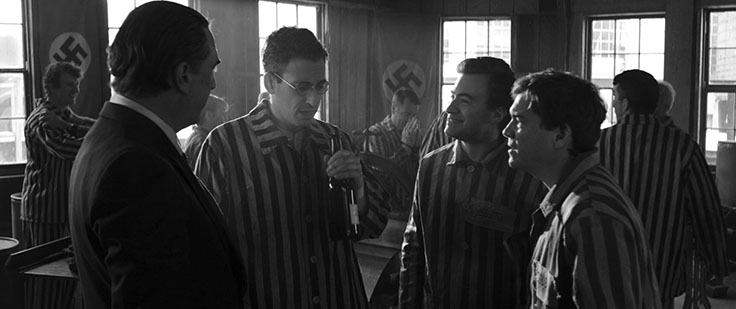
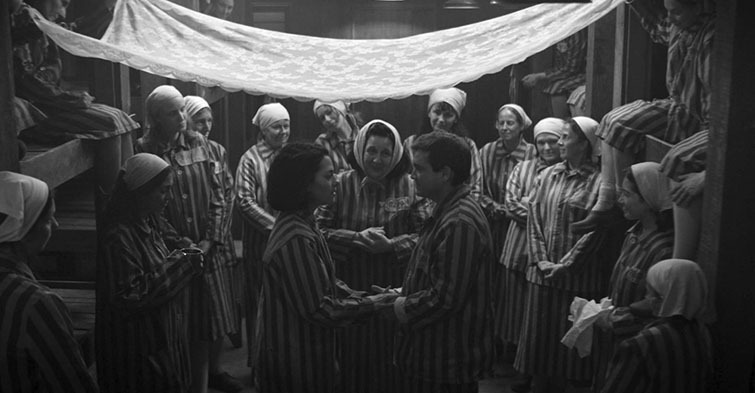
Remember the wedding scene in “Schindler’s List” where a couple secretly marries inside a concentration camp barracks? “Bau: Artist at War” tells the full story of that real-life couple — Joseph and Rebecca Bau. The movie has the virtues of “Life is Beautiful” and the intensity of “Schindler’s List,” and stands on its own as an engaging Holocaust drama. Go see it. 

Joseph, played by actor Emile Hirsch, was a talented artist and a mischievous jokester. While in the Kraków-Płaszów concentration camp, his skills with a pen made him useful in mapmaking and making propaganda posters and signs. Kommandant Amon Göth (Josh Blacker) takes a liking to Bau but is just as heinous as SS officer Franz Gruen (played by Yan Tual). Actress Inbar Lavi plays Rebecca, who walks on eggshells in every scene she’s in with Göth and Gruen. 

After the war, Bau became known as “the Walt Disney of Israel,” producing satirical paintings and animated shorts. He was later the chief artist for the Mossad — he even worked on the fake passport used in the extradition of Adolf Eichmann from Argentina to Israel in 1960. 

Bau’s daughters, sisters Clila and Hadasa Bau, traveled from Israel to Los Angeles for the premiere. They both said that their parents never wanted to be remembered as heroes who saved Jews, but as people who taught others “to laugh, to be happy, and to laugh.”

Hadasa told The Journal that their father taught her to write music, and he took them to the theater, the museum, the cinema. “That’s what we are doing now, telling our parents’ story, with jokes and with music.”

For the sisters, the film fulfills a wish they have long carried. “Our parents were there. They witnessed and experienced what happened,” Hadasa said. “People say Joseph Bau was James Bond, not in the movie — in life. He was very secretive, not allowed to be famous. Now is the time that everyone will know who is Joseph and Rebecca Bau”

The film had been in progress for years. The production was originally set to film in Kraków, Poland, but shut down when the COVID-19 pandemic began in 2020. Production was delayed for two years. 

Director Sean McNamara said he initially saw the movie as a story about events that happened decades earlier, but its meaning changed after the attacks of Oct. 7, 2023. “When I made the movie, I made the assumption that I was making a tale of something that happened 70 years ago, I had no idea how the world would change on Oct. 7. That was a shock,” McNamara said at the Jewish American Summit in September. “A big enough shock as it is. But then what’s happened since Oct. 7 and what’s going on in the world today, it is unfathomable to me. These films need to be seen now.” 

Hirsch said he was moved by Joseph’s optimism, explaining that it’s easy in difficult times to be consumed by hopelessness and despair. Portraying a character who doesn’t give in to that mindset, Hirsch said, was “inspiring and enjoyable.” 

He said that Robin Williams was an influence on his performance. “I love Robin in general. You can’t imitate Robin Willams, it would never work, but there’s something to that sense of humor in that playfulness that he had that I, in playing Joseph, was trying to not only find with the writers and the director.” 

Oskar Schindler (Edward Foy), Yitzhak Stern (Adam Tsekhman) and Joseph Bau (Emile Hirsch)
Provided with permission

Adam Tsekhman, who plays Itzhak Stern, said conveying the moral tension behind “the list” was daunting. “One thing I did learn … is that [Stern] was a man that you could really rely on someone with a very strong moral compass,” he told The Journal. “Someone who always kind of did the right thing, but it’s hard to do the right thing. So many of these situations happened during the Holocaust. It’s like the trolley problem where you pick this and five people die, or you pick this and one person dies. What do you do? And to imagine the weight on someone’s shoulders to determine do these people die? And especially because he’s the one compiling the list. And there is a powerful moment in the movie where Rebecca Bau begs Stern to switch her name with Joseph.” Rebecca didn’t even tell Joseph what she did until they were doing press for “Schindler’s List” — almost 50 years later.

Singer-songwriter Ryn Kidd, who co-wrote “However Long Forever Is,” which is heard during “Bau’s” epilogue, said the melody came to her effortlessly after seeing the engagement scene. “Joseph says, ‘However long forever is, share it with me,’” Kidd told The Journal. She co-wrote the track with her frequent collaborator Andrew Burr, along with the score’s composer, John Coda. “That line encapsulates their experience.”

The Jewish Couple Who Met and Married in a Nazi Concentration Camp Read More »

Ten Secrets to Academic Success | Celebrate Old-Fashioned, Academic Liberalism

Others in the series:

#1: Remember Why You’re Going to College

#2: Give Yourself the College Orientation You Deserve

#3: Great Debates About Great Books Yield Deep Knowledge, Sharp Minds and Constructive Citizens

#4 Make for Yourself a Teacher – Acquire a Friend

#5 Turn It Off! Managing Social Media, Middle East Minefields, and Political Difference

#6 Fighting Educational Malpractice Personally: What Do I Do with a Politicized Prof – or Teacher

#7 Fighting Educational Malpractice Institutionally: A Consumer Rights Issue

#8 Distinguishing Fair Criticism of Israel from Anti-Zionist Antisemitism


The bile’s been building for decades. Many Americans have lost faith in America. With so many stuck in the depths of despair, deaths of despair from suicide, drug abuse and alcoholism are soaring — especially among students. I can’t recognize this political world where progressives don’t believe in progress and conservatives don’t conserve institutions. I can’t recognize an America where people treat politics as religion pitting “good” against “evil,” religion feels increasingly politicized, historians keep bashing America, not explaining its successes and hope is a stranger.

 In the academic world I once worshiped, the crisis feels particularly acute. After Oct. 7, when protesters assaulted Jewish students; when college presidents, who imposed long lists of unacceptable phrases, suddenly championed “free speech” for Jew-bashers; and when some billionaires finally revolted, headlines emphasized the anti-Zionist mania.

But, beware, framing this struggle as about Israel, soft-pedals the illiberalism and anti-Americanism. They burn American flags with Israeli flags. Last year, when launching “To Resist the Academic Intifada: Letters to My Students on Defending the Zionist Dream,” I recorded a video. I said this doctrinaire, often-bullying anti-Zionism dominating academia “isn’t just a Jewish crisis” and “isn’t just a Zionist crisis,” but it’s “a crisis of liberalism” threatening academia too. Somehow, TikTok decided my two-minute-riff “violates our Community Guidelines” by passing on “misinformation.” My appeal remains unanswered.

 A small group of ideologues punches far above their weight — in the academic and media circles most treasured by American Jews — and by you, my students. They call themselves “Progressives.” Actually, they’re illiberal liberals undermining the liberal values essential to healthy democracies, thriving universities, and happy, fulfilled people too.

Although the term has been hijacked, twisted, perverted, most Americans are “liberals.” “Liberal” is from the Latin root “liber,” free. Most Republicans and Democrats take the Declaration of Independence’s proclamations for granted. We agree that we’re all inherently equal. We know that such equality spawns essential rights, including the right to participate actively in politics. And we all desire and deserve a life of goodness and quality with ever-expanding liberties, as among our keys to pursuing happiness.

Most debates in American history, past and present, have been more about means – how do we get there? Americans champion these values and goals, which create millions of worthy individuals forming what some call “civil society,” others call “democracy.”

The Yale president turned Major League Baseball commissioner, A. Bartlett Giamatti, said: “A liberal education is at the heart of a civil society, and at the heart of a liberal education is the act of teaching.” A “liberal education” must be liberal — broad, open-minded, inviting questions, not imposing answers, while covering various fields. And second, it should prepare students to be productive citizens in liberal democracies, pursuing truth while living with its messiness; taking strong stands while respecting others who might disagree; and mastering today’s knowledge while acquiring tools to keep questioning, learning, updating.

These definitions of liberalism and of liberal education clarify why the stakes are so high in fighting for the soul of the university – and how toxic the anti-Semitism of both left and right are to democracy and America – not “just” its Jews.

Anyone, from Tucker Carlson to your indigenous studies professor, who demonizes “the” Jews, violates the Declaration of Independence’s fundamental tenets while breaking the covenant essential to civil society. Democracies, especially American democracy, run on individualism tempered by responsibility, with individual rights leading to individual successes, that then improve the collective.

Ideologues judging people by their particular group then rationing rights or even respect to them based on group identity are fundamentally illiberal and un-American. Their decade-long pity party and Victimization Olympics have raised a bitter, alienated, paralyzed generation. That so many such sourpusses dominate social media and classrooms today threatens America’s future. An authoritarian, oversimplified media universe, and a university privileging political correctness over truth, will raise generations of soulless, intolerant, robotic partisans, more committed to defending their tribe and getting revenge than understanding or improving our world.

The true liberal education parents and students, professors and administrators must demand relies on reason and cultivates doubt. The medieval philosopher Maimonides taught: “Our thought should be empty, waiting, not seeking anything, but ready to receive in its naked truth the object that is to penetrate it.” That vision has power, purity and mystery.

Maimonides also advised: “Teach your tongue to say ‘I do not know,’ and you will progress.” Genuine education requires humility, asking good questions, freeing ourselves from preconceptions, using our reason to sharpen arguments and follow the truth.

I once took a course on the history of the Mongol Empire. I had no idea what I was getting into – which made it fun. Entering this alternate universe filled with obscure tribes, forgotten empires and exotic nations also sharpened my understanding of American and Jewish nationalism.

And trust in doubt. Certainty is the best friend of bovine conformists, trendy influencers and fanatic politicos; it’s the enemy of the ever-exploring and evolving student-citizen. Two centuries ago, the Hasidic master Rabbi Nachman of Breslov said: “If you believe breaking is possible, believe fixing is possible.” Doubt doesn’t weaken but strengthen, it doesn’t depress, it stretches. It urges you to plunge deeper into a problem, double-check your assumptions, and bolster your vision.

Just decades earlier, in a different universe, the Jew-hating French philosopher Voltaire called doubt “an uncomfortable condition, but certainty … a ridiculous one.” Liberal educators taught me to delight in that quote, even if Voltaire, indulging in hateful certainty, said that “the” Jews, “all of them,” are “born with raging fanaticism in their hearts, just as the Bretons and the Germans are born with blond hair.”

This, then, is the model I’ve lived and learned by – and you can too. Sift intelligently. Learn what you can from everyone – even Jew-haters and hypocrites. Trust reason, follow real facts and keep calibrating your moral compass along the way.  And don’t stop doubting the fanatics, while resisting the well-credentialed, mis-educated mob’s desire to keep bashing your people, and your own country too.


Gil Troy, a senior fellow in Zionist thought at the Jewish People Policy Institute, is an American presidential historian. Last year he published, “To Resist the Academic Intifada: Letters to My Students on Defending the Zionist Dream” and “The Essential Guide to October 7th and its Aftermath.” His latest, “The Essential Guide to Zionism, Anti-Zionism, Antisemitism and Jew-hatred” was just published and can be downloaded on the JPPI Website. 


Ten Secrets to Academic Success | Celebrate Old-Fashioned, Academic Liberalism Read More »

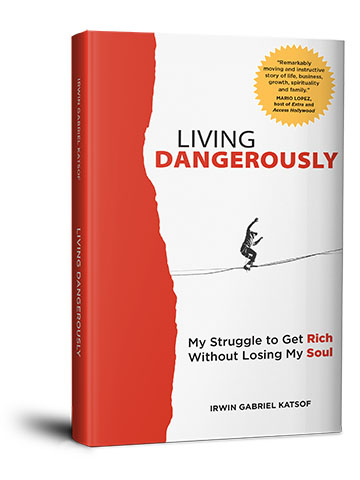
For Irwin Katsof, ‘Living Dangerously’ Means Giving Generously

This book intrigues, astonishes, and inspires. Irwin Katsof combines rich descriptions of business ventures close to home and far away, sometimes in dangerous places.

He calls the book “the story of my worst of times and my best of times” and is painfully honest throughout. It is the perfect book to read before Rosh Hashana.


Katsof, a ba’al teshuva, at 24 was back-packing through Europe in 1979. He ended up in Aish HaTorah in Jerusalem for the High Holidays, where he was deeply impacted by the classes of Rabbi Noah Weinberg. “I started slowly, but by the end of the year I was fully committed to the Torah path.”

Three years later he met his future wife, Judy, who he calls “sensitive and brilliant.” She plays a very big part in his life, including during the most challenging times.

Three years later Katsof was sent by Aish HaTorah to Los Angeles to organize their first fundraising banquet, which led to his opening an Aish branch in L.A. He proposed to Judy on the phone so he could sign the lease on an apartment, that included her name. This bold move became the hallmark of his behavior in fundraising and later in business. He became an ordained rabbi and teacher and was successful in reaching out to Jews of different ages seeking meaningful Judaism.

For 22 years Katsof was successful in bringing potential donors — corporate people, politicians and Hollywood stars — to Aish in Jerusalem, a task at which he was eminently successful. He became the Executive Director of The Jerusalem Fund of Aish HaTorah.  One mission was led by Larry King, with whom he wrote the book – Powerful Prayers – and they were hosted by King Hussein of Jordan. Katsof describes running through the palace grounds with a present for the King and almost getting shot by the palace guards.

He cast a wide net. “I recruited Jason Alexander to participate in the Aish Discovery program and met with Jerry Seinfeld about our ‘Words Can Heal’ program.” He met with refuseniks in the Soviet Union and launched the program “Help Our People Know” while he was in L.A., “to raise public awareness about the plight of Soviet Jews.”

After 22 years, he decided that rather than asking others for money, he’d work at becoming wealthy enough to donate money himself.

Rabbi Noah Weinberg had a massive influence on his life and “[I]f it wasn’t for Aish, I would never be who I am today…” When he consulted with Rabbi Weinberg regarding his new plan to become successful in business, the rabbi gave him his blessing, and said, “[D]on’t forget why you are doing it… Feel [the Almighty’s] pain at the suffering of His children…and ask yourself what you can do to help them.”

“As of January 1, 2005,” writes Katsof, “I was self-employed.”

As a budding entrepreneur, he is devoted to giving tzedakah. He meets Rabbi Zilberman in the Old City who has a yeshiva and who arranges tzedakah for poor families. Katsof continues the relationship with him throughout the years, and the rabbi continues to pray for his success. They even write a contract.

Katsof quickly discovered that making money in business was not an easy road and that “To meet my goal of giving away $1 million a year, I would have to be making $5 million, after taxes.” He reached out to a friend, who he mysteriously calls only “Paul,” who became a close financial advisor. He takes out loans on his home and from various funds and from friends and family. His deals – and attempted deals that did not work out – were in the U.S., Eastern Europe, Russia and elsewhere.

His stories are hair-raising and sometimes scary, including fear of arrest in Moscow.  Months of work may result in nothing; other times, he succeeds (with God’s help, he is always aware). He travels to Odessa, Barcelona, Nepal, Singapore, Abu Dhabi…the list goes on and on.

His financial escapades read like a thriller, a roller coaster of uncertainty, with fear of bankruptcy, and exuberance at successes.  There are stories of intrigue, obfuscation and distrust. The political situation in various countries is often precarious, and occasionally a deal that collapses turns out to be a blessing in disguise.

Katsof is always aware that anything he has is from God, and believes with all his heart that only if he behaves in a way that is in keeping with Torah and mitzvot, will God smile on him and his ventures. He struggles with setting aside time for Torah study and for praying in a minyan. He writes, “We cannot often see God’s presence…but in hindsight…His role is suddenly all too clear.”

He meets with US presidents and European and Israeli prime ministers. He works on projects that he hopes will improve the world. He becomes involved in renewable energy.

He was hired by a group of oligarchs from Kazakhstan to establish the Global Foundation for Democracy and in 2007 he organized the first Global Conference in Geneva for them with 15 former world leaders and diplomats. Some of the become personal friends. He has an adventurous chapter on the time he spent on the Virginia farm of U.S. Attorney General John Ashcroft.

In 2010, as director of America’s Voices in Israel, he brought the cast of the hit TV show “House” to Israel.  One of its stars, Omar Epps, has a warm blurb on the book jacket. Katsof says, “He is a Moslem. He is a deep, sensitive and empathetic human being and we became close friends and are still in touch today.” He also met Cameron Jordan and others from the NFL.

Katsof contacts Rabbi Zilberman often, asking him, again, to pray for him. On some occasions the rabbi gently asks him about his religious practice.

He becomes addicted to his Blackberry and business ventures and realizes that it is severely reducing his quality time with his children and that his marriage to a woman who he adores, and who he describes as his “rudder and anchor,” is seriously in jeopardy. Their anguish is deep and painful.

They try various therapies. We are let into his innermost pockets of pain, regret, and self-doubt. Eventually they find their way together. Today they live in Jerusalem, and he returns to America for part of the year. He is most proud when writing or speaking about his eight children – all of whom live in Israel– and his 25 grandchildren.

The Katsof family

Katsof lists eight tips he would tell someone thinking of going into business or finance. The first is: “Stay at your current job until you have at least eighteen months of savings in the bank.”

“Living Dangerously” moved and fascinated me, and led me to ask, “What can I take from this to improve my own life?”

Speaking with Irwin Katsof

I asked him what compelled him to write the book.

“I’m a big believer in the quote that words from the heart, enter the heart…When I left Aish HaTorah and went into business, it was overwhelming and frightening.” He found solace in writing a journal. “When I was flying with a business man in his private plane over Ukraine…or when I saw a group of blind and deaf children signing to each other at Ben Gurion airport and I wondered, ‘How does a blind and deaf person experience Manhattan?’ I’d get on the plane and start typing.

“I got perspective on what was happening in my life, and it wasn’t so overwhelming. I was just writing for me. I wondered if the flight attendant was thinking. ‘Oh, there’s the guy crying in 5A again.’ I was just writing for me.”

So why publish?

“Being with Aish Torah for 25 years, every day was meaningful… When I went into business, I missed that, and the sense of helping people.”

In 2012, he writes, “I kind of hit a wall and started my own personal rebirth. I went into therapy —Jungian analysis, and Core Energetics. I took out my journal and thought, ’There are powerful lessons here.’ I cried many times, rereading it.”

He sent 30 entries to editor Uriela Obst Sagiv, a former journalist and Pulitzer nominee, who now lives in the Old City of Jerusalem and had edited one of his earlier books. “She wrote me back, ‘Irwin, this is an absolutely beautiful story.”

She asked if he was sure he wanted to publish something so vulnerable. “I said, ‘It’s my story. And I think it’s so many people’s stories.’”

Katsof’s children include a daughter in Florentine, Tel Aviv and a son in Esh Kodesh in the Binyamin area where he established the Settlers Wine winery. “They’re all very different. We let them know that we love them and believe in them no matter who they are, that they need to follow their own path.”

He is still in touch with Rabbi Zilberman, and with most of his business associates. Today Katsof does trade missions in partnership with the U.S. Department of Commerce through his company, Trademissions.org.  “But my main work is assisting U.S. companies and fund managers in raising capital.” He writes that he’s brought over 750 US fund managers to 15 countries where they have met over 10,000 potential investors. In 2023 alone they went to Geneva, Zurich, London, Dubai, Riyadh, Hong Kong, Singapore, Mexico City, Toronto and Montreal.

He runs two to three miles every morning, has a practice of mindfulness when he meditates, and says, “Probably the biggest change for me is I make sure to walk my two-year-old grandson to pre-school every morning…. I have a beautiful family… a sense of peace of mind.

“I learned from my journey to have a balanced lifestyle, not chase every pot of gold. God controls the world and He will decide what’s going to happen.

“That doesn’t mean I don’t have problems. We all have problems… I strive to have a sense of equanimity and peacefulness, which doesn’t mean that I don’t get anxious, but I allow myself to be with those feelings because that’s a part of being alive.”

He has trained in Core Energetics, in trauma therapy, psychodrama and more, and has an M.A. in transpersonal psychology with a specialty in applied spirituality. “I have a lot of qualifications in the helping professions, and it’s something that I would like to do; I think that’s my next act.”

Speaking of acts, he says he had his own TV show when he was a child and “would love to get back into theater.”

He also developed an AI tool as a companion to the book, called Living Dangerously the Companion, intended for, among others, professionals and entrepreneurs, that help one deal with personal and ethical dilemmas and is programmed to draw from both Jewish and non-Jewish sources. Among those he mentions are Rabbi Jonathan Sacks, of whom he is a great admirer, and Carl Jung. One can also request only Jewish sources.

He gives tzedakah to the yeshiva world, to needs in their community, and “to people who need to put food on the table.” He and Judy would like to help Israeli war widows who gave birth after their husbands fell in battle.

 “I owe everything to my wife, because the wealth I have in my life now is my family… and it’s all because my wife saw my potential, understood that I was a little lost, and caught up, but knew that I was a good man.

“I think my journey has been becoming more grounded…connecting to my soul and to the Jewish people and to God, so that I’m never really alone and I can deal with anything that happens. Whether it was with an oligarch or the financing of a business deal falling apart, they’re external manifestations that really have nothing substantive about them… It’s just there to get us in touch with God and with the world and with eternity.”

What were the last words that Rabbi Zilberman wrote in his contract with Katsof? “God will bless you from Zion and you will see the good of Jerusalem your whole life – you, your children, and children of your children, and all Israel.”


The writer is an award-winning journalist and theater director and editor-in-chief of WholeFamily.com.

For Irwin Katsof, ‘Living Dangerously’ Means Giving Generously Read More »

Copper Colored Dreams — A Hearty Harvest Veggie Soup

There’s an old Ladino saying, “Vinieron los huesos a su lugar,” which roughly translates to “Your bones have come back in their place.” It is a colloquial way of describing something that is restorative, to body and soul. For me, that magic elixir is soup.

Almost every Friday night dinner at my home begins with soup on the menu. It’s a ritual inherited from my mother, who started every Shabbat meal with it. As a child, I remember the comforting aromas that wafted through the house. The gentle bubble of the chicken broth, the savory scent a reminder that soon enough we’d all be gathered around the table.

Soup has that kind of power. It signals that you’ve arrived and that the week’s rush and noise can finally fall away. The first spoonful seems to whisper that you’re home now. Sit down. Breathe.

On Friday nights, that message feels even more profound. After a long week, when everyone’s been moving in different directions, soup brings us back to center. It marks the transition from the outside world to the sacred space of the table, a place of connection, gratitude, and rest.

My mother’s soups were never fancy, but they were always full of care and always nutritious. Sometimes it was a rich, golden saffron-infused chicken soup, served with matzah balls or thin noodles. Other times, it was her now famous velvety vegetable soup. Whatever she served, it set the tone for the meal, simple yet deeply comforting.

Now, I carry on that tradition. Even when I’m tired or tempted to skip it, I find myself reaching for the soup pot. Because Shabbat just doesn’t feel right without that first warm bowl. It’s my way of saying to my family that the week is done and that being together is precious.

As that old saying reminds us, sometimes the thing we need most is something that can put us back together, one flavorful spoonful at a time.

—Rachel

It is an oft mentioned cliché that Los Angeles doesn’t have seasons. While it may be true that the weather in Los Angeles is more temperate, there is a fall feeling in the air. There is a cooler breeze, the days are shorter and the leaves are definitely falling off the trees.

These are the days that make us crave a warm, comforting soup. This hearty harvest veggie soup recipe includes my favorite cooking technique — roasting vegetables on a sheet pan. We layered tons of root veggies—butternut squash, sweet potatoes, carrots and turnips — with aromatics like leek, onions, garlic, tomatoes, sage and thyme. We seasoned with olive oil, turmeric, Himalayan pink salt, freshly ground black pepper and a generous drizzle of honey.

After the vegetables were roasted to caramelized, deep earthy perfection, we puréed this perfect base with a pareve chicken consommé broth to create a silky, smooth, copper-colored soup.

My daughter Alexandra made croutons from a sourdough French country loaf drizzled with olive oil and sprinkled with a generous dash of za’atar and garlic powder.

The crispy croutons are a perfect contrast to the vibrant, nutrient-packed soup. It’s a delicious and warming recipe that incorporates simple, seasonal ingredients for a surprisingly healthy, luscious soup.

—Sharon

Harvest Veggie Soup

1 large butternut squash, cut into thin 2″ wedges

2 medium sweet potatoes, peeled and chopped

8 oz. petite carrots, cut in half

2 medium turnips

2 onions, cut into wedges

1 leek, cut into thin rounds

8 large garlic cloves

8 Campari tomatoes, halved

6 sprigs fresh thyme

10 leaves fresh sage

2 Tbsp turmeric

2 Tbsp Himalayan pink salt

1 tsp freshly ground black pepper

1/3 cup extra virgin olive oil

2 Tbsp honey

8-10 cups parve consommé


Preheat oven to 425°F.

Layer all the vegetables and all the herbs on a parchment lined baking sheet.

Season with turmeric, salt and pepper.

Drizzle with olive oil and honey.

Roast in the oven for 30-40 minutes or until the vegetables are fork tender.

Working in batches, place the roasted vegetables and consommé in a blender and purée.

Transfer puréed mixture to a pot and bring to a boil before serving. If soup is too thick, thin out with water. Adjust seasoning according to taste.

Note: Soup can be stored in an airtight container in the refrigerator for up to five days.

– Sharon 


Sharon Gomperts and Rachel Emquies Sheff have been friends since high school. The Sephardic Spice Girls project has grown from their collaboration on events for the Sephardic Educational Center in Jerusalem. Follow them
on Instagram @sephardicspicegirls and on Facebook at Sephardic Spice SEC Food. Website sephardicspicegirls.com/full-recipes.

Copper Colored Dreams — A Hearty Harvest Veggie Soup Read More »

Table for Five: Bereshit

One verse, five voices. Edited by Nina Litvak and Salvador Litvak, the Accidental Talmudist

And God created man in His image; in the image of God He created him; male and female He created them.

– Gen. 1:27


Rabbi Janet Madden

Malibu Jewish Center and Synagogue

We begin with the assurance that we are created in the image of the Holy One, a concept designed to be something to which we turn and return – like the Torah itself – since the second half of the statement appears to contradict the first. Adding to the complexity of the relationship between the Holy One and humanity, Vayikra Rabbah 14:1 expands on Torah’s two-part statement, explaining both that “the earthling” is created “androgynous” and that “the earthling was created with two faces. [Divinity] sawed him/them, and two backs were formed, a back for the male and a back for the female.” From this surgical model of separation, we can extrapolate that we were once whole in a way that we can only imagine, that humans are forever severed from full unity with one another and that we are also separate and different from the Divine. All of these implications provide much to ponder. But when set against Bereshit Rabbah 8:1’s teaching that the initial human creation was a golem – a soulless, unformed thing, embryonic, yet full of potential – how can we not feel profound awe? Whoever we are, whatever physical bodies in which we find ourselves, we are assured that when the Divine breathes into the earthling, our potential is activated into reality: we become so much more than our earthly bodies. As the Or HaChaim teaches: our outward, physical form holds within it the hidden, the spiritual and therefore the true image of the Divine.


Benjamin Elterman

Screenwriter, Essayist, Speechwriter at Mitzvahspeeches.com

Clearly the big question is, did Hashem create “man” as a male or a female? Later in verse 2:21 we get the famous line that Hashem made Adam fall asleep and He created Eve from his rib. Except the word for rib, mitzalosayon can also mean “from his side.” The Midrash expounds on this word commenting, “Adam was created with two faces [i.e. male and female persons combined.]” This clarifies our verse in that man and woman resembled a conjoined twin, created as both male and female. So this leads to the question, why did Hashem make the split? 

There are two ways we can think about a relationship. One is a partnership. 1+1=2. I get what I want, maybe you get what you want. And together we achieve more than if we had stayed separate. Then there is a covenant. This is an agreement that isn’t about what I can get, but what we can be together. This equation is 0.5+0.5=1. Or 0.25+0.75=1. Or whatever permutation is necessary to reach unity. Healthy relationships care about what is best for everyone involved because it is as if they are a part of you, like you’re connected. And this is why we’re created in the image of God. Because He is always searching for ways to restore unity with us. Reconnecting with our soulmate is just a first step.


David Sacks 

Happy Minyan of Los Angeles

Imagine the Garden of Eden just after it was just created. What do you think it looked like? The lushest, most exotic arrangement of flowers, fruit trees, and plant life that ever existed, right? Actually … the Garden of Eden was totally barren. There wasn’t a bit of greenery in sight. Then God inspired Adam with a sense that there was something missing, and that his need could be answered through prayer. And so, Adam prayed. 

And it rained. And suddenly, every fruit tree, plant, and flower that had already been created, but existed just below the ground, rocketed up, and the Garden of Eden transformed into the lushest, most exotic assortment of visual riches that ever existed. 

From this we learn something amazing about God. 

The very first thing He wanted us to know, 

Was that He hears our prayers, 

And for us to know, 

He answers them, 

In the most beautiful way.


Rabbi Tova Leibovic-Douglas

@rabbi_tova, Founder of The Ritual House

Our world would be more whole if more people knew this part of the creation story. 

Most of us learned the second version, where Adam is created first and Eve from his side. While that story holds meaning, it has often been used to justify hierarchy, patriarchy, diminishing us all — especially women. 

But before that, there is another story. 

In Genesis 1:27, the Divine creates humanity in the Divine image: male and female God created them. This is not a story of one before the other, but a vision of sacred balance. The ancient sages and mystics understood this verse as revealing a cosmic truth: every human being is made in the image of the Divine, and within each of us are both masculine and feminine energies. These energies are divine qualities, spiritual currents that live within all of us, waiting to be honored and brought into harmony. Neither is higher, neither is lesser. Both are essential for wholeness — in ourselves, in community, and in the world. 

Perhaps we have forgotten this truth because one story became louder. Or perhaps we are afraid to remember. But remembering is sacred. You, me, the stranger, the neighbor — we each embody the Divine. We each have that spark within. And that remembering may be what heals our world.


Rabbanit Alissa Thomas-Newborn  

BCC – Rabbanit at Netivot Shalom and Hospital Chaplain

What does it mean to be created betzelem Elokim? I recently explored this with students in a Master’s program for Spiritual Care. Our context, however, was not the usual one; we were reading the verse amidst mental illness. How can we apply this belief when we are in the midst of a mental health crisis? Or when our loved one is? When, God forbid, we are supporting someone who doesn’t feel like themselves, let alone reflecting the Divine? To add to the complexity, mental illness can even present with taking this verse too far. Which is why, when I work as a chaplain in psychiatric emergency settings, I am sensitive to the reality that religion can offer comfort and resilience … or, God forbid, unintentionally trigger worsening symptoms. There is no simple answer, so the students’ answers varied between having self-compassion and forgiveness, to reflecting on practicing self-care rather than self-harm, to thoughts of guilt, unworthiness and self-negation. I would humbly suggest that God gives us this definition of what it is to be human specifically for those moments when we or others are at our lowest points. In crisis, untethered from our source, disconnected from our own worthiness. Because it is then that we are least likely to remember from where we come. It’s easy to internalize “betzelem Elokim” when we feel whole and holy. The challenge is to develop this theology in how we treat ourselves and others when divinity feels out of reach.

Table for Five: Bereshit Read More »