fbpx

May 2, 2025

Did Someone Call for A Chaplain

I am an interfaith hospice chaplain who on average handles 20 deaths every week; at times I manage 40. This number may sound staggering but it’s not. As people age and society understands death, more people will choose to die with the dignity of hospice.

The career of a chaplain is not one of the most appealing for new clergy. Why would someone want to hold the hand of a woman as she goes in and out of consciousness surrounded by her family and friends? Did I, someone Jewish, think that I would perform a cremation? As a side note, more people are asking for cremation due to the expense of burial.

As a Jewish communal leader who overcame learning difficulties, my spiritual calling to be a chaplain has been one of the more fulfilling aspects of my life both personally and professionally. Before my shift to hospice, I spent a year in residency as the first Jewish chaplain in the Deep South doing hospital chaplaincy.

The work of a chaplain in healthcare is fundamental to both how systems operate and the complete betterment of the patient. I split my time between bedside care which involves being there as the patient and family deal with a death to the weekly grief therapy I call “Cognitive Behavioral Spirituality.” This form of therapy includes weekly pastoral sessions that end in homework for my client. By doing homework like getting a massage or eating something fatty and delicious, I help walk them back into life. Grief is not a straight line. The path towards finding meaning and purpose is different for each person.

When I moved to the Bay Area to work for my company, I took this job knowing that I would primarily see non-Jews. Since Oct. 7 and its aftermath, I have been an advocate for more Jewish professionals to work in non-Jewish spaces. To put it in Talmudic language, the sage Hillel had it right when he said, “If I’m only for myself who am I”? If we want allies, we must expand how we’re seen in the communities we inhabit.

Another term for what I do is “death doula.” Similarly to helping women give birth, I am there at the time when it really matters. In one encounter, I went to lead an extubation at our local San Jose hospital where life-support tubes were removed from a patient. As a member of the clergy who takes pride in my appearance, most of my shoes come from Cole Haan, a brand I love. As I entered the hospital room, the daughter of the patient looked at me and through tears told me how much she loved my shoes! This, as her father was dying. I am so fortunate to have these and many more stories to share and to help guide and facilitate these conversations.

In another encounter with a family I served, I led my first celebration of life at a local Mexican restaurant. Surrounded by loved ones there to honor their matriarch, we toasted with Reposado tequila. How meaningful that was!

Due to my personal circumstances that led me to pursue chaplaincy in all of its raw and beautiful moments, I feel I have found my calling, and I look forward to helping more members of clergy become chaplains so that this career can be one that helps others thrive!


Jonah Sanderson is a chaplain and interfaith hospice provider. His training includes his master’s degree from theAcademy Jewish for Religion, as well as a residency in Gastonia, North Carolina.

Did Someone Call for A Chaplain Read More »
Amy Dell: Saturday Sauce, Deli Food and Tunisian Tuna Toast

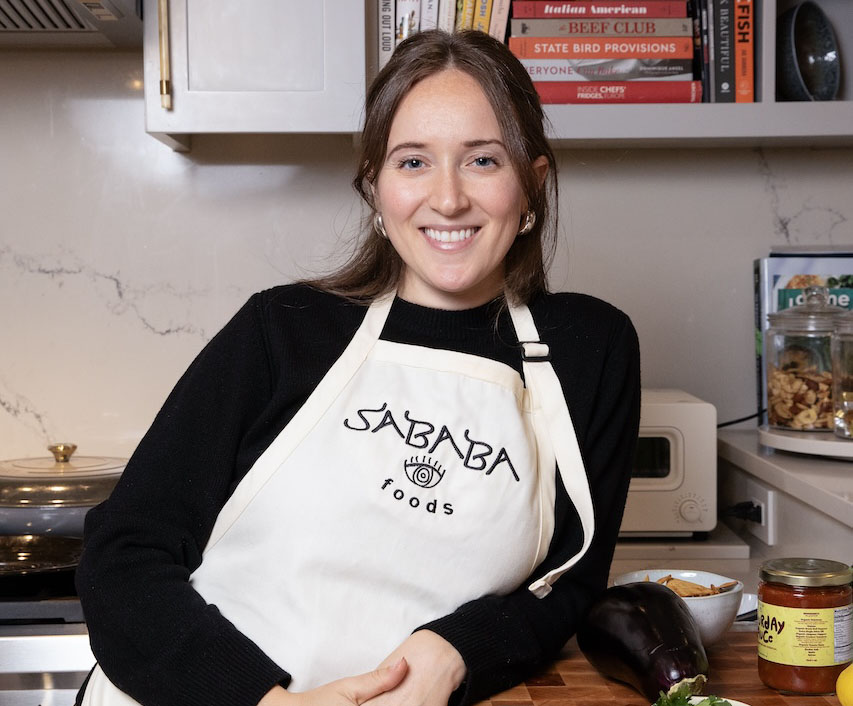
Amy Dell grew up in the restaurant industry and is still deli-adjacent. Her father, who is from Israel, owned Mr. Broadway kosher restaurant in New York City. Her husband, Jake, is the third-generation owner of Katz’ Deli.

“When my husband and my father met, one of the first questions my father asked my husband was, would he ever consider making Katz’s Deli kosher?” Dell told the Journal. “He said he’d think about it.

My husband did make my father his own kosher pastrami,” she said. “And my father said that it was the best gift he’s ever received in his life.”

While Dell’s dream was to own a restaurant, her dad begged her not to.

“It is a hard industry to be in,” she said. “Especially in New York City.”

Dell, who has been working in hospitality and marketing for more than 10 years — planning events and creating menus, found a compromise. Embarking on her own food adventure, she created Sababa Foods, which produces authentic Middle Eastern foods with a modern-day flair. Her first product, Saturday Sauce, is her take on matbucha. It is a slightly spicy tomato-based sauce.

“I get to use my dad’s recipe, what I grew up eating,” said Dell, who loves this sharing the rich tradition and history.

When asked about the name, Saturday Sauce, Dell said, before launching, she told her friends about it and explained that the sauce was like the base of a shakshuka; she got a lot of confused looks.

“People didn’t know what shakshuka was and — some people do, but it was surprising to me that not everybody did,” she said. “I also didn’t want to pigeonhole the sauce as, ‘just a shakshuka sauce.’ “

Dell uses it for Moroccan fish, sheet pan chicken, many different things.

Then it occurred to her that Saturday Sauce is like the Jewish version of ‘Sunday sauce.’

“Sunday sauce generally refers to [what] an Italian family’s grandma is making [on] Sunday,” she said. “Tomato sauce, stewing for hours … [that] you use it in so many different ways and formats.”

Both are good, simple red sauces that go with just about everything.

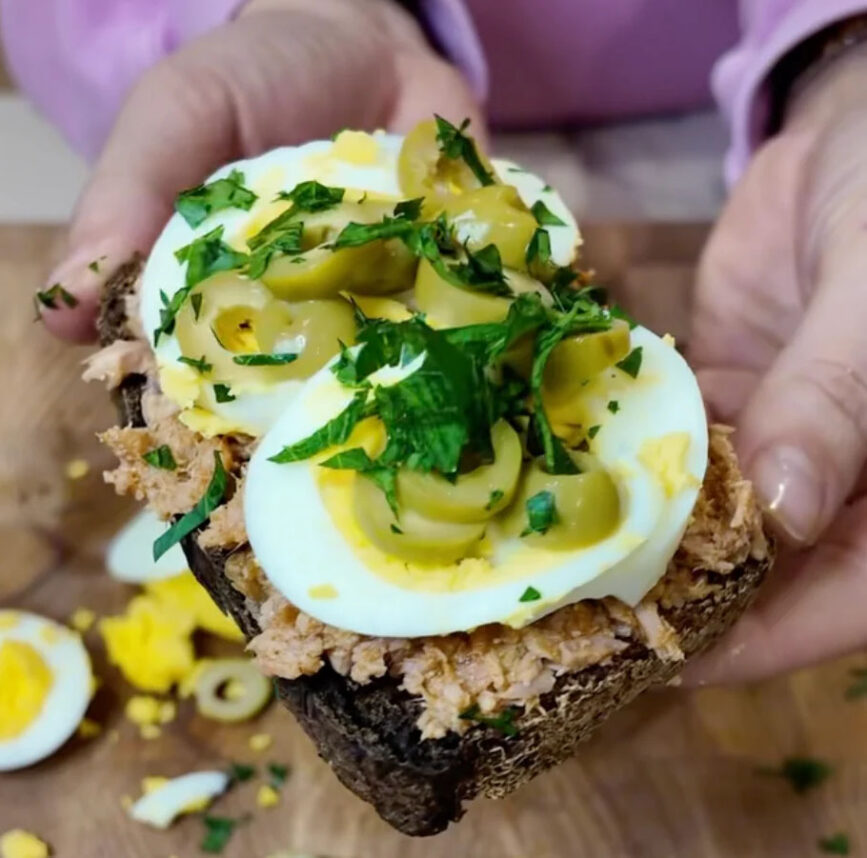
One of Dell’s favorite Saturday Sauce recipes is Tunisia tuna toast; it’s easy and adaptable. You can add a hard-boiled egg, some olives, fresh herbs.

“It has the elements of everything that you want in a bite: fattiness, creaminess from the egg, a little bit spicy, crunchy toast, a little bit of briny elements,” she said. That recipe is below.

Dell, who prefers fine versus chunky tuna, says her tuna technique is to fully drain the can and smash it down with a fork. That way, the sauce is able to coat everything.

Living in the food and deli world is something Dell is definitely used to. And that’s a good thing.

“The first date that I went on with my husband, I was like, ‘Oh, you smell like pastrami, that’s a familiar smell,’” she said. And Katz’s Deli is an enduring institution.

“Katz is amazing in so many ways; people are so connected to it and its history,” she said. “I think it’s also really fun that my husband, Jake, comes from an Ashkenazi Jewish background, whereas my dad’s parents are from Morocco and Tunisia, so we eat very different food.”

She added, “At the end of the day, it’s kind of fun to mix and match those things.”

When it comes to deli sandwiches the ultimate question is: Are you team corned beef or team pastrami?

“I’m team pastrami,” Dell said. “I mean, pastrami just melts in your mouth, but I will say my favorite thing at Katz’s, which might be controversial, is the turkey; the turkey is underrated and it’s delightful.”

Learn more about Amy Dell and Saturday Sauce at Sababa-foods.com and follow @Sababa_foods on Instagram, TikTokand YouTube. Saturday Sauce is now available in Erewhon stores.

For the full conversation, go to JewishJournal.com/podcasts, and check out the latest episode of Taste Buds with Deb.

For the full conversation, listen to the podcast:

Watch the interview:

Tunisian Tuna Toast

Serves ~2

If you don’t have Saturday Sauce on hand, you can recreate a similar version using Sababa’s core ingredients: organic diced tomatoes, onions, organic crushed tomatoes, organic green peppers, extra virgin olive oil, organic jalapeño peppers, organic tomato paste, kosher salt, garlic, and your favorite spices.

Tuna

1 5 oz. can Tuna (I like Safe Catch)

3-4 Tbsp Saturday Sauce

Squeeze of 1/2 Fresh Lemon

Drizzle of extra virgin olive oil (EVOO)

Kosher salt and pepper


Toast

Your bread of choice (I like Knead Love Herby Sourdough), toasted

1 Boiled Egg

Sliced Green Olives

Chopped Fresh Parsley


To Make the Tuna:

Drain your tuna and put on a flat bowl or plate so that you can “flake” the tuna with a fork, making sure the tuna pieces are flaky and somewhat uniform (so that there are no large chunks).

Add the fresh lemon juice, a drizzle of olive oil, kosher salt and pepper to the tuna. Mix well, then add 3-4 Tbsp. of Saturday Sauce to your tuna and mix thoroughly.


To Assemble the Toast:

Boil an egg. Let cool and slice into rounds. Toast your bread. While your bread is toasting, thinly slice some olives into rounds and chop some fresh parsley.

Add your tuna to the toast, then top with egg, olives, and parsley in that order. Drizzle EVOO and flaky sea salt on top.


Debra Eckerling is a writer for the Jewish Journal and the host of “Taste Buds with Deb.Subscribe on YouTube or your favorite podcast platform. Email Debra: tastebuds@jewishjournal.com.

Amy Dell: Saturday Sauce, Deli Food and Tunisian Tuna Toast Read More »

Community Leader Says “Value High” in Voting in Zionist Congress Elections

As voting for the U.S. elections in the 39th World Zionist Congress nears conclusion—voting closes May 4—American Zionist Movement (AZM) Executive Director Herbert Block said there were few barriers of entry to voting in what Jewish leaders are describing as a consequential election.

In fact, it costs just $5 per person to vote—essentially the cost of a cup of coffee, the AZM leader said during a recent Zoom interview.

“The price is low,” Block said, “but the value is high.”

What is the World Zionist Congress?

Known colloquially as the “global parliament of the Jewish people,” the Zionist Congress meets every five years in Jerusalem and influences appropriations of $1 billion in annual funds and the decisions of four of global Jewry’s national institutions and programs: World Zionist Organization (WZO), the Jewish National Fund-Keren Kayemet LeIsrael (KKL-JNF), The Jewish Agency for Israel (JAFI) and Keren Hayesod.

This year, more than 2,900 candidates from 43 U.S. states and territories—including approximately 200 candidates from the Los Angeles area—are running in the World Zionist Congress elections on a record-high 21 slates, which span the ideological spectrum. The candidates are vying for the 152 seats allocated to the U.S. Jewish community in the 525-seat Congress.

As in a parliamentary system, seats are distributed based on what percentage of the vote each slate gets.

All Jews who are age 18-or-older by June 30, live in the U.S. and accept the “Jerusalem Program,” the global statement of beliefs of the Zionist movement, are eligible to vote.

Voting is done at zionistelection.org.

For the current election, the slates span the spectrum. Some are representing Orthodox values; others are liberal; and there are those that advocate for pluralism. But despite their differences, the slates are all Zionist, Block said.

“The diversity of the slates really reflects the diversity of the American Jewish community,” the AZM leader said.

Some of the slates have participated in previous elections, while others are participating for the first time. The slate with the largest number of Los Angeles candidates, “ANU: A New Union,” is a new slate, with 27 local candidates. It describes itself as “A NextGen Big Tent for the Jewish American Consensus.”

Another slate with a large numbers of Los Angeles candidates is “Orthodox Israel Coalition-Mizrachi,” a religious Zionist slate. Its members include Orthodox Union, Yeshiva University and Rabbinical Council of America, among other institutions. The group’s platform notes a disproportionately large percentage of the fighting forces in the IDF identify as religious Zionist. The slate has 24 local candidates, including Young Israel of Century City (YICC) Senior Rabbi Elazar Muskin, who spoke with the Journal about the election.

“I support this philosophy very strongly,” Muskin said. “Our community, YICC, is a religious Zionist synagogue. It’s part of our mission statement. You walk into YICC, you know it’s a religious Zionist organization. The beautiful tapestries in the main sanctuary, the sculpture in the backyard, a model of the Knesset menorah, is prominently displayed. Everywhere you turn in Young Israel, you can see we are religious Zionists.”

“A lot of people go on a slate to show their support for the slate,” Lizz Berney, national director of research and special projects at Zionist Organization of America, said in a phone interview.

Berney is a candidate on the slate, “ZOA Coalition,” which represents more than 30 organizations, including Zionist Organization of America; Committee for Accuracy in Middle East Reporting and Analysis (CAMERA); and Lawfare Project.

In a phone interview, Berney said there was “more visibility about the election this year than in previous years.”

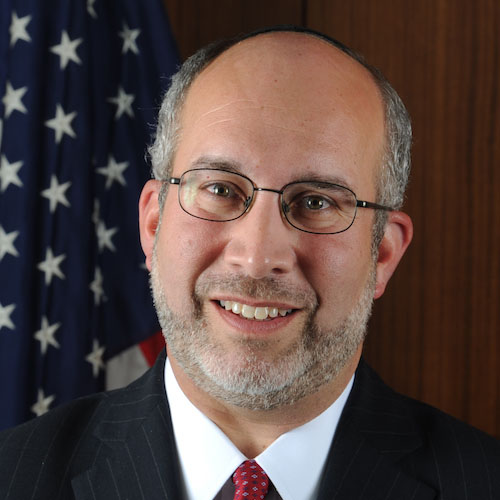
AZM Executive Director Herbert Block. Courtesy of AZM

Block concurred, saying, “By all signs, more people are interested, and more people are engaged than they were in the past.”

“Kol Israel” slate, associated with pro-Israel education organization StandWithUs and Zionist youth movement Young Judaea, has 17 local candidates.

On the opposite end of the ideological spectrum are slates “Vote Reform” and “HaTikvah: The Progressive Slate.” Groups including Hebrew Union College-Jewish Institute of Religion, NFTY and Central Conference of American Rabbis support “Vote Reform,” while “HaTikvah” is endorsed by JStreet; Reconstructing Judaism, the voice of the Reconstructionist movement; and Jewish Labor Committee, among others.

The Conservative movement’s “Mercaz USA” slate, supported by Cantors Assembly, Jewish Theological Seminary and Ziegler School of Rabbinic Studies, has 15 local candidates. Recently, Yizhar Hess, vice chairman of the WZO, spoke at Temple Beth Am, a Conservative congregation, as part of a get-out-the-vote effort for the Mercaz slate.

Other new slates includeIsrael365 Action,” “Israeli-American Council (IAC)” and “Aish Ha’am.”

Another new slate, “AID Coalition (American-Israel Democracy),” which advocates strengthening the bond between Israeli Americans and Israel, has 13 local candidates.

Voting began March 10. As of April 21, 147,414 votes had been cast in the election, exceeding the 123,575 votes recorded during the entirety of the 2020 election, according to AZM.

Block said the role AZM plays in the election process is an unbiased, administrative one, which he likened to the function the nonpartisan League of Women Voters has in U.S. elections.

“Our job is to run an open, fair and democratic election,” Block said. “We don’t endorse any particular slate. We’re in charge of the election.”

Ultimately, he hoped as many pro-Zionist Jews as possible casted their vote before voting concluded on May 4.

“We want to make sure the voice of the Diaspora Jewish community, and particularly the American Jewish community, is heard at the Congress,” Block said, “and so if our vote collectively is backed up by a larger number, that gives us a stronger voice.”

Voting for the U.S. election in the World Zionist Congress continues through May 4. Courtesy of AZM

Community Leader Says “Value High” in Voting in Zionist Congress Elections Read More »

An Extraordinary Commandment

On June 26, 2012, the Cologne, Germany regional court ruled that circumcising young boys is a criminal offense because it constitutes “illegal bodily harm.” The court held that a child’s right to physical integrity outweighs parental rights and religious freedom. This ruling sparked outrage in the Jewish world. Rabbi Israel Meir Lau, a survivor of the Holocaust, sarcastically noted that “it is an amazing thing to see German speakers discover they are sensitive to a baby’s cry…I did not experience this in my childhood.”

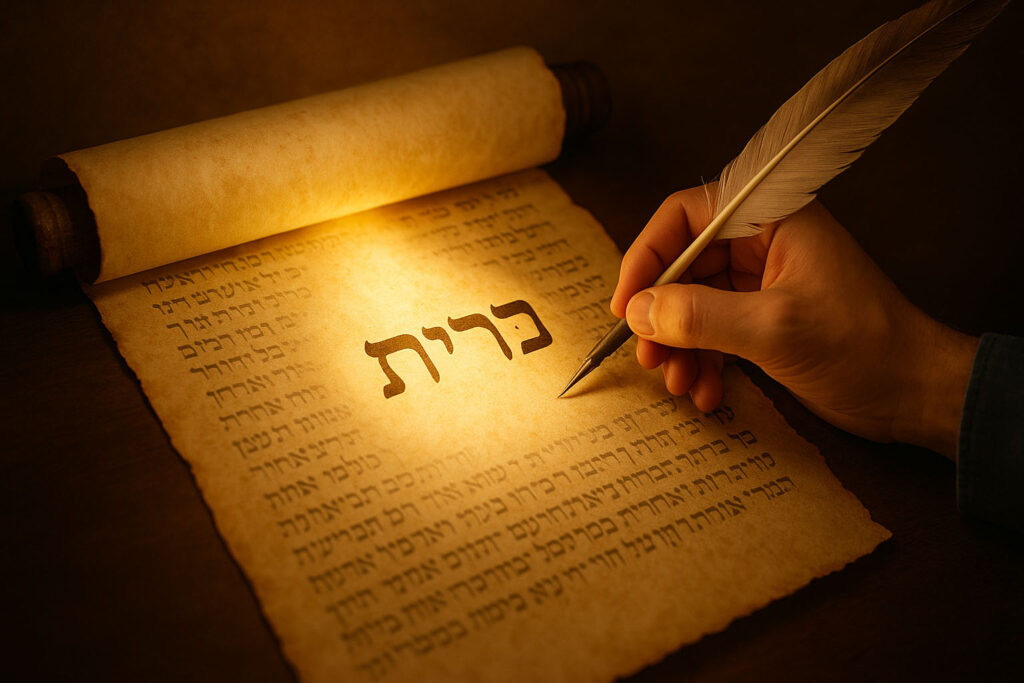
This ruling was later overturned; but it is not at all an outlier. Circumcision, or Brit Milah, has always attracted controversy. The Seleucid king Antiochus Epiphanes outlawed circumcision and executed Jewish women who circumcised their sons. The Roman Emperor Hadrian banned it as well.

The Hellenistic world considered circumcision disfiguring. This attitude influenced many Jewish men as well; to advance socially, they would undergo an epispasm, a painful procedure to restore their foreskins. Epispasm was so common that the Talmud (Yevamot 72a) debates whether one requires a second circumcision after an epispasm; it adds that during the Bar Kokhba rebellion, many who had had epispasms undertook second circumcisions as a sign of Jewish pride.

In the 18th and 19th centuries, circumcision was once again a matter of debate. Here too, the zeitgeist was influential. No less an authority than Immanuel Kant was quoted as saying, “As long as the Jews…will be circumcised, they will never become more useful than harmful in civil society.” Some Jews wanted to follow course. In 1843, the Society of the Friends of Reform in Frankfurt declared that “they do not consider circumcision binding either as a religious act or a symbol.” While a handful of radical reformers supported them, this view was widely opposed, even in Reform circles. Circumcision proved to be too compelling, and even those generally opposed to ritual couldn’t let go of circumcision. Spinoza, otherwise a harsh critic of Judaism, could not fail to notice that “The sign of circumcision is, as I think, so important, that I could persuade myself that it alone would preserve the nation forever.”

Both assimilation and persecution have done little to shake the Jewish commitment to circumcision. There is something extraordinary about this commandment.

The Torah mentions circumcision in five different sections; surprisingly, four of the five focus on women. When circumcision is first commanded to Abraham (Genesis 17), it is accompanied by a name change both for Abraham and Sarah, and the promise that Abraham and Sarah will have a child.

After Dinah is raped, (Genesis 34) Shechem asks Jacob’s family to marry her; her brothers respond by asking for the entire city of Shechem to circumcise.

When Moses returns to Egypt (Exodus 4), an angel encounters him and tries to kill him; his wife Zipporah ends the crisis by circumcising their son.

In Parshat Tazria, when enumerating the sacrifices a new mother brings after childbirth, it adds that if she gives birth to a baby boy, “On the eighth day the flesh of his foreskin shall be circumcised.” (Leviticus 12)

It seems as though the Torah is anticipating the following question: How is it that a commandment of such significance inherently excludes women?

Like most other commandments, the Torah does not explicitly state the purpose of circumcision; however, a reading of the sections related to circumcision offers some hints. Philo connects circumcision with fertility; that is very much the theme of Genesis 17.  However, it is not Abraham’s fertility that is in question; he already has a child from Hagar. Circumcision symbolizes fertility within marriage, and is a symbol of the bond between Sarah and Abraham.

This comes into clearer focus when looking at Genesis 34. Maimonides sees circumcision as fostering sexual self-restraint, which is the underlying theme of that narrative. Shechem’s sexual violence is responded to with a “solution” of circumcision. It is the text’s way of underlining that the purpose of circumcision is to keep Jews far away from the “disgraceful” crime Shechem committed.

Taken together, these two texts depict an ideal of male behavior. Building families may be intuitive for women; but it is less so for men. The future of every society requires a cadre of men who are dignified and respectful to women, while at the same time aspiring to marriage and children. Circumcision conveys this message to young men from the very beginning of their lives.

But that is only the first step. Rabbeinu Bachya sees circumcision as being similar to a sacrifice, and writes: “Circumcision is like a sacrifice, and just as the blood of a sacrifice atones on the altar, so too does the blood of circumcision atone. Therefore, its commandment is on the eighth day, because a sacrifice is not valid until the animal is eight days old.”

This lesson of sacrifice builds on the prior lesson of family. In Judaism, parenting is not just about providing a nurturing home of love and warmth. It is about dedicating one’s children to the future of the Jewish people.

Leviticus 12 and Exodus 4 focus on this idea. The newborn mother, who has given so much of herself to create this new child, is still not done. She must include God in her good tidings, and offer sacrifices. And the greatest sacrifice she will make is to bring her son into the covenant, to offer him to serve God. Zipporah understands this as well. She recognizes that Moses’ mission requires that they dedicate their child to God.

The Maharal offers an idea that complements the concept of sacrifice. He writes that circumcision takes place on the eighth day, because it symbolizes going beyond the natural; seven represents nature, which was created on the seven days of the week. So too the circumcision itself; it seeks to go beyond man’s natural state to create something more refined. In other words, circumcision demands that Jews go beyond the ordinary, and to sacrifice to do so.

Jews have never chosen to take the easy road; we have chosen to defy the rules of nature and history, and made many sacrifices to do so.  And that has defined Jewish parenting.

Every parent wants their children to be happy. But if that’s all Jewish fathers and mothers ever wanted, the Jewish people would have disappeared years ago. For 2,000 years of exile, it would have been a lot easier to give up; it would have been a lot happier for children not to be burdened by their Jewish identity.

We are here today because Jewish fathers and mothers wanted more than happiness from their children.

And that is extraordinary.


Rabbi Chaim Steinmetz is the Senior Rabbi of Congregation Kehilath Jeshurun in New York.

An Extraordinary Commandment Read More »