fbpx

January 24, 2025

LA Resident Takes Neighborhood Cleanup into Her Own Hands

April Silverman, a resident of Hancock Park, grew increasingly frustrated by the city’s inaction against a homeless man who was terrorizing her quiet neighborhood. Despite constant complaints from residents, no action was taken.

“I followed all the steps the city of Los Angeles outlines,” said Silverman. “I called 311—no response. I emailed L.A. Councilwoman Katy Yaroslavsky’s team, but no action was taken.”

At first, the man was camped near Ralph’s, a block and a half away from her house. But when he started moving closer to the residential area and more and more tents started popping up, Silverman said, “That’s enough!”

After six weeks of unsuccessfully trying to get the city to act, the determined Silverman decided to take matters into her own hands, to the immense relief of her neighbors.

“The kids were petrified and no one could walk to the temple like this. It had been a problem for months,” she said.

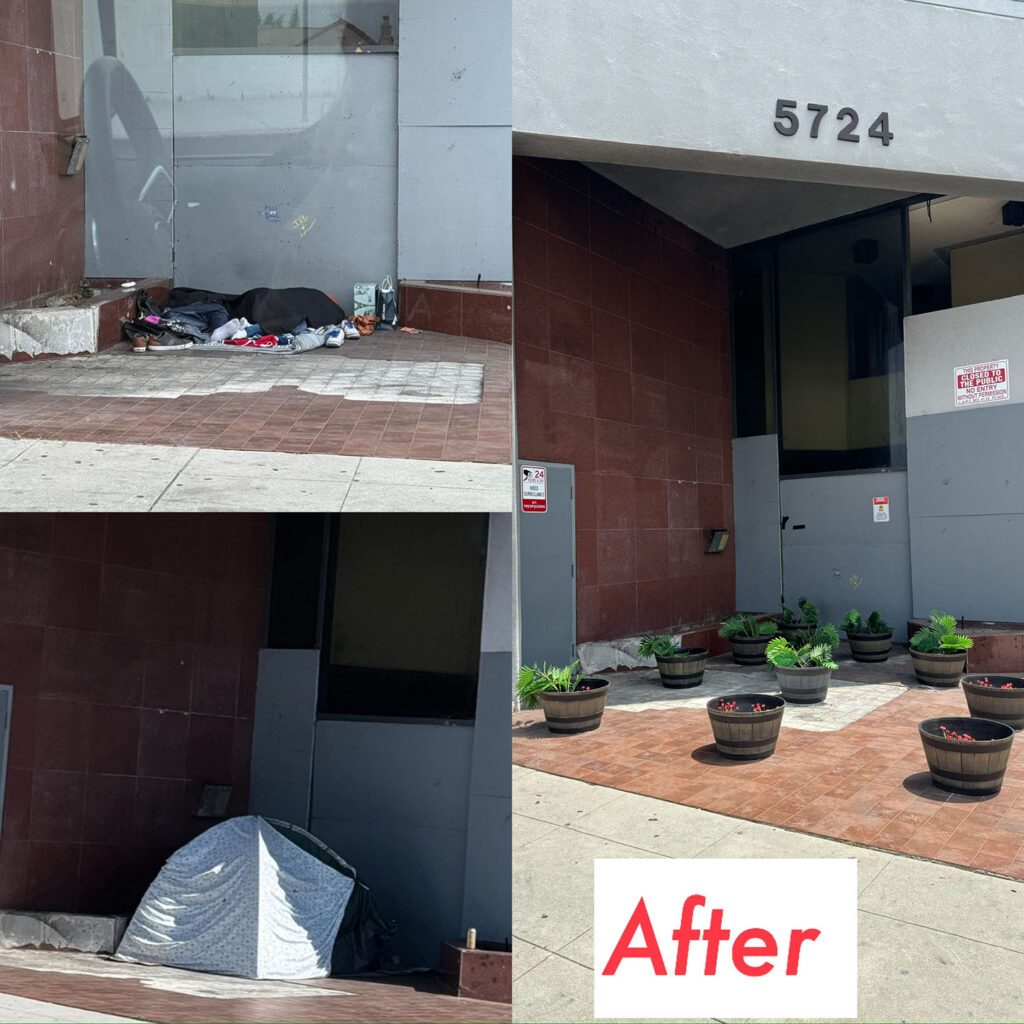
When a CARE+ cleanup was scheduled, Silverman hired a security guard, arrived at 5 a.m. and started removing the belongings left by the homeless man. She also arranged for a massive concrete wall to be built. “By the time the cleanup was over, he had nowhere to sit, and he didn’t come back.”

CARE+ is a program where city officials conduct mandatory cleanups of homeless encampments. Silverman compares it to hotel room service: they clean, throw away trash, and make the area tidy, only for the homeless to return, set up their tents and let it get dirty again.

“[Mayor] Karen Bass’s philosophy isn’t working,” said Silverman. “She has the ‘Housing First’ philosophy, which doesn’t take anything else into account—not mental health, not drug use or anything like that. If you have somebody who does drugs, they feel invincible. Only 6% of them accept Bass’s permanent housing. They don’t want housing; they want to continue dealing drugs. They’d rather be out on the streets than deal with the regulations of being housed. We are in a real crisis here.”

“We are in a real crisis here.”- April Silverman

The issue started in October 2023, when tents began appearing in the upscale neighborhood along Sycamore Avenue. There were not only tents and cars, but also non-stop activity involving drug sales. According to Silverman, people used the area like a drive-thru, purchasing drugs through car windows. These individuals even commandeered city cones to block parking on the street, giving themselves full control of the block. As the number of tents, cars and drug users increased, so did the piles of trash, and nobody felt safe anymore.

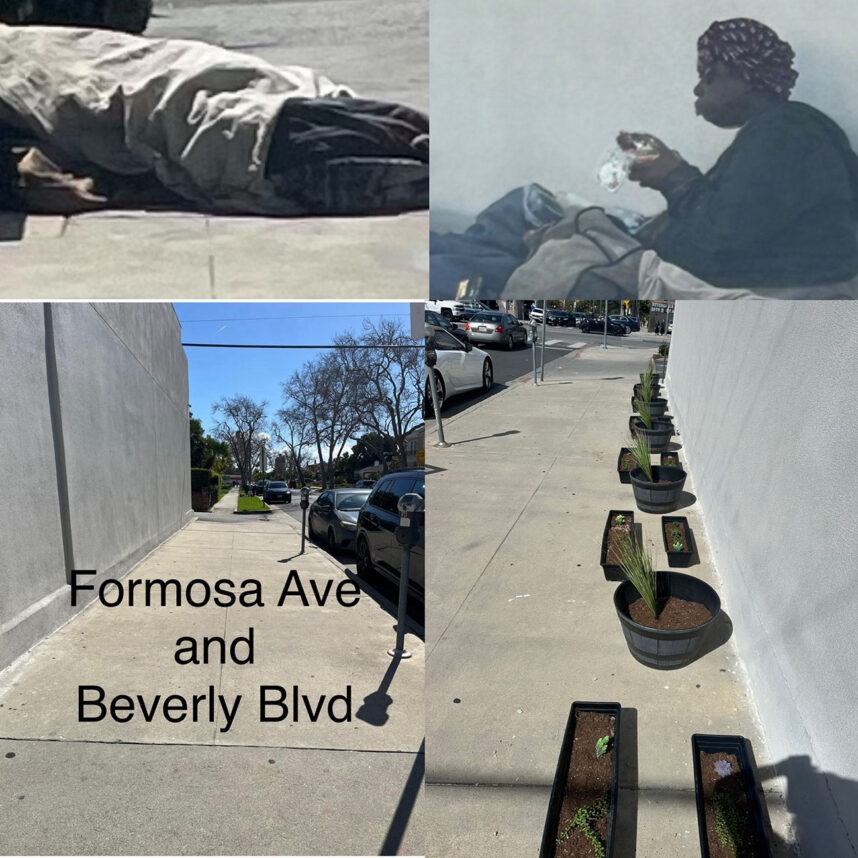
It wasn’t only residents who suffered but also local businesses dealing with homeless encampments right outside their doors. With no laws preventing tents from being set up anywhere, business owners were left to fend for themselves. Some found creative ways to address the issue, installing bike racks and large planters to deter transients.

“If you drive on Third Street and Beverly, you’ll see bike racks everywhere, and it’s not for bikers,” said Silverman. “Store owners were tired of the city council and the mayor not doing anything. They couldn’t get rid of the homeless person squatting next to their business. People couldn’t get into their stores, and they lost business as a result.”

Silverman applied the same strategy across Jewish neighborhoods in Los Angeles. She started in Hancock Park and recently did the same in the Pico area. She shows up as soon as a cleanup is underway and arranges for deterrents, often in the form of large, decorative planters that prevent transients from camping outside stores again. “If you don’t make deterrents, they’re going to keep coming back and start all over again,” she said.

Since starting her cleanup project, Silverman’s name has become well-known in Jewish communities and among business owners seeking her help. Building deterrents costs money for materials and labor, but the community, having suffered for years, is willing to pay.

Silverman doesn’t profit from her endeavor. In fact, she said, she uses her own money, time and energy for these projects.

 “They know I understand the law and policies, and I’m coaching them because you have to say the right thing, or no one will help you. The police are so understaffed and were defunded in 2020, the culture has become so anti-police and they’re scared to act.”

Silverman has become a full-time community and political activist. Before the presidential elections, she prepared a voter’s guide to help people choose candidates who were pro- police, law and order, parental rights and Israel. “I got 10,000 people to vote using my guide,” she said. “I picked up ballots, explained the candidates’ platforms and got people involved in Valley Village, Agoura, Pico, Beverlywood and other Jewish neighborhoods.”

Over a year has passed since Silverman cleaned up Hancock Park, proving it’s possible to resolve the problem. None of the homeless people have returned, having moved to other neighborhoods lacking an activist like Silverman.
Despite massive funds being spent on the homeless crisis, the problem persists, raising questions about where the money goes and why the city doesn’t change its policies.

“The city’s policy is the tolerance approach,” said Silverman. “But giving drug addicts clean needles and Naloxone to revive them isn’t tolerance—for them or for taxpayers and the innocent people walking by. It’s unacceptable. Somebody has to put a stop to this because it’s not working.”

If you would like to support the cause of cleaning up the Jewish neighborhoods of LA, consider donating to April Silverman.

Venmo: @AprilSilverman or Zelle: astone58@gmail.com

LA Resident Takes Neighborhood Cleanup into Her Own Hands Read More »
TLV Tapas Bar Celebrates Second Anniversary by Giving Back

The past two years have been full of ups and downs for TLV Tapas Bar, an upscale kosher Mediterranean restaurant in Tarzana. While the business is thriving, the shadow of October 7 and its aftermath have been lingering.

“The months following October 7 were especially difficult for us, both emotionally and operationally, as we worked to support our team and community while navigating the uncertainty of the situation,” said General Manager Or Peleg.

Then, the wildfires struck Los Angeles, burning only three miles away from the restaurant.

“That weekend was a very tense and challenging time for us,” Peleg said. “We lost over 90% of our reservations during the week of the fires, which was a significant blow to the business. However, our struggles are nothing compared to those who lost their homes and loved ones. It is what it is, and our hearts go out to those who were deeply affected.”

Since the fires began, TLV Tapas Bar has been donating meals to first responders and victims through the LA Community Meals initiative, as well as donating a portion of their restaurant proceeds to the fire department. And now, they’re continuing to give back, hosting their second anniversary in conjunction with the Los Angeles Trade-Technical College (LATTC) Foundation on Tuesday, February 4 at 7 p.m. at their restaurant.

“Partnering with LATTC is our way of supporting the next generation of culinary professionals,” said Peleg. “We’ve worked with talented culinary students, offering them opportunities to learn, grow and gain hands-on experience in a fast-paced restaurant environment. It’s incredibly rewarding to help nurture their skills and passion for the industry.”

The event will feature the restaurant’s signature dishes like zaaluk, which is fire roasted eggplant, Chilean sea bass, rib eye skewer with a charcoal baked potato and their homemade hummus with sumac, parsley and olive oil. The restaurant’s handcrafted cocktails will also be available.

TLV Tapas Bar is owned by Doron Goldberg, Tsahi Yom Tov, and Garry Aizin. According to Peleg, they all have a “deep love for Middle Eastern cuisine and hospitality.”

The restaurant is open until midnight on Thursdays and Saturdays, and guests who come on those days must be 21+ or accompanied by an adult. It is RCC kosher certified, and the regular menu features items like short rib cigar, bluefin lime sushi roll, charcoal roasted cauliflower steak, lamb chops and arais, which is charcoal roasted ground beef and lamb with pistachios wrapped in a thin flour tortilla and served with tahini and zaatar oil.

“TLV Tapas Bar stands out for its authentic and innovative take on Israeli cuisine,” said Peleg. “We’ve curated a unique menu that brings bold Mediterranean flavors to a modern tapas-style fusion experience. Beyond the food, we focus on creating a warm, vibrant atmosphere where guests feel like family.”

Though the past two years have not been easy, Peleg and the rest of the team are looking forward to commemorating TLV Tapas Bar’s anniversary.

“Despite the challenges, we’ve focused on staying resilient.”

“Despite the challenges, we’ve focused on staying resilient and continuing to provide a welcoming space for our guests,” he said. “We’re incredibly excited to celebrate this milestone anniversary with our guests and community. This event is not just about looking back but also about looking ahead to the future of TLV Tapas Bar. We want to thank everyone who has supported us and invite them to join us for this celebration—it’s going to be a night to remember.”

TLV Tapas Bar Celebrates Second Anniversary by Giving Back Read More »

OBKLA Volunteers Prep Meals, MOT Lights up Building for Hostages

Responding to the wildfires, Our Big Kitchen Los Angeles (OBKLA), a nondenominational nonprofit committed to fighting hunger, held a gathering at its kitchen space in Pico-Robertson to prepare meals for those in need.

The Jan. 19 event drew students and families from Chabad of Northridge as well as local community leaders, including Jewish Federation Los Angeles CEO Rabbi Noah Farkas and Los Angeles County Supervisor Lindsey Horvath.

Volunteers were divided into groups. Some prepared meatballs. Nearby, adults old enough to use sharp knives busied themselves with chopping vegetables, dicing squash into small cubes and removing the seeds from green bell peppers. Afterwards, everyone came together to bake chocolate chip cookies.

OBKLA volunteers prep meals. Photo by Ryan Torok

Indeed, it was a raucous, bustling atmosphere in OBKLA’s 4,600-square-foot kitchen space as everyone was still reeling from the fires that had devastated Altadena and the Pacific Palisades earlier this month.

OBKLA has organized multiple meal-prep sessions since the fires began, and people have been clamoring to help. Volunteer spots have been filling up in a matter of minutes, OBKLA Executive Director Yossi Segelmantold the Journal, resulting in a waitlist of approximately 1,500 volunteers.

“All we did since Jan. 9th is turbo-charge what it is we do all day, every day,” Segelman said. “We’re really trying to give people an opportunity to come and volunteer, even for a short period of time.”

This past Sunday, as the volunteers worked toward the goal of preparing 500 ready-to-eat meals, Leon Jankswas among those who turned out.

“The reason I support OBKLA is because it’s very easy to see the impact,” Janks, who was with his daughter and grandson, said. “You can measure the results. You get a lot of volunteers to come here and enjoy the experience of giving back. With not-for-profits, often it’s not easy to quantify the impact on the community. In this situation, Yossi [Segelman] measures exactly how much is produced, where it gets distributed, and the fact that it gets distributed to both Jews and non-Jews is very appealing to me. It’s really a community-based operation that serves everyone.”

“The metrics for me are the looks on people’s faces and that they’re not on their phone for two hours,” Segelman said.

OBKLA’s mission is uniting volunteers to cook and package meals for those facing hardship. The organization originated in Sydney, Australia before Segelman and his wife, Chaya, brought OBKLA to Los Angeles during the pandemic. The two started small, packing snack boxes in their garage. With the support of those including OBKLA Advisory Council Founding Chair Avi Hager, OBKLA’s work grew into a destination of volunteerism, where families and schools come together to cook and distribute meals for those in need.

In 2022, with the support of the Feder family, the group was able to move into its current kitchen space, the Margaret Feder Our Big Kitchen Los Angeles, which is in the heart of the city’s observant Jewish community. Margaret was a Holocaust survivor from Hungary.


On Jan. 19, Museum of Tolerance lights up in blue to commemorate the hostages brought home that day. Courtesy of Museum of Tolerance

The Museum of Tolerance lit its building—located on Pico Boulevardblue on the event of Jan. 19 to honor the release of three Israeli hostages that were freed from Hamas’ captivity earlier in the day, sending a message of hope and solidarity.

“In honor of the release of three Israeli hostages, The Museum of Tolerance in Los Angeles lit its building in blue on Sunday night,” a MOT statement said. “It will do so every time hostages are released to offer a wordless tribute to hostages returning home, those left behind, and those forever lost. This powerful and symbolic act will continue each night a hostage is released, Israeli, American, or from communities around the world.”

The blue light stands as a beacon of hope, healing, and solidarity, a tribute to those returning home, and a memorial for those who perished, according to the museum.

“We join the global community in praying for the safe return and recovery of all of the hostages, for those who perished to receive a proper burial in the land of Israel, and for an end to the suffering of civilians throughout this war,” the museum’s leadership said. “This light is our message: we welcome them home, and we will never forget.”

OBKLA Volunteers Prep Meals, MOT Lights up Building for Hostages Read More »

The Strands and the Cord – Thoughts on Torah Portion Va’eira 2025


The Strands and the Cord

Thoughts on Torah Portion Va’eira 2025


Throughout her discussion of this week’s Torah portion, Va’eira (“I appeared”) in her The Particulars of Rapture, Avivah Zornberg draws fascinating parallels among three main protagonists – Moses, Pharaoh and the Israelites, starting with last week’s Torah portion, Shemot.


Look at Exodus chapter 3:2 from last week’s Torah portion. Etched in the memory of the reader is this: “An angel of God appeared to him (Moses) in the heart of the fire within the bush, and he (Moses) saw that the bush was aflame but not consumed. Moses said (to himself), ‘I shall turn aside and look upon this great sight, why the bush is not consumed.’”


God’s voice replaces the appearance of the angel and calls out to Moses. God sets out the ground around the bush as holy. God identifies God’s self. Moses hides his face, “For he was (too) awestruck to gaze toward God.” After a lengthy introduction, God gives Moses his mission, “I shall send you to Pharaoh, and you shall take my people Israel out of Egypt.”


The reader is awestruck by the appearance of the Angel in the heart of the fire, and then the Voice of God being revealed to Moses. From that voice comes Moses’ life’s purpose. In God’s commanding Moses to lead the people out of Egypt, all the strands of Moses’ painful past are tied into a cord. The fugitive from justice will lead an exodus of slaves and deliver harsh justice to Pharaoh and his minions.


At least, that is what sticks in my mind when I recall the story. I don’t remember right away Moses’ getting over his awe rather quickly, saying in response to God, “But why me?” It was a complaint, not a question. Moses’ response takes the air right out the story.


In the Midrash that Zornberg presents in this week’s Torah portion, a protracted days-long argument followed the call of Moses, Moses insistently choosing, for one reason or another, not to accept the mission. God, unlike the IMF, doesn’t say, “this mission, should you choose to accept it . . ..” God had already said “yes” for Moses. God wanted to reason with Moses and get Moses to say “yes” himself.


In the end, Moses hears everything God had to say, but demurs. “No one will believe this.” God promises to take care of the people’s disbelief, predicting the miracles in this week’s Torah portion, Va’eira.


Moses changes tactics. Despite his eloquent arguments against God presented in the Midrash, Moses says (in Exodus 4:10), apparently without a shred of irony, “We’ve been talking for three days now. You know I am not good at speaking. I can’t do this!” God says, in all caps, “GO! I WILL BE WITH YOUR MOUTH AND TELL YOU WHAT TO SAY.” Just follow the script!


Moses responded dismissively, effectively saying, “Yeah, whatever, fine. Send anybody you want.” God’s wrath finally burned against Moses and God made an offer that Moses apparently could not refuse. Moses said yes, but started his mission halfheartedly.


Moses told the people what happened between him and God at Mt. Sinai, but to Moses’ amazement, they actually believed him (Exodus 4:29-30). The text is not being entirely straightforward with us, the readers. The people believed that what Moses told them did happen, but it turned out that it just didn’t mean that much to them. They turned out to be like Moses, denying the mission, refusing to hear.


Pharoah is presented in the text as an odd parallel to Moses and the Israelites. Pharaoh hears everything, including the warning of the plagues and the sword. Pharoah answers, in similar fashion to that odd positive-negative in use today, “Yeah, no.” “Yes, I believe what you are saying, but no, it doesn’t make any difference to me.” Pharaoh takes out his own wrath on the Israelites, who lose faith in Moses fairly quickly. They say, “May God judge you Moses! It’s all gotten worse!” Moses, the people and Pharaoh, and even God, start to look like each other. No one is listening to the other.


What a bizarre story! The strands of the heart of the fire, the voice of the Eternal One, the promise of freedom all dramatically unravel in the verses that follow the call of Moses at the Burning Bush.


Refusal. Insolence. Denial. Half-heartedness. Wrath. Faith gained and abandoned. Blaming. Pain and suffering. Fear. Something was troubled way down in Egypt land.


And then, peeking out from this story, are verses that echo to us from the book of Genesis, from the story of Rebecca and her pain in her troubled pregnancy. Rebecca went to seek of God in her pain, and said Hebrew words almost impossible to translate, (Genesis 25:22), “Im ken, lamah zeh anokhi,” “If thus, why do I exist?” The answer – that there were two nations struggling in her womb – did not bode well. The troubled pregnancy augered further unraveling.


At the end of last week’s Torah portion, capping the entire unraveling at the beginning of the book of Exodus, Moses said to God (Exodus 5:22), “Why have you done evil to this people and why did you send me (lamah zeh shelachtani)?” “Lamah zeh?” “Why?”


This subtle reference to the pregnancy of Rebecca has us re-ask all our questions of last week’s Torah portion in a different tone, “Why does this story exist?” Why did God choose such an unfit servant? Why did God redeem an unfit people? Why was Pharaoh impervious to truth? Why did things go so terribly wrong? Why didn’t God matter to the people? These questions are only sharpened in this week’s Torah portion.


With this reference to the pregnancy of Rebecca, we know the answer: Because this is the way things are. Life is tragic. Each part of the story stands for parts of our inner lives, our lives with others, and our lives with God. There is trouble in the womb of consciousness. The pregnancy of self is painful, the birthing of self produces woe. Things fall apart and then fall apart some more. When you are in the midst of things falling apart, you ask “why?” Once the strands start to form a cord, you know why. The answer is in the cords. Cords come from strands.


There are those moments of strands becoming cords. When Joseph and his brothers reconciled in Egypt. When the waters broke at the Sea of Reeds. When the people would go to Mt. Sinai, to the place where Moses saw the angel in the heart of the fire. The people saw the angel in the heart of the fire too, for just a moment. If only our gaze could hold the appearance of the angel in the heart of the fire. If only our minds could hold the voice of God. If only our purpose could resolutely guide the path before us.


That’s not the way things are. We must continuously take the strands at the margins of life and form them into cords. The cords then unravel. We rewind the cords. It’s our mission, our purpose, as we trudge down Highway 61.

The Strands and the Cord – Thoughts on Torah Portion Va’eira 2025 Read More »

Mexico Responds to Trump by Regaining Its Pride

Did you see that new movie about tens of millions of U.S. citizens crowding the border with Mexico desperate to get out of America?

No, because it doesn’t exist.

But it does suggest an interesting thought experiment: What does it say about a country when so many of its citizens are desperate to flee? Indeed, it seems that the biggest story coming out of Latin America in recent years has been the caravans of millions of migrants headed for the U.S. border.

Don’t these leaders have any pride?

Well, according to a new report in The New York Times, it looks like Mexico at least has taken that question to heart. It has turned the tables on President Donald Trump by welcoming its people back home.

Reacting to Trump’s aggressive plans to deport undocumented migrants, our southern neighbor has launched a new program called “Mexico Embraces You.”

“Plans are underway to build nine reception centers along the border — massive tents set up in parking lots, stadiums and warehouses — with mobile kitchens operated by the armed forces,” according to The Times.

The report adds: “Nearly every branch of government — 34 federal agencies and 16 state governments — is expected to participate in one way or another: busing people to their hometowns, organizing logistics, providing medical attention, enrolling the recently returned in social welfare programs like pensions and paid apprenticeships, along with handing out cash cards worth about $100 each.”

The plan also includes negotiating agreements with Mexican companies to link people to jobs.

“We are ready to receive you on this side of the border,” Mexico’s interior minister, Rosa Icela Rodríguez, said at a news conference this week. “Repatriation is an opportunity to return home and be reunited with family.”

It’s too early to say, of course, how well this new program will work and whether it can be sustainable.

It’s also important not to be overly judgmental on the immigration issue. Our nation was founded on immigrants and on everything they have contributed to our society. Today’s Americans are the descendants of yesterday’s immigrants.

The crisis today is different, rooted in a quasi-open border policy that made a mockery of the law and led to massive waves of illegal immigration. This is why two thirds of the country—including Democrats, Republicans and many Latinos as well—supports a tougher border policy, especially when it comes to dealing with criminals.

But U.S. policy has to do with U.S. obligations. We can agree or disagree on those policies.

The obligations of the countries where the migrants come from are a whole other matter.

Traditionally, when we see caravans of migrants desperate to reach our borders, we have a tendency to see only our own obligations– our need for compassion, for a welcoming spirit, indeed our need for immigrants.

But that is only half the story.

Mexico’s program to welcome back its citizens suggests that the other half of the story can be more aspirational. Instead of assuming and accepting that citizens must leave your country to have a better life, why not offer them hope in their own home so they don’t have to leave in the first place?

I got a taste of that idea a few years ago when I went on a humanitarian mission to Guatemala with the Israeli NGO IsraAID. At the time, the country was still traumatized by a 2018 volcano that was the worst it had seen in 45 years.

What caught my attention was that the NGO didn’t just come to help with emergencies. It stuck around. Its volunteers moved into villages and worked for up to a year with the locals to improve their daily lives.

“We see plenty of ‘hit and run’ type of humanitarian work, when activists fly into disaster areas, provide emergency aid, and then move on,” I wrote in a column about the trip. “IsraAid provides emergency aid but does a lot more than that, so their teams tend to stick around. They bring Israeli know-how, from technology to trauma therapy, to people who need it on a daily basis. They also bring plain old human compassion.”

How does this relate to our immigration crisis and Mexico’s new approach? It brings up a new, common-sense paradigm— the better you can improve people’s lives in their own home, the less they’ll feel life fleeing to another country. And yes, that includes dealing with your own criminal element.

Who knows, if one day some Americans feel like moving to Mexico in search of a better life, maybe they’ll turn that into a movie where Mexico will proudly embrace them.

Mexico Responds to Trump by Regaining Its Pride Read More »