[Isaac told Jacob] Do not take a wife from among the Canaanite girls… ~ Genesis 28:6
These are things I tell my son
in the same way that Jacob told
his son things…
Be nice.
Don’t drive faster than
the signs tell you.
Don’t judge the Canaanite girls
or any of the girls, or any of
the people.
Eating lunch is important.
Lead up to it by
eating breakfast.
Do the things you need to do
well before the deadlines
to do them.
Practice. I’m not sure what
but whatever it is
practice.
Try not to let us see you rolling
your eyes. We know they’re rolling,
but we don’t need to see it.
Be generous. Don’t focus on
what you’re owed, but what you
can give to make it better.
Be even nicer.
Marry a nice someone or other.
Have kids, or a kid, or no kids.
Make them read this.
Be comfortable knowing they’ll
ignore it until it’s time to
share it with their kids.
Be nice to your kids
even when they do the things
that make your hair fall out.
Like Jacob, I won’t be here forever.
So hold onto this.
The end is coming.
Don’t rush to get there.
There’s nothing after.
Rick Lupert, a poet, songleader and graphic designer, is the author of 28 books including “God Wrestler: A Poem for Every Torah Portion.” Visit him at www.JewishPoetry.net
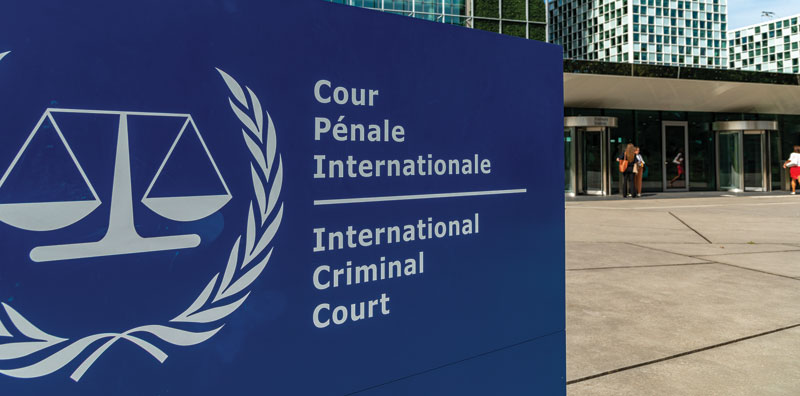
It’s official. The International Criminal Court has issued arrest warrants for Prime Minister Benjamin Netanyahu and former Defense Minister Yoav Gallant for alleged war crimes in Gaza.
Commenting on the ICC’s decision, Netanyahu condemned it as an act of ‘antisemitism,’ likening it to ‘a modern-day Dreyfus Affair,’ referring to the wrongful conviction of a Jewish officer in France that exposed widespread antisemitism in the 19th century.
Now, here’s the thing—I am in no mood to defend Benjamin Netanyahu right now.
Not only did he preside over the most devastating security breach in Israel’s history, but he has flatly and consistently refused to take any responsibility for the catastrophes that happened under his watch.
His coalition of extremists and provocateurs has sullied Israel’s image abroad at a time when international scrutiny and condemnation are already at a high.
He has recklessly strained Israel’s relationship with America.
And finally, and most horrifyingly, he has abandoned the hostages to their fate for the pettiest of political considerations.
For the people of Israel to have such a terrible leader during this grave moment of crisis is nothing less than a tragedy—one which we are forced to watch unfold, day after day, as it lurches towards an uncertain end.
Having said all of that, it must still be pointed out that the ICC has no right to charge Netanyahu with anything. As written in the Wall Street Journal, “the ICC only has jurisdiction over its member states, but Israel isn’t a member and Gaza isn’t a state.” Moreover, the ICC’s mandate is complementary, which is to say that they are only supposed to intervene with countries that have no internal mechanisms for investigating and prosecuting their own crimes.
This is why the only other leaders that have been charged by the ICC are from countries like Russia, Sudan and Libya. This is not because only benighted nations break international law. Rather, it’s because the ICC is only supposed to act when national courts are unable or unwilling to prosecute.
Israel, however, has a strong independent judiciary, one which has locked up prime ministers, and which is currently investigating allegations of criminal activity at the Sde Teiman detention facility, as well as a number of other incidents from the current war.
Indeed, one of the main arguments against Netanyahu’s controversial judicial reform plan was that it would leave Israel vulnerable to prosecution in international courts. So much for that. Now Netanyahu can say that an independent judiciary didn’t end up protecting Israel after all. He’ll be correct.
This is not the first time that bodies charged with preserving the international order have been weaponized against Israel. Let us not forget that on October 7th, the day that this horrible war began, UN staffers from UNRWA—the UN agency tasked with serving Palestinians throughout the Middle East—were among those who streamed across the border from Gaza to participate in the frenzy of killing, kidnapping, raping, and looting.
Later, when Israel’s troops pushed into Gaza, they discovered that UNRWA buildings were regularly being used to store weapons and conceal tunnels.
The UN’s many entanglements with Hamas in Gaza ought to redden the face of the international community and prompt them to consider what moral authority they have to cast aspersions on Israel’s military response.
The UN’s many entanglements with Hamas in Gaza ought to redden the face of the international community and prompt them to consider what moral authority they have to cast aspersions on Israel’s military response.
But while UN staffers literally participated in the invasion of southern Israel, their actions in the north have been worse than useless.
Few people were even aware that UNIFIL—the United Nations Interim Force in Lebanon—still existed. That is, until world leaders were suddenly deeply concerned that UNIFIL troops would be harmed by Israel’s campaign against Hezbollah.
What they should have been concerned about was the fact that these alleged peacekeepers had done nothing to keep the peace. Despite their presence in southern Lebanon, Hezbollah was able to take control of the region and use it as a launching pad for an illegal and immoral war on Israel—a war that has decimated Israel’s northern communities and continues to claim the lives of civilians and soldiers.
For those concerned that UNIFIL troops might be injured, the answer is obvious. Evacuate them immediately and send them back to their home countries instead of demanding protections so that their pointless commission can continue indefinitely.
In short, Israel has been attacked by UNRWA, failed by UNIFIL, and now charged with war crimes by the ICC.
There is only one conclusion to draw, and as much as I resent Netanyahu, as much as I pray for the day when he is replaced by someone with integrity and courage, as much as I see him as a true threat to Israel’s survival as a Jewish democracy, I must concede that here, in this instance, he is correct.
This is antisemitism.
This is a modern-day Dreyfus Affair.
Matthew Schultz is a Jewish Journal columnist and rabbinical student at Hebrew College. He is the author of the essay collection “What Came Before” (Tupelo, 2020) and lives in Boston and Jerusalem.
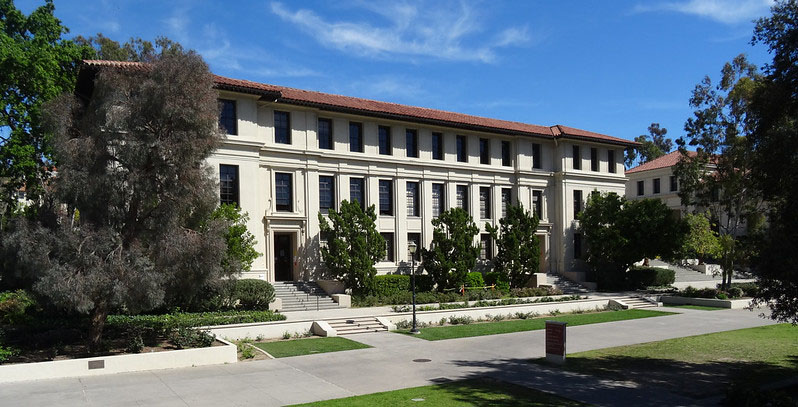
The Anti-Defamation League (ADL) and Louis Brandeis Center for Human Rights Under Law reached a settlement agreement with Occidental College over a Title VI complaint filed to the Department of Education’s Office of Civil Rights (OCR) alleging that the college failed to properly address antisemitic incidents on campus.
The Journal previously reported on how the complaint, which was filed in April, alleged that Jewish students were bullied and harassed on campus. Occidental President Tom Stritikus, who came into office in July, announced on Nov. 26 that the voluntary settlement agreement had been reached on Nov. 22.
“While the College has not confirmed all the facts and characterizations in that complaint, we validate the experiences and perspectives of our students,” Stritikus said. “Throughout this process, College leadership has heard from students across the ideological spectrum — including Jewish students for whom Zionism is a core component of their religious or ancestral identity, and Jewish students who express their faith in other ways. During the mediation process, we learned more about several Jewish students’ experiences and concerns; discussed potential remedies with the OCR, the Brandeis Center, and the ADL; and continued to move forward with the College’s Plan for Building Community and Promoting Dialogue.”
“During the mediation process, we learned more about several Jewish students’ experiences and concerns; discussed potential remedies with the Office of Civil Rights, the Brandeis Center, and the ADL; and continued to move forward with the College’s Plan for Building Community and Promoting Dialogue.” – Tom Stritikus
The agreement acknowledges that Occidental has already voluntarily taken various measures to address the campus climate, including an updated Discrimination, Harassment and Retaliation (DHR) policy to include “examples of prohibited conduct that could constitute disparate treatment or harassment based on shared ancestry, such as Jewish identity,” mandatory student training on the DHR policy and Title VI and “updates to the College’s time, place, and manner policies to place reasonable limitations on the hours and conduct of demonstrations on campus.” The college will also use the International Holocaust Remembrance Alliance (IHRA) definition of antisemitism when examining reports of antisemitic incidents. These measures will be continued through the 2025-26 academic year under the agreement and the policies will be reviewed prior to the beginning of the Fall 2025 academic year.
Per the settlement, the college will provide “expert-facilitated training” to the Bias Education and Support Team and Civil Rights & Title IX staff at the college that “will include examples of conduct that may constitute discrimination against Jewish or Israeli students based on their Zionism as an integral part of their religious or ancestral identity.” IHRA will also be used in “educational materials that will be made available on Occidental’s website.”
Stritikus went on to say, “although it is important to note that OCR did not open an investigation or issue any findings of noncompliance with Title VI, Occidental acknowledges that multiple students raised concerns, both informally and formally, about feeling excluded from the campus community based on their Jewish and Israeli identities. As I believe this Resolution demonstrates, antisemitism is antithetical to the College’s values, and discrimination against Jewish and Israeli students should be unequivocally rejected in our community. As we continue campus discussions around inclusivity, Jewish and Israeli identities should be recognized alongside other groups that have historically faced discrimination due to their religious, ancestral, or national identities.”
ADL CEO Jonathan Greenblatt said in a statement, “we are pleased that Occidental College has committed to meaningful steps to ensure that the civil rights of Jewish students on campus are protected and affirm that antisemitism has no place on campus,” “This outcome demonstrates how the Title VI OCR process can work to effectively protect Jewish students. We are deeply grateful for the U.S. Department of Education’s dedication and assistance in resolving this case. It is our hope that this resolution will lead to other college administrators implementing these or similar measures proactively to address antisemitism on campus.”
Brandeis Center President Alyza Lewin also said in a statement, “This agreement demonstrates Occidental College’s commitment to counter all forms of contemporary antisemitism and underscores their recognition that effectively combatting antisemitism requires understanding the relationship between Jewish identity, Israel, and Zionism. We are gratified by the school’s engagement in meaningful discussions at the highest levels of the administration, and we are heartened that Occidental has committed to creating a safer environment for Jewish students. When implemented, this agreement will help ensure that Jewish students are able to learn and thrive in an environment free from anti-Semitic hate, discrimination, and harassment.”
Israeli-born educator Metuka Benjamin is fond of the Theodor Herzl quote, “Im tirtzu ein zo agadah,” Hebrew for, “If you will it, it is no dream.” It’s a sentiment she applied to her life’s work building Jewish day schools in Los Angeles. And it’s a notion the Jewish educator is applying to her latest initiative: Connect Israel.
Metuka Benjamin
In the Diaspora Jewish community, there’s no shortage of organizations that focus on bringing young Jewish adults on short but impactful trips to Israel. While Birthright Israel is the most well-known, there are countless other groups that provide the coveted demographic of 20- and 30-somethings with the opportunity to familiarize themselves, up close and personal, with the Jewish state.
For Benjamin, the key question was: How do you keep them engaged with the Jewish State after they’ve returned to the United States? “Many participants of these programs have been frustrated there was no ‘day after’ to involve them beyond their trip,” she said. “I’m trying to change that.”
A recent Pew Report showed the growing disconnect between young American Jews and Israel. It’s precisely for this reason that Benjamin has undertaken the new initiative. Dr. Stephen Marmer, a Los Angeles-based psychiatrist and the founding chairman of Connect Israel, explained that Benjamin realized that to cement a deeper connection between American Jewry and Israel, “she needed to establish an organization that had an ongoing, hopefully lifetime interaction, based both on business and professional interests, but also personal interests.”
A recent Pew Report showed the growing disconnect between young American Jews and Israel. It’s precisely for this reason that Benjamin has undertaken the new initiative.
Designed for those ages 30-42 who’ve achieved midcareer professional success, Connect Israel is a multidimensional, experiential and, most importantly, lifelong program with the aim to strengthen American-Jewish and Israeli bonds by offering unprecedented experiences, professional collaborations and friendships between American Jews and their Israeli counterparts.
Those who participate get more than a trip to Israel.The program includes a leadership network, career acceleration, workshops and mentorship. The only criteria for being accepted into the program is the person must’ve traveled to Israel on an organized program in the past. “My goal is that the American-Jewish visionaries of tomorrow have a lifelong relationship with the State of Israel,” Benjamin, founder and CEO of Connect Israel, said in a recent interview at her home in Westwood. “We’re investing in a Jewish future.”
“My goal is that the American-Jewish visionaries of tomorrow have a lifelong relationship with the State of Israel … We’re investing in a Jewish future.” – Metuka Benjamin
Founded in 2019, the program is highly subsidized, though participants are responsible for paying for their travel to Israel, where they spend approximately one week. Benjamin says that while she’d initially intended for the program to be free, she quickly realized those participating in Connect Israel had the means to pay for aspects of the program. Early participants of Connect Israel readily agreed to paying for their own travel, she said.
But Connect Israel is “not a sightseeing trip,” Benjamin emphasized. While participants of other programs visit the Western Wall, the Dead Sea and Masada, Connect Israel reaches people at a different, more mature stage in their lives.
Participants spend their days differently than they would on other trips. Their time in Israel includes meeting high-level experts in numerous fields, including communications expert Frank Luntz; journalist Khaled Abu Toameh; Amir Hayek, the first Israeli ambassador to the United Arab Emirates; and OurCrowd CEO Jonathan Medved, named one of Israel’s 50 most influential Jews by The Jerusalem Post.
As of 2022, the United Arab Emirates has also entered the mix. The Abraham Accords — which saw four Arab countries, including the UAE, normalize relations with Israel — has allowed Connect Israel to expand and include midcareer professionals from UAE in the program as well. In 2022, participants of Connect Israel traveled to Dubai and Abu Dhabi — a visit, Benjamin said, that “opened the door for future relations, investment and opportunity.”The group met with UAE Minister of Tolerance Sheik Nahayan Mabarak Al Nahyan, among others.
A Lifelong Educator
Those who know Benjamin — whose first name, “Metuka,” is Hebrew for “sweet” — know she has two passions: Jewish education and Israel. In pursuit of the former, she spent more than four decades leading the Stephen Wise and Milken day school communities in Los Angeles before retiring from the position of Milken Community School president in 2018.
Born in 1936, in Tel Aviv, before Israel was officially declared a nation-state for the Jewish people, Benjamin was raised by a Lithuanian father and American mother. She spent her early life in Israel — where her father opened an American-style ice cream company, Kar Tiv — until the family emigrated from Israel to the U.S. and settled in New York. At the time, Benjamin was 15. Later, she attended Columbia University’s Jewish Theological Seminary, where she received a master’s degree in Jewish education.
After moving to Los Angeles, her introduction to Jewish education was working as a teacher at Temple Emanuel of Beverly Hills. There she met Rabbi Isaiah Zeldin; they co-founded Wise’s educational system, which today includes an early childhood center and elementary school. Their efforts, according to Jewish education experts, legitimized the idea of Reform Jewish day schools.
Alongside with pioneering work in Jewish education lasting more than four decades, Benjamin always kept her eye on Israel. For decades, she’s fundraised for causes there close to heart, including for the Israeli air force, the country’s hospitals and for populations living on the peripheries of Israeli society, including the Ethiopians.
The extent to which she, an Israeli expatriate, has been embraced by Israel is uncommon. In 2005, she and Canadian philanthropist Charles Bronfman were selected to light the Independence Day torches in Israel during an annual ceremony on Mount Herzl, a rare honor for Israelis who’ve left the country.
Marmer attended the Yom HaAtzmaut ceremony in Israel where Benjamin was honored with torch-lighting duties. The two have known each other for decades, their relationship dating back to Benjamin’s school-building days.
“She’s a dynamo,” Marmer said. “She’s got unbelievable energy, creativity, passion. She’s just a phenomenon. I count it among my great blessings to have been her friend for so many decades.”
Benjamin attributes much of her success to her mentor, the late Rabbi Zeldin. A formidable fundraiser, supporter of Israel and believer in Jewish education, Zeldin taught Benjamin the way to attract supporters of any new endeavor is to “sweeten the pie,” she said — meaning to offer it at no charge. “To me, my hero was Rabbi Zeldin,” Benjamin said. “I learned a lot from him, and from his wife, Florence Zeldin.”
Connect Israel Fellows
Participants of Connect Israel — or “fellows,” as Benjamin calls them — have come from a variety of professional backgrounds. One fellow is entertainment attorney Eden Rachel Cohen. Cohen said her experiences with Connect Israel have been invaluable. One of the highlights, she said, was meeting with Luntz. The successful communications consultant and pollster taught Cohen strategies she’s since incorporated into her work, she said.
For Cohen, meeting with Luntz as well as other “high level” leaders was a gamechanger. “The level of access was amazing, the people we met were so high level, and I can’t imagine going to any other country and being welcomed by the leaders of a nation in this way,” Cohen said. “The amount of time we got to spend with the Israelis was unlike any other program that I’ve been on. The way the Israelis opened their workplaces and homes to us formed a basis for a lifelong relationship with all the people we got to meet.”
Another fellow, Alex Weil, is a software engineer at Google. Prior to his trip with Connect Israel, he’d been to the country approximately 20 times, including four trips while in middle school and high school at Milken Community School. However, before his Connect Israel experience, he hadn’t developed any relationships with other young professionals in Israel. That all changed because of Connect Israel. During his trip, he spent his days meeting business and tech leaders while enjoying shared experiences with Israelis at a similar stage in their lives.
Connect Israel was “different than any of the organized trips I’ve done in Israel,” Weil, 28, said in a phone interview. “There was an assumed familiarity already with Israel. No one had to learn what Tel Aviv or Jerusalem was … I loved going to the Dead Sea and Masada, but I don’t need to do that again. The goal was to learn things I wouldn’t learn in other contexts, so [with] some of the speakers who were on the agenda, there was an opportunity to get insights and make connections with Israelis I wouldn’t have [otherwise had] the chance to do.”
Daniel Siegel, 29, learned about the organization through his former boss, Luntz. He joined Connect Israel on its inaugural trip in 2019, and he returned to Israel as a Connect Israel fellow in 2022. The latter trip included several days in the UAE, with the group spending time in Dubai and Abu Dhabi.
From the beginning, Siegel, a L.A.-based tech communications strategist, saw his participation in Connect Israel as an opportunity to “broaden and deepen my commitment and interest in Israel,” he said in a phone interview.
Ultimately, it is precisely these ongoing connections between Americans and Israelis that sets Connect Israel apart, Marmer said. “We’re trying to establish meaningful relationships and be a catalyst for ongoing business and personal interchange.”
What’s Next?
Benjamin is pleased with the early successes of Connect Israel, but she has her mind on even more growth. For one, she’d like to facilitate the involvement of the spouses of the current fellows. Additionally, she’d like to find ways to engage young adults who are ages 26-29.
Since Oct. 7, the organization has adopted three kibbutzim in Israel — kibbutzim Nir Am, Nahal Oz and Holit — and is supporting the development of early childhood programs in the three Gaza-adjacent communities.
“We’re trying to help them raise money,” Tomer Nitzan, a Connect Israel fellow from Israel, said in a phone interview from his home in Tel Aviv. “They’re like refugees in their own country at this point.”
Nitzan, 42, became involved with Connect Israel through his association with Stephen Wise Temple summer camps, where he worked as a counselor. When he first became active in Connect Israel, it was in 2022. At the time, many of his conversations with fellows from the U.S. were focused on the protests over judicial reform in Israel. After Oct. 7, however, many of the discussions—mostly held over Zoom—have been about the ongoing war.
As the head of the U.S.-Israel desk for BDO, a leading accounting and consulting firm in Israel, he routinely travels back and forth between Israel and the U.S., and he can visit with fellows who live here. His experience is proof that Connect Israel has been successful, he said, in “ensuring there is a constant relationship between the Jewish communities in the U.S. and the State of Israel.”
Led by a board that includes L.A. husband-and-wife Julie and Peter Weil; former Consul General of Israel in Los Angeles Jacob Dayan; and Rabbi Abraham Cooper of the Simon Wiesenthal Center, Connect Israel is seeking financial support from the community.
Benjamin readily admits fundraising is not her forte — she’s more comfortable focusing on recruitment, education and developing the programmatic aspects of Connect Israel, she said. But the need for philanthropic support is a reality, and she’s hoping the community recognizes the value in what Connect Israel’s offering.
She says she’s not trying to take away from the Israel-focused programs that are already out there, be it Birthright Israel or something else. Rather, Connect Israel provides the next step in strengthening ties between the Diaspora American-Jewish community and Israelis, she said. “The whole thing is Am Echad,” Benjamin said, using the Hebrew term for “one people.” “We want it to spread everywhere.”
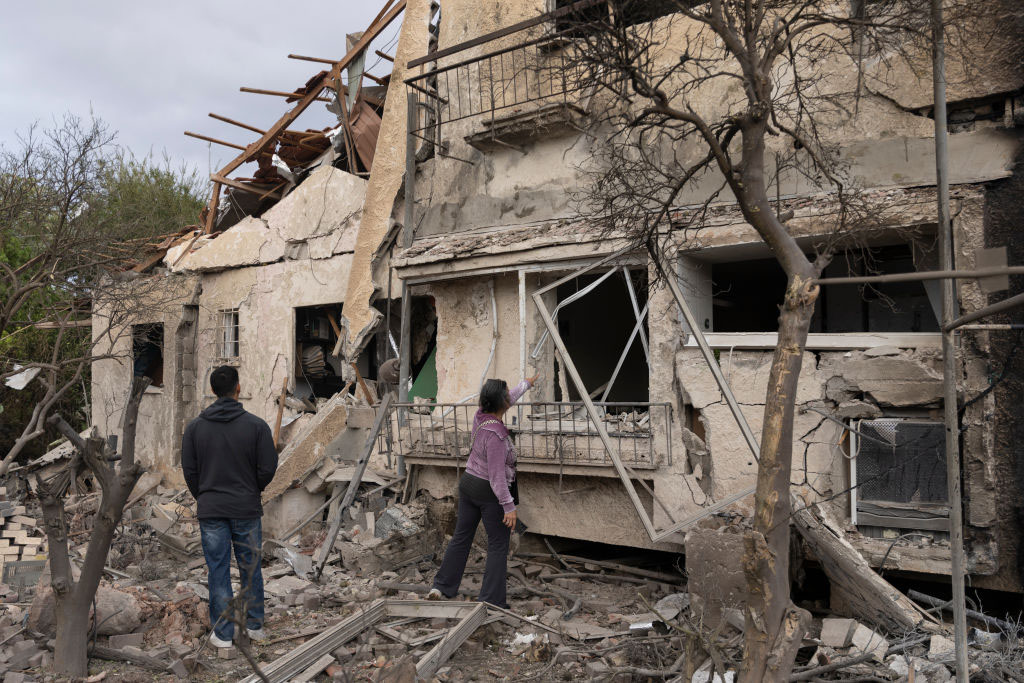
(Nov. 26, 2024 | Updated Nov. 26, 16:09 / JNS) The Israeli Security Cabinet voted on Tuesday evening to approve a ceasefire with the Iranian-backed Hezbollah terror group in Lebanon.
The Prime Minister’s Office announced that the Security Cabinet, which is responsible for all defense-related decisions and composed of senior ministers, voted in favor of the deal with Lebanon by a majority of 10-1.
“Israel appreciates the U.S. contribution to the process and maintains its right to act against any threat to its security,” the PMO statement added.
The sole member of the Security Cabinet to vote against the agreement was National Security Minister Itamar Ben-Gvir, local media reported.
Earlier on Tuesday, CNN cited an Israeli source familiar with the matter as saying that Prime Minister Benjamin Netanyahu was seeking to bring the deal before the Security Cabinet only, rather than the full Cabinet.
Hebrew media quoted officials as saying that the potential move would be legally sound, as a temporary ceasefire with Hezbollah is considered a security question rather than a political one.
According to the reported terms of the agreement, Israel Defense Forces troops are expected to gradually withdraw from Southern Lebanon over a 60-day “transition period,” while the country’s official Lebanese Armed Forces is deployed to the border region.
Jerusalem has pledged to halt “any offensive military action against targets in Lebanon, including on the ground, in the air and at sea.”
Hezbollah has promised to relocate its “military infrastructure” north of the Litani River, located some 18 miles north of the border with Israel.
The deal includes an oversight committee, which the United States will lead, to monitor implementation and address potential violations.
U.S. President Joe Biden confirmed in a televised statement that followed the Israeli Cabinet decision that, “effective at 4 a.m. tomorrow local time, the fighting across the Lebanese-Israeli border will end.”
As the Israeli Security Cabinet met to approve the deal on Tuesday evening, air-raid sirens were activated across the Galilee and Haifa regions, warning of more rocket and missile fire from Lebanon.
Meanwhile, the IDF issued evacuation orders for structures in the Lebanese cities of Tyre and Sidon, announcing that the Israeli military would “soon act against Hezbollah infrastructure located in the area.”
Hassan Fadlallah, a Lebanese lawmaker representing Hezbollah’s March 8 Alliance, told the Reuters wire agency earlier on Tuesday that the terrorist organization would “remain active” after the war ends, including to help rebuild areas destroyed by Israeli airstrikes.
A Hezbollah official told Qatar’s Al Jazeera following the Israeli approval that the terror group still needs to “examine the points that Netanyahu agreed to before the [Lebanese] government signs tomorrow.”
Authorities in northern Israel have canceled public gatherings until Thursday, anticipating a flare-up in violence ahead of the truce.
On Sunday, Hezbollah fired more than 240 projectiles at Israel, marking one of the most intense days of hostilities since the Lebanese terror group joined the war in support of Palestinian Hamas on Oct. 8, 2023.
Lawmakers of the Knesset Foreign Affairs and Defense Committee sent an urgent request to Israeli Defense Minister Israel Katz on Tuesday afternoon to reveal the terms of the agreement under discussion.
“Following publications about Israel’s intention to sign a deal in the north, we, representatives of the undersigned coalition and opposition parties, demand to summon Defense Minister Israel Katz, to present the principles of the agreement,” the coalition Knesset members Amit Halevi (Likud) and Ohad Tal (Religious Zionism) stated.
Israeli Finance Minister Bezalel Smotrich, a senior member of the Security Cabinet, informed Netanyahu of his four demands for supporting the agreement, Israel’s Channel 12 News reported.
The Religious Zionism leader reportedly pressed the premier to call a Cabinet vote on every withdrawal from Lebanon, respond to Lebanese violations of the deal within 48 hours, hold the government in Beirut responsible for any attack from Lebanese territory and ban rebuilding destroyed infrastructure in Southern Lebanon.
Hezbollah has attacked the Jewish state nearly daily for more than a year, firing thousands of rockets, missiles and drones across the border.
More than 60,000 residents of Israel’s north remain internally displaced due to the ongoing cross-border attacks from Lebanon. The attacks have killed at least 76 people in Israel, including 31 IDF soldiers and six foreign nationals. More than 700 have been wounded.
Jerusalem has escalated attacks on Hezbollah since adding the return of displaced citizens to northern Israel to its official war goals on Sept. 17.
On Sept. 30, the IDF announced that ground forces had moved to “limited, localized and targeted raids” inside Lebanon. More than 40 IDF troops were killed by Hezbollah terrorists during the two-month-long ground maneuver, according to official military data.
U.N. Security Council Resolution 1701, which brought an end to the 2006 Lebanon War but was never enforced, mandated the complete removal of Hezbollah south of the Litani River and banned the presence of armed groups in Lebanon except for the Lebanese army and U.N. peacekeepers.
It’s traditional at this time of year to reflect on the many things we’re grateful for. At Thanksgiving tables across the country, many families will go around and share those feelings of gratitude.
These expressions tend to be predictable— grateful for family, friendships, good health, freedom, etc.—but that doesn’t make them any less valuable. Indeed simplicity is the very essence of gratitude— a straightforward act of saying thank you for the many things we so often take for granted.
In that sense, Thanksgiving is an unabashedly corny holiday in the best possible way. Few things can deepen our humanity and our relationships like showing genuine gratitude.
That said, with the kind of year we’ve been through, as we prepare for this great American holiday I’ve been thinking about a flip side to gratitude, one that’s not as cheerful or innocent.
Maybe because we’ve seen so many tragedies this year, it seems as if my gratitude has instinctively gravitated towards the absence of bad stuff rather than the presence of good stuff.
My mind, in other words, has been less preoccupied with the presence of blessings than with the many bullets we dodge as we go through life.
I know it feels like semantics. It’s impossible, after all, to be grateful for avoiding accidents, illnesses and tragedies without automatically seeing that avoidance as a kind of blessing.
So where does this semantic insistence come from?
It may come from an instinct, perhaps journalistic, to simply think about other people. These are people who are not in my shoes, people who could not avoid life’s tragedies. Especially in the wake of Oct. 7, these people have dominated our consciousness.
Maybe I feel a certain obligation to connect my own blessings to the many souls who are no longer here to count theirs.
Maybe I’d rather not express gratitude for life, freedom, family and community without remembering those who no longer have those.
Maybe I’d rather not say thank you for avoiding life’s tragedies without remembering those who couldn’t.
Maybe I just need to remember.
Memory has a sharp edge. Thanksgiving calls on us to remember all the good things we should be grateful for, but there is value in remembering those who have not been so blessed. We remember them not because it reinforces our own gratitude but because it reminds us to never forget the other.
Let’s add an empty chair this year for all those others. It’ll make this great American holiday of gratitude a little less corny, but also more meaningful and unifying. And we should be grateful for being able to do that.
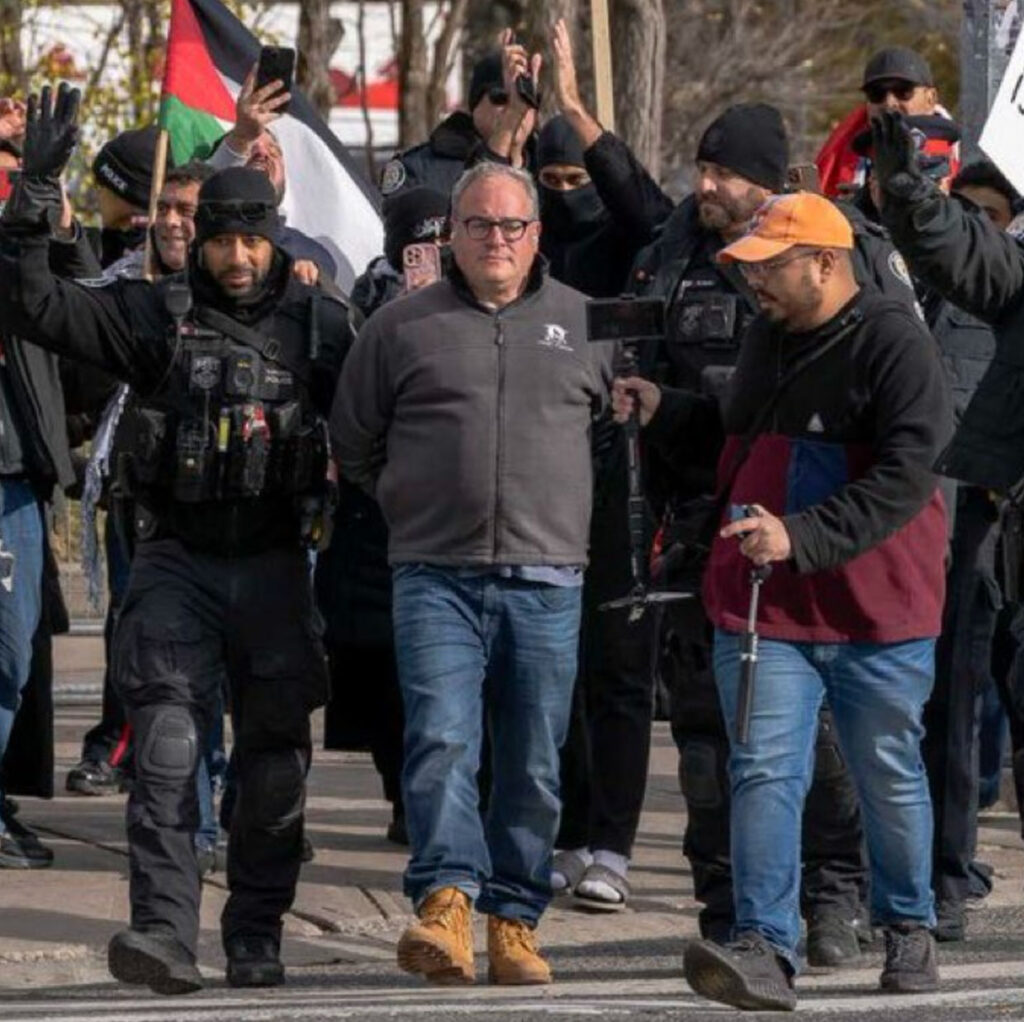
On Sunday, Nov. 24, journalist and Rebel News Co-Founder Ezra Levant was arrested after silently filming a pro-Hamas demonstration in his Jewish neighborhood in Toronto and refusing to cross the road.
“I’m refusing to leave because I’m a Jew, and I’m a citizen, and I’m your boss,” Levant told the police. “And I don’t leave because you say Jews aren’t allowed on this side of the street.”
The officer replied that Levant was under arrest for breaching the peace, while protestors called out “loser” and “Zionist.”
According to Levant, every single Sunday since October 7, 2023, a group of 100 pro-Israel, pro-Canada people wave flags at the same spot and call for the release of the hostages held in Gaza.
“For the last month, pro-Hamas protestors have driven into our Jewish neighborhood and set up a counter protest on the other side,” Levant told the Journal. “They chant antisemitic slurs and hold up swastikas. It’s really awful.”
This time, they did a reenactment of Hamas leader Yahya Sinwar’s final moments when the IDF killed him.
“It was bizarre and macabre,” Levant said. “I was absolutely disgusted. The police were just standing around.”
The journalist, who describes himself as a free speech libertarian, stood on a public sidewalk, taking photos and filming the Sinwar display. The police told him to cross the road, but he would not. As Levant detailed on X, one officer then pushed him away.
“Another officer, named Macduff, said if I didn’t go to a special ‘free speech zone’ they’d set up far away, I’d be arrested,” he wrote. “I told him Canada was my free speech zone, I was a citizen and taxpayer, and I would not get off the sidewalk.”
According to Levant, the police then handcuffed and searched him and took him to the back of their car. He was put in a jail cell, where he had to wait for a few hours to learn his fate. Ultimately, he was released.
“It was completely unconstitutional,” Levant said. “Hamas protestors don’t get to veto who can be on a public sidewalk. It’s bad enough that there are foreign entities in Canada who are agent provocateurs. It’s gross that the police are now their concierge.”
There are a few reasons Levant believes he was treated this way.
“It’s the path of least resistant for the police,” he said. “What’s easier? If you arrest Hamas protestors, you’re in for a riot. But the police do not have the power to arrest someone just because other people are threatening them.”
There is also what Levant calls “woke policing” going on.
“You have police commissioners and chiefs who realize in some places that demographics have changed,” Levant said. “In Toronto, there are 400,000 Jews and 2 million Muslims. Politicians have altered their stance. They’re fine with antisemitism.”
“Politicians have altered their stance and are fine with antisemitism.”
Since Oct. 7, there has been an alarming rise of antisemitism in Canada; it has increased by 670% according to the Israeli ministry, with shocking incidents of shootings at Jewish school buildings.
Levant said that unlike in America, where there are pro-Israel, pro-Jewish politicians on both sides of the political spectrum, “in Canada, our entire cabinet and political class is overwhelmingly antisemitic. Pierre Poilievre, the leader of the Conservative party, has been very good, but that’s about it.”
The lesson that the journalist learned from this incident was that “Jews have to stop being passive and quiet. We cannot be pushovers. We need more muscular Jews – not in terms of violence – but we need to be assertive and not let them steal our rights.”
Levant is working on a lawsuit against the Canadian police force. Rebel News already has seven lawsuits against the Canadian government.
“We are very active when it comes to holding them accountable,” he said. “[Prime Minister] Trudeau hates us and has banned us from attending press events. He’s obsessed with us because he doesn’t control us. We’re one of the few media companies in Canada that’s independent, since almost all the others are taking government funding.”
Though the antisemitism in Canada has gone up, Levant plans to stay and keep reporting on the news.
“My family has been here for 120 years,” he said. “I’m not leaving because some thugs just off the airplane think this is Gaza. I will help turn things around in Canada.”
When you hear the name Martin Scorsese, typically, beautifully crafted movies about gangsters – like “GoodFellas” or “Casino” – come to mind. However, the dynamic filmmaker has reinvented himself over the years, and this time, he’s serving as the narrator, executive producer and host of an eight-part docudrama on Catholic saints called “The Saints,” streaming now on Fox Nation.
The creator of this series is a Jewish Israeli producer, Matti Leshem. Together, Scorsese and Leshem showcase the stories of saints like Joan of Arc, Saint John the Baptist, Saint Sebastian and Maximilian Kolbe, who was accused of antisemitism but ultimately provided refuge to Jews during World War II.
The Journal spoke with Leshem about why he decided to make a series about Catholic saints, working with the legendary Scorsese and creating content about antisemitism in a post-Oct. 7 world. The interview has been edited for clarity.
Jewish Journal: How did the idea for this project come about?
Matti Leshem: The origins of this project are deeply rooted in personal history. In 1968, when my father served as Israel’s Ambassador to the United Nations, I was sent to Ramaz, a prestigious Jewish school in New York. Then, in the 1970s, when my father was appointed Ambassador to Denmark, I found myself enrolled in a Catholic school in Copenhagen, run by English nuns. It was there that I was first exposed to the stories of the Saints. I was struck by the notion that some individuals were willing to die for their convictions. As a Jew, this concept resonated deeply with me—our own tradition speaks of dying Al Kiddush Hashem (sanctification of God’s name). What these figures represented, beyond religious boundaries, was a radical commitment to a cause larger than themselves.
When I was introduced to Martin Scorsese, and presented the concept of a series focused on the Saints, it turned out that he too had always been interested in doing a series about “The Saints” and had actually tried to develop one in the late 80’s. After a three-hour intense conversation, he shook my hand, and we decided to work together.
JJ: How does your family background influence your work? I know your father was a Holocaust survivor, and your grandmother was killed in Auschwitz.
ML: My family history has had a profound impact on my work. I gravitate toward stories that examine the best of humanity confronting the worst in the most brutal of circumstances. My work—whether it’s “The Survivor,” which explores Harry Haft’s harrowing battle for life in a concentration camp, or “The Commandant’s Shadow,” which delves into the psyche of Rudolph Höss, the Auschwitz commandant—consistently grapples with questions of morality, survival and belief. I often ask myself, “What would I have done? Could I have endured? What do I stand for?”
In “The Saints,” the characters never have the benefit of knowing they will be canonized. Their heroism is unsung in their lifetimes. We witness their lives unfold with all their flaws, complexities and moments of grace. The series invites us to consider not just the nature of faith, but the lengths to which one goes to live it authentically, despite the challenges of the world around them.
JJ: What was it like working with Martin Scorsese?
ML: Working with Martin Scorsese is, without exaggeration, the greatest experience of my professional life. Marty is a bona fide maestro, not just in the art of filmmaking, but in his vast understanding of history, politics, literature and the humanities. His intellectual generosity is extraordinary—every collaboration feels like an intimate masterclass, not only in cinema but in life itself. His attention to detail, his relentless pursuit of truth, and his deep empathy for the subjects we tackle made working with him a transformative experience.
Though we approached the lives of the Saints from different traditions, our shared commitment to exploring the complexity of faith and the human condition made our collaboration perfect.
JJ: I see there is a lot about antisemitism in your new work. Why was it important to include this, especially in a post-October 7 world, and what can we learn from it?
ML: In “The Saints,” one of the most fascinating and troubling stories we tell is that of Maximilian Maria Kolbe. Kolbe was a Polish priest who, for much of his life, was a vocal proponent of antisemitic conspiracy theories. His Catholic radio station propagated the “Protocols of the Elders of Zion.” When the war began and the Nazis invaded Poland, Kolbe sheltered over 1,500 Jews in his monastery. He was repeatedly arrested by the Nazis and eventually sent to Auschwitz. In Auschwitz, Kolbe sacrificed himself for a fellow inmate who he didn’t know by taking his place in a starvation bunker. This act of self-sacrifice is deeply complex. Kolbe’s antisemitism never simply disappears, yet his relationship with the Jewish people changes, and his ultimate selfless act, giving his life for another, complicates any easy moral judgments.
In a post-October 7 world, when antisemitism is on the rise again, these stories are more necessary than ever. The resurgence of hatred, particularly toward Jews, is neither new nor incidental—it is a recurrent thread in human history. Telling stories of the Nazi genocide and the people who resisted it forces us to confront these uncomfortable truths and, I hope, galvanize a collective commitment to confront hatred in all its forms.
JJ: Why is it crucial to tell these stories?
ML: These stories are undeniably inspirational. But they are not inspirational in the conventional sense; they do not offer neat resolutions or simple answers. Instead, they push us to examine our own beliefs and values. What would we do in the face of great adversity? These are questions that transcend religious or ideological boundaries.
“The stories of the Saints are universally compelling because they invite us to confront the most fundamental aspects of what it means to be human and to have faith.”
Whether you are an atheist, a Jew, a Christian or any other faith, the stories of the Saints are universally compelling because they invite us to confront the most fundamental aspects of what it means to be human and to have faith.
JJ: What is your ultimate goal with all the work you’re doing?
ML: My goal is not simply to entertain, but to provoke thought, to challenge the audience to engage with the deeper questions of history, faith, and morality. I want my work to invite viewers into a conversation about what they believe in—what they are willing to fight for, what they are willing to stand up for. In a world where so many institutions have eroded and faith in our shared values seems to be in decline, I believe that stories rooted in the great traditions of humanity have the power to reawaken a sense of purpose, and even reverence.
I am not interested in proselytizing any particular ideology; rather, I want to spark an ongoing conversation. These are stories that come from the 2,000-year-old canon of one of the world’s great religions, but the themes they address, sacrifice, redemption and belief, are universal. If I can contribute to keeping those stories alive and relevant, then I will have succeeded. The world needs to remember these narratives now more than ever.
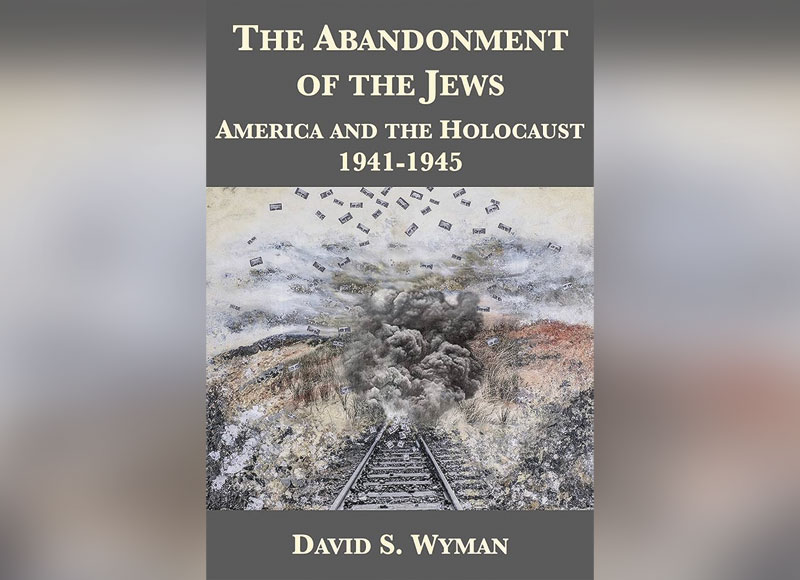
This month marks the 40th anniversary of the publication of David S. Wyman’s “The Abandonment of the Jews,” a book that changed the way we think about our nation’s history — and also saved lives. That is a rare achievement.
Wyman (1929-2018), a Harvard-trained historian and grandson of two Protestant ministers, did not set out to write about the Holocaust. But he was puzzled by the reluctance of other scholars to confront the question of how America responded to the Nazi genocide, so he decided to explore it himself. “The Abandonment of the Jews: America and the Holocaust 1941-1945,” was published by Pantheon in November 1984.
Prof. Wyman often spoke about how difficult it was for him, as a Christian, to find himself face to face with evidence of the meager response by American Christians, including our elected leaders, to news of the Holocaust. Sometimes he “cried for days” and had to take a break from his research. He said he “had been brought up with the belief that at the heart of Christianity is the precept that, when people need help, you should provide it.”
Prof. Wyman often spoke about how difficult it was for him, as a Christian, to find himself face to face with evidence of the meager response by American Christians, including our elected leaders, to news of the Holocaust.
Prior to the publication of The Abandonment of the Jews, the widespread assumption among the American public was that there was little or nothing the Roosevelt administration could have done to save Jews from the Holocaust.
Prof. Wyman’s meticulous research demonstrated that there were many ways the U.S. could have aided European Jewish refugees, without interfering with the war effort or undermining America’s immigration laws. He documented how President Franklin D. Roosevelt and his State Department suppressed news about the Holocaust and ignored opportunities to rescue refugees. He exposed how U.S. planes struck within a few miles of the Auschwitz gas chambers—yet failed to bomb the railways and bridges leading to the camp, or the mass-murder machinery itself.
“The Abandonment of the Jews” quickly rose to the New York Times best-seller list, and reviewers were nearly unanimous in their acclaim. “We will not see a better book on this subject in our lifetime,” Prof. Leonard Dinnerstein concluded. Prof. Hasia Diner wrote that that Abandonment “systematically demolishes often repeated excuses for inaction.”
“The Abandonment of the Jews” won numerous prizes, went through seven hardcover printings and multiple paperback editions, and was translated into German, French, Hebrew, and Polish.
Most remarkably, the book also played a key role in the rescue of Jews from Ethiopia in 1985.
A secret agreement between Israel and Sudan in 1984 had enabled Israel to begin airlifting tens of thousands of Jews from an area along the Ethiopian-Sudanese border. But an overly eager American Jewish journalist rushed to publish the scoop, prompting Sudan to suddenly halt the airlifts in January 1985. That left some 800 Ethiopian Jewish refugees stranded at the border.
A team of Jewish activists, including Los Angeles Jewish publisher Phil Blazer and Nate Shapiro of the American Association for Ethiopian Jews, flew to Washington to seek U.S. intervention. In meetings with members of Congress and Vice President George H.W. Bush, they distributed copies of “The Abandonment of the Jews” and pleaded with them not to repeat the indifference of the Roosevelt years.
Senators Alan Cranston (D-Calif.) and Rudy Boschwitz (R-Minn.) and Congressmen Stephen Solarz (D-N.Y.) and John Miller (R-Wash.) spearheaded the bipartisan effort to press the Reagan-Bush administration for action.
Learning that Vice President Bush was scheduled to visit Sudan on diplomatic business shortly, Rep. Miller went to see him. Citing “The Abandonment of the Jews,” Miller told Bush “that this was a chance to write a very different history than the history of America’s response to the Holocaust.” Sudan might refuse to let the Israelis land on its soil, “but Sudan would not be able to say no to the United States – if our government insisted,” Miller argued.
On March 22, 1985, shortly after Bush’s meetings in Sudan, a fleet of U.S. Air Force C-130 Hercules transport planes airlifted the 800 refugees from Sudan to Israel. The vice president subsequently sent Prof. Wyman a handwritten note of thanks and made a point of saying in a speech afterwards, “Never again will the cries of abandoned Jews go unheard by the United States government.”
CNN anchor Wolf Blitzer, who at the time was the Washington correspondent for the Jerusalem Post, wrote: “Today’s direct and very active cooperation by the U.S. government in helping to rescue Ethiopian Jews is in marked contrast to the documented abandonment of European Jewish refugees before and during World War II … [which has been] well-documented in David S. Wyman’s recently published book, ‘The Abandonment of the Jews.’”
In 2008, Prof. Wyman visited an Israeli air force base, where he met Major-General Amir Eshel, who was involved in the 1985 airlift operation, and Moshe Gadaf and Ami Farradah, who, as eight-year-olds, were among the Ethiopian Jewish children who were rescued. Wyman described meeting them as one of the most moving experiences of his life.
“The Abandonment of the Jews” remains the definitive study of America’s response to the Nazi genocide. A handful of polemicists and pundits have tried to excuse FDR’s Holocaust record, but additional research in the field in recent years has only reconfirmed Prof. Wyman’s original conclusion.”
Forty years later, “The Abandonment of the Jews” remains the definitive study of America’s response to the Nazi genocide. A handful of polemicists and pundits have tried to excuse FDR’s Holocaust record, but additional research in the field in recent years has only reconfirmed Prof. Wyman’s original conclusion: President Roosevelt, “the era’s most prominent symbol of humanitarianism, turned away from one of history’s most compelling moral challenges.”
Dr. Medoff is founding director of The David S. Wyman Institute for Holocaust Studies and author of more than 20 books about Jewish history and the Holocaust. His latest is “Cartoonists Against Racism: The Secret Jewish War on Bigotry,” coauthored with Craig Yoe.
“Sarah’s lifetime — the span of Sarah’s life — came to one hundred and twenty-seven years. Sarah died in Kiriath-arba — now Hebron — in the land of Canaan; and Abraham proceeded to mourn for Sarah and to bewail her. Then Abraham rose from beside his dead, and spoke to the Hittites, saying, ‘I am a resident alien among you; sell me a burial site among you, that I may remove my dead for burial.’” (Genesis 23:1–4)
This week’s Torah portion —somewhat paradoxically named Chayei Sarah (“The Life of Sarah”) — recounts the death of our matriarch. Abraham mourns his wife’s passing and then begins planning the next steps. He needs a place to bury her and asks the local inhabitants to sell him some land. Although they offer to give it to him as a gift, Abraham insists on purchasing it at full price. Later commentators note that Abraham does this to ensure there can be no future confusion about who owns the burial site — it belongs to him and his descendants.
Later in the Torah, we learn that this same site becomes the burial place of Abraham, Isaac, Jacob, Rebecca, and Leah. To this day, the Cave of Machpelah remains one of the most sacred places in Jewish tradition. It is also a shrine for Muslims, known as the Haram el-Khalil (“The Sacred Precinct of the Friend of God”).
Jews and Muslims take turns praying at this site. I visited many years ago, right as the attendants were preparing the space for Jewish worship, respectfully removing the prayer rugs used by Muslims and bringing in siddurim and tallitot for the Jewish worshippers.
In a time when Israel is often labeled—and libeled—as a “colonial enterprise,” I find deep meaning in returning to this passage. For more than 3,500 years, this place has been central to the story of the Jewish people. (Of course, we are not the only people with a historic connection to the land, which is why we have repeatedly agreed to share it — first in 1947 with the U.N. Partition Plan, and again through multiple Israeli and American administrations. Each time, however, these offers were rejected by Arab leadership.)
To claim that our return to Zion is illegitimate is to deny our history — a history written not just on parchment but also in stone. The burial site mentioned in this parasha is surrounded by archaeological evidence of Jewish habitation and sovereignty over that part of the land of Israel, dating back to before the time of King Herod (first century BCE).
Our connection to the land is both profound and ancient. One doesn’t need to accept a theological rationale to recognize this truth. What cannot be denied, however, is how deeply these places are interwoven with our story and identity. Nor can one deny the abundant archaeological evidence of Jewish settlement in the land of Israel spanning over 3,000 years.
What feels especially galling and absurd is hearing accusations of Jewish colonialism from college students and academics living and working in the United States — a country built on land to which its settlers had no historic claim — which is something no land acknowledgment can erase.
What feels especially galling and absurd is hearing accusations of Jewish colonialism from college students and academics living and working in the United States — a country built on undeniable colonization.
Amanda Berman, Founder and CEO of the Zioness Movement, beautifully articulates that Zionism is the ultimate expression of anti-colonialism. Zionism is the movement for the self-determination and national liberation of the Jewish people in their ancestral homeland. It represents the return of a people forcibly exiled from their land to dignity and sovereignty.
Zionism is a movement that anyone who calls themselves a political progressive should embrace wholeheartedly.
Even as we mourn Sarah’s death in this week’s parasha, we celebrate Abraham’s foresight and our enduring connection to a land that has been bound up with our People’s story for more than three millennia.
Rabbi Yoshi Zweiback is the Senior Rabbi of Stephen Wise Temple in Los Angeles, California.