fbpx

November 4, 2024

Squeezing the Meaning Out of Hitler

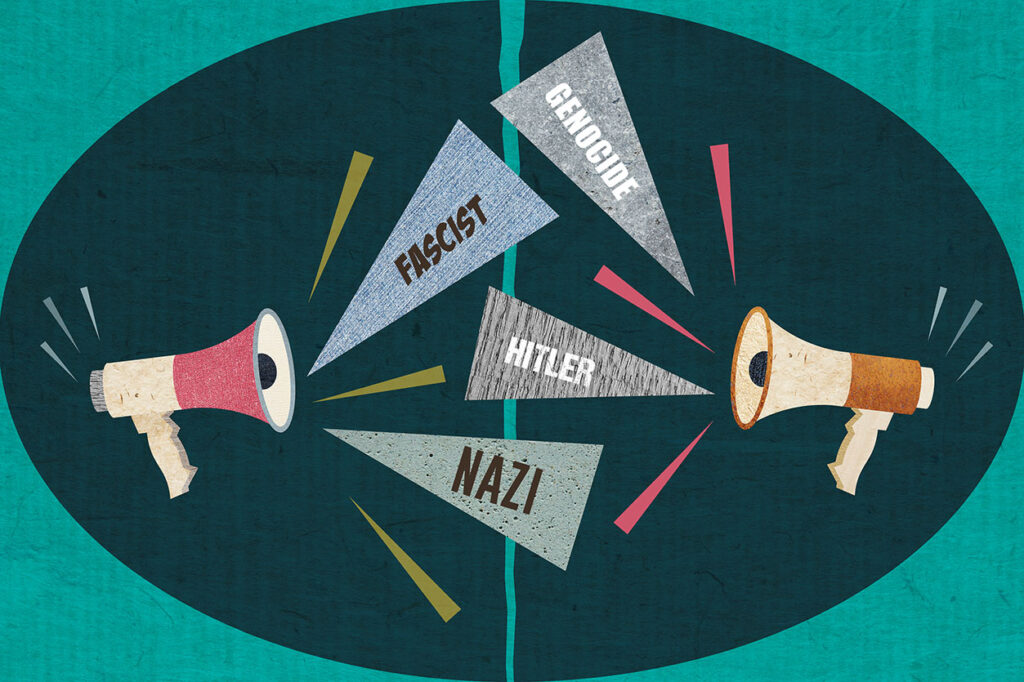
Over the past few weeks I’ve witnessed a fascinating phenomenon: The closer we get to Election Day, the more those on the fringe deploy the word “Nazis” to serve their own agenda. Nazis, fascism, Hitler, genocide—all words hijacked and robbed of their meaning, all disconnected from their reality, un-fashioned and re-fashioned to serve a political goal.

War is now genocide, everyone on the other side is a fascist or a Nazi, and leaders we want to take down are Hitler. In the next 24 hours and especially after the election, be prepared to be inundated with these terms.

It’s nothing new. In fact it’s been happening for decades as people constantly move the goal posts of meaning for words that have power in American discourse. Who can forget the Republican obsession—and it wasn’t just the far right—with comparing Barack Obama to Hitler? It’s the knee-jerk response to anything that makes us uncomfortable, anything we don’t like, anything we disagree with—and everyone is doing it.

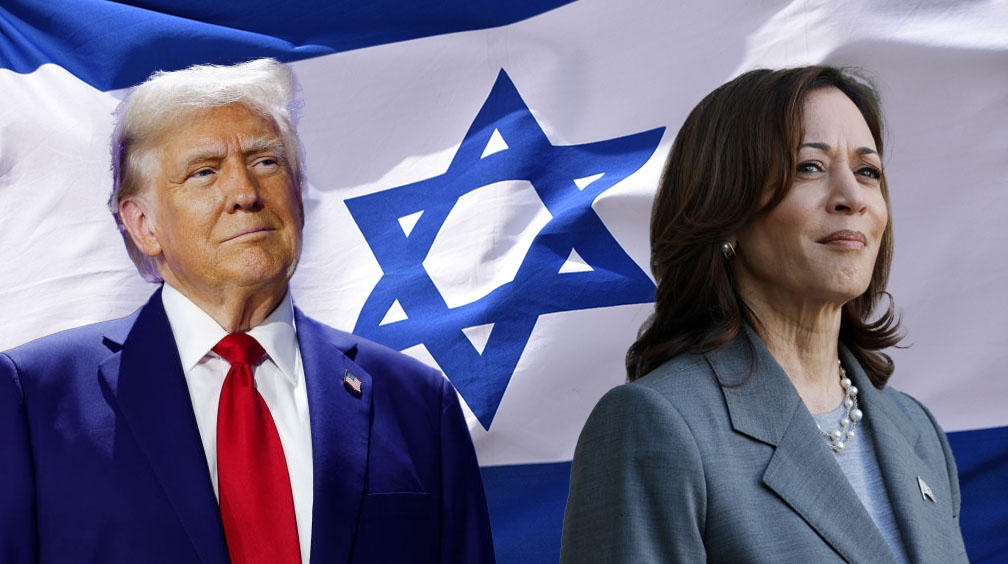
If you don’t like Israel or the war in Gaza, it’s genocide. You hate Donald Trump? Well it must be because he’s Hitler, “literally Hitler” as some people put it. It’s a linguistic free for all. If you can’t make your case thoughtfully and intelligently, just grab a word that will feel like you’ve dropped a bomb when it comes out of your mouth and apply it to whatever or whoever you don’t like. This is how we destroy people. Words connected to the Holocaust are now completely untethered from their historical contexts and have broadened so far that they are rendered meaningless, but we still use them as if they are nuclear bombs, reserved only for the worst of the worst.

I get why people do it. Nazis have been established as the ultimate bad guys, the dark heart of the evilest of evil. It’s a convenient categorization because once you call someone a Nazi, the assumption is that everyone will agree with you because everyone knows Nazis are bad. One obvious problem with this is that it’s not hard to get otherwise reasonable people to agree that “punching a Nazi” (cue the clip of Harrison Ford as Indiana Jones punching a Nazi) is a good thing, so call someone (or half the country) a Nazi and the implication is that any violence done toward such people is not only justified but also morally required. We have to take down the Nazis, right? We can’t allow fascism (which is always the other side) to reign in America, right? It’s the same thinking that has paved the way for open discrimination, bigotry, and violence against American Jews since Oct. 7. Accuse Israel of genocide and suddenly all Jews are Nazis deserving of violence. How convenient.

In many cases it’s coming from highly educated people—academic elites who presumably believe that their education has given them license to abuse terms in whatever way they like. It’s the ultimate entitlement: I get to decide what words mean and you have to accept it. I have the luxury of changing the meaning as I see fit because I am morally superior.

It’s the ultimate entitlement: I get to decide what words mean and you have to accept it.

I’ll state the obvious: Most of the people using this language are coming from the fringe left, though it’s certainly creeped into the social media posts of some on the liberal left. But I see it on the right, too. “Leftism is literally Hitler,” wrote one very educated woman on her social media page.

But right now, a good segment of the political left is convinced that Trump is the next Hitler who has vowed to usher in a new Third Reich. For example, one friend is tired of the “Don’t let politics ruin your friendships” posts, and suggests that half the country is cheering on Nazi ideology. “It’s time to ruin some f—king relationships over this s—t.” Another wonders how he can go about his usual business when “actual Nazis are prowling the streets.” If you’re voting for Trump you’re “standing with the Nazis” or just “Nazi scum,” writes another. Few people on the left will actually engage with his policies on immigration, the economy, and workers’ rights—the things that actually matter most to most Americans—because it’s easier to just call Trump a Nazi and write him off. And doing this reveals something deeply troubling: the extent to which so many people on the left are completely disconnected from what many average Americans are experiencing.

I reflect on my many years of Holocaust research, teaching, and publications and I think to myself: You have no idea what Nazism is.

But never mind those inconvenient details. After all, the Trump rally in Madison Square Garden was not a rally in which jokes some people find offensive were said. Instead, it was a Nazi rally, and people posted about how they were chilled to the bone thinking of the other Nazi rally that was held there in 1939. But as one rando on Twitter put it, Billy Joel also performed at this venue. Trump is no more Hitler than he is Billy Joel no matter how much we want it to be so.

Using the language of the Holocaust is a way to shut down dialogue, to make sure that people are afraid, to push them down under the surface of mainstream public discourse. But when people are silenced and pushed into corners and below surfaces, they don’t go away; they get angry, and rightfully so.

Using the language of the Holocaust is a way to shut down dialogue, to make sure that people are afraid, to push them down under the surface of mainstream public discourse.

There is nowhere this is more pronounced than on university campuses and academic circles. Recently, Newsweek op-ed editor Batya Ungar-Sargon posted a video that she calls a love letter to her community on the eve of the election. In the video, she explains why she is voting for Trump and why he is the candidate that most represents Jewish values. It’s a compelling video that breaks down many of the lies that are repeated constantly about Trump, and I passed it along to some liberal academic friends who I knew would not stop talking to me for having the audacity to entertain such a thing without banishing it to the dustbin of history. I shared it because it was smart and interesting and compelling—and because I still care about dialogue. I have friends who are voting for Harris. I have friends who are voting for Trump. All of them are good people who have good reasons for their decisions. I have also seen compelling cases made for Harris being the candidate that most represents Jewish values. We can entertain both of these possibilities.

But sharing Ungar-Sargon’s video started another kind of conversation—about the impossibility of having this kind of dialogue in academia. “When you live in the academic universe,” said one friend and colleague, “it’s impossible to discuss nuance.” If nothing else, the pervasiveness of the hijacked language of the Holocaust in academic circles and the fear that academics not voting for Harris have when it comes to voicing their dissent have revealed that there is a sickness on many of our campuses.

I remember earlier this year when I learned that the line attributed to Trump about there being “fine people on both sides” in the wake of Charlottesville was something taken completely out of context. I felt betrayed by the media and by journalists I had trusted once I listened to the entire clip and discovered that it had been edited in such a way as to paint Trump as the Nazi of our time. I remember sending the link to the complete video to friends who didn’t want to listen to it because they were so committed to their belief that he is a Nazi. “People are not willing to think it through,” says my colleague, not even in academia. Even when presented with evidence contrary to their beliefs, people will still insist on their original thought.

“People are not willing to think it through,” says my colleague, not even in academia.

Ungar-Sargon’s video felt important to me, even alongside competing claims for Harris as the appropriate Jewish choice, because it suggests that the nature of Jewish values is such that one could say either candidate represents them. (Let’s not forget the constantly competing perspectives of Hillel and Shammai.) The most important take away from the video, for me, is not necessarily that one should vote for Trump, but rather that it’s not inherently transgressive to vote for him. It’s not anti-Jewish. But as one academic friend who is voting for Trump told me, “If Trump wins I still have to act either sad and anxious or indifferent.” Why? Because in academia, admitting you voted for Trump is suicide because you will have become, yourself, a Nazi in the eyes of many of your colleagues.

People are afraid, and using these words can make us feel more powerful, as if we are naming the thing that needs to be destroyed, which is half the battle.

There’s a desperation in the hurling of these linguistic missives, and I understand why people feel desperate. For many, issues that they care about like abortion and other women’s rights, are seemingly on the line. People are afraid, and using these words can make us feel more powerful, as if we are naming the thing that needs to be destroyed, which is half the battle. But when we do it we are playing with fire, and slowly but surely we are ushering in the exact kind of violence that we thought we were fighting.


Monica Osborne is a former professor of literature, critical theory, and Jewish studies. She is Editor at Large at The Jewish Journal and is author of “The Midrashic Impulse.” X @DrMonicaOsborne

Squeezing the Meaning Out of Hitler Read More »

New York School Giving Kids Day Off to Recover from Election—but What About the Adults?

I’ve seen two distinct forms of “safe spaces” over the past year. The first is one of those ubiquitous bomb shelters in Israel that you must rush into when a siren lets you know a terror rocket is on the way. Those shelters are made of reinforced concrete and are built in one piece without columns or beams. The outer walls are at least 25 centimeters thick and the inner walls at least 20 centimeters.

I’ve been in those shelters when bombs were falling. It’s the strangest sensation to feel you’re actually in a safe space at that moment.

I came across another kind of safe space this week when I saw that a private school in New York City is providing services for students experiencing “election anxiety.” Evidently, the Ethical Culture Fieldston School — which costs $65,540 a year — announced that it will make attendance optional on the Wednesday after Election Day for “students who feel too emotionally distressed.”

I couldn’t resist wondering what those students would do on Wednesday to relieve their election anxiety. Play video games? Read Shakespeare? Get on Instagram or TikTok? Just stay in their rooms and cry?

I know what to do when I’m in a bomb shelter in Israel—I sit still and pray that they’re not sending bombs that may cut through the reinforced concrete.

But what about when the bombs are news reports on the U.S. elections? How should students and other Americans protect themselves from the result of a presidential election?

What kind of result, you ask? Are you serious? Is there any doubt that the protective worry warts at Fieldston are only worried about a Trump victory?

And how can you blame them? Given that the Harris campaign backed by the mainstream media has been calling Trump a modern version of Hitler who is a serious threat to our democracy, what did we expect? Why should the Fieldston students not be in shpilkes if Trump wins?

After all, isn’t a Hitler in the White House at least as dangerous as a Hamas rocket falling on Tel Aviv?

It’s easy for me to poke fun at the “safe space” phenomenon that has swept through our culture in recent years, especially with college students complaining about microaggressions. But that’s already been well covered. Books have been written on how we’re raising a fragile generation constantly on the lookout for anything that will offend them or hurt their feelings.

This election, though, is different. Here it is us, the adults, who have been assaulting our kids with incendiary and terrifying language in our zeal to have our political team win.

Imagine those students at Fieldston who learn about the Holocaust one day and then see on the news that one of the candidates is a “Nazi” who hosted a Nazi-like rally at Madison Square Garden?

I’d be full of anxiety as well.

So here’s my suggestion for whoever will be in charge of relieving the students’ emotional distress on Wednesday and beyond: Tell them the truth.

Tell them that the grown-ups in America have a tendency to lose their minds when they want their candidate to win. Tell them they will say and do virtually anything to beat the other team, including flinging the harshest insults up to and including Hitler.

If the kids respond by asking their elders why they couldn’t tone down the hysterics and set a better example, I’m hoping the grown-ups will listen and start learning from the kids.

So yes, the Fieldston school needs a day off on Wednesday— for all the parents, teachers and school leaders who must answer to the students for the ugliest, nastiest election season in modern history, where the search for truth became a lonely bystander.

For the lethal verbal bombs we routinely launch every day in our zeal to win political wars, there are no bomb shelters.

New York School Giving Kids Day Off to Recover from Election—but What About the Adults? Read More »

The Dilemma of Iran’s Support for Its Proxies

According to Ham-mihan newspaper on Oct. 28, 2024, Kourosh Ahmadi, an international affairs analyst close to the Iranian regime, stated in an interview: “Tensions (in the Middle East) will continue only if Israel’s policy is to destroy the Axis of Resistance, while Iran seeks to defend it.” Following Israel’s attack on military targets in Iran, Iran’s Supreme Leader, Ali Khamenei, remarked, “Some believe that refraining from producing certain weapons that provoke arrogant powers, including missiles, can bring security for Iran [read: the Iranian regime]. But this false notion essentially instructs the people and officials to keep the country weak to ensure security.”

The Regime’s Role in Regional Destabilization

On the first day of the war in the Middle East last October, few believed the Iranian regime was the driving force behind the conflict. However, the Iranian opposition, the National Council of Resistance of Iran (NCRI), based on 45 years of experience resisting a regime that masks domestic repression with external wars and crises, declared that the heart of warmongering lies in Tehran.

After the 2022 uprising, the Iranian regime teetered on the edge of collapse and depended on conflict and crisis in the region to survive. It turned to foreign wars to prevent another uprising and avoid being overthrown by the Iranian people and their resistance. In a speech on Oct. 23, 2024, referring to Yahya Sinwar, the leader of Hamas, and Hassan Nasrallah, the leader of Hezbollah, Khamenei said, “If it weren’t for Yahya Sinwar and Sayyed Hassan Nasrallah, the fate of the region would have been different.” One year later, Germany’s Foreign Minister stated, “It is absolutely clear that [the Iranian regime] is behind these attacks.” In its 45-year history, this regime has not seen a single moment without war and bloodshed, either in the region or within Iran itself.

Hezbollah’s Role in the Region

Among the Iranian regime’s proxy forces, which have expanded its warmongering, crisis-exporting, and terrorism in the region and even into parts of East Africa, Hezbollah holds a unique position. Hezbollah has been involved in various international assassinations, such as the bombing of the U.S. Marine barracks in Lebanon and the attack on the Jewish community center in Argentina, and it has also played a critical role in training and coordinating resistance forces for terrorist acts and warfare. Hezbollah took part in the final coordination between Hamas and other forces involved in the Oct. 7 attack, and in Syria it served as the backbone of proxy forces that brutally suppressed the Syrian people, resulting in hundreds of thousands of deaths.

Hezbollah has also been heavily involved in drug trafficking, generating substantial revenues while establishing ties with criminal gangs, providing a strategic advantage to the regime.

The Strategic Deadlock of the Iranian Regime

The Iranian regime is compelled to support its proxies and will not abandon them unless in absolute weakness, as war and crisis are essential to the regime’s survival. However, continuing this support risks direct confrontation with Israel, which would inevitably spark popular uprisings. Moreover, the path to a nuclear bomb has been effectively closed, as crossing this red line would bring irreversible consequences.

The Policy of Appeasement Toward the Regime

For the past four decades, the European Union and the U.S. have pursued a appeasement policy of dialogue with the Iranian regime despite the regime’s severe human rights violations, which, according to the UN Special Rapporteur’s July 2024 report, amount to genocide and crimes against humanity. This policy has granted the regime international impunity.

Ignoring the regime’s interference and terrorism in the region has led to visible consequences: A significant portion of the Middle East is in flames. With its unchecked terrorism, the regime has turned Europe into part of its battlefield. From June 2018 to June 2024, Iran was responsible for at least 11 attacks in Europe, including an assassination attempt on Professor Alejo Vidal-Quadras, former Vice-President of the European Parliament.

The religious dictatorship also collaborates with organized crime groups to expand its terrorism, making the regime an immediate threat to European and global security. Continuing this policy leads directly to the crises we are now witnessing in the Middle East.

A Democratic Alternative as the Key to Regional Peace

For over four decades, the National Council of Resistance of Iran (NCRI) has served as a democratic alternative to the regime. This coalition brings together various political, ideological and religious orientations, united by a shared goal and a rejection of all forms of dictatorship, whether under the Shah or the mullahs.

Several key factors have enabled this resistance to stand firm against the regime and drive change in Iran, including a belief in that the separation of state and religion opposing the ruling fundamentalism, long-term resilience at any cost, broad social support, and principles of humanity and equality that strengthen unity among diverse segments of Iranian society, including Shiite and Sunni Muslims, non-Muslims, and oppressed ethnic minorities. This alternative aims to establish a republic based on gender equality and autonomy for ethnic minorities—a country free from executions and torture, and a non-nuclear Iran in peace and solidarity with its neighbors and the entire world.


Hamid Enayat is a political scientist, specializing on the topic of Iran, who collaborates with the Iranian democratic opposition.

The Dilemma of Iran’s Support for Its Proxies Read More »

The “Better for Israel” Thing

These are days of trepidation, and tests. A new president is elected, and the world wonders about the future of the U.S., about the future of U.S.’ policies, about the future of U.S.’ involvement in international affairs. Americans go to the polls thinking about the economy, immigration, abortion. The world watches with other things on its mind.

Every new president is a black box. Yes, he was the president some four years ago. Yes, she is still the VP. And yet, and yet – a new president is a reason to wonder about plans, tendencies, appointments, priorities, pressures. We know – and by “we” I’m narrowing the scope to talking about Israelis – that a new president is tasked with the command to be “good” for America. We wish to think that “good” for America doesn’t mean “less good” for us, Israelis, who have no real say in the choice of a new American leader, but are highly impacted by the outcome.

Last week, we asked Israelis two questions about Donald Trump and Kamala Harris. We asked which of these two is “better” for the U.S., and which is “better” for Israel. We did not define what “better” means, and better could mean many things. And yet, we got a response that seems sensible: By and large, the share of Israelis who see Trump and Harris as better for America is about the same size. Right-wingers say Trump, center-left voters say Harris. But when the perspective changes, when Israelis are asked about the candidates and Israel, the response changes too — to 56% for Trump 20% for Harris (61%-20% among Jews).

What causes the variation? It is mostly Israelis on the center and the left who change their view. Here’s an example how: 75% of self-defined “center-left” Israelis say Harris is better for America. It is easy to understand why. These Israelis have views quite similar to the views of the Democratic party on things such as abortion, democracy, respect for the rights of minorities. But when we asked them about the candidates and Israel, only 46% of them choose Harris as better, while the others shift to either Trump (10%), or “no one” (22%) or “don’t know” (22%). Center-left Israelis have a hard time explicitly pointing at Trump — Trump! — as their preferred choice. Still, they make their choice clear by refraining from sticking with Harris when the question changes.

You might find it strange. “Better” must reflect an ideology. So, you’d expect that Israelis who want a “two-state solution” and Israelis who want an “annexation” would not point at the same person as “better” for Israel. And yet, a clear majority of Israelis do. Why? Because there are some things on which most Israelis agree, and these are the exact issues on which Trump seemed to them like the “better” choice.

A clear majority of Israelis think Trump would be “better” for Israel. Why? Because there are some things on which most Israelis agree, and these are the exact issues on which Trump seemed to them like the “better” choice.

Let me give you one clear and recent example: the status of UNRWA (The United Nations Relief and Works Agency for Palestine Refugees in the Near East). After many years in which this supposedly humanitarian organization served mainly one purpose – to keep the Palestinian refugee problem as a problem and prevent any hope for ever finding it a solution that does not involve damage to Israel’s security and future – Israel had had enough. Involvement of UNRWA workers in acts of terrorism on Oct. 7 and after, pushed the Knesset to make a move. It decided that Israel is going to cut ties with the agency, and thus make it much more complicated for UNRWA to operate.

The U.N. reacted as you’d expect it to react. The U.S. reacted – well, here’s where the “good for Israel” becomes an issue – by saying it is “deeply troubled.” The U.S. called Unrwa “a key partner.” That’s an agency that 92 Members of Knesset voted against. The only MK’s opposing it were Arab MK’s – all 10 of them. There’s no more consensus than that. There’s no clear sign that for a clear majority of Israelis “better for Israel” means accepting the idea that UNRWA isn’t a solution to anything, it is a problem.

What is Harris’ position on UNRWA? Former U.N. Ambassador Nikki Haley described the situation aptly: “the U.S.stopped giving them hundreds of millions of dollars … Biden-Harris gave the money back.” So, the position of the Biden administration (and there’s no hint that Harris was an objector on this issue) is one that Israelis reject. It is not the right-wing coalition rejecting it. It is not “Netanyahu.” It is not the “pro anexation camp.” It is the representatives of all Jewish Israelis. It is 80% of the country. It is a rare consensus on what needs to be done, on what’s better for Israel.

You can call it a litmus test. You can call it a case with which to reject the often-repeated truism that “better” is always in the eye of the beholder and a matter for debate between two or three Israeli camps – and thus that the mere question of who’s better for Israel is unanswerable.

But it is answerable. UNRWA is an answer.


Shmuel Rosner is senior political editor. For more analysis of Israeli and international politics, visit Rosner’s Domain at jewishjournal.com/rosnersdomain.

The “Better for Israel” Thing Read More »