fbpx

November 1, 2024

Over 1,000 Take Stand Against Boycotts of Israeli and Jewish Writers

More than 1,000 prominent figures from literature and entertainment have signed an open letter organized by the nonprofit Creative Community for Peace (CCFP), to oppose boycotts “of Israeli and Jewish writers, publishers, authors, book festivals, and literary agencies, along with those who support, work with, or platform them.”

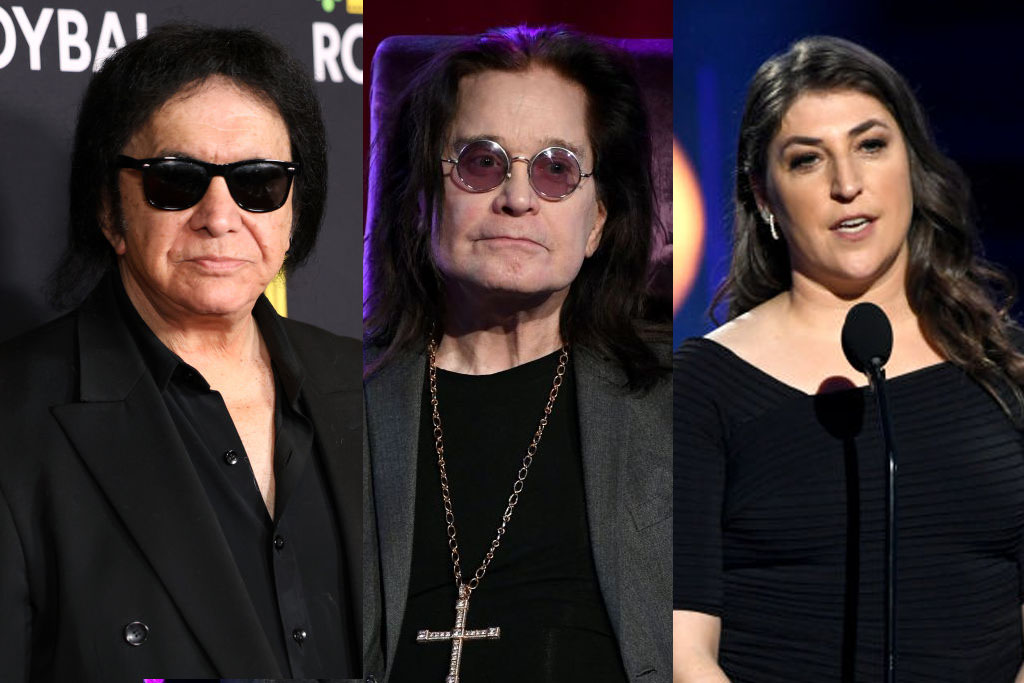
The signatories include Nobel laureates, Pulitzer Prize winners, actors, executives and music icons, highlighted by philosopher and author Bernard-Henri Lévy; playwright, author and Nobel Prize winner Elfriede Jelinek; author and Pulitzer Prize winner David Mamet; Pulitzer Prize winning New York Times columnist Bret Stephens; author and Nobel Prize winner Herta Müller, singer Ozzy Osbourne; TV personality Sharon Osbourne; Kiss singer and bassist Gene Simmons; actress Julianna Margulies; actor Jerry O’Connell; music executive Scooter Braun; chairman and CEO of Mattel Ynon Kreiz; chairman and CEO of Saban Capital Group Haim Saban, and Warner Records CEO/co-chairman Aaron Bay-Schuck.

The letter expresses “shock” and “disappointment” at what CCFP describes as the tolerance of harassment and ostracization of Israeli and Jewish creatives in the literary world over the past year. Since Oct. 7, 2023, the day marking the largest single-day murder of Jews since the Holocaust, Israeli and Jewish creatives have faced high-profile jeers and outright cancellations of events and projects.

The website Literary Hub has published multiple reports each month since November 2023 criticizing Israel in connection with Palestinian casualties in the war with Hamas.

On Jan. 31, protesters from Writers Against The War on Gaza disrupted a PEN America event in Los Angeles featuring Moshe Kasher and Mayim Bialik.

On March 12, Book Workers for a Free Palestine organized a protest outside one of London’s largest book fairs. At the event, demonstrators quoted lines from a poem by the late Palestinian writer Refaat Alareer. In response to reports of atrocities by Hamas on Oct. 7, Alareer quipped on X, “with or without baking powder?” He was killed in an airstrike two months later.

In May, an account on X shared a spreadsheet titled “Is Your Fav Author a Zionist?” and encouraged harassment and divestment.

In August, a book talk in Brooklyn featuring debut author Joshua Leifer and Reform Rabbi Andy Bachman was canceled after the bookstore owner cited not wanting a “Zionist on stage.”

This past month, Shelf Awareness, an online magazine for publishers and booksellers, refused to advertise Bernard-Henri Lévy’s new book, “Israel Alone,” stating that it “could cause trouble that independent bookstore partners haven’t asked for and don’t wish to have.”

CCFP warns that such boycotts ultimately “subvert the spirit” of art’s openness. “Boycotts against authors and those who work with them is illiberal and dangerous,” the letter states. “In fact, we believe that writers, authors, and books — along with the festivals that showcase them — bring people together, transcend boundaries, broaden awareness, open dialogue, and can affect positive change.”

Founded in 2011, CCFP began as a response to support cultural exchange and defend artists amid the Boycott, Divestment and Sanctions movement (BDS). CCFP co-founder David Renzer, then chairman and CEO of Universal Music PublishingGroup, initiated the organization following high-profile cancellations by musicians like Elvis Costello and Pink Floyd’s Roger Waters. “And here we were, people from the entertainment industry, kind of looking at each other, troubled by these cancellations and saying, ‘We need to do something,’” Renzer told The Journal in 2022. Now in its 13th year, CCFP’s voice faces new challenges amid heightened calls for cultural boycotts.

Over the years, CCFP has provided a platform for entertainers and other creative industry professionals to sign petitions and fostered conversations about the harms caused by the BDS movement against Israel.

“This is a coordinated campaign to bully and threaten anyone who refuses to condemn Israel, targeting Jews and their allies worldwide,” CCFP Executive Director Ari Ingel said in a press release. “These boycott calls, led now by members of the literary community themselves, are reminiscent of the 1933 boycott of Jewish authors, when antisemites burned over 25,000 books. The works of Jewish authors like Albert Einstein and Sigmund Freud, alongside American works by Ernest Hemingway and Helen Keller, were burned. This is where things are once again headed.”

“These boycott calls, led now by members of the literary community themselves, are reminiscent of the 1933 boycott of Jewish authors, when antisemites burned over 25,000 books. The works of Jewish authors like Albert Einstein and Sigmund Freud, alongside American works by Ernest Hemingway and Helen Keller, were burned. This is where things are once again headed.” – Ari Ingel

Booker Prize-winning author Howard Jacobson was among the signatories to point out that censorship in the arts is contradictory to its purpose.

“Art is the antithesis to a political party,” Jacobson stated in the press release. “It is a meeting place, not an echo chamber. Art explores, discovers, differs, questions, and surprises. Precisely where a door should be forever open, the boycotters slam it closed.”

Actress and author Mayim Bialik also spoke out, calling identity-based boycotts “disturbing and polarizing …

Attempts to dictate ‘who’ or ‘what’ should be published have nothing to do with any path to coexistence or peace,” Bialik said.

The former “Jeopardy!” host was recently honored by CCFP as an “Ambassador of Peace,” for her steadfastness in publicly standing up against antisemitism. That night, she told The Journal, “a lot of people didn’t and probably still don’t understand the basic definition of Zionism — that it’s a belief in the right of Jewish people to have a state in our historical homeland. It seems like a basic definition that a lot of people don’t understand. But I think also one of the things that I’ve learned from CCFP is about the level of nuance that is involved in understanding any of these topics at all, and the amount of work that everyone here puts into correcting misinformation, and also giving me and others like me the tools to be able to communicate effectively.”

As Israel faces continued attacks from Hamas, Hezbollah, and Iran, calls across the arts to disavow Israeli and Jewish creators are likely to persist. Still, CCFP and the over 1,000 signatories conclude their latest letter with a call for more in the industry to take a stand.

“Regardless of one’s views on the current conflict, boycotts of creatives and creative institutions simply create more divisiveness and foment further hatred,” the letter says. “We call on our friends and colleagues worldwide to join us in expressing their support for Israeli and Jewish publishers, authors, and all book festivals, publishers, and literary agencies that refuse to capitulate to censorship based on identity or litmus tests.

The full text of the letter can be viewed on CCFP’s website: https://www.creativecommunityforpeace.com/blog/2024/10/29/authors

Over 1,000 Take Stand Against Boycotts of Israeli and Jewish Writers Read More »
Jews in LA React to Dodgers Winning 8th World Series Title

The Los Angeles Dodgers won their eighth World Series championship on Oct. 30, defeating the New York Yankees in Game 5 at Yankee Stadium.

The Dodgers began the game needing just one victory to shore up the championship. Things looked bleak in the fifth inning, with the Dodgers down 5-0.  But with two outs in the top of the fifth, the Dodgers piled on five unearned runs to tie the game. Former Yankee Alex Rodriguez called that fifth inning one of the greatest meltdowns he’d ever seen. By the end, the Dodgers won 7-6. It was the major league’s largest World Series comeback and clinched thefirst Dodger championship since 2020.

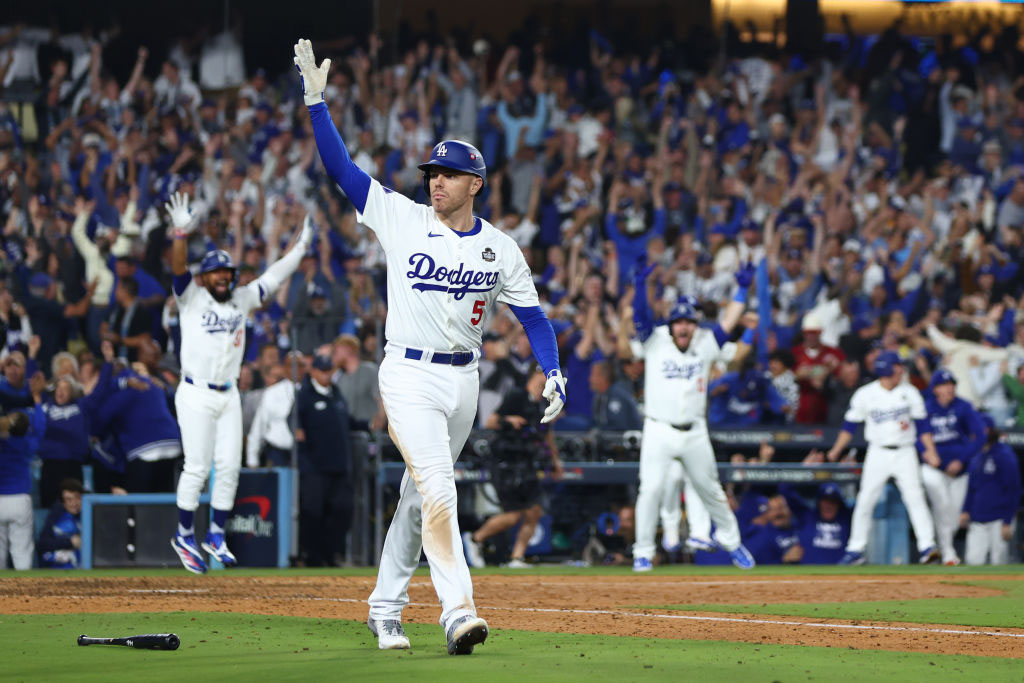
Things looked bleak for the Dodgers in Game 1, down 3-2 in the bottom of the ninth inning at Dodger Stadium. But with two outs and bases loaded, first baseman Freddie Freeman smacked a game-winning grand slam home run to the right field bleachers to propel the Dodgers to a 6-3 victory. It was the first ever walk-off grand slam in World Series history

This was the 12th time the Dodgers and Yankees have faced off in the World Series, dating back to 1941 when the Dodgers were still based in Brooklyn. No two teams have faced each other in the World Series more frequently. Since both teams come from the second and third most-Jewish cities in the world, Jewish fans of both teams were spotted in the attendance during the World Series — among them, actor Billy Crystal and music manager Steve Lobel both cheering on the Yankees, and actor Jonah Platt and punk guitarist Greg Hetson in Dodger blue.

The last time the Dodgers faced the Yankees in the World Series was in 1981. That was the year that Fernando-mania took over Los Angeles, as a husky 21-year-old pitcher named Fernando Valenzuela captivated Dodger fans throughout the season. He won his first eight starts that season, five of them shutouts.

Valenzuela had been part of the team’s Spanish broadcast team since 2003. But Dodger fans were shocked to hear that Valenzuela passed away on Oct. 22 at age 63, just three days before the start of the World Series. Dodgers players all wore a “34” patch on their uniforms throughout the World Series in his honor. This year was also the first time the Dodgers competed in the World Series since team manager (1976-1996) Tommy Lasorda passed away in 2021. It’s also the first since longtime announcer Vin Scully passed away in 2022. Scully was the voice of the Dodgers from 1950 in Brooklyn until his retirement in 2016.

Although Jewish legend and Hall of Fame Dodgers pitcher Sandy Koufax did not make any public appearances during the 2024 World Series run, the publication Dodgers Nation reported this week that Koufax “approved” of how manager Dave Roberts was leading the team.

“We’ve had that conversation in years past, but I think right now he gave me a ‘good job.’ He gave me a ‘you’re doing all right,’” Roberts told Dodgers Nation. Koufax still holds the record for the second-most strikeouts thrown in a single World Series game, with 15 strikeouts against the Yankees in the 1963 World Series. In 2023, the Dodgers honored Koufax with a statue just outside the centerfield bleachers, next to the statue Jackie Robinson, who broke Major League Baseball’s color barrier in 1947.

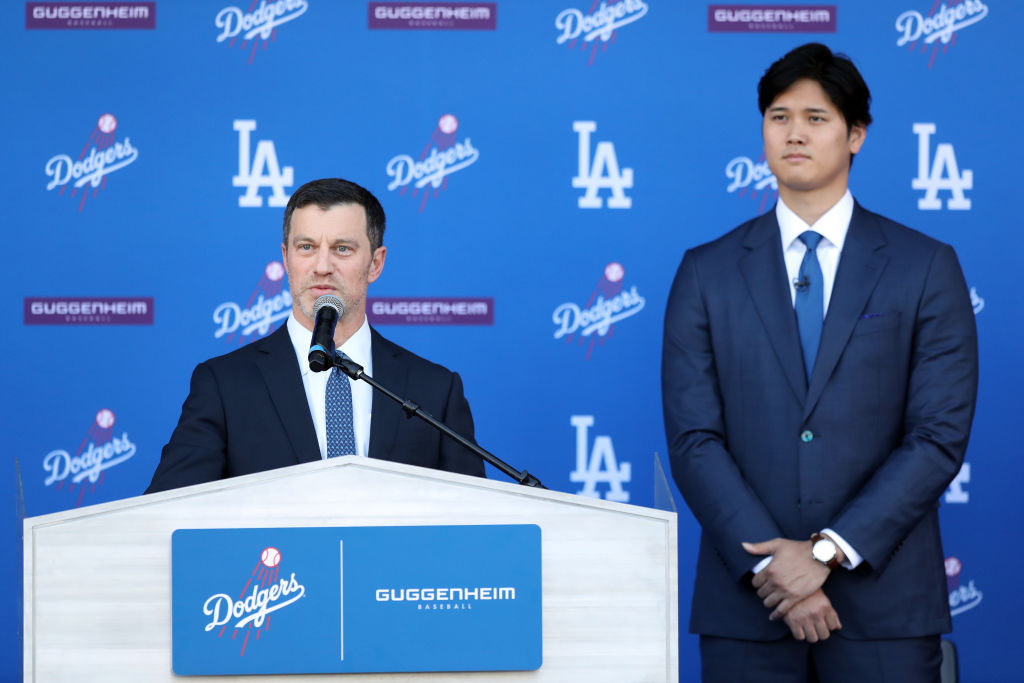
Although there were no Jewish players on this year’s Dodgers roster, Andrew Friedman, the team’s President of Baseball Operations for the Dodgers since 2015, is Jewish. This was the team’s second World Series championship during his tenure. In 2023, Friedman was part of the process of signing Japanese pitching sensation Shohei Otani to the largest contract in Major League Baseball history — $700 million over 10 years.

Andrew Friedman, President of Baseball Operations, speaks prior to introducing Shohei Ohtani at Dodger Stadium on December 14, 2023 in Los Angeles, California. (Photo by Meg Oliphant/Getty Images)

“Obviously winning is the number one goal, but I’ve always tied that to a parade” Friedman said in a post-game interview in the locker room — drenched in champagne. “Bringing the fans of L.A. — the amazing fans we have — bringing this trophy home and celebrating it with them and [2020] we didn’t get the chance to do it. To do it now is everything. Freddie winning the MVP of this series is storybook. What he went through this year, what he went through in the playoffs, for him to do what he did, just speaks volumes about who he is.”

“Bringing the fans of L.A. — the amazing fans we have — bringing this trophy home and celebrating it with them and [2020] we didn’t get the chance to do it. To do it now is everything.” – Andrew Friedman

He was referring to how the Dodger first baseman’s three-year-old son Max was diagnosed with Guillain-Barré syndrome — a rare neurological condition where the body’s immune system attacks the nerves. Max spent eight days in the intensive care unit on a ventilator before being discharged. Freeman stepped away from baseball for nine days to be there for Max. Freeman told ESPN that Max had to relearn “how to do pretty much everything.” Freeman’s wife Chelsea told “Good Morning America” that Max is “doing much better” and is in physical therapy. Max and the rest of Freeman’s family were at Yankee Stadium for the World Series-clinching game 5.

Some Jewish Dodgers fans have wondered whether Freeman is Jewish — he’s not. But Dodger fans will certainly remember where they were when he smacked the game-winning grand slam home run in Game 1 of the World Series.

When the Dodgers’ victory parade makes its way through Downtown L.A., expect to hear the song, “I Love L.A.” by Jewish songwriter Randy Newman on repeat. The song is played at Dodger Stadium after each home victory.

Jon Fischer, a Jewish lifelong Dodgers fan, saw much symbolism in the victory.

“Winning this game two days after Fernando’s passing felt surreal, almost like he was watching over us,” Fischer said. “This parade celebrates the Dodgers World Series Win against the New York Yankees. It will take place on Friday, November 1, which is also Fernando Valenzuela’s Birthday. Fernando died just two days before the start of the series.” To honor Valenzuela, the Dodgers painted the pitcher’s mound with his number #34 for each home game … Rest in peace Fernando ‘El Toro’ Valenzuela and thanks for watching over our Dodgers during this World Series.”

Max Rosenblum, a Jewish writer in Los Angeles reflected on how much of a long-time coming it had been for this Dodgers World Series victory, especially with the last title coming during the abridged, limited-attendance pandemic season.

“I’ve probably seen the Kirk Gibson 1988 walk off highlight a thousand times, but that had happened months before I was born. I wanted to see them win a World Series in real life. In the 2000s, the Dodgers had good teams, but couldn’t get through to the World Series. In the 2010s, the teams were even better, but still no World Series appearances until 2017. I was traveling abroad at that time and remember I fell asleep with the ESPN app open, waking up at 5:00 a.m. to see the Dodgers had lost to the Astros in a decisive Game 7. The next year also spelled defeat against Boston. In 2020, the Dodgers won the World Series in the shortened Covid season, but as a fan, it always felt incomplete. And with postseason collapses in 2019, 2021, 2022, and 2023, it started to feel like it wasn’t destined to happened. But today, the Dodgers are champions. Congrats to the team and all the fans. This one hits differently.”

The celebration is already in order. The “D” in the Hollywood sign was lit up in blue in honor of Los Angeles’ beloved baseball club.

Ken Levine, a writer and actor, celebrated with a simple nod to the team’s nickname from their Brooklyn days.

“Dem Bums did it!” Levine said, referencing the Brooklyn Dodgers’ nickname, the Brooklyn Bums. “I’m sure Vin Scully would have said, ‘there’s only one team that could have won in such a crazy fashion and it had to be the Dodgers.’”

The victory parade began Friday, November 1 at 11:00 am near Los Angeles City Hall — on what would have been Valenzuela’s 64th birthday.

Jews in LA React to Dodgers Winning 8th World Series Title Read More »

Before Solving the World’s Problems

Many Holocaust survivors remained permanent refugees long after arriving in North America. They kept packed go bags and hidden gold bars, just in case they needed to flee. Even after finding for themselves a safe haven, these survivors never fully trusted it; and so they were always on the lookout for danger, ready to leave at a moment’s notice.

This mindset may seem like it should belong to medieval Jews, but actually, it’s not of the distant past. It certainly wasn’t foreign to my parents’ generation, which had seen Germany change overnight from “Berlin is Jerusalem” to Berlin is a nightmare. It is not even distant. Last year, Jewish university students in New York had to quickly pack their bags and run home as well.

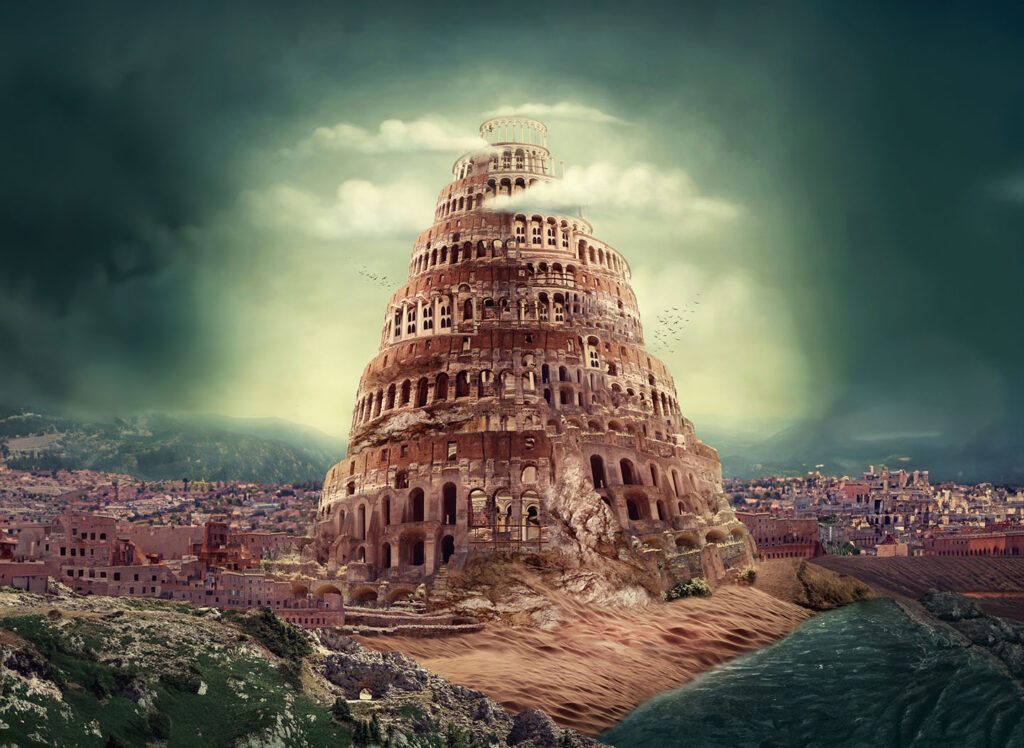
One fascinating example of this attitude is found in the writings of Rabbeinu Nissim of Gerona, who lived in the early 1300s, in his interpretation of the Tower of Babel.

The Biblical text about the Tower of Babel challenges its readers. The text, which is found in Parshat Noah, is quite vague. People move to a valley and want to make sure that they never separate. So they begin to build a city with a great tower in the center, with which they will make a name for themselves. God then descends to the tower and confuses the languages of the builders; the resulting communication gap halts the construction. From there, each language group spreads out over the world.

It is unclear why God did this, and how the builders sinned.

The lack of clarity may have to do with a lack of context. Contemporary scholarship identifies the Tower of Babel with the Etemenanki Ziggurat. This ancient building, (literally the “Temple of the Foundation of Heaven and Earth,”) was quite impressive, reaching nearly 300 feet tall; and it was intended to literally reach up to the Gods, and be a display of technological dominance. But from a biblical perspective, these notions are absurd; man is not God, and not at all God’s equal. God metaphorically has to descend to see this tower that the builders claim “reaches the heavens”; and the name the tower makes for its builders is not of greatness, but rather impermanence and dispersion. From this perspective, the text is a subtle satire about hubris.

However, this explanation does not exhaust the full meaning of the text. Many commentaries wonder why God would desire the confusion of languages and the divisions between nations. And this brings us back to Rabbeinu Nissim of Gerona.

Rabbeinu Nissim explains that at the time of the Tower of Babel, the vast majority of the world were pagans, and they persecuted those who served God. and that’s why the dispersion was good. He explains:

There is no question that the division of nations and governments was good for the handful of righteous individuals in those generations. When the people of a certain kingdom would oppress them, they would move on to a different land where they could serve God as they desired. This is the case in our present-day exile; when persecution renews in the lands of Ishmael (i.e., Muslim countries), its fugitives flee to another land. And (when needed,) people will sometimes flee from those places back to the lands of Ishmael. This is for us a little bit of sustenance during our servitude.

National differences increase the chances that maybe one country would be good for the Jews and serve as a refuge from the bloodthirsty mob. And for much of medieval Jewish history, that was precisely the case; people had a mental map of where they might flee if they needed to.

Modern readers take a very different view than Rabbeinu Nissim. Ludwik Zamenhof, who invented the universal language of Esperanto, did so because he believed that a common language would allow different communities to bridge their differences. He grew up in Bialystok, and observed the enormous animosity between Russians, Poles, Germans, and Jews; as he explained once in a letter, “In such a town a sensitive soul feels more acutely than elsewhere the misery caused by language division and sees at every step that the diversity of languages is the first, or at least the most influential, basis for the separation of the human family into groups of enemies.” So he dreamt of reversing the dispersion of Babel. Even when he was only 10 years old he wrote a play entitled “The Tower of Babel or the Bialystok Tragedy in Five Acts.” That became his life’s work.

To Zamenhof, the division of languages was a curse. And that may well be the meaning of the Biblical text as well. Many commentaries have noted the textual similarities between the Tower of Babel and the Garden of Eden narratives; and both narratives end with a tragic expulsion from an extraordinary home. Perhaps, had the builders of the tower been righteous, they would have achieved the unity envisioned by Zephaniah, of a day when “I will restore to the peoples a pure language, that they all may call on the name of the Lord, and unite to serve Him.” It is quite possible that Zepahniah’s “pure language” is precisely the one spoken by the people in the valley. If only they had been worthy of that linguistic unity, history would have been different.

Esperanto achieved peak popularity in the early to mid-1900s, the heyday of internationalism. At the same time, The League of Nations was meant to achieve world peace by bringing countries together; the world would change through dialogue and cooperation. Today, internationalism continues to reside in the United Nations, where it has been commandeered by dictators and stands in service of the corrupt. Uniting the world didn’t improve it much.

A very different reading of the Tower of Babel is offered by Rabbi Jonathan Sacks in his book The Dignity of Difference. Sacks wrote in the aftermath of 9/11, and much like Zamenhof, is searching for ways to help bring about world peace. Because the attack by Al-Qaeda was done in the name of religion, Sacks felt a particular urgency to find a way to end religious hatred.

Sacks turns to the Tower of Babel, which he argues emphasizes the importance of respecting differences. The world was created with enormous diversity, and no two humans are the same. Because of this, Sacks sees the tower as an attempt  “to impose an artificial unity on divinely created diversity.” Quoting the commentary of Rabbi Naftali Tzvi Berlin, Sacks argues that the builders of the tower didn’t respect difference; they were authoritarians who were determined to weed out nonconformists like Abraham. Instead, God disperses the people of the valley to diminish centralized power, and to have them claim their God-given diversity.

Sacks sees the post-Babel division and dispersion as a blessing. Only through pluralism, respecting the perspectives of those different than us, can a diverse population of individuals function together peacefully. Sacks went so far as to write in the first edition of his book that “God has spoken to mankind in many languages: through Judaism to the Jews, Christianity to Christians, Islam to Muslims… God is the God of all humanity, but no single faith is or should be the faith of all humanity.” This was denounced by the ultra-Orthodox as heresy; by the second edition of the book this was changed.

God belongs to everyone; unity is found by embracing diversity.

Sadly, the word diversity has taken on a different meaning since Sacks wrote his book. Today, lurking behind a supposed multicultural campus culture is a network of radical academics and administrators ready to cancel anyone who thinks differently. Diversity can be used in authoritarian propaganda as well, a weapon to silence those who deviate.

What is fascinating is that both Sacks and Zamenhof imagine they can solve the Jewish problem of antisemitism by first solving the world’s problems. But maybe they have it in the wrong order.

After the Tower of Babel, Abraham appears on the world stage. Now, solutions start with one man, one family, and one people. Reversing order, the micro becomes the template for macro solutions.

Jews must never forget the prophetic dream of world peace that Zephaniah mentioned. But before that, we have to survive. We simply can’t fix the Tower of Babel right now.

Maybe, after the last year, we need to consider solving the problems of the Jews first.


Rabbi Chaim Steinmetz is the Senior Rabbi of Congregation Kehilath Jeshurun in New York.

Before Solving the World’s Problems Read More »

5 Reasons U.S. Election Day Should be a Federal Holiday

Have you ever thought about why the United States should make our Election Day a Federal Holiday? When my 6-year-old son asked me why they don’t just elect Superman as President to fix unemployment by hiring people to handle kryptonite, I realized that as Americans we do not really have a lot of culture and education around voting day.

There is a sharp contrast between our elections and holidays that are a top priority for Americans such as the 4th of July and New Year’s Day.

Along with voting for the next President of the United States on November 5, 2024, millions will cast votes for all 435 House of Representatives and 34 Senate seats.

And yet, the U.S. is still ranked 31st out of 49 countries for voter turnout, as of 2022, according to Pew Research.

And while 28 states, plus Washington D.C., offer paid time off to vote, 21 states do not have paid voting leave, making it harder to vote, according to Forbes.

After thinking about this exchange with my son more, here are the 5 reasons that I believe that Election Day should be a recognized holiday in America to elevate the importance of voting and our democracy.

1. To Encourage Civic Responsibility and Patriotism

Patriotism is not only a love for one’s country, but also an active commitment to the values and duties that make the country strong. Making Election Day a holiday would recognize the significance of voting, placing it alongside other national observances that honor American principles and history, such as Thanksgiving.

An Election Day holiday can reinforce the idea that voting isn’t just a personal act, but a patriotic one that strengthens the country overall. Election Day as a holiday can emphasize the importance of voting as a core responsibility of every citizen, promote a sense of national pride and encourage citizens to uphold civic duties and responsibilities.

2. To Increase Election Integrity and Trust

Elections need to be fair and secure. Many people are forced to vote before or after work, leading to peak congestion at polling stations in the early morning and late evening. The result is long lines, increased wait times, and occasionally technical issues with voting equipment.

By creating a federal holiday, voting can be spread more evenly throughout the day, allowing polling staff to manage crowds more effectively and reducing the risk of errors that can arise when polling stations are overwhelmed. Poll workers can be better at enforcing voter identification and registration checks, and instill greater trust in the integrity of elections.

3. To Increase Volunteering and Community Engagement

Election day can be a much bigger day of community involvement with families and neighbors becoming more engaged in politics through volunteering at polling stations, driving neighbors to vote, and assisting with other Election Day activities.

Making election day a holiday will allow more Americans to volunteer as poll workers, boosting staffing levels and ensuring there are sufficient people to handle voting, oversee security, and troubleshoot any potential issues with voting equipment. A better-staffed polling site will also enhance monitoring efforts and accountability making the process more transparent and secure and building faith in American democracy.

4. To Honor Military, Law Enforcement and Essential Worker Sacrifices

Making Election Day a holiday can also help Americans reflect on the sacrifices that have been made to secure, protect and uphold our right to vote. Recognizing voting day as a federal holiday can honor our military, law enforcement and essential workers who’ve sacrificed so much to protect our freedoms.

From the founding of the nation to the fight for civil rights, generations have dedicated their lives to ensuring that every American has a voice in elections. Some of this history is forgotten.

A federal holiday would also help these groups vote that often have long shifts by allowing them more flexibility without compromising public safety, health, and infrastructure.

5. To Encourage Informed and Responsible Voting

Overall, recognizing Election Day as a federal holiday can promote a more thoughtful voting process by giving citizens the chance to research candidates, discuss issues, and engage in democracy with fewer time pressures. It can lead to a better informed and more engaged electorate.

By making voting day a holiday, it can become a celebration of both individual liberty and collective responsibility, underscoring the principle that each citizen has a vital role to play in preserving and shaping our future.

So let’s all take a minute to think about the idea of making Election Day a federal holiday as the countdown to the 2024 Presidential Election continues. Discuss it with your family, friends and neighbors, and reflect on the benefits for America.


Jonathan Bernstein is the Author of the new “Election Day” board book as a reminder to vote. Bernstein has a PhD from Yale University in Literature, and this is his first book in an American Holidays series. https://electiondaybook.com

5 Reasons U.S. Election Day Should be a Federal Holiday Read More »

Destruction and Regeneration – Torah Portion Noah


Destruction and Regeneration

Thoughts on Parashat Noah 2024 (adapted from previous versions)


I imagine warring bands of murderous maniacs, spreading ruination everywhere they went. Anyone who stood up to them was hacked down. Just about everyone eventually joined the frenzy. Something like the zombie shows, except in this case, the zombies win, and the murderous hordes are not zombies. These are mobs of human beings, but they have gone very, very bad.


We saw awful, horrific evidence of this maniacal evil in the atrocities committed by Hamas on 10/7/23. The wound is fresh, so horrific, so painful that we might forget that Hamas just another in a line of incarnations of evil. We see this humanity-gone-bad in the depredations of Nazism and the bloodlust reigns of Stalin, Mao, Imperial Japan, Pol Pot, the Kims of North Korea, and Saddam Hussein. We see this in the genocides in Rwanda, Myanmar, and the Balkans. We see it in the crazed viciousness of ISIS, Al Qaeda, and the Taliban. Slavery and the destruction of indigenous populations. Every time I dig into world history, I see it. The Armenian genocide. The Mongols. The Russian depredations in Ukraine. The list is long.


Imagine that the background of our Torah portion is these maniacal tribes are winning their war against humanity and are closing in to murder the final remaining other tribes and everyone in their path. You might write, as the Bible does, that “the world had become corrupt and was filled with violence.” If you believed in a God that acted in history, you might pray that this powerful God would wipe out this heinous humanity and all its cruelty. (If you have trouble imagining this, go watch Darren Aronofsky’s movie “Noah.”)


The Bible, in the Noah story, imagines this depravity and its consequences in its own way. Humanity, the Bible tells us, has been an awful error. The solution will be that human beings, made from earth and water and animated by spirit, would be dissolved back into the earth from which they came, and ultimately into the abyss of water that existed before creation. The spirit, trapped in a form that became monstrous, would be released back to God. The form would crumble. The spirit of God would hover silently again over the face of the waters. Cries of savagery would be stilled.


The bone chilling story of an ancient flood seemed to inhabit the minds of everyone in the ancient world of the Middle East. The “Black Sea Deluge” theory holds that the Mediterranean Sea broke through the Bosporus around 5600 BCE, flooding an ancient littoral civilization within months. Others believe that the Mesopotamian Rivers overflowed and deluged the cradle of civilization for centuries. Plato taught that the ancient island city of Atlantis fell out of favor with the gods and sank into the Atlantic Ocean (of all places). Whatever the source of the ancient Middle Eastern cultural memory of the flooding, The Deluge became part of the collective memory of that part of the world. Everyone knew it happened. Why it happened was the question. Ancient mythological systems came up with a variety of answers; for example, human beings were too noisy and disturbed the dreams of the gods.


The biblical author(s) held that this flood was an act of God to reverse creation. In other words, the Bible rewove an ancient tradition of a flood to support its theory that, referring to the human being, “every form of the thoughts of his heart are all bad, all the time” (Genesis 6:5). It took 10 generations, from Adam to Noah, for such a complete human degeneration that would require creation to be reversed to a watery silence.


As in other flood stories there was a “last good man.” In some flood stories, this person was hidden by a renegade god to survive the flood, much to the displeasure of the other gods who wanted to do away with all of humanity.


In the biblical story, it is the one God who is looking for the righteous person, the one who walks with God, to regenerate humanity out of the havoc and debris. The regeneration of humanity told in our Torah portion is bizarre and seems to forebode something awful. The parsha ends with the tower of Babel story, which reflections the tyrannical state.


The God of the Bible has apparently learned a lesson and waits patiently, 10 full generations, for the next chapter of the regeneration of humankind – the election of Abraham and Sarah.


Abraham would “walk before God and be whole.” Abraham would teach his descendants, spiritual and biological, to keep God’s way and the righteous law. The Bible, as literature and philosophic psychology, sees the human being as fallen but also able to stand up again. To achieve moral standing, however, we would need a teaching – a vision and a path so strong and clear that this teaching would guide us in turning back the flood of destructiveness.


People would learn to stand up against hordes that want to destroy humanity. We would also learn to turn back the destructive flood that rises within each of us and among us. It is in our nature to be destructive, but it is also within our nature to transcend our nature. Chaos, too, can be reversed. Entropy is not the ultimate law of the universe.


New tribes would come into being, holding the line against evil, fighting evil regimes, making room for teaching the vision and the way.

Destruction and Regeneration – Torah Portion Noah Read More »