fbpx

October 22, 2024

Get Yer Ya-Yas Out

In September of 1970, the Rolling Stones told the world to “Get Yer Ya-Yas Out.” Thrice Chai years later, the Israeli Defense Forces did exactly that. A precision strike rendered Yahya no more. The man whose surname comprised the words sin and war has now become a true environmentalist by involuntarily becoming one with Mother Earth.

The IDF welcomed Rosh Hashanah 5785 by liquidating Hezbollah leader Hassan Nasrallah. The IDF’s 5785 Sukkos gun powder gift basket rid the world of Hamas leader Yahya Sinwar. One year and 10 days after masterminding the worst attack on Jews since the Holocaust, Sinwar became a justifiable casualty of a war he unjustly started.

Sinwar was so evil that even the Washington Post, New York Times and CNN could not lament the death of an “austere religious scholar.” Even America’s State Department could not find a reason to criticize the Israeli strike. Even America’s Ivy League professors could not muster the most tepid of anti-Jewish criticisms. Even France and the rest of Old Europe failed to condemn Israel. Even United Nations diplomats took a break from meaningless non-binding anti-Israel resolutions. Sinwar was that bad.

The State Department did offer its typical ceasefire blather, but the United States presidential election has rendered them more impotent than usual. The Ceasefire Now crowd has been thoroughly discredited. Israeli Prime Minister Benjamin Netanyahu’s total victory approach has been completely vindicated. The Jerusalem Post’s Caroline Glick, among the best in the business, is reporting that Netanyahu’s popularity is sky high.

Hamas could surrender and return every remaining Jewish hostage, but long-term tactical and strategic planning are not their strong suits. Expect Hamas to cry crocodile tears for their dearly departed terrorist leader. Expect Hamas to offer Israel a high-risk, zero reward prisoner exchange agreement that deserves immediate rejection. The horrendous 2011 Gilad Shalit deal is what freed Sinwar to begin with.

This leaves Bibi with an alternative high-risk, high-reward move left to make. After New Year’s with Nasrallah and Sukkos with Sinwar, the trilogy needs Simchas Torah with the Ayatollah. Jewish jolly requires removing Ali. International law prohibits the assassination of leaders of foreign nations, but that law can be repealed as easily as Iran’s Ali Khamenei himself. International law has not prevented Khamenei from trying to assassinate former President Donald Trump. Decades of terror render Khamenei the foulest of fair game.

So let us hold the Torah, dance the Horah, and reduce every single Iranian mullah to rubble to be deposited in some cave in Tora Bora.

Until then, raise that lulav sky high. Join it with an esrog and shake it all about. Do the Hokey Pokey and take all the mullahs out. To win this war, that’s what it’s all about.

As for the IDF, somebody with deep pockets needs to take every one of them out for sandwiches and cigars. Hoagies and stogies…they’ve earned it.


Eric Golub is a retired stockbrokerage and oil professional living in Los Angeles.  

Get Yer Ya-Yas Out Read More »

A Note on the Quiet Jews

Since Oct. 7, so many Jews have spoken up. They have proudly declared they are Jewish, risking their careers and their reputations. Other Jews have supported Israel online and off. Some have transformed their entire lives, solely focusing on Judaism and Israel advocacy over the past year.

And still, there are the Jews who said nothing post-Oct. 7. I dub these people the “quiet Jews.” I wonder where their heads are at. What are they thinking in this post-Oct. 7 world?

Some have messaged me privately, telling me how much they are struggling, but that they are too scared to say something because of the repercussions. They don’t want to lose their friends or risk hurting their careers.

Some are cynical and in survival mode. They had family members who died in the Holocaust, and they think, “Same antisemitism, different day.” So, they detach.

But some, I must admit, some I just don’t understand. They go on posting about their lives, about their upcoming events, their successes, the great time they had at their friends’ wedding. It was as if Oct. 7 and everything horrible that came after it never happened. And I’m not close enough to them to reach out and say, “Don’t you want to stand up for your people? Shouldn’t you say a nice word or two about the only place in the world that would accept you with open arms if, God forbid, something terrible happened in the Diaspora? Don’t you feel anything?”

One of the hardest things I’ve struggled with over the past year is holding back criticism of the quiet Jews, especially the ones who were so openly Jewish before Oct. 7 and have been mostly silent since then. A few of the famous ones even profited off their Jewish content in the past. And yet, when it comes down to it, when we really need them to say something and stand by our side, they retreat. 

One of my favorite outwardly Jewish bands, for instance, didn’t speak up after Oct. 7, and have since wiped clean all their social media accounts. I’m so hurt that I can’t even listen to their music anymore. If I could meet them in person, I’d ask them: “Why? Why are you so quiet?” 

When I think of the quiet Jews, I try my hardest not to get angry or lose hope in them. I pray they are doing more hidden work that I simply cannot see. 

Perhaps they are pleading with God every single day, just like me. Maybe they are secretly worried about Israel and checking the news all the time, just like I am. They could be thinking about the Jewish homeland and their Jewish identity constantly, just like I do. Who knows?

Perhaps they are pleading with God every single day, just like me. Maybe they are secretly worried about Israel and checking the news all the time, just like I am… Who knows? One thing is for sure: I can’t make them speak up. I can’t change them. But I can change myself. 

One thing is for sure: I can’t make them speak up. I can’t change them. But I can change myself. 

Ahavat Yisrael, to love your fellow Jew, is one of the most important mitzvot. This year and beyond, I will work on loving all Jews, even if they’ve been quiet in the face of all this tragedy. 

Ultimately, unconditional love for your fellow Jew is what will bring the Jewish people’s redemption. It’s not an easy mitzvah, but it’s one that we all must try to fulfill. I know I will.

On that note, whether you’ve been loud or quiet about your Judaism over the past year, whether you’ve publicly supported Israel or you’ve retreated to your inner world, I still have love in my heart for you. I still believe in you. 

Maybe now, you will know that it’s safe to say something. You shouldn’t be afraid. 

Your fellow Jew – at least one – is here for you. And I promise: I will never leave your side.


Kylie Ora Lobell is an award-winning writer and Community Editor of the Jewish Journal. You can find Kylie on X @KylieOraLobell or Instagram @KylieOraWriter.

A Note on the Quiet Jews Read More »

Rosner’s Domain | The Killing of Sinwar as a Rorschach Test

One analyst explained that the killing of Hamas leader Yahya Sinwar is an opportunity. Another declared it a prelude to victory. A third asserted it changes the region. A fourth disagreed. After several days, thousands of spilled words, countless hours of television chatter, here’s what we can say with certainty about the killing of Sinwar: It is a Rorschach test. Tell me what you thought before the killing, and I’ll tell you what you think about the impact of the killing. Tell me your plan the night before the killing, and I’ll tell you your plan for the day after.

Should Israel rush to negotiate for the hostages, conceding more now than before to bring them home? You’d be hard-pressed to find someone who thought that’s the proper plan before the killing, who didn’t explain afterward that now, indeed, the time has truly (!) come. And how about a ceasefire? The Biden administration pressured for a ceasefire prior to the killing, and – surprise! – its officials consider the killing of Sinwar a golden opportunity to strive for … a ceasefire. Or, as President Biden calls it: “an opportunity to seek a path to peace.” Imagine that: Had Israel accepted Biden’s plan months ago, Sinwar would not be killed, and an “opportunity” for peace would have been lost. 

We could pile on more examples, but the principle is the same. Sinwar’s killing is proof of something. Of what? Of whatever I previously thought. In this sense, it is no different from most of what has transpired since the first day of this war. Yes, Oct. 7 was also a Rorschach test. Is the attack proof of the Gaza 2005 disengagement’s failure, hence a definitive argument for returning to occupation, maybe even resettlement? Or is the attack proof of the failure of Netanyahu’s strategy of bolstering Hamas as a barrier to the Palestinian Authority’s political aspirations? Is it proof that the two-state solution is a mirage, or proof that the two-state solution is more urgent than ever?

Some interpret the event this way, others that way. Typically, what we get is a preconceived opinion, reinforced by realities. Oct. 7 is proof that the judicial reform was disastrous and brought division and destruction. No, Oct. 7 is proof that the opposition to the judicial reform was disastrous and brought division and destruction. 

A survey we conducted a few weeks after the attack taught us early in the war that in the eyes of a significant part of the Israeli public, the dramatic event is not an opportunity for self-examination but rather one for reinforcement of past beliefs. True — a significant portion of the public agreed at the time with the general statement that “on Oct. 7, all strategies collapsed.” But the moment those same respondents were given the opportunity to specify which “strategies” collapsed, they aligned according to their political camps and preexisting positions. Each side tended to claim that it was the strategies of the other side that had collapsed.

A survey we conducted a few weeks after the attack taught us early in the war that in the eyes of a significant part of the Israeli public, the dramatic event is not an opportunity for self-examination as much as one for reinforcement of past beliefs. 

This phenomenon offers an interesting opportunity to observe the psychological process that ends up being referred to as a rigid conception. Want to know why we were all captives of a rigid conception? Look at the response to the killing of the master terrorist Sinwar, and you can see how it happens in real time. People have a position. Then a dramatic event occurs. Then people interpret this dramatic event in light of their positions. Instead of a dramatic event being an opportunity for reassessment, doubt, or the challenging of foundational assumptions, the dramatic event only strengthens the pre-existing position, anchoring it. Of course, occasionally there are events so powerful that they do shake core beliefs. After Oct. 7, it will be hard for anyone to maintain the position that Hamas is a potential interlocutor for peace talks. But on most things, and in most cases, events are not an opportunity to challenge beliefs as much as an opportunity to strengthen them.

Yet, it is necessary to pose a question: Was the pre-Sinwar-killing position that it is time to end the war too impatient? Were Americans and Israelis who demanded a ceasefire were mistaken in their assumption that Israel has nothing more to gain in the fight?

And yet, it is necessary to also pose the opposite question: Now that Sinwar is dead — a result we all wanted — are we truly better off when it comes to having a reasonable plan for the future of Gaza? 

The death of Sinwar — like that of Nasrallah before him — is an important achievement. Every leader who threatens Israel should know that such policy could lead to his personal destruction. But the death of Sinwar – like that of Nasrallah before him – is also a limited achievement: The challenge of Gaza after him is very similar to the challenge of Gaza before him.

Something I wrote in Hebrew

When Sukkot is over, the Knesset will reconvene to discuss, among other things, the demand of the ultra-Orthodox parties to pass a law that exempts their youngsters from military service. Here’s a paragraph I wrote about this:

If you want to describe it in a somewhat pompous way, you can say that a decision was made by the coalition to take a risk. What is the nature of the risk? The coalition will pass an exemption law — which it will call a conscription law — and hope for the best. That is, its members will hope that the public will not protest, they will hope that the reservists will not react harshly, they will hope that the wives of the reservists, and the mothers of the regulars, will not take to the streets. They will hope that because of the situation — war — or the mental state — a feeling of helplessness — the public will grumble but not react.

A week’s numbers

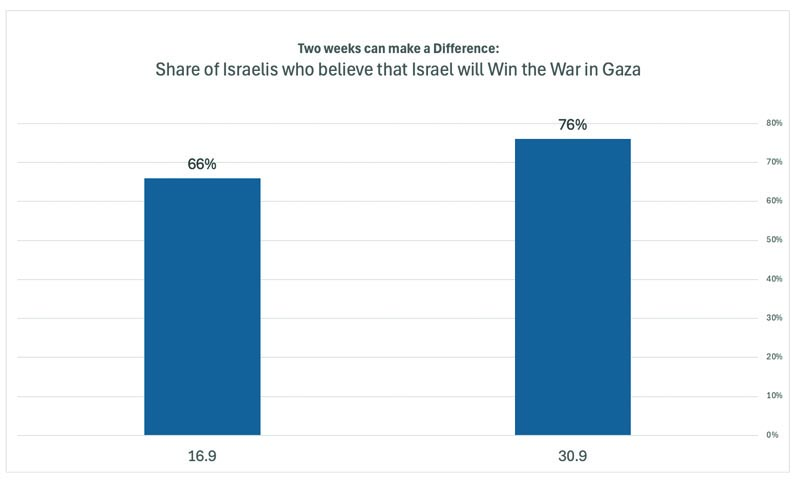
As a survey by INSS shows, a string of Israeli

Screenshot

s tactical achievements convinces the public that the war can be won (these numbers were collected even before the killing of Sinwar).


A reader’s response

Donna Mentzov asks: Do Israelis want Trump to get elected? Answer: Most of them – yes. 


Shmuel Rosner is senior political editor. For more analysis of Israeli and international politics, visit Rosner’s Domain at jewishjournal.com/rosnersdomain.

Rosner’s Domain | The Killing of Sinwar as a Rorschach Test Read More »

A Torah Was Hidden in Poland for Over 70 Years. One Man is Determined to Have Holocaust Survivors Complete It

As Jews around the world observe Simchat Torah and celebrate another completion of the Torah reading cycle, the 85-year journey of “the Survivor Torah” from Poland is still being written.

The Survivor Torah story begins in 1939 in the tiny northeastern Polish village of Filipów. At the time, the village’s Jews were being rounded up by the Nazis to be deported to Treblinka extermination camp. In a last-minute effort to save the community’s Torah, the town’s rabbi handed the Torah to his non-Jewish neighbor, Tomasz Wróblewski, a shepherd. The rabbi’s directions were simple: Hide this Torah until his return or give it to another Jew who would know what to do with it. The rabbi, along with most of the Jewish population of Filipów, was murdered in Treblinka.

The Wróblewski family kept the Torah hidden under their couch for 75 years. They didn’t know what it was, let alone its sacredness. So over the years, parts of the Torah were sliced away by the family and used for ordinary things like making a handbag and insoles for shoes, and then back under the couch it went. 

But in 2015, the Torah would emerge from hiding because of Jonny Daniels, the British-Israeli founder of the nonprofit From the Depths. Daniels connected with the Torah when volunteers with his organization went to Filipów as part of their mission to find lost Jewish cemeteries in Eastern Europe. The student volunteers from University of Warsaw had been going door-to-door asking villagers about any remnants of Jewish gravestones they may know of. When they knocked on the door of the Wróblewski home, an elderly couple brought them in, thinking that they were the Jews he’d been awaiting for 76 years. The students, however, weren’t Jewish, and the Wróblewskis said they could only tell their secret to a Jew. So the students returned with Daniels.

“The shepherd lifted up the sofa, and lying on the floor was half of the Torah, It was a shocking sight,” Daniels told The Journal. Rather than bury the damaged Torah, as Jewish law dictates, Daniels saw a much bigger mission for it. “This Torah really is the last survivor from this village. All the Jews from Filipów were taken to Treblinka and killed, but this Torah survived. Now, our opportunity was to bring it back to life.” 

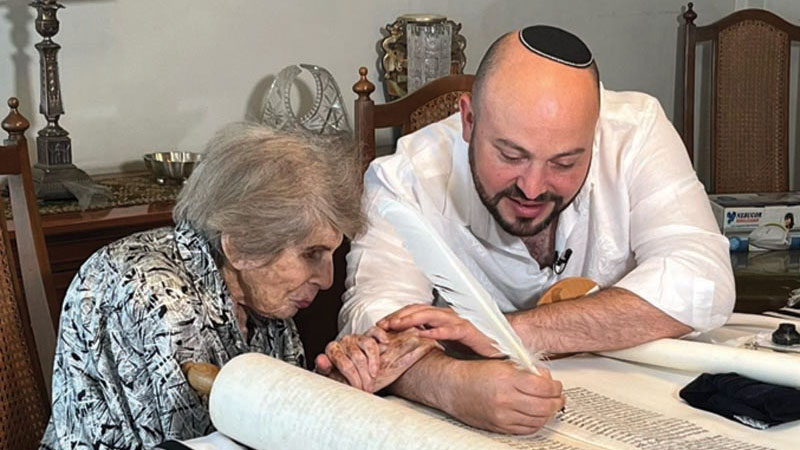
Thus began the Survivor Torah Project, Daniels’ initiative to restore the Torah by having Holocaust survivors from around the world fill in the missing letters. The Torah was ripped from the end of Leviticus onward, so there’s quite a bit to go — over 100,000 letters remain to be written.

“This Torah is being refilled by the very people who survived,” Daniels said. 

To keep the letters looking uniform, Daniels has a Torah Sofer (scribe) outline each of the letters. The process of filling in the letters can take several forms. Most often, the survivor is holding Daniels’ arm as he puts the letters onto the parchment. 

“They’re holding onto me, which also allows women to be involved in as well, and to have this as a Torah that is accepted by everybody,” Daniels said. Daniels has done the process with Orthodox Jewish woman who won’t hold onto his arm, but may hold the end of the feather quill or sit next to Daniels and he writes the letter on their behalf.

“It’s important for me that in the end, this Torah could go into a Hasidic synagogue, into a Reform synagogue — this is a Torah for the entire Jewish people,” Daniels said. Once it is complete, the plan is to have the Survivor Torah be permanently stored at the synagogue inside Beit HaNassi, the residence of the President of Israel in Jerusalem.

Daniels said that many survivors have asked to write multiple letters in the Torah to honor the family members they lost during the Holocaust. He’ll sit with survivors who want to write a letter for each sibling they lost, or for their children or grandchildren.

Since its rediscovery, the Survivor Torah has traveled with him to several countries, including Sweden, Denmark, Mexico, Germany and Poland. Just recently, Daniels drove to a remote town in the Pocono Mountains of Pennsylvania to meet with a Holocaust survivor who lives there alone. In fact, finding Holocaust survivors living their lives in solitude is all-too-common. Daniels said how, during a visit to Los Angeles in 2023, he sat with a Holocaust survivor for three-and-a-half hours at her home in Beverly Hills. 

“She was completely alone, not willing to leave her house,” Daniels said. “But when I brought the Torah to her, it was like she was reconnecting with her past, with her family, with her faith.” So far, over 600 Holocaust survivors from around the world have participated in the restoration of the Torah. This past year, the Torah crossed the equator for the first time, traveling to Brazil. Daniels met survivors in São Paulo, South America’s second-most Jewish city.

“When we brought the Torah to Brazil, the reaction from the survivors was overwhelming,” Daniels said. “Many of them had never heard of the project before, and they were so touched to be part of something that connects them directly to their own history and to Jews around the world.” It’s always in Daniels’ possession, stowed in a thick, locked briefcase wherever he goes. As an Israel Defense Forces veteran, Daniels is confident in being its protectorate. And it’s never, ever checked baggage on an airplane.

Since the attacks of Oct. 7, 2023, Daniels has also become one of the go-to Israel information influencers on social media today. But every few days, his posts about the news of the day are interspersed with photos and videos of additions to the Survivor Torah. It’s not lost on him for a moment that the largest single-day murder of Jews since the Holocaust took place last year on Simchat Torah, what was supposed to be one of the most joyous days on the Jewish calendar. This year, the Survivor Torah will be spending Simchat Torah in Los Angeles, where Daniels hopes to have even more Holocaust survivors bring it another letter closer to completion. 

It’s often an occasion where survivors and their families make an entire event out of the moment — even when the arrangements are made at the last minute. “Suddenly the grandkids are wearing the suits and the great-grandkids, these little beautiful Jewish children over there in their best clothes — they understand the beauty and significance of this for their family member,” Daniels said. “And the survivors get a level of closure, conversation and connection. It gives them a level of comfort in what has been a very difficult year for Holocaust survivors who are re-seeing images of Jew hatred that they haven’t seen since the 1930s.”

To arrange a time to have a Holocaust survivor contribute to the Survivor Torah, contact Jonny Daniels on Instagram: https://www.instagram.com/jonnydaniels

A Torah Was Hidden in Poland for Over 70 Years. One Man is Determined to Have Holocaust Survivors Complete It Read More »

Columbia Prof Shai Davidai Says University Barring from Campus Is ‘Personal Insult’

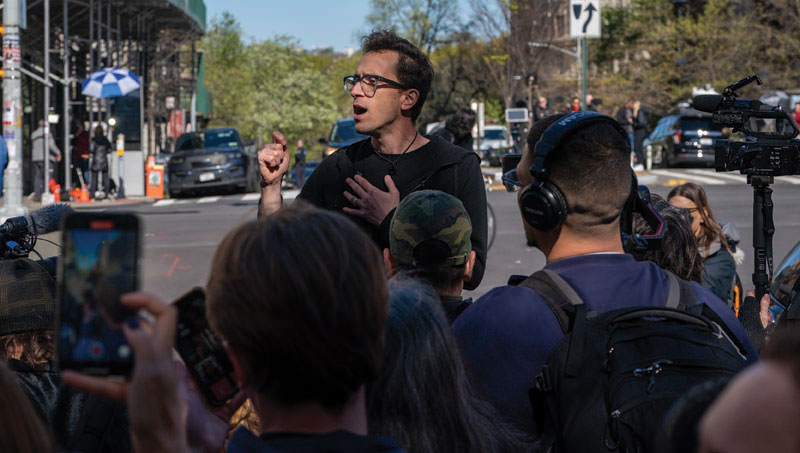
In an exclusive interview, Columbia University Professor Shai Davidai told The Journal that the university temporarily barring him from campus is a “personal insult” and that “there’s a bigger of how solve this, how do we move forward, not about myself necessarily but everything that’s happening on campus.”

A university spokesperson told The Journal, “Columbia has consistently and continually respected Assistant Professor Davidai’s right to free speech and to express his views.  His freedom of speech has not been limited and is not being limited now.  Columbia, however, does not tolerate threats of intimidation, harassment or other threatening behavior by its employees.  Because Assistant Professor Davidai repeatedly harassed and intimidated University employees in violation of University policy, we have temporarily limited his access to campus while he undertakes appropriate training on our policies governing the behavior of our employees.” According to a university official, Davidai’s suspension is the result of him harassing university employees on Oct. 7, but did not elaborate further. The university official added that Davidai is not suspended, but restricted from campus and that his compensation or status as a faculty member is not affected.

Davidai has maintained that he did not harass or threaten anyone and that the university is retaliating against him for posting videos to social media confronting university officials for not taking action against an anti-Israel protest on campus. The posts include videos where Davidai confronts University Chief Operating Officer Cas Holloway for being “indifferent” to an anti-Israel walkout occurring on Oct. 7. Davidai called the action “unsanctioned’ and violated time, place and manner restrictions. Other videos show Davidai confronting Assistant Director of Public Safety Bobby Lau, telling Lau to his face that he’s “useless.” Davidai claimed in the video that he was being elbowed and kicked in the shin by anti-Israel protesters as Lau stared on.

Davidai explained that “pro-Hamas organizations and professors” were protesting a memorial service held by Jewish students on Oct. 7. “They held signs saying ‘no peace,’ ‘resistance by all means necessary’ but also signs saying ‘long live the Al-Aqsa Flood’ which is the Hamas name that was given to the October massacre,” Davidai said of the anti-Israel protesters. “They were given their space to protest our memorial service, and even though I find that heinous … it’s free speech, and they’re allowed to do that, and I didn’t interact, I didn’t do anything about that.” But later on, the protesters left their designated protest space and began marching on campus “basically saying all of this is ours, we’re allowed to be everywhere, we’re allowed to terrorize Jewish students,” Davidai said. “At that point, I decided that I’m not going to cede my ground. I did not enter their protest — there were some false claims about that — I stood in a path on campus where they were marching, and they came and enclosed all around me.” It was at that point that Davidai says he confronted Holloway and Lau.

Regarding the video where Davidai tells Lau that he was elbowed and kicked by the anti-Israel protesters, the Columbia professor said, “I’m not a big man, but I can take a punch or two, so I’m okay with that. But they were walking around me, thinking no one sees it, they were kicking me in the shins, they were elbowing me, and Bobby Lau just does nothing.” 

To Davidai, the irony is that “he says that by me standing there, I was the one causing the problem.  And yet when I wasn’t the one standing but I was the one walking after Cas Holloway … I was also the one causing the trouble. So for them, it’s just my mere existence on campus which is a problem.”

In one of the videos where Davidai is confronting Holloway while walking alongside him, Davidai points out that an Israeli student is crying over the anti-Israel march. The student is not shown in the video which Davidai said was because he “didn’t want to expose the student.” He explained that the student came to the university this year to study neuroscience and she was “shocked” at the march. “Imagine coming from a country who experienced the worst massacre of its history, coming to the U.S., to her dream school, and on the first anniversary of that massacre, being confronted with a protest in celebration of that massacre,” Davidai said. “And the fact that Cas Holloway just, with that dead look in his eyes, basically tells her there’s nothing we can do, file a complaint. I’m still dumbfounded when I think about that, I still don’t understand how it is that this is our reality.”

His fight, he said, is not against the students and faculty who support Hamas. Instead, his fight is “against the administration that allows this to happen. So I wanted to expose the world to who are these administrators.”

His fight, he said, is not against the students and faculty who support Hamas. Instead, his fight is “against the administration that allows this to happen. So I wanted to expose the world to who are these administrators.”

Davidai claimed that the administrators didn’t like being exposed, and thus the university retaliated by temporary banning him from campus; he further alleged that his lawyers were notified that he might be banned from campus later that evening on Oct. 7, which Davidai said shows that the university’s top priority was “getting rid of me.”

“They didn’t tell me who I harassed … they never told me what exactly I did that was harassment. The university is again being the jury and the executioner,” Davidai said. “There’s no due process. They wouldn’t allow me to appeal, they wouldn’t allow me to state my own argument.”

The professor pointed out that his activism has been “public” and that people can watch the videos for themselves to see if his actions amounted to harassment. He also maintained that the university “is using very different standards” as the university is taking action against him but not against professors who are “openly calling for the destruction of Israel, openly glorifying a massacre against Jews. That doesn’t count as harassment. So clearly Columbia has a huge double standard problem.” 

On social media, Davidai has also accused the university of engaging in a double standard for not taking action against anti-Israel students who verbally confronted then-Columbia President Minouche Shafik in May.

But for Davidai what is “most painful” about being barred from campus is that he can’t be there for the Jewish students and he hopes “they have other people coming there and supporting them. I’m not sure that there are.” He elaborated that Jewish students have a “bifurcated experience” on campus as some simply avoid any parts of campus where a pro-Hamas protest is taking place, while others “stand up to the hate, and some of them are just standing there shocked. They don’t know what to do. I think most of their shock is not from the hate, it’s from the administrators — their tuition money is paying for those administrators’ salaries, and not only do they not do anything, they’re actually protecting the Hamas supporters.”

According to a university official, their expectation is that Davidai will complete a workplace training program and return to campus once he does so. Davidai had told The Columbia Daily Spectator that he would only engage in the program if Holloway did so as well. Davidai told The Journal that he’s “in a bit of a pickle” and doesn’t know what to do. 

“On the one hand, I truly believe that if you have done nothing wrong, you should not be punished,” he said. “Call me naïve, call me stupid, but that is the rule of democracy. In totalitarian regimes, you can get punished unrelated to if you did something wrong. In democracies, you’re supposed to only get punished if you did something wrong, and only after you had a chance to actually state your case … that’s not what happens at Columbia. So there’s a part of me that says no, I need to fight this.” On the other hand, “Columbia doesn’t want me on campus. They don’t want me documenting everything. They are happy to have pro-Hamas protests keep going on campus, and as long as people like Shai Davidai aren’t on campus and aren’t documenting it, the world won’t know.” Therefore, Davidai acknowledged he’s “still torn” on whether or not he should do the training.

“Columbia doesn’t want me on campus. They don’t want me documenting everything. But they are happy to have pro-Hamas protests keep going on campus.”

According to a university official, Davidai is not teaching this semester; Davidai explained that he is conducting research rather than teaching, but “the suspension does mean that I can’t go into my office, that I can’t use the printer and all this stuff at the university, but also more importantly, I cannot go to faculty meetings, I cannot go to research seminars, I can’t go to different research talks, everything that faculty life is all about, I’ve been completely barred from it.” 

Davidai said that a lawsuit against Columbia is not out of the question, as his lawyers are already suing the university over campus antisemitism, but his preference is not to sue the university and spend time in a courtroom. “But if Columbia refuses to change course, if Columbia refuses to deal with its problem with antisemitism and its support for terrorism, then we’ll use any legal way possible to force them to do so, if it’s the court of law, if it’s the court of public opinion, if it’s political pressure,” he said. “Clearly Columbia doesn’t want to fix itself, they’ve become too big to fail, and our goal is to not let go.”

The Columbia professor also criticized mainstream media coverage, noting that  The New York Times is “painting me as the bad guy … I think in many ways it’s way more damaging, because the suspension will at some point be over, but the damage the media does by downplaying, by minimizing, by telling half-truths, by omitting important information, just to push a specific narrative about peaceful protests — which they are not peaceful — is something that will stay with us for many years, and I worry about that.”

Davidai specifically pointed to how the article portrayed him as “going against pro-Palestinian protests, even while a week before, The New York Times was forced to admit that these students are not pro-Palestinian, they’re openly supporting Hamas. We have to remember: Last week this organization at Columbia said that they stand with armed resistance and violence is the only path forward, and The New York Times insists on these peaceful protests ‘pro-Palestine,’ which they are not.” He also criticized the Times for calling him “a polarizing presence on campus since Oct. 7, 2023”— to which Davidai said that “they are the one creating me as a polarizing figure” — and stating that Davidai “falsely” referred to retiring Professor Rashid Khalidi as a “spokesperson for Hamas.”

“I never claimed that,” Davidai said. “All I said was, when I saw that he was retiring, that he could go now and be a spokesperson for Hamas, clearly a tongue-in-cheek comment about his support for terrorism, and yet The New York Times smears me as someone who is spreading lies about this person, which I haven’t and I won’t.”

David Dee Delgado/Getty Images

He said The Times article states that he “declined an interview request.” But Davidai insisted that he “didn’t decline an interview. They asked for my comment, and my comment was: I will not talk with The New York Times so long as Sharon Otterman, who’s been covering the beat of Columbia, is still doing that … and I wrote, ‘that is my comment’ … so there’s a clear agenda, and the agenda is problematic because The New York Times portrays itself as the unbiased arbiter of the world. Yet when you look at the reporters’ social media accounts, you can see not only are they not unbiased, but they are biased in a very specific way. So I think we have a much steeper hill to climb than we believe.”

“The New York Times portrays itself as the unbiased arbiter of the world. Yet when you look at the reporters’ social media accounts, you can see not only are they not unbiased, but they are biased in a very specific way. So I think we have a much steeper hill to climb than we believe.”

Otterman, one of the co-authors of the Times article in question, told The Journal that it was “accurate” for them to report that Davidai declined an interview request and that “interview subjects cannot dictate which reporters should cover what topic for obvious reasons.” Regarding their use of the word “falsely,” Otterman said that “we will have to check [with] our editor how we should respond. I think the idea was signaling to readers that Rashid Khalidi is not an actual Hamas spokesperson, in case they thought he could be.”

Davidai said that he has received “incredible” support from the Jewish community as well as non-Jewish allies. “They’ve been helping me stay afloat because honestly, in the past few days I felt like I was drowning, and to have this entire community stand up for me and with me helped me keep my head above water,” he said. “And I think what is happening is that people realize that, if this is done to me, and if they’re able to silence me, then they are going to be able to do this to everyone… I’m just so immensely grateful for the community.”

Columbia Prof Shai Davidai Says University Barring from Campus Is ‘Personal Insult’ Read More »

Oct. 7 Meets the Simchat Torah Challenge

How is it possible to commemorate the darkest event in Israeli history on the most joyful day of the Jewish year?

This is not a rhetorical question. The massacre of Oct. 7 happened last year on the morning of Simchat Torah, the day when Jews are supposed to sing and dance with Torah scrolls in a state of total exuberance. But the disconnect between that spirit of joy and the massacre is so great that to commemorate that horrific event, much of the Jewish world has chosen the secular date of Oct. 7. 

That makes sense: Why contaminate a day of ultimate joy with memories of ultimate grief?

This is why “October 7” has become a brand of its own, like “September 11.” Through countless films, songs, art exhibits, books, essays, stories, poems, memorials and other initiatives, Oct. 7 has become the definitive moniker for a day that will live in Jewish infamy.  

But that still leaves us with an uncomfortable question: What should we actually do on Simchat Torah, which begins this year on Thursday night, Oct. 24? Should we sing and dance as if nothing had happened?

That doesn’t seem right.

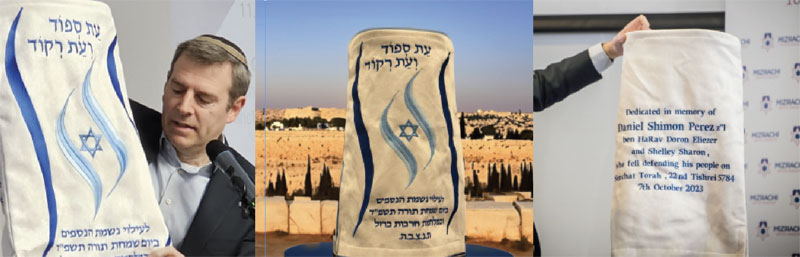
Several initiatives have sprouted to find ways of marking the tragedy while still celebrating the holiday. One of the largest is the Simchat Torah Project, which has been in the works for many months. The idea is to have synagogues use a specially designed Torah cover to honor the victims of the massacre. According to its website, this cover has been created for “1,600 synagogues across the world” and “will proclaim that this Torah is dedicated in memory of the 1,200 souls and the many soldiers and hostages who have since died.”

Each Torah cover will feature the name of one of the victims embroidered onto it, so that when Jews who participate in this initiative hold up the Torah on our day of joy, they also will be holding up the names of those who perished and continue to live in our memories. As you’ll read in this week’s community story from our reporter Ryan Torok, a few local synagogues have jumped onboard, while others are finding their own ways to navigate the day.

One initiative that has especially caught my attention is the Simchat Torah Challenge, which goes beyond the Torah cover and into the Torah itself.

The idea is to transform the darkness of Oct. 7 with the light of Simchat Torah by encouraging the timeless ideal of Jewish learning. 

“These are challenging times for Jews all around the world,” it says on its website. “So what can we do? The same thing we’ve always done: Take a few minutes each week and read the Torah. So grab a friend, a relative, or everyone you know, and join us on the Simchat Torah Challenge, where our community of 10,000 Jews [and growing] will read just one Torah portion a week and discover some surprisingly modern wisdom in a very old book.”

Two things in particular struck me about this initiative. One, it’s not limited to one day. Those who will learn Torah each week will be honoring the victims throughout the year, not just on the holiday. 

The second thing that moved me is the action itself. It’s unusual to honor someone’s memory by improving ourselves. From what I gather, the idea came about when someone visited a Chabad rabbi in the hospital and asked if they could do something for the rabbi. Not surprisingly (for those who know Chabad), the rabbi asked the man to put on tefillin. Eventually, they began to learn Torah once a week for several years.

When the massacre struck on Simchat Torah, suddenly the second word of the holiday took on added significance. So when it came time to commemorate the first anniversary, a difficult dilemma became a holy challenge. Instead of agonizing over what to do on that most joyful of days, Jews would be encouraged to do what has kept us going for millennia: study Torah, the one book that brings us all together.

As you’ll see on its website (simchattorahchallenge.org), the initiative goes way beyond a simple suggestion and includes, among other things, user-friendly tools and the creation of a global “Torah community.”

I can’t think of a better combination for this year’s Simchat Torah: Dance with special Torah scrolls to commemorate the victims, and then begin learning a little Torah each week from those same Torah scrolls.

Gaining the wisdom of Torah every week is an unusual way to honor the memory of the worst day in Israeli history. But by transforming the deepest darkness with the light of learning, it’s also very Jewish.

Oct. 7 Meets the Simchat Torah Challenge Read More »

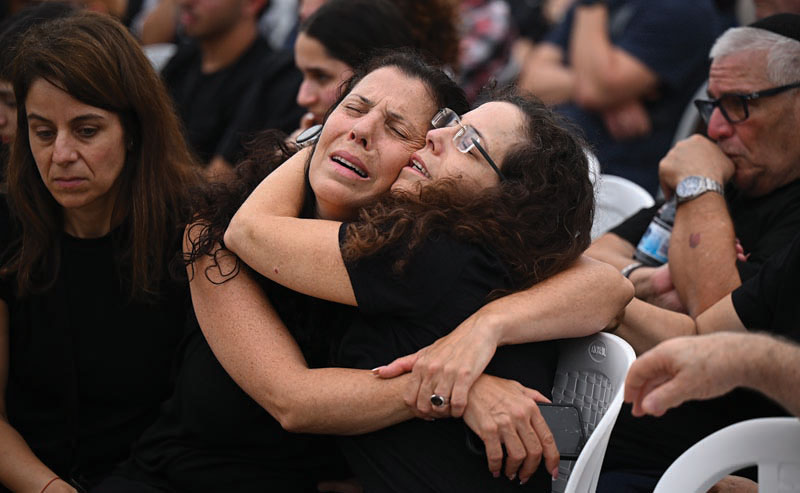
The First Simchat Torah Since Oct. 7: Leaders Weigh In

On the morning of Oct. 7, 2023, Hamas attacked Israel as the country was preparing to celebrate Simchat Torah. 

Consequently, Simchat Torah, the most joyful day on the Jewish calendar, is now intrinsically connected to one of the darkest days in modern Jewish history.

This month marks the first Simchat Torah since the tragic events of Oct. 7.

In acknowledgment of this, 1,600 synagogues around the world are participating in the Simchat Torah Project, a global undertaking to provide synagogues with special Torah scroll covers that mark the first yahrzeit of Oct. 7. Each cover is embroidered with the Israeli flag and a phrase from the book of Kohelet (Ecclesiastes), read during Sukkot, that says: “There is a time to mourn, and a time to dance.” 

Additionally, each Torah cover is embroidered with the name of one of the approximately 1,200 victims of Hamas’ Oct. 7 attack or the name of an Israeli soldier who has died during Israel’s subsequent war in Gaza.

Sinai Temple is among the local congregations participating in the initiative. According to Sinai Co-Senior Rabbi Erez Sherman, the Conservative synagogue commissioned two Torah covers, each honoring the memory of two individuals affected by Oct. 7 who also happen to be relatives of Sinai Temple congregants.

With its participation in the project, Sinai is honoring the memory of hostage Amiram Cooper, who has been declared dead — his body yet to be returned — and was the uncle of Sinai Temple congregant Rona Passman. The congregation’s other new Torah cover honors the life of Niv Raviv, who was killed on Oct. 7 in Kibbutz Kfar Azza. Raviv was the cousin of Sinai Temple congregant Stacy Sharf. 

On Oct. 24, the Sinai Temple community will take two of its Torahs adorned with these commissioned covers to an event in the streets surrounding its Westwood campus. The program will feature a live band along with an ice cream truck and snacks. Congregants will sing and dance with the Torahs and unroll one of the Torah scrolls, as is customarily done on Simchat Torah. Attendees of the event — held from 5:30-6:30 p.m. — are encouraged to wear blue and white.

Another major initiative is the Simchat Torah Challenge, which encourages weekly Torah study so that the honoring of Oct. 7 victims lasts all year (see David Suissa’s column this week).

Across town from Sinai Temple, Wilshire Boulevard Temple is also marking Simchat Torah with a community gathering that pays tribute to the survivors and victims of Oct. 7, including those killed at the Nova music festival in Israel. The synagogue’s Oct. 25 event — ”Honoring Nova: A Music Festival Simchat Torah Experience” — features a Nova survivor, a live Israeli DJ, a light show, food vendors and artistic displays.

During his recent sermon at Sinai delivered on Kol Nidre, Sherman described the community’s participation in the Simchat Torah Project and the community’s plans for the holiday, which marks the end of one and the beginning of another annual cycle of readings from the Torah.

“We as a community will dance through our tears,” Sherman said, appearing on the bimah with Sinai Co-Senior Rabbi Nicole Guzik. “We will take these Torahs to the streets, and we will dance again!”

“We as a community will dance through our tears,” Sherman said, appearing on the bimah with Sinai Co-Senior Rabbi Nicole Guzik. “We will take these [specially embroidered] Torahs to the streets, and we will dance again!” 

Rabbi Tarlan Rabizadeh, vice president of Jewish engagement at American Jewish University, was among the city’s spiritual leaders wrestling with how to celebrate Simchat Torah this year. In a phone interview, she said the significance of Simchat Torah is that it emphasizes the cyclical nature of life and the importance of celebrating new beginnings even amidst endings. She connected this to the current global challenges, particularly the ongoing conflict in the Middle East and the perpetual hope among Israelis for the release of the remaining hostages. 

“We are a religion that chooses life and [the onus is on us] to choose to dance again with the Torah,” Rabizadeh said, “even though the holiday falls on a day when so many died.”

The female Persian rabbi said dancing with the Torah, as is done on Simchat Torah, can be a powerful symbol of embracing life, while beginning a new Torah cycle is a symbol of continuity. 

At a moment when the Jewish people in Israel are currently in an existential war with neighbors who’d like to see it wiped off the map, a message of Jewish continuity, she said, couldn’t be timelier.

Local writer Eliyahu Abramson said the community, still grappling with the trauma of Oct. 7, ought to double down on the joy of Simchat Torah. 

As a community, Abramson told the Journal in a phone interview, “We draw strength from crises.”

Abramson said the holiday’s themes of renewal resonate with the geopolitical realities in the Middle East. Just as Simchat Torah provides an opportunity to begin the Torah anew, Israel is looking to embark on a new beginning after the trauma of last year’s attack, he said.

Thus, even as we remember what happened last year on Simchat Torah, this year, Simchat Torah obliges the community to keep the celebratory and joyful spark alive. 

In other words, “We will dance again.”

The First Simchat Torah Since Oct. 7: Leaders Weigh In Read More »

All Trauma Is Valid… Unless You’re an Israeli Jew

Naomi Klein has written a 6260-word essay in the Guardian, accusing Israelis of “weaponizing” the trauma of October 7. Klein lets it be known that she “openly grieved the Israeli civilians killed in the 7 October attacks.” But, she muses at length, do the Israeli people and legacy Jewish organizations have to do so much memorializing them: producing art, theater, exhibitions, documentaries? Aren’t the volume and speedy production of this “sprawling memory culture” highly unusual? Where Jews have found comfort in sharing pain, and a refuge amid skyrocketing antisemitism—including pervasive denial that atrocities even took place—Klein sees a cynical ploy to generate sympathy for Israel’s war aims.

Where Jews have found comfort in sharing pain, and a refuge amid skyrocketing antisemitism—including pervasive denial that atrocities even took place—Klein sees a cynical ploy to generate sympathy for Israel’s war aims. 

In all her writing, Klein has shown a profound lack of empathy for the victims of October 7,  including women survivors of sexual violence. Whether they are Jewish and Israeli, or Arab, Bedouin, African, Hispanic, Asian, American or European, their experiences are consistently decentered and marginalized by Klein, subsumed by her animus toward the existence of  Israel — the Jewish right to collective political self-determination and freedom. She deems efforts to tell the survivors’ stories manipulative, attempts to peddle “a simple fable of good and evil, in which Israel is unblemished in its innocence, deserving unquestioning support, while its enemies are all monsters, deserving of violence unbounded by laws or borders, whether in Gaza, Jenin, Beirut, Damascus or Tehran.” 

The humanity and human rights of survivors of October 7 disappear within Klein’s fluid prose. When acknowledged in passing, it is only to further her argument against the state in which those attacked on October 7 lived and of which the vast majority were citizens. In so doing, Klein objectifies and instrumentalizes survivors, adding to their suffering and potentially contributing to their retraumatization. 

Klein also claims that it is wrong for the October 7 survivors and others to relate them to the Holocaust. Just because October 7 was the worst one-day slaughter of Jews since the Holocaust, carried out with barbarity reminiscent of the Nazis, by an organization whose founding charter calls to kill every living Jew and which has vowed to repeat October 7 until the Jewish state is eliminated and thousands more Jews are murdered, it’s apparently absurd to link October 7 to the most shattering trauma of the Jewish people. That Jewish people around the world have viscerally felt this connection and expressed it widely and repeatedly for a year now – including many Holocaust survivors – does not make her question her condemnation of  Jews interpretating their own history, identity, and contemporary realities of antisemitism. 

Among the many venerable organizations Klein spuriously criticizes for conflating the Holocaust with October 7, she names the USC-based Shoah Foundation, who have recorded the testimonies of survivors of the massacre as part of their collection of testimonies. 

There are many reasons why the USC foundation’s collection of testimonies of victims of the October 7 massacres is valuable and important. Among them are to refute the widespread global misogyny directed at the Jewish women victims of sexual violence, denial of the massacres, and rising antisemitism in the United States and globally. Another is so that people like Klein, who devalue the victims of October 7, can — if and when they are ready to feel more empathy and compassion and expand their consciences — will be able to hear the stories and recognize the humanity of the individuals whose experiences they have marginalized. 

USC’s Executive Director, Robert Williams, has expressed the foundation’s reasons for collecting these testimonies with moral clarity. 

“We recognized there was an urgency to capture the voices of people who had been caught up in those events,” he said. “We immediately recognized it was an act of mass violence against Jews.” 

The Shoah Foundation has already collected over 400 testimonies and is continuing to collect more. 

Williams has said that the Shoah Foundation’s collection of testimony is “about building an awareness [of antisemitism] through testimony” and “to serve the future historical record.” 

Steven Spielberg, who envisioned, established, and funded the Shoah Foundation, has clearly and compellingly stated the importance of its work collecting testimonies of survivors of the October 7 Hamas massacres. 

“Both initiatives — recording interviews with survivors of the October 7 attacks and the ongoing collection of Holocaust testimony — seek to fulfill our promise to survivors: that their stories would be recorded and shared in the effort to preserve history and to work toward a world without antisemitism or hate of any kind. We must remain united and steadfast in these efforts.”

Klein’s sneers on survivors commemorating  their own experiences and those of their loved ones demeans survivors and denies them agency. 

None are compelled to provide their testimonies; they choose to do so. 

The Shoah Foundation should continue to honor their wishes to provide testimonies, irrespective of Klein’s denigration of their efforts  to tell their stories in the manner of their own choosing.

The Shoah Foundation’s aims to provide education, commemoration, and the affirmation of human rights and human dignity are all served by preserving the testimonies of survivors of the October 7 massacres alongside the other diverse testimonies they collect and preserve.

It is not for Naomi Klein, from her place of privilege and safety far from the sadistic violence and destruction of October 7, to lecture survivors on how to tell their stories, to whom, and in what contexts and forms.

It is not for Naomi Klein, from her place of privilege and safety far from the sadistic violence and destruction of October 7, to lecture survivors on how to tell their stories, to whom, and in what contexts and forms.

That is their decision to make and theirs alone.


Noam Schimmel is a Lecturer in Global Studies with an emphasis on human rights at University of California, Berkeley. 

All Trauma Is Valid… Unless You’re an Israeli Jew Read More »

A Babka By Any Other Name

It was Israel in the 1970’s. I was nine years old and we were visiting my maternal grandparents, as well as my many aunts and uncles that had made Aliyah from Morocco in the 1950’s. Sitting in the kitchen of my aunt Messody, I watched as she took a ball of dough and rolled it thin, spread it with jam and melted chocolate, rolled it into a tight log and placed it in a loaf pan. Half an hour later, hot out of the oven, that dough was puffed up into a tall log. It was completely crispy, golden and glossy on the outside and the inside was deliciously soft and chewy, delightfully streaked with melted chocolate.

Over the years, I often thought about my aunt’s “chocolate bread” and now I realize that she was making Babka.

As I started to research babka, I discovered that babka is a dessert that originated in Poland and Ukraine. The name comes from the word baba, which means grandmother. How sweet is that?

As I started to research babka, I discovered that babka is a dessert that originated in Poland and Ukraine. The name comes from the word baba, which means grandmother. How sweet is that?

Awhile back, I asked my cousin if she had her mother’s recipe for babka and she had no idea what I was talking about. That’s when I learned that in Israel, babka is called “ugat sh’marim” or yeast cake.

—Rachel

When I was a little girl, my mother would always bake cakes for Shabbat. Many times, she would reference her well worn Israeli cake recipe book. I can still picture the cover of the book, but I couldn’t tell you the name. At the time I couldn’t read Hebrew.

Sometimes she would make marble cake and I remember her carefully swirling the chocolate batter into the vanilla batter. My father had a very sweet tooth and he especially enjoyed this cake with his morning coffee.

Other times, she would make “ugat sh’marim” and the name of this cake would confuse me. I knew that “shomer” in Hebrew means guard, but had no idea that “sh’marim” meant yeast, so in my mind it was literally the “guard’s cake.” Thankfully, my Hebrew has improved with time.

Fast forward many years and now it’s my kitchen that is the scene of much action. Luckily, all three of my daughters are amazing helpers. But it’s my daughter Alexandra who especially loves to bake and dream up treats to serve family and friends.

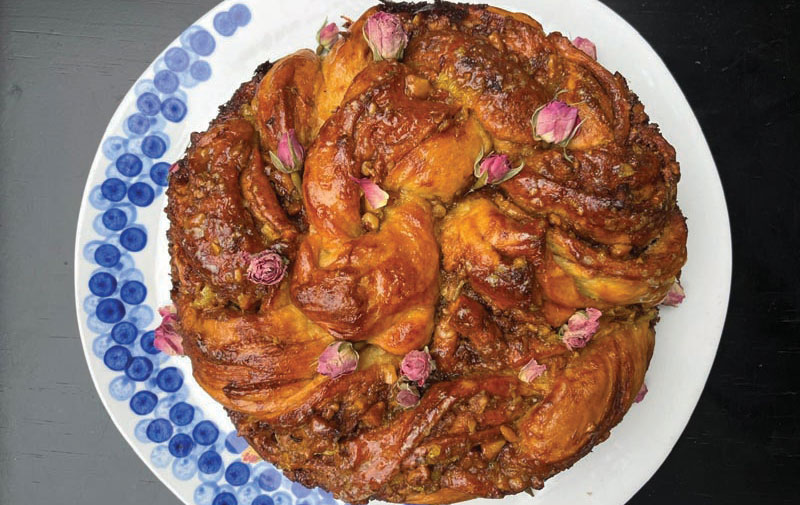
On her recent visit home from college, between all the roasting of meats and vegetables, she kneaded some delicious light and fluffy challah dough. We braided some of it into challah and baked the rest into an orange and cardamom babka. We rolled the soft dough with a filling made with our favorite warm spices, orange zest, an oat milk butter and crispy, meaty walnuts. Then we drowned the dough with a glaze made from slowly melted sugar and freshly squeezed orange juice. The babka rose to glorious heights and it tasted absolutely scrumptious. (We know it was good because my mom took a slice home to have with her morning coffee!) Whether you call it babka, “ugat sh’marim” or by its modern Israeli name “crunch,” this is a truly easy and brilliant dessert for busy Jewish cooks the world over.

—Sharon

Babka Recipe

Filling
1/2 cup brown sugar
1 1/2 Tbsp cinnamon
1 Tbsp ground cardamom
2 tsp vanilla extract
1 pinch salt
1/3 cup pareve butter
Zest of 1 whole orange

In a bowl combine the sugar, cinnamon, cardamom, vanilla extract, and salt. Add in the butter and orange zest and combine to form a paste.

Glaze
1 cup sugar
1/2 cup fresh orange juice

Combine the sugar and juice in a small pot over medium heat and bring to a low boil. Reduce the heat and simmer for 2 to 3 minutes until the sugar dissolves.

Remove from the heat and cool.

Dough
2 1/4 tsp yeast
2 Tbsp white sugar
1 cup warm water
2 large eggs
1/2 cup avocado oil
1/3 cup honey
1 Tbsp kosher salt
4 1/2 cups flour, plus more for dusting

Preheat the oven to 350°F.

Grease a 9-inch round baking pan.

In the bowl of a stand mixer, combine yeast, sugar and water. Cover with a towel and allow to bloom for 10 minutes.

Using the hook attachment, mix the eggs, oil, honey and salt until mixture is smooth.

Slowly add the flour and knead to a smooth dough.

Cover with a towel and allow to rise in a warm place for 1 hour.

Lightly dust a work surface.

Remove the dough from the bowl and punch down and knead for two minutes.

Roll out the dough and spread the filling.

Roll the dough into a log. Using a sharp knife, slice the log down the middle.

Arrange the babka dough in the pan and bake for 35 minutes and tent with foil. Bake for another 10-15 minutes until fully baked.

Remove from oven and pour the glaze over the babka.

Let cool and serve.


Sharon Gomperts and Rachel Emquies Sheff have been friends since high school. The Sephardic Spice Girls project has grown from their collaboration on events for the Sephardic Educational Center in Jerusalem. Follow them
on Instagram @sephardicspicegirls and on Facebook at Sephardic Spice SEC Food. Website sephardicspicegirls.com/full-recipes.

A Babka By Any Other Name Read More »

A Mission to Heal Wounded Soldiers

I was at a party for wounded soldiers. Yoni’s sister showed me a short video on his phone that had been filmed and edited by Hamas. The 30-second clip showed a terrorist sniper lying down and taking aim, before the image cut to three Israeli soldiers standing by a house. The film cut back to the sniper, who shot his rifle, then back to the three Israeli soldiers. The middle soldier collapsed. “That was the moment I’d been shot in the leg,” Yoni [not his real name] explained.

“I felt a massive pain,” he continued, “and the bullet went right through me. It’s unbelievable that Hamas shot me twice at the same time — once through the leg, and once with their camera to make this video of the whole event. Welcome to modern warfare.”

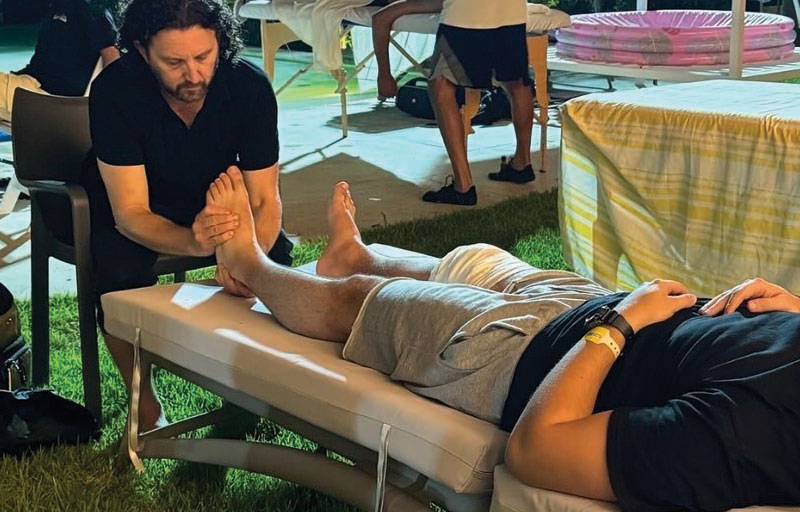
I was giving Yoni a reflexology treatment at the time. The lower part of his right thigh was bandaged, and there was a small circle of dried blood on the front of the bandage, covering where the bullet had torn through his leg. While it was shocking to see, I focused on the healing treatment, giving a friendly and supportive energy.

The event for injured soldiers took place on a warm summer’s night. Most locations and names can’t be mentioned for security reasons, but we were in central Israel. There were 60 young wounded soldiers with their friends, all-you-can-eat shawarma, salad and beer, and 15 volunteer therapists providing a range of alternative treatments for whoever was interested. 

All of the therapists had brought their treatment tables since they lived locally; I had flown in from Los Angeles (via England) and improvised a massage table using comfy pool furniture, pillows and cushions. The huge house and garden was an elegant compound, hidden from the street behind nondescript walls, and wouldn’t have felt out of place in Beverly Hills. As we did our healing work in the therapy area, you might imagine there would be calming music to sooth the spirit. Instead there was Mizrachi karaoke music blasting at full volume. One aspect of Zen philosophy is going with the flow, so we did. In this case the flow had hard bass beats and vaguely tuneful vocals. But guests were happy, which is the important part.

Why this and why now?

For months, I had been asking the question; “what skilled work can I do that will help support Israel?” I was stumped.

The journey to my volunteer trip had begun many months earlier, soon after Oct. 7, when I was trying to find a personal way to help Israel. Friends had used their special skills — the comedian Avi Liberman had toured army bases, musician Yehuda Solomon of Moshav was regularly performing concerts, but my Hebrew wasn’t good enough to perform plays that anyone would understand.

Friends had used their special skills — the comedian Avi Liberman had toured army bases, musician Yehuda Solomon of Moshav was regularly performing concerts, but my Hebrew wasn’t good enough to perform plays that anyone would understand.

I’d always felt guilty about not serving the IDF at the age of 21 after graduation, but a series of events led to the unique solution I was looking for. During the last few years I had received a lot of alternative medicine while recovering from brain surgeries following an accident, and I had learned various trauma-release and healing modalities including deep-tissue massage bodywork, cranio-sacral therapy, reflexology, acupressure and more (but not Reiki!)

In recent times I had been giving my father a lot of reflexology and other treatments to help manage the lung disease he is suffering from, and I began to regularly hear the fatherly advice, “Marcus, you have to do this professionally.” So I got certified, got insured and began seeing clients. It was going well, and it suddenly occurred to me that the next step was to book a flight, get to Israel, and get to volunteering.

 Landing at Ben Gurion Airport was the first shock. The passengers on the El Al plane from London were almost all Israelis, since no other airline was flying to Israel at the time. The “Foreign Passports” section at Israeli customs was completely empty. This meant that there was no line, but not for a good reason. 

My first day was to see soldiers in a rehabilitation unit. I treated four injured soldiers at the rehab unit, and primarily kept the work to reflexology and craniosacral therapy. Amos had an eye injury that was due to flying shrapnel while in Khan Younis. Nir suffered arm and back pains after an RPG exploded near him while in Gaza City. Zohar is a young soldier who was serving as a paramedic in Gaza and was currently confined to a rehab unit while recovering from leg surgeries. We did short sessions of 30 minutes each, and it was humbling being in their presence, especially because some of them had literally taken a bullet of behalf of the Jewish people.

Daveed is a Druze Arab who suffered from leg injuries and neuropathy (loss of feeling) as a result of getting injured last year on the Lebanon border. He has had over 20 operations and wanted to return home to be with his wife and children in one of Israel’s Arab villages. Meeting Daveed was especially moving since he was a non-Jew who had sustained lifelong injuries while serving the Jewish State. I was painfully aware of how little time we were able to spend together, since there was so much healing to be done. And yet, something is better than nothing. As Ethics of the Fathers says, “it’s not your responsibility to complete the task, but nor can you refrain from getting started” (2:16).

Daveed was especially moving since he was a non-Jew who had sustained lifelong injuries while serving the Jewish State. I was painfully aware of how little time we were able to spend together, since there was so much healing to be done. 

The Metaplim

While there aren’t easy ways for volunteers to visit IDF bases, there are many opportunities to help our soldiers who need healing. The “HaMetaplim/Therapists” WhatsApp group has a cornucopia of possibilities. A typical post will begin along the lines of “Call for Therapists” before listing the which treatments are needed, e.g. all styles of bodywork treatment, Chinese medicine, or psychotherapy, where the event is taking place, and which army brigade will be visiting. Once you confirm, you are then added to another WhatsApp group for that specific event.

The event I attended took place at a Beverly Hills-style house for wounded soldiers, where the chayalim and their friends wandered between the shawarma station, karaoke, open bar, and the therapy tables. In addition to Yoni and his sister, with their gruesome video of his being shot by Hamas, I met Avi, who was injured in Gaza city when a wall fell on his back, requiring him to have metal poles inserted into both his legs. Then there was Yitzi, who was wheelchair-bound since a bomb had exploded near where he was stationed in Khan Younis, injuring his right leg. After that, a couple of their civilian friends politely came up to me with requests along the lines of “I have a bad back from a car accident two years ago…I wasn’t injured in battle, so technically I shouldn’t be asking tonight…” but I welcomed them onto the treatment table to bring some healing anyway.

One person who especially moved me was a 19-year-old guy called Yosef — except of course that’s not actually his name — and he was there with two of his childhood friends. They were all in great spirits.

Yosef had been injured during the first few months of basic training by carrying  equipment that was too heavy for him, and had spent the subsequent year in hospital trying to heal his legs and back. He was there with a couple of friends who translated between us, since Yosef’s spoken English is as good as my Hebrew. He found the session so helpful that the friend asked if I could go and visit Yosef in the rehab hospital where he was staying for a few days each week, and “how much would it cost?” I explained that I was in Israel to volunteer, and payment was out of the question. 

Givati at the water park

There are various events taking place in Israel for soldiers who are on leave, and I went along to a fun day at the Yamit 2000 water park in Holon, just south of Tel Aviv. Around 250 young soldiers from the Givati brigade were there to enjoy a day of rest, relaxation, rehabilitation and fun. There were five large inflatable signs with the emblem and name of each of their army units, and every one of the mixed-gender group was in their swim suits, enjoying the water park, a plentiful lunch, and having the opportunity to enjoy therapy sessions with any one of the 20 volunteer therapists who were spread between a couple of indoor rooms.

While a lot of therapists were doing longer sessions, I tried to do a series of 15-20 minute treatment sessions which would allow as many people to benefit as possible. The atmosphere was light and happy, and in lieu of bringing my own treatment table, I improvised once again, using a couple of yoga mats on the floor. On that day I primarily focused on reflexology and some shoulder/back treatments. My immediate neighbors were an acupuncturist, a chiropractor, and a woman who was meditating while waving some smoking sage over her client. 

At one point I ended up teaching a small group of guys some basic shoulder relaxation-release massage techniques, along with a basic reflexology sequence that they could share with one another to bring some healing when needed. I hope it will be useful if they get some rest time while taking a break from fighting on the front lines (or at least once they return home after being discharged and spend time with their girlfriends).

Who will live?

Ironically, the part which hit me hardest was seeing the fun they were having at lunch. There was a large outdoor covered area where over 200 people, still in swimsuits, were enjoying themselves.  They were eating burgers, fries, salads, sodas, cotton candy and more. Some of the guys were due to be back in Gaza before the end of the week, and I wondered how many of the 200 young soldiers would return home in full health, and how many will not make it? The Rosh Hashanah unitaneh tokef liturgy suddenly rang around my head; “who will live and who will die?” I prayed that all of them will live, return home in full health, and get to enjoy long and wonderful lives.

I had visions of the war films and musicals, the night before soldiers are deployed to war. “Good Morning Vietnam,” “Full Metal Jacket,” or the words of “Miss Saigon’s” opening number “still at midnight the party goes on/ a goodbye party in hell.” Except this was far from hell; it was a beautiful sunny day on the outskirts of Tel Aviv. 

On my final day of volunteering I paid the promised visit to see Yosef — the soldier who had been injured during basic training — at his rehab unit. We had lots of laughs, used Google translate on our respective phones to make the conversation easier, and it was a heartwarming experience. After giving an extended two-hour treatment, we said our goodbyes and I headed out. 

Hostage Square

By this point I was physically and emotionally depleted after shlepping up and down Israel dragging a small suitcase, frequently mixing up bus stops and having to walk an extra kilometer to the next one, not to mention the work itself. I thought I’d take a quick stop to Tel Aviv and visit Hostage Square, just by the Museum of Art, where there are exhibits, flyers, meeting tents and memorials to the hostages held by Hamas. It was a tremendously heavy day, since six hostages had just been murdered — including Hersh Goldberg-Polin.

I walked through the art installation that recreated a portion of one of the Gaza terror tunnels. It was as chilling as you would expect. Nearby is the latest version of the empty Shabbat table first set up in October 2023 with an empty chair for each of the hostages. The table sat inside an elegant Sukkah and continues to have a heavy impact since as yet another festival as rolled by and we still have hostages in Gaza.

The table [with empty chairs] sat inside an elegant Sukkah and continues to have a heavy impact since as yet another festival as rolled by and we still have hostages in Gaza.

I visited a book stand and saw copies of “The Garden of Emunah,” which I already owned. Although I had no intention to buy it, the lady behind the stand said “this is in the merit of my son who is being held hostage in Gaza.” My heart sank, and I bought a copy. A girl nearby told me that her boyfriend was killed on Oct. 8 in a kibbutz near Gaza. The day just kept getting worse. 

It was time to head to the train station and get back to where I was staying in Jerusalem, so I followed the Google Maps for the short 10-minute walk. I really was exhausted, albeit incomparable with the exhaustion of our soldiers on the frontline. Fortunately the station was just 10 minutes away. The only problem was that there were 300,000 people between me and the station, since I had inadvertently walked into the biggest anti-government rally in Israel’s history. On the following day, I joined the crowds on the streets of Jerusalem while Hersh Goldberg-Polin’s family drove by as part of his funeral procession. It was a momentous time to be in Israel, the very air we breathed felt heavy, and you could feel that this is a nation with PTSD.

To share or not to share?

This was the most meaningful trip of my life, but I was torn about whether or not to share these stories, and whether to share photos on social media, albeit with the soldiers’ faces completely hidden. The decision was to share — not to gain any personal credit since what I did was just a brief trip and drop in the ocean of Israel volunteerism — but to help publicize how Israel’s therapists are doing such a crucial job of supporting soldiers, and to inspire more therapists to visit Israel and offer services. 

Israel needs volunteers

Right now, Israel needs volunteers, and there is a high chance that your skills — whatever they are — can be put to great use. If you have skills as a therapist, you are needed. If you want to pick fruit, you are needed. If you want to make sandwiches, fold blankets for soldiers, help families who have lost providers, or do any one of hundreds of tasks, you are needed.

Right now, Israel needs volunteers, and there is a high chance that your skills — whatever they are — can be put to great use. If you have skills as a therapist, you are needed. If you want to pick fruit, you are needed. If you want to make sandwiches, fold blankets for soldiers, help families who have lost providers, or do any one of hundreds of tasks, you are needed.

The “Swords of Iron” Facebook group is a great resource for all-things-volunteering in our nation’s homeland. If you are a therapist of any kind, and interested in finding out how to get connected with the Israeli therapy organizations, please reach out to me via Instagram @marcusjfreed or via www.freedhealing.com. My teacher Rabbi Sacks once said “Where what we want to do meets what needs to be done, that is where God wants us to be.” 

Where does God want you to be?

The Israeli volunteer therapists ‘HaMetaplim’ WhatsApp group can be joined at www.hametaplim.org


Marcus J Freedwww.freedhealing.com and on Instagram @marcusjfreed.

A Mission to Heal Wounded Soldiers Read More »