fbpx

September 6, 2024

Hersh and a Story of Love

He was everyone’s Hersh.

Hersh’s charismatic smile let you know he was, as his mother Rachel described, a  “happy-go-lucky, laid back, good humored, respectful and curious person.” He was, as the death announcement put it, “a child of light, love and peace.” People were drawn to the story of a young man who loved soccer and music, had a passion for geography and travel, who had just gone to six music festivals in Europe over the span of nine weeks.

And then came October 7th. Hersh’s last messages to his family, at 8:11 AM on October 7th, were “I love you” and “I’m sorry.”

Hamas kidnapped 251 hostages that day. But a statistic doesn’t ignite the same passion as an actual person; and through Hersh, the world connected to all of the hostages. Heads of state spoke about Hersh. At the Democratic National convention many in the crowd openly wept for Hersh, and chanted “bring them home.” His image was posted everywhere; “Bring Hersh Home” was graffitied on walls and printed on posters. Tehillim groups prayed for Hersh, and a Sefer Torah was written in his merit.

And after Hamas murdered Hersh, millions of people cried; and they cried for all of the hostages, including the 101 who remain in captivity.

Hersh’s story is one of love. His parents Rachel and Jon Goldberg Polin advocated for him 24/7. Despite their overwhelming pain, what Rachel called “our planet of beyond pain, our planet of no sleep, our planet of despair,  our planet of tears,” they found the superhuman strength to advocate every single day, to remind the world how many days it was since Hersh was held captive. Rachel and Jon traveled everywhere to do everything and anything possible to bring him home.

Most of all they told the world how much they loved Hersh, and got the world to love Hersh as well. Even at the funeral, with an otherworldly expression of spiritual strength, Rachel declared that “I am so grateful to God, and I want to do hakarat hatov (offer gratitude) and thank God right now, for giving me this magnificent present of my Hersh…. For 23 years I was privileged to have this most stunning treasure, to be Hersh’s Mama. I’ll take it and say thank you. I just wish it had been for longer.”

The Rambam says that when you truly love someone “you will recount their praises and call on other people to love them.” And that is what Rachel and Jon did.

Love has its limits. At Hersh’s funeral, the speakers apologized to him for being unable to bring him home; sadly, this immense outpouring of love could not accomplish what everyone desperately wanted. But the Song of Songs says “love is as strong as death.” Jon declared at the end of his eulogy that Hersh’s memory “can begin a revolution.” And without question that is what love can do.

Love is belittled because it is bewildering. It is immaterial, a force that ought to be reckoned with but cannot be measured. Charles Darwin wondered whether altruism would disprove his theory of natural selection; to sacrifice oneself for others contradicts a theory based on a single-minded pursuit of survival. (A person of faith grappling with the same question would see the traces of a divine love tucked away in the DNA of the universe.) From a political standpoint, love is the frail runner up to raw power. Machiavelli wrote that “it would be best to be both loved and feared. But since the two rarely come together, anyone compelled to choose will find greater security in being feared than in being loved.”  In a world about survival and strength, love is seen as the veneer that covers up far uglier forces.

Judaism sees love as the very center of the universe. There are commandments to love God and to love all of humanity, both one’s neighbor and the stranger. Hillel explained that the entire Torah can be reduced to the commandment of loving others; one first experiences the divine in interpersonal connections, and only from there does the rest of the Torah become comprehensible.

The world begins with love; the Book of Psalms (89:3) says “the world was created in kindness.” Rav Saadia Gaon and Rabbi Moshe Chaim Luzzatto see love as God’s very motivation in creating the universe. Love becomes the spiritual blueprint for all of existence.

The very human love we have for others reflects this larger divine love. Rabbi Abraham Isaac Kook offers a fascinating perspective on Shir HaShirim, the Song of Songs, a biblical book written in the style of a love song. In the Talmud, Rabbi Akiva already reinterprets Shir HaShirim as a metaphor of the love between man and God; ordinary love songs don’t belong in a holy text. Rabbi Kook offers a fascinating reinterpretation of Rabbi Akiva, and explains that the ordinary love songs in Shir HaShirim are actually a small-scale reflection of the greater love between man and God; and that is because our “ordinary” loves are not ordinary at all. All loves lead one to the divine.

It’s difficult to talk about love at a time of war. Love sometimes requires one to go into battle to protect one’s family, reluctantly but resolutely. But that is not at all the goal; Isaiah dreamt of a world where the swords are beaten into plowshares. War is our nightmare; the dream is peace, of each person sitting contentedly under their own vine and own fig tree.

And that is the love we continue to search for, an otherworldly force that will transform history. Rachel explained that Hersh had a unique ability to bring people together that he had “befriended… German (soccer) fans over the years when they visited Jerusalem to watch their team play soccer. Together they painted a peace mural with both Arab and Jewish residents near our home in Jerusalem…” One prays for the day when this will be more than a mural.

Judaism proudly asserts the power of love. Machiavelli’s approach is tempting; sometimes all that matters is pure strength. But the mistake is that brute force works for a generation or two, until there’s a crisis. Then the fear disappears, and the ruler is deposed. Power is as finite as those who wield it, grasped tightly by princes whose lives are short and temporary.

To survive for a generation or two, one needs power; to survive for millennia, one needs love. And that is the story of Jewish history. Jews are a people who never quit because they had a passion for God, Torah and the Jewish people. The love Jews around the world had for Hersh (who was named for a great-uncle who perished in the Holocaust) is part of this same never-ending story.  The Jewish people are living proof that love can outlast power.

The day of Hersh’s funeral, several posts on social media reported about children being named Hersh in the memory of Hersh Goldberg Polin z”l. These were not relatives or even acquaintances of the family. Just ordinary Jews who cared, and wanted Hersh’s legacy to continue onward. They were naming their children after a man they loved but never knew.

They were sharing Rachel and Jon’s remarkable love for Hersh with their own family.

And in doing so, they were starting a revolution of love once again.

May Hersh’s memory be a blessing, and a revolution.


Rabbi Chaim Steinmetz is the Senior Rabbi of Congregation Kehilath Jeshurun in New York.

Hersh and a Story of Love Read More »
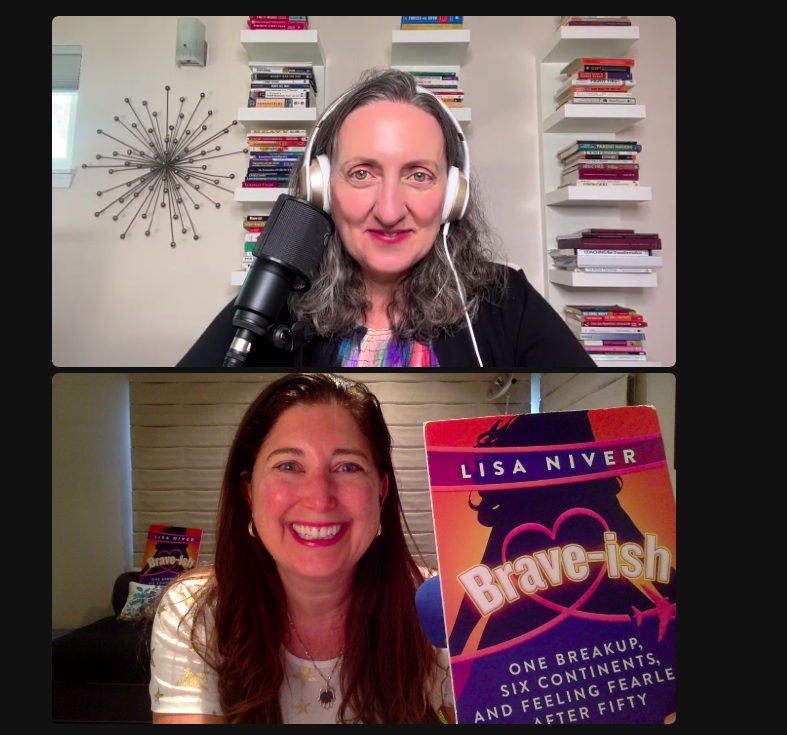
BRAVE-ish on NPR

NPR logo

Thank you to Giovanna Rossi for interviewing me on The Well Woman Show for NPR!

324: How To Be Brave With Lisa Niver – The Well Woman Show

Giovanna Rossi interviewed me to discuss my book “Brave-ish: One Breakup, Six Continents and Feeling Fearless After Fifty” and “The transformative potential of embracing change. The importance of setting bold goals for personal growth. Strategies for overcoming fear and self-doubt, and much more!” Listen Podcast

324: How to be Brave with Lisa Niver

By Giovanna Rossi | November 30, 2023 |
https://player.captivate.fm/483dd2b1-3063-4607-9816-f9bb72f8e37b “Hello well women! On the Well Woman Show today I interview Lisa Niver. Lisa is the author of Brave-ish: One Breakup, Six Continents and Feeling Fearless After Fifty and an award-winning travel expert who has explored 102 countries and six continents. Discover her articles in publications from AARP: The Magazine and AAA Explorer to WIRED and Wharton Magazine, as well as her site WeSaidGoTravel. For her print, podcast, digital and broadcast segments, she has been awarded five Southern California Journalism Awards and three National Arts and Entertainment Journalism Awards. Niver is also the host of the award-winning podcast Make Your Own Map.”
We discuss today:
  1. The transformative potential of embracing change.
  2. The importance of setting bold goals for personal growth.
  3. Strategies for overcoming fear and self-doubt.
The books she recommended were: Hidden Potential: The Science of Achieving Greater Things by Adam Grant 50 Years of Ms.: The Best of the Pathfinding Magazine That Ignited a Revolution by Katherine Spillar

Giovanna’s episodes about turning fifty: Part 1 Part 2

The WWS is thankful for support from Collective Action Strategies – a consulting firm that supports systemic change so that women and families thrive, and by the Well Woman Life Movement Challenge Quiz at wellwomanlife.com/quiz

If you’re in burn out or major transition, this is YOUR time to figure out what is holding you back from making the changes you need to make in order to live your fullest, most joyful life! The cause of all our challenges (personal or professional) can actually be rooted in the lack of Internal Superpowers and/or External Supports. Our Well Woman Life Framework tells you which stage of the WWL Cycle you’re in and what to do about it so you can truly live your best life. When women and girls are healthy, successful and thriving, the community as a whole thrives. Well Woman Life supports women to achieve their highest level of fulfillment and well-being. We are women doing something innovative in order to make a difference in our lives or in the lives of others, and maintain a sense of well-being while doing it all! Whether it’s personal, physical or sexual health, juggling life and work, professional development or financial success, emotional or spiritual wellness, a Well Woman is passionate about achieving her highest level of health and well being.
I met Giovanna on Women’s Equality Day 2023 in Los Angeles at the Take the Lead Conference when she was presenting “Be SELF-ish: How to set boundaries without sacrificing your career.” Kathy Spillar of Ms. Magazine accepted the Leading Media award at the conference and was also a guest on Giovanna’s NPR show.

BRAVE-ish on NPR Read More »

Law’s Shadow – Thoughts on Torah Portion Shoftim 2024


 Law’s Shadow

Thoughts on Torah Portion Shoftim 2024 – adapted from previous versions.


In every great piece of literature, law eventually makes its appearance, usually because someone is breaking it. People commit some felony – theft or murder. They might be breaking a civil law, negligently causing harm to their neighbor.  They might be breaking the moral law – unkindness, causing hurt, not fulfilling promises, breaking vows. There might be ethical breaches – not living up to the stated or implicit obligations that bind us as human beings.


Noncompliance with the law is the story of humanity, and a core theme of the Bible. In the Bible, this noncompliance begins with Eve and Adam disobeying God, following the advice of Snake (the name “Conjecture” was a giveaway). Straightway, Cain (Kayin) murders Abel (Hevel) and shows how rhetorical questions are acts of evasion. (“Am I my brother keeper?”) Things skid down the slope from there. Rebecca and Isaac broke a local ordinance about the first born, preferring Jacob over his older brother Esau, claiming they were serving a higher purpose.  Joseph’s brothers intended to murder Joseph passively (by throwing him in a pit), but then just sold him into slavery. They knew it was wrong or they would not have hidden it.


The sin of the molten calf was an honest sin.  The intended to sin and made no excused. The people finally said, “We don’t want this law. We don’t care what its purpose is.”  They didn’t care that the law would save them from themselves. Like a drug addict resisting rehab, they did not want to be saved. They got the law anyway, but even then, the law did not save them from their addiction to the resistance of the teachings.


In fact, the law assumes resistance to the law – otherwise there wouldn’t be law, all the way from the law on the law books to the moral law. Sometimes the resistance is because someone is just a scoundrel or a scofflaw. Other times, though, the resistance is out of character, a crime of passion, due to an unbearable temptation, distraught circumstances. Those transgressions emerge from what Carl Jung would call “the shadow.”


The shadow is the hidden part of the inner life, into which we push all that we cannot admit about ourselves. Our pretensions, our falseness, our willful illusions.


The shadow looms large in the Bible in nearly every law and narrative that matters. Sometimes that ominous, discordant note that comes from the hidden depths is obvious – the sin of the spies comes to mind. The spies arrive back from spying out Canaan filled with fear, ready to rebel.


The malevolence lying in the shadow of God in the book of Job is hidden to most people. The book of Job is not about Job’s suffering or Job’s patience. This book of Job is about the evil that the God in the book does. Job suffers because the God-figure in the book of Job let Satan have his way. Job’s resilience has him not backing down to his friends or to God, and not being afraid of that God. What else could that God do to him? Have his children killed? Satan had already murdered all his children.


In this week’s Torah portion, Shoftim, the shadow is particularly well hidden. One reads along and sees a variety of laws, reasonable attempts to codify justice into law. All looks good. Judaism is ethical and rational, as I was taught.


The Jews, though (more properly, the Israelites), standing for all humanity, were not all ethical or rational. The laws in our portion speak about some people who were on the dark side of ethical and rational. On the other side of every law, we find lawbreakers and venality, criminals and moral turpitude. Every law assumes its opposite, those who break it. We have laws against judges taking bribes because judges took bribes. We have laws against lying witnesses because witnesses lied in court. We have laws against sorcery because sorcery probably had people doing wicked and destructive things. We have laws against war crimes, false prophets and what happens when someone does not securely attach an axe head to an axe. There’s even an unclaimed dead body. You read this Torah portion carefully and you might get the sense that everything is falling apart, and that Law and Justice are valiantly trying to hold back a vicious tide of a humanity bent on harm. You start to feel some sympathy for the God who, in a moment of despair, had flooded the world to start over.


According to the disturbing narrative of Noah’s Flood, however, the God of the Bible admitted to regretting flooding the world, after it was too late to do anything about it. God saw God’s own shadow, you might say, and didn’t like what it caused. “Ok, no more wiping out everything and starting over,” God mutters.


That impulse to destroy remains within us, though. I’ve read about people who are on the record saying just that. They want to destroy everything if they can’t have their way.


The good and the right, the vision and the way, law and justice try to hold back the shadow and chaos that can rage into our inner lives, our families, our communities and the world around us.


Any person trying to establish the rule of virtue in their life will experience the profound pushback of a shadow that does not want to be corralled.


It’s the dead body that haunts me. In Deuteronomy 21:1-9, we are told how the elders of the nearest city deal with the discovery of a nearby corpse. Someone found the forlorn victim, meaning that somebody got away with murder. It seems from the story that no one can even identify the body.


The elders of the closest city to the crime find a nearby backwoods and perform a ritual that says, in effect, “We didn’t do it.” (Then why are their hands shaking?)


Here’s the shadow, as I see it: the elders are thinking, “There’s a Cain walking about, maybe walking among us.” The elders look at each other, “Maybe one of us.” Even elders have shadows, even judges can murder. Chaos is on the loose. Law’s shadow is lurking.


The inner life tradition would tell us this: there’s a Cain lurking about in each of us, deep in the shadow we can’t see in ourselves, a force that we won’t admit to. Maybe, like Cain and his host of descendants, wanting to kill someone else, even just with our words, a cut at a time. Maybe like those who worshipped the molten calf, riotously trying to kill whatever beauty and good remain within us.


Ideas of the good and the right, the vision and the way, law and justice are all we have to stop the flood. When in doubt, when confused, when hope is receding, pursue justice – and love, and truth and beauty. We can push back the flood, the raging waters, and in their place, we can find a fountain of life, pouring jetting) up and or flowing from the soul, pushing back the shadow, giving us light.


And tomorrow, we have to push back the flood again.


Law’s Shadow – Thoughts on Torah Portion Shoftim 2024 Read More »