fbpx

August 23, 2024

Dispatches From Chicago: Anti-Israel Network Now Bird-Dogs Anyone Who Supports Israel

To view previous dispatches, click here.

CHICAGO – At Union Park on the city’s West Side, former Republican presidential candidate Vivek Ramaswamy arrived unexpectedly to survey the scene, strolling through the park, buying a paper from comrades in the Revolutionary Communist Party and absorbing the sights and scenes, when a balding, bearded man suddenly appeared in front of him, standing in his path.

As the Democratic National Committee closed its convention hours later, Kamala Harris accepting her party’s nomination for president, the park encounter provides a window into the next phase of political agitation that protestors are going to deploy: bird-dogging, which means to “dog” someone, confronting, questioning and shaming politicians, leaders, surrogates and, really, anyone, persistently and aggressively in public, to attempt to intimidate them and keep them on the defensive.

In recent days, the bird-dogging hit former House Speaker Nancy Pelosi. “Madam Speaker, do Palestinian lives matter as much as Israel lives,” asked an activist reporter from Zeteo, a platform sympathetic to the anti-Israel activists. Now it was Ramaswamy’s turn.
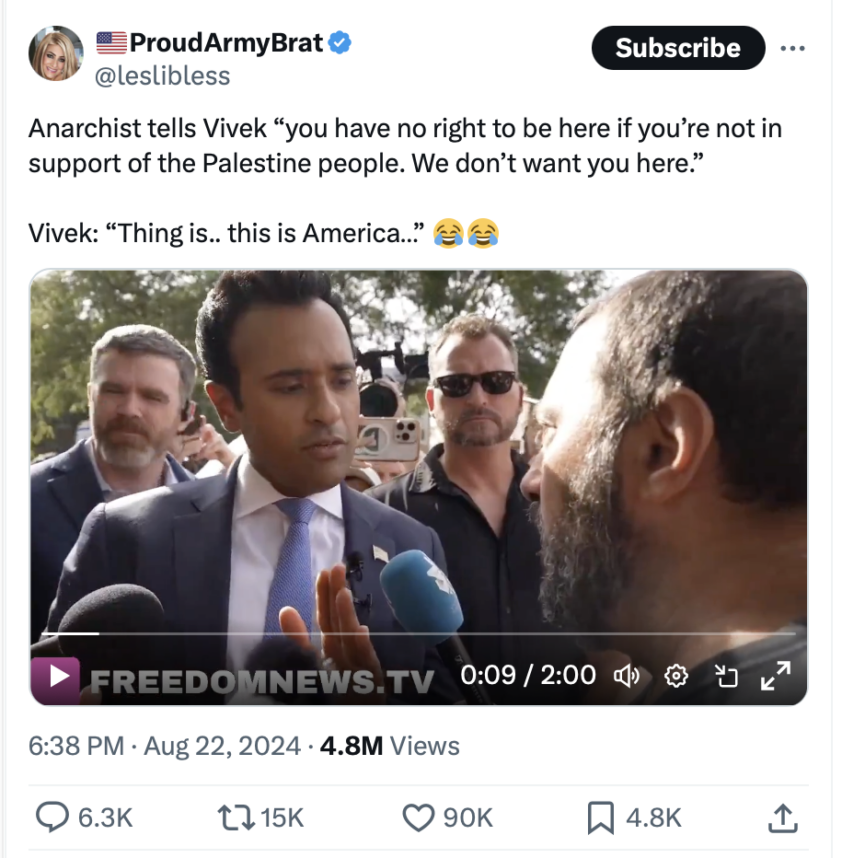
“Are you a supporter of Israel?” the man asked Ramaswamy, stopping him in his tracks.

Like a tree falling in the forest, bird-dogging isn’t complete unless it gets into the media, and social media works. Soon enough, FreedomNews.TV, a media platform, published the confrontation, which an X user shared, calling the man an “anarchist,” the video going viral with 4.8 million views now, a sign of a successful bird-dogging attack. 

But the balding man wasn’t an anarchist. 

He was Hatem Abudayyeh, the chief organizer of the March on DNC coalition and co-founder of American Muslims for Palestine and Students for Justice in Palestine. Years ago, the FBI investigated him for alleged support of terrorist activities, though charges were not filed. His appearance in front of Ramaswamy wasn’t spontaneous—it was part of a well-coordinated campaign that will spread like wildfire over the next months until the election in November.
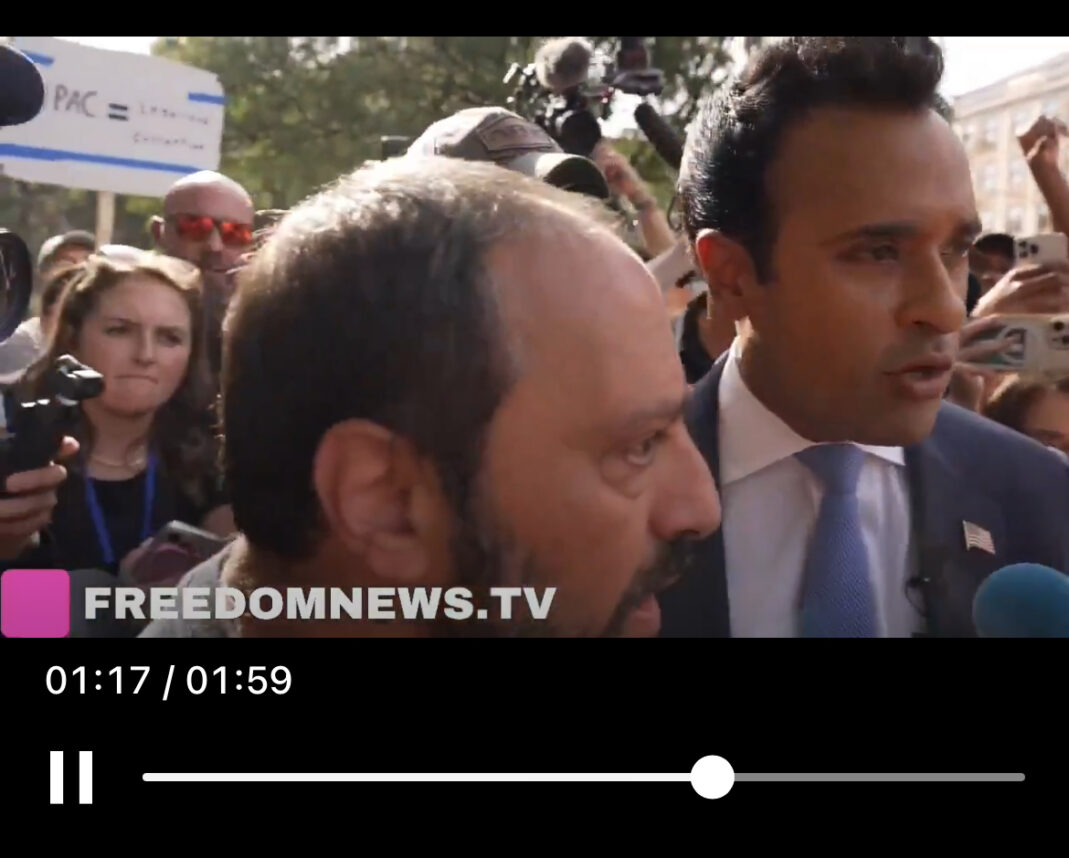
As this example illustrates, the activist going after a prominent Republican, the fight to shame anyone who supports Israel crosses party lines and is equal opportunity bipartisan. And it is important to understand the network that is fomenting anti-Israel and anti-Semitic hate.

These individuals are activated by a vast network that organized this past week to #MarchOnDNC and will now deploy to harrass Harris and her surrogates on the campaign trail. 

Shocked by the murder of my friend and Wall Street Journal colleague Daniel Pearl in 2002 for the alleged crime of being Jewish and a grandson of Israel, I’ve spent the past 22 years reporting on Muslim groups that are virulently anti-Israel and also anti-Semitic. Last year, I published a book, “Woke Army,” on the unholy alliance of far-left groups and Muslim groups, united in their hate for Israel, the U.S., and the West.

In a new investigation I am leading at the Pearl Project — a nonprofit journalism initiative named for my friend, I have identified 242 organizations listed as “members” and “supporters” of marches held this past week against the DNC. I put my findings into a public portal, the Malign Foreign Influence Index, with many of the organizations tied closely to adversaries of the U.S., including Russia, China, Iran, N. Korea and Cuba. Abudayyeh and his the groups he cofounded are in the network.

As I reported in a series, which can be found at JewishJournal.com/DispatchesFrom, the groups in the network don’t represent a battle between “progressives” and centrists within the Democratic Party. Instead, these protests are the product of a deeply coordinated effort by an alliance of three units — self-described socialist organizations, far-left groups, and anti-Israel Palestinian, Arab, and Muslim organizations — who represent an insidious dynamic coined malign foreign influence.

Out of the 242 organizations in my updated analysis, 34 openly identify as some form of socialism—ranging from “anti-revisionist Marxist-Leninist” to “Revolutionary Socialist” and even “building toward the creation of a new Communist Party” in the U.S. 

Another 166 groups are “socialist-adjacent” or pro-socialist, working closely with the openly socialist organizations and nations. 

Finally, 42 groups are Muslim, Palestinian, or Arab, many with sympathies for Hamas, like American Muslims for Palestine, Students for Justice in Palestine, the U.S. Campaign for Palestinian Rights and the U.S. Palestinian Community Network.

Abudayyeh was following classic bird-dogging tactics. One of the #MarchOnDNC lead organizers, the U.S. Campaign for Palestinian Rights, has a guide online for harassing lawmakers when they aren’t in D.C. The first action: “Birddog.” 

Another tipsheet, “Your guide to bird-dogging,” by American Friends Service Committee, a Quaker group and member of the #MarchOnDNC coalition, recommends: “Be in the candidate’s path.” Earlier this year, Rolling Stone magazine published an insider account of Jewish Voice for Peace, another #MarchOnDNC member, and other groups “bird-dogging Biden everywhere he goes,” including a fundraiser where “a succession of activists affiliated with Jewish Voice for Peace and several other groups takes turns shouting, chanting, or questioning Biden whenever he tries to speak,” stunning the “shell-shocked attendees.”

Ramaswamy was no longer a candidate but he was a surrogate for former President Donald Trump, a candidate. 

“Prepare your question. Make it brief, fact-based and direct,” the guide read.

Ramaswamy tried to answer the question: “I support the United States, and because of that, I support Israel and our relationship.”

Continuing, staccato-style, chopping the air with his hand, Abudayyeh continued: “Do you support a genocide that has killed 40 million Palestinians in the last 10 months?”

As Ramaswamy started to answer, Abudayyeh interrupted him, “I’m an organizer.”

After some back-and-forth, Abudayyeh continued: “I’m asking you that you have no right to be here if you are not in support of the Palestinian people.”

He wasn’t really asking a question, which is a classic bird-dogging style. And Union Park is certainly public property.

He accused Ramaswamy of being a “racist Zionist pig,” his voice dripping with contempt.

As Ramaswamy kept walking, Abudayyeh led the crowd in a chant of “Racist, go home! Racist, go home! Racist, go home!”

Another man in a black t-shirt continued the chant, wearing on his chest the logo of the organization where Abudayyeh is the executive director: the U.S. Palestine Community Network, another #MarchOnDNC coalition member.

The march continued on a route protestors followed on Monday and Wednesday. As the sun set and Kamala Harris accepted the Democratic nomination for president, a different kind of theater played out on the streets outside. A band of activists walked menacingly to the corner of N. Ashland Avenue and W. Warren Boulevard to walk the three blocks to the United Center to bird-dog delegates that would soon be leaving the convention hall.
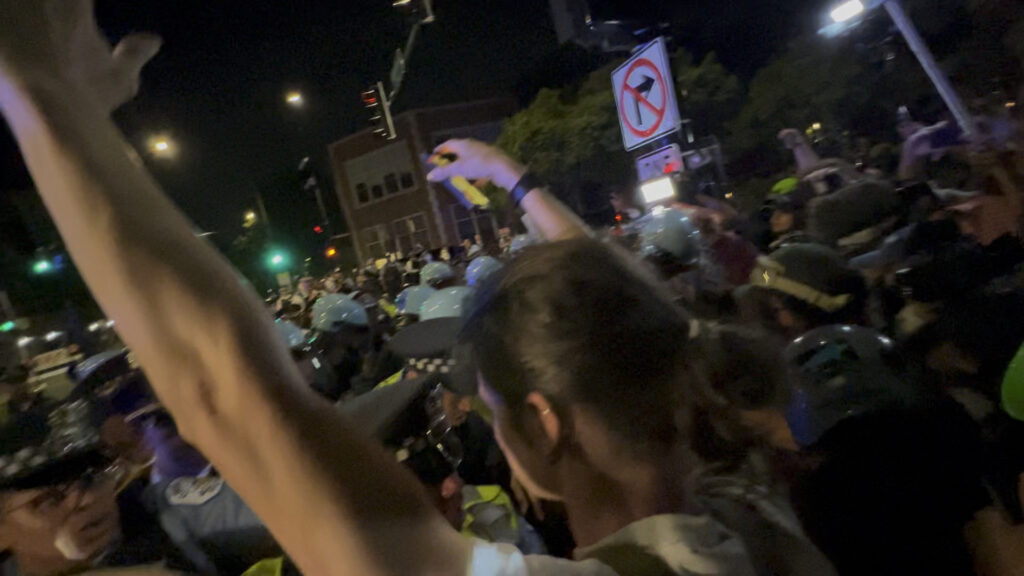
An activist, full of bravado, rallied his “comrades” for a bum rush against the police, standing between them and the convention center. He had just come from leading a small sit-in on N. Ashland Avenue, where about 20 young people had gathered in a show of defiance, as most of the protestors from the last #MarchOnDNC headed home. 

One of them casually lit a joint, as if this was just another day in the park.

Back at the corner, the situation escalated. The police, in trained formation, barked their orders: “MOVE BACK! MOVE BACK!” 

A tussle followed. An activist banged on a pot.

The activist, consulting other leaders quickly, all of them realizing the futility of the situation, turned to their cue to get fellow comrades to listen: “Mic check!” 

“Mic check!” the crowd responded.

He continued: “Fall back! These people are being too aggressive. We’ll stand back and regroup. Y’all see how they just got violent? See that?…Step back!”

A senior police officer nodded his head and gave a thumbs up sign. 

The activist’s voice cracked with the reality of their position, far from the center of power. The curb was where they found themselves, literally and figuratively. In the background, one of the activists, a young woman, told me, “My mom will beat my ass if she sees me on TV.” 

With that, the activists retreated into the park, curbing their own activism with their ineffectiveness. A few of them moved to the sidewalk off N. Ashland Avenue to heckle the Democratic delegates now emerging, covering their faces with their “Kamala” placards. 

“Killer Kamala! That’s who you like. Killer Kamala,” said a young woman in camouflage green overalls, wearing a keffiyeh over a baseball cap, as her friend, beside her, carried a placard for Freedom Road Socialist Organization, twirling some strands of her hair, nervously.

Across the street, where the young cadre had retreated, a regular fixture from D.C. protests swung her hips to the music as she danced and chanted, “Stop funding genocide!” 

I last saw her in the summer of 2023 in front of the U.S. Supreme Court, where she protested along with students who opposed the decision to block anti-Asian discrimination at Harvard University.
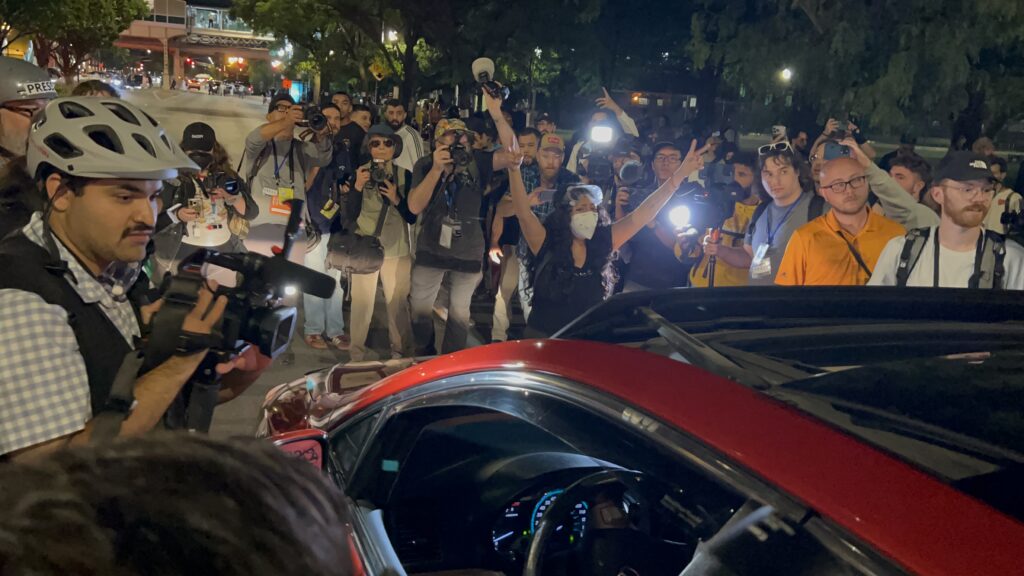
Northward a block, a  young woman threw herself on the hood of a red Toyota four-door car driven by an Uber driver, trying to make a living on a high-traffic night.

Clapping between every word, she shouted: “Your. Tax. Dollars. Are. Funding. GENOCIDE!” 

Standing defiantly in front of the car, she flashed “V” for victory signs with both hands, as about 20 photographers and journalists circled the car, catching her every exclamation and gesture.
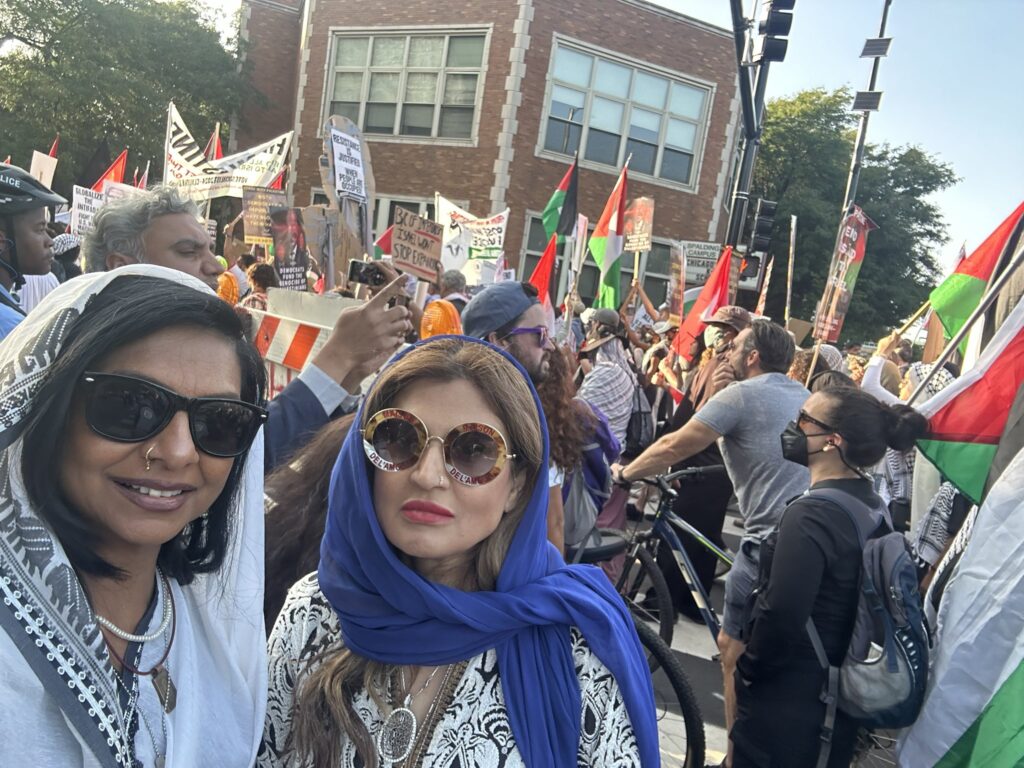
Earlier in the day, another scene was unfolding nearby, revealing how these protesters often curb their own impact by turning against even those within their own faith who challenge their narrative. Soraya Deen, a Muslim woman born in Sri Lanka, stood in the park with other Muslim women, including community organizer Anila Ali, and called out Hamas for its terror and sexual violence against women. 

“We had to ask the police to stay with us,” she said later on X. 

The hostility she faced underscored the contradictions within this protest movement. Deen lamented, “This whole ‘Protest Saga’ has drained our law enforcement. It’s colossal amounts of taxpayers’ money spent on law enforcement, a loss of our freedoms, promoting lethal hostilities between our people, impairing the safety and the security of our nation. And it’s downright a movement to destroy America and its values.”

Her frustration was evident, especially at the protesters’ selective outrage. “Never once do the protesters call out Hamas atrocities, the war on October 7th, the desecration of Islam by Hamas and the vacuum of leadership in Palestine. I wish some of these protest leaders would move to Gaza, organize Gazans, elect a decent leadership that abandons the perennial call for the destruction of Israel and the murder of Jews and build a future for the Palestinians without terror and hate, without violence and victimhood.”

As the evening progressed and delegates began to leave the convention hall, the activists, now on the sidelines, found new targets. 

They shamed and heckled the delegates, their frustration spilling into the streets. 

The activists, desperate for relevance, shouted them down with chants of “Shame! Shame!” 

But the contrast was clear—their anger clashed against the delegates’ celebratory mood, and the shaming fell flat. The delegates simply laughed it off, their enthusiasm untouched by the curbside vitriol.
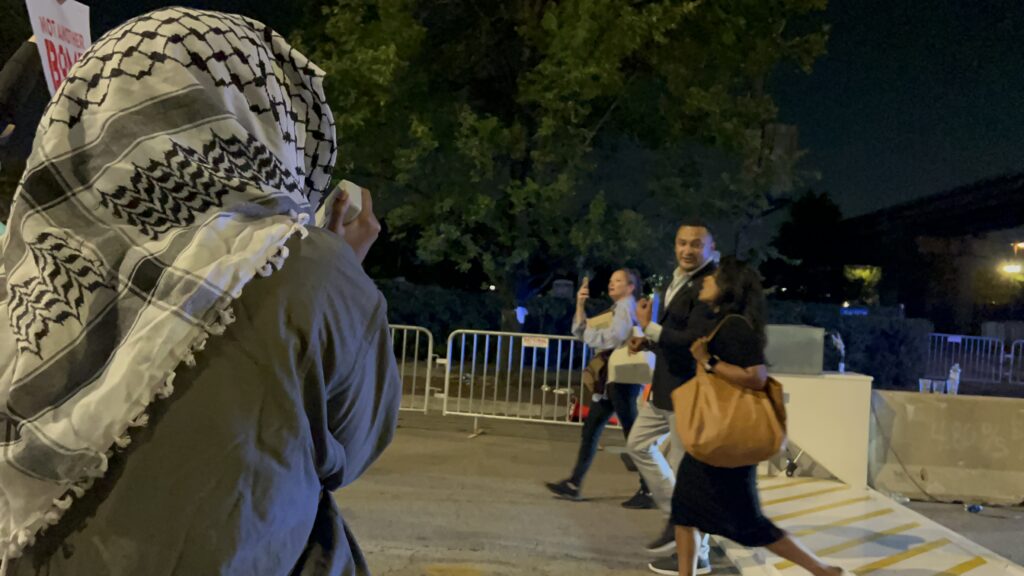
A few blocks away, in front of the Democratic National Convention exit, activists from the Chicago chapter of Students for Justice in Palestine, one of the organizations that Abudayyeh helped launch, lined an exit route, their mission clear: to make their presence known. They heckled delegates as they departed, their chants sharp and unrelenting. I wasn’t immune either. 

Earlier in the week, on Tuesday night, one of the activists—a young woman with a “PRESS” badge dangling from her neck—had recognized me during a protest that turned aggressive in front of the Israeli consulate. 

She approached me then, her voice cutting through the crowd, asking, “Are you Asra Nomani?”

I said I was and answered her question politely about what I was doing there, although she had no grasp of my answer.

Then, on Thursday night, as I spoke to someone on her side whom I knew from work years earlier, she tried to escalate the confrontation. Turning to a computer scientist with whom I was speaking, she delivered her line with the precision of a rehearsed insult: “Did you know she is a Zionist?” 

It was meant to dehumanize me, to shame me into silence. But I didn’t flinch. I accept the state of Israel, just as I do the Muslim states of Saudi Arabia, Pakistan, and Qatar, with their manmade boundary lines, just like Israel’s.

Her attempt to shame me backfired, just as the curbside activist had become curb checked. The extremism of her argument revealed itself, as did another two students who followed me around and declared with unflinching certainty, “Israel should not exist.” 

“Do you support genocide?” one of the students asked me, in classic bird-dogging style of asking rhetorical questions.

These insults, far from achieving their intended effect, only highlighted the shortcomings of their tactics. Shaming, once a powerful tool in activism, had turned into a blunt instrument, alienating more than it persuades.

Inside the convention hall, Harris had just rejected their shaming of her. On the campaign trail, friends of these Chicago activists had pulled of a successful bird-dogging operation on her. Activists in a group, Students Allied for Freedom and Equality at the University of Michigan at Ann Arbor, made headlines by heckling Harris at a campaign stop in Michigan, yelling, “Kamala! Kamala! You can’t hide! We charge you with genocide!” 

In her speech, Harris expressed clear support for the existence of the state of Israel. Pundits immediately began to describe her as a “hawk,” her stance on Israel firm and unwavering. She had made her choice, aligning with military support and allyship for the Jewish state.
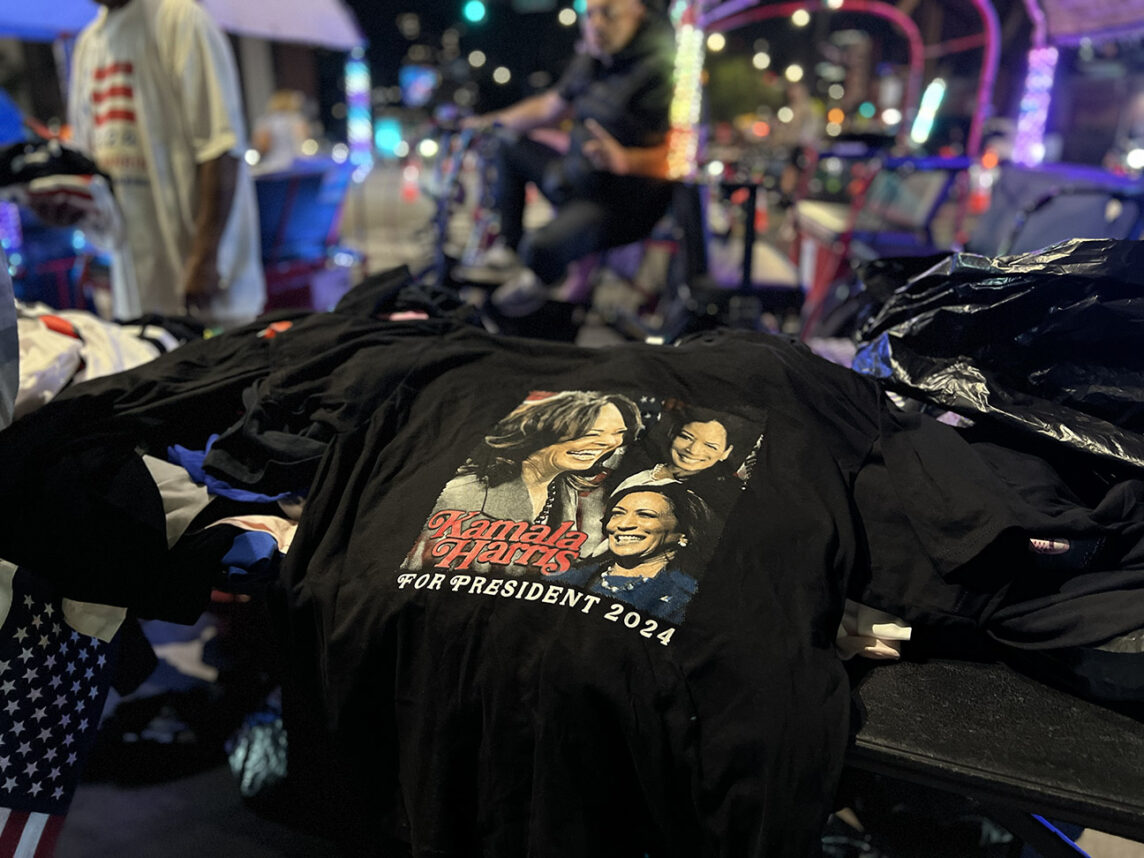
As the week drew to a close and the clock pressed toward midnight, the activists retreated into the night, the student activists at the DNC exit sitting on the curb, their shouts and jeers fading into the growing quiet of the night, the t-shirt vendors and rickshaw wallahs even heading home. 

The protests, the bird-dogging, the curbside confrontations — all were part of a larger, calculated effort that will continue to unfold across the nation in the coming months. 

As they sought to disrupt and shame, what the groups revealed more clearly was the growing divide between their radical tactics and the American mainstream. The Democratic delegates, like Harris herself, may have been heckled and harassed, but their resolve seemed only to strengthen in the face of such aggression. 

Meanwhile, the activists, so intent on shaming others, found themselves increasingly isolated — curbed, both literally and figuratively, by the very extremism they wielded. The question that remains is whether this strategy will gain them any ground or if, in the end, it will only serve to push them further to the margins of the political landscape.

For those of us, caught in the tussle, the scenes from Chicago are not just a dispatch from one week of protests but a harbinger of the battles to come as the country edges closer to the November election. We will continue to bring you more dispatches from college campuses and cities, adding names to the Malign Foreign Influence Index. 

The activists from Students for Justice in Palestine finally called it a night, the one student heckling me slipping into a taxi No. 429, cowardly hurling more insults at me, now from behind the comfort of her moving taxi, her chants like those of her fellow activists ringing hollow in the wind. 


Asra Q. Nomani is a former Wall Street Journal reporter and the author of a book, “Woke Army: The Red-Green Alliance That Is Undermining America’s Freedom.” She is a founder of the Pearl Project, a nonprofit journalism initiative that is building the Malign Foreign Influence Index, examining the groups fomenting anti-Semitism. She has an MA in international communications, with a speciality in the study of propaganda. She can be reached at asra@asranomani.com and @AsraNomani.

Dispatches From Chicago: Anti-Israel Network Now Bird-Dogs Anyone Who Supports Israel Read More »

Both DNC and RNC Give Hostage Families Speaking Time on Night 3

Night three of both the Democratic and Republican National Conventions featured gut-wrenching prime-time speeches by the parents of an American being held hostage in Gaza by Hamas terrorists.

Both sets of parents lauded the respective nominee at the conventions. Both speeches, 35 days apart, included a prayer in Hebrew that brings each family strength and hope for their safe return.

On Wednesday, August 21 at the DNC, U.S. Senator Cory Booker (D-N.J.) introduced the parents of Hersh Goldberg-Polin. Their 23-year-old son Hersh was abducted by Hamas from the Nova Music Festival on Oct. 7, 2023 in Re’im, Israel. Footage of Hersh alive surfaced in late April, with his left arm missing at the forearm.

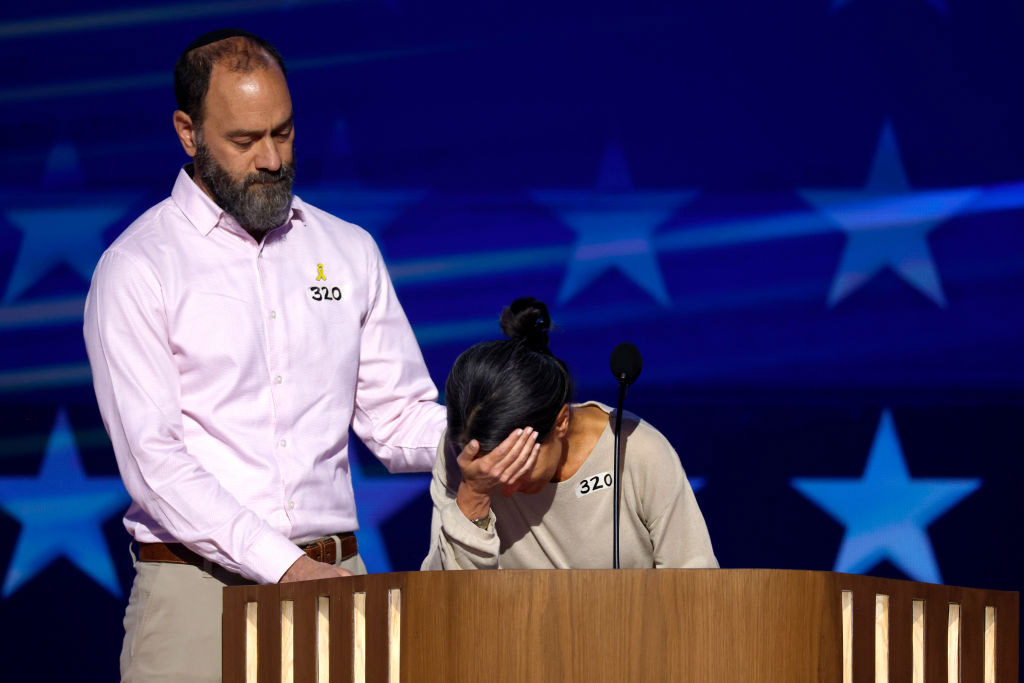
When Jon Polin and Rachel Goldberg, both originally from Chicago, walked out onto the stage, they were met a long ovation and chants of “bring them home.” Twice, Rachel put her hand over her heart and wept, the second time lowering her head to the lectern, overcome with emotion. They both spoke with “320” scrawled in marker on a sticker over their hearts, an indicator of how many days their son has been held hostage.

Throughout Goldberg’s and Polin’s speeches, the cameras panned to teary-eyed, captivated delegates in the crowd. In addition to sharing details about Hersh, Polin and Goldberg related that like the Democratic Presidential nominee, Vice President Kamala Harris, Hersh was born in Oakland, California.

“The families of the American eight hostages meet every few weeks in Washington,” Jon Polin told the crowd at the United Center in Chicago. “We’re heartened that both Democratic and Republican leaders demonstrate their bipartisan support for our hostages being released. We’ve met with President Biden and Vice President Harris numerous times at the White House. They’re both working tirelessly for a hostage and ceasefire deal that will bring our precious children, mothers, fathers, spouses, grandparents, and grandchildren home, and will stop the despair in Gaza.  We are all deeply grateful to them.”

“We’re heartened that both Democratic and Republican leaders demonstrate their bipartisan support for our hostages being released.” – Jon Polin

Jon offered a bit of scripture as he pled for leadership to broker a hostage deal. “In our Jewish tradition, we say ‘kol adam olam um lo’o,’ ‘every person is an entire universe,’ Jon Polin said. “We must save all these universes. In an inflamed Middle East, we know the one thing that can most immediately release pressure and bring calm to the entire region: A deal that brings this diverse group of 109 hostages home and ends the suffering of the innocent civilians in Gaza.”

Win McNamee/Getty Images

A similar scene played out on night three of the Republican National Convention at the Fiserv Forum in Milwaukee on July 17. Ronen and Orna Neutra appeared on stage to chants of “bring them home.”

Their son Omer was taken captive on Oct. 7, 2023 while serving as a tank commander near the Gaza border. “He was born in New York City one month after 9/11,” Omer’s mother Orna said. “Eight months pregnant, I walked across the Queensboro Bridge towards home that day, and here we are 23 years later, and he’s the victim of another vile terrorist attack.”

Orna shared the prayer that brings her strength.

“Imagine over nine months not knowing whether your son is alive, waking up every morning, praying that he too is still waking up every morning, that he is strong and is surviving,” Orna said. “I recite Psalm 23 in his merit every single day: ‘Gam ki eilech b’gei tsalmavet, lo ira ra ki atah imadi.’ ‘I walk through the valley of the shadow of death. I will fear no evil for thou art with me. Thy rod and thy staff, they comfort me.’”

Omer’s father Ronen spoke about the support they received from the Republican nominee for President, former President Donald Trump. “President Trump called us personally right after the attack when Omer was taken captive,” Ronen said. “We know he stands with our American hostages. We need our beautiful son back.”

They too, exited the stage to the sounds of the crowd chanting “bring them home,” with Ronen lifting a determined left fist to the air.

Both DNC and RNC Give Hostage Families Speaking Time on Night 3 Read More »

UCLA Dismisses Appeal of Injunction Requiring University to Protect Jewish Students from Being Barred from Campus Spaces

UCLA filed a motion on Aug. 23 dismissing their appeal of a preliminary injunction requiring the university to protect Jewish students from being barred from campus spaces.

The Becket Fund for Religious Liberty announced the university’s voluntary dismissal of the appeal. “We’re glad to see UCLA in full retreat,” Becket President Mark Rienzi, an attorney representing three Jewish students in their lawsuit against UCLA over the university’s handling of the encampment, said in a statement. “Appealing Judge [Mark] Scarsi’s very reasonable order to stop discriminating against Jews was always a bad idea. Dismissing that appeal is the first step on the road to recovery of a campus that welcomes all, including its Jewish students.”

The university said in a statement to The Journal, “UCLA is committed to fostering an environment where every member of our community is safe and feels welcome. We are in full alignment with the court on that point. While we will always create conditions for the free expression of ideas, we will not tolerate antisemitism, Islamophobia or any forms of discrimination or harassment. The University will forgo an appeal given UCLA’s own anti-harassment and anti-discrimination policies and the current implementation of the directives issued by the UC Office of the President. We will abide by the injunction as this case makes its way through the courts.”

In the injunction, Scarsi wrote “In the year 2024, in the United States of America, in the State of California, in the City of Los Angeles, Jewish students were excluded from portions of the UCLA campus because they refused to denounce their faith. This fact is so unimaginable and so abhorrent to our constitutional guarantee of religious freedom that it bears repeating, Jewish students were excluded from portions of the UCLA campus because they refused to denounce their faith. UCLA does not dispute this. Instead, UCLA claims that it has no responsibility to protect the religious freedom of its Jewish students because the exclusion was engineered by third-party protesters. But under constitutional principles, UCLA may not allow services to some students when UCLA knows that other students are excluded on religious grounds, regardless of who engineered the exclusion.”

UCLA Dismisses Appeal of Injunction Requiring University to Protect Jewish Students from Being Barred from Campus Spaces Read More »

Backyard Mysticism

“Rabbi Ishmael said: ‘What are the songs that one should recite, one who desires to behold the vision of the divine chariot, and still descend in peace and ascend in peace?'”

So begins the book of “Hekhalot Rabbati,” a mystical work from the seventh century. Spiritual seekers have always craved a direct connection with God, calling out that “My soul thirsts for God, the living God. When will I come to see the face of God!” (Psalm 42:3.)

In Judaism this quest is not merely the preoccupation of a few mystics; it is a commandment for all. Parshat Ekev includes the commandment “and to Him you shall cleave” twice; in total, it is found four times in the Book of Deuteronomy. This commandment, known as “devekut,” is difficult to interpret. How does one cling to God?

Mystics argue that this commandment demands an exceptional amount of discipline and effort. Some take this idea to the extreme, and describe devekut as an experience of “unio mystica,” where the person’s individuality disappears, and they are united as one with God. But even less dramatic descriptions of devekut are distinctly other-worldly. The Ramban in his commentary to this verse writes:

“It is possible that the term ‘cleaving’ includes the obligation that you remember God and His love always, that your thoughts should never be separated from Him … to such a degree that one’s conversation with other people is just with their mouth and tongue; yet their heart will not be with the others, but rather with God. With men of such excellence it is possible that even in their lifetime, their souls shall be ‘bound in the bond of everlasting life,’ since they have become a dwelling for the Divine Glory …

“To cling to God one must let go of the world.”

This vision is both intoxicating and terrifying; the very idea of devekut is fraught with questions. How does a lowly being of flesh and blood scale the heights of the divine? And if one visits God’s palace, will they care anymore about their own earthly abode? While it may represent an exhilarating spiritual achievement, the Ramban’s description of devekut is nonetheless disturbing; the person then becomes all soul and no body, a mere shell of a human interacting robotically with others.

In contrast, other commentaries offer more worldly interpretations of devekut. Hizkunni says it means to imitate God’s attributes of kindness and mercy. The more similar man is to God, the deeper the bond is between them. Rabbi Samson Raphael Hirsch says devekut means to be completely devoted to the performance of mitzvot. Rabbi Chaim of Volozhin says that one achieves devekut through Torah study. He explains that one actually should avoid contemplating the divine worlds on high while learning, because it will impede them from achieving full comprehension. Instead, he explains that “through deep involvement and rigorous study one cleaves to His will and words (i.e., the Torah), and He and His will are identical.” Cleaving to Torah is how one cleaves to God. 

Similarly, Rabbi Joseph B. Soloveitchik argues that the mystical view of devekut “denied man’s full selfhood.” Quoting the Talmud, he explains that the Halakhic view of devekut is that one can cleave to God by “living a life of value and elevation.” (And this perspective is shared by all of the commentaries quoted above.) We may never be able to connect to God in a fully satisfying way; but a deep connection to the divine can still be forged through religious and spiritual development. 

This “worldly” view of devekut is first found in the Sifrei, which says: “… How is it possible for a man to ascend the heights and cleave to Him? Is it not written (Ibid. 4:24) ‘For the Lord your God is a consuming fire’? and (Daniel 8:9) ‘His throne was like a fiery flame and its wheels like burning fire’? Rather, it means to cleave to the Torah scholars and to their disciples …”

Great teachers are a key link to the tradition, and by attaching to them one attaches to the essence of the Torah. And that is why it is a form of devekut. Simply being in the presence of great teachers offers implicit lessons about spirituality.

But there is a second element to this text. It locates the connection to the divine in the interpersonal. God is present in the soul of each person; and a deep connection to the divine can be found in day-to-day social interactions. 

In a recent book about Rabbi Yehuda Amital, an anecdote is told about a conversation he had with another rabbi. Rabbi Amital asked about the Sifrei: “What if you live in an area that has no Torah scholars?” How would one fulfill the obligations of devekut?

The other rabbi responded that then one would have no choice but to search for a direct connection with God. 

Rabbi Amital disagreed. He said if there are no scholars, “connect to a simple Jew. Each Jew is a Torah scroll.”

Devekut occurs not just in heaven, but in the classroom as well. And, as Rabbi Amital suggests, devekut is possible anywhere another holy human being is found. The spirit of the prophets is found in every caring heart.

This lesson is critical now. In November, I watched a documentary about the Shura army base, which processed the bodies of the 1,200 people murdered on Oct. 7. A member of the Chevra Kadisha, which is responsible for the ritual preparation of the bodies, related that one of the rabbis on the base never joined the minyan for prayer services; when he asked the rabbi why, the rabbi explained: “I’m not ready to speak to God yet.” 

In the midst of a horrific war, connecting to God is often impossible. And even though I myself am thousands of miles away from these horrors, my own prayers have suffered as well. 

God has stood at a great distance the last 11 months; but at the same time, we have never been closer to Him. We are privileged to be surrounded by remarkable human beings, both in Israel and America, who have done so much. Heroes who leave their families and risk their lives to protect their country. Women who stand alone to keep their families together on the home front. Remarkable volunteers who work endlessly to help those in need. 

All of them ordinary people, all of them ready to act selflessly. They pack backpacks in their homes, and organize fundraisers in their backyards. And to be with them, one finds a connection to the divine that otherwise eludes us. 

It is here that one can experience a moment of backyard mysticism, a devekut that is possible even when God seems far away.


Rabbi Chaim Steinmetz is the Senior Rabbi of Congregation Kehilath Jeshurun in New York.

Backyard Mysticism Read More »

321 Nights of Suffering: Bring Them Home

Shabbat Shalom. Please read these words from my Rabbi Yoshi Zweiback, Stephen Wise Temple:

If you saw it you would understand. The heartbreak. The utter heartbreak.

Right before she begins her speech at the DNC with her husband, Jon, at her side, she hears tens of thousands of people chanting “Bring Them Home.” Rachel Goldberg puts her hand on her forehead and then collapses on the lectern, her body convulsing as she begins to cry. Jon gently helps her stand and says to her gently, “You’ve got this.” And then, “let’s go.”

https://youtu.be/661i1R_46q8?si=uv71LDKw026x3cgm

She starts to speak: “At this moment, 109 treasured human beings are being held hostage by Hamas in Gaza. They are Christians, Jews, Muslims, Hindus, and Buddhists. They are from 23 different countries. The youngest hostage is a one year old, red-headed baby boy. And the oldest is an 86 year old mustachioed grandpa. Among the hostages are eight American citizens. One of those Americans is our only son. His name is Hersh. He’s twenty-three years old.”

She tells us that Hersh is a happy-go-lucky young man who loves soccer and music and is obsessed with travel; his room at home filled with atlases and travel books.

If this impassioned plea by Jon and Rachel on behalf of their child, and the rest of the hostages, doesn’t open your heart, I can’t imagine what would.

Bringing our hostages home is an issue that, no matter our politics, every American should be fighting for, along with every person of conscience in the world.

Jon referenced this directly when he said, “We are heartened that both democratic and republican leaders demonstrate their bipartisan support for our hostages being released.”

At last month’s RNC gathering, Orna and Ronen Neutra, the parents of Omer, age 22, another Israeli-American being held hostage in Gaza, spoke. There as well we heard the convention participants chanting in one voice, “Bring Them Home.”

Empathy should be bipartisan and, yes, empathy should extend to the innocents in Gaza who suffer mostly because of the intentional cruelty of the Hamas regime.

Jon and Rachel powerfully demonstrated  their own empathy by acknowledging that the agony they feel is not unique. It is shared, of course, by the families of the other hostages. This agony is also experienced by millions of others in the region, Israeli and Palestinian alike, who are affected by the awful war initiated by the terror attacks of October 7. The tens of thousands of Israelis who have had to evacuate their homes. Gazan families who desperately seek safety in the middle of a war zone. Survivors of the Nova music festival who struggle with the horrific trauma they witnessed. Soldiers who are asked to do hard things so that terrorists might be brought to justice, hostages might be rescued, and whole communities might be kept safe.

So much agony on every side. As Jon put it: “There is a surplus of agony on all sides of the tragic conflict in the Middle East. In a competition of pain, there are no winners. In an inflamed Middle East, we know the one thing that can most immediately release pressure and bring calm to the entire region: a deal that brings this diverse group of 109 hostages home and ends the suffering of the innocent civilians in Gaza.”

We need to bring Hersh and Omer home, now, along with Kfir and ArielCarmel and Liri — every last one of them. This includes the dead so that we may bury them properly.

An exhibit to raise awareness for the hostages being held in Gaza on the sidelines of the Democratic National Convention in Chicago on August 20, 2024. (Jacob Magid/Times of Israel)

It’s been far, far too long.

The masking tape on Jon and Rachel’s shirts made this clear; noting exactly how many days have passed since the hostages were taken: 320.

Almost a year since these sons and daughters, mothers and fathers, and grandparents were stolen from their lives and their families. Almost a year of unimaginable agony.

Our broken hearts must remain open. We must hold on to our capacity for empathy.

This week’s Torah portion, Eikev, points the way:

“Cut away the thickening about your hearts and stiffen your necks no more. For the ETERNAL your God is God supreme and Sovereign supreme, the great, the mighty, and the awesome God, who shows no favor and takes no bribe, but upholds the cause of the fatherless and the widow, and loves the stranger, providing food and clothing. You too must love the stranger, for you were strangers in the land of Egypt.” (Deuteronomy 10:16-19)

Our Torah calls us to stop being hard-hearted, stubborn, and stiff-necked; to see the pain of the orphan and the widow, the agony of the stranger, of the other.

These verses remind us that empathy is divine; a Godly attribute which, as God’s creations, we can actually hope to attain.

We can do this. We are capable of seeing the agony of the other. We can cut away the “thickening of our hearts” and love even the stranger.

And then, regardless of race or religion, political affiliation or ethnic background, we will someday experience justice, liberty, and peace together.

Shabbat shalom,

Rabbi Yoshi

The parents of Hersh Goldberg-Polin, an Israeli-American hostage who was kidnapped by Hamas at the Nova music festival, spoke at the Democratic National Convention. Rachel Goldberg-Polin talks with CNN’s Jim Acosta about an emotional moment on stage. THE JERUSALEM POST: “DNC stands in support as parents of American hostage Hersh Goldberg-Polin plead for deal


THE TIMES OF ISRAEL: “Chanting ‘Bring them home,’ tens of thousands applaud Goldberg-Polins’ speech at DNC” “We’re also profoundly thankful to you — the millions of people in the United States and all over the world who have been sending love, support and strength to the hostage families. You’ve kept us breathing in a world without air,” said Jon, who, like his wife, wore “320” written in black marker on a piece of white masking tape stuck to his shirt, a number they have painfully updated each new day that their son has spent in captivity. With the gratitude came a stern message: “This is a political convention, but needing our only son and all of the cherished hostages home is not a political issue. It is a humanitarian issue,” Jon said to further applause from the crowd. There is a surplus of agony on all sides of the tragic conflict in the Middle East. In a competition of pain, there are no winners,” he continued. “In our Jewish tradition, we say… Every person is an entire universe. We must save all these universes.”


321 Nights of Suffering: Bring Them Home Read More »