fbpx

July 17, 2024

Jews Should Stop Calling the LA Protest a Pogrom (and Trump the Next Hitler)

In June 1941, a horrific pogrom during the Shavuot holiday targeted Baghdad’s large Jewish community and resulted in hundreds of murders, rapes, and the mass destruction and looting of Jewish homes, synagogues and businesses. It irreversibly traumatized a once-flourishing Jewish community that had called Mesopotamia home since the sixth-century BCE. By the late 1940s, a mass exodus of over 130,000 Jews had fled Iraq and mostly resettled in the nascent Jewish state.

Fueled by age-old antisemitism and new-found Nazi propaganda, Muslim Iraqis savagely targeted Jewish citizens. Bloodthirsty mobs proved so merciless that some men even cut off the breasts of Jewish young women they had mass-raped and waved them in the air as a sign of savage triumph. 

The “Farhud,” or “violent dispossession,” marked the end of 1,300 years of Jewish life and culture in Iraq. It traumatized an entire generation, and its children. The 1941 Farhud was a pogrom against Jews. 

On June 23, virulently antisemitic protesters blocked the entrance to a West Los Angeles synagogue and clashed violently with Jewish counterprotesters. It was the perfect storm, with rage-filled protesters who seemed to enjoy instilling fear, violence and chaos in a local Jewish community; worried Jews who had had enough of antisemitism masked as anti-Zionism; and an LAPD presence that was, by all accounts, shockingly unprepared.

The June 23 antisemitic protest was unprecedented in L.A. It was terrifying and traumatic. But it was not a pogrom. 

My friend, Sam Yebri, disagrees with me. Yebri is a community and nonprofit leader, an attorney, a stalwart Democrat and a passionate Jewish American voice who serves on the boards of many organizations. Yebri’s family fled Iran when he was one-year-old and I have always found his views to be sage and nuanced. Yebri ran for L.A. City Council in 2022 and was defeated by Katy Young Yaroslavsky. 

I have worked alongside Yebri for nearly two decades (we co-founded 30 Years After with other young Iranian American Jews in 2007) and have seen how his deep passion is often tempered by a more sober rationality. That’s why I’ve been so surprised to see that Yebri has continued to refer to the Pico protest debacle as a pogrom. 

“2 weeks have passed since the Pico Pogrom in LA,” he wrote in a July 7 post on X. “Not 1 criminal who bludgeoned Jews was arrested. Despite promises from politicians, no new laws (to ban masks at protests, require permits, develop buffer zones near houses of worship, increase security funding) have been adopted.”

I believe Yebri is right about everything. Everything, that is, except using the word “pogrom.” I worry that such practices, however well-intentioned, cheapen the word and demean the suffering of Jews throughout millennia. So I asked Yebri, who was at the protest (I was not) why he believes “pogrom” is apt in describing what happened in L.A. last month.

I worry that such practices, however well-intentioned, cheapen the word “pogrom” and demean the suffering of Jews throughout millennia. 

“Words – like ‘violence,’ ‘attack’ or ‘hate crime’ simply do not capture the magnitude of what happened,” he told me. “In the past, Jewish Angelenos have been randomly shot at on Pico and synagogues on Pico have been vandalized. On Thanksgiving Day, the home of a major L.A. Jewish leader was even attacked but the criminals scurried away when the police arrived. 

“This time,” he continued, “the violence was not random nor did the criminals shy away when they saw the police. Instead, a menacing mob that celebrates both Hamas by wearing green headbands and Hitler by imitating the Nazi salute marched into Pico-Robertson, one of America’s most Jewish neighborhoods, in plain view of the police, with a singular goal of harming and terrorizing Jews. No other word captures what happened; no other word reminds us what worse will come if people of good conscience do not speak up now.”

In contemplating whether non-Jews may soon stop believing problematic Jewish claims about pogroms, I was humbled by my own skepticism over whether most non-Jews worldwide even know the definition of “pogrom.”

Let that sink in for a moment. 

My ardent belief that the protest wasn’t a pogrom was vindicated on July 7, when an attorney for Ronen Helmann filed a lawsuit against Code Pink and the Palestinian Youth Movement (PYM) because they prevented him from entering a place of worship on June 23. I can’t recall the last anti-Jewish pogrom in which Jews were allowed to sue their persecutors two weeks afterwards, claiming that their First Amendment rights were violated because they couldn’t enter a synagogue. (Only in America, it seems.)

There were many angry Jews who counterprotested and who later told me that they were comfortable calling the incident a pogrom. But unlike Yebri, some of them are not pro-Israel Democrats; many are self-described pro-Israel Jews with deeply right-wing values.

And ironically, one of the biggest thorns currently in their side — for the ones who love Donald Trump, at least — is the multitude of Jews who now are incessantly comparing Trump to Adolf Hitler, and the Trump movement to Nazism. 

Just when I thought Jews needed to be more careful about fomenting alarmism, an entirely different contingent of Jews now insists that the candidate running (again) for the American presidency is none other than the Fuhrer, with orange hair — and without the mustache.

Of course, this isn’t the first Trump-Hitler comparison. That began in 2016, when seemingly everyone from the cast of “Saturday Night Live” to Abe Foxman of the ADL and Vicente Fox, the former president of Mexico, claimed there were Trump/Nazi similarities. Even former Fox News host Glenn Beck told George Stephanopoulos, “You know, we all look at Adolf Hitler in 1940. We should look at Adolf Hitler in 1929. He was a funny kind of character who said the things that people were thinking.” 

More recently, a December 2023 opinion essay in The Washington Post was titled, “Yes, it’s okay to compare Trump to Hitler. Don’t let me stop you.” One Jewish friend named Michael recently posted on Facebook a meme of a screaming Trump with fire behind him that read, “Don’t worry about the blood bath if he loses. Worry about the death camps if he wins.”

Really? Death camps?

I asked my friend to clarify whether he truly believes what he posted. “For the Jewish people, Trump is nothing like Hitler. However, he does use Hitler’s playbook by denigrating groups that do not fit the White American ideal — Mexicans, Muslims, disabled, and gay community targets,” Michael said. “In Nazi Germany, first they came for the Jews, then the Gypsies, and the disabled … If we don’t stand up to this now, Project 2025 has a good chance of implementation, and our Democracy goes down the tubes.”

If you’re not familiar with Project 2025, it’s a playbook for presidential transition proposed by The Heritage Foundation, though it sounds more like a 1950s sci-fi film about mutant cars that drive themselves in the year 2025. 

I understand some of my friend’s concerns, and Trump’s most die-hard followers, especially the ones who zealously salute him by raising their right hands, are inarguably unsettling.

But one of the biggest dangers of the Trump-Hitler comparison is one that’s often overlooked: In such a hysterical, binary inflation of language and imagery, it now seems all but guaranteed that anyone who argues that Trump is not a new Hitler will do so at their own peril. 

It used to be that we canceled someone by calling them a Nazi. Now, we cancel them if they refuse to call others Nazis.

How sad that it took an assassination attempt against Trump for many of my friends to pause the Hitler comparisons and rightly declare that political violence has no place in America, even if the target of such violence was a man whom they truly deplore. 

I thought about asking Holocaust survivors what they think about the comparisons to Nazism. But I couldn’t bring myself to do so They will read this nonsense for themselves, if they haven’t done so already. I have a hunch about what they would say, even the ones who dislike Trump, but I’ll spare readers the use of colorful Yiddish expletives. 

Of all the allusions to Trump and Hitler, the one about death camps bothers me the most. Consider this: If the average non-Jewish undergraduate sees image after image of Trump as Hitler, a certain desensitivity will eventually set in, if it hasn’t already. And this kind of desensitivity won’t do much to taint Trump; it’ll only water down Hitler. And at a time when most college students don’t even know the meaning of Auschwitz, that’s unforgivable meshugas.


Tabby Refael is an award-winning writer, speaker and weekly columnist for The Jewish Journal of Greater Los Angeles. Follow her on X and Instagram @TabbyRefael.

Jews Should Stop Calling the LA Protest a Pogrom (and Trump the Next Hitler) Read More »
Biden Can’t Fight and Unite

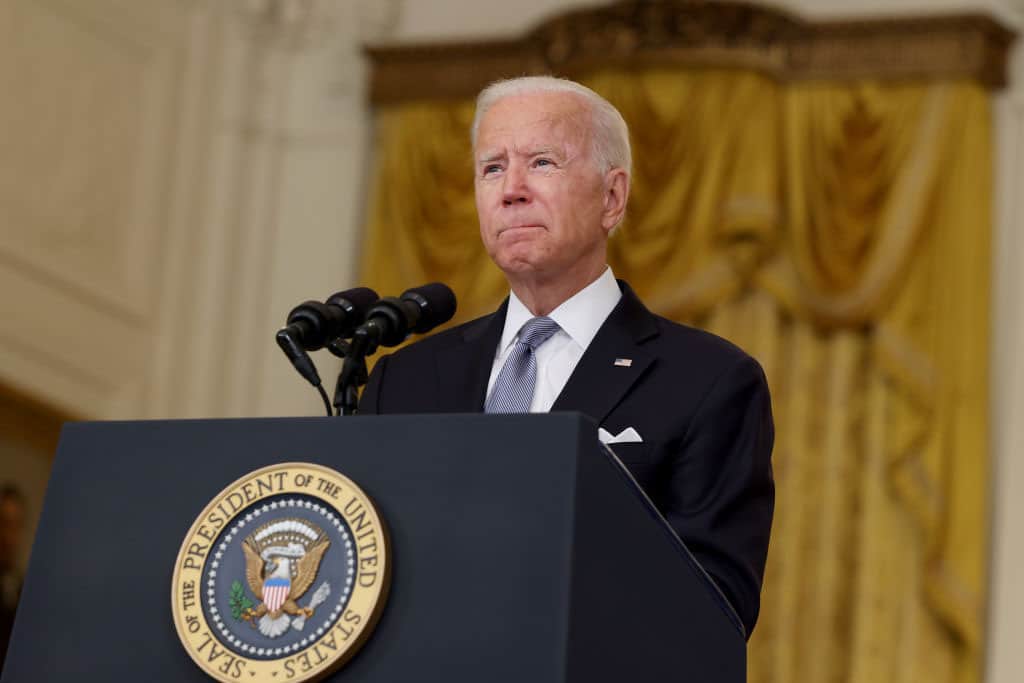
Joe Biden should not be a candidate for president of the United States.

I write this not as a partisan strategist who wants to increase one party or the other’s chances of winning in November. Nor do I write this as an advocate for another candidate who I would prefer to see in office. My impression is that Vice President Harris would gain the Democrats some votes among young people and other progressives but cost them support among the Rust Belt working-class voters who elected Donald Trump in 2016. And it’s an open question whether there is a Democratic governor, Senator or cabinet member who would more effectively represent their party in the fall.

This is not about Biden’s diminished physical and emotional vigor. Over the last few weeks, the nation has been obsessed by a necessary but ghoulish effort to calculate the current health and future trajectory of our octogenarian leader. But it’s simply not possible to ascertain what Biden’s physical or mental state will be in four weeks, four months or four years.

Biden should not withdraw from the race because he had a singularly bad night on a debate stage last month or because of a more gradual decline that has visibly slowed and weakened him. He should step aside because of the political moment created by the attempted assassination of his opponent. 

Our politics has become increasingly polarized over the years and our society has become increasingly fractured. The nastiness and ugliness of the political discourse has empowered the extremes, eliminated the center and alienated Americans of all ideological stripes. When Biden ran in 2020, he decried these divisions and promised a return to normalcy. But whether you happen to blame the president or his antagonists, the fights have become even more confrontational and even more toxic over the last four years. 

But the attempt on Trump’s life seems to have struck a chord in the body politic and with the country’s voters in a way that other recent instances of political violence did not. In the hours after the shooting, Biden and Trump voiced similarly uplifting appeals for civility and peaceful disagreement. But in the days that followed, the sheer improbability of either party maintaining that tone throughout the closing weeks of a high-stakes presidential election has become clear.

Biden’s own media appearances have demonstrated the difficulty of balancing between high-minded unity and the practicalities of a competitive political campaign. The night before the shooting, Biden harshly attacked Trump before a partisan audience in the key swing state of Michigan. In an Oval Office address the following day, he called for the country to come together and rise above our differences. Then in a television interview on the first day of the Republican convention, he toggled between both messages and managed to undermine them both in the process.

Biden’s own media appearances have demonstrated the difficulty of balancing between high-minded unity and the practicalities of a competitive political campaign. 

This is not a criticism of Biden. No politician can simultaneously deliver these two contradictory messages and hope that either can effectively be heard. Fifty-plus years ago, another Democratic president faced a similar predicament. Lyndon Johnson was trying – and failing – to heal the country in the midst of wrenching social and cultural divisions at the same time that he was making his own case for reelection. Johnson recognized that he could not accomplish both goals at the same time and ended his reelection campaign so he could fully concentrate his efforts on the nation’s formidable challenges.

Johnson was unable to bring the country together by election day and he left office under a cloud. But over the decades he has received considerable recognition for his domestic policy achievements, to the point where observers used his Great Society as a standard against which to measure Biden’s work.

Biden should announce his retirement not from a position of weakness under pressure from supporters nervous about the fading skills of an elderly president. Rather, he can depart from a position of strength as a leader who put his country’s unity over his own political ambition. His selfless and admirable decision would be judged kindly by history.


Dan Schnur is the U.S. Politics Editor for the Jewish Journal. He teaches courses in politics, communications, and leadership at UC Berkeley, USC and Pepperdine. He hosts the monthly webinar “The Dan Schnur Political Report” for the Los Angeles World Affairs Council & Town Hall. Follow Dan’s work at www.danschnurpolitics.com.

Biden Can’t Fight and Unite Read More »

After Nine Months, Rabbi Kahn Says Jews Realize ‘We Are All One’

Rabbi Yanky Kahn exhaled deeply before he sat down on his living room couch and explained how he prepares for his nearly monthly humanitarian missions to Israel since Oct. 7.

Normally a vigorous, outgoing personality, he spoke slowly, deliberately. “The first step each time is finding out what is needed in Israel,” he said. “The second step is getting it.”

Before he explained in depth how Israeli needs have expanded and changed in the past nine months, he exhaled deeply, and gave a one-line summation: “Changes in the peoples’ needs, and in the land, have been drastic.”

Shortly before leaving with his wife, Rebbetzin Hindy Kahn, his four children, and friends (mostly from Chabad of the Valley) on a 15-person nonstop one-week mission, his sixth trip to Israel since Oct. 7, Rabbi Kahn admitted that bombings and related nonstop wartime disruptions across the state are “a little challenging. After all, it is Israel. 

One thing Kahn has learned is that someone may think they are connected with a country he knows as well as the Valley, but war changes everything. “A lot of the soldiers are in the reserves,” he said. “One time you are there, they are serving. Next visit, the situation is changing the whole time.”

The day before The Journal visited the Kahn family, they learned that 50% of the residents of Metula, a town of around 1,700 on the Lebanese border in the far north, “will not be going home ever again. That means that going up north is more dangerous than going to the southern part of Israel,” site, until recently, of the worst fighting. “That means half a city is not going back.”

What changed? “Rockets from Lebanon flying into homes.”

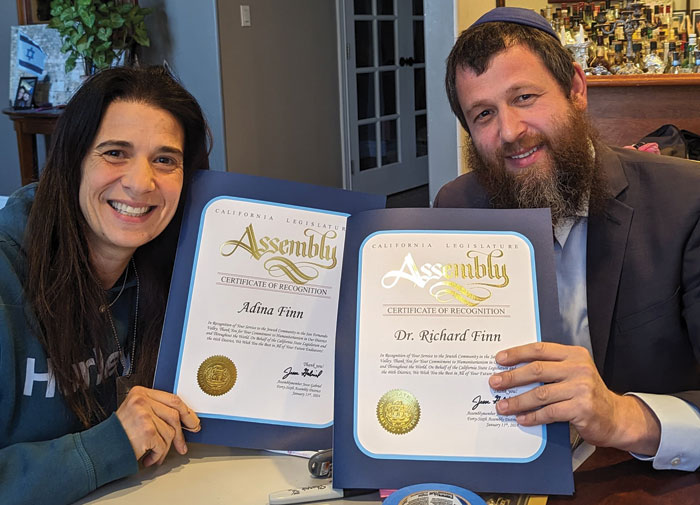
Most of the reporting of human and structural casualties in Israel has been dwarfed by coverage of Gaza. “I can tell you there is suffering in Israel, and that is the reason we are going back,” Kahn said. “Here is one of the highlights of our next mission: I want to give a big shout-out to Rabbi Chaim and Charna Mentz of Bel-Air. His words to me were ‘Yanky, we are going to go and make damage.’ What he meant to say was, ‘‘we are going to make a huge impact.’” Along with the Mentzes, Adina Finn, a major donor to the Israeli war cause, will join the Kahns. 

As the war’s nine-month anniversary approaches, help is en route for some of the war’s most tragic victims.

Rabbi Kahn and friends have been in contact with social workers in Israel. “We are going to take care of 35 widows, mostly younger women, many with infants,” the rabbi said. “We are going to help them financially, help them emotionally.  I can tell you every relationship that happens, each of these widows, each of these human beings, is an ongoing matter.”

“We are going to take care of 35 widows, mostly younger women, many with infants. We are going to help them financially, help them emotionally.  I can tell you every relationship that happens, each of these widows, each of these human beings, is an ongoing matter.”

It becomes quite personal. Many widows have babies under a year old, and Rabbi Kahn’s mother, Rachel, longtime resident of Jerusalem, has a list of many widows and their bank accounts. “Three times a year,” he said, “my mother sends each widow a bank transfer to help them through holidays.”

The rabbi said the nonstop missions are “having a ripple effect where the love continues to grow.”

On an earlier Kahn mission, they treated a group of children from displaced families in Kfar Maimon to a restaurant outing. “Thank God those families are home now,” Kahn said. “But as we speak, there is a lady in Israel who came on a previous trip — Tziporah Okavat — and she is continuing to take those children out to a restaurant.” Breaking into a smile, he said “every time we go somewhere and make friendships, it just expands and expands in helping other people.”

 The widows, he said, are “crying every day. Parents who lost soldiers are crying. I spoke to a parent today. This is why we are going — to really help, to make a difference for the people.” He offered two explanations why coverage of wartime Israeli seems light. “Unfortunately, yesterday’s news was old news. “Second,  when we hear, G-d forbid, about an injury or worse, we do a kvetch, we say ‘oy vey,’ and then we go on with our lives.”

The rabbi cited the loyalty of Jeff and Rita Weiss, Adina Finn (on her third mission) and others who prefer anonymity “for sticking with us every mission.” Many hometown Jews have told the rabbi: “We are going to have your back and make a difference. We go on with our lives every day, but so many people have not gone home. They suffer every day.”

Finn, who recently brought seven injured IDF fighters to Los Angeles to aid their recovery, estimated she has helped transfer $4 million in requested/needed equipment to Israel. Working with the nonprofit Maman, she has sent a vast amount of military supplies, only tactical equipment such as kneepads, boots, and tourniquets, “trying to supply them with practical equipment.”

Rabbi Kahn said “suffering among Israelis is really bad in the north, but there is suffering in Jerusalem, suffering in the south. There are families w sitting all alone. Kids going to sleep every night without their fathers. Many people have not been home since Oct. 7.” 

He noted at least 12,000 disabled soldiers won’t fight again.

“The people in Israel,” he said, “need our help more than you can imagine. This is a war like none we ever have fought. I think the Jewish people realize, after nine months, now we are all one.”

What does the rabbi learn on each new trip? “So many need help,” he said. “Importantly, you help one person and you say ‘I have done my mitzvah. The answer is no, you haven’t. It’s ongoing.”

Jewish Journal: Do you have any major unfulfilled goals?

Rabbi Kahn: Yes, many in Israel. I would like to do a lot more to help the widows and soldiers. In the Valley, I have many dreams, including a Bikur Cholim center for Providence Cedars-Sinai Tarzana Medical Center. 

J.J.: How have the war trips altered family life when you are home?

Rabbi Kahn: My family is very involved. We discuss the individual soldiers and widows. It’s very much a joint collaboration.

J.J.: What are your favorite moments of the week?

Rabbi Kahn: Watching my wife and daughter light candles on Friday nights. And no cell phone for 25 hours.

After Nine Months, Rabbi Kahn Says Jews Realize ‘We Are All One’ Read More »