fbpx

May 24, 2024

Brandeis Center Sues Harvard Over Allegedly Ignoring, Tolerating Antisemitism on Campus

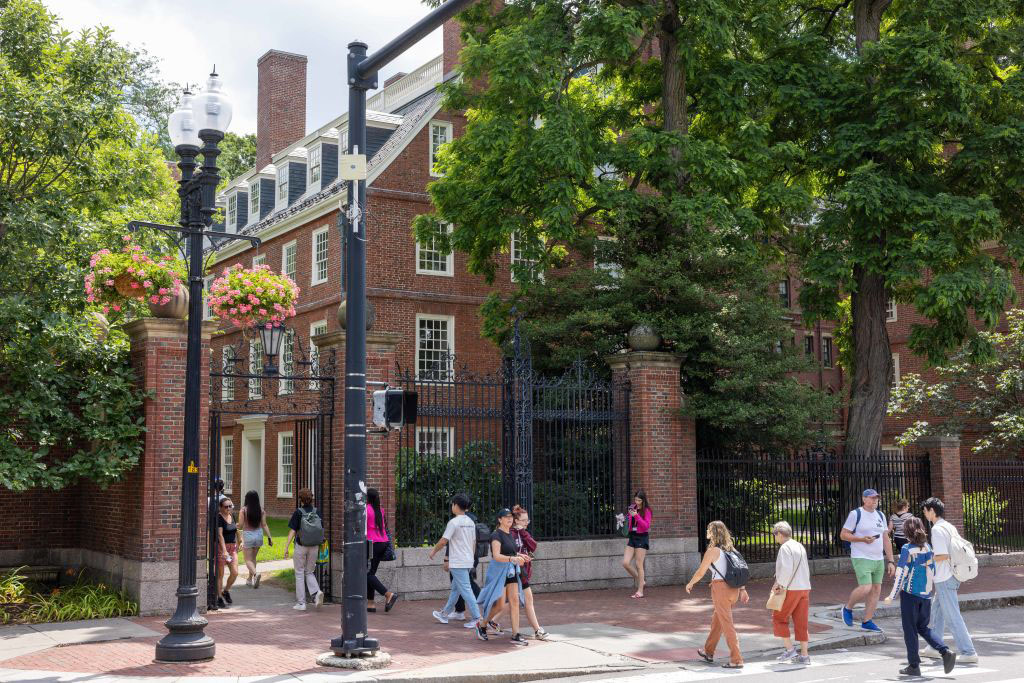
The Louis D. Brandeis Center for Human Rights Under Law filed a lawsuit against Harvard University on May 22 alleging that the university has ignored and tolerated antisemitism on campus, thus causing it to be pervasive.

The lawsuit, which was obtained by the Journal, alleges that the Oct. 7 massacre sparked “vicious antisemitism on campus,” pointing to how a day after the massacre, the Palestine Solidarity Undergraduate Committee and 33 other student groups penned a letter solely blaming Israel’s “apartheid regime” for the carnage; the letter did not condemn Hamas. According to the lawsuit, university leadership subsequently issued a statement saying they were “heartbroken — not solely or specifically by the carnage of Jews and Israelis wrought by the Hamas attack but by unspecified ‘death and destruction’ the attack had ‘unleashed’ and the larger ‘war in Israel and Gaza now under way.’” The lawsuit claims that leadership “also did not condemn the PSC letter for blaming Israel, nor did it offer any specific consolation for Jewish students — indeed, it did not mention Harvard’s Jewish students at all. Instead, it promised to ‘take steps as an academic community to deepen our knowledge of the unfolding events and their broader implications for the region and the world.”

Then-President Claudine Gay made a statement condemning the Hamas atrocities on Oct. 7 but didn’t “condemn the PSC letter and noted only that student groups do not speak for Harvard University or its leadership. President Gay also made no mention of antisemitism or protecting Jewish students on campus … The statements by President Gay and Harvard leadership were woefully inadequate and signaled that antisemitism was tolerable and just another element of the Harvard experience … Students received the message that they would face no repercussions, even for the most vile, anti-Jewish or anti-Israel statements.”

The lawsuit proceeds to detail how an anonymous Jewish-Israeli graduate student at the Harvard Business School was assaulted after he started recording anti-Israel protesters on campus participating in a die-in. “When protestors saw him and identified him as Jewish and/or Israeli, they accosted him. A mob surrounded him, engulfed him with keffiyehs, and chanted ‘Shame! Shame! Shame!’ in his face,” the lawsuit states. “The assailants grabbed him, and one hit him in the neck with his forearm, before forcing [the student] out of Harvard’s quad. The video of the assault is shocking. But more remarkable perhaps is that Harvard has not taken any action to date.” Thus far, the university has stated that they are waiting out “an ongoing criminal investigation” against the assailants, but the lawsuit contends that the “assault was caught on tape, and the offenders have been identified. Harvard can make its own assessment, based on its own policies, and it can act accordingly.”

The assaulted student was subsequently subjected to “defamatory remarks” online accusing the student of being aggressive with his recording and stepping over people, harassing the protesters and that none of the protesters got “physical” with him.

Another anonymous student cited in the lawsuit stays clear from campus after being subjected to Harvard students screaming “F— you! Free Palestine! Harvard supports genocide!” and “You guys are liars!” while the student was at an event providing support for those being held hostage by Hamas. They have also seen “numerous antisemitic, anti-Israel posts by physicians, professors, and researchers affiliated with Harvard” on X, such as one professor allegedly reposting tweets stating “explain to me again the difference between Hitler exterminating the Jews and the Jews exterminating the Palestinian people” and “Zionists have been violently displacing & dispossessing Palestinians to achieve [their] ‘dream’ for over 75 years,” in response to, “Zionist doctors have facilitated in the genocide of Palestinians,” per the lawsuit. “This has made it incredibly difficult for (the student) to engage with those faculty members, see them at interdisciplinary seminars or networking events for women in STEM, or to go to campus in general.”

There have also been documented instances of students posting “vile antisemitic statements and conspiracy theories” on “Sidechat,” a digital platform that allows anonymous texting and is accessible to anyone with a Harvard email address. The statements included calling a Jewish student “pro-genocide” who “looks just as dumb as her nose is crooked” and another posting a rhyme about “Hillel burning in hell” because it’s funded by Jeffrey Epstein and “supports genocide,” per the lawsuit.

The lawsuit also states that “several student groups and a faculty group posted an antisemitic cartoon on their social media accounts” in February of “a hand etched with a Star of David and a dollar sign holding a noose around the necks of what appear to be a black man and an Arab man.”

In March, Harvard Law School’s student government voted on a resolution anonymously in a “secret and rushed anti-Israel resolution accusing Israel of ‘ethnic cleansing,’ ‘genocide,’ and ‘illegal occupation of Palestine.’ Despite the fact that Israel exited Gaza in 2005.” The resolution called for Harvard “to divest completely from weapons manufacturers, firms, academic programs, corporations, and all other institutions that aid the ongoing illegal occupation of Palestine and the genocide of the Palestinians.”

The lawsuit goes into great detail about allegations preceding Oct. 7 accusing Harvard Kennedy School (HKS) Lecturer Marshall Ganz of marginalizing and belittling three Jewish Israeli students for referring to Israel as a “Jewish democracy” in their group project. The school hired an outside investigator to review the allegations against Ganz, and the university accepted the majority of investigator’s findings that Ganz violated university policy and discriminated the students based their Jewish and Israeli identities, per the lawsuit. Not only did HKS not take any action against Ganz, it also celebrated him “as a civil rights hero,” the lawsuit alleges. For his part, Ganz — who is Jewish — told The Harvard Crimson that the investigation was a “kangaroo court” and accused Dean Doug Elmendorf of preventing him from talking to lawyers during the investigation and that the school didn’t bring in other faculty members in during the fact-finding part of the process. A spokesperson for HKS denied Ganz’s allegations, telling the Crimson that three senior faculty members advised him “on appropriate action and prevention of future incidents” and that “all parties were given the opportunity to present evidence and to review and comment on preliminary findings. The Dean then took action responsive to the allegations.” The spokesperson added that “the investigator reviewed documentary evidence and interviewed at length both the students and Professor Ganz to hear their perspectives.”

Ganz told the Crimson that he simply advised the three students to “reframe” the project, calling their project “inflammatory” because the class isn’t about Middle East politics, but community organizing. Multiple faculty members gave statements in support of Ganz to the Crimson.

“For years Harvard’s leaders have allowed the school to become a breeding ground for hateful anti-Jewish and radical anti-Israel views,” Brandeis Center Founder and Chairman Kenneth L. Marcus said in a statement. “An outside investigator warned of the problem more than a year ago, Harvard Kennedy School’s Dean acknowledged it, and yet crickets. When are university leaders going to learn that in order to prevent your school from becoming a cesspool of antisemitism action is required? Schools must hold students and faculty accountable. They must follow through with public consequences when Jews are harassed and discriminated against like they would for any other minority group, as required by law.”

“An outside investigator warned of the problem more than a year ago, Harvard Kennedy School’s Dean acknowledged it, and yet crickets. When are university leaders going to learn that in order to prevent your school from becoming a cesspool of antisemitism action is required?”  – Kenneth L. Marcus

A university spokesperson said in a statement to The Journal, “Harvard has and will continue to be unequivocal – in our words and actions – that antisemitism is not and will not be tolerated on our campus. We remain committed to combating hate and to promoting and nurturing civil dialogue and respectful engagement.”

The university pointed the Journal to a list of actions Harvard has taken to combat antisemitism as of May 10, including increasing campus security, only allowing Harvard College students to access Sidechat and ensuring that its content moderation guidelines are being strictly enforced, maintaining a 24/7 hotline for incidents to be reported anonymously, holding spaces often in conjunction with Hillel for Jewish and Israeli students to connect and establishing the Presidential Task Force on Combating Antisemitism.

The spokesperson would not comment on the specifics of the lawsuit as university policy is not to comment on pending litigation.

Brandeis Center Sues Harvard Over Allegedly Ignoring, Tolerating Antisemitism on Campus Read More »
JPAC Advocacy Summit Draws 500 Community Members to Capital

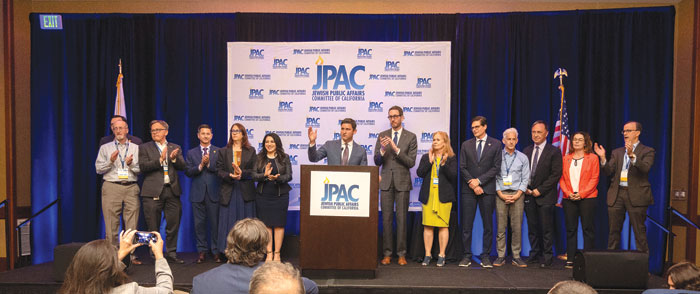
Approximately 500 Jewish leaders, community members and college students from across California turned out to the Jewish Public Affairs Committee of California (JPAC) Capitol Summit, held at downtown Sacramento’s Sheraton Hotel from May 14-15. 

Speakers included California Gov. Gavin Newsom, who highlighted how his recently unveiled “Golden State Plan to Counter Antisemitism” will invest millions of dollars in preventing hate crimes, increase funds for nonprofit security enhancements and provide critical support services for Holocaust survivors. 

“Antisemitism is unique, it’s uniquely insidious,” Newsom said, delivering prerecorded remarks via video. “It’s a uniquely insidious form of a hate that demands that kind of precise and aggressive action, and that’s why we created this extensive roadmap.”

Newsom was one of dozens of speakers at the conference. The other keynotes were State Attorney General Rob Bonta; Lieutenant Governor Eleni Kounalakis; State Superintendent of Public Instruction Tony Thurmond; and Jewish Council for Public Affairs CEO Amy Spitalnick.

While Newsom painted a broad picture of ways the state is stepping up to support Jews, Thurmond emphasized the importance of standing strong with Jewish students at a moment when Jew-hatred is pervasive on college campuses and K-12 schools. 

“I’ve made a pledge that on my watch, we will never let any act of antisemitism stand in the schools,” Thurmond said in remarks.

Throughout the conference, the state’s elected officials addressed ways the events of Oct. 7 have impacted them. One of the breakout sessions, “Reflections from Israel and the Gaza Border,” focused on a recent three-day solidarity trip to Israel taken by a group of California legislators this past February.

During their trip, the legislators visited kibbutz Kfar Aza, one of the southern communities targeted by Hamas, as well as the site of the Nova musical festival massacre. At the time of their visit, Israel was conducting its war in Gaza, just a few miles away.

“We heard the constant booming of artillery,” Assemblymember Al Muratsuchi, a Japanese-American Democrat who represents parts of the South Bay in Los Angeles, said during the breakout session.

Assemblymembers Jesse Gabriel and Al Muratsuchi speak on “Reflections from Israel and the Gaza Border,” a panel about a recent solidarity trip to Israel. California legislators participated on the trip. Courtesy of JPAC

The conference kicked off on Tuesday evening with an appearance by 50 statewide elected officials, nearly half of the total legislators serving in the California State Assembly and Senate, which have 80 members and 40 members, respectively. State Senators Scott Wiener, Ben Allen and Josh Newman along with Assemblymembers Jesse Gabriel, Rick Chavez Zbur, Laura Friedman and Josh Lowenthal, among others, attended Tuesday night’s dinner in the hotel ballroom.

Chavez Zbur, who isn’t Jewish, has emerged as one of the most vocal supporters of the Jewish community over the past several months. Addressing the room of people seated at banquet tables, he likened the California Legislative Jewish Caucus to “an army of people standing up for you.”

An annual event, the JPAC Summit provides representatives of Jewish communal groups an opportunity to hear from elected officials in the state legislature on hot-button issues. The conference wrapped up with attendees lobbying officials in the State Capitol on bills they’d like to see approved by the legislature. 

JPAC — a coalition of 32 Jewish organizations from across the state — defines itself as “the voice of the California’s Jewish community to the State Capitol.”

This year, JPAC lobbied for a package of 10 bills, with a focus on the rise of statewide antisemitism. They include a $5 million request to establish and fund a Teachers Collaborative on Holocaust and Genocide Education for K-12 schools and an $80 million budget request toward the state’s nonprofit security grant program. 

Whether they’ll be approved remains to be seen, as the state is currently grappling with an  estimated $56 budget deficit over the next two fiscal years.

On the second day of the conference, Keely Bosler, who served as chief fiscal advisor to Gov. Newsom during the pandemic, delivered a “budget briefing” in conversation with Joanna Mendelson, senior vice president of community engagement at Jewish Federation Los Angeles. Bosler explained the budget is highly dependent on capital gains – meaning profits earned by taxpayers in the stock market. With the stock market not performing as well as it was during the height of the pandemic, less funds are available in the budget, she said. 

Nevertheless, she said Newsom was committed to funding for nonprofit security grants, which allow for security enhancements to synagogues and other institutions vulnerable to hate crimes.

David Bocarsly, executive director of JPAC, said this year’s summit was the most well-attended in the event’s history, with 300 of the conference’s 500 attendees attending for the first time. He attributed the growth to communitywide concern over what’s happening at schools, campuses, online and in Jewish neighborhoods. 

“There’s a lot of new engagement, which is really amazing,” Bocarsly said in an interview. “And I think that just demonstrates that people are trying to translate their fear into action.”

Jewish Federation Los Angeles brought 100 people along, representing the largest delegation of attendees at the conference. They joined members of groups including American Jewish Committee, Anti-Defamation League and HIAS. Registrants traveled in from San Diego, San Francisco and Orange County, among other cities across the state.

Many of the attendees were those who work professionally for Jewish organizations. Michael Chertok, chief advancement officer at Jewish Family and Community Services East Bay, said he appreciated the efforts of JPAC to advocate on behalf of the community. 

“JPAC does an extraordinary job to bring together our California Jewish community to advocate for our interests—and our values,” Chertok said in an interview. “Even as we lobby for a set of critical bills to protect our community from rising antisemitism, we are also supporting refugees and asylum seekers.”

Naomi Goldman, who travelled in from Los Angeles, is actively engaged in local politics. As a member of Democrats for Israel California, a chartered club in the California Democratic Party, she expressed concern about progressive groups that have not stood with Israel as strongly as they could have since Oct. 7. In that vein, she appreciated the opportunity of being around likeminded people who care about Israel and the wellbeing of the Jewish people.

“Especially now, since Oct. 7, these have been such challenging months for so many people and definitely for the Jewish community and definitely for anyone who feels Israel has the right to defend itself and feels these have been hard months in terms of antisemitism, in terms of some coalitions we thought were stronger than maybe they turned out to be,” she told the Journal. “And I think the JPAC Summit is so special because it’s just not about lobbying for bills and asking for budget dollars—which are hugely important—but I think this is about building community.”

JPAC Advocacy Summit Draws 500 Community Members to Capital Read More »

The Modernist Novel You’ve Never Heard of: A Review of Blanche Bendahan’s “Mazaltob”

“Ulysses.” “Mrs. Dalloway.” “Amerika.” “Nightwood.” “Mazaltob.”

Are these the novels that come to mind when we think of Modernism, the literary movement of the early-20th century that challenged traditional ideas and more importantly forms, employing stream-of-consciousness, fragmentation and experimentation?

“Mazaltob,” of course, is the exception here—though perhaps it ought not be. The “Jewish novel,” as the author deemed it, was first published in 1930 by Blanche Bendahan, a woman from Oran, Algeria; Bendahan was born to a Jewish father and Catholic mother and was a successful writer in her time.

The novel is narrated (mostly) by the collective voice of the Jewish community of Tetouan in northern Morocco (where Bendahan’s father and husband were from), and it chronicles the short and frustrated life of a woman with the curious name of Mazaltob, or “good fortune.”

We meet Mazaltob in the year 1900; she is being educated in the Alliance Israélite Universelle system, a carefully curated and disseminated Paris-based curriculum for Jewish schoolchildren throughout Arab and Muslim countries (my own father, a boy in Cairo in the ’30s and ’40s, was one of its pupils). Bendahan creates tension between Mazaltob, who reads French literature (Baudelaire, Lamartine) and takes singing lessons, influenced by the French “civilizing” mission of her school, and the Tetouan community, which stifles difference and fears the dangers of foreign influence, wanting to protect its unique heritage. The narrative voice, for instance, wonders why Mazaltob learns to sing operas when “their Judeo-Spanish ancestors had brought to Tetouan ballads from Castilla like ‘The City of Toledo’ and ‘The Moorish Queen Xerifa’” along with “joyous” piyyutim, Jewish liturgical poems. Where the author sits in this push and pull is, as in any good work of fiction, not always clear; there is little doubt she, too, internalized the belief of European superiority, particularly in terms of the rights of women, but she also displays a deep affection for a dying way of life in her lovingly detailed depiction of Jewish Tetouan.

As for our heroine, a woman out of place, commended and condemned for her white skin and quiet manner (“One can barely hear her when she speaks,” one neighbor complains, a problem another neighbor chalks up to her Europeanness: “Mi bueno, in Europe, no one talks loudly”), she is also a woman very much of her place. Mazaltob marries, as she ought—at a very young age, without love, to a man more than twenty years her senior—and never leaves the African continent.

If you don’t, for leisure, sit down with William Faulkner’s “The Sound and the Fury,” or a poem by Mina Loy, you might need to adjust to Bendahan’s style of the writing, which resists generic conventions. Quotations often appear without named speakers, adding to the sense of collectivism created by the first-person plural narration, which usually seems to represent the community, but sometimes makes snide remarks about the community, and other times seems to come from within one or another of the characters’ heads. Jarring sounds repeatedly invade the prose: Toc. Toc. Toc. Toc. Crush, crush, crush. Clank. Clank. Clank. Clank. You…You…You…! Wo…Wo…Wo… Moreover, in the original publication, contemporary translators and editors Yaëlle Azagury and Frances Malino explain that “Mazaltob” borrows from the four linguistic and cultural universes it inhabits: Judeo-Spanish, French, Arabic, and Hebrew. The translators strive to keep some of Bendahan’s deliberate Sephardic métissage in the new English edition, so expect to rely on their endnotes.

Those who prefer to look past the formal and linguistic experimentation and use this text solely to learn about Moroccan Jewish life in the early part of the 20th century will be rewarded.

Those who prefer to look past the formal and linguistic experimentation and use this text solely to learn about Moroccan Jewish life in the early part of the 20th century will be rewarded. “Mazaltob” gives sound, sight and smell to the world it describes, along with a delineation of its value system. After all, the author seems to expect a reader unfamiliar with the daily life, customs and rituals of her characters. She provides a gloss on many, explaining, for example, what Mazaltob must do when she begins menstruating (dip her finger into a pot of honey before her mother and maid), and what happens at the nuptial ceremony of Bab al‘Urs, and how her bridal outfit, her Berberisca costume, includes a crown called a sfifa and hennaed nails. Foods are described in rich detail, and verses of songs are written out.

But to come to the novel only as a work of ethnography seems to me a grave mistake.

“Mazaltob” is not a perfect book; it devolves, in the end, into melodrama. But I am utterly swayed by the essay Azagury provides in the new English edition that calls Bendahan a “pioneer of a modern Sephardi feminist literature.” It is a shame that this colorful novel doesn’t have the cultural status of, say, Gertrude Stein’s “Three Lives,” and one wonders how much of that is the result of it not being the product of a writer from one of the world’s literary centers. In any case, with this new edition, readers and scholars can judge anew its place in the literary canon.


Karen Skinazi, Ph.D is Associate Professor of Literature and Culture and the director of Liberal Arts at the University of Bristol (UK) and the author of “Women of Valor: Orthodox Jewish Troll Fighters, Crime Writers, and Rock Stars in Contemporary Literature and Culture.”

The Modernist Novel You’ve Never Heard of: A Review of Blanche Bendahan’s “Mazaltob” Read More »

Second Pro-Palestinian Encampment at UCLA Dispersed

While Chancellor Gene Block testified before the House Education and Workforce Committee in Washington, D.C., a second pro-Palestinian encampment at UCLA was dispersed by police on May 23 shortly after it was rebuilt.

ABC7 reported that “protesters used tables, metal fences, plywood and other materials to block off a section of campus between Kerckhoff and Moore Halls” and that UC Police, the LAPD and the Santa Monica Police Department returned to campus, where the confronted the protesters as they gave orders to disperse.

The protesters have since moved to Dodd Hall where, according to The Daily Bruin,  200 protesters chanted outside while others occupied the Hall before voluntarily dispersing at 5:20 p.m.

Alexi Aloni, a recent UCLA alumnus and a board member of the university’s Hillel, told The Journal in a phone interview that Jewish students on campus are “freaking out. They’re tired. It’s Week eight. The TAs are going on strike, people have professors who are just completely turning off their courses until the end of the year … I’m honestly sick to my stomach. I haven’t woken up anxious in a long time, and I woke up anxious today. You kind of just want to avoid campus when something like this is going on.” She added that “everyone’s upset. We’re sick of it.”

Aloni is also irked how the timing of the pro-Palestinian encampment happened a day after Hamas released a hostage video. “They’re probably not even aware of what came out yesterday … and if they are aware of it that’s even worse … they’re not necessarily paying attention through reasonings of victimization and the oppressor vs the oppressed and that can’t keep happening.”

Block opened his appearance before the House Education and Workforce Committee by saying he was “saddened by the recent turmoil on campus” but expressed pride in his university’s record of peaceful free speech and debate. He also contended that it’s been particularly hard to balance the public university’s obligation to protect free speech while also preventing students from being targeted and harassed since Oct. 7. “I’m fully aware that many of our Jewish students have had to confront rhetoric and images on campuses that any reasonable person would find repugnant,” Block said. “Trust me, I understand their pain. I’ve lived it myself.” He explained that he grew up with Holocaust survivor relatives and recalled watching neo-Nazis rioting “outside the synagogue in Charlottesville where my children were called to the Torah” as well as seeing an art show in which he was depicted “with exaggerated facial features that were reminiscent of caricatures of Jews during the Nazi era.”

Block acknowledged that in hindsight, “we should have been prepared to immediately remove the encampment if and when the safety of our community was put at risk. We’ve since taken decisive action. I’ve created a new office of campus safety that reports directly to me.” He also vowed to “hold accountable all those who engaged in violence or violated our policies. No student should be threatened or excluded based on their beliefs or identity.”

Rep. Michelle Steel (R-Cypress) asked Block if he has taken any action against a professor who offered extra credit for students to attend pro-Palestinian protests on campus; Block said he wasn’t familiar with the incident. Steel also asked Block about why first-year medical students were required to attend a lecture at UCLA’s Medical School where students were led in a “Free, Free Palestine” chant and instructed to bow to “Mama Earth”; Block replied that the university is working “to confirm the facts” and that the Medical School is reviewing its first-year material. Steel remarked that she didn’t think she’s “getting any answers from you.”

Rep. Kevin Kiley (R-Rocklin) asked if the individuals who blocked Jewish student Eli Tsives from entering a main pathway campus were students, Block said he didn’t know and that it’s being investigated.

Rep. Ilhan Omar (D-Minn.) lambasted Block over the university’s handling of the night of violence on April 30-May 1 for standing by “for hours” and allowing the violence against the encampment to occur and asked why the university didn’t intervene sooner, or why the university didn’t intervene when someone released rats into the encampment or when an anonymous group displayed “vile and disturbing footage,” an apparent reference to the display of Oct. 7 footage. Block replied that he rejected “the premise,” prompting Omar to exclaim “are these pictures lying? Are any of these people in jail?” in reference to the counterprotesters on April 30-May 1. Block responded police are investigating, at which point Omar pointed out that “it’s been over a month.” She then asked why police weren’t immediately sent to intervene; Block claimed that “we tried to get police there as quickly as possible” and said that the encampment violated university policy. Omar again asked why the “violent agitators” haven’t been held accountable for attacking 150 of UCLA students.

“You should be ashamed for letting a peaceful protest gathering get hijacked by an angry mob,” she added. “You should be ashamed for allowing such violence to take place on your campus, which will now be weaponized by Republicans in this committee.”

Second Pro-Palestinian Encampment at UCLA Dispersed Read More »

Chosen Links by Boaz – Episode 1: Comedy Round Table

Here it is!!! I proudly give you the premiere of my “Chosen Links” Round Table discussion with Tiffany Haddish, Judy Gold, Avi Liberman, Shawn Eni aka Unofficial: The Mossad IL, L.E. Staiman and Ryan Turkienicz aka The Daily Brine.

They were each fantastic as you’ll see, and I thank them for what I hope will be the first of many discussions I host.

Chosen Links by Boaz – Episode 1: Comedy Round Table Read More »

Radical Commitment

Rabbi David Hartman coined the term “covenantal anthropology” to indicate that the metaphors Jews use to describe their relationship with God will define their understanding of the covenant’s obligations. In the Tanakh and Talmud, varying terms are used. God is our father, and we are His children; God is our king, and we are His subjects; God is our husband, and we are His wife; God is our teacher, and we are His students; and God is our master, and we are His slaves.  And each one of these relationships is very different than the other.

Some of these relationships require what Hartman calls submission, to accept the authority of God uncritically. Others expect humanity to be assertive and become God’s partner in a shared covenantal mission.

In addition, different texts offer dramatically different perspectives on the question of submission versus assertion. The Akeidah, when Abraham accepts God’s command to sacrifice his son Isaac, is a moment of absolute submission; Abraham does not hesitate and does not ask any questions. God is Abraham’s king and master.

A very different perspective is found in the Talmud in “The Oven of Akhnai” story. During a debate between Rabbi Eliezer and his colleagues, God’s voice calls out to declare that Rabbi Eliezer is correct. Instead of listening to God, Rabbi Joshua responds by rejecting God’s opinion and saying: “It is not in heaven.” Once the Torah is given, interpretation is left in the hands of mankind.

After Rabbi Joshua’s response, God smiled and said: “My children have triumphed over me, my children have triumphed over me.”  This text sees human creativity as critical; God wants us to implement his mission on earth in the manner we consider best.

How does one reconcile these very different visions? Hartman writes that Rabbi Joseph B. Soloveitchik hoped to create a dialectical synthesis; that is to say, one must integrate both assertion and submission into one’s religious life. However, he writes that Soloveitchik held that submission must remain the supreme value.

Hartman offers a different interpretation. The relationship between God and man is constantly evolving; like a child who continues to mature as they get older, after thousands of years in God’s covenant, the Jewish people need to take on greater spiritual initiative. The submission of earlier stages of Jewish history now needs to give way to assertion.

Leaving this debate aside, it is critical to recognize that submission and assertion are not always opposites. On two occasions in Parshat Behar, God declares about the Jews: “they are my slaves.” One might think these verses are intended as a demand for submission; but they are not. Instead, “they are my slaves” is the explanation given for why a Jewish slave must be sent free on the Jubilee year, and must be redeemed if bought by a foreign owner. If all Jews are already God’s slaves, they can no longer be sold into slavery. As Rashi puts it, “God’s contract comes first,” and any other contract to buy a slave violates God’s ownership rights. To be God’s slave is to belong to no man.

Seforno takes this idea a step further. He writes that the verse teaches us that even if someone wants to be a slave, they are not permitted to be one. Slavery’s mindless lack of responsibility may be attractive to some. Individuals and communities often look to escape from freedom and its endless choices and responsibilities. If freedom is just about living unimpeded by others, then it would be reasonable to let people sell themselves into slavery, if they so choose. But a Jewish view of true liberty is to enable a person to become the best possible version of themselves. Paradoxically, being God’s slaves actually demands absolute human freedom.

But why use the metaphor of slavery at all? Because even the free must at times emulate slaves, and undertake radical commitments. Acts of total devotion, such as the Akeidah, are not merely the submission of the meek; it can be a way of finding one’s true self. The Mishnah uses the metaphor of a “servant who served his master with no interest in receiving a reward” to describe serving God with love. This is puzzling: wouldn’t the parent-child relationship be a better example of a loving relationship?

The explanation for this lies in the idea of radical commitment. Every servant acts without hesitations or questions. But unlike a child, if the servant loves their master, it is not out of gratitude; it is because they have an absolute commitment to the master’s mission. And those who love as a servant who loves their master take on their mission immediately; Abraham runs to saddle his own donkey early on the morning of the Akeidah without any equivocation.

At times, one must learn devotion from a servant and a slave.

Without radical commitment there would be no Jewish people today. Had Jews wanted their children to simply be happy, they long ago could have converted and had a comfortable life. But they chose to stay Jews, no matter how difficult it was.

They didn’t see their love for Judaism as an act of submission; on the contrary, it was their way of asserting who they are in a world that despised them. They declared they will never give up on the mission Abraham had taken on. Jewish pride is for the strong.

After October 7th we saw inspiring stories of radical commitment. Young Israelis found their way back to Israel to serve again in the IDF. They flew in from all parts of the world, often with help from others; an anonymous man stood in JFK Airport that day and bought, out of his own pocket, 250 tickets for soldiers returning to Israel. That week El Al flew on Shabbat for the first time in 41 years. On one flight from Bangkok an El Al stewardess brought 25 soldiers onto an overbooked plane and seated them everywhere, including the cockpit and bathrooms.

Here in New York City, Shai Bernstein rushed back to his unit in Israel, leaving behind his wife Naama and three young children. The children couldn’t understand what was happening and they asked Naama: “Why does Abba have to go?” Naama responded directly: “when Israel needs us, we come.”

That is radical commitment. In one sentence, Naama taught her children what has stood at the center of Jewish identity from the very beginning.


Rabbi Chaim Steinmetz is the Senior Rabbi of Congregation Kehilath Jeshurun in New York.

Radical Commitment Read More »