fbpx

April 19, 2024

Shabbat HaGadol – Redeeming Dibbur – Voice and Speech of God

 

Shabbat HaGadol the Shabbat Before Passover “Redeeming Dibbur” 2024


One of the core themes of Passover is liberation from exile, especially the liberation of the Israelites from exile in Egypt. The masters of Kabbalistic and Hasidic teachings saw the this-worldly exile of the Israelites from Egypt as symbolizing the exile of the divine word that is in constant need of liberation.


The aspect of the Divine that is core to this constant process of exile and redemption is called “dibbur.” In the spiritual psychology of the Kabbalah, dibbur, “speech,” is the lower emanation of  “Kol,” the “Voice of the Divine.” Kol is at the heart of the system of the 10 Emanations that symbolize the mind of God.  In the Kabbalah, the Voice of God is a completely mystical idea. The Voice of God in the Kabbalah also refers to the Voice of Torah, the meaning of Torah, before it becomes a languaged text. “Dibbur” can refer to the written Torah, itself imagined in the Midrash an “unripened fruit” of the Upper Wisdom.


Hasidic psychology takes these Kabbalistic ideas, Kol and Dibbur, and directs them toward the human being. What does this idea of the “Voice of God” and “Speech of God”  mean for the inner life of the human being?


The Voice of God within does not mean a voice that one hears or the things we say. The Kol does not even refer to the meanings behind our words. Kol is connected with Truth, Truth toward which our speaking, and even our inner thoughts, should aspire.


We know that our thoughts can go wrong, and therefore our meanings can go wrong, and therefore the words that we say can go very wrong.


This is a small part of what the spiritual masters meant when they said that just as the word/speech of God was in exile in Egypt, the word of God was in exile in each of us. The “dibbur” can be understood as an intermediary between divine consciousness and our consciousness. But the dibbur can be hijacked, imprisoned, enslaved.


Arthur Koestler captures the idea brilliantly in his Darkness at Noon (from Job 5:14, “They encounter darkness by day and grope at noon, as if it were the night.”) Koestler writes from the perspective of an accused staunch Communist party loyalist, apparently during the Stalinist purges of the late 1930’s. The accusations are fabrications. In his interrogations, language is completely inverted. He must confess to falsehood. His accusers know that the accusations are fabricated. Everyone knows it’s false. Truth is what the Party says it is. The Party is a quasi-religion, a rigid one at that. A loyal Communist, a member of this quasi-religion will admit what is false if the Party requires it.


A grim Stalinist era joke comes to mind.  A prison guard in Siberia asks an inmate what he’s in for. “Serving 20 years, for absolutely nothing.”  The guard says, “Let me investigate that for you. ‘Absolutely nothing’ usually gets you only 15 years.”

The theme is sharpened by George Orwell’s 1984, and many other masterpieces. We know this:  the first thing that ideological tyrants do is pervert the meaning of words.  Regular tyrants want power over what you do.  Tyranny that becomes a quasi-religion employ a thought police that want power over your words and the meaning of words, so that eventually words will mean what the thought police and inverters of language will say they mean. Eventually they have power over your thoughts.


Recall Alice’s conversation with Humpty-Dumpty in Through the Looking Glass:  “‘When I use a word,’ Humpty-Dumpty said, in rather a scornful tone, ‘it means just what I choose it to mean—neither more nor less.’


‘The question is,’ said Alice, ‘whether you can make words mean so many different things.’


‘The question is,’ said Humpty Dumpty, ‘which is to be master—that’s all.'”


Holy Words, such as Love, Justice, Truth and Beauty, are uttered by the Heart of the Universe, the Kol,” into human consciousness. Holy words arrive with meaning. Holy words are rooted in pure Divine thought. The words are emanated into the filter of human consciousness, the “dibbur” – the intermediary that attempts to translate God’s meaning into our meaning. Our inner life, seen as an inner Egypt, resists truth and authenticity.


From an inner life perspective, there are destructive forces within us that want to tear apart the meaning of Holy Words and replace them with our own fabrications. The Yetzer Ha-Ra becomes the master. The Yetzer HaRa has its own thought police.


I think it terrified the Hasidic masters to contemplate the idea that the problem is not just how we behave and how we speak, how we think and what we mean. The problem is rooted in the substratum under all meaning, a substratum imprisoned in a darkness at noon.


In their moments seeing into the shadow, the Hasidic masters saw through the darkness at noon. They could see the dibbur imprisoned in an exile, a wasteland of semantic inversion. For the Hasidic masters Passover was, at its core, about redeeming the dibbur from exile.


The dibbur is in exile in each one of us. Passover is a yearly reminder that there is a darkness at noon in each of us yearning to be redeemed with the light of God.

Shabbat HaGadol – Redeeming Dibbur – Voice and Speech of God Read More »

Ha Lachma Anya

This is the bread of affliction our ancestors ate in the land of Egypt,

This is the bread of affliction, we too eat, in the land of America rife with rage, hatred, and discontent.

This is the bread of affliction that sustained our ancestors, through years of abuse and enslavement,

This is the bread of affliction, we too eat, incredulous, faced with anti-Semitism at home in this land.

This is the bread of affliction that filled the bellies of our ancestors when starved, afraid, and diminished,

This is the bread of affliction, we too eat, having watched, our brothers and sister in Israel, who were beaten, raped and taken hostage.

This is the bread of affliction once eaten when Pharaoh ruled as if a god, but just a despot, tyrant, and      authoritarian ruler,

This is the bread of affliction, we too eat, watching men aspire to rule this land who are despots, tyrants, and authoritarian.

This is the bread of affliction that became the symbol of liberation, rushing out of dark, moving toward the light,

This is the bread of affliction, we too eat, a symbol of our power to stand against the dark and moving toward the light.

This year we face so many suffering in war, lost and afraid, in Ukraine, Africa, and now in Israel our beloved homeland.

This year, we in America, face division, antagonism, and political chaos on the home-front and abroad.

Next year may we come to see and work towards harmony, security, safety, and peace at home and in the rest of the world.

Rabbi/Cantor Eva Robbins

April 2024

Ha Lachma Anya Read More »

Passover 2024: The Four Difficulties

Today is Shabbat HaGadol which marks that the Passover seder is soon to start. Rabbi Yoshi shares about the four questions in the seder which is actually called the four difficulties. Every year at this time we are reminded that our people were once slaves. This year, I will continue to pray for the release of all the hostages, “Let My People Go,” and for peace and safety in Israel, on college campus, at home and everywhere in the world. I truly wish that Next Year we will all be in Jerusalem together.

Four Difficulties for This Year’s Seder

BY RABBI YOSHI ZWEIBACK, Stephen Wise Temple

Our tradition interestingly calls this part of the seder the “Four Difficulties” (ארבע הקושיות – Arba HaKushiyot), not the “Four Questions.” It’s really just one question, “How is this night different from all others” with various challenges (difficulties) pointed out, i.e., “On other nights we eat both leavened and unleavened products. Tonight, only unleavened.” This year, the questions—and difficulties—seem even heavier. In this moment of collective pain and sorrow, I want to suggest four “difficulties” that are particularly resonant in 5784/2024.


WATCH: Columbia student @edenyadegar spoke at a Congressional hearing investigating antisemitism at her university, embodying courage and tenacity even as she and her fellow Jewish students increasingly face anti-Jewish bigotry on campus.

Today is 196 days since our captives were taken from us. Over six months into this terrible war, we continue to mourn those murdered on October 7 and the hundreds of fallen soldiers who have made the ultimate sacrifice since then. We sympathize with the more than 100,000 Israelis who are still internal refugees. We are still shaken from the trauma of this past Shabbat afternoon when we waited in fear to see how Iran’s unprecedented attack on Israel would unfold. Each day, we hear another story of how our children are being forced to confront virulent antisemitism and anti-Israel rhetoric on their college and high-school campuses. We are tired. We are in pain. How do we not give in to despair? How do we hold on to hope?

After a few initial days of solidarity and sympathy, it seems that the world has forgotten why we are even fighting this war. But for Hamas, the cease fire that existed on October 6 would still be in place, and the suffering that has been inflicted on our people (as well as their own) would not have occurred. We feel at times isolated, an embodiment of the text from the Book of Numbers that describes our ancestors as: “a people that dwells apart, not reckoned among the nations.” At such a moment, how do we acknowledge these feelings without forgetting that we have real friends, true allies who have stood with us through hard times and who will, God willing, be there for us in the future? 

Screenshot

The struggle we are engaged in is no sprint, it’s a marathon. If history is a predictor of what will unfold going forward, we will need the strength, courage, and resilience to stand up for ourselves in the face of antisemitism for many generations to come. In the face of double-standards, demonization, and delegitimization, we will need to defend Israel continually. Recently, Franklin Foer argued in The Atlantic that the “Jewish vacation from history” is over. In such a time, where can we find the koach (כּוֹחַ – “energy, strength”) to continue to build Jewish community and embrace our glorious, 3000- year-old heritage? How will we nurture the resilience we need in the face of real enemies who seek our harm to stand up for our inalienable rights as Jews and human beings to liberty, autonomy, happiness, security, and life?

I don’t know about you, but in addition to sadness and pain, I have felt a great deal of anger well up inside of me over these past six months. When I hear story after story of the victims of October 7, those who survived the trauma, and those whose lives have been upended as a result, I sometimes feel rage. In our traditional Haggadah, we ask that God “pour out wrath” on those who seek our harm. It’s an understandable response to thousands of years of antisemitism that has resulted in pogroms, massacres, and even Holocaust. But I fear that anger and hatred will ultimately consume us and distort the essence of who we are as Jews, a people described by our tradition as “compassionate ones, the descendents of compassionate ones (רַחְמָנִים בְּנֵי רַחְמָנִים).” Our essential nature is to be loving, good-hearted people. There are times for anger and wrath but our default must be love, empathy, and compassion. How do we remain a loving, kind-hearted people in the face of the very real hatred that is directed towards us?

Let’s just acknowledge that these four difficulties are a lot. Like most of you, I would guess, I’d rather just return to the traditional “Four Questions.” They are easierwhy do we eat matzah and maror, why do we dip our foods not just once but twice, and why do we recline while eating? The difficulties above are much harder, more nuanced and more painful.

But sometimes, often really, history acts on us and we have no choice but to respond.

The kushiyot (questions) of October 7 and its aftermath cannot be ignored. They are, tragically, part of a pattern of challenges going back at least until the time of the Pharaoh who knew not Joseph. And perhaps that’s part of the way we manage all of these new/old difficulties. As we sit at our Passover tables and retell the story, we remind ourselves of the many experiences of redemption, liberation, and joy that have been scattered throughout the moments of oppression, trauma, and pain.

We have crossed through narrow spaces before and made it to the Promised Land. We have experienced deliverance in our own lifetimes: 1948, 1967, and perhaps even this past Saturday evening. No matter the difficulties: עוֹד לֹא אָבְדָה תִקְוָתֵנוּ (od lo avda tikvateinu) — we have not yet (nor must we ever) lose our hope.

May this festival of our freedom be one that inspires in us and all Israel strength, resilience, determination, compassion, love, and tikvah.

Shabbat shalom and Chag Sameach, Rabbi Yoshi

Passover 2024: The Four Difficulties Read More »

Israel Strikes Deep Inside Iran

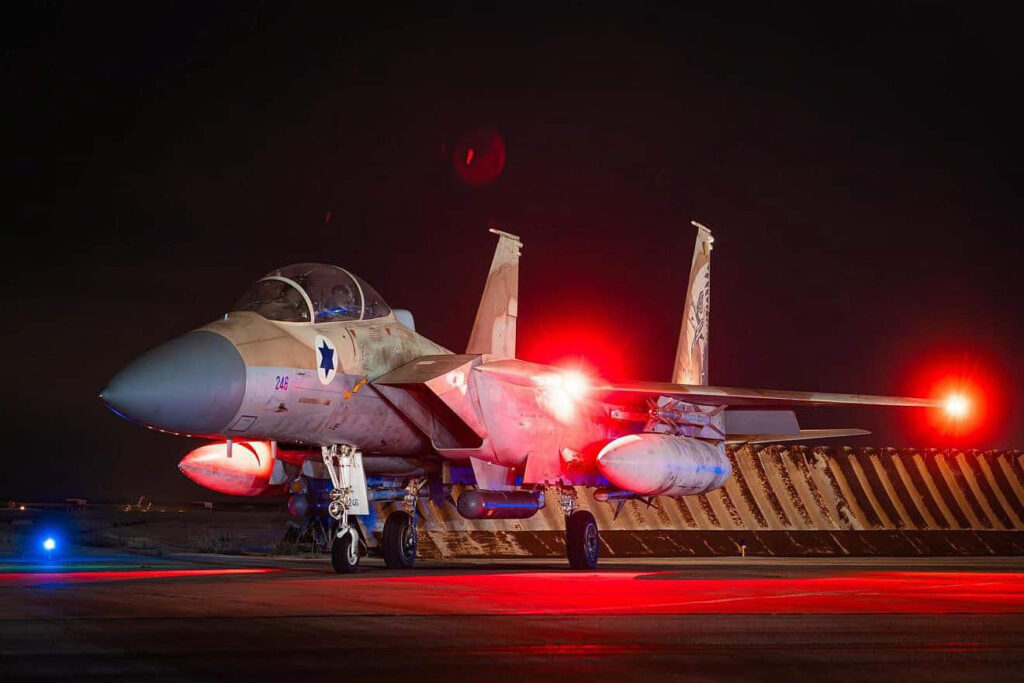
Israel launched an attack deep in Iran early Friday morning, reportedly targeting a military facility close to the city of Isfahan.

Three Iranian sources confirmed to The New York Times that an airbase in Isfahan was targeted, while anonymous Israeli and U.S. officials were cited by outlets as saying that the IDF conducted the strike.

Iranian media denied any Israeli missile attack, claiming that the Islamic Republic had shot down drones in its airspace. Iran’s nuclear facilities were not hit, according to the U.N.’s atomic watchdog.

An Israeli official told the Washington Post that the assault “was intended to signal to Iran that Israel had the ability to strike inside the country.”

Jerusalem reportedly told the United States on Thursday that it planned to retaliate to Tehran’s massive drone and missile assault over the weekend within a 24- to 48-hour window.

There was no immediate comment from the Israel Defense Forces or the Prime Minister’s Office.

The U.S. Embassy in Jerusalem issued an alert to government employees and their families restricting travel to the Tel Aviv, Jerusalem and Beersheva regions out of “an abundance of caution following reports that Israel conducted a retaliatory strike inside Iran.”

Early on Friday, the IDF also struck air defense systems in southern Syria, according to the SANA state-run news agency.

The Israeli military has attacked more than 50 targets belonging to Hezbollah and other Iran-backed terrorist groups in Syria since Oct. 7, in an ongoing effort to prevent further Iranian military entrenchment in the country.

Overnight on Saturday, Iran launched more than 300 missiles, including ballistic missiles, and drones at the Jewish state. The IDF said it and its military allies intercepted some 99% of the projectiles.

Israeli Prime Minister Benjamin Netanyahu said on Wednesday that Israel would make its own decision on how to respond to Tehran’s unprecedented attack.

“I thank our friends for supporting Israel’s defense—support both in words and in deeds,” Netanyahu said ahead of a Cabinet meeting in Jerusalem.

“They also have all kinds of suggestions and advice. I appreciate those, but I want to make it clear: We will make our own decisions, and the State of Israel will do everything necessary to defend itself,” he added.

Western governments have called on Israel to refrain from retaliating against Tehran, fearing the expansion of regional war.

U.S. President Joe Biden reportedly told Netanyahu during a phone call on Saturday that Washington would not participate in or support an Israeli retaliatory attack.

Israel’s Kan News public broadcaster reported this week that Netanyahu had backtracked on a pre-approved military response against Iran due to pressure from Biden.

Unnamed Egyptian officials told the Qatari Al-Araby Al-Jadeed news outlet on Wednesday that Washington had agreed to back an Israeli operation in Gaza’s southernmost city of Rafah in exchange for Jerusalem forgoing a major strike on the Islamic Republic.

In January 2023, Israel reportedly conducted a drone attack on a production facility for Shahed-136 kamikaze UAVs near Isfahan.

Iranian Supreme Leader Ali Khamenei turned 85 on April 19.

Israel Strikes Deep Inside Iran Read More »