fbpx

March 20, 2024

From Nomadic Adventures to Jewish Artistry: The Eclectic Journey of Sarah Izard-Podolski

There is simply no other way to describe Sarah Izard-Podolski’s life and art other than eclectic. Her portfolio includes murals at Jewish day schools and synagogues, recreating biblical scenes, Jewish symbols, or Hebrew writings. She also made a name for herself as a restoration artist who worked on the iconic art of Millard Sheets at the Home Savings and Loans building on Wilshire Boulevard and artist David Hockney’s mural in the swimming pool at the Roosevelt Hotel.

Most recently, she worked on a mosaic wall in a Pico-Robertson mikvah. It was initially designed with computer assistance, but she faced a series of challenges during its execution. Despite meticulous planning, the installation faltered, resulting in sagging and loose stones. 

Izard-Podolski drew upon her expertise gained from restoring mosaic murals and the result is a design of flowers and hummingbirds cascading down the wall. Employing a technique learned through her previous experiences, she stained the grout to match the stones, enhancing the overall imagery and colors.


Sarah Izard-Podolski’s restoration work at a local Mikveh

The artist describes herself as Orthodox, but she wasn’t always observant. In fact, she wasn’t even raised Jewish. The decision to convert to Judaism came after she had divorced her second husband, the father of her youngest daughter. 

“I had a studio in Venice, right next to the Bay Cities Synagogue, which later became the Pacific Jewish Center,” she said. “From my studio, I could observe the Jewish community. I watched Simchat Torah celebrations, the bride and groom on their way to the chuppah. Every Shabbat, men, women and children were walking down the boardwalk dressed nicely, waiting for the sunset to welcome the Shabbat and I was very impressed by that. I remember watching Michael Medved and Rabbi Daniel Lapin walking down the boardwalk and into the shore. They had their Torah dancing for some weddings, and it was so beautiful.”
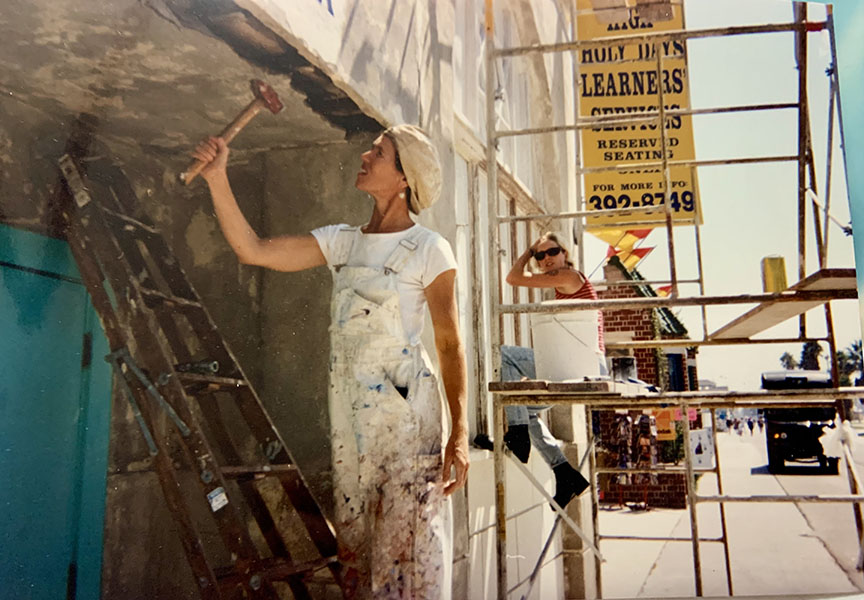
Sarah Izard-Podolski working on the facade of Shul on the Beach in Malibu in the 80s.

These scenes across the street sparked something inside her. Perhaps it was her longing to belong, to feel a part of a community and break the loneliness of living far away from her family back in England. She also wanted to raise her daughter, Miriam, Jewish. 

“I wanted her to have a Jewish upbringing and Jewish education,” she said. “I began to go to their services and eventually became part of the synagogue.” 

Soon after, she started learning Torah and Hebrew, sent her daughter to Gan Israel and began keeping kosher and Shabbat in the late ‘80s.

We took three donkeys and traveled 300 miles, meeting tribes along the way.” Izard-Podolski, who was nine years old at the time, remembers the trip well. “This was the first time I saw Israel from afar.” 

Her decision to convert didn’t sit well with her British parents, who struggled to comprehend her unconventional life choices. Her father, Ralph Izzard, was an established journalist for the British Daily Mail and spent most of his career in the Middle East, where Izard-Podolski also grew up along with her three siblings. Her mother, Molly Izzard, was a writer who published five books, among them “Smelling the Breezes,” which was published in the United States under the title “A Walk in the Mountains.” The book, which she co-wrote with her husband, chronicles the family camping trek in the High Lebanon mountains in 1957. “We were about to move back to England and my parents decided to travel before we leave,” Izard-Podolski said. “We took three donkeys and traveled 300 miles, meeting tribes along the way.” Izard-Podolski, who was nine years old at the time, remembers the trip well. “This was the first time I saw Israel from afar,” she said. “I remember my father pointing at the Hermon mountains, telling me: ‘You see, over there is Israel.’”

Her father was known as an adventurer. During World War II he served as a Naval Intelligence Officer for the British Royal Navy and was part of the 30 Assault Unit under the command of Ian Fleming. He would later base some character in his James Bond books on Izzard, borrowing also from his real-life experiences. In his first novel “Casino Royale,” he described how Bond found himself playing poker against a covert Nazi intelligence agent, something that indeed happened to Izzard. Another writer, Tom Stacey, fictionalized him in the book “The Man Who Knew Everything,” which was later adapted to a feature film “Deadline” (1988) starring John Hurt.

“My father’s first post was Berlin where he was appointed as bureau chief,” said his daughter. “So, when World War II broke, he joined the Royal Navy Volunteer Reserves as a gunner and eventually became Lieutenant Commander in position with British Naval Intelligence. Like Fleming, he also attended Cambridge. This, along with the fact that he spoke German fluently, made Fleming decide to recruit him to his unit.”

By the time she turned nine, Izard-Podolski had lived in Egypt, Cyprus and Lebanon, wherever her father was stationed. The children were used to the nomadic family life. After they returned to England, her father moved by himself to Bahrain and saw his family during summers. His wife used to travel to Bahrain in the cold British winters. He stayed there for 17 years becoming the first journalist to cover the Arabian Gulf.

One would think that these two adventurous parents would understand their daughter’s decision to choose a life less ordinary, but they didn’t. “They disapproved of my decisions from the start,” Izard-Podolski said, “from my decision not to attend a prestigious acting school I was accepted to, to my decision to take my baby daughter and travel to India when I was 21. I traveled from ashram to ashram and learned the four keys meditation.”

After close to a year of traveling, she returned to England and reunited with her husband, Peter. The couple then decided to move to the U.S. “This was another blow because my mom felt that I’m getting away from them and she won’t be able to enjoy her granddaughters,” she said. 

The young family settled in Los Angeles in 1973 and Izard-Podolski soon found work as Tony Bennett’s au pair to his daughter Antonia. “They wanted a British nanny and I’m also a macrobiotic cook, something I learned in India, which they liked,” she said. 

Her stint as a nanny/cook didn’t last long, nor did her marriage. Peter moved back to England and she met Richard Levy, who soon became her second husband and the father of her daughter, Miriam. He taught her the hard-edge acrylic line technique which is used also by Israeli artist Yaacov Agam, but this marriage didn’t last either, and she became a single mother of two.

The life of a struggling artist was anything but romantic. She resisted her parents’ pleas for her to return to England. With a little financial help from them and selling her art, she managed to make ends meet. After her conversion to Judaism and adopting a religious lifestyle, she sent her daughter to Camp Gan Israel in Santa Monica and then to Yavneh. When her daughter turned 13, she sent her to Israel to learn Hebrew. 

“Richard’s mother was thrilled,” she said. “Most of their family had assimilated and it was important for her that her granddaughter would be raised Jewish. Miriam was supposed to stay In Israel for a short time, but her ‘adoptive’ Israeli family there persuaded me to let her stay. They have five daughters, and she became the sixth. They were very careful to include me in everything. They sent me Rosh Hashanah cards each year and I would come and visit her.” She is now married, living in Yeruham, in the south of Israel, and has five children.

Izard-Podolski, who is married for the third time, said she isn’t doing art to become wealthy but to enrich her soul and to have people inspired by it. “I don’t ask for exuberant prices,” she said. “I feel it’s a mitzvah to do what I’m doing and it’s a privilege. I do art to help remind people who they are as Jews, from painting Simchat Beit Hashoava and Beit Hamikdash (Holy Temple) at Or Ha’emet synagogue to painting Hebrew lettering and calligraphy on the Aron Hakodesh (Holy Ark) at Torat Hayim synagogue. People tell me it touches their hearts when they look at my art and it helps me redeem my life.”

Sarah Izard Podolski instagram:  Artzyisrael

From Nomadic Adventures to Jewish Artistry: The Eclectic Journey of Sarah Izard-Podolski Read More »


Beverly Hills Art Studio Says Employee Who Targeted Jewish Woman Is No Longer With the Company

A painting studio in Beverly Hills announced on Friday that an employee who targeted a Jewish woman earlier in the day is no longer with the company.

Leah Yebri, the wife of attorney and former Los Angeles City Council candidate Sam Yebri, posted on Instagram earlier in the day that she wore her “Jewish star necklace” when she walked into Color Me Mine Beverly Hills, a franchise in the paint-your-own ceramics chain; she claimed that one of the employees at the studio “stared at my Jewish star, and immediately went to the back and wrote ‘Viva Palestine’ on a shipping label and placed it on her apron.” Yebri alleged the employee subsequently placed another sticker on her apron with the scrawled message “Stop the Genocide” . “She stared angrily at me to a point where I couldn’t even finish what I was working on,” continued Yebri. “I just picked up and I left.”

The post concluded by calling out Color Me Mine “for tolerating antisemitism and bigotry in their business. We are veering towards Nazi Germany.”


View this post on Instagram


A post shared by Leah Ye (@leahye48)

Fred Anderson, who owns the Color Me Mine Beverly Hills studio, said in a statement posted to the studio’s social media that Friday was the individual’s “last shift” with the company and that the then-employee was “acting retaliatory towards Color Me Mine, me, their co-workers, and the community … We in no way share their beliefs and are so sorry to those that this hurt,” Anderson said. “I spoke with the person that was targeted today and have expressed my deeply apologies. I expressed as clearly as I can that those views were not the views of me, my family, my staff or my business.” Yebri confirmed in her Instagram post that Anderson had apologized to her personally.

Anderson told the Journal in a phone interview that he wasn’t at the studio at the time of the incident and that the former employee “would have been fired on the spot, had it been their first day, their last, whatever, had I been in the store and seen that… I have zero tolerance for antisemitism.” Anderson further claimed that when the company vetted the person’s social media prior to employment, there was nothing to suggest that the person harbored antisemitic views, nor were there any such incidents during the individual’s employment with the company until the Friday incident occurred. The individual “was already given their final warning and advised to seek employment elsewhere” prior to their last shift on Friday, added Anderson.

Beverly Hills Mayor Lili Bosse thanked Color Me Mine Beverly Hills in an Instagram comment “for immediately addressing this.”

Beverly Hills Art Studio Says Employee Who Targeted Jewish Woman Is No Longer With the Company Read More »

“The People Had Done it to Themselves”: Sarah Bernstein’s “Study for Obedience”

In a recent talk I attended, Sarah Bernstein, one of Granta’s “Best of Young British Novelists” of 2023, said that she would prefer that readers come away from her novels with questions rather than answers.

If this was her great hope with “Study for Obedience,” she succeeded.

“Study for Obedience” is about an unnamed narrator who travels to an unnamed place and either acts upon or is acted upon by the new setting. She is there to tend to her unnamed brother, who was likely abusive and who becomes ill under her care. The story takes place in the narrator’s head; there is no dialogue. We know that the narrator is clearly Jewish—not that this word is ever used—and probably comes, like the author, from Canada. It could as easily be the United States, but we are all prone to projecting the author into a first-person narrator, and the use of the phrase “none is too many” will send a small shiver down the back of any Canadian Jew, knowing that these were the words uttered by the Canadian minister of immigration in 1939 when asked how many Jews would be allowed into Canada after the war. The nameless country to which the narrator relocates is where her ancestors were from, where they were reviled and eventually “put into pits.” One imagines Babi Yar, but there were many Babi Yars; my own ancestors were thrown into pits in Górka Połonka.

This narrator is self-effacing, almost literally so. Airport sensors don’t register her presence. It is as though she is a ghost. And like a ghost, she haunts the town, cycling and walking through the lands by night, leaving strange woven dolls at the homes of locals. Bad things start to occur. The return of the repressed—a modern-day, ghostly Jew—sends the townspeople into a state of fear.

“Study for Obedience” is a short book—barely two hundred pages, with much white space on each page—and my own copy arrived misbound. I didn’t realize this fact at first, but as I read a sentence that began on one page and continued onto the next, I found myself lost, and I had to start over. Initially, I attributed the strange syntax to the warped mind of the narrator, and I moved along. Soon after, it occurred to me that the narrator was repeating herself, though this point, too, didn’t seem entirely out of keeping with the novel’s logic. Finally, I noticed that my edition went from page 103 to 39. Aha!

I ordered a new copy.

It, too, was misbound.

I mention this aberration only because I almost wonder if it was an aberration at all, or rather if there was something deliberate in the shuffle of pages—if the author or publisher wanted to make a statement about time, past and present, never staying in order. Because that is certainly a message (or question) of the novel.

But there is also something else at play in “Study for Obedience.” The opening lines feel tauntingly like “A Fable for Tomorrow,” the opening passage of Rachel Carson’s “Silent Spring,” the 1962 landmark book that launched the environmental movement. Imagining at first an idyllic land, Carson writes: “A strange blight crept over the area and everything began to change … mysterious maladies swept the flocks of chickens; the cattle and sheep sickened and died.” Similarly, Bernstein begins “A Study for Obedience” by telling us that “the sow eradicated her piglets,” crushing them to death. A local dog had a phantom pregnancy. Cows went mad (and are shot and put into mass graves). A lamb became stuck mid-birth by a trapped ewe and remained half-emerged from the ewe’s body, its eyes pecked out.

Carson’s fable closes with an indictment: “No witchcraft, no enemy action had silenced the rebirth of new life in this stricken world. The people had done it to themselves.”

So, too, we might think, did the people in this unnamed land create their own blight. For although they had “lived through a blessed and prosperous fifty years,” allowed to be connected to the place since time immemorial, conveniently removing from memory or history the roles their people played in the lives of the narrator’s people, we might say that when the land and animals turn on them, “the people had done it to themselves.”

This dark, absurdist, often confusing novel is not for everyone.

This dark, absurdist, often confusing novel is not for everyone. It is wretched to be trapped in the head of a narrator who is relentlessly unreliable and very unlikeable, who embodies, following the artist Paula Rego’s “Obedience and Defiance” exhibition, two extremes. The narrator takes empathy to its (il)logical end, seeing the self (a painfully abject figure) and her victimized people in the eyes of perpetrators, deserving blame, deserving death. And at the time, we suspect that she herself is a kind of perpetrator, terrorizing not only the townspeople but also her ill, immobilized brother-patient (think Kathy Bates in “Misery”).

But for all that, “Study for Obedience,” which was shortlisted for the Booker Prize, is not a novel soon forgotten. It takes a very talented writer to take hold of a reader who (along with townspeople and brother) finds herself wishing desperately to escape the narrator’s clutches.


Karen Skinazi, Ph.D is Associate Professor of Literature and Culture and the director of Liberal Arts at the University of Bristol (UK) and the author of “Women of Valor: Orthodox Jewish Troll Fighters, Crime Writers, and Rock Stars in Contemporary Literature and Culture.”

“The People Had Done it to Themselves”: Sarah Bernstein’s “Study for Obedience” Read More »

Gaza Could Have Been Another Singapore

In a recent letter to the editor of the Bulletin of the Canadian Association of University Teachers, Israel was accused of deliberately bombing and destroying Palestinian universities in Gaza, as well as killing faculty, students and administrator. The letter makes no mention of the killing, raping and kidnapping of Israeli men, women and children on October 7. It does not mention the thousands of rockets fired indiscriminately toward Israeli civilian centers by Hamas. Nor does it mention that Hamas weaponized hospitals, schools and civilian residences throughout Gaza, or that hundreds of Israeli soldiers have been killed and thousands injured in a war that includes lethal ambushes and booby-traps set by an enemy that intentionally embeds itself in a civilian population.

The writer, a professor at a Canadian university, asks Canadian institutions of higher learning to cut ties with Israeli institutions. He also mentions a call by 15 Palestinian universities for the international community to boycott Israeli academic institutions.

How many Palestinian universities are there in Gaza? According to Le Monde, there are 12 universities in Gaza. The Islamic University of Gaza, for example, has 15,000 to 20,000 students and the pictures on the internet portray a handsome cluster of buildings that would be a source of pride to the residents of any country in the world. (I do not know what it looks today after five months of war.) A pharmacy student at the University of Palestine in Gaza (20,000 students) is quoted as saying “Before October 7, Gaza was a pretty pleasant place,” and “My university, not far from the sea, was very nice.”

An Israeli journalist, Roi Yanovsky, who spent three months fighting in Gaza, reported that living conditions in Gaza City are far more luxurious than he was led to believe from reading and hearing years of press reports describing crowded and backward conditions—all blamed on the siege conditions imposed by Israel. He notes, “Gaza is a modern, beautiful and developed city—with large and well-equipped houses, wide boulevards, public spaces, a promenade by the sea, and parks. It looks much better than any Arab city from the Jordan River to the sea; it resembles Tel Aviv far more than Kafr Qassem or Umm Al Fahm.” Hardly “an open air prison.”

Gaza also has 36 hospitals, yes 36, for a population of a little over two million. Al Shifta, the largest and the focus of accusations that Hamas used hospitals for military purposes, can accommodate 800 beds.

Judging from some of the hospital names, for example, the Indonesian Hospital, some were built with the help of generous donations from various parts of the world. In fact, financial support for Gaza, including significant funding from the EU, the United States and other western countries to support UNWRA, as well as generous donations from Arab states, particularly Gulf States such as Qatar, has amounted to billions of dollars over the years. While the residents of Gaza must fend for themselves during the war, the leaders of Hamas are riding it out in the lap of luxury in Qatar.

However, the most impressive example of innovation, engineering prowess and technological ability in Gaza must surely be in the construction of an extensive and sophisticated system of tunnels. This interconnected system, hundreds of kilometers long, designed to protect Hamas militants from Israeli attack, also provided a safe environment for the production of an array of weapons, particularly rockets. (Of course, since October 7 the tunnels have been used to hide Israeli hostages.)

The best description of the tunnels that I found is a detailed Reuters article from December 31, 2023 that includes pictures, maps and drawings showing how the entrances were hidden in the high rise buildings of Gaza, as well as in the sand dunes outside the urban centers. Many of the concealed entrances are in private homes, also under hospitals such as Al Shifta.

Bassem Eid is a Palestinian human rights activist who has written extensively about human rights abuses, including torture, by both the Palestinian Authority and Hamas. On October 9, 2023, two days after the Hamas attack, Newsweekpublished an opinion piece by Eid, titled “Gaza Could have Been Singapore. Hamas turned it into ISIS.” How right he was.

Israel is conducting a war against Hamas, a war initiated by Hamas, a war in which Hamas is intentionally hiding among civilians. Hamas, not Israel, is responsible for the tragedy that has unfolded in Gaza.


Jacob Sivak, a Fellow of the Royal Society of Canada, is a retired professor, who taught at the University of Waterloo.

Gaza Could Have Been Another Singapore Read More »

UC Berkeley Professor Holds a Sit-In Protest Against Antisemitism

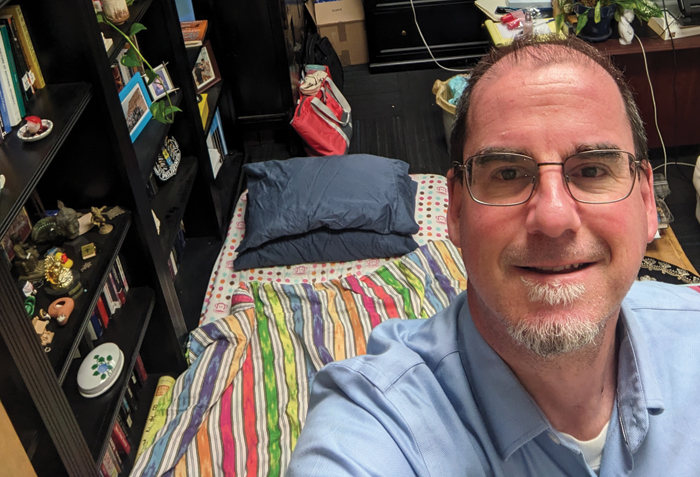
On March 7, Professor Ron Hassner, the chair of Israel studies at the University of Berkeley California, decided to stage a sit-in at his office. He brought in a mattress and has been sleeping on the floor ever since. He not only sleeps in the room, he also eats and teaches from it and doesn’t go back home to shower – or go anywhere else for that matter. 

He announced his protest after Jewish students were attacked by 200 anti-Israel protestors at Zellerbach Playhouse last month. “Dear students, I have hatched a strange plan,” Hassner wrote. “I am launching a sit-in protest against antisemitism for student safety in my office, starting today, March 7 at 6pm. If my students feel that they cannot walk safely across campus without being bullied, then I will not cross campus either.”

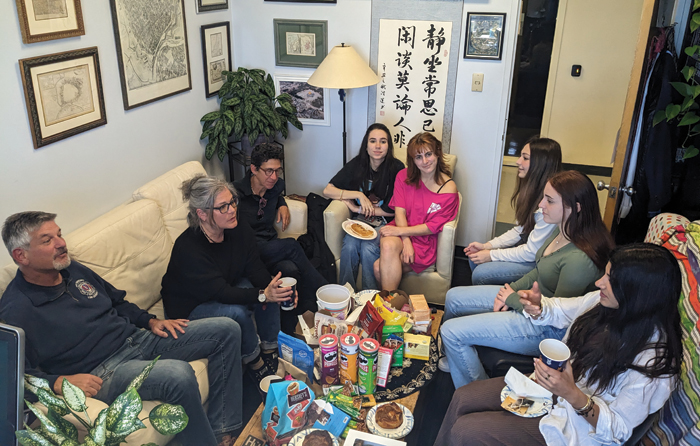
Since then, students, parents, alumni and community leaders from around the Bay Area have flocked to his office, carrying trays of food. There are boxes of pizza, salad, cookies, brownies, challah, coffee and tea. Some people sent him food from the east coast. Once, he opened his office door to find a box filled with two dozen bagels and cream cheese, sender unknown.

It almost feels like a shivah — Hassner’s face is unshaven, he sits on the floor and people keep coming in to show support — only no one is crying, and guests seem rather cheerful. His office has become the students’ favorite hang-out place, a safe haven from antisemitism on campus. They have been craving it.

“People are here to cheer me up, to cheer one another up, and find comfort in one another’s company,” he told the Journal in a phone interview. “When I first started this, I put a little light in my window so that people across campus can see that I’m in my office at night, and know the door is always open and they can just come in.”

“I want students to be strong and resilient and proud, and I’m trying to set a good example.”
– Ron Hassner

Many of the students expressed their frustration about what’s been happening on campus since Oct. 7, especially the rise in antisemitism. “Many of them talk about not feeling safe, and I’m a little ambivalent about that,” Hassner said. “Violence has happened on this campus in the last few weeks and it’s terrible and it’s criminal and it will be prosecuted, but violence is very, very rare. There’s no real reason to feel unsafe. In fact, in part it’s important that students develop tools to confront antisemitism while they’re on campus, because the antisemitism that they will experience outside campus will be much worse. There will be no professors and no campus leadership to protect them. I want students to be strong and resilient and proud, and I’m trying to set a good example.”

Many Jewish students are disappointed by the administration’s lack of action against anti-Israel demonstrators who have bullied them since Oct. 7. No arrests were made when a mob of anti-Israel students broke windows, injured one student’s hand, strangled another and prevented a lecture by Israeli author and lawyer Ran Bar-Yoshafat. The reason given by the university spokesperson for the lack of action? There were too many demonstrators and not enough police officers.

Ron Hassner

One of Hassner’s requests for the school, before he’ll move his mattress back home, was to issue a letter of apology to Bar-Yoshafat and invite him back to Berkeley. That request was actually fulfilled, but not all of his requests, Hassner said, are as easy to implement because the university is constrained by law and by resources.

For a month now, Sather Gate has been blocked by Justice for Palestine supporters who have taken up space in the gate’s main entrance. The university recently took their caution tape down, but then a massive banner went up, and they put tables and speakers blocking the entrance and forced students to use side gates. Hassner wants the gate clear of protesters, which will require police officers to ensure they are not going to block it again. 

The professor has also requested that campus leadership ensure the safety of Jewish students on campus, and mandate Islamophobia and antisemitism training for resident assistants and registered student organizations.

Hassner was born in Israel and moved to United States 30 years ago. He has been a Political Science professor at UC Berkeley for 20 years, and his classes always fill up quickly. His sit-in protest received a lot of attention, not only in California, but worldwide. He has received emails of support from Australia, Europe, Brazil and Uganda.

“People are telling me that I’m this amazing role model,” said Hassner, “and I think to myself, if a nebbish professor who’s sleeping in his clothes on a mattress in his office is your role model, then Judaism really badly needs leadership. Anybody could do this. Where are the rabbis who should be going on hunger strikes? Where are the politicians who should be marching from one campus to the next protesting this? Where are the leaders of Jewish institutions who should be joining me in my office, bringing their mattresses? 

“I don’t understand it and I’m deeply baffled,” he said. “I don’t want to think that only Israelis or Zionists can do what I do. Every other Jewish person I’ve talked to so far have all the admiration in the world and all the gratitude, sincerely, but they’re not willing to take the next step. They’re willing to write, to speak, to complain, to retreat, but they’re not willing to inconvenience themselves a tiny bit and say: ‘This stops here and now. I’m going to go on a strike or I’m going to march across the city’ … something that signals that they’re willing to pay a price and put their put their money where their mouth is.”

The last thing that Hassner wants is for parents to prevent their children from attending elite universities such as Berkeley. By doing do, he said, they will do exactly what anti-Israel activists want to accomplish: rid universities from Jewish presence. It’s important to allow Jewish students to receive a high-quality education but also, without Jewish students, what will happen to all these important institutions, such as the Israel Studies Institute, Chabad Jewish student center and the Jewish Museum? 

In a statement shared by the university spokesperson, it said: “Insofar as Prof Hassner’s protest is concerned, we wish to share that the university remains committed to fostering an environment conducive to robust free speech and in which all members of its community feel that they may engage in campus life without fear of harassment. The administration is committed to confronting antisemitism and holds Professor Hassner in great esteem and it is in conversation with him about his concerns.”

UC Berkeley Professor Holds a Sit-In Protest Against Antisemitism Read More »

Rosner’s Domain | Does the Army Unify?

I have no way of answering the following two questions:

Are Israeli reservists naive or smart?

Are Israeli reservists made of special cloth?

These are two intriguing questions, given the findings of a survey that examined the views of those who have a connection to the reserves — we’ll call them “the reservist community” — versus those who have no connection to the reserves.

Reserve duty is something many Israelis are familiar with, and most Americans can’t fathom. A lawyer, a car mechanic, a farmer, a student, a teacher, a tech executive —  all civilians — leave home, put on a uniform, and go back to being soldiers. In the war that Israel is now fighting, about half a million Israelis served as reservists. Many of them left their families behind – wives, children, a job, a daily routine. They are a unique bunch, especially those who serve in combat units on the frontlines. 

Uri Keidar from the organization Israel Hofsheet came up with the idea to identify these people in a survey. So we asked: Have you or a close family member (nuclear family) served in the reserves in the last few months? It was possible to answer: “Yes, me,” or “Yes, a family member” or “Yes, both,” or “No.” Those who marked one of the first three categories are the “reserve community.” And when we examined their attitudes separately from the views of those who have no such connection to reserve duty, we found something interesting: there is, indeed, a clear difference. Reserve duty makes a difference. Meaning: Either those who serve, from all sectors, are a special breed to begin with. Or it’s the act of going to serve that changes people.

“The result was inspiring: in the reserve companies, hatred was erased and replaced by brotherhood, heroism and solidarity. The melting pot of the new Israeliness was created in the reserve brigades.” – Micah Goodman

Israeli philosopher Micah Goodman proposed such a possibility in an article he published about a month ago, and it is echoed in his forthcoming book. Goodman wrote: “After nine months of national strife, war broke out. Over 300,000 Israelis enlisted in the reserves. They gathered into units and brigades where Israelis with different opinions and different identities rubbed against each other in the most intense way imaginable, and all this face to face, without digital mediation, and over a long period of time. Reluctantly, they went through a detoxification workshop. The result was inspiring: In the reserve companies, hatred was erased and replaced by brotherhood, heroism and solidarity. The melting pot of the new Israeliness was created in the reserve brigades.”

Is Goodman right? He assumes that when people put on uniform and serve with their comrades, they change. And while I can’t confirm such exact assumption, I can confirm the conclusion that the “reserve community” is indeed less polarized and more socially conciliatory. Whether that’s good or bad is a debate for another day (some people might want Israelis to keep their ideological zeal), but for those wanting conciliation, the reserve community portends hope. It is a community of Israelis who are less willing to quarrel over all kinds of social issues. For example: The percentage of Israelis who prefer not to address the controversial issue of “civil marriage” in Israel anytime soon, because it is a divisive issue, or because “there are more important things,” is higher among members of the reserve community. In other words, these Israelis prefer to postpone what could become another reason for social quarrel. Thirty-one percent of the seculars who wore a uniform in the last couple of months said no to having this debate about civil marriage now, compared to just 20% of the seculars who did not wear a uniform (or have a family member who did). 

And they — members of the reserve community — are also more optimistic. Which brings us back to the first question we don’t have an answer to: Is it because they are more naive or because they are smarter? We don’t know. It’s too early to tell. But when we ask Israelis “about the relations between religious and seculars,” and whether these relations will “improve after the war” or “will not improve after the war,” we see again the clear differences between the reservists and the non-reserves. 

Forty-seven percent of the religious reservists (and their family members) think that the relations will improve, compared to 41% of those who are not part of the reservist community. Among seculars, the difference is even greater: 39% think that the relations will improve, compared to 15% of those who did not serve. Are they naive or wise? Did they become more optimistic as they sat together – religious and secular reservists – in tents, bunkers and tanks? If that’s the case, then we might have found a solution to social polarization in Israel and elsewhere: send them all for a month or two in uniform. They will both protect us from our enemies, and along the way they also will learn to stop being enemies.

Something I wrote in Hebrew

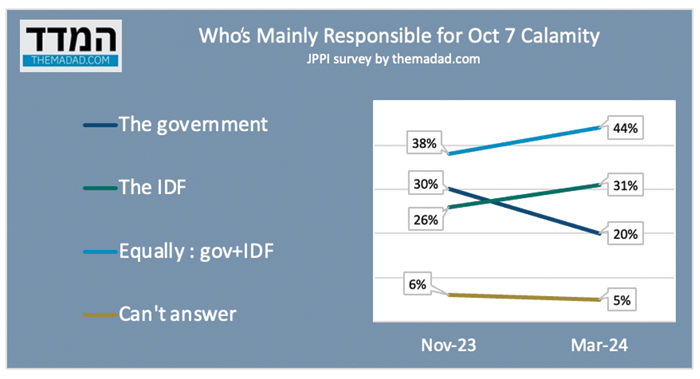
In the months since the beginning of the war, Israelis were exposed to information about the mishandling of information and lack of preparedness in the IDF prior to the Oct. 7 attack. This brought about a change in attitudes. Here’s what I wrote, followed by a graph:

The less surprising thing that happened is that even more coalition voters shifted the main responsibility for the calamity from the government to the IDF and Shin Bet … The more surprising thing — and perhaps not surprising, because in the end when reality hits you, it’s hard to ignore it — is the change in attitudes of the opposition voters. No longer believing that the government is mainly responsible for the “mechdal” (failure) a majority of them now divide the responsibility equally between the government and the security agencies. 

A week’s numbers

More opposition voters realized: It’s not just the government’s fault. 

A reader’s response:

Mia Lowenthal asks: “Shmuel, do you think Trump is going to be better for Israel?” My answer: I have no clue what policy Trump would pursue in the Middle East, and to be honest, I’m not sure that he has one. 


Shmuel Rosner is senior political editor. For more analysis of Israeli and international politics, visit Rosner’s Domain at jewishjournal.com/rosnersdomain.

Rosner’s Domain | Does the Army Unify? Read More »

Bomb Threats in the Naked City

It’s the email no parent wants to receive. “Emergency Building Evacuations,” read the subject line. “This morning, we were made aware of a threat to our school buildings.” My son texted me the missing detail: “We are in lockdown right now because there was a bomb threat.” For once, his phone served a positive purpose.

A couple of hours later, after a thorough search by the NYPD, the kids returned to their classes, though many parents had picked up their kids by then. It’s a private school; roughly half the kids are Jewish. It’s also one block south of a huge mosque. Rightfully, the parents were terrified. The school has security, but nothing like what synagogues and Jewish community centers have.

Many of us had lived through 9/11. Many of us had lived close enough to the Twin Towers that we lived with black smoke and endless helicopters for weeks. But very soon after the planes hit, the city began to unify, and most importantly, the local, state and federal governments took control of the situation: We soon felt safe.

Precisely the opposite has happened here since Oct. 7, beginning with the riot in Times Square on Oct. 8, days before Israel began to respond. 

Precisely the opposite has happened here since Oct. 7, beginning with the riot in Times Square on Oct. 8, days before Israel began to respond. Pro-Hamas riots here are daily — up at Columbia University, down at Washington Square Park, in the subways, on the bridges, in the streets.

But most egregious for most New Yorkers is what happened in December and then again last week: pro-jihad “disrupters” took over the World Trade Center, first outside the building and then in. It was both symbolic and “normalizing.” Any strong political leader would have condemned it, as well as all of the riots, with every threat available. But Mayor Eric Adams, who has repeatedly said he “stands with the Jewish people” said … nothing.

Five months after 9/11, I felt completely safe. Five months after Oct. 7 and I am trying hard not to be terrified.

Five months after 9/11, I felt completely safe. Five months after Oct. 7 and I am trying hard not to be terrified. Many of us have begun to call the city that has still not recovered from Governor Cuomo’s lockdown insanity: Jihad City.

At the same time that a bomb could have blown up my son’s school, Senator Chuck Schumer (D- N.Y.) thought it was a good idea to lambaste the Israeli government before Congress and then tweet: “NYC will receive a fresh $106M from feds to reimbursement for migrant costs.” That no doubt made every NYC parent feel so much safer. 

To say that the Democratic Party is clueless right now is an epic understatement. And it is precisely its embrace of terrorism, both here and in the Middle East, that led to a recent poll showing that Jewish New Yorkers prefer former President Donald Trump to President Joe Biden by 9%. An astonishing shift—but anyone who lives here completely understands why. 

For decades we’ve been told that the increased violence during Ramadan stemmed from hunger. It never made sense — I personally have never felt a desire to blow up a building during Yom Kippur — but this was the prevailing explanation. The Yom Kippur War of 1973, in which Egypt and Syria slaughtered 2,700 Israelis in a surprise attack, occurred during Ramadan.  

Only this year the truth is beginning to emerge. “Egyptian and Syrian soldiers were given an exemption from fasting because they were engaged in the religious duty of killing infidels,” writes David M. Weinberg in the Jerusalem Post. The connection between violence and Ramadan goes back to the beginning of Islam, when, during that month, Muhammad won brutal victories over his enemies.

Needless to say, students in NYC schools will be taught none of this.  And while there’s no question that this city handled 9/11 better than it has handled Oct 7, perhaps a grave mistake was made in not taking a deeper look into what is being taught in mosques globally.

Meanwhile, parents in NYC were just given another reason to not trust the Democratic Party, though the growing Candace Owens contingent of the right continues its bizarre embrace of jihad. 

There’s no question that Europe is doing a better job controlling their pro-Hamas mobs than we are. At what point will U.S. elected officials have a “come to sanity” moment and begin to take this growing threat to not just Jews but to Western civilization seriously? Is it really going to take a school being blown up during Ramadan? Right now, all we hear is pro-Hamas virtue-signaling — or silence.


Karen Lehrman Bloch is editor in chief of White Rose Magazine.

Bomb Threats in the Naked City Read More »

Let’s Be Joyful

I don’t know about you, but I’ve spent the last few weeks in a fog, feeling hopeless about the situation in Israel, about the antisemitism at home and abroad, and wondering when this will end. 

Checking the headlines and social media every day, it just seems more and more depressing. From finding out that hostages were killed to seeing Jews turn their backs on the community and witnessing Jewish students being assaulted on campus, it seems like we’re in a perpetual loop of bad news.

With Purim just days away, we are commanded to be joyful. How can we be b’simcha at a time when it seems like there isn’t much to be happy about?

I recently spoke to a Jewish person who told me that she wasn’t a believer before Oct. 7, and that day cemented her feeling that there is no God, because if there was, He wouldn’t have let Oct. 7 happen.

I completely disagree with that sentiment. While I understand how difficult it was to witness that horrible day, and how you could come to that conclusion, I believe it’s wrong. What she said made me realize how I – and the entire Jewish community – can approach these dark times.

Before Oct.  7, there was the Holocaust, the pogroms, the Inquisition, the destruction of the temples and all the other terrible things that happened to Jews throughout history. I knew that antisemitism always existed; sometimes it was clear, and other times it was festering below the surface, ready to emerge at an opportune time like now.

Despite all the misfortune the Jewish people have experienced, we have survived – and thrived. How did we do it? By being hopeful and finding ways to be joyous. 

If the Jewish people had decided to focus solely on their pain and all the bad things that happened to them, we wouldn’t exist today. Studying the history of our people gives me so much hope.

Take Purim, a time when it looked like Haman’s evil plan was going to come to fruition. Esther and Mordecai didn’t give up, even though Esther certainly felt like it at first. 

Take Purim, a time when it looked like Haman’s evil plan was going to come to fruition and we were going to be annihilated. Esther and Mordecai didn’t give up, even though Esther certainly felt like it at first. With Mordecai’s encouragement, she garnered the strength to step up and save her people. 

Oftentimes, as we see, it’s darkest before the dawn, and it’s not easy to stay hopeful in these moments. But this is when it matters the most. This is when we can strengthen our own connection to Hashem, building upon our emunah (faith) and bitachon (trust).

But how? 

First, do what I do when I’m feeling down, and make a list of everything you’re grateful for in your life. Your health, the roof over your head, the clothes in your closet and the food in your fridge cannot be taken for granted.

Instead of reading the same sad headlines every day, look for stories that fill you with hope. There are countless volunteers going to Israel to help the country recover. Jews from all walks of life are united now more than ever. We have been able to fight back and win, like on college campuses, where we are holding universities accountable for their actions and demanding they protect Jewish students. The polls say that most people are on our side. We are defeating Hamas. 

There is so much more love in the world than hate. Most people are good; the small minority of haters may be the loudest, but they hold fringe views that most people don’t support. So many people have stood up and showed their love for us, even though they aren’t Jewish. They can see the truth.

It may seem strange for me to urge you to be joyful now, but it’s necessary. It’s what is going to get us through this dark period. It’s going to ensure that just like always, we will come out victorious and stronger than ever before. 

Have you been able to find joy lately? Email me: Kylieol@JewishJournal.com.


Kylie Ora Lobell is the Community Editor of the Jewish Journal.

Let’s Be Joyful Read More »

Over 450 Entertainment Names Sign Letter Condemning Jonathan Glazer for His Oscars Speech

More than 450 Jewish figures in the entertainment industry condemned director Jonathan Glazer for his speech at the Oscars last week. In an open letter published by Variety “Jewish creatives, executives and Hollywood professionals” signed the open condemnation of Glazers words saying, “We refute our Jewishness being hijacked for the purpose of drawing a moral equivalence between a Nazi regime that sought to exterminate a race of people, and an Israeli nation that seeks to avert its own extermination.”

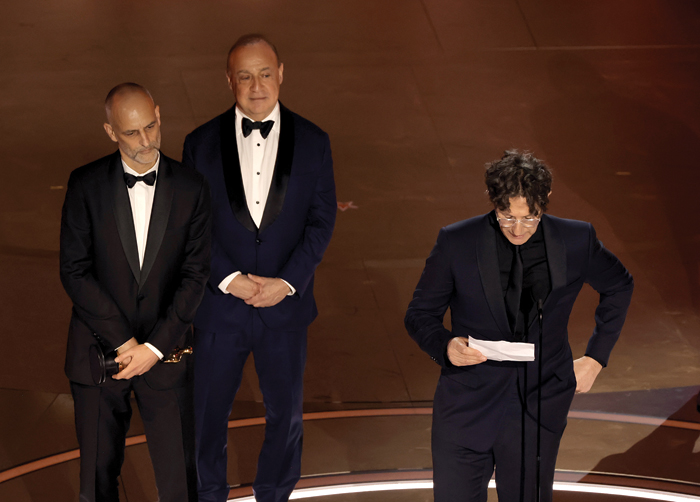
The letter comes in response to the acceptance speech by Glazer, whose film “The Zone of Interest” had just won an Oscar for Best International Feature. Below is the full text of Glazer’s speech:

“Thank you to the Academy for this honor and to our partners, A24, Film4, Access, and the Polish Film Institute to the Auschwitz Birkenau state museum for their trust and guidance. To my producers, actors, and collaborators. All our choices were made to reflect and confront us in the present. Not to say look what they did then rather look at what we do now. Our film shows where dehumanization leads at its worst. It shaped all of our past and present. Right now, we stand here as men who refute their Jewishness and the Holocaust being hijacked by an occupation which has led to conflict for so many innocent people. Whether the victims of October the— [Applause]. Whether the victims of October the 7th in Israel or the ongoing attack on Gaza, all the victims of this dehumanization — how do we resist? Aleksandra Bystroń- Kołodziejczyk, the girl who glows in the film as she did in life, chose to. I dedicate this to her memory and her resistance. Thank you.”

“The Zone of Interest” tells the story of Rudolf Höss, commandant of Auschwitz, and his family living in the shadow of the death camp.

The list of signatories includes past Oscar nominees and even a past President of the Academy of Motion Picture Arts and Sciences, Howard “Hawk” Koch Jr., who served as President of the Academy from 2012-2013. Past Academy Award nominees who signed include Amy Pascal (producer, “The Post” and “Spider-Man: Across the Spider-Verse”) and Jennifer Jason Leigh (Best Supporting Actress nominee, “The Hateful Eight”). A few Emmy winners signed the letter, including Amy Sherman-Palladino (creator, “The Marvelous Mrs. Maisel”), David Shore (showrunner, “House”) and Debra Messing (actress, “Will & Grace”). Grammy-winning musician Joanie Leeds also signed the letter.

Some of the signers with major social media following include dancer/Israel activist Montana Tucker (3 million Instagram followers), comedian Michael Rapaport (2 million), author and Israel activist Noa Tishby (741,000) actor Brett Gelman (889,000), and actress Emmanuelle Chriqui (700,000).

Some of the signers with major social media following include dancer/Israel activist Montana Tucker (3 million Instagram followers), comedian Michael Rapaport (2 million), author and Israel activist Noa Tishby (741,000) actor Brett Gelman (889,000), actress Emmanuelle Chriqui (700,000), actress Odeya Rush ( 557,000), voiceover actress Tara Strong (453,000), director Eli Roth (334,000), actor Yuval David (140,000), and actor Jonah Platt (127,000).

The letter goes on to say that “every civilian death in Gaza is tragic” and that “Israel is not targeting civilians. It is targeting Hamas.” It also objects to Glazer’s use of the word “occupation” to describe the Jewish people defending their homeland of Israel. Though many of the signers are writers and Screen Actors Guild members, independent photographers, agents and clergy also signed. The Journal was told under the condition of anonymity that it was organized by the Jewish Writers Committee, a subgroup of the Writers Guild of America West. It is one of WGA’s 13 Committee Advisory Panel (CAP) Committees.

One of the executive producers of “The Zone of Interest,” Danny Cohen spoke out against Glazer’s comments on a podcast last week.

“I just fundamentally disagree with Jonathan on this,” Cohen said on the podcast “Unholy: Two Jews on the News.” The conversation with Cohen begins at the 29:22 mark. “My support for Israel is unwavering. I believe very strongly that the war and the continuation of the war is the responsibility of Hamas, a genocidal terrorist organization which continues to hold and abuse the hostages. And which doesn’t use its tunnels to protect the innocent civilians of Gaza, but use it to hide themselves and allow Palestinians to die.”

He continued, “John has the right to say what he wants to say, but I don’t agree with what he said.” Still, Cohen did not sign onto the letter condemning the speech. It has not been confirmed whether Cohen was approached to sign.

The official X account of the Auschwitz Memorial in Poland weighed in four days after Glazer’s speech. “In his Oscar acceptance speech, Jonathan Glazer issued a universal moral warning against dehumanization,” Auschwitz Memorial Director Dr. Piotr M. A. Cywiński wrote. “His aim was not to descend to the level of political discourse. Critics who expected a clear political stance or a film solely about genocide did not grasp the depth of his message. ‘The Zone of Interest’ is not a film about the Shoah. It is primarily a profound warning about humanity and its nature.”

As of this writing, Glazer himself hasn’t spoken publicly since the Oscars.

The full text of the letter is below:

“We are Jewish creatives, executives and Hollywood professionals.

“We refute our Jewishness being hijacked for the purpose of drawing a moral equivalence between a Nazi regime that sought to exterminate a race of people, and an Israeli nation that seeks to avert its own extermination.

“Every civilian death in Gaza is tragic. But Israel is not targeting civilians. It is targeting Hamas. The moment Hamas releases the hostages and surrenders is the moment this heartbreaking war ends. This has been true since the Hamas attacks of October 7th.

“The use of words like ‘occupation’ to describe an indigenous Jewish people defending a homeland that dates back thousands of years, and has been recognized as a state by the United Nations, distorts history.

“It gives credence to the modern blood libel that fuels a growing anti-Jewish hatred around the world, in the United States, and in Hollywood. The current climate of growing antisemitism only underscores the need for the Jewish State of Israel, a place which will always take us in, as no state did during the Holocaust depicted in Mr. Glazer’s film.”

A.M. Driver – SAG
Aaron Erol Ozlevi – Director
Aaron Fishman – DGA Producer / Director
Adam Berkowitz – Manager/Producer/Strategic Advisor
Adam Friedman – Creative Artists Agency
Adam               Goldworm – Manager/Producer
Adam Kulbersh
Adam Newman
Adam Rosenberg
Adam Waltuch – TelevisaUnivision
Alan R. Cohen – WGA
Alex Anhalt – Sugar23
Alex Foster
Alex Horn – Author and Editor
Alex Lebovici – Producer
Alex Litvak – WGA Writer
Alex Meitner
Alida Michql – AEA
Alissa Vradenburg
Aliza J. Sokolow
Allan Spielman – RETRO69, WOODTSOCK TRIBUTE MUSICIAN AND COMPOSER DEVELOPER
Allison Lahav
Ally Shuster Agent
Alon Aranya
Alyssa Hill – WGA Screenwriter
Amanda Markowitz – SAG/AFTRA, PGA
Amy Engelberg – WGA
Amy Pascal – Producer
Amy Sherman-Palladino – WGA / DGA Writer/director/producer
Amy Straus – WGA Writer
Andrea Barros
Andrea Cayton
Andrew Avner
Andrew Stearn – PGA Producer
Anna April-Ross
Annie Wood – WGA/SAG/AFTRA Actor/Writer/Artist
Ari Ackerman
Ari Arad
Ari Frenkel – SAG Actor / Filmmaker
Ariel Nishli
Ariel Vromen – DGA Filmmaker
Ariella Blejer – WGA
Ariella Noveck
Ariyela Wald-Cohain – CDG 892 COSTUME DESIGNER
Art Levitt
Asher Weinberger
Avi Liberman – SAG/Aftra
Avital Levy
Avital Onn – Shachar Business Affairs
Aviva Pressman – AEA, SAG
Avram Butch Kaplan – DGA Jamsea Productions, Inc
Barbara Garshman – WGAE Garshman Productions LLV
Barbara Heller – SAG Actor writer producer
Barbara Lazaroff – ASID Commercial designer, restaurateur, businesswoman
Barbie Kligman – WGA
Barry Schkolnick – WGA Writer/Producer/Creator
Bart Coleman
Batia Parnass – SAG AFTRA
Becky Tahel – PGA, SAG-E Producer, Writer, Actress
Ben Cosgrove – CEO, Leviathan Productions
Ben Levin – LINK Entertainment
Ben Mor – DGA Director
Ben Younger – WGA/DGA
Benjamin Gober
Benjamin Rapoport
Bess Kargman – DGA Director
Beth Milstein – WGAW Writer
Betsy Borns – WGAW Writer/Producer
Bill Freiberger – WGA Writer
Bob Bookman
Bob Kushell – WGA
Bonnie Greenberg – Music supervisor/producer/professor
Bradley J. Fischer- Producers Guild of America Producer
Brett Gelman – Actor and Writer
Brett Gursky – Writer / Director / Producer
Brian Frazer
Brian Liebman
Bruce Burger – Music Producer and Recording Artist, RebbeSoul
Bruce Franklin – DGA Producer
Bruce Goldstein – The Cat in Manhattan
Bruce Resnikoff
Caitlin Gold – Producer
Cameron Curtis
Carin Sage – EVP, Feature Film, Skydance Prods
Carl Schwaber – SAG-AFTRA
Carmi Zlotnik
Carolyn Newman
Caryn Osofsky – SAG SAG actress and director
Chava Floryn – Filmmaker/Actress Twin Rose Media
Chuck Slavin – SAG-AFTRA Actor
Cindy Kaplan
Claudine Jakubowicz – Film Producer
Clifford J. Green – WGAW Screenwriter
Cory Richman – Manager / Liebman Entertainment
Craig Emanuel – Entertainment Executive
Craig Singer – p.g.a. Producer
D.M. Harring – WGA
Dan Adler
Dan Birnbaum
Dan Kaufman – VFX Supervisor/VFX Producer
Dan Marshall – SAG-AFTRA
Dan Redfeld – AFM Local 47 Composer
Dan Signer – WGA
Dana Min Goodman
Dani Menkin
Daniel Alcheh – SCL
Daniel Grindlinger – WGA Writer
Daniel Kaufman – DGA Director
Daniel Lehrer – WGA Writer
Daniel Rosenberg – WGAE
Daniella Rabbani – SAG AFTRA AEA Actor
Danielle Pretsfelder Demchick – CSA Casting Director
Danna Rosenthal
Danny Manus Writer – Script Consultant
Danny Weiss – WGA
Dave Chameides – Local 600 and DGA Camera Operator
David Abrookin
David Bickel – WGA Writer/Producer
David Brandes – WGA writer
David Fury – WGA/DGA/SAG-AFTRA Round Swamp Entertainment
David Grae – WGA
David Haring
David Kekst
David Kendall – WGA/DGA
David Kohan – WGA Writer-Producer
David Lipper – SAG Actor, writer, director, producer
David N. Weiss – WGA Writer-Director
David Price – TV Academy Executive Producer
David Renzer – Creative Community for Peace
David S. Rosenthal – WGA
David Shore – WGAW DGA
David Zabel – WGA
Debi Pomerantz
Deborah Marcus
Debra Messing – SAG/AFTRA Actor/Producer
Deena Stern – Entertainment Marketing Executive
Dena Roth – Ampas Set decorator
Dena Waxman – Executive Producer / Writer
Diane Robin Sag
Diego Chojkier
Doug Mankoff – Producer
Eitan Chitayat – Creative Director
Eli Roth – Director/Screenwriter
Eli Steele – Producer
Elin Hampton – WGA/SAG-AFTRA Round Swamp Entertainment
Ellie Kadosh – Actress
Elon Gold – WGA SAG/AFTRA Comedian/Actor/Writer
Elyssa Nicole Trust
Emmanuelle Chriqui – SAG Actor
Erez Rosenberg – Attorney / Partner at Jackoway Austen et al
Eric Feig – Entertainment Attorney
Eric Fineman
Eric Tuchman – WGA writer-producer
Estelle Lasher
Esther Netter
Evan Silver – DGA Director / Writer
Fernando Szew
Franklyn Gottbetter – DGA Producer
Fred Raskin – ACE Film Editor
Frederic Richter
Gabriela Tscherniak – DGA Director
Gail Berman – PGA Producer
Gail Goldberg – CSA Casting Director
Gail Katz PGA – Producer
Gary Barber – Spyglass Media Group
Gary Gilbert – Gilbert Films
Geoff Silverman – Producers the Cartel Literary Management
Geoffrey Cantor – SAG-AFTRA Actor
George Gallagher – SAG-AFTRA
Gil Goldschein
Ginette Rhodes – SAG AFTRA AEA
Golan Ramraz – writer/producer
Gregg Simon – DGA Director
Guri Weinberg – SAG/AFTRA Actor
Hank Steinberg – WGA / DGA Writer / Director / Producer
Hannah Louise Shearer – WGAW Writer
Hannah Tuber
Hawk Koch – PGA, DGA, AMPAS Producer
Heshy Rosenwasser – Musician and songwriter / The Hesh Inc.
Hope Levy – Sag Aftra Actress
Howard Michael Gould – Writer
Howard Reichman – Producer/director
Howard Rosenman- SAGAFTRA MOVIE & TV PRODUCER
Iddo Goldberg – SAG Actor
Ilana Wernick – WGA Writer-Producer
Inbal B. Lessner- ACE Executive Producer/Editor
Inon Shampanier – WGA
Ivan Menchell – Writers Guild Writer/Producer
Jacey Stamler – 705 Wardrobe Supervisor
Jack Plotnick – SAG/AFTRA Actor
Jacob Fenton – UTA Agent
Jaime Becker
Jaime Eliezer Karas – DGA
James Beaman – SAG/AFTRA Actor/Writer
Jamie Bialkower
Jamie Denbo – WGA, SAG-AFTRA CO-EP Grey’s Anatomy
Jamie Elman- SAG, WGA YidLife Crisis
Jan Oxenberg- WGA
Jared Sleisenger
Jarred Weisfeld – Publishing
Jason A. Kessler – WGA Screenwriter
Jason Newman – Manager / Untitled Entertainment
Jason Venokur- WGA
Jay Kogen – wga, dga, sag-aftra WRITER/Producer/Director
Jay Shore
Jeff Astrof – WGA Writer/Showrunner
Jeff Fierson – PGA Producer
Jeff Greenberg – Gersh
Jeff Handel
Jeff Rake – WGA Writer/Showrunner
Jeffrey Braer – Former SAG/AFTRA Independent Writer/Producer & Theme Park Developer
Jenn Levine – Writer / Producer
Jennifer Jason Leigh
Jennifer Maisel – WGA Playwright/Screenwriter
Jennifer Shakeshaft – SAG
Jennifer Smith – GMS (Guild Of Music Supervisors) Music Supervisor
Jeremy Aluma – SDC Theatre Director & Producer
Jeremy Drysdale – WGA Screenwriter
Jeremy Elice – Writer
Jeremy Garelick – WGA/DGA
Jeremy Goldscheider – Producer
Jeremy Lehrer-Graiwer – WGA Writer
Jeremy Padow – Screenwriter
Jerry Weil – SAG-AFTRA Actor
Jessica Leventhal – WGA
Jessica Switch – PGA Producer
Jill Kargman – WGA/SAG
JJ Adler Dga – Director
Jo LaMond – WGA
Joanie Leeds – Recording Academy
Jodi Fleisher – SAG/Aftra Actor
Jodi Lieberman – Talent Manager
Joe Pearlman
Joe Weisberg
Joel Fields – WGA
Joel H. Cohen – WGA
Joel Michaely
Joelle Boucai – WGA
Joey Jupiter-Levin – SAG/Aftra Fi-Core Actress
John Altman
John Fogelman
Jon Polk
Jon Weinbach – President, Skydance Sports
Jonah Platt – WGA, SAG
Jonathan Baruch
Jonathan Herman – WGA
Jonathan Jakubowicz – Wga Writer & Director
Jonathan Prince – WGA, DGA, SAG
Jonathan Rosen
Jonny Caplan – WGA Impossible Media
Jonny Umansky – WGA Screenwriter
Jordan Roberts – SAG-AFTRA Actor & Producer, Content Creator
Josh Schaer – WGA TV writer / producer
Josh Silver – Personal manager
Joshua Katz – WGA
Josie Davis – SAG/AFTRA
Judie Aronson – SAG-AFTRA
Judy Gols – Sag/Aftra, WGA, Actors Equity
Julianna Margulies – SAG-AFTRA Actor
Julie D. Holman – WIFT Independent film, Director, writer, and producer
Justin Arnold – SAG-AFTRA Actor
Kadia Saraf – SAG and WGA-E Actor and Writer
Karen Morse – WGA Screenwriter
Kate Cohen – DGA, PGA Producer/Director
Keetgi Kogan Steinberg – WGA Writer/Producer/Showrunner
Keith Eisner – WGA Showrunner
Ken Hertz – Hertz Lichtenstein Young & Polk
Keren Hantman – 1st AD
Kevin Asch
Kevin Bright – DGA Producer/Director
Kimberly Wallis- SAG/AFTRA Actor
Kory Lunsford – Producer
Lana Melman – Authors Guild Writer
Lanie Siegel
Laurie Israel – WGA, TAG
Laurie Seidman – Producers Guild Producer
Lawrence Bender- Producer
Lea Porter – The Beverly Hills Estates
Leah Gottfried
Lee Broda – SAG and PGA Producer and actress
Lee Trink
Lee Weinberg – Weinberg Gonser LLP
Leo Pearlman
Leonard Dick
Leslie Belzberg – AMPAS, PGA Self Employed
Leslie Schapira – WGA Writer/Producer
Lev L. Spiro – DGA Director
Limor Gott – Producer
Linda Burstyn – WGA
Lior Rosner – ASCAP Rosner Music Inc.
Liron Artzi
Lisa Edelstein – SAG/AFTRA, DGA, WGA Actor, director, writer
Lisa Ullmann – Producer and Social Impact
Loni Steele Sosthand – WGA Writer, Producer
Lori Alan SAG-AFTRA – Actress/producer/writer
Lorin Green
Loris Kramer Lunsford – Producer
Lynn Harris – PGA:AMPAS Producer
Lynn Roth – WGA, DGA Writer/Director/Producer
M.J. Kang – WGA, SAG-AFTRA Writer, Actor
Mandana Dayani
Mandy Mitchell – Wardrobe Stylist
Marc Guggenheim – WGA, DGA, PGA, Animation Guild Writer/Producer
Marci Liroff – AMPAS Intimacy Coordination
Marcus J Freed – SAG-e
Margrit Polak – Talent Manager
Mark Feuerstein – SAG, DGA, WGA Actor
Mark Moskowitz – Producer
Mark Pellegrino – SAG Actor
Mark Reisman – WGA
Mark Schiff
Marni Flans
Marty Adelstein – PGA Tomorrow Studios
Matt Ritter – SAG Screenwriter/Producer/Actor
Matthew Hiltzik
Matthew Salsberg – wga writer producer
Matti Leshem – WGA Writer, Producer
Max Jacoby
Maya Lasry
Melissa Byer- WGA
Melissa Center – Actor, Filmmaker
Melissa Greenspan – Sag-aftra
Melissa Rosenberg – WGA Showrunner
Melissa Zukerman
Menachem Silverstein – Comedian
Micha Liberman – 700 editors guild Owner Mind Meld Arts
Michael Auerbach
Michael B. Kaplan – WGA
Michael Berns – WGA Writer/Producer
Michael Borkow – WGA
Michael Diamond – Talent Manager / MGMT Entertainment
Michael Glouberman
Michael Konyves
Michael Lewis – Agent
Michael Malone
Michael Pelmont – Manager
Michael Rapaport – Actor/Disruptor
Michael Robertson Moore
Michael Sobel
Michal Schick
Micky Levy – WGA Writer/Director
Mikhail Nayfeld – Heroes and Villains Entertainment
Mimi Steinberg – Writer/producer
Miranda Bailey – Sag – pga – academy member Cold iron pictures
Mitchell Akselrad – WGA
Montana Tucker
Moran Atias – SAG Actress producer
Nancy Cohen – WGA Writer/Producer
Nancy Spielberg – Producer
Natalie Marciano – President/ Producer
Natalie Shampanier – WGA
Nathan Firer
Neil A. Cohen
Nick Greene – SAG
Noa Tishby – SAG Author
Noam Ash – Writer, actor
Odeya Rush
Omri Lahav
Ophira Dagan – Producer
Oren Safdie – WGA ST. OLAF COLLEGE
Ori Elon Shtisel- Screenwriter
Pam Reynolds – AMPAS / Executive branch Amazon MGM Studios
Pamela Davis – WGA
Patrick Moss – WGA
Paul A Mendelson – WGGB Screenwriter and author
Paul Weitzman – Literary Agent
Peter Lenkov – WGA
Phyllis Strong – WGA
Po Kutchins – Showrunner
Rabbi David Wolpe – Sinai Temple/ Harvard U
Rabbi Marvin Hier
Rabbi Steve Leser – Wilshire Boulevard Temple
Rabbi Yonah Bookstein
Rachel Kamerman – Art Directors Guild local #800
Rachel Kaplan – PGA
Rachel Seymour
Rahman Daneshgar
Rakefet Abergel- SAG AFTRA
Rami Rivera Frankl – DGA
Raphael Margules
Raymond Leon Roker – Creator
Rebecca Mall – CMO
Rebecca Thomas – Agent
Rena Strober – Sag-Aftra Actor
Rhonda Price
Rina Mimoun – WGA
Rinat Arinos
Rob Kutner – WGA Writer-Producer
Rob Lee PGA
Robert Kaplan
Robert Lantos – PGA Producer
Robert Rovner- WGA Writer/Producer
Robin Lippin – Local 399 and CSA casting director
Robyn Bluestone
Rochel Saks – Manager
Rod Lurie – DGA, WGA
Roger Kumble – WGA
Ron Rappaport – WGA
Ron West- Thruline Entertainment
Rona Geller
Ross Greenberg
Ross Novie – DGA Director / 1st AD
Rosser Goodman – PGA Circle Content
Rotem Alima – Executive Producer
Ryan Guiterman – Writer-Director
Salvador Litvak
Sam Feuer – SAG/AFTRA Actor/Producer
Sam Sandak – WGA Writer / Producer
Sam Wasserman – Producers Guild, Academy of Television Producer
Samantha Ettus – Founder, 2024 New Voices
Sami Kolko – SAG AFTRA Actor / Producer
Sammy Horowitz – WGA Writer
Samuel Franco – WGA
Sarah Afkami – WGA Writer
Sari Sanchez – SAG-AFTRA Actor/ Writer
Saul Blinkoff
Scott Kaufman
Scott Levine – DGA Producer
Scott Melrose – Talent Agent
Scott Mitchell – Rosenberg CEO, Platinum Studios Inc.
Scott Rosenbaum
Scott Rosenfelt – WGA, DGA Writer/Producer/Director
Sepideh Makabi – Director
Seth Fisher
Seth Kurland- WGA Writer/Producer
Seth Rudetsky – Sag/Aftra, WGA East Actor, radio host, writer, musician
Shaked Berenson – pga
Shani Atias – SAG AFTRA Actress
Shanni Suissa – CEO, Jews Talk Justice
Sharon Bialy – CSA, Academy of Motion Pictures Member Casting Director
Sharon Lieblein – CSA, teamsters local 399 Casting Director
Sharona Beck
Shauna Perlman – Agent
Sheer Aviram – Actress / Writer / Director
Shep Rosenman – Attorney
Sherry Lansing – Producer
Shie Rozow – Picture Editors Guild Composer, Music Editor
Shir Samari
Shira Rosenfeld – Creative producer
Shira Yoram – Producer
Simcha Jacobovici – Filmmaker
Sophie Kargman – DGA Director
Spencer Berman – Producer
Stacey Tenenbaum – CSA
Stacy Sarner – The Walt Disney Company
Stella Evans
Stephanie Liss – WGAW, DRAMATISTS GUILD Writer
Stephen Levinson – WGA-E
Steven E Gordon – 839 and 800 Director Wild Canary
Steven Marmalstein – WGA
Stuart Acher – Director/Writer
Sue Steinberg
Susan Rovner
Susan Rudick- SAG-AFTRA Actor
Tamar Pelzig
Tamar Simon – BAFTA Film Distributor and Publicist
Tamara Becher-Wilkinson – WGA
Tara Strong – SAG/ACTRA Actress
Terry Serpico – SAG AFTRA, WGAE Actor, Writer,Director
Tiffany Haimof – Wasserman / Senior Director, Business Affairs
Tiffany Lo WGA
Tovah Feldshuh – SAG-AFTRA-EQUITY ACTOR
Traci Szymanski
Tracy-Ann Oberman – Actor
Victoria Gordon
Vincent LeGrow
Wendy Engelberg – WGA
Wendy Sachs – WGA Director/Producer
Yael Swerdlow – Video Game Industry CEO/Founder Maestro Games SPC
Yahm Steinberg – Actor
Yuri Rutman – SAG
Yuval David – SAGAFTRA, AEA Actor, Director, Journalist
Ziba Terrio
Zusha Goldin – Celebrity Photographer


Over 450 Entertainment Names Sign Letter Condemning Jonathan Glazer for His Oscars Speech Read More »

Schumer’s Gamble

If you are reading this column about Chuck Schumer (D – N.Y.), you have probably already heard and thought quite a bit about the senator since his unprecedented speech in opposition to Benjamin Netanyahu last week. But after days of arguing about whether it was appropriate for him to inject himself into Israeli politics, we should now be asking what was actually accomplished by the Senate majority leader’s call for a new prime minister. Now that Schumer has spoken out, what has changed — in Gaza, in the Knesset and in American politics?

In the short run, Schumer’s most significant impact may have been to consolidate Israeli political support for Netanyahu. Even potential successors like Benny Gantz and Naftali Bennett felt obligated to denounce American interference in their country’s internal politics, providing the prime minister with a political life raft at a time when he is particularly vulnerable. Netanyahu has always expertly leveraged Israeli public opinion against outsiders who he accuses of misunderstanding the existential threat the Jewish state faces every day and meddling where they don’t belong. Much as Donald Trump’s rivals for the Republican presidential nomination were forced to defend him in the face of his various legal challenges last year, Netanyahu’s detractors had little choice but to stand with him against Schumer’s attempted intervention.

Schumer is smart enough to have anticipated precisely this reaction. His dissatisfaction with Netanyahu is genuine, heartfelt and wrenching: His objective was certainly not trying to throw Bibi a political life preserver. But he did it anyway, recognizing that a short-term gain for the Israeli leader was a worthwhile tradeoff to lay the groundwork for more lasting change in the Middle East. 

Schumer agrees with Democratic President Joe Biden that normalizing relations between Israel and Saudi Arabia to form a region-wide alliance against Iran is the key toward peace and stability in the region. The Saudis have made it clear that they will only pursue such an arrangement once a Palestinian state has been established. That is not going to happen until the current conflict has ended. Biden has been letting it be known in recent weeks that he sees Netanyahu as an obstacle to these steps and his impatience for the prime minister to move in this direction has been growing.

Biden’s tacit approval of Schumer’s message to Netanyahu sends a strong signal that U.S. backing for Israel’s approach to the war is no longer unconditional. 

It was obvious that the president was largely in agreement with Schumer’s speech, even if Biden himself has not publicly taken such dramatic steps. Biden’s tacit approval of Schumer’s message to Netanyahu sends a strong signal that U.S. backing for Israel’s approach to the war is no longer unconditional. Bibi’s public bluster masks his realization that even though the core relationship between the two countries remains strong, he cannot afford to settle for a more measured level of support that growing numbers of congressional Democrats are espousing. Biden didn’t issue the warning himself, but coming from such a stalwart ally of Israel as Schumer has been over the years, the message was received as if he had.

The other immediate impact was in this country, where the partisan battle lines over Israel continue to harden. GOP congressional leaders quickly pounced on Schumer after his speech, creating an even deeper divide between the two parties.

While an ardent pro-Israel Democrat like Schumer certainly cannot enjoy watching the growing polarization of the Jewish state, he could not have been surprised by the way Republicans leaped to Netanyahu’s defense. But again, this may have been a short-term sacrifice to achieve more sweeping change further down the line. Anger toward Israel in his party’s base continues to grow, and in addition to the real-world geopolitical stakes in the Middle East, the political trends among young people and minority voters will be devastating for the Democrats if left unchecked.

Schumer knows that pushing back at Bibi appeals to progressives, but actually achieving a two-state solution would be even more popular. The obstacles to such a success are considerable, but for Schumer and other Democratic Zionists, the current situation in Gaza — and in both Israeli and American politics — are unsustainable. We’ll know soon if Schumer’s interventionist risk paid off.


Dan Schnur is the U.S. Politics Editor for the Jewish Journal. He teaches courses in politics, communications, and leadership at UC Berkeley, USC and Pepperdine. He hosts the monthly webinar “The Dan Schnur Political Report” for the Los Angeles World Affairs Council & Town Hall. Follow Dan’s work at www.danschnurpolitics.com.

Schumer’s Gamble Read More »