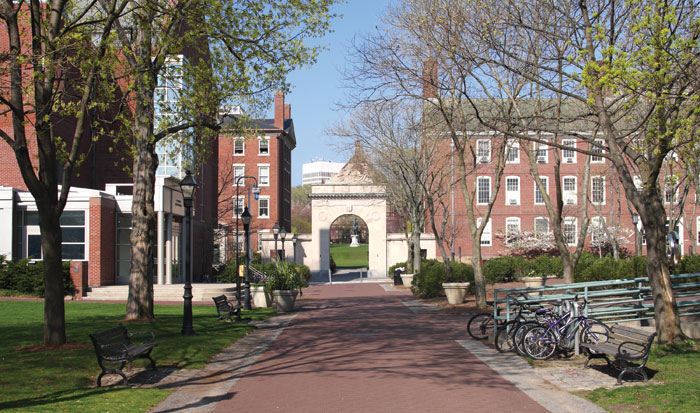
This op-ed was originally published in The Brown Daily Herald.
The violent threats against the leaders of Brown-RISD Hillel have left the Jewish community sad, angry and disgusted. But even more troubling than the threats may be the absence of outrage from the campus community.
On the morning of Sunday, Feb. 12, the director and assistant director of Brown-RISD Hillel received violent threats in their emails. This was not, however, the first time Brown-RISD Hillel was subjected to vile threats. Over a year ago, someone left a sinister note in the Hillel lobby saying: “I would never give the rich stuck up entitled Jews any money. F— you all. Hail [sic] Hitler. Gas the f—ing Jews and hope you die.”
I wish I could say these instances were anomalies; however, in the wake of Oct. 7, just hours after a tragedy that saw innocent babies, men, women and children slaughtered and raped in broad daylight, Brown students made statements that challenged the very fabric of our moral compass and show a disturbing detachment from basic human values.
Weeks before any Israeli military response to the most devastating day for the Jewish people since the Holocaust, was there a note of sympathy toward Brown’s Israeli and Jewish community from student groups? No. Just days after this horrible bloodshed, Brown Students for Justice in Palestine justified the attacks, stating that “the Palestinian right to return and right to resist their elimination is not only just, but enshrined under international law.” Students labeled posters of kidnapped children as “Israeli propaganda.” And rather than condemn the barbaric rapes that took place on Oct 7, Brown’s Graduate Labor Organization deemed those reports “Zionist propaganda” and participated in a rally that called The New York Times report of rapes “tired, old, racist fantasies.”
Let me be clear: Mass murder, rape, and the kidnapping of civilians are not resistance,they are barbaric terrorism. Justifying or denying the realities of such a massacre under any context is indefensible. This isn’t about cultural, political or Western stances; it’s about universal human decency, a principle that should know no borders or beliefs.
Given the response to Oct. 7, and the delegitimization of Jewish accusations of violence, it is no coincidence that violent threats were sent to the central hub of Jewish life at Brown. Celebrating violence and denigrating Jewish victims of sexual violence does nothing but normalize antisemitism. In fact, increases in anti-Zionist activity, which has become a near constant at this point at Brown, are ultimately shown to lead to increases in antisemitism.
Can you imagine the rightful public outrage that would ensue if the head of the LGBTQ Center or Brown Center for Students of Color received such threats against them and their families? At the same time that antisemitism has skyrocketed across the globe, it has increasingly become normalized.
More than ever, there is a need for us to put aside political differences and recognize identity-based harms for what they are. Consider the example from 1997, when King Hussein of Jordan personally offered condolences to the families of Israeli girls killed by a Jordanian soldier, telling one of the mourning Israeli parents at the time, “Your daughter is like my daughter. Your loss is my loss.” His actions transcended political and national lines, embodying a humane response to tragedy.
In response to the antisemitic notes on campus, I am imploring two groups to act: faculty members, and the broader, “silent” student body.
To professors: Your role extends beyond your political positions. Whether you advocate for extreme positions on either side of the Israel-Palestinian conflict, one of your primary responsibilities is to educate and inspire future leaders. This responsibility includes teaching them to condemn violence and to foster an environment that encourages healthy debate and critical thinking. Your leadership, or lack thereof, shapes the future. If you promote an environment that enables hate and drives our community into further division, you have failed in your role as an educator.
To the wider Brown community: Complacency is not an option. Misinformation, silence and cowardice, manifested in anonymous online posts or masked protestors, have severe consequences. True leadership, exemplified by figures like Mahatma Gandhi or Martin Luther King Jr., is characterized by openness and bravery. This is a moment to reflect critically on the information we consume and speak out against hate. Denying facts, such as the atrocities of Oct. 7, is akin to rejecting the historical truths of the Holocaust or the realities of COVID-19. Opinions are a personal right, but distorting facts and ignoring legitimate threats to safety undermines the very foundation of American society and the campus community.
Given the rise in antisemitism on Brown’s campus and beyond, students and faculty members must actively denounce all hateful behavior and stop endorsing statements and ideologies that contribute to such discrimination.
It is our collective responsibility to work together to foster a community where safety, respect and collaborative problem-solving prevail — not to shout down anyone and everyone you disagree with. It is time to listen to all Jewish students, even the ones you disagree with politically, and learn about antisemitism and how it manifests today. Given the rise in antisemitism on Brown’s campus and beyond, students and faculty members must actively denounce all hateful behavior and stop endorsing statements and ideologies that contribute to such discrimination.
Only by truly learning rather than getting defensive, can we combat the rise in antisemitism taking place around the world today and on our campus. If we do so, we can make Brown a model for other institutions worldwide in addressing complex and sensitive issues.
Brooke Verschleiser is a student at Brown University, Class of 2025.
When Israelis speak about Oct. 7, they frequently say “there are no words.” But one word they consistently use is “shattered.”
Israeli psychologists have been treating severe trauma, complex trauma and collective trauma. The word “trauma,” however, fails to convey the scale, the savagery or the sadism of events that day. The term does not encompass the complex mix of disorientation, anguish, emotional overload and the experience of utter brokenness after the deadliest day for Jews since the Holocaust.
There is no word for the shock felt by Jews around the world when Israel was suddenly and without warning attacked by thousands of rockets targeting civilians from the north to the south and from the river to the sea. There is no word to describe what it is like to be a Jew kidnapped by terrorists indoctrinated since early childhood to believe that murdering Jews is rewarded in the afterlife. Or to know that the people you love are in the hands of terrorists who delight in rape, torture and slaughter; who enjoy forcing parents and children to watch as they inflict horrors on loved ones.
There is no word to convey the terrifying ordeal suffered by survivors of the attempted genocide that Hamas perpetrated on Oct. 7. There is no word that communicates the panic, betrayal, horror and distress of those who hid for hours waiting for help to come, reading WhatsApp messages about terrorists inside their neighbors’ houses. Hearing terrorists break into their own homes. Hearing the screams of injured and dying friends and relatives. Hearing sounds of gunfire and exploding RPGs punctuated by ecstatic shouts of “Allahu Akbar.” All the while knowing they were being hunted.
Everyone in Israel is just one or two degrees of separation from someone who was murdered, injured or kidnapped on Oct. 7. And everyone knows someone who sped to the rescue that day, many of whom never returned.
There is no word to describe the grief of a country still holding its breath while more than a hundred hostages remain in Gaza, and while hundreds of thousands of soldiers, many in their teens and early 20s, go to battle. Some returning badly injured. Some returning to be buried.
Israel, which in the 20th century absorbed hundreds of thousands of displaced Holocaust survivors as well as nearly 900,000 Jewish refugees fleeing antisemitism and violence in neighboring Arab countries, is now temporarily housing about 200,000 displaced Israelis — refugees in their own country — some in hotels and even dormitories.
This includes not only those evacuated from areas near the Gaza border, but also from the north, as confrontations with terrorists in Lebanon escalate. Many displaced families are unsure how long it will take before they can return home. Some refugees from the south have already returned. Some don’t have homes to return to. Some don’t know if they want to return.
There is no word in the psychological lexicon for what happened on Oct. 7 or the new world in which Israelis now live. But “shattered” comes closer than “trauma.”
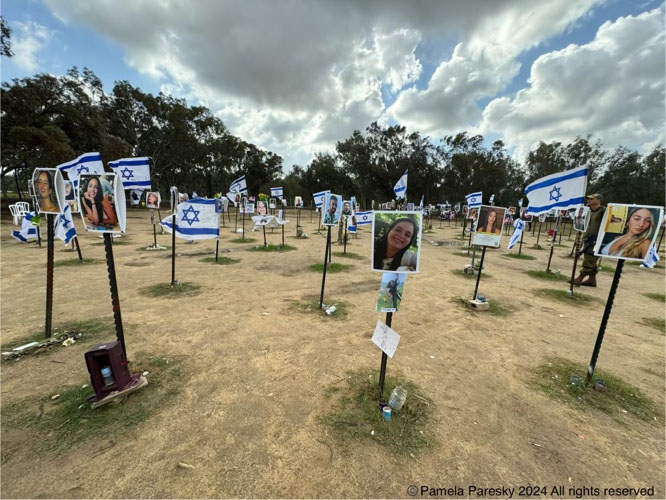
Copyright Pamela Paresky
A Shattered Paradigm
Jews are the only indigenous people who lived in one region for thousands of years, and then, when the majority were dispersed across the globe to be a tiny minority wherever they lived, managed to retain the same religion, rituals, language and attachment to their ancient land for 2,000 years — even as they believed themselves to be full members of their new host countries.
Jews have been unable to spend even one century without being ethnically cleansed, violently persecuted, or massacred somewhere — whether in the Diaspora or the land of Israel.
But Jews have also been unable to spend even one century without being ethnically cleansed, violently persecuted or massacred somewhere — whether in the Diaspora or the land of Israel. And since the newest iteration of Jewish control of the land in 1948, Israelis have existed under a threat to which there has been no real solution.
During the Second Intifada, roughly 1,000 Israelis were killed by Palestinian terrorists. There were stabbings, shootings, suicide bombings and beginning in 2001, mortar and rocket attacks launched from Gaza. In response, Israel increased security. Terrorists from the Palestinian Territories became less able to penetrate Israel’s borders and the number of injuries and deaths decreased. And of course, from the time they are little, Israeli children are aware that they will be required to serve in the Israel Defense Forces (IDF).
One of the most surprising things I learned during my time in Israel is that for decades, new parents have believed — or at least hoped hard enough to almost believe — that by the time their children are old enough to serve, defending the country from terrorism will no longer be necessary.
Gaza: “Land For Peace”
Gaza was home to Jews for over 2,000 years, beginning in at least the second century BCE and ending in 1929, when Arabs in the region once known as Judea killed more than 65 Jews in Hebron and around 135 Jews in Gaza. These pogroms came after a decade of similar antisemitic violence in the British Mandate of Palestine. A British commission referred to the pogroms as “racial animosity on the part of the Arabs.”
In part to protect Jews and in part to appease the forebears of the Arabs who in the 1960s would come to be called Palestinians, British colonial forces expelled the Jews from Hebron and Gaza, and restricted Jewish immigration to the region.
After the Six-Day War in 1967, Jews returned to live in Gaza. In 2005, in the hope of securing both peace and international goodwill, the Israeli government led by Prime Minister Ariel Sharon unilaterally withdrew its forces from Gaza and forcibly removed the 9,000-plus Jews who lived there, as well as disinterring those buried in Gaza.
Referencing the long history of Jewish expulsions by colonial forces and antisemitic governments, Gazan Jews’ protest slogan was “Jews don’t expel Jews.” The IDF physically carried many of them out of their homes and across the newly designated border.
Hours after the finalization of the historic 2005 withdrawal, Palestinian terrorists in Gaza fired rockets at Israeli civilians. In 2007, the year Hamas took over as Gaza’s government and murdered its political rivals, terrorists in Gaza launched more than 2,800 rockets and mortars at Israel.
Hours after the finalization of the historic 2005 withdrawal, Palestinian terrorists in Gaza fired rockets at Israeli civilians. In 2007, the year Hamas took over as Gaza’s government and murdered its political rivals, terrorists in Gaza launched more than 2,800 rockets and mortars at Israel. By then, the staunch international support for demolishing Gaza’s terrorist infrastructure, which Sharon expected would last a decade, had already evaporated.
Instead, between then and Oct. 7, with backing from Iran along with appropriated international aid controlled by UNRWA, the United Nations Relief and Works Agency (which has been revealed to be both a terrorist-training system and an internationally funded source of income for Hamas terrorists and supporters), Hamas significantly expanded its terrorist capabilities and vastly increased its stockpile of weapons.
Without the international support necessary to destroy Gaza’s terrorist capabilities, in order to keep Israelis safe, Israel had to rely on defensive strategies. Israelis’ famous technological ingenuity resulted in an increasingly sophisticated rocket-alert system that now includes smartphone apps, and the “Iron Dome,” a highly advanced technological system that intercepts terrorists’ rockets, neutralizing the vast majority that don’t fall within Gaza.
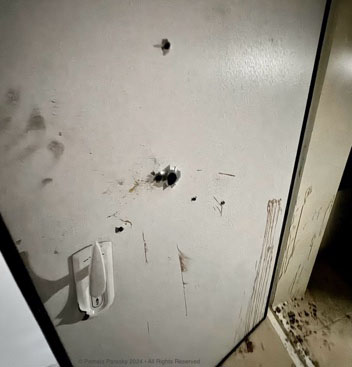
Nonetheless, bomb shelters are still necessary. They appeared across Israel’s roadways as well as in Israeli homes and businesses. The fortified room in a home is called a “mamad,” an acronym for “merkhav mugan dirati” which means “apartment protected space.” The door to a mamad doesn’t lock. If a home is damaged, first responders need to be able to open it in order to extract the people inside.
Life in Israel, and especially the otef (the Gaza envelope), can be hard for those outside of Israel to truly grasp. Imagine needing constant protection from terrorist rocket attacks, and trying to prevent your children from developing anxiety, panic disorders and PTSD. Israel’s creative solution was to turn children’s bedrooms into bomb shelters. In newer homes, when rocket attacks happen at night, instead of awakening children to take them to a shelter, Israeli parents calmly visit their children’s bedrooms until the danger has passed. Sometimes children don’t even wake up.
This all had the effect of transforming something life-threatening into something more like a nuisance. On Jan. 29, I experienced this myself when air raid sirens sounded in Tel Aviv and my cell phone app blasted a “critical alert.” Hamas rockets aimed at the city came close enough that from the bomb shelter, I could hear them exploding when Iron Dome missiles destroyed them in the air.
In a tacit contract between Israeli citizens and their government, Israelis have come to tolerate a certain level of antisemitic terrorist violence as the price of Jewish self-determination in the historical, biblical, and continuous homeland of the Jews. In return, Israeli homes — or at least, the mamads — were thought to be as safe as if covered by an iron dome.
On Oct. 7, that contract was shattered.
The Kibbutzim
Early in the morning, Hamas began their barbaric rampage. Thousands of rockets were launched from Gaza at civilian targets across the country, and Israelis took refuge in their mamads as they always do.
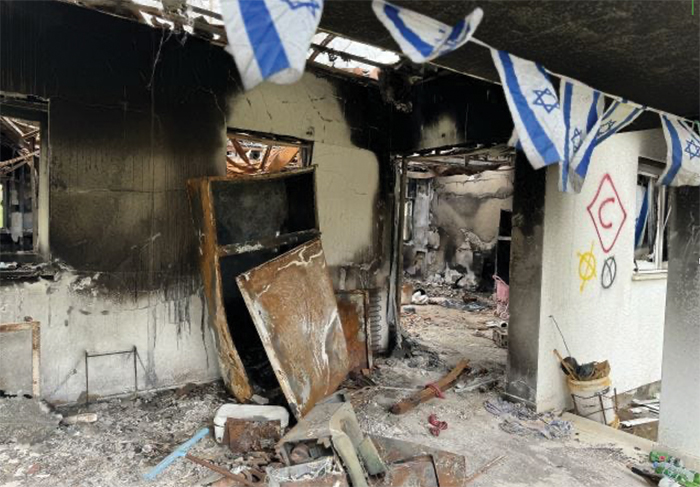
They soon understood that it was not a “normal” rocket attack — the alerts didn’t stop when they usually do. But they could not have imagined that at that moment, thousands of terrorists were breaking through the border wall and invading their country, intending to murder, rape, dismember and kidnap as many Israelis as possible. Or that terrorists knew exactly where to find them. Or that their “safe rooms” would become death traps.
Entire families were gunned down in their children’s bedrooms. Or they died from smoke inhalation. Or they were burned alive when terrorists set fire to their homes. In many cases, terrorists shot their victims through mamad doors as Israelis tried desperately to hold them shut.
That is how 18-year-old Maayan Idan was murdered in front of her family as her father, Tsachi, held the door closed. Terrorists livestreamed the family’s ordeal on Facebook as Maayan’s parents and young siblings tried to process what was happening.
Tsachi was kidnapped from Kibbutz Nahal Oz and is still a hostage in Gaza. At Maayan’s funeral, her mother, Gali, described being “shattered into pieces.”
Sixty-nine-year-old Itzik Elgarat was shot in the hand through his mamad’s door. He called his brother, Danny, who thought the handle had somehow injured Itzik and told him how to create a tourniquet. Just before the call was disconnected, Itzik became hysterical. “Danny! This is the end!” he said. “This is the end!”
Not understanding what “end” it could be, Danny called a relative who lived in the same kibbutz, asking him to check on Itzik. His relative told him the kibbutz had been overtaken by terrorists. As one of the few residents with a weapon handy, he had killed two terrorists in his own home. Danny then opened his phone tracking app and watched as Itzik’s phone entered Gaza.
Danny’s sister lived in the same kibbutz. She spent seven hours holding her door handle in the closed position, saving the lives of the two grandchildren who were with her. Terrorists kidnapped her ex-husband, Alex Dancyg, a 76-year-old world-renowned scholar of the Holocaust and Polish Jewish history, and the son and brother of Holocaust survivors. He has trained Israel’s Auschwitz guides for over 30 years, and is a beloved fixture at Yad Vashem, Israel’s memorial museum of the Holocaust.
According to released hostage Nili Margalit, for at least the first 50 days, Hamas held her and Dancyg and others from Nir Oz, most of them elderly, deep in a tunnel. To keep their minds active, they took turns giving talks about their areas of expertise. When Dancyg lectured about the Holocaust, the others asked him to speak about something else.
Margalit, Dancyg and Elgarat were kidnapped from Kibbutz Nir Oz, where 46 residents were murdered. By the time the IDF arrived, the terrorists were gone and had kidnapped approximately 80 people — about a third of all the hostages. About one quarter of their close-knit community was either kidnapped or murdered.
Thirty people from Nir Oz are still held hostage in Gaza, including Dancyg and his brother-in-law Elgarat. Also kidnapped were Elgarat’s next-door neighbors: Four-year-old Ariel Bibas, his 9-month-old brother, Kfir (who, if alive, spent his first birthday as a hostage), their mother, Shiri, and father, Yarden, who was taken separately after trying to protect his family. Images (shot by a Palestinian “civilian” who works as a photographer for the Associated Press) show Yarden being kidnapped on a motorcycle, blood gushing from his head; a terrorist with a hammer in one hand, holding Yarden by the throat. Hamas streamed the kidnapping of Shiri and her boys, all of them wrapped in a blanket. A screenshot of the terrified mother and her red-headed babies has become an iconic image of the Oct. 7 kidnappings.
About 100 residents of the larger Kibbutz Be’eri were also murdered that day, and about 30 kidnapped — together, 10% of that community. Among the kidnapped were Emily Hand, who spent her ninth birthday as a hostage. She was at a sleepover with her friend, Hila Rotem, when terrorists invaded the kibbutz.
After her release, Emily revealed that in Gaza, she, Hila and Hila’s mother, Raya, had been held not in tunnels, but in homes. For at least part of the time, she was with Be’eri resident Yossi Sharabi whose brother, Eli, was also taken hostage. Yossi’s wife and three daughters survived the massacre, but terrorists killed Yossi in Gaza, where Eli remains a hostage. Eli’s wife and two daughters were murdered. Yossi and Eli’s brother, Sharon, says his family is “shattered.”
The Nova Festival
Hamas terrorists who invaded Israel on motorized paragliders swarmed the Nova “peace rave” at a campground near Kibbutz Re’im. (Re’im means “friends.”) With assault weapons, grenades and RPGs, terrorists mowed down hundreds of partygoers who fled on foot and by car, many of which were incinerated. Of between 3,000 and 4,000 attendees, 364 were murdered and many more were injured. Forty from the festival were reportedly taken hostage.
Ayala Avraham and her husband, Ilan, although in their 50s, were regulars at trance music festivals, dancing together every weekend. Ilan frantically drove Ayala and a friend away from the Nova grounds while terrorists shot at them, hitting the car. The three made it to Moshav Yakhini, a small community near Sderot, where they hid in a standalone bomb shelter behind a security gate.
When Ilan realized terrorists were approaching, he gave Ayala the car keys, hugged and kissed her, and said “You will be okay.” Then he stood outside the shelter to distract the approaching terrorists, hoping they would not look inside. Several terrorists grabbed Ilan and absconded with him.
Other terrorists soon discovered the women, but left only one to guard them. The women broke free from their captor, who shot at them, wounding Ayala’s friend as they ran to hide behind her car. They were not well hidden. If he had come after them, they would have had no chance. But for whatever reason, he ran back toward the other terrorists. The women were soon rescued by the IDF.
For three weeks, Ilan, who wore dreadlocks, was thought to be missing. Eventually, his unusual hairstyle allowed him to be identified — terrorists had completely mutilated his face. It was later revealed that he had refused his captors’ demands to knock on doors and tell people in Hebrew that it was safe to come out of their homes.
Meanwhile, near the festival grounds, in tiny roadside bomb shelters, each built to accommodate 10, dozens of terrified festival-goers huddled together as terrorists sprayed them with gunfire and threw in grenades. In one shelter, a 22-year-old unarmed off-duty soldier, Staff Sgt. Aner Elyakim Shapira, caught seven grenades and threw them back out. The eighth grenade killed him.
Some survivors of the blast were kidnapped, including Aner’s close friend, Hersh Goldberg-Polin, an Israeli-American whose left arm was blown off below the elbow. His fate is unknown. In the shelters and elsewhere, many young people survived the massacre by hiding under the bodies of their friends and others.
As of this writing, 144 of those kidnapped have been released or rescued and 134 are still held hostage in Gaza. Reports indicate that as many as 50 of those in Gaza may now be dead.
Sexual Violence
Survivors who witnessed gang-rapes describe terrorists mutilating women before murdering them. In at least one account, a terrorist shot a woman in the head, killing her while still raping her. Hamas later denied the rapes, but manuals recovered from Hamas terrorists included a list of Hebrew phrases for communicating with Israelis — including “take your pants off.” And when interrogated, terrorists admitted to the raping of even dead bodies, saying that despite religious prohibitions on mistreating or killing women and children, Hamas leaders instructed them to murder entire families and permitted them to perpetrate rape.
In testimony delivered at the United Nations headquarters in New York, first-responders and those tasked with handling women’s dead bodies reported that many of the murdered were found partially naked; some with broken pelvises, some with grotesque injuries to their genitals. The Association of Rape Crisis Centers in Israel recently issued a report revealing that terrorists inserted nails, grenades and knives in Israeli women’s vaginas. The report detailed evidence that the sexual violence perpetrated by Hamas on Oct. 7 was intentional, “systematic, targeted sexual abuse.”
Meanwhile, many women’s organizations around the world have remained silent. Those that eventually condemned Hamas did so only many weeks later. Some have even denied the sexual violence. The director of the University of Alberta Sexual Assault Centre signed an open letter that referred to Hamas terrorists as “Palestinian resistance,” called Israel “terrorist,” claimed that false reports about the Al-Ahli Hospital bombing were accurate, and asserted that testimony about Hamas rapes amounted to no more than “unverified accusations.”
Such appalling hypocrisy notwithstanding, a recent United Nations report noted a pattern among the murdered — mostly women — who were found naked, at least from the waist down, with their hands tied. This and other evidence, along with witness testimony, provides what the report called “reasonable grounds to believe that conflict-related sexual violence occurred during the Oct. 7 attacks in multiple locations across Gaza periphery, including rape and gang rape.”
Regarding hostages, the report is equally unsettling. “The mission team found clear and convincing information that some have been subjected to various forms of conflict-related sexual violence including rape and sexualized torture and sexualized cruel, inhuman and degrading treatment. The team also has “reasonable grounds to believe that such violence may be ongoing.”
Antisemitism and Shattered Illusions
If Jews in the Diaspora thought the events of Oct. 7 would turn the tide against anti-Zionist antisemitism, it took only one day to disabuse them. On Oct. 8, while Israel was still collecting bodies and eliminating terrorists within its own borders, more than 30 student groups at Harvard issued a joint statement declaring that “the Israel regime” was “entirely responsible for all the unfolding violence.” Across the country, identical posters advertising a “Day of Resistance” appeared, prominently displaying an image of a terrorist flying a motorized paraglider.
Despite such dispositive evidence to the contrary, on March 1, a New York Times news article (not an opinion piece) reported that this campus movement “began as general protests against continuing Israeli retaliation” (emphasis added).
Even as the depth of Hamas depravity and brutality is revealed, students, faculty and other illiberal activists continue to assert that what happened on Oct. 7 was not terrorism — it was “resistance.” And resistance, they insist, is justified “by any means necessary.” Hamas is an Arabic acronym for Islamic “Resistance” Movement.
A favorite campus chant, “From the river to the sea, Palestine will be free” is a Hamas slogan — a call to annihilate the Jewish state, which is bordered by the Jordan River and the Mediterranean Sea. Some demonstrators prefer the Arabic version, which is more explicit: “From water to water, Palestine is Arab.”
By “Palestine,” they mean Israel.
Some protesters may not understand which river or what sea. But other slogans are less ambiguous: It’s difficult to see how “Globalize the intifada” and “There is only one solution, intifada revolution” are calls for peace rather than for violent attacks on Jews everywhere. If all that weren’t enough, many of the increasingly disruptive and even violent demonstrations in the United States incorporate the word “flood,” reflecting the name Hamas gave their Oct. 7 sadistic orgy of atrocities: Operation Al Aqsa Flood.
Photo courtesy of Yael Bar Tur
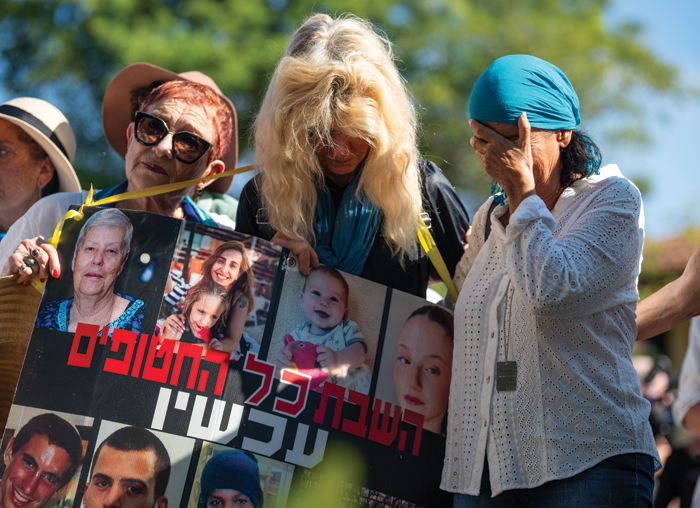
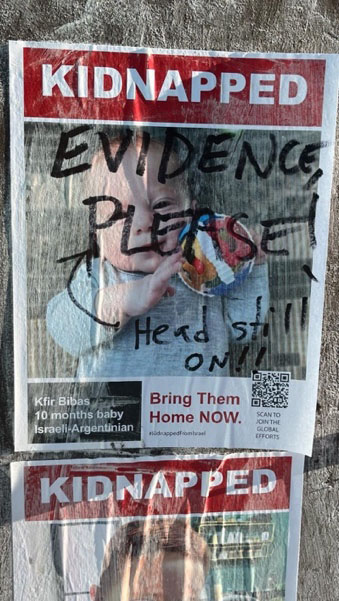
In a particularly cruel example of global anti-Zionist antisemitism, when posters of kidnapped Israelis appeared, they were quickly vandalized or torn down. At Harvard, a photo of baby Kfir was defaced with the words “evidence please” and “head still on.” On a picture of 4-year-old Ariel, graffiti read “google dancing Israelis,” a reference to an antisemitic conspiracy theory that Israel was behind the 9/11 attacks on the Twin Towers. And many of the faces of other kidnapped Israelis were obscured with red paint on a multi-part display.
After more than 150 days, anti-Israel rallies have continued on- and off-campuses across America. As hostages languish in tunnels and in the homes of terrorist-captors (some of whom, like an UNRWA employee and a physician, have been referred to in the media as “civilians”), many demonstrations include calls for a one-sided Israeli “ceasefire” with no calls for Hamas to surrender — nor even release the hostages.
The Oakland, CA City Council even voted down a condemnation of Hamas when passing a ceasefire resolution. Oakland residents argued that “the notion that this was a massacre of Jews is a fabricated narrative,” “Israel murdered their own people on Oct. 7,” and “Hamas isn’t a terrorist organization.” One went as far as to say, “I support the right of Palestinians to resist occupation including through Hamas.”
In other words: It didn’t happen. But if it happened, the Jews did it. And anyway, they deserved it.
Meanwhile, video footage taken from a camera in Rafah on Oct. 7 was released in February, showing Shiri Bibas and her two young boys with six terrorists in civilian clothing. On Feb. 12, the IDF pulled off a spectacular rescue of two hostages held in a private home in Rafah. Days later, students at Columbia University held an “all eyes on Rafah” rally. The demonstration was not to celebrate the daring commando rescue. Nor was it to demand the release of other hostages held in Rafah.
It was organized by two anti-Israel campus groups, Students for Justice in Palestine and Columbia University Apartheid Divest, to protest “Israel’s recent attacks on the city of Rafah.” The groups instructed members to obscure their faces with masks “for security.” During the rally, someone broke the glass in a door to the library.
Shattered Hopes for Peace
Though well aware of Hamas’ murderous intentions, many who lived near the border believed there was a bright line between Palestinian civilians and their violently oppressive, terrorist government. Residents of Kibbutz Nir Oz like survivor Irit Lahav, and of Kibbutz Be’eri, like Vivian Silver, who was one of the founders of the organization “Women Wage Peace,” devoted time to driving Palestinians from the Gaza border to hospitals in Israel, where they received the same, high-quality medical care available to Israelis. For over a month, Silver was thought to be among the kidnapped, since no body was found in her house. Eventually, however, her remains, found in the debris of her badly burned home, were identified using techniques borrowed from archeology.
In recent years, Hamas developed a penchant for using kites and balloons to launch Molotov cocktails and other incendiary devices into Israel, often killing wildlife and damaging agriculture. Some airborne packages carried brightly colored toys in order to appeal to children, and if all went as planned, blow them up as they reached for the toys. In spite of this, every year, members of the kibbutzim near the border would fly kites bearing messages of peace, signaling their hopes for the future to their neighbors across the border.
Saturday, Oct. 7 was supposed to be that day.
For the last 15 years, the “Kites for Freedom” celebration in Kibbutz Kfar Aza was organized by Aviv Kutz. On Oct. 7, Aviv, his wife and their three children were slaughtered by terrorists.
Margalit, a pediatric nurse who worked primarily with Arab-speaking patients at Soroka Hospital in Be’er Sheva, had planned to fly kites for peace that day. Instead, she was kidnapped from Kibbutz Nir Oz and spent 54 days as a hostage. Her father was murdered at Nir Oz and his body taken to Gaza.
For 12 hours Natali Yohanan and her family hid in their mamad, listening as Palestinian “civilians,” including a woman, rummaged through their belongings, and when they tired of trying to get the family out of their mamad, heated and ate the food Natali had left on the stove, and even switched the Netflix to Arabic to watch some shows before finally leaving with their booty.
For 12 hours, in the same kibbutz, Natali Yohanan and her family hid in their mamad, listening as Palestinian “civilians,” including a woman, rummaged through their belongings, and when they tired of trying to get the family out of the mamad, heated and ate the food Natali had left on the stove, and even switched Netflix to Arabic to watch some shows before finally leaving with their booty. Once the family emerged, they found that the looters had stolen everything from electronics, to Natali’s jewelry and makeup, to the family’s clothing — even Natali’s underwear.
In the aftermath of the massacres, residents of several kibbutzim were shattered to learn that Palestinians they had employed created maps of their communities for the terrorists, detailing the locations of their armories, the names of the residents, and even which homes belonged to members of security teams — the first to be murdered.
“Are these the people I wanted to help? These are people who want peace?” Irit Lahav now asks herself. She was equally astonished that after murdering her neighbors, terrorists took their dead bodies into Gaza — and sometimes only their heads. “What kind of human being would want to take somebody’s head …?”
After the beheading of 19-year-old soldier Adir Tahar was recorded on video, a terrorist in Gaza tried to sell Adir’s head for $10,000. The boy’s father was finally able to complete his son’s burial after the IDF found the head in a duffel bag — in an ice cream store freezer in Gaza.
A poll by The Palestinian Center for Policy Survey and Research found that more than 50% of Palestinians in Gaza and 85% in the West Bank support the Oct. 7 attacks. Most claim to not have seen videos of the atrocities and say they do not believe they happened.
Still, the Palestinian Authority (PA), which governs the West Bank, pays a monthly stipend to terrorists who slaughter Jews, and the pay scale is based on how many Israelis they murder. According to news reports, the PA recently added 661 of the Oct. 7 terrorists to the payroll, increasing last year’s $161,000,000 payments for murdering Israelis by $16,000,000.
These “pay for slay” incentives are enshrined in Palestinian law.
“This is outrageous,” Adele Raemer, who survived the massacre at Kibbutz Nirim, told the Jewish News Syndicate. “We teach our children coexistence while our neighbors make a living off our deaths.”
There are many stories of heroic Arab Israelis who saved lives that day—including four who spent hours rescuing dozens of people on their way to save a cousin, and Youssef Ziadna, a bus driver who drove straight into the massacre to help, rescuing 30 Jews, many of them wounded, even as he was constantly under fire. After news of his courage and selflessness went viral on social media, he received a death threat from someone who claimed to be from Gaza. “You saved 30 Jews’ lives,” the man said, adding, “Don’t worry, we’ll get to you.” Ziadna’s cousin was murdered, and four other family members were kidnapped. Only the two teenage family members were released.
It is currently unknown how many of the roughly 150,000 Palestinians who had work permits to legally enter Israel (including 18,000 from Gaza) participated in the attacks or aided terrorists. It is also unclear how many would participate in or aid future attacks if given the opportunity.
I’ve heard stories of Palestinians with work permits who immediately went to authorities on October 7 when they realized what was happening. But it is currently unknown how many of the roughly 150,000 Palestinians who legally worked in Israel (including 18,000 from Gaza) participated in the attacks or aided terrorists. It is also unclear how many would participate in or aid future attacks if given the opportunity.
Those permits have been suspended indefinitely.
Taher El-Nounou, a Hamas media adviser, told The New York Times, “I hope that the state of war with Israel will become permanent on all the borders.”
Hamas abhors the democratic and Jewish values that allow equal rights for all regardless of sex, ethnicity, religion, sexual orientation … etc. Their intention, which is shared by other Islamist terrorist groups like Hezbollah, the Houthis and Iran, is to conquer the West and establish a global caliphate. Israel is just the beginning.
Israeli Anti-fragility
The red anemones, which have come to symbolize Israel’s south, are now in bloom. Seeing them after everything that happened is hard, Vered Libstein of Kibbutz Kfar Aza told The Times of Israel. Almost 20 years ago, she and her husband, Ofir, founded the annual festival known as Darom Adom (Red South). Annually, more than 400,000 visitors would come to see the red blossoms, celebrate nature and enjoy the many family-friendly events.
On Oct. 7, Ofir was among the 62 residents murdered at Kfar Aza. Their 19-year-old son was also murdered, as were Vered’s mother and nephew — who jumped on a grenade, saving his fiancée’s life. Nineteen from their kibbutz were taken hostage. “Life is stronger than everything,” Vered insists, with typical Israeli resilience, adding, “We’ll need to find the strength to renew ourselves as well.”
Whether observant or secular, conservative or progressive, soldier or survivor, one thing I hear is a fierce determination not to let terrorists rob Israelis of more than what’s already been taken. “It’s the first and last time I’m ever leaving,” the owner of a shawarma spot near the Gaza border told American journalist Nancy Rommelmann. He and his wife have returned and reopened their store. “I won’t let Hamas win” he says.
Still, the country’s economy has been significantly disrupted. Not only are more than 150,000 Palestinian employees no longer working in Israel, until recently, more than 350,000 reservists across all business sectors were serving in the IDF instead of going to work as usual. (Now the number is roughly 130,000.) At the same time, tourism, which had only been back in business for less than two years since COVID, has nearly ground to a halt.
To make matters worse, many of Israel’s farms are in areas that have been evacuated. The kibbutzim that terrorists attacked provided close to 60% of Israel’s produce, and operated dairy farms, hen houses, and cattle ranches.
Many of the kibbutzim employed people from Thailand. At Kibbutz Nir Oz alone, 11 Thai employees were murdered, five were kidnapped, and only two have been released. But farm workers from Thailand are beginning to return. And there is a fairly steady stream of mostly (but not entirely) Jewish volunteers from other countries coming to Israel to pick avocados and citrus fruits, package food and undertake various other tasks disrupted by the war. Some visitors are here to console grieving friends and family. Others are here to participate in solidarity missions.
Still others, such as investors in OurCrowd, an Israeli startup investing platform, come looking for opportunities to donate or invest. The shekel has already rebounded to pre-war levels, and if history is any guide, now is the time to invest in Israel. Between 2008 and 2021, in the aftermath of each Hamas attack and IDF response, the Israeli stock market quickly not only rebounded, but surpassed pre-conflict levels. That may be why OurCrowd was able to raise and commit the financing for its Israel Resilience Fund in record time. It may also be why international investors have been investing in the Tel Aviv Stock Exchange — including billionaire Bill Ackman and his wife, Neri Oxman. But perhaps most emblematic of Israel’s anti-fragility: When everything was shattering and reservists were called to serve, 150% of the number summoned reported for duty. And despite the political fractures of 2023, this war’s young soldiers are proving to be Israel’s new “Greatest Generation.”
Meanwhile, the ethically illiterate and morally corrupt have joined forces to accuse Israel of genocide, an obscene blood libel designed to delegitimize Israel’s war to defeat an internationally designated terrorist organization — one that attempted an actual genocide of Jews on Oct. 7.
Meanwhile, the ethically illiterate and morally corrupt have joined forces to accuse Israel of genocide, an obscene blood libel designed to delegitimize Israel’s war to defeat an internationally designated terrorist organization — one that attempted an actual genocide of Jews on Oct. 7.
This type of Holocaust inversion, a central feature of contemporary antisemitism, codes empowered and self-determined Jews as “Zionists,” and casts Zionists as Nazis. This is how, on the day after Hamas circulated a video claiming to have murdered seven of the hostages, film director Jonathan Glazer, who says he is a Jew, can use an Oscars acceptance speech for “The Zone of Interest,” a movie about the Holocaust, to claim that the “occupation” has “hijacked the Holocaust” and that this “occupation” — rather than sadistic, genocidal terrorism — is to blame for “conflict” and by extension, for “the ongoing attack in Gaza” and even for the suffering of “the victims of October 7 in Israel.”
In other words: Whatever happened to Jews is their own damn fault.
Only in an upside-down world can a man who made a movie about the dehumanization and genocide of Jews make a speech dehumanizing both the victims of the largest massacre of Jews since the Holocaust and Jews now risking their lives to ensure that the latest attempted genocide fails. In this inversion, the lesson of the Holocaust is not the imperative to clearly identify and marginalize those who disseminate and act on hate. And it is not the moral obligation to stand against evil. It is a moral indictment of Jews, whose stubborn refusal to be annihilated and creative ability to overcome even genocide only serve to increase the believability of conspiracy theories that paint the Jew — and the Jew among the nations — as the powerful villain.
People outside of Israel still make the mistake of thinking Israel exists because the Holocaust happened. The truth is precisely the reverse: The Holocaust happened because Israel did not exist. With global antisemitism at record levels, Jews around the world are awakening to this reality.
The truth is much simpler. Throughout history, as a small minority group, when Jews in the Diaspora were violently attacked, they fled. With an army of Israelis, however, Jews have been able to fight back. Israel’s Special Envoy on Combating Antisemitism, Michal Cotler-Wunsh, told an assembly at the United Nations that people outside of Israel still make the mistake of thinking Israel exists because the Holocaust happened. The truth, she says, is precisely the reverse: The Holocaust happened because Israel did not exist. With global antisemitism at record levels, Jews around the world are awakening to this reality.
Naomi Petel survived the massacre at Kibbutz Nahal Oz with her husband and their three young children because a terrorist’s bullet jammed the lock on her front door, making it inoperable, and looters in the other half of her duplex caused a flood, preventing the house from burning when terrorists tried to set it on fire. Even after their ordeal, she told me, there’s nowhere else she wants to live. Israel’s south is her home. Her family, along with most of their displaced kibbutz, are temporarily living in the north. They don’t know how long it will take before they can go back home. She and her husband now have red anemone tattoos.
On the “Walk-Ins Welcome” podcast, she told writer Bridget Phetasy, “What Jews have done throughout history is be kicked out, try to make it again in a different place … contribute as much as you can to society, and [hope that] maybe they’ll like us enough that they don’t try to kill us.” Over and over. Again and again.
“This time,” she said, “we’re not going anywhere.”
A version of this essay is found at The State of Tel Aviv, a weekly newsletter and informative podcast focusing on the Middle East and Jewish life, by Vivian Bercovici, former Canadian Ambassador to Israel.
A social psychologist with a clinical background, Dr. Paresky serves as Senior Advisor to the Open Therapy Institute and Advisor to the Mindful Education Lab at New York University. In addition to The Jewish Journal, her work appears in Psychology Today, The Guardian, Politico, Sapir,The New York Times, and elsewhere. She has taught at Johns Hopkins, the University of Chicago, and the United States Air Force Academy, and writes the Habits of a Free Mind newsletter. Follow her on Twitter at @PamelaParesky
It’s hard to recall a time in recent decades when we’ve seen more bad news for Jews. The massacre of Oct. 7; the alarming rise in antisemitism, especially on college campuses; the framing of Jews and Israel as white oppressors and colonialists; a protest movement that defends terrorists; biased media and education, etc.– everywhere we turn, we seem to find another threat.
In all this bad news, one piece of good news can easily get lost: we’ve never had more power and freedom to fight back.
Indeed, one can argue that the most significant Jewish development of the past 100 years is the transformation of Jews from a physically vulnerable people that went to its slaughter to a powerful people able to defend itself.
Given the rise in Jew hatred, it may sound odd to mention Jewish strength. But both thoughts can be true at once: We have a greater need to defend ourselves as well as a greater power to do so.
Israel’s 75-year history is the epitome of that idea. Surrounded by antisemitic animosity and constant threats to its survival, the Jewish state was forced to become stronger and stronger. With a greater need to defend itself came a greater power to do so. The massacre of Oct. 7 only reinforced that idea.
Now compare modern Israel to the Jews of Europe who trembled with fear 85 years ago as Jew haters prepared to take them to their deaths, all six million of them. Those Jews also had an enormous need to defend themselves– but zero power to do so.
If there’s such a thing as an afterlife, I can imagine six million Jewish souls in heaven right now smiling at the feistiness of their descendants.
Feisty we are.
Whether in Israel or in the Diaspora, the Jews of 2024 are anything but the Jews of Auschwitz. We are no longer weak. We are no longer invisible. We are no longer silent.
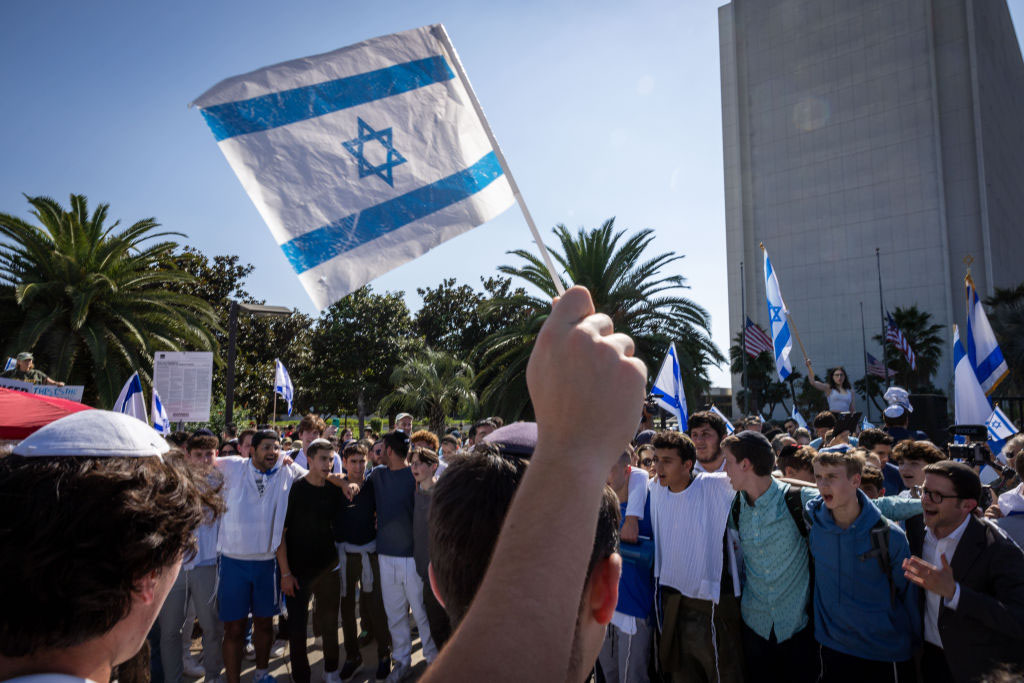
Everywhere there are threats, we see assertive Jews defending their people, whether through institutional gatherings, civic activism, social media, legal initiatives, street rallies, philanthropic involvement, academic activism, Super Bowl commercials, even flashy murals of Israeli hostages to greet attendees at the Academy Awards.
The Jews of 2024 make noise. We should never underestimate or underappreciate the power and the freedom to make that noise.
Pick any attack on Jews and you’re bound to hear Jewish noise. The United Nations may be shamelessly biased against Israel, but that didn’t stop Foreign Minister Israel Katz from addressing the UN Security Council this week, asking its 15 members to declare Hamas a terrorist organization and to pressure the group to release all hostages.
Oscar-winning filmmaker Jonathan Glazer had every right to use his acceptance speech to hijack the Holocaust and bash Israel, but the backlash has been as loud as an Iron Dome rocket. Among the reactions was a letter from the Holocaust Survivors Foundation telling Glazer it was “disgraceful for you to presume to speak for the six million Jews, including one and a half million children, who were murdered solely because of their Jewish identity. You should be ashamed of yourself for using Auschwitz to criticize Israel.”
This week, Hebrew University suspended a law faculty lecturer, Professor Nadera Shalhoub-Kevorkian, due to her involvement in a petition that accuses Israel of committing genocide in Gaza.
Jew haters may have the right to spew their hate, but Jews have the right to take them on, and we are using it.
The Anti-Defamation League has been chronicling that hate for years, while also taking action. Last week it held its annual Never is Now conference that attracted 4,000 attendees and featured speakers like Israeli President Isaac Herzog; State Department antisemitism envoy Deborah Lipstadt; Rabbi David Wolpe; author Dara Horn; philanthropist-activist Marc Rowan; and Daniel Lifshitz, an advocate for the hostages whose grandfather, Oded, is still in captivity.
“Antisemitism is not just a threat to Jews but to democracy,” said Lipstadt.
“We are not OK,” ADL head Jonathan Greenblatt said in his “State of Hate” address. “The world of Oct. 8 is one in which the perpetrators of the worst antisemitic massacre since the Holocaust are celebrated as heroes – not just in Ramallah or Beirut, but in London and New York and on campuses, including Harvard and Columbia.”
We are not OK, but we are blessed that we can do something about it.
Even if Israel may face opposition in some parts of our government, let’s never forget that the most powerful parliament in the world, the U.S. Congress, is strongly supportive of Israel, and that American political leaders across the board have joined the fight against antisemitism.
So yes, the bad news is that there’s a greater need to defend ourselves, but the good news is that all around us are signs of our ability to do just that. We need not apologize for our influence and our activism to protect Jewish rights. That activism also includes the freedom to dissent. Jews are not a monolithic voice, which is part of our strength.
Our strength also comes from our multiple and diverse contributions to America, which date to the very beginning of our American journey. As Lipstadt said, our fight is America’s fight. As grateful beneficiaries of the American Dream, we are ideally suited to bring it back to life.
I saw this anonymous note in Reddit recently that moved me:
“We are not weak, we are Jews. We are the ones who wrestled with angels. We are the ones who dragged Nazis out of South America to stand trial in the homeland. We are the ones who rescued more than 100 hostages in Entebbe in the pitch black of night. We are the ones who rose from near obliteration to absolute shining examples of productive citizens. We will continue to show the world how we alchemize fear and trembling into courage and success.”
Throughout our post-biblical history, Jewish strength came from our tradition, our wisdom and our values. Today, our strength also comes from our ability to defend ourselves, as fundamental a value as there ever was one. We may be under attack from haters, but unlike our ancestors, now we can fight back.
Embracing Adventure and Empowerment: Reflecting on the Women’s Travel Fest at Grand Hyatt Playa Del Carmen
In the heart of the stunning coastal paradise of Playa Del Carmen, Mexico, I attended the inspirational Women’s Travel Fest being held this year at the Grand Hyatt Playa Del Carmen. It was my distinct honor to take the stage at this incredible event, sharing my journey and memoir, “Brave-ish,” with fellow women travelers from around the globe. As I reflect on my time there, I am filled with a profound sense of gratitude to my friend and owner of the conference, Alexandra Jimenez who I met in 2012 when she started Travel Fashion Girl.
The Grand Hyatt Playa Del Carmen offers an array of experiences that cater to the soulful adventurer within each of us. From the moment you step foot onto the property, you are greeted by a fusion of modern luxury and ancient Mayan-inspired architecture. The entrance, reminiscent of a majestic Mayan temple, sets the stage for an unforgettable journey.
One cannot help but be captivated by the abundance of art scattered throughout the property, with over 200 pieces adorning the walls and open spaces. Notably, the renowned artist César López Negrete, known for his captivating works that blend traditional Mexican motifs with contemporary flair, has contributed to the vibrant tapestry of the resort. From life-size whale sharks on the wall by the infinity to the giant snake bench at the entrance, each piece tells a story and adds to the rich cultural experience of the resort.
One of the highlights of my stay was the opportunity to indulge in the rejuvenating treatments offered at the Cenote Spa. Nestled amidst the mangroves, the spa provides a sanctuary for relaxation and reflection. The magic massage, inspired by the mystical cenotes of the region, left me feeling renewed and invigorated.
For those seeking adventure, the Grand Hyatt offers an array of exhilarating activities. I loved my time ocean kayaking and watched as others did outside sunrise soul cycle starting their day with intention and vitality. I found my favorite dose of serenity at the lap pool in the spa which offers a tranquil almost secret retreat.
Watching the way the infinity pools reflected the clouds at sunset looked like a painting, it provided an awe-inspiring backdrop for relaxation after I gave my talk.
Of course, no visit to the Grand Hyatt would be complete without indulging in the culinary delights offered at the resort’s restaurants. With all dining options boasting ocean views, guests are treated to a feast for the senses as they savor the flavors of Mexico and beyond. For those with dietary restrictions, The Grill stands out as the only kosher restaurant in the area, offering a delectable selection of dishes to suit every palate.
But perhaps what makes the Grand Hyatt Playa Del Carmen truly special is its unwavering commitment to celebrating and honoring Mexican culture. From the vibrant paseo through the property to the cenote inspired spa and the incredible art, every aspect of the resort pays homage to the rich heritage of the region.
As I look back on my time at the Women’s Travel Fest, I am filled with a sense of awe and gratitude for the experiences shared and the connections made. It was a reminder of the power of travel to not only broaden our horizons but also to deepen our understanding of ourselves and the world around us. I eagerly await the opportunity to return to the enchanting shores of Playa Del Carmen and the warmth of the Grand Hyatt.