fbpx

January 17, 2024

The Times They Are A-Changing

The 21st century has not been kind to the Los Angeles Times. After more than one hundred years of local and family ownership, the Times was sold in 2000 to an out-of-state buyer and then changed owners twice more in the next 18 years. By the time Los Angeles billionaire Patrick Soon-Shiong purchased the paper in 2018, it had experienced massive circulation losses, large staff reductions and a perceptible reputational decline throughout the Southland, California and nationally. 

Soon-Shiong promised to heavily invest in the paper to restore it to its former greatness, a commitment that was reinforced by his decision to hire respected veteran journalist Kevin Merida as the Times’ executive editor. While the Times had retained quality newsroom leaders such as Austin Beutner and Dean Baquet, and significant numbers of talented reporters and editors during this tumultuous period, this appeared to be the first opportunity in a long time when the combination of stable ownership, strong management and accomplished journalists could return the paper to its former levels of success.

But Merida resigned his position last week, and while the gossip about his growing estrangement from Soon-Shiong focused largely on financial losses, circulation and advertising declines, and ongoing struggles with the transition to a digital platform. But it has become clear that a primary reason for Merida’s departure was a strong disagreement of how the Times would cover the war between Israel and Hamas, and more specifically on whether reporters who had publicly criticized Israel should be allowed to cover the conflict. 

Back in early November, several Times’ journalists had signed an open letter condemning Israel’s response to the Oct. 7th attacks and including references to “atrocities,” “genocide” and “apartheid.” Merida decided that Times’ employees who had signed the letter would not be permitted to cover the war for a period of three months. When Merida announced his decision, he cited the paper’s long-standing ethics policy, saying that “a fair-minded reader of the Times news coverage should not be able to discern the private opinions of those who contributed to that coverage, or to infer that the organization is promoting any agenda.”

This reflects the standards that most legacy news organizations have maintained since the early 20th century, attempting to present the news without taking sides. While many committed partisans on both sides of the political aisle can point to examples of mainstream news coverage that did present information in a biased way, most of this country’s major media outlets strive for the even-handedness reflected in Merida’s statement. 

Merida did not fire the journalists who violated that policy. He did not suspend them. He did not even say that they could never cover issues relating to the Middle East or Israel again. He simply determined that for 90 days, the Times’ employees who signed a letter vilifying Israel for defending its people against a grotesque terrorist attack should not be involved in covering the conflict. Imagine the public outcry if he had made a similarly tepid decision regarding a Times staffer who was a white supremacist, a homophobe, or a serial sexual harasser. 

But his boss clearly felt otherwise. While Soon-Siong denied that Merida’s decision was not the reason for his departure, he did say that he was “disappointed” that Merida had not discussed the decision with him. Meanwhile, the New York Times reported that “Some members of the Soon-Shiong family raised objections to Mr. Merida’s decision …”

(Soon-Shiong’s daughter Nika has aggressively advocated for progressive endorsements and news coverage since her father purchased the paper. Last October, she posted the following statement on Twitter: “It’s not journalistic malpractice to describe the state of Israel as an Apartheid state. This is well-established in international law.”)

I wonder – and worry – how the Soon-Shiong family will allow their newspaper to cover these issues in the future. So should you.

The war in Gaza will not end anytime soon. The tensions and violence that have roiled the Middle East for centuries will last even longer and the ugly anti-Semitism that has re-emerged with a vengeance since October 7 will last longer than that. I wonder – and worry – how the Soon-Shiong family will allow their newspaper to cover these issues in the future. So should you.


Dan Schnur is the U.S. Politics Editor for the Jewish Journal. He teaches courses in politics, communications, and leadership at UC Berkeley, USC and Pepperdine. He hosts the monthly webinar “The Dan Schnur Political Report” for the Los Angeles World Affairs Council & Town Hall. Follow Dan’s work at www.danschnurpolitics.com.

The Times They Are A-Changing Read More »
Rosner’s Domain | Until There’s Good News

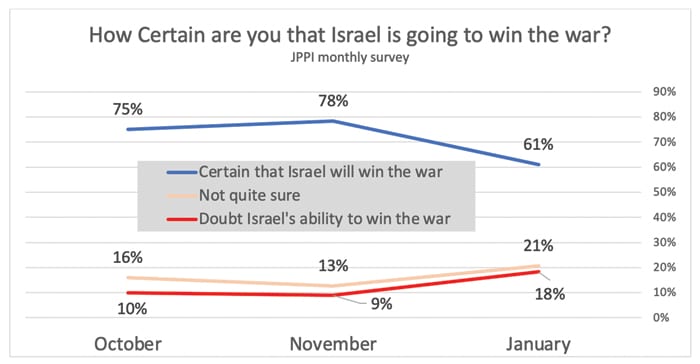
You will not fall off your chair when you see the data. But you should pay attention to its meaning: The lower the trust in Prime Minister Netanyahu, the lower the level of confidence in Israel’s victory in the war. This is a problematic finding, because trust in Netanyahu was low and has not improved. On the other hand, the confidence level of Israeli citizens in victory is decreasing (see graph on the righthand side). It is still high, but clearly eroding. Netanyahu seems to be aware of this. What he said at his press conference last Saturday testifies to his awareness. The IDF chief of staff also seems to be aware of this. The things he said an hour before Netanyahu testify to this. Both made sure to emphasize that Israel is hitting Hamas hard. Both asked for patience, reminding us that a quick victory was never the plan. 

I have no way of judging whether Israel is on the way to victory in the campaign. In my estimation, most other commentators who try to assess Israel’s situation are also fishing in the dark. The question of whether Israel is on the way to victory depends on many variables, only some of which it can truly control. The question of whether Israel is on the way to victory also depends on the question of what victory is. And here is one item that may cause concern. One of the things that victory requires is a sense of victory. That is, the very decrease in the confidence of the citizens of Israel that Israel will win erodes Israel’s chance of winning. That’s why the chief of staff asks for patience. That’s why Netanyahu hammers the pundits who focus on the mounting difficulties. 

The public believes the chief of staff. For three months now, since the beginning of the war, polls by JPPI show that the public trusts the military’s high command. Beyond slight fluctuations, trust in the high command remains roughly the same as it was when the war started. So, when the Chief of Staff says that the campaign is progressing well, he might have the ability to convince the public that Israel is on its path to victory. The PM has no such ability. Not because the facts he presents are different, but because the level of trust in Netanyahu is low. When the war started trust in him was low, and the war itself did not change his situation one iota. It seems as if those who have lost trust in Netanyahu are already deaf to what he says. They are blind to his rhetoric. The percentage of those who trusted Netanyahu in October, shortly after the start of the war, was 32%. In November it decreased to 30%, in January it increased to 34%. These are not changes. These are natural oscillations of the sample. 

Why has the confidence of Israeli citizens that Israel will win gone down? First, because time is passing and victory is not yet in sight. Patience is a necessary commodity, but it’s a rare one too. Every day without victory is another day of news about dead and wounded soldiers, about hostages who have not yet returned, about demonstrations, about heartbreak. Every day in which there is no victory is a day of petty political fights, of wading in muddy waters, of Israeli evacuees who do not return to their homes, of rockets in the north, of discussions in The Hague. 

This is all news that erodes the confidence in victory, regardless of the question of what the IDF forces are achieving in the alleys of the Gaza Strip. If tomorrow the soldiers suddenly find and rescue the hostages, or find and kill the main leaders of Hamas — the picture will likely be reversed. But until there’s good news, there is mostly bad news. And indeed, in the face of bad news, patience is required. Determination and seriousness are required. A leadership that the public can trust is required. 

Netanyahu and his supporters will say, quite rightly, that pundits in TV studios rush to celebrate imaginary victories (in this they are similar to politicians), and rush to announce imaginary failures (in this they irritate the politicians). Netanyahu and his supporters will say, quite rightly, that Israel must show determination, and refrain from desperation. 

In World War II, Winston Churchill maintained high morale in Britain for many months of mostly bad news. Netanyahu was never a Churchill, and even if he was, he is no longer it. He did not enter the war like Churchill, as someone who came to save his people. He entered the war with a significant part of the public believing that his people must be saved from him. Thus, his ability to maintain high morale is limited. And it shows.

Something I wrote in Hebrew

Amid the discussion of the must-win situation vs. the demand not to harm uninvolved citizens in Gaza I wrote this:

There are many reasons to protect the innocent. There are moral reasons — because the innocent are innocent. There are social reasons — because a society that loses its moral compass is a lesser society. There are political reasons — because Israel needs allies for whom it is important to make sure that Israel is a country whose values are similar to their own. There are operational reasons — a moment’s hesitation before pulling the trigger prevents injury to innocents, and prevents our forces from harming their peers. Bottom line: Life is a pendulum, and principles also swing with it. Israel must fight to win. But the way to victory is also important. Do whatever it takes to win. Don’t do anything that’s not essential for winning.

A week’s numbers

Most Jewish Israelis still believe that victory is within reach, but the share of such believers is worryingly declining. 

A reader’s response:

Herb Levin writes: “I just wanted to say that it’s important to repeatedly highlight the bravery and dedication of Israel’s soldiers. Their sacrifice must be always on our minds”. 


Shmuel Rosner is senior political editor. For more analysis of Israeli and international politics, visit Rosner’s Domain at jewishjournal.com/rosnersdomain.

Rosner’s Domain | Until There’s Good News Read More »