Malibu Jewish Center and Synagogue hosted more than 200 attendees honoring Kibbutz Kfar Aza, one of the communities in southern Israel that was attacked on Oct. 7.
During the Dec. 19 gathering, local resident Galia Mizrahi shared the story of relatives returned from Hamas captivity, the Goldstein Almog family. Chen Goldstein-Almog, one of the hostages abducted by Hamas, is the wife of Mizrahi’s cousin. Almog, along with her three children, were safely returned during a temporary ceasefire in November.
Additionally, the event featured testimonies from the Rosenfeld family. On Oct. 7, Hadar and Itay Berdichevsky were killed in their homes at Kfar Aza; their ten-month-old twins were rescued by IDF soldiers 14 hours later. The orphaned siblings’ aunt and uncle, Dvir and Maya Rosenfeld, are now helping raise their twin nephews, and they recently visited Los Angeles to share their story.
“Walk with WIZO” participants march in solidarity with Israeli girls and women. Photo by Ryan Torok
“Walk with WIZO,” an Israel solidarity march organized by the Women’s International Zionist Organization (WIZO), was held on Jan. 4 in Beverly Hills. Approximately 300 people turned out to express support for women and girls who were assaulted by Hamas during its Oct. 7 attack on Israel.
Beverly Hills City Councilmembers John Mirisch and Sharona Nazarian attend “Walk with WIZO.” Photo by Ryan Torok
Attendees included WIZO California Chairperson Gina Raphael, Beverly Hills City Councilmembers Sharona Nazarian and John Mirisch, Deputy Consul General of Israel in Los Angeles Amit Mekel, Adat Shalom Rabbi Miriam Potok, Israeli-American Civic Action Network CEO Dillon Hosier, L.A. City Councilmember Traci Park; congressional candidate Nick Melvoin; and Cantor Shanee Zamir.
“Today, as we bear witness to the unspeakable trauma and the brutalized bodies of our sisters, we know that this is not our time for peace,” Potok, one of the event’s speakers, said to the crowd gathered outside Mickey Fine Pharmacy on Camden drive. “Yet we hold out hope.”
Attendees carried signs reading “I Stand with the Women of Israel” and “Believe Women,” while waving Israeli flags. They marched up and down Rodeo Drive to show their solidarity with Israel and demonstrate support for Israeli girls and women who were sexually assaulted by Hamas terrorists during the unprecedented October attack on southern Israel.
“I think it’s time to finish Hamas,” Pablo Nankin, a participant in the march, said. “It’s time to be heard, it’s time for the poor people who were raped and killed to be cared for [and remembered] and that’s what we have to do. We have to tell the people we’re here; we’re going to stay here, and they can’t keep on doing this to us.”
The event was held as increasing evidence has emerged of Hamas’s gender-based crimes against Israeli women.
Sinai Akiba Academy parents come together, and braid together, during a community challah bake. Courtesy of Sinai Akiba Academy
On Nov. 2, in celebration of the Shabbos Project’s Worldwide Challah Bake initiative, more than 160 Sinai Akiba Academy (SAA) community members came together for a community-wide Challah Bake. Led by SAA Middle School math teacher Heather Lipman, the SAA community mixed and braided bread together, in preparation for Shabbat and in honor of Israeli soldiers.
When registration went live in October, the event sold out in less than three hours, and was a highlight of the school year thus far. Special shoutout to the tireless event committee, led by Co-Chairs Hannah Khoubian, Elian Ohebshalom, Mahsa Pakravan and Shelly Shapiro.
Our family travelled this week to Palm Springs for our annual PARR (Pacific Association of Reform Rabbis) conference. While not in session, we made time to take the aerial tramway up the mountain. As we gazed as the changing landscape – and felt the plummeting temperature (it was 55 degrees at the bottom and 25 degrees at the top), I thought of the incredible interplay between Divine and human craftsmanship.
I mean, c’mon! The views going up were breathtaking. And the fact that human beings were able to place wires and pillars holding up our tram blew my mind.
Our liturgy reminds us each morning to capture the beauty of creation as a gifted moment in time: “Mah rabu ma-asecha, Adonai!/ How wondrous are Your works of Creation, oh God!”
Australia is going through a kind of preemptive deNazification. So why can’t Gaza?
Nearly eight decades after the end of World War II, Australia has just outlawed publicly making the Nazi salute or displaying the swastika or the signs of the SS.
Attorney General Mark Dreyfus said the laws are necessary to deter Australians from “glorifying” or “celebrating” the “evil ideology” of Nazism.
Neo-Nazi groups in Australia have never attracted many members, and their candidates for office have won only a tiny number of votes. Most Australians want to keep it that way. Placing Nazi gestures outside the margins of civilized society is a small step in that direction.
The salute, known in German as a Hitlergrub (Hitler Greeting), was adopted by the Nazis in the 1920s, along with the accompanying words “Heil Hitler” or “Sieg Heil.” After the Nazis rose to power in 1933, the salute was made compulsory for all government employees in Germany and during the singing of the German national anthem. Failure to give the salute could result in criminal prosecution or worse. Portugal’s consul-general in Hamburg was beaten up by Nazi thugs for failing to salute a march by Hitler supporters. German Jews were prohibited from giving the salute on the grounds that their use of it would dishonor the gesture.
In post-World War II Germany, the Allies outlawed all Nazi symbols, gestures, and activities as part of a “deNazification” strategy. The goal was to eliminate all traces of Nazism from the political and educational systems, and from popular culture, in order to ensure that Hitler’s followers could never again influence German society.
A similar policy was pursued in Japan. The American occupation authorities rewrote the Japanese Constitution and drastically reformed Japan’s schools. They also implemented what was known as the Shinto Directive, to curb the influence of the Shinto religion because of its militaristic elements. Shinto-linked government officials were removed from office, Shinto priests and shrines were deprived of government funding, and school textbooks reflecting Shinto ideology were revised or eliminated.
In the years following World War II, many other countries—now including Australia—implemented laws to obstruct neo-Nazi activity, even when such legislation ruffled the feathers of some civil libertarians.
Thus in addition to Australia (and Germany), the Nazi salute is outlawed in Austria, Slovakia, and the Czech Republic. In Sweden, giving the salute is considered a hate crime. In many other European countries, it is prohibited if used to promote Nazism.
Public display of the swastika is banned in twenty-one countries. In some others, there are partial restrictions on the symbol, such as permitting its display only for educational or artistic purposes. Some countries have prevented neo-Nazis from running for office; earlier this year, Greece banned the neo-Nazi Golden Dawn party from participating in the upcoming general election. And a number of democratic countries have outlawed various forms of hate speech.
Many Israelis support implementing a “deNazification”-type process in postwar Gaza. Terrorist groups and supporters of terrorism would be banned from any future political process. The curricula in Gaza schools would be completely overhauled to eliminate textbooks that glorify terrorists or teach hatred of Jews and Israel, and teachers would be re-trained accordingly. The news media would be required to engage in genuine journalism, not cheerleading for murderers and rapists.
To be successful, such a process would have to address even those of aspects of Gazan society that might at first glance seem innocuous, such as children’s toys. In Nazi Germany, the authorities sought to entrench the Hitler salute in the national culture by giving all children a three-inch-tall plastic figurine of Hitler with a movable right arm. In Gaza, there is a popular doll of a child holding a rock in his upraised arm, his face covered by a keffiyah. Rooting out the glorification of violent antisemitism needs to start at a young age.
DeNazifying Gaza will be a lengthy and complicated undertaking. Vigilant monitoring will be necessary to guard against backsliding, and even decades from now, additional corrective steps might be needed, just as Australia and other countries are still doing, all these years after World War II. But the alternative is an eventual repeat of October 7.
Dr. Medoff is founding director of The David S. Wyman Institute for Holocaust Studies and author of more than 20 books about Jewish history and the Holocaust. His latest is America and the Holocaust: A Documentary History, published by the Jewish Publication Society & University of Nebraska Press.
…and a heavy mixture of noxious creatures came to Pharaoh’s house and his servants’ house, and throughout the entire land of Egypt… ~Exodus 8:20
Thanks to my inability to look into the face
of any creature and think of them as noxious
a commandment was set upon my house that
I am not allowed to feed the outside cats.
(Or the outside coyotes, or outside squirrels.)
This commandment came down from
my wife on high when she saw that there
were four cats in our house one day and
determined that this was too many cats.
It didn’t help when one of them had babies
and, for the all-too-briefest time, there were
nine cats in our house. Some of them, so small
and furry, and cute, that the word noxious
took up permanent residence outside of
our vocabulary.
My first inclination, when a squirrel found its way
into our house (not through any efforts I made.
It was just inside the house somehow, sitting
on top of one of the treadmill arms, close to the
backyard screen door and the rest of its world)
was to try to give it a carrot. Oh that squirrel
must be hungry was the first thing I thought
and not how can I get this squirrel out of the house
as, undoubtedly, my wife would have preferred.
If I were Pharaoh, wild beasts never would have
worked on me as I would be commanding my people
to pet them…not into submission, but until they knew
we were on their side. Until word got out in the
wild beast community that Egypt may just be
the place to be. Of course, I am not Pharaoh and
those furry faces just hardened his heart reminding us,
Egypt is never the place to be…not when a promised land
is just across the river, only forty years away.
Rick Lupert, a poet, songleader and graphic designer, is the author of 27 books including “God Wrestler: A Poem for Every Torah Portion.” Find him online at www.JewishPoetry.net
(New York Jewish Week) Days after a wall at Chabad’s Brooklyn headquarters — and the entire internet — broke down over an effort to burrow into a synagogue there, New York City investigators have revealed exactly what kind of tunnel everyone is talking about.
An illicit underground passageway running underneath a building adjacent to the complex’s main synagogue stretched for 60 feet, the city’s Department of Buildings said on Wednesday. The tunnel was 8 feet wide, 5 feet tall and threatening the structural stability of two buildings, the department said.
Drama surrounding the tunnel drew international attention after bedlam broke out at the complex’s synagogue on Monday. A group of men had tried to tunnel into the synagogue in an effort to expand the headquarters, and when the building’s administration attempted to repair holes they had breached, the men tore into the synagogue’s walls.
Nine people were arrested and three cited for disorderly conduct during the commotion, which also gave rise to antisemitic conspiracies online and brought rifts within Chabad to the fore. The headquarters at 770 Eastern Parkway, a building that has taken on symbolic significance for the Hasidic movement and its global network of emissaries, has been closed since Monday afternoon.
But until now, the extent and nature of the tunnel was unknown. Investigators uncovered “a single linear underground tunnel” approximately the length of a bowling alley that had been illegally excavated, the buildings department told the New York Jewish Week on Wednesday.
“The safety of our fellow New Yorkers is our highest priority,” the department said in a statement. “We will continue to monitor the progress of this emergency stabilization work, and if necessary, we are ready to take additional actions that may be required in the interest of public safety.”
Reports of the tunnel first surfaced last month, and videos from the scene on Monday showed young men shouting, arguing with police, being handcuffed and taken out of the building in an effort to preserve it. In the end, police arrested people for charges including criminal mischief, reckless endangerment and attempted hate crimes, a spokesperson for the NYPD told the New York Jewish Week. There was no further information on the nature of the alleged hate crimes.
The complex is a place of prayer, study and other Chabad activities, and in the past, it served as the office of the movement’s late leader, Rabbi Menachem Mendel Schneerson, who died in 1994. A small, independent group from Chabad has been pushing to expand 770 — believing that Schneerson, who some Chabadniks believe is the messiah, instructed them to do so. Students who were at the scene told the New York Jewish Week that the tunnel had been part of that effort to expand the complex.
Chabad spokespeople and witnesses to Monday’s mayhem described those responsible for the tunnel as a fringe group within the movement. Chabad leaders have condemned the incident and expressed anguish over the synagogue’s closure.
In response to the city’s investigation, Chabad spokesperson Motti Seligson said on X, formerly Twitter, that a “basement-level space” with similar dimensions to the tunnel found by the Department of Buildings “was dug out by young agitators underneath a ground-level extension made by the synagogue decades ago.” The spokesperson, Motti Seligson, said that concrete had been used to fix some of the damage, in coordination with the city.
Seligson said Chabad leadership had alerted authorities to the “destruction and vandalism” on Monday and coordinated the response with the NYPD.
“This episode has been deeply painful for us and the entire Jewish community,” Seligson said in a statement. “We look forward to the sanctity of the synagogue being restored and its light continuing to emanate to the world.”
The tunnel was in the basement of a single-story building behind the Chabad headquarters’ main synagogue, where Monday’s fracas took place, the city investigation found. The department has been investigating it since Tuesday morning.
Those who dug the tunnel had created several openings in the basement walls of the single-story building. It wasn’t immediately clear how much of the tunnel had been excavated from the ground, and how much was formed by making openings in existing rooms.
The tunnel had rudimentary supports in place and was constructed without approval or permits. City engineers said the excavation had undermined the building above it, as well as another building on Kingston Avenue, causing structural stability issues. The Department of Buildings issued partial vacate orders for both buildings due to safety concerns.
The department said other neighboring structures were unaffected and could be reoccupied, apparently meaning that the synagogue itself was secure.
The city instructed the owners of the properties to hire an engineer to stabilize the excavation and fill in the tunnel where necessary. The owners had already employed an architect, engineer and contractor on site who were preparing to do the emergency work, the department said.
This is not the first controversy to envelop the complex, which has been the subject of a years-long legal battle over ownership between rival Chabad institutions. Disputes over where the site should be expanded, and how it should be done, have gotten renewed attention in the wake of the incident.
Baseless antisemitic conspiracies also spread online, including false claims that a tunnel network under the synagogue was used for trafficking children, echoing centuries-old antisemitic blood libels.
The tunnel was empty except for dirt, tools and debris, the Department of Buildings said.
Efficiency is overrated. Jim Benson, expert in time management claims that efficiency becomes “a limitless reservoir for other people’s expectations.” Author Oliver Burkeman explains that we should stop worrying about our overflowing to do lists, endless emails, and attempts to finish everything. Burkeman doesn’t imply that we ignore our responsibilities. However, he suggests we refrain from “clearing the decks.” Clearing the decks is the idea that through our busy work, we will eventually see blank slates and empty counters. The attempt is futile. Getting to a zero inbox leads to more emails and more responses. Checking off bucket lists means we will inevitably fill the list with other random duties. We are engaged in an endless race in completing meaningless tasks instead of choosing to engage in meaningful moments.
The secret to time management is knowing what kind of time we hope to manage. When we sit on our deathbeds, will we feel pride in conquering our emails or feel contentment in knowing we engaged with family and friends? Efficiency becomes less about giving our full attention to everything and more about determining who and what deserves our attention. Perhaps time management is best practiced when we see time as finite, practice “staying present” and wonder if our activities will leave positive impacts on future generations.
We learn that the first mitzvah given to the Jewish people is delineating time for the new Jewish month. Establishing Rosh Chodesh. The mitzvah is given after the story of our people enslaved in Egypt, finally experiencing the tastes of freedom. But perhaps, the gift of Rosh Chodesh has more to do than with just structuring the calendar. Perhaps God is reminding us that true freedom comes in understanding how to best use our time. Not merely fill time but rather, live purposefully.
May we manage our time wisely and in doing so, taste freedom.
Shabbat Shalom
Rabbi Nicole Guzik is senior rabbi at Sinai Temple. She can be reached at her Facebook page at Rabbi Nicole Guzik or on Instagram @rabbiguzik. For more writings, visit Rabbi Guzik’s blog section from Sinai Temple’s website.
Author Dianne Jacob says her love of food came from her parents, who were Orthodox Iraqi Jews from China, and very adventurous eaters.
“My ancestors came from Iraq through India to Shanghai, so I ate a lot of Bombay Baghdadi Jewish food,” Jacob told the Journal.
In Iraqi food there’s a lot of stews, vegetables and stuffed items. Baghdadi Bombay food is spicy, like Indian food, with curries, chutney and mango pickle.
“Since [about] 95 percent of American Jews are Ashkenazi, [my parents] had a very hard time with their identity in the context of being Jewish,” she said. “So they cooked to identify themselves and to remember who they were.”
Jacob’s father made pickles and labneh, her mother did all the cooking and baking. Plus, they had a garden.
“They were very wrapped up in their past and food was how they expressed it,” she said.
Jacob got a journalism degree in her twenties, started writing for newspapers and became a magazine editor and then a book editor, before going out on her own.
Jacob, who teaches and coaches food writers, is author of “Will Write for Food: The Complete Guide to Writing Cookbooks, Blogs, Reviews, Memoir, and More.” Now in its fourth edition, “Will Write for Food” has won three international and national awards. She co-authored two cookbooks:”Grilled Pizzas and Piadinas” and “The United States of Pizza,” and her essay, The Meaning of Mangoes, won an annual award from the Association of Food Journalists and from Les Dames Escoffier.
A lot has changed in food writing over the years.
“I think what’s best about it is that anyone can go online and start,” Jacob said. “Before there were a lot of gatekeepers.”
There still are gatekeepers in print, but not as many online. Anyone can start by creating their own platform, whether it’s a blog, an Instagram profile or a Substack newsletter.
Jacob finds the expression “I love food” impossibly broad. Food could be popsicles, curry or the Feast of the Seven Fishes.
“I always say that in writing, you should pick something that’s narrow and deep versus something that’s wide and narrow,” Jacob said.
For instance, Jacob’s topic is food writing. She teaches and talks about it, and has a blog and newsletter.
“I never run out of topics,” she said. “I could be writing about AI, the technical specifics of recipe writing, I could be interviewing an agent or a publisher.”
People’s strong connection to food comes from necessity – we all have to eat – but it’s so much more.
“From a survival standpoint, we do have to engage with food and then you have to make decisions about it,” she said. “What you like, what you don’t like, what you perceive is healthy, what you perceive is indulgent [and] how much is too much.”
Jacob says because outside food has become normalized, there’s more emphasis on being a good cook.
“When I grew up, we went out like once a month, maybe, for a meal,” she said. “Now you can get takeout breakfast, takeout coffee, a takeout sandwich. … Standards are higher for what that food tastes like, as opposed to home cooking, which usually isn’t quite as complicated or doesn’t have as much fat or salt.”
She adds, “Even if you’re just going to In N Out Burger, they’ve spent a lot of time figuring out how to make the absolutely most delicious burger possible, and that’s what you have to compete with as a home cook.”
Because of her background, Jacob loves to make Middle Eastern and Asian food. She also enjoys making soup.
“In the winter, I don’t like to eat salads as much as in the summer, so I like to get all my vegetables in by having soup,” she said. “I never get bored making a huge pot of soup and putting some in the freezer and discovering it [a month later].”
Jacob’s earliest food memory is making a trade with another little girl on her street.
“I think her family was Scandinavian,” Jacob said. “She gave me a cookie and I gave her a preserved Chinese olive, which is cured with licorice and salt and sugar. … Another time she had a bowl of milk that had blueberries in it, and I thought, ‘Wow, your food is really boring.’”
When asked how people can make their food less boring, Jacob said to use more salt.
“I was a terrible cook for a long time because I had no idea how much salt to put in food,” she said. “In fact, I was a terrible soup maker. I used to say that my stock tasted like dish water, but I have learned to use salt properly.”
In fact Jacob “despises” recipes that say “salt to taste.”
“If you’ve never made this thing before, you really don’t know how much salt should be in it and you don’t know what it’s going to taste like, so it’s just not helpful,” she said. “A good recipe writer will tell you how much salt and then if you want more, great. If you’re watching your salt, use less, but at least there’ll be a guideline.”
The key to writing recipes is to take ownership of them.
“It’s your recipe, it’s the way you like it, and that’s how you should present it,” Jacob said. “You do have to think about who is your target audience and how much time [they are] willing to put into this.”
One more thing.
“A lot of people are obsessed with describing food; they want to use an endless number of adjectives,” Jacob said. “That really doesn’t add anything to your writing. It’s better to tell a story and explain the food that way.”
Learn more about Dianne Jacob at DianneJ.com, follow @DianneMJacob on Instagram, and subscribe to her newsletter, aimed at food writers, at Diannejacob.substack.com.
For the full conversation, and more cooking and recipe-writing tips, listen to the podcast:
Debra Eckerling is a writer for the Jewish Journal and the host of “Taste Buds with Deb.” Subscribe on YouTube or your favorite podcast platform.Email Debra: tastebuds@jewishjournal.com.
We all wait for that moment. The audience at the 75th Primetime Emmy Awards becomes silent as the lights dim, orchestral music is cued, and a powerful singer — think Jennifer Hudson — appears dramatically as the traditional In Memoriam segment of the show begins. This year, the Television Academy has compiled a list of over 250 people who left us since the last Primetime Emmy Awards were given out (https://www.emmys.com/in-memoriam). They brightened our lives as performers, series creators, writers, producers, journalists, executives, and even government officials. And they brought pride and joy to the Jewish community.
On TV, the names and images of the departed flash by so quickly (and some are omitted inadvertently) — we barely have any time to register what lasting impact they had on screen, and beyond television.
All are worthy of this special tribute, which reflects their lasting importance in shaping our viewing experience, and beyond that, influencing our larger thinking in ways that will stand the test of time.
Although many of the departed were notable for a particular season or series, a select group of seven Jews were among those who truly moved the needle; they brought extra-special qualities to their television work, and to humanity itself.All are worthy of this special tribute, which reflects their lasting importance in shaping our viewing experience, and beyond that, influencing our larger thinking in ways that will stand the test of time.
Consider this as a handy guide while watching the In Memoriam during this year’s 75th Primetime Emmy Awards broadcast, hopefully deepening that fleeting experience and our cultural connection to them. More importantly, we have designed this to serve as a heartfelt reference to be reviewed well after the show’s closing credits begin to scroll. Simply put, we remember these Jewish television luminaries with enduring respect and appreciation.
Norman Lear (Frederick M. Brown/Getty Images)
Norman Lear, 101 More than just a prolific sitcom producer, Norman Lear’s comedies often imparted messages about how society was changing. Beginning in the early 1970s, Lear left a permanent imprint on America by exposing, with plenty of laughs, hot-button issues to a wide audience. He placed a spotlight on topics like civil rights, abortion, divorce, feminism, homosexuality, alcoholism, and patriarchy.
Virtually nothing was off-limits in a Lear sitcom. He created sharply drawn, oftencontroversial characters, like the bigoted Archie Bunker in “All in the Family,” a program that was the top-rated TV show for five consecutive years. That series broke fresh ground with frank but funny depictions of social issues within a dysfunctional but loving family that mixed liberals with a staunchly conservative father figure.
Other Lear shows knocked down barriers by featuring mostly black casts, like “The Jeffersons” and “Good Times,” or “Maude,” with a boldly feminist lead character. With Norman Lear’s successes piling up, other producers felt increasingly comfortable presenting real-world topics in comedic settings, connecting to audiences as they were experiencing situations in real life.
Archie Bunker thought of himself as a patriot, but Norman Lear was the real deal. His love for America’s values clearly ran deep. He had been a gunner in World War II bombing missions over Germany. He also was a passionate liberal who founded People for the American Way, a nonprofit nonpartisan advocacy group.
And in a striking gesture, Lear and his wife Lynn spent over 8 million dollars to buy one of the few surviving 1776 copies of the Declaration of Independence. He called it our nation’s birth certificate and mounted a three-and-a-half-year cross-country tour of the document to some 100 cities in all 50 states, including visits to more than a half dozen Presidential libraries. The goal was to inspire Americans to participate in civic activism, to exercise their rights, and to vote.
Bernard Kalb, 100 Bernard Kalb, along with his younger journalist brother Marvin Kalb, brought viewers a deep understanding of global events through his pioneering reporting of international affairs. Through him, we began to see how the United States was positioned in the larger arc of history that was being shaped outside our shores.
For nearly a quarter century at CBS and NBC (and before that, at The New York Times), Kalb reported on the scene with sobriety and authority. He covered wars, revolutions, and the diplomatic breakthroughs that ultimately led to the end of the Cold War. These were complex situations that required explanation without simplification, and Kalb’s ability to do this helped educate generations about the high stakes at hand, and often the fragile egos of those who were in charge. By setting a high standard for diplomatic reporting, he created a new path for other television journalists to follow, including Ted Koppel (ABC), Andrea Mitchell (NBC), and Christiane Amanpour (CNN).
Kalb left broadcasting in 1985 to become the chief State Department spokesman during the Reagan Administration, in part to have an active role not just in reporting on diplomatic events, but in shaping them. He was the first journalist who had covered the State Department ever to assume that role. Kalb brought a stature and professionalism that, like journalism, depended upon truth and credibility as essential assets.
With these principles in mind, Kalb then resigned from this job of a lifetime in 1986 to protest what he called an unconfirmed “reported disinformation program” conducted by the administration against the Libyan leader Col. Muammar Gadhafi. In doing so, he became a pioneering public official to warn about the corrosive potential of government disinformation. He set an example with a principled resignation that amplified this warning around the world, and to this day.
Newton Minnow (Chip Somodevilla/Getty Images)
Newton Minow, 97 Newton Minow, a former aide to two-time Democratic presidential nominee Adlai Stevenson, became an overnight sensation shortly after President Kennedy appointed him as Chairman of the Federal Communications Commission in 1961. That May, Minow addressed the annual National Association of Broadcasters convention in Washington, DC, and brought some tough love to the assembled television executives. He admonished them for the shows they were airing in prime time, calling the terrain a “vast wasteland” and admonishing them to do better. Never before had a government official who ran an agency that could renew or reject broadcast licenses delivered such a stark critique.
Few viewers could disagree with it, however. As Minow noted, the “public interest” required that television should serve a better and higher purpose than just as window dressing for endless advertising messages. “Vast wasteland” became a rallying cry for those who wanted television to do better, although those clinging to the status quo refused to remain silent. When Sherwood Schwartz created “Gilligan’s Island” for CBS, he made sure that viewers always remembered the name of the sinking ship that left the crew marooned — the SS Minnow.
Minow’s influence on television programming extended well beyond his rhetorical flourish and the necessary national conversation that it generated. He was instrumental in the creation of public television, and served as Chairman of PBS during its formative years. And while understanding the immense power of television, he also realized that its impact could be expanded exponentially if television networks could distribute programming more widely and seamlessly through communications satellites.
As FCC Chairman, he championed the government’s role in promoting communications satellites that have expanded what we can watch at home and abroad — to thousands of channels on cable and in streaming media. In the end, technology has proven to be the best tool for countering the limited choices that Minow perceived when he delivered his “vast wasteland” commentary so dramatically.
Ed Bieler (Mat Szwajkos/Getty Images)
Ed Bleier, 94 Bugs Bunny, Daffy, Duck, Elmer Fudd, Porky Pig, Road Runner and their friends were kept alive for future generations by a television executive named Edward Bleier. Bleier’s extraordinary career in television helped nurture the growth of MTV, Nickelodeon, and The Movie Channel. He pioneered the concept of interactive and pay-per-view television. Any of these accomplishments would have been enough for him to be remembered as a legendary TV businessman.
But his role as President of Warner Brothers Animation is even more enduring. Bleier aggressively challenged Disney’s leadership position for Saturday morning cartoons that kept us enthralled. His genius was in mining the Warner Brothers vault, which included Looney Toons cartoons, and repackaging them for endless enjoyment of kids and their parents.
Unlike Mickey Mouse or Donald Duck, the Looney Toons characters definitely were on the edge — always ready to fall off a cliff or be blown up in the interest of making us laugh. Danger seemed less dangerous when we saw the Tasmanian Devil race around.
Bleier made sure that these characters would live perpetually on screen. Many more Looney Toons shorts were ordered for production during the past 50 years, and creative partnerships with the likes of Steven Spielberg, Michael Jordan, and LeBron James brought us Tiny Toon Adventures and Space Jam. Thankfully, Tweety’s chirping still remains as sweet music to our ears.
Ed Bleier realized that resurrecting Looney Toons was reviving a beloved animated comedic tradition. But he had an even more ambitious idea about another tradition — Thanksgiving. He spent years thinking about how to create a day that was more than just overeating and watching endless football games. He wanted people to celebrate the national holiday as a true day of gratitude, and organized readings and activities that could be pursued by all ages as the turkey and trimmings were passed around the dining room table.
Bleier then wrote The New York Times bestselling book, “The Thanksgiving Ceremony: New Traditions for America’s Family Feast,” as an aspirational guide for making Thanksgiving every bit as memorable as the Fourth of July. “My attitude is that everything embodied in this country is in that holiday and should be celebrated accordingly,” he noted. Ed Bleier reminded us that Thanksgiving always begins with thanks.
Betty Rollin, 87
Network news correspondent Betty Rollin covered many important stories as a broadcast journalist for NBC, ABC, and PBS, but her most powerful ones were very personal and public. They were about Rollin’s own experience with cancer and assisting her mother’s death.
After a series of delays and errors, Rollin was diagnosed in 1975 with malignant breast cancer and underwent a mastectomy. Her bestselling memoir and made-for-TV movie about that experience, starring Mary Tyler Moore — “First, You Cry” — pushed the emotional trauma and recovery option prominently into the public spotlight. She was amazed at the personal responses to “First, You Cry” and found relief from reading breast cancer jokes sent to her by women around the country.
Her 1985 bestseller, “Last Wish,” detailed how she helped her mother’s assisted death when she was in great pain from ovarian cancer (some thought the book could be interpreted as an admission of murder). It also reached a wide audience as a made-for TV movie, with Patty Duke portraying Rollin.
Rollin didn’t enjoy opening up many intimate personal details with the public, but she felt it was important to tell the truth about them as part of her activism. Her self-reporting was not about vanity but about opening windows on important topics that had been taboo in polite society.
“Last Wish” created a national conversation that led to Oregon’s first-in-the-nation Death with Dignity law in 1984. Rollin also became a National Death with Dignity Center board member. She shined a light on both these issues, which would help millions of people confronting comparable situations.
Betty Rollin faced her final health challenge in 2023 when suffering from gastrointestinal issues and arthritis. She chose voluntary assisted suicide in Switzerland, but requested not to have that revealed until after her passing.
Jerry Springer (Bruno Vincent/Getty Images)
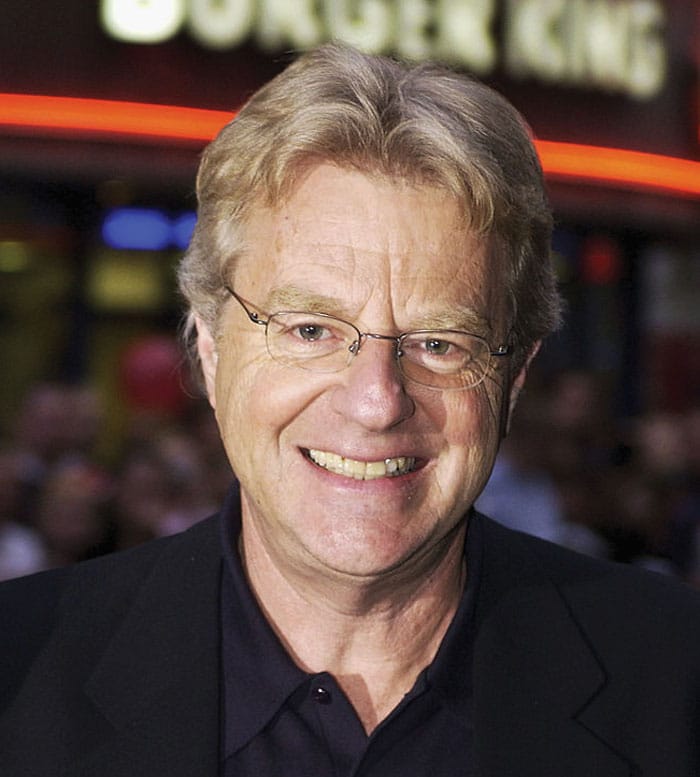
Jerry Springer, 79
Jerry Springer helped usher in a style of daytime talk show that resembled professional wrestling in its depiction of heroes and villains, along with the drama that played out whenever good and evil lined up to battle each other for an hour. Springer clearly was the ringmaster, egging his guests on to say and do outrageous things to the delight of the studio audience.
For loyal viewers, the experience was often like watching a slow-moving car wreck. Yet he also let viewers know that they shouldn’t take the on-screen antics so seriously; they always got a sense that Springer was skeptical, even embarrassed, by what was transpiring, yet willing to play along in the interest of making the show interesting — worthy of buzz well before the advent of social media. Where Phil Donahue brought a palatable plain vanilla to daytime talk, Springer’s confection was a complete ice cream sundae — lots of whipped cream, and of course, loads of nuts.He helped us eat it up without worrying too much about the calories.
Springer honed his television skills in several different high-stakes fields — law, news, and politics. As a politician, including a stint as Mayor of Cincinnati, he had broad exposure to connecting with people from all walks of life. As a TV news anchor, he knew that storytelling was essential to make viewers care about what they were seeing every night before they went to sleep. And his passion for social justice led him to take a leave of absence from law school to work full time for Robert F. Kennedy’s campaign for President in 1968. His commitment to social justice stemmed from his Polish-born parents, who escaped from Berlin in 1939, enabling them to flee to the United Kingdom as World War II began.
Jerry Springer brought unusual intelligence to presiding over a circus-like atmosphere that made his show a ratings blockbuster. He knew that seeing the sense of madness he orchestrated actually might help us cope with the greater real-world tensions that he had experienced in the other facets of his professional life.
Paul Rubens (Jamie McCarthy/Getty Images)
Paul Reubens, 70
Paul Reubens, a versatile comedic actor, was a performance artist at heart. While his man-child alter ego, Pee-wee Herman, seemingly was meant for children, he also made it okay for adults to experience childhood wonder once again.
Reubens was part of the legendary L.A. improv troupe, the Groundlings. When his “Saturday Night Live” audition didn’t work out, he took Pee-wee Herman to the stage, and ultimately to his acclaimed CBS Saturday morning series, “Pee-wee’s Playhouse.” The outrageous character, trademark skintight suit and bowtie, rouged cheeks, and imaginative Playhouse reflected a totally offbeat world.
His unflinching commitment to Pee-wee Herman’s eccentric character, who had a seemingly endless fascination with almost everything, amused kids and adults alike. Reubens’ unrelenting commitment to always stay in character may have resembled the single-minded focus of his father, a founding pilot in the Israeli Air Force and one of just five military aviators who flew missions against Arab forces in smuggled fighter planes during the 1948 Arab-Israeli War.
Paul Reubens hoped Pee-wee Herman and the world he developed for him would inspire creativity and open-mindedness about nonconformity for children, without being overly preachy or teachy. “Pee-wee’s Playhouse,” with its garish colors and characters that included a talking Floory, a hugging Chairry, and Mr. Window with a life of their own, reflected Reubens’ wild make-believe environment, which carried over from his collection of eccentric art and design at home.
This fantastical environment on screen was a tilted look at reality — a mix of postmodernism, secondhand store chic, and all-around kitsch. It expressed the imagination of Reubens and other series creators, including painters, cartoonists, and sculptors. “Pee-wee’s Playhouse” stands the test of time as Paul Reubens’ expansive vision for the sheer joy it brought to all ages.
As often is said in the Jewish tradition, may their memories be a blessing. While all lives seem to flash by quickly on screen and off, their indelible contributions undoubtedly will trigger deep appreciation for all they contributed to television viewers, and our lives in 2024 and beyond.
Stuart N. Brotman and Bob Males grew up in suburban New Jersey as television Baby Boomers, glued to their living room screens. Friends since high school, they pursued their shared viewing passions professionally. Brotman served as President and CEO of The Museum of Television & Radio (now the Paley Center for Media) in New York and Los Angeles and is a noted media scholar. Males has won several regional Emmy Awards as a television producer for newscasts, documentaries, and other programs. They email each other daily with updates about those in the television world who have recently passed on, expressing sorrow, but also sharing fond recollections about those whose impacts are destined to be felt by millions of TV viewers for years to come.
An unusual transformation has swept through the Israeli community in Los Angeles since the outbreak of the war in Israel. Many have found themselves becoming social activists, fervently organizing demonstrations, soliciting donations and gathering funds from friends and family for the IDF.
Some have gone to great lengths, flying to Israel to personally deliver crucial equipment like bulletproof vests and helmets to soldiers. Others, who were in Israel on vacation before the terror attack, chose to extend their stay to prepare hot kosher meals for the soldiers. Notably, there’s even an Israeli artist who, while visiting Israel, volunteered for ZAKA and helped with the sacred work of collecting bodies.
This unprecedented surge of activism reflects a profound shift in people’s willingness to dedicate themselves entirely to the cause. Noa Zahavi, an Israeli actress who has lived in Los Angeles for seven years, shared her perspective on this change.
“I moved here with my husband when I was pregnant with my first daughter,” Zahavi said. “One of the reasons we chose to relocate was our concern for the security situation in Israel. On the day we got married there were three teen boys, Yaakov Naftali Frenkel, Gil-Ad Shaar and Eyal Yifrach, who were kidnapped by Hamas members.We questioned how we could raise children in Israel under such circumstances.”
In Israel, Zahavi performed at the Cameri Theater and her husband worked as a technical producer. After moving to L.A., Noa dubbed the voice for the character Hila Bashan in “Fauda” and focused on raising her two children, ages four and seven. A month before the terrorist attack, she established a performing arts school. However, in the aftermath, she set aside her endeavors to wholeheartedly commit to supporting the families of the abductees.
Driven by a shared sense of responsibility, Zahavi formulated a plan to assist these families. She initiated a call to action by posting on social media and invited families to contact her for media interviews in the United States. Joining forces with producer Tal Yaari, a friend and colleague, they organized interviews, arranged for meetings with influencers and people in the entertainment industry.The Israeli Consulate then reached out with a request for collaboration, followed by an official request from the Hostage Families Forum in Israel to establish an official branch in LA.
The families of the hostages arrived in the U.S. and met with Los Angeles Mayor Karen Bass, lit Shabbat candles in Beverly Hills and participated in events including a large-scale solidarity gathering at Sinai Temple with senior members of the Black Christian community. One ongoing project focuses on fulfilling wishes for the children who returned to Israel after being kidnapped by Hamas. One ongoing project focuses on fulfilling wishes of the children who were released by Hamas. Notably, singer Coco Malone created a video for Abigail Edan and got Emily Hand, who is a huge Beyoncé fan, an invitation to attend Beyoncé’s concert.
Sharon Stone meets with hostages’ families in her home
Several celebrities, including Arnold Schwarzenegger and Sharon Stone, took the time to meet with the families. Stone hosted a few family members at her home, including Ella Shani and Yoni Asher. Fourteen year-old Ella from Kibbutz Be’eri told Stone about her father’s murder and the abduction of her cousin Amit, 16. Yoni’s wife Doron and their two daughters, Raz (4) and Aviv (2), were also taken by Hamas (and since released). After the meeting, Stone shared an emotional post in which she wrote, “Meeting people whose children were taken prisoners and who lost their close family members. Don’t support violence.” Stone pledged to personally speak to the Red Cross and do everything in her power to assist the families.
Another meeting took place at the home of Scooter Braun, Justin Bieber’s Jewish manager, along with film producer Lawrence Bender (“Kill Bill,”“InglouriousBasterds”).
Zahavi said that they are working on bringing the families of hostages and other lecturers to U.S. campuses, mainly those who have been known for their antisemitic rhetoric, in order to create a shift. “Those universities are being funded for years by Qatar which results in a history of hatred in U.S. Campuses. We aim to inform major companies like Procter & Gamble about the funding sources and activities at these institutions.”
The activity of the organization is funded by donations which goes to bringing the families to the U.S., hotels, car rentals, billboards and a truck featuring “LEDs” displaying pictures and names of the hostages. Zahavi, who is arranging interviews and raising money, admitted it’s not easy, but there is an urgency to bring awareness to the grave situation of the hostages.
“We don’t have a moment to lose.” – Noa Zahavi
“We don’t have a moment to lose,” she said. “We receive shocking testimonies from the released hostages regarding the situation of those who are still there, especially what they are doing to women in captivity. We know about severe sexual crimes against women. We heard testimonies about women who are being used as sex slave (sic). There is one hostage that was released and got pregnant there and needed to have an abortion and now is dealing with the mental consequences of what she had endured. They need to be released today, not tomorrow. People don’t realize how severe the situation is.”





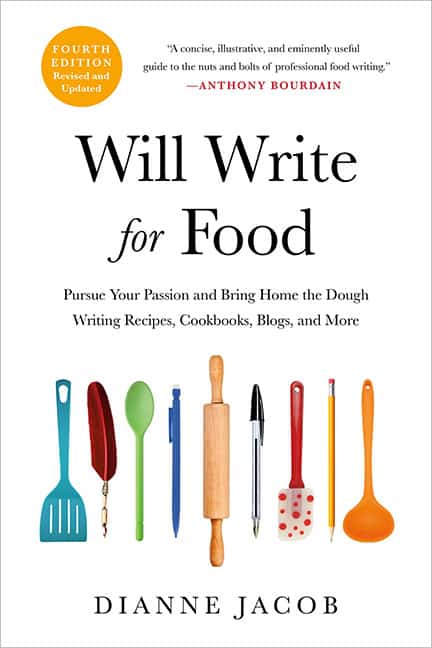 Jacob, who teaches and coaches food writers, is author of “Will Write for Food: The Complete Guide to Writing Cookbooks, Blogs, Reviews, Memoir, and More.” Now in its fourth edition, “Will Write for Food” has won three international and national awards. She co-authored two cookbooks:”Grilled Pizzas and Piadinas” and “The United States of Pizza,” and her essay, The Meaning of Mangoes, won an annual award from the Association of Food Journalists and from Les Dames Escoffier.