fbpx

December 8, 2023

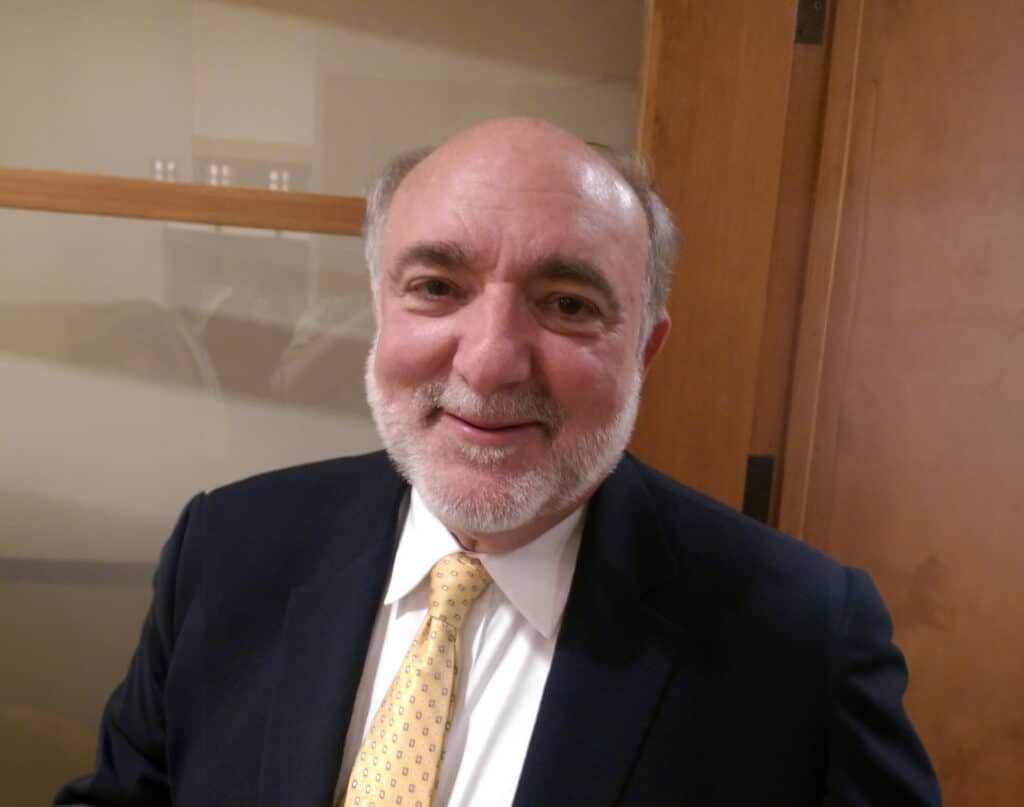
A Conversation with David Ellenson

A conversation with David Ellenson, whether in person, by phone or via email, was always an emotional uplift. Beyond asking thoughtful and probing questions, his parting messages were always reassuring and supportive. One could be “in conversation” with David, even if you were not formally in dialogue with him. His ideas and his warm and affirming personality were always imprinted on your mind. His insights did not begin or end when one was directly engaging him. David was conducting a living dialogue, always to be continued, always affirming.

Upon reflection, as we mourn his sudden passing, Rabbi Dr. David Ellenson (1947-2023) was always in conversation. David’s circle of colleagues, students and friends covered the universe of the Jewish world. He appeared to be engaged in multiple and simultaneous conversations with his extensive audiences of learning partners. He relished being in such a discourse, enjoying its diversity as well as its complexity.

Despite being trained and engaged as a Reform rabbinic leader for much of his distinguished career, his academic pursuits took him into the world of 19th Century German Orthodoxy and modern Jewish thought and history. He possessed an extraordinary command of Jewish tradition. His academic tablet included a keen understanding of modern Jewish religious movements, while being able to explore many of the existential questions surrounding American Jewish life. David could comfortably discuss the intricacies of the debate surrounding religion and state in Israel, as the Jewish State represented something particularly and uniquely significant to Ellenson, with all of its warts and challenges!

His journey to Reform Judaism did not come naturally, as he was born and raised in an Orthodox family. Growing up Newport News Virginia, David transcended both his personal religious background and Southern family roots, from which he would never fully separate, to emerge as a defender and interpreter of Reform Judaism. Operating in a diverse academic environment, through his many books and hundreds of articles he made a major contribution to American Jewish religious thought.

When I wrote for Jewish Insider about his leadership as Hebrew Union College-Jewish Institute of Religion’s (HUC-JIR) President between 2001-2013, I focused on his vast set of connections:

In no small measure Ellenson’s network of relationships, both within and outside of the institution, has served him well as he brought to the office of the president a host of personal and academic connections and friendships that would benefit the presidency. These relationships would both provide support and comfort to him in his most difficult moments.

We should remind ourselves that David came to this role without any significant institutional leadership experience. At his essence, Ellenson was an academic, where intellectual inquiry and the love of teaching essentially defined his identity.

David would graduate from the College of William and Mary in 1967. Rabbi Dr. Ellenson received his Ph.D. from Columbia University in 1981, and was ordained by HUC-JIR in 1977. From 1979 until his appointment to the HUC Presidency in 2001, David would be on the Los Angeles faculty of HUC-JIR, directing the College’s Jerome H. Loughheim School of Judaic Studies, the undergraduate Jewish Studies program for USC.

At a time when HUC had been facing major financial challenges, Ellenson, as its new leader, would play a central role in advancing the institution’s fundraising position. This would be accomplished not only by accelerating its annual campaign but by also significantly growing its endowment. He deserves credit for numerous new initiatives, programs, and institutes.

The Ellenson Presidency marked the appointment of new faculty on each of the HUC-JIR campuses, the expansion of intercampus cooperation and shared learning opportunities across the campuses through the implementation of new technology.

During the most critical times of tension within the Middle East, David would affirm the College-Institute’s abiding commitment to the Jewish State and its people. Further, he would seek to strengthen and expand the range of academic and professional programs being offered on HUC-JIR’s Jerusalem campus as a way of asserting the school’s role and the presence of Reform Judaism in Israel.

Upon leaving office, David had occasion to reflect on his commitment to Hebrew Union College:

My soul is bound to this institution and to the holy mission that animates it,” he told the Jerusalem Center for Public Affairs. “It has been the greatest privilege to devote my life to this school.”

Rabbi Ellenson enjoyed an extensive academic and communal existence beyond HUC, often teaching at major universities, serving as a scholar-in-residence for national organizations as well as local congregations. His more recent work at at Brandeis University’s Schusterman Center of Israel Studies (2015-2018) or the array of other honors and appointments were representative of his ability to operate in all spheres of the Jewish world.

Returning to where we began, as a collector of friends and students, he was always personally and emotionally connected to his constituencies.  Friendships along with his profound loyalty and deep connections to his Chaverim (partners)defined his humanity. Some years ago, David was set to give to the widow of his dear departed colleague and friend, Rabbi Michael Signer a special memorial honor at our spring HUC graduation. Standing next to him, David turned to me in tears, asking if I might read this special tribute, overcome as he was by the meaningfulness of the moment and the personal memories coming full force at him!

On reflection, as I reread his prior emails and messages to me, I was struck by his words, always upbeat, and his loving invitation to move our conversations forward.

And so it will be, my friend and teacher, the dialogue will continue!


Steven Windmueller is Emeritus Professor of Jewish Communal Studies at the Jack H. Skirball Campus of HUC-JIR, Los Angeles.


A Conversation with David Ellenson Read More »
Dear Anna: A Hannukah Message for College Students

Note: “Anna” in the following letter is a composite, and is based on conversations I have had with multiple students and their parents, as well as some media reports.

Dear Anna:

I am just as furious as you with Liz Magill’s demeanor during her testimony before Congress. The university presidents of Penn, Harvard, and MIT all mumbled and stumbled when asked how they would classify calls for “the genocide of Jews.” (They invoked the importance of free speech, an argument that, knowing how quickly anything politically incorrect is canceled at these universities, was transparently hypocritical.) But it was the complete lack of emotion that made me angriest. These three presidents all know how vulnerable Jewish students like you feel; yet, when asked about calls to kill Jews, not one of them could show the slightest bit of emotion. Instead, we got pablum and legalese, topped off with a condescending smirk from Magill.

Anna, your generation was supposed to reap the benefits of 75 years of achievement. After the Holocaust, Jews created a comfortable home for themselves in the United States, and built a flourishing homeland in Israel. Your parents and grandparents worked overtime so that you could have a better life than any previous generation of Jews. On October 6th, everything was going according to plan. And then Hamas attacked.

Anna, you told me with tears in your eyes how shocked you were by the depravity of Hamas; burning people alive, beheading babies, and brutal sexual violence against women. For a few days, it even looked like Israel’s very existence hung in the balance. The sheer evil of it was bewildering not just to you, but to everyone. After watching the gruesome videos of this attack, one had to wonder: where is God? Even rabbis have been grappling with their own beliefs. Israeli TV did a feature on the Shura Army Base, where the 1,200 people murdered by Hamas were processed for burial. The rabbis and soldiers there had the agonizing task of identifying the mutilated bodies. In a television report on Shura, a soldier related that in the days after October 7th, a senior rabbi at Shura stopped participating in the daily services. When asked why, he explained: “I’m not ready to speak to God just yet.”

Hamas’s attack has inspired admirers around the world to attack Jews as well. There has been an explosion in antisemitism in the United States. And Anna, students like you have borne the brunt of this attack.  Antisemitism has exploded on campus; 73% of Jewish students have reported experiencing or witnessing incidents, and 37% feel compelled to hide their Jewish identity. Hillels have been invaded, and students have been assaulted, spit at, and cursed at; death threats have been posted publicly on campus discussion boards.

But even those who don’t attack the Jews are at best indifferent. It is now fashionable to ignore Jewish concerns; and that’s exactly what you saw when the university presidents testified before Congress.  One student mentioned to me that she doesn’t know who she can invite to her birthday party; friends who supported the same progressive causes as her have been steadfastly supporting Hamas. How can you socialize with someone who says that the victims at the Nova festival deserved to be killed? Signs of kidnapped Israelis are torn down by fellow students, or even worse, defaced with the word “occupier.” The propaganda of Hamas is ubiquitous, with many students accepting conspiracy theories that Israel staged the massacre. The chant of “From the river to the Sea,” has been mainstreamed, even though it clearly suggests that the historic Jewish homeland must now be Judenrein, one way or another.

On campus, “Zionist” is used as a pejorative, and Israelis are slandered and called Nazis. I know your heart aches for civilian deaths in Gaza. That is the Jewish way, one that goes back to the book of Genesis. When Jacob expected war with Esau, he prayed that he not kill any of the innocent in battle. We continue to pray fervently for that today. But at the same time, Anna, you know exactly who is responsible for the deaths of Palestinians: Hamas. Michael Walzer, the foremost contemporary expert on just war theory, wrote last week:

“Hamas benefits from civilian deaths; it isn’t indifferent to the fate of the people it rules, it has a positive interest in their suffering.”

Hamas uses human shields and calculates the strategic value of civilian deaths; it sees the death of Palestinians as a major benefit to its “100-year war.”. Hamas trades in human suffering, filming and publicizing their massacre to cause maximum anguish, taking hostages and then dangling them in front of their families. They are an army of sadists, driven by hatred. And they have murdered, tortured, and raped your fellow Jews, just because they are Jews. Anna, you have tried to talk to your friends about this, but they just turn away. You feel betrayed.

This betrayal extends to your professors, who have used regularly scheduled classes in other subjects to “explain” the conflict in Gaza. During these lectures, Jewish students are bullied into silence. And when students like you turn to the administration, what can they expect? On Tuesday, all of America saw that from the president on down, these universities have been complicit in making Jewish students feel unwanted.

Anna, I know you feel alone.  But sometimes being a Jew is going to be lonely. Generation after generation of Jews have learned how to go against the stream, to stand proud despite the jeers of haters and bullies. In many ways, that is the very lesson of Hanukkah.

Hanukkah is about the power of the few. A handful of Maccabees took on the Seleucid empire, a war of the few against the many. The ritual of the Menorah reinforces this theme. After the war, only one jar of oil is found, but that one jar is more than enough. One small candle is lit on the darkest, coldest night of the year, and yet it brings light to every Jew. Anna, you don’t need to be a part of the biggest and noisiest group. You just have to bring the light.

Anna, the lesson of Hanukkah is critical to students like you. On campuses, they hound you and gaslight you. They demand that you renounce your birthright and surrender to the majority. These tactics are not new at all. Medieval Christian polemicists offered the same arguments. First the gaslighting: Jews were condemned for killing Jesus in the past, even though Crusaders were murdering Jews right then and there in the present. These polemicists argued that the Jews were a dying, disappearing people who had been rejected by God; it was time for Jews to join Christianity, the winning team. Today, new polemicists demand that Jewish students bow to the majority and accept the wisdom of a noisy rabble.

Anna, Hanukkah reminds us of the power that a small, dedicated group of people has. That was true 2,200 years ago, and that is true now. You and your friends have proven yourself equal to the challenge. You have come together as a community, and stood up as activists. There are overflow crowds at Hillel events. As Molly Goldstein, (who is going to be speaking at KJ next Friday night,) said in an interview: “We’ve had Shabbat dinners filling the capacity of the kosher dining hall.” In the face of all the threats and hatred, Jewish students have rededicated themselves to the Jewish people. This rededication is what Chanukah is all about.

While the holiday of Hannukah started in Israel, it became far more significant in exile. Wherever they were, a handful of candles reminded Jews that they didn’t need to give up. Even the few can triumph, if they maintain their resolve.

Anna, you and your friends have been resolute. Bella Ingber, an NYU student who spoke to congressional leaders this week concluded her speech by saying: “I am a proud Jew, and I am a proud Zionist. I am the granddaughter of Holocaust survivors. We are not going anywhere.”

Anna, students like you and Bella have added another page to the Hannukah story; you have told the world that the Jews are here to stay, and not going anywhere. And I am so proud of what you have accomplished. l know that if you are our future leaders, the Jewish future is very bright.

Chag Sameach!


Rabbi Chaim Steinmetz is the Senior Rabbi of Congregation Kehilath Jeshurun in New York.

Dear Anna: A Hannukah Message for College Students Read More »

Pam Stein: In Pam’s Kitchen, Baking with Wine and Hanukkah Dishes

Hanukkah is the perfect time to experiment with recipes and have a little fun. And, while you’re at it, why not try adding wine to some of your favorites!

Pam Stein, founder of In Pam’s Kitchen, started baking with wine in 2020. When Hampton Water Wine Co., co-founded by father-son team Jesse and Jon Bon Jovi, started offering virtual Happy Half Hours during the pandemic, it inspired her to start cooking and baking with wine.

“My go to is always a cookie,” Stein told the Journal. “I created this strawberry rosé cookie and sent it to the company. Jesse Bon Jovi made these on one of his Hampton Water Happy Half Hours and the rest is history.”

People started contacting Stein, asking her, ”What else can you do with and without alcohol?” Her @InPamsKitchen social media cooking demos and tips soon followed.

One of Stein’s favorite Hanukkah recipes is baked glazed strawberry rosé donuts with dipping sauce. You still have the jelly, It’s just outside of the donut. Recipe is below.

“In these doughnuts, [I use] a freeze-dried strawberry, because if you use a regular strawberry, you’ve really got to be mindful of the fact that there’s water in the berry,” she said.

In fact, if you’re doing any type of cooking, or especially baking, with alcohol, less is more. Fruit and other ingredients may add water to the recipe. The result may be a “runny mess.”

Typically, Stein advises, donuts use a half cup of wine, whereas a cookie may use three quarters of a cup, because there is more flour in the batter.

“It’s a lot of trial and error,” she said. “I have some other cookies that I’m experimenting with right now that use limoncello.”

These only use a couple tablespoons, because it’s a stronger alcohol taste. You don’t want to overpower what you’re doing. You want to enhance the flavor.

When I asked Stein if you could use any brand of wine for the donuts, she said it’s fine, as long as it’s a dry or very dry rosé.

“That’s another catch to cooking/baking with alcohol,” she said. “Rosés run a spectrum of super sweet to very dry. If it’s a sweet rosé it will definitely affect the taste of the recipe and the extra sugar could affect the leavening of the donut.”

Experimenting with recipes is one of Stein’s favorite things.

“I really like to just get in the kitchen and see what I can create,” she said. “I’ll start with a recipe that I’ve already created, where I have some basic measurements, and see what I [can] change.”

One of these experiments led to a jicama latke with bourbon applesauce. That recipe is below too.

The key is to take what you know, whether it’s your recipe, from a cookbook or a treasured family recipe – and just have fun.

“I’ve got recipes handwritten by my grandparents,” Stein said. “There’s something special about that.”

However, older recipes tend to be unhealthy.

“People used to cook – and some people still do – with a lot of schmaltz, fats, etc,” Stein said. “That becomes an opportunity to take these recipes, update them and make them a little healthier.”

Follow @InPamsKitchen on Instagram.

For the full conversation, listen to the podcast:

Watch the interview:

Strawberry Rosé Donuts

Yield: 12 donuts

1 3/4 cups all-purpose flour

2 tablespoons finely ground, freeze-dried strawberries

1/2 teaspoon baking soda

1 teaspoon baking powder

1/4 teaspoon Salt

1/2 cup sugar

2 tablespoons vegetable oil

1 large egg

1/2 cup plus 2 tablespoons Hampton Water Rosé wine

3 tablespoons Milk

For the Glaze:

1 cup powdered sugar

1 teaspoon finely ground, freeze-dried strawberries

2 tablespoons heavy whipping cream

1 tablespoon Hampton Water Rosé wine

Pink food coloring, as desired

To Make the Donuts:

Preheat the oven to 350 Degrees F. Lightly coat two six-cavity donut pans with nonstick cooking spray. Set aside.

In a medium bowl add the flour, ground strawberries, baking soda, baking powder and salt. Whisk to  combine. Set aside.

In another medium bowl add the sugar, vegetable oil, egg, wine and milk. Whisk until smooth.

Add the dry ingredients into the wet ingredients; stir to combine.

Using a scantily filled #16 cookie scoop (or scant 4 tablespoons), fill the cavities of the donut pans 2/3 way full. With a knife smooth the batter to make level.

Bake for 16-18 minutes*, or until a toothpick inserted in a donut comes out clean.

Remove from the oven and cool in a pan for 5 minutes. Transfer to a wire rack to cool completely.

To Make the Glaze:

In a small bowl add the powdered sugar, ground strawberries, whipping cream**, wine, and food  coloring to reach desired color. Whisk until smooth.

When donuts are cooled, dip each donut in the glaze and return to a wire rack for the glaze to set.

Store donuts in an airtight container for up to 5 days

*If using a mini donut maker, follow the manufacturer’s directions for baking time and amount of batter to use.

** For a thinner glaze, replace whipping cream with milk.

Rosé Dipping Sauce

Yield: 1 cup

1 jar strawberry preserves

2 – 3 tablespoons Hampton Water Rosé wine

In a small bowl stir together the strawberry preserves and 2 tablespoons of wine. If you prefer a thinner consistency to your sauce, add an additional tablespoon of wine.

Serve with strawberry rosé donuts.

Refrigerate leftovers in an airtight container for up to 10 days.

Jicama Latkes

Yield: 12 latkes

4 cups jicama, coarsely shredded

2/3 cup yellow onion, coarsely shredded

2 large eggs, slightly beaten

1/2 teaspoon salt

1-1/2 tablespoons fresh basil, chopped

1 teaspoon fresh parsley, chopped

1/4 cup cornstarch

Extra virgin olive oil

Line a rimmed baking sheet with a paper towel. Lay the shredded jicama on the paper towel and cover with another sheet of paper towel. Let stand to dry for 15 minutes.

In a large bowl add the jicama, onion, eggs, salt, basil, parsley and cornstarch. Stir to  combine.

Line a baking sheet with parchment paper. Spoon 1/4-cup mounds of the latke batter into the pan, about 2 inches apart; flatten slightly. Let stand for 5 minutes.

Lightly brush the tops of the latkes with olive oil.

Preheat the air fryer to 380 degrees for 3 minutes. Spray the inside of the air fryer with nonstick cooking  spray.

Place latkes in the air fryer. Do not overlap.

Cook for 12 minutes. Do not flip over.

Preheat the oven to 300 degrees.

Remove latkes from the air fryer and set on an oven-safe platter. Place the platter in the oven  to keep warm while you fry the remaining latkes.

Serve with the bourbon or rosé applesauce sauce.

Store any leftovers in an airtight container in the refrigerator for up to 3 days or wrap well and freeze for up to a month.

Bourbon Applesauce

Yield: About 3 cups

2 medium Granny Smith apples-peeled, cored and cut into quarters

2 medium Macintosh apples-unpeeled, cored and cut into quarters

1 tablespoon fresh lemon juice

1-1/2 tablespoons Bourbon (for Rosé applesauce, use 2 tablespoons of Hampton Water Rosé wine instead)

Add all ingredients in a high powered blender in the order listed and close the lid.

Begin  processing at the lowest speed and gradually increase to high. Blend for 1 minute or to  desired consistency.

Place applesauce in a serving bowl. Serve immediately or cover and refrigerate for up  to 3 days.


Debra Eckerling is a writer for the Jewish Journal and the host of “Taste Buds with Deb.Subscribe on YouTube or your favorite podcast platform. Email Debra: tastebuds@jewishjournal.com.

Pam Stein: In Pam’s Kitchen, Baking with Wine and Hanukkah Dishes Read More »

Why is This Book Different From All Other Books on Antisemitism?

When I first proposed my book, “From Outrage to Action: A Practical Guide to Fighting Antisemitism”(https://www.kickstarter.com/projects/fightingantisemitism/a-practical-guide-to-fighting-antisemitism), I encountered skepticism from a potential publisher. They questioned whether anything new could be said on the subject or if the fight against antisemitism was solely a matter for the Israeli Defense Forces and their battle against Hamas.

After going through most of the stages of grief since October 7, I thought about what I could do to help. In the aftermath of this tragedy, the sense of helplessness can be overwhelming. My book will argue that there is plenty that can be done in our own virtual and physical communities. We don’t have to passively watch horrible events unfold; everyone can play a part in combating antisemitism. This book is about showing how and why.

I chose to do this via Kickstarter and self-publish for a couple of reasons. First, I don’t trust any publishers to handle this the way I’d like or to recognize the urgency. Typically, Kickstarter is known for funding comic books and games, but I’m testing its ability to support a comprehensive project against antisemitism. It’s a risk because there is no book like this on Kickstarter, and I’ve never crowdfunded anything in my life. It appears to be working so far. Within the first 24 hours, the campaign was already 30 percent funded.

When a skeptical Jewish blogger recently asked me what sets this apart from other books on antisemitism, my answer was clear: This book is “The Next Generation.” While previous works have outlined the problem, our book is focused on solutions. It will be a hands-on guide, focusing on the practical. It’s one thing to recognize the problem, but let’s look at what can physically be done. What do the experts recommend? What has worked for other people?

The book will cover a wide range of topics, including:

Online Antisemitism: Online spaces are rife with antisemitism, often disguised as criticism of Israel. My book aims to break down the definition of antisemitism and address the straw man argument that Jews claim antisemitism whenever Israel is criticized. I’ll explore best practices for dealing with antisemitic trolls on social media, whether to engage, report, or block them, and provide strategies for responding to accusations of “genocide,” “apartheid,” and “settler-colonialism.”

Campus Antisemitism: On college campuses, Jewish students and faculty often face isolation and discrimination. My book will delve into the combination of legal, social, and policy actions they can take if they are harassed or excluded from student organizations. I’ll share stories from those who have experienced campus antisemitism and offer advice on navigating these challenges, highlighting the support networks established by Jewish organizations and law firms.

Workplace Discrimination: In the workplace, antisemitism can manifest in subtle or overt ways, from being harassed for opinions on the Middle East to being overlooked for promotions. CEOs and employers often find themselves unprepared to handle geopolitical issues that spill into the office. My book addresses these challenges, offering insights into employment law and real examples of antisemitic discrimination. I’ll consult with legal experts and interview workers who have faced on-the-job harassment, providing actionable advice for both employers and employees.

The book will also explore policy and legislation, interfaith and intercultural dialogues, and community action. It will feature real-life examples and stories of triumph over antisemitism, expert interviews, and insights.

As a child and grandchild of Holocaust survivors, I have studied and written about antisemitism my entire life. I’m the former managing editor for JTA, my work has appeared in mainstream and Jewish publications, and I have interviewed a range of experts on identifying and fighting antisemitism. This book is the culmination of that experience.

If this sounds like something you’d like to support, you can find more information on my Kickstarter page. (https://www.kickstarter.com/projects/fightingantisemitism/a-practical-guide-to-fighting-antisemitism). If it’s something you believe in, then please spread the link on your social media channels. This is a community effort.


Howard Lovy is a Michigan-based author, book editor and journalist. 

Why is This Book Different From All Other Books on Antisemitism? Read More »

Why the University Presidents Hedged on Israel’s Right to Exist

Why did the presidents of some of Americas leading universities respond misleadingly to the question of Israels right to exist, when they testified before Congress on December 6?

And why did many in the mainstream media stumble so badly in their coverage of that part of the hearing?

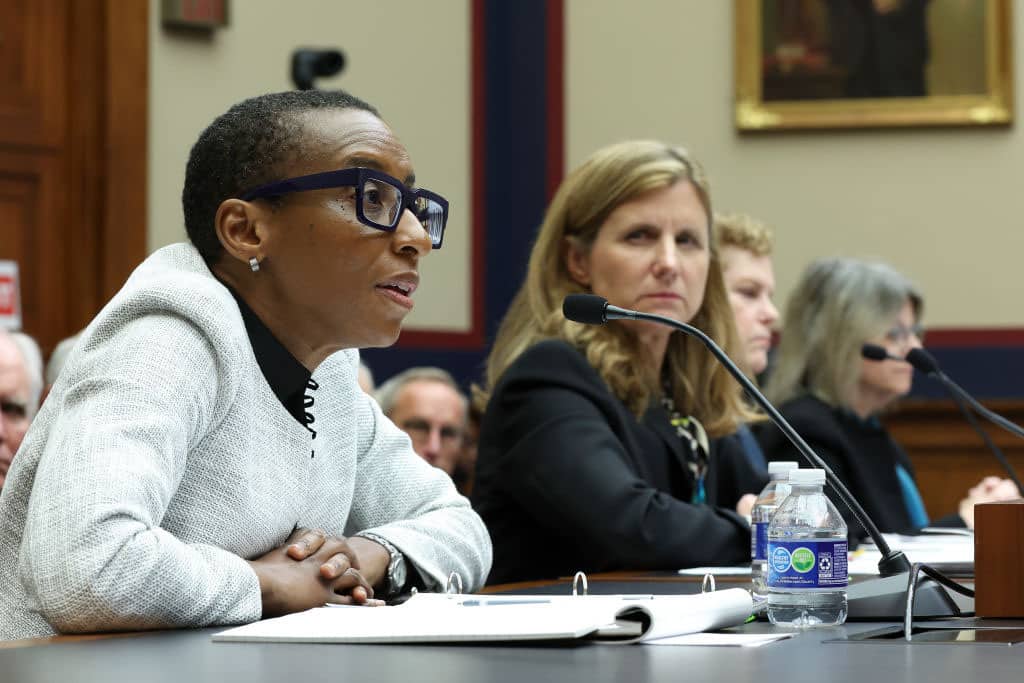
The exchange on the topic was initiated by Congresswoman Virginia Foxx (Republican of North Carolina). She posed the question simultaneously to Harvard president Claudine Gay, Penn president M. Elizabeth Magill, and MIT president Sally Kornbluth: Do you believe that Israel has a right to exist as a Jewish nation?”

Dr. Gay replied: I agree that the State of Israel has the right to exist.” Presidents Magill and Kornbluth then answered with the identical language, except that Kornbluth added that she absolutely” agrees that the State of Israel has the right to exist.” But thats not what Rep. Foxx asked them.

The Virginia congresswoman specifically included the phrase as a Jewish nation” in her question, yet the three university presidents specifically excluded it from their replies.

Not that you would know that from much of the mainstream media coverage.

The Associated Press and Reuters, which reported at length on the hearings, ignored the exchange concerning Israel’s existence.

The New York Times altered Rep. Foxxs question before misreporting the presidents’ replies. According to the Times, “When asked whether they supported the right of Israel to exist, they all answered yes, without equivocation.”

CBS News, for its part, got the question right but the answers wrong.

It reported: Foxx asked each individual president if Israel has the right to exist as a Jewish nation, and all three college presidents agreed that Israel does.”

There is no way to know whether the mis-reporting of the exchange was just sloppy reporting, or a conscious effort to paper over the presidents’ sentiments regarding Israel. Either possibility is troubling.

Heres why the episode matters.

It is highly doubtful that the presidents’ omission was accidental—first, because the presidents must have carefully prepared for the kinds of questions they were likely to be asked; second, because they all used the same language.

Which means that in all likelihood, Presidents Gay, Magill and Kornbluth are personally uncomfortable with the concept of Israel as a Jewish state.

Israels Jewish identity has been one of its core principles since the founding of the state in 1948. The Israeli declaration of independence repeatedly refers to Israel as a Jewish State,” not merely a state where many of Jews happen to reside. That document also describes the Land of Israel as belonging to the entire Jewish people, including those living around the world, and not just those living in Israel at the moment.

Legislation adopted by the Israeli parliament in 2018 fleshed out some of the ways in which the state is Jewish, including its national calendar, flag, anthem, and language. Additional details likely will emerge by national consensus in the years ahead.

This is not just a matter of semantics. Words can be weapons. Since the 1970s, Palestinian Arab spokespeople have promoted the creation of a secular, democratic Palestine instead of Israel. They think that sounds more moderate than explicitly calling for Israel’s annihilation. Some pundits today prefer the term “one-state solution.” But in practice, it’s the same as saying Israel should be destroyed, because such a state would have an Arab majority and therefore nothing about it would be Jewish.

Thus by declining to affirm that they recognize Israel as a Jewish state, the university presidents left room for the kind of solution” that pretends to support Israels existence but actually means eliminating Israel.

If Presidents Gay, Magill and Kornbluth were willing to engage in that kind of linguistic slight-of-hand in testimony before the U.S. Congress, it is not hard to see why their response to the anti-Israel and antisemitic hysteria on their campuses has been so weak. A president who does not think Israel needs to exist as a Jewish state is not likely to crack down on mobs that are saying similar things, just more crudely, in their shouts, manifestos, and blood-red graffiti.


Dr. Medoff is founding director of The David S. Wyman Institute for Holocaust Studies and author of more than 20 books about Jewish history and the Holocaust. His latest is America and the Holocaust: A Documentary History, published by the Jewish Publication Society & University of Nebraska Press.

Why the University Presidents Hedged on Israel’s Right to Exist Read More »

Fighting Antisemitism with Adam Sandler’s Hanukkah Song

When I saw this morning that a foundation had just donated $100 million to Robert Kraft’s initiative to combat antisemitism, which includes television commercials among its efforts, an idea popped into my head.

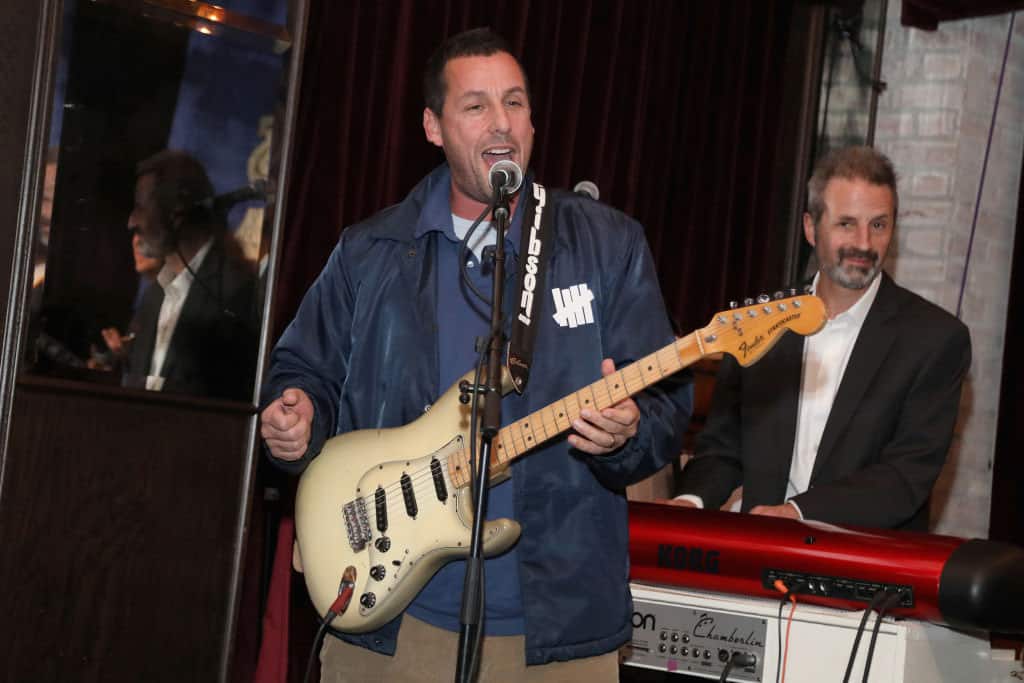
Maybe because of my advertising background, I thought of taking a clip from an Adam Sandler concert where he performs his famous Hanukkah song, in front of large, cheering crowds, and putting these words at the end:

“Happy Hanukkah, America.”

So cool, right? Well, I thought so.

The problem, of course, is that it feels tone deaf. At a time when the news is all about the alarming rise in antisemitism, it feels like a disconnect to focus on something positive, to remind America and our community that there is a whole other side to this country. That other side, let’s remember, has nothing to do with the ugly, Jew-hating cries to “globalize the Intifada” that is terrifying many American Jews.

That other America, the one where thousands of non-Jews show love for a Jew singing about a Jewish holiday, is one that is easily forgotten in today’s festival of hate. It’s an America where being Jewish is not just a symbol of success but also one of humor and coolness. Remember that country?

The America that is grabbing all the headlines today is the one captured by U.S. Senate Majority Leader Chuck Schumer (D-N.Y.) in his historic Nov. 29 address on the Senate floor.

He addressed his remarks, ironically, to non-Jews, which presumably includes Adam Sandler fans.

“I have noticed a significant disparity between how Jewish people regard the rise of antisemitism, and how many of my non-Jewish friends regard it,” he said. “To us, the Jewish people, the rise of antisemitism is a crisis—a five-alarm fire that must be extinguished.”

So, in one America we have concerts where non-Jews cheer a Hanukkah song from a Jewish comedian; while in another, we see “five-alarm” demonstrations where Jew haters cheer the worst atrocity against Jews since the Holocaust.

If you’re one of those Jewish college students who is feeling bullied and intimidated by this hysteria of hate, I could see why that Adam Sandler America would be the last thing on your mind.

But maybe that is precisely why Mr. Kraft’s foundation ought to run those Adam Sandler Hanukkah ads.

You see, there are two approaches to empowering Jews while they’re feeling under siege. One approach, which is mandatory, is to defend their rights and protect their safety using all means at our disposal. The community is doing that.

The other way is to boost their morale, to play up popularity rather than protection, to remind Jews that there is an America beyond the land of hate. That America won’t hit the streets to demonstrate its love for Jews; it would rather pay to attend an Adam Sandler concert or get HBO so it can catch the new season of “Curb Your Enthusiasm.”

That America rarely makes the news. It is the haters who make most of the noise.

Those haters would love nothing better than to squelch Adam Sandler’s America; to drown it in their genocidal cries of “From the River to the Sea”; to stereotype Jews not as cool and funny but as cold-blooded oppressors representing the height of white privilege.

Because they’ve given their Jew hatred a progressive patina, the haters now have the wind in their sails, given the progressive storm that is sweeping much of our mainstream culture. No one feels they’ll get in trouble today by taking on a group they believe epitomizes what progressives hate about the West.

We’ve allowed the haters, then, to define both the Jews and America to fit their nefarious agendas. Their nightmare is the Adam Sandler America, the one that contradicts their dark vision, the one where Jews are admired rather than reviled. They’re lucky that, so far, they’ve had free rein to define us as they wish.

Let’s make their luck run out.

While we continue to extinguish the “five-alarm fire” Senator Schumer talked about, let’s light up the America that thinks Jews are really cool. There’s no better place to start, Mr. Kraft, than Adam Sandler’s wildly popular song.

Happy Hanukkah, America.

Fighting Antisemitism with Adam Sandler’s Hanukkah Song Read More »

Rabbi Wolpe Resigns from Harvard Antisemitism Board After “Painfully Inadequate” Testimony

Rabbi David Wolpe, who left Sinai Temple in Los Angeles after 26 years to take a visiting scholar position at Harvard Divinity School, has resigned from the Harvard University Antisemitism Advisory Committee.

This comes two days after the presidents of Harvard, the University of Pennsylvania and Massachusetts Institute of Technology (MIT) gave what Wolpe called “painfully inadequate testimony” at a hearing in the House of Representatives.

In a three-part statement posted to his account on X, formerly-known as Twitter, Wolpe explained his position.

“The short explanation is that both events on campus and the painfully inadequate testimony reinforced the idea that I cannot make the sort of difference I had hoped,” Wolpe wrote. “However, the system at Harvard along with the ideology that grips far too many of the students and faculty, the ideology that works only along axes of oppression and places Jews as oppressors and therefore intrinsically evil, is itself evil. Ignoring Jewish suffering is evil.”

Wolpe cited a lack of knowledge amongst students following a “herd mentality” as another reason for his resignation.

“Part of the problem is a simple herd mentality – people screaming slogans whose meaning and implication they know nothing of, or not wishing to be disliked by taking an unpopular position,” Wolpe wrote. “Some of it is the desire to achieve social status by being the sole or greatest victim.  Some of it is simple, old fashioned Jew hatred, that ugly arrow in the quiver of dark hearts for millennia.”

Wolpe added that he believes Harvard President Claudine Gay to be “both a kind and thoughtful person” and that the majority of the students at Harvard “only to get an education and a job, not prosecute ideological agendas, and there are many, many honorable, thoughtful and good people at the institution.”

On December 5, while appearing before the House Committee on Education and the Workforce, President Gay, Penn President Liz Magill and MIT President Sally Kornbluth of the Massachusetts Institute of Technology (MIT) were asked if “calling for the genocide of Jews” was against the colleges’ conduct of conduct.

“It is at odds with the values of Harvard, we embrace a commitment to free expression, even of views that are objectionable, offensive, hateful,” Gay responded. “It’s when that speech crosses into conduct that violates our policies against bullying, harassment and intimidation.”

When pressed, Gay continued, “We take action and we have robust disciplinary policies that allow us to hold individuals accountable. Given students’ rights to privacy and our obligations under [Family Educational Rights and Privacy Act] FERPA, I will not say more about any specific cases other than to reiterate that processes are on-going.”

Harvard’s Hillel posted a reaction to Gay’s testimony on Facebook later in the day.

“President Gay’s failure to properly condemn this speech calls into question her ability to protect Jewish students on Harvard’s campus,” the Hillel statement read. “Chants to ‘globalize the intifada,’ an endorsement of violent terrorist attacks against Jewish and Israeli civilians, and ‘from the river to the sea,’ an eliminationist slogan intended to deprive Jews of their right to self-determination in Israel, have become tragically routine at Harvard.”

Harvard University’s official X account posted a statement the next day appearing to backtrack from Gay’s testimony on Capitol Hill:

“Statement from President Gay: There are some who have confused a right to free expression with the idea that Harvard will condone calls for violence against Jewish students. Let me be clear: Calls for violence or genocide against the Jewish community, or any religious or ethnic group are vile, they have no place at Harvard, and those who threaten our Jewish students will be held to account.”

Gay spoke at Harvard Hillel on October 27, saying that “to begin the vital work of eradicating antisemitism from our community, I have assembled a group of advisors whose wisdom, experience, and counsel will help guide us forward.” Thirteen days later, Gay announced the members and a six-pronged mission of the committee.

About an hour-and-a-half prior to posting his resignation from the Harvard Antisemitism Advisory Committee, Wolpe posted a video to his X account celebrating the first night of Hanukkah.

“This year, we put [the Hanukiah] in the window to also say ‘we are not afraid,” Wolpe said. “Chag Hanukkah Sameach.”

Rabbi Wolpe Resigns from Harvard Antisemitism Board After “Painfully Inadequate” Testimony Read More »

Artwork Unveiling Honors SWC’s Rabbi Marvin Hier

Community leaders turned out to the Museum of Tolerance on Nov. 15 to celebrate Rabbi Marvin Hier, founder and outgoing CEO of the Simon Wiesenthal Center (SWC), and for the unveiling of artwork honoring Hier.

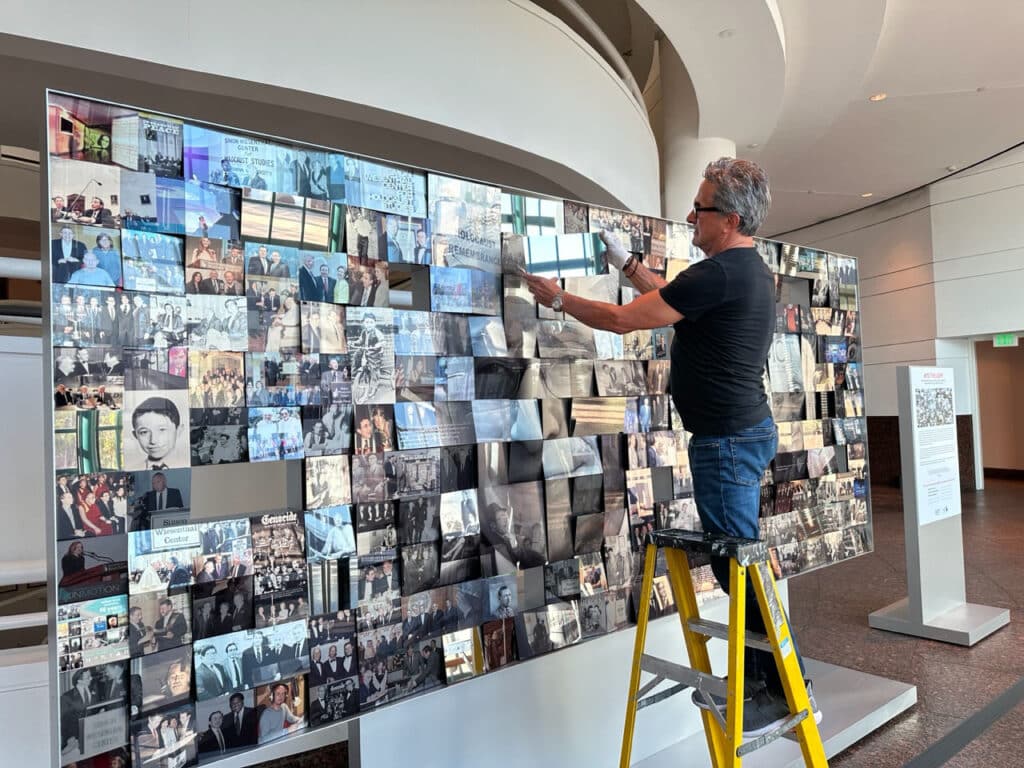
Artist Marc Bennett’s work, “Into the Light,” is an original art piece, featuring a rich tapestry of archived images of Hier that form a collage assembled on angled metal panels. In the images, spanning decades, Hier appears with dignitaries in notable moments and as part of historical events. The mirrored panels create an intimate connection between the viewer and the depicted scenes.

The artwork is now a permanent piece in the main lobby of the museum for all to see and experience.

The event, meanwhile, honored Hier’s lifetime of service. It was held as Hier transitions at SWC to the role of founder and dean emeritus, as SWC recently announced Hier’s successor, media executive Jim Berk.

From left: Artist Marc Bennett, Ian Aaron, SWC Chair Dawn Arnall Aaron, Rabbi Hier and
Marlene Hier in front of the artwork. Photo by Rich Prugh

Artwork Unveiling Honors SWC’s Rabbi Marvin Hier Read More »