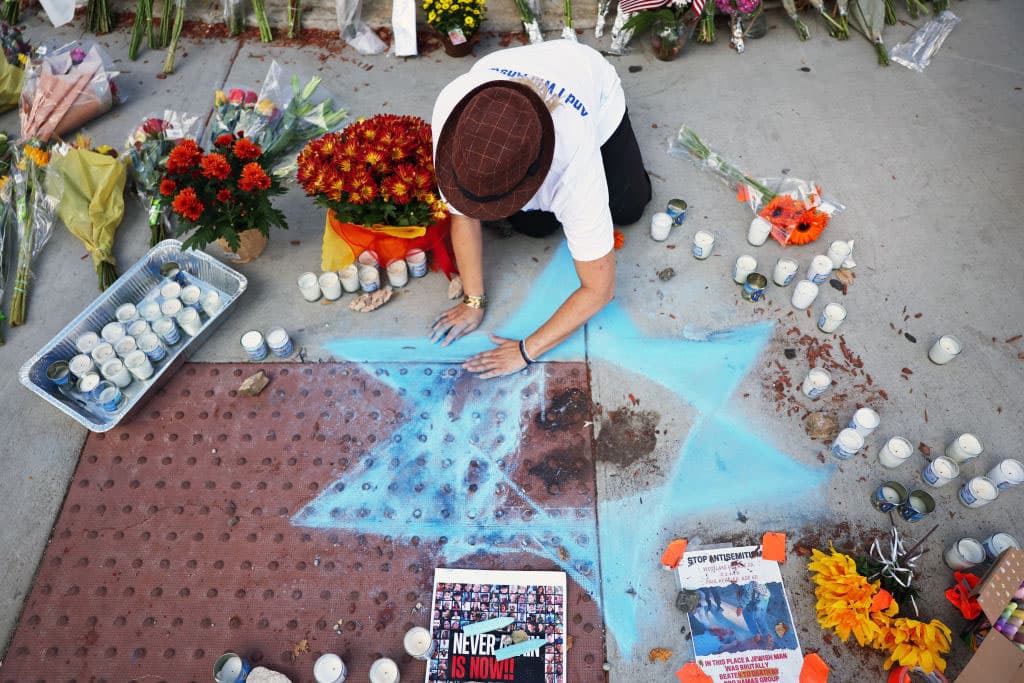
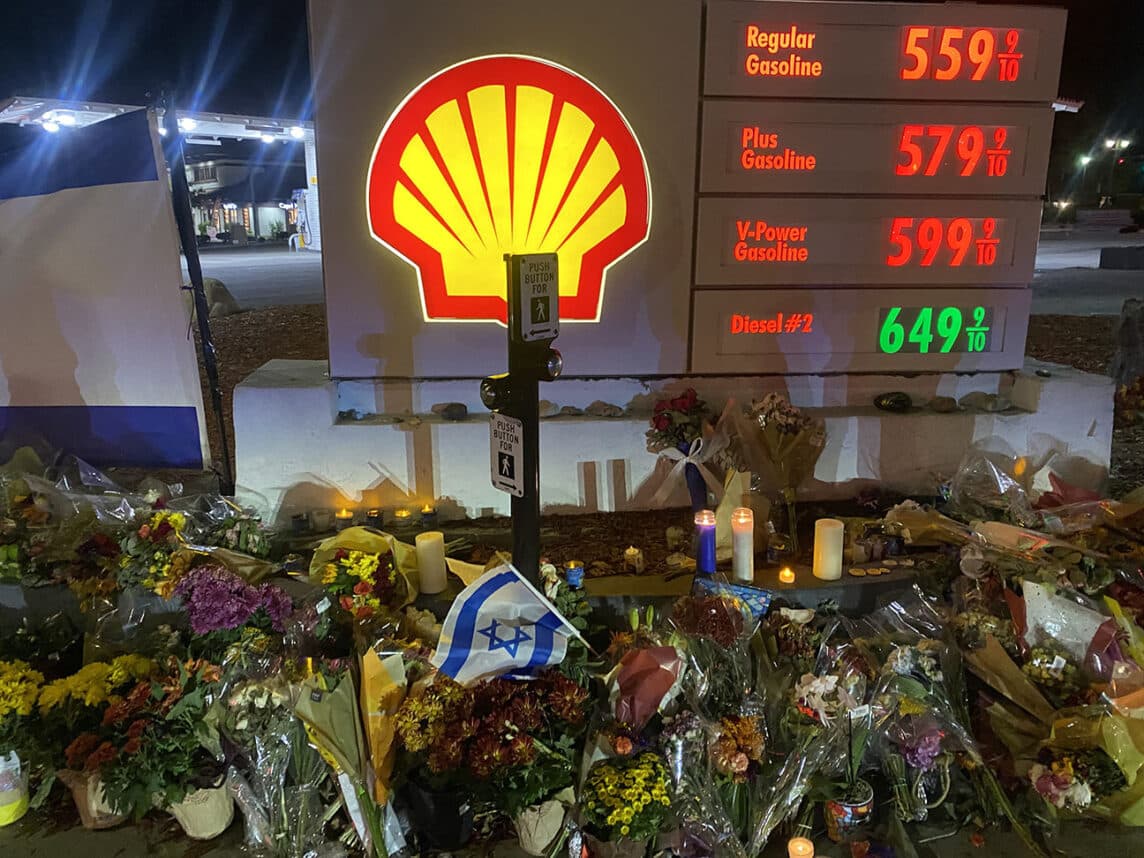
When driving through Thousand Oaks on November 6, Elena Colombo noticed “police pegs” at the intersection of Westlake Boulevard and Thousand Oaks Boulevard. It wasn’t until later that she learned that’s where Paul Kessler, 69, died following an altercation with a pro-Palestinian protester. She then helped turn that intersection into a memorial for Kessler.
Elena Colombo, a West Hills resident and Hamakom synagogue member who describes herself as a “Jew by choice,” told the Journal in an interview at the intersection on the evening of November 9 that she saw an Instagram post stating, “Pro-Israeli man dies after being assaulted by pro-Palestinian.” Kessler was among the pro-Israel protesters and had been holding an Israeli flag. The sheriff’s office has since announced the arrest of the suspect, 50-year-old Moorpark resident and college professor Loay Alnaji, who faces charges of involuntary manslaughter and battery. Alnaji had pleaded not guilty to the charges and his lawyer has argued that video evidence will prove that his client did not kill Kessler.
Regardless, the intersection has become adorned with Israeli flags, yahrzeit candles and flowers. Colombo told the Journal that she “wanted to be a virtual shomerit,” the Hebrew term used to describe a guardian of the deceased’s body, as she is a volunteer for a chevra kadisha. The Chevra Kadisha is a Jewish group that prepares the deceased’s body for burial. While she was standing the intersection, Colombo noticed “spilled blood” and told another woman nearby that she didn’t want to leave. “And I said, ‘I want to get a candle,’ and she goes, ‘I’m gonna get candle,’” Colombo recalled, “and then … one person came here and another came here, and it just grew. And then I became friends with some Israelis, they put me in a group and we’re here every day. And I try to stay later in the evening always with other people holding space.”
Colombo explained that on November 7, she drew a Star of David around “our lost blood of my brother from another mother” and has since maintained everything. “I keep telling people to light a candle when they’re ready, hold space,” she said.
Colombo also aims “to have as many positive words from the Torah written on the sidewalk that talk about love” and often wears her Israeli flag while at the intersection. “I’ve had lots of positivity, people for it, and when I have someone who says horrible things, I turn around and I say, ‘I love you man,’” Colombo said. “Because the world is so shattered and we need love. I’ve seen the effect where someone’s screaming and they’re parked at the red light and they have more time to insult me … and all I say is, ‘One love brother’ and I see the change.” Colombo said that she has been asked how she sends love in moments where people spew hatred at her; her reply: “I’m Jewish. This is what we do.”
There have been vigils held in Kessler’s honor during the evenings. “The first night we did it we had a very, very large crowd … and we sang,” Colombo said. “We sang, we held, we talked, ‘What else can we do?’ When we come, we invite all, and this space has grown into a community coming to share our respect, to cry, to be held, to know that we are not alone. And we stand together.” Colombo recounted that some Catholics have also stopped by, and told her that their entire church will be coming to a demonstration held in Kessler’s honor at the intersection on Sunday morning.
Colombo said that she has found it difficult to leave the intersection at night since she’s not sure what the memorial will look like the following morning. “As of today, it just gets bigger and fuller,” she said, recalling how community members she never met put stakes to keep Israeli flags upright at the intersection.
Photo by Aaron Bandler
The Journal talked to some community members who dropped by the intersection on the evening of November 9. Sharon Sadon, who runs a store in the area, told the Journal, “The community’s devastated. We are very, very sad. We lost one of our friends. Most of us knew Paul, I know his wife as well, they’re one of our customers at the shop … the last few days, every customer that’s been coming to the store has been talking about the whole situation, has been talking about Paul. Everybody’s heartbroken.” Sadon said that he only met Kessler “once or twice,” but described him as “a very nice person.”
Shula Bryski, the Rebbetzin of the Chabad of Thousand Oaks and wife of the Chabad Rabbi Moshe Bryski, told the Journal at the intersection, “The Chabad Lubavitch rebbe, who is our mentor, he taught us that in a time of darkness, we all have the power to add light. In a time of such ugliness, I think the beauty of kindness and light is even more prevalent, and that’s what the world needs now: to combat the darkness with light.”
Bryski described the “light” as “Jews walking proudly as Jews, doing mitzvos, embracing their identities as Jews and loving their fellow, reaching out to other people … getting out of our comfort zone to really truly be kind. That’s how we combat the hatred in this world.” Bryski said that her husband has spoken with Kessler’s widow and that “she is the sweetest woman but she is in shock.”
Bryski said that the community is “understandably shaken” about what happened to Kessler, and that she and her husband have been telling people that the only thing they have the power to do right now is “to add light.” “Acts of kindness make a difference,” she said. “You’re extra kind to a slow barista on her first day at work, you smile and tell her she’s doing great, and then she’s filled with that sense of well-being, and that spills over into how she treats the next customer and it fills her with confidence and then that impacts the next person and it’s contagious, it doesn’t end. So our acts of kindness have a tremendously powerful effect.”
Sadon said he has heard from the community that Kessler was “hit with a megaphone in the head [and] fell backwards” and has heard from witnesses that “it was an assault.” “The guy needs to be in jail no matter what, if it’s murder, if it’s manslaughter, if it’s an assault that guy needs to be in jail,” Sadon said, “and the community––the Israeli community, the Jewish community––are not gonna rest until this guy is in jail.” The sheriff’s office had previously said in their November 7 press conference they have not confirmed that Kessler was hit in the head with a megaphone, but acknowledged that it could be a possibility.
Alnaji’s lawyer, Ron Bamieh, has alleged that Kessler was shouting obscenities at pro-Palestinian protesters and “he put his phone in the face of my client and my client brushed the phone away.” According to the Associated Press, Bamieh also claimed that it’s possible that “Alnaji may have struck at the phone with a megaphone and unintentionally hit Kessler in the face,” and that video footage will show that Alnaji was several feet away from Kessler when he fell and thus did not cause Kessler to fall.
Regarding the memorial at the intersection Sadan said: “Our community’s beautiful. I’m in tears. Nothing but love to our people.”
“Am Yisrael Chai,” Bryski said. “We will prevail. We have been through hard times … and we’re still here, and we’re gonna get through this.”
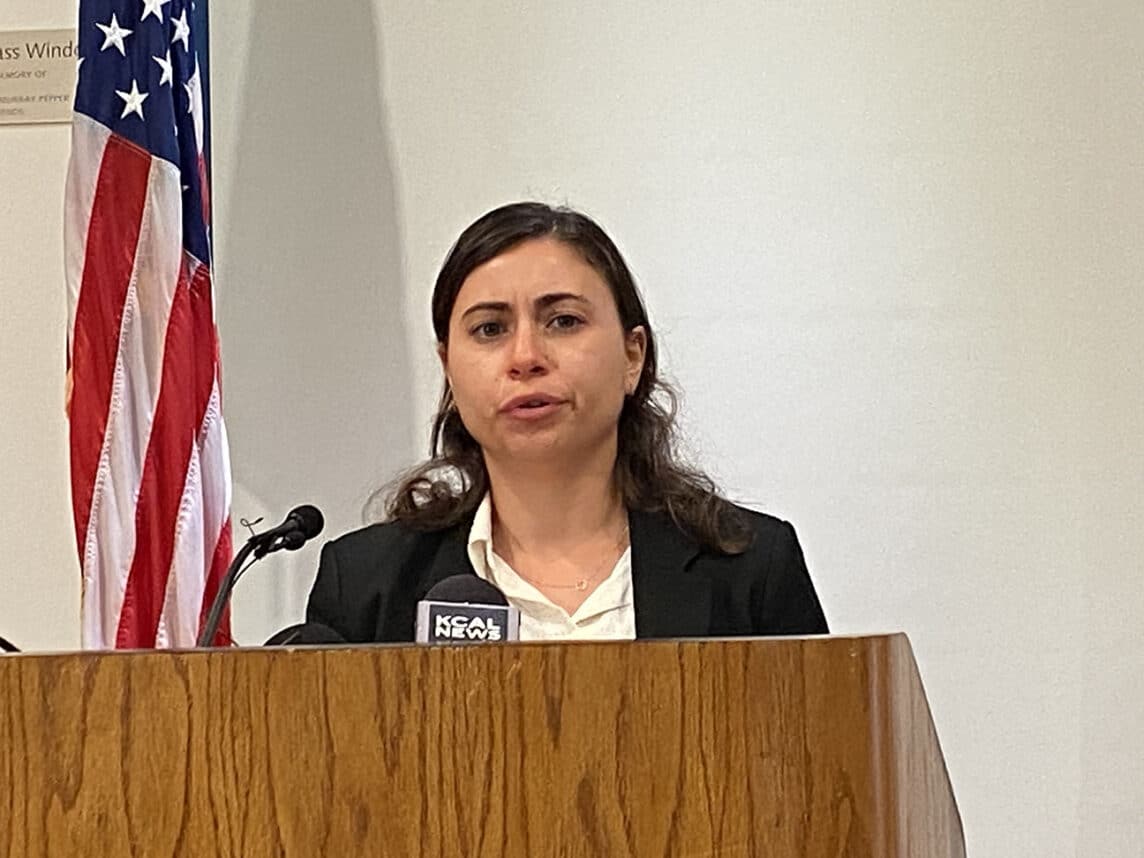
Several Jewish students spoke out against rising antisemitism at their respective college campuses in a Thursday press conference at UCLA’s Hillel, with one student saying: “We are terrified.”
The press conference was held the same day as the UC Board of Regents meeting, which was held at the Luskin Conference. The first student to speak was Sophia Brodie-Weisberg, a fifth-year student at UC Davis, explaining that the day before, she received a call from a student asking for help because he was harassed for being Jewish by a group of students while riding his bike to class. She has received multiple calls from students this past week alone about antisemitic incidents on campus.
Sophia Brodie-Weisberg (Photo by Aaron Bandler)
“Reporting the incident to the university does not lead to the necessary clear, empathetic and productive response as it should,” Brodie-Weisberg said. “This was an issue before October 7 and has significantly increased since then. Jewish students report antisemitism to the campus and are either still waiting on a response––even a month after the incident––or are told that what they experienced does not warrant any action by the UC. Why are antisemitic incidents on campus not taken seriously? Your students do not feel safe on campus. Your students are in danger and are being attacked on campus.”
She added that Jewish students are avoiding parts of campus or classes altogether as well as hiding their Jewish identity. “The harassment on campus that they experience is hindering their ability to learn,” Brodie-Weisberg said. “To the regents of the University of California and the UC Davis administration, we say: antisemitism will not disappear, as long as you are soft in your condemnation and response to antisemitism on campus.” She urged for the adoption of the International Holocaust Remembrance Alliance (IHRA) definition of antisemitism and implementing antisemitism training on campus.
Naum Yankelevich, a second-year student at UC Riverside, described the past month as being “turbulent” on campus. “Our small Jewish population is heavily outnumbered by the volume of Middle Eastern and Arab students,” he said, adding that while they typically all got along, that has changed after the October 7 Hamas massacre. “Last week, students put up banners calling for the destruction of Israel,” Yankelevich said. “The UCR Hillel, the only established Jewish organization on campus, was vandalized. Last month, at the first class after the terrorist attack, my professor promoted the third intifada without providing any context onto the situation in the region.”
He called UC Riverside’s response “half-hearted” and “reactionary” and further accused humanities teachers (Yankelevich said he’s studying to become a “critical thinker”) at the school of being “passive.” “Why are they failing to be role models when it comes to critical thinking?” he asked. “Why do they fail to address the misinformation that is becoming more prevalent by the day? We have seen what happens in the world when misinformation goes unaddressed. In this case, misinformation has resulted in broken friendships, the alienation of our students and an echo chamber where hate against Israel, Israelis, and the families of our Jewish students are normalized.”
“Unless something is done to rectify this, then fear will become the norm,” Yankelevich warned.
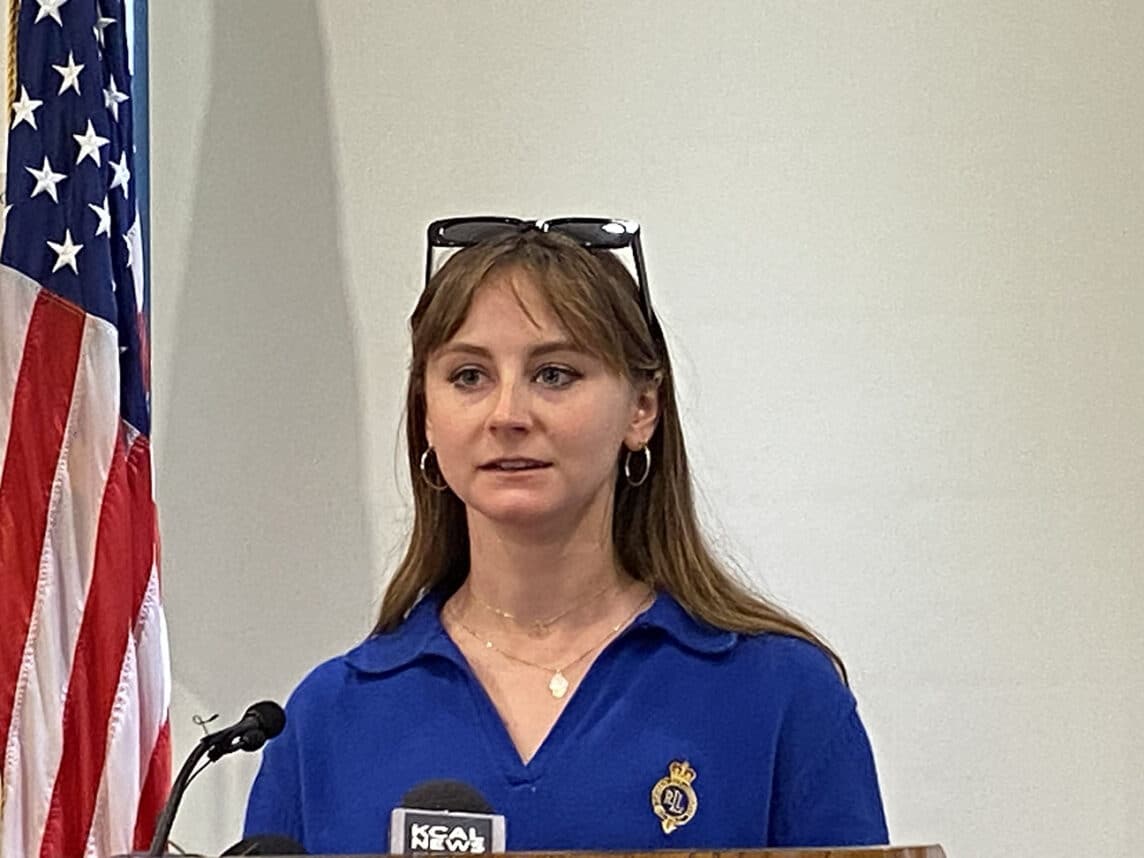
Elizaveata Borroum, a third-year bioengineering student at UC San Diego, said that she was the first person in her family to not be born into a country of “state-sponsored antisemitism, and yet every day I have to make the decision between my safety and my education. I’m not alone in this choice.” Borroum proceeded to share two instances of antisemitism that she has experienced on campus: during the spring, someone drew “swastikas in human feces” in a bathroom at a dormitory that housed 12 Jewish students; one of the students was someone that Borroum had mentored. The school’s response was “hollow,” Borroum claimed, as they offered words of support “but no actionable items were implemented to support our safety.”
Elizaveata Borroum (Photo by Aaron Bandler)
The second instance of antisemitism, which happened after October 7, involved a student targeting and harassing Borroum over her Star of David necklace. “They made me feel unsafe and unwelcomed on campus,” she said. “I did not receive any resources from administration to help me feel safe on campus despite reporting the incident.”
Borroum elaborated on the incident further after the press conference in an interview with the Journal, explaining that she was walking to class and was wearing blue jeans and a white t-shirt when a person noticed her necklace and color scheme and assumed a “connection to Israel because of the Star of David with the blue jeans and a white t-shirt,” the colors of the Israeli flag. “He followed me, he said names, he flipped me off,” she said. “He made it so I don’t feel safe on campus over a religious symbol that I’ve worn since I was 13.” Borroum said that when she reported it to the university, she was told they couldn’t move forward with an investigation because she couldn’t identify the perpetrator.
In the press conference, Borroum urged the UC schools “to listen to us when we say that Jewish students are scared to be on campus, to be visibly Jewish. We are being targeted, harassed, and threatened for our identities … I should be in my engineering lab section right now. But instead, I chose my safety over my education today.”
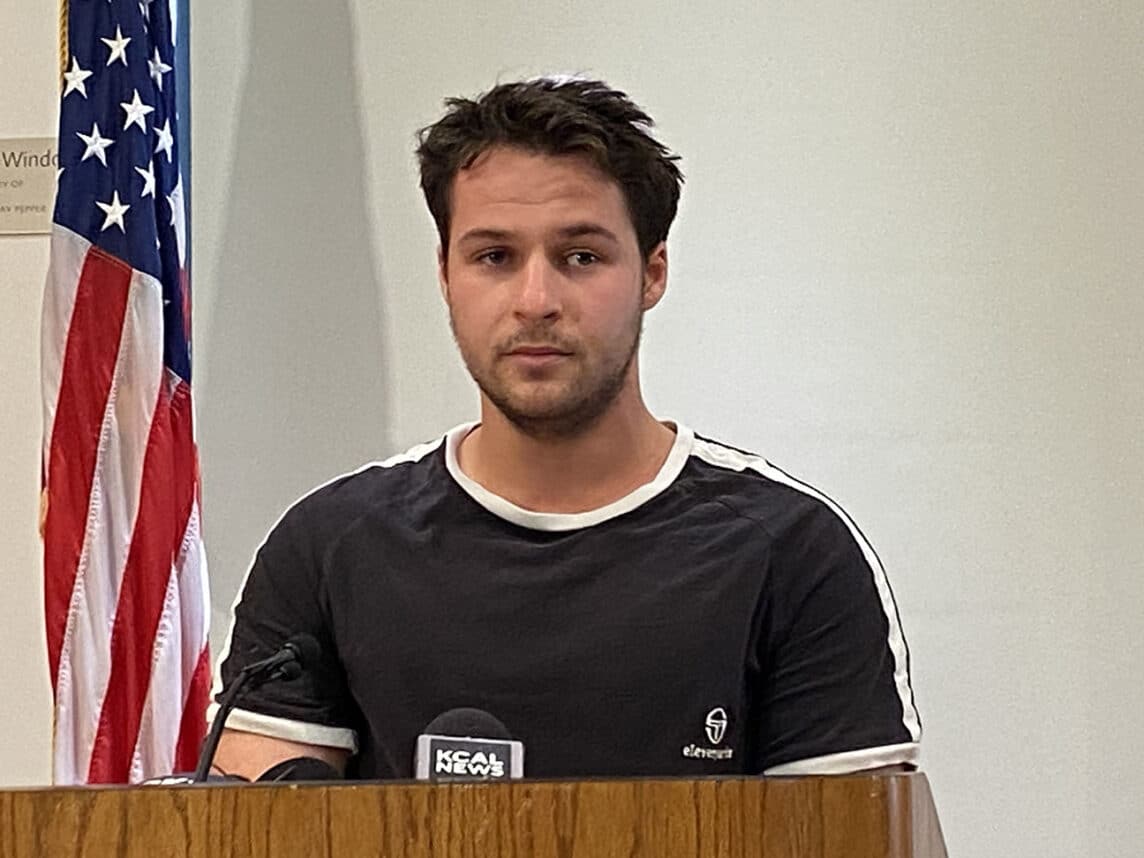
Eyal Wrobel, a fourth-year student at UC Santa Barbara and president of the university’s Students Supporting Israel chapter, declared at the press conference: “Today, we are terrified. I am terrified. Terrified because a Jewish man was murdered 10 days ago in LA. Terrified because my family who was once hiding in an attic is now hiding in a bomb shelter. Terrified because so-called activists, whose hate for the state of Israel is stronger than their love for their own people, are attending the same classes as I am.” He also claimed that it took “two seven-hour sessions” for the UCSB student senate to condemn Hamas and that one of his professors “openly made fun of religious Jews while spreading lies about my people, my religion.”
Eyal Wrobel (Photo by Aaron Bandler)
“How am I supposed to learn in an environment I do not feel welcome in?” Wrobel later asked. “How am I supposed to earn a degree in a place I do not feel safe in? How are we supposed to reach peace on the land if we are not even capable of recognizing and denouncing hate 10,000 miles away from it?”
Another fourth year UCSB student, Michelle Lebowski, followed Wrobel by saying: “It has been so ingrained in people’s psyche that standing up against Jewish people is used in the façade of activists standing up for what they believe is a colonial fight for land.” Lebowski, who is on the UCSB student senate, claimed that the student governing body couldn’t vote on a resolution the night before that denounced both antisemitism and Islamophobia. “I sat there, with my fellow senators, baffled,” she said. “I have no words for that.”
Michelle Lebowski (Photo by Aaron Bandler)
Additionally, Lebowski claimed that there is a professor on campus “who is proud to be antisemitic,” noting that this professor is one of the faces featured on antisemitism watchdog website. “He continues to spread antisemitic rhetoric continuously throughout his classes without being held accountable for his actions,” Lebowski said. “This professor is not alone. It is our educators’ blame for a great of deal this. How can we continue to allow these people to educate future generations?”
UC Irvine student Daniel Avidon recounted an incident on October 26 when pro-Palestinian activists “stormed a classroom and screamed that students’ tuition funds genocide. The administration did not condemn these actions.” A Tuesday lecture on the Israel-Hamas war was also disrupted, Avidon claimed, causing “chaos and intimidated Jewish students yet again … these incidents are becoming more frequent and no action has been taken in a timely manner.”
Daniel Avidon (Photo by Aaron Bandler)
Danielle Sobkin, a UC Berkeley student, pointed out that two Jewish students have been assaulted on camera in broad daylight. “Why? For being Jewish? For holding an Israeli flag? For openly expressing their Jewish identity?” Sobkin said. “UC Berkeley, is this a problem? A problem that becomes more evident each day as Jewish students are advised to avoid certain parts of campus at certain times, to lower their gazes during rallies, to exist unobstrusively in the shadows … is this the inclusive environment you boast of?”
She added: “We’ve been patient. We’ve been told to wait, to trust administrators to handle it. But how long must we wait?” While Sobkin acknowledged that the university has taken steps to try and address the problem, “the issue remains unsolved: there is a clear, evident distinct problem on campus. The behind the closed doors strategy isn’t working, it’s failing. It’s a strategy that breeds more uncertainty and more fear.” Sobkin urged the university to adopt “transparent decisive action” and “policies that are not just words on a page” but actively enforced.
“We must collectively reject the normalization of antisemitism,” Sobkin continued. “We must stand together not in silence but in solidarity asking for change and ensuring safety of all students. UC Berkeley: the world is watching. What we do now … will not only define our present but will resonate into our future.”
UCLA graduate student Ella Petter explained at the press conference that she moved from Israel to the United States a couple years ago for her graduate studies program. “I was impressed by the strong emphasis given for inclusivity, diversity and respect on campus towards every individual and community,” Petter said. “We were taught that words matter. I never expected that when my own community needed this protection, the boundaries of tolerance would be stretched so thin and Jewish students would feel unsafe and unwanted on campus.”
Ella Petter (Photo by Aaron Bandler)
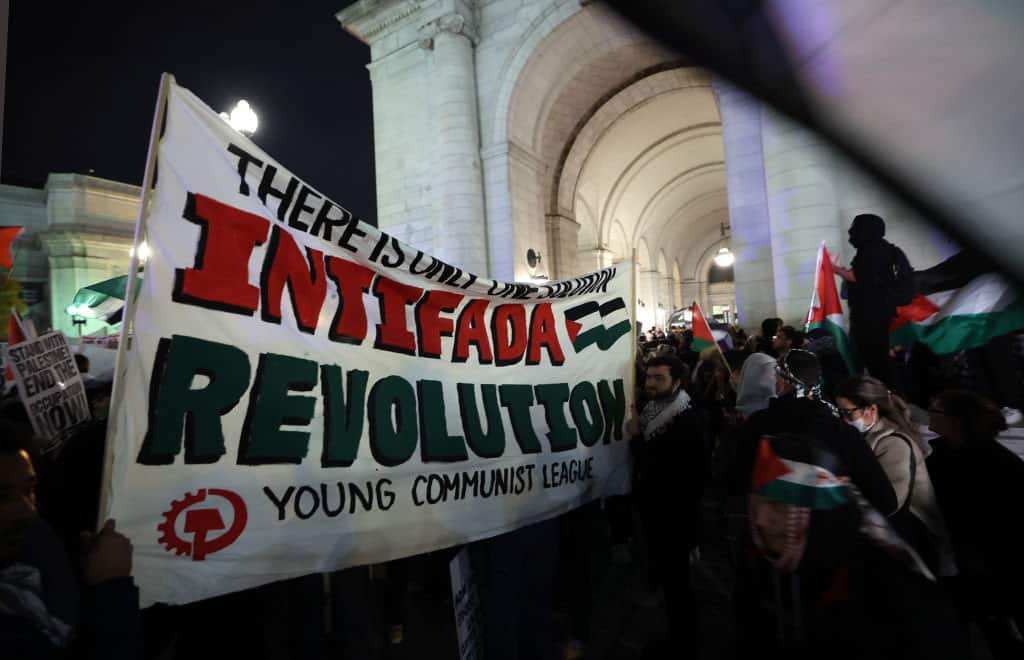
Petter claimed that there are weekly pro-Palestinian rallies on campus that “have become a platform for chants inciting for violence, such as ‘only one solution intifada revolution’ and ‘from the river to the sea.’” “Suddenly it is ‘words matter, but…’” she added. “The gaslighting that tends to downplay the impact of these words only contribute to the toxic atmosphere here. We are told there are various interpretations for these phrases, but their historical meaning is not ambiguous at all: they directly call for violent attacks on Jewish people and Israeli civilians.”
Petter also claimed that pro-Palestinian student groups on campus “circulate flyers” that “often includes imagery of weapons and stone throwing. These are direct threats targeting our communities, families and homeland.” Petter highlighted the recent video of pro-Palestinian students beating a pinata of Israeli Prime Minister Benjamin Netanyahu to show that “it is not just words anymore.”
“Personally, I’ve been avoiding coming to campus lately,” she said. “I’ve witnessed friends removing or concealing their Star of David jewelry and many, many others who once considered this campus their home feel unwelcome and questioned their belonging here.”
Hannah Schlacter, a UC Berkeley student, concluded the press conference by urging people to visit the website ConcernedCal.org, which urges the UC system to undertake a series of actions, including adopting IHRA as well as antisemitism training. The ConcernedCal.org petition specifically criticizes UC Berkeley for not classifying two alleged assaults against Jewish students in October as being hate crimes.
In response to the ConcernedCal.org petition, UC Berkeley Assistant Vice Chancellor Dan Mogulof told the Journal that in one of the October incidents, the victim “did not report that he was assaulted or struck, but, yes, there has been one case of alleged battery, and that is one case too many as far as we are concerned. I must note that what the petition claims about how both of these incidents are being investigated and pursued is simply inaccurate. While neither case was initially classified as a hate crime based on what was initially reported, UCPD keeps all possibilities open when conducting an investigation. If the investigation reveals facts that indicate a hate crime was committed, then they will update the classification. The initial classification has no bearing on the final charge.”
Mogulof added: “We do not have a campus definition of antisemitism for a good and important reason: we don’t want to inadvertently narrow or distort the possible range of antisemitic expressions or action. Our prioritization and focus is on impact, and so we have made clear to students that all that matters to the campus is whether they have been discriminated against, harassed, or hampered in their ability to pursue their education due to their Jewish identity. If they believe they have, we are telling them, they must report that to our Office for the Prevention of Harassment and Discrimination. If an action or expression results in the harassment of, or discrimination against a Jewish student that, for us, is an antisemitic act that will be responded to. In addition—and crucially—that office oversees compliance with the federal Title IV statute and every staff member is well aware that the federal Office of Civil Rights is required by law to consider the IHRA definition of antisemitism. In other words, Berkeley could not have a more expansive definition of antisemitism, and nothing is ignored once reported, and all reported incidents are responded to.”
He also said that the university acknowledges that they “can always do better” and that the university has been receiving guidance from the campus’ Antisemitism Education Initiative.
The Journal spoke with some of the students after the press conference. “The campus climate has definitely deteriorated,” Bourroum told the Journal. “A lot of the discourse has shifted away from demonstrating First Amendment rights … towards a discourse of harassment, threats of violence.” Consequently, “a lot of Jewish students are not comfortable going onto campus. A lot of students just like to do their classes online from home or from Hillel.” Bourroum herself said that she still doesn’t feel safe on campus after being threatened. “I have made the decision some days to just not go to class because of different things going on campus that day or just in general I didn’t have someone to walk with me to class,” she said.
Bourroum urged the UC regents to implement better safety measures on campus––such as an enhanced security presence––and adopting IHRA.
Petter told the Journal that the pro-Palestinian rallies often turn into marches. “You can hear it everywhere,” she said. “I have friends who attend class at Science Court and they say that’s all they hear.” Petter said that Jewish students have sent emails to university administrators complaining about the matter but have only received “generic” responses condemning antisemitism.
Lebowski told the Journal that one of her friends, who is an Israeli, saying that she was barely able to finish her midterm because she could hear pro-Palestinian protesters outside chanting, “Intifada intifada.” “That’s frightening,” Lebowski said.
Wrobel told the Journal that since the events of October 7, “people have released statements, a lot of organizations have said stuff condemning Israel and not even mentioning the October 7 massacre.” “I spend a lot of time tabling on campus trying to have a conversation with people and I feel like those people who release statements and condemn Israel, they never show up to have conversations … they see us as the devil,” he said. “At the end of the day, we’re never gonna reach peace if we’re not even capable of talking to each other.”
Lebowski said that she believes that UCSB Chancellor Henry Yang “supports us but it’s very hard because we are a public university. But the rest of the staff of UCSB is completely silent.” Wrobel argued that the university staff is supportive of pro-Israel students, but they’re scared that “releasing a statement condemning Hamas will make the anti-Israel students. It’s really not about picking a side, it’s about condemning terror and doing what’s right.” Wrobel did recall that during a recent pro-Palestinian protest on campus, some university staff supervising the protest checked on pro-Israel students nearby to make sure they were doing alright. “I think they definitely support us, but by not saying anything, that hurts us more than saying something,” Wrobel argued.
Lebowski’s message to the UC regents is that “our educators need to stand up for us because students and other professors are changing history as they see it and making their narrative truth. It’s extremely dangerous … they owe their students the respect of truth and history.”
Other speakers at the press conference included JPAC Executive Director David Bocarsly and Maya Parizer, a survivor of the Nova music festival massacre.
Maya Parizer, who survived the Nova Music Festival massacre on October 7, recalled her experience at a Thursday press conference at UCLA Hillel and condemned the surge in antisemitism on college campuses.
Parizer, 27, said at the press conference that she was at the festival with her fiancé because “it was supposed to celebrate love, peace and people” and that it’s a community. She felt the need to share her experience at UCLA because “on campuses just like this, for some reason people have a ‘but’ for what happened on October 7” and speculate “that it’s fake or it’s AI.” “Two-hundred and forty-one of my friends are still in Gaza being held as captives, as hostages,” Parizer said, adding that “they really, really need our help” and “should not be used as any sort of leverage.”
Parizer explained that they arrived at the festival at 3 a.m. and is supposed to last for 17 hours. They went to the dance floor shortly after arriving, knowing that sunrise “is supposed to be the most amazing time.” But sunrise this time was met with “thousands and thousands” of rockets and missiles from the Gaza Strip. “We decided to stay it out,” she said. “We had no idea that this is just the very beginning of it all. I was very scared at that time, and the first people that left were the first people to encounter more than 2,000 terrorists from Gaza who just infiltrated the state of Israel in our Shabbat holiday, and most of them are not alive to tell their stories.”
It wasn’t until security told them to leave because it was “dangerous” that Parizer and her fiancé decided to leave. “A lot of people decided to stay because this is the situation in Israel we’ve been accustomed to for so long,” she said. “We just wait it out for five, 10 minutes, and then told, ‘Go back to your routine.’ If it’s a wedding, if it’s a graduation ceremony, if it’s a festival, it doesn’t matter. You’ll be interrupted and then life goes on. Well, it didn’t this time.”
Another stroke of luck for Parizer was that they parked their car “very close to the entrance of the party and also to the main road”––which was against the instructions of the festival––so they were able to immediately get onto the main road and take the fastest exit out of there possible. “All these cars are u-turning, some cars are abandoned and we passed them by so fast, we were so confused and a little bit drunk … only later, looking at my dash camera, we were really able to see what happened” she said, “and some of the cars were still on, some of the doors were open, windows were shattered.” They also drove by someone who appeared dead at the time, but when looking at the dash camera the person could be seen dying in real time. “His leg is still up, going down as we drive closer,” Parizer said. “So which means the shooting was very, very recent. We thought it was maybe a car accident because the whole ride was chaotic.”
Parizer was about to call the police when they started hearing gunshots. “We thought it was from afar, from behind, but looking backwards at the camera, we saw the truck of the terrorists just in front of us,” she said, “so basically, when we were driving forward, we’re driving into lap. But by some miracle we weren’t hurt.”
Eventually, Parizer and her fiancé pulled over at Kibbutz Sa’ad, and hid at a shelter there for 24 hours. “You just hear more and more people around you saying, ‘Terrorists are in my house,’ ‘Terrorists have hurt my kids,’ ‘I’m hurt, I’m dying,’” Parizer said. “We did not get help for so many hours because there was so many of them that they didn’t even care if it was children, babies, women, girls, didn’t care.”
The next morning, they drove back home. “We’re lucky because all we endured is luck and escaping terrorists, but I can’t say the same for a lot of my friends,” she said.
Parizer, herself a recent college graduate, said that she came to UCLA because “it hurts me to see what happens at campuses in the U.S. and around the world, where students, who are expected to be the number one educators and should be able to understand what is trending and what is fake news as to what is real, and for some reason, think that it’s okay to rip kidnapped signs because ‘yeah, they deserve it.’” “Can you stop that and say it again?” Pariza said. “In 2023, which baby deserves to pay for a crime of a government, crime of a military? This is a baby … what happened to us on October 7 has nothing to do with politics because it was just brutality.” She added that Israelis were “butchered” and “burned alive.”
“I wish it was fake, I wish it was AI, I wish I could just go plan my wedding and continue my life as an adult,” Pariza said. “I was just supposed to start my adulthood life. But I decided to come here and speak because for me, I just want to say: stop before you’re spreading lies. Double check. Even double check what I have to say, reach me and I will happily share the horrible videos that I possess of my friends and myself. Because what happened to us is real, and it cannot just be forgotten as the next news. This is a massacre that happened in 2023 in a world that’s supposed to be for peace and a world that’s supposed to solve conflicts with diplomacy, but rather than that, people here in the U.S … I’m an American citizen, but I feel scared to be wearing my Jewish identity.”
She urged people to “speak up” and to not “be fooled.” “We were just dancing at a party,” Parizer said. “We did nothing wrong to deserve being massacred and butchered. The world should just condemn terror, regardless of who did it and who deserved it.”
What does give Parizer hope is that, while in America, she has “met all these amazing people who also volunteer and also do whatever they can to help” as well as members of Congress who told her “they will do whatever it takes so I can feel safe being American in my homeland country because I am also an American citizen and I deserve to be safe here too.” She urged everyone listening to “condemn terror and condemn Hamas.”
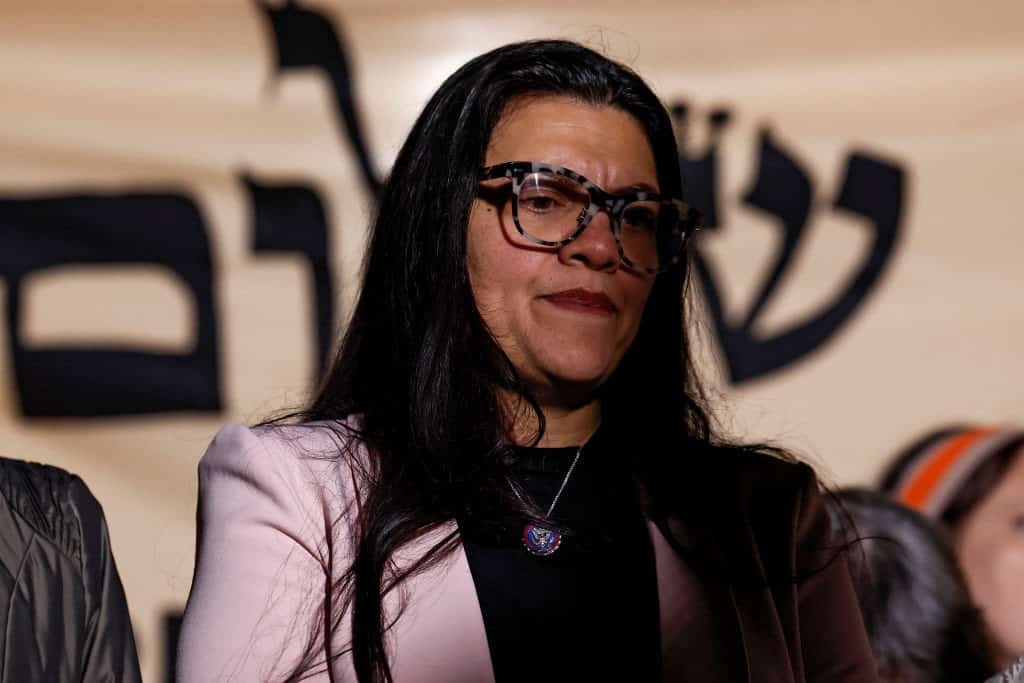
Arizona State University (ASU) canceled an on-campus event featuring Representative Rashida Tlaib (D-MI), citing procedural issues.
A university spokesperson told The State Press, a student newspaper: “The event featuring Congresswoman Tlaib was planned and produced by groups not affiliated with ASU and was organized outside of ASU policies and procedures. Accordingly, that event will not take place today on the ASU Tempe campus.”
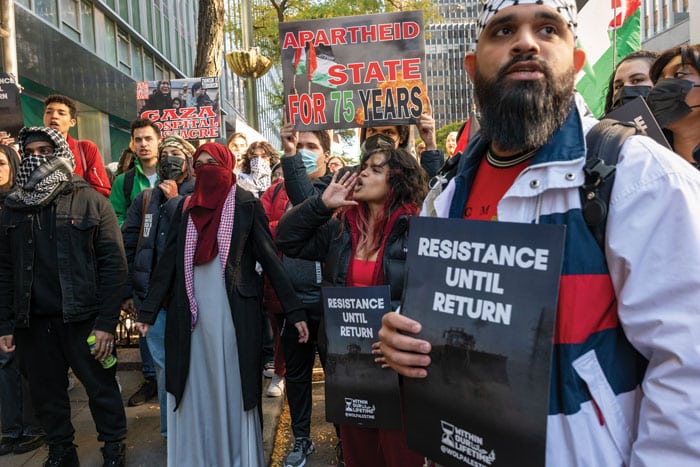
The event, called “Palestine Is an American Issue,” was organized by the Arizona Palestine Network and co-sponsored by ASU’s Students for Justice in Palestine (SJP) chapter, per The State Press. The SJP chapter called the university’s decision to cancel the event “unacceptable.” “Rashida Tlaib must be heard on campus as the only Palestinian member of Congress who plans to speak on an American issue at an event,” they said in a social media post, per The State Press. “ASU cannot claim to hold free speech as a principle while denying Palestinians their voices on campus.”
Tlaib did, however, speak virtually through a laptop to a pro-Palestinian protest on campus that afternoon, The State Press reported. She told the protesters, per The State Press: “Do not let the university sway you all. What you are doing is powerful and impactful. People are going to ask you where you were during this moment. And you’re going to say I was focused on saving lives.”
The day before, a bipartisan letter from members of the Arizona House of Representatives urged the university not to use any taxpayer dollars toward the event, noting that Tlaib was recently censured by the House of Representatives “for perpetuating anti-Jewish sentiments that support the destruction of the state of Israel.” The letter later added: “Congresswoman Tlaib is of course free to speak on campus, and we commend our universities for supporting free speech and holding uncomfortable conversations. However, ASU should not use public dollars, collected through student fees, to support SJP––an organization that, in addition to opposing the existence of the state of Israel, proudly denies the existence of the United States.”
In a rare bipartisan news release by Arizona House of Representatives Michael Carbone (R-25), Alma Hernandez (D-20), Alexander Kolodin (R-3), and Consuelo Hernandez (D-21):
Members of the Arizona House are calling for ASU to not use taxpayer dollars to host Rashida Tlaib, and… pic.twitter.com/1qFjVQ1nij
Tlaib’s office did not respond to the Journal’s request for comment.
Tlaib was censured on November 8 by a vote of 234-188, with 22 Democrats voting in favor and four Republicans against. The censure resolution accused Tlaib of “promoting false narratives regarding the October 7, 2023, Hamas attack on Israel” and “calling for the destruction of the state of Israel.” The resolution specifically criticized Tlaib for promoting the slogan “from the river to the sea, Palestine will be free,” which many have interpreted as being a call for the destruction of Israel. Tlaib claimed on the floor of the House that the phrase is “an aspirational call for freedom, human rights and peaceful coexistence, not death, destruction or hate” and maintained that she has only criticized the Israeli government, not Israelis as a whole, according to The New York Times.
Growing up in Hong Kong during the ’80s and ’90s, antisemitism was as immaterial to me as the animosity between the Hutus and the Tutsis in Rwanda. I knew it existed. I knew many people were persecuted and killed because of it. I knew the course of history was altered by it. Still, my teenage self was too preoccupied living my own historic moment to pay it any mind.
In the summer of 1997, the sovereignty of Hong Kong was handed over to China after 156 years of British colonial rule. The sense of uncertainty and angst the decolonization process provoked among the island and territories’ six million people was all consuming. So when Professor Robert Stone of my photojournalism class recounted stories from his war reporting days in the Middle East and explained the history of antisemitism to a roomful of freshmen, I was only half listening.
It was not until 2004 when I met my now husband, David, that I dabbled in learning about antisemitism again. Disputative and unyielding, I spent hours debating with him the rights and wrongs of Israelis and Palestinians. David argued from a staunch Zionist position while I took the simplistic and, it pains me to admit, poorly-informed “what do you expect the Palestinians to do?” attitude. He gave me Robert Kagan’s “Of Paradise and Power,” which argues that the U.S. and, by extension, Israel have very different philosophical outlooks on the use of power than the more passive nations of Europe so I could “educate myself” on the complexities of the conflict. I returned fire by giving him Desmond Tutu’s “No Future Without Forgiveness” to highlight his lack of vision where the most vicious conflict can be resolved through truth and reconciliation. Looking back, dueling gifts notwithstanding, this was when I became cognizant of my ignorance when it came to antisemitism.
During my process of converting to Judaism in 2019 and 2020, one of my goals, besides accomplishing the required learning that went with conversion, was to truly understand what antisemitism is, its origin, its evolution and its contemporary manifestations. After all, what could demonstrate a more ardent desire or a more clear-eyed determination to convert than tying my fate to the Jewish people fully aware of the enduring hatred waiting on the other side of the mikveh?
Prior to Oct 7, 2023, I would say I had a solid intellectual grasp of contemporary antisemitism, from its variants on the far right to the far left, and everything in between. I read Bari Weiss, Deborah Lipstadt and more articles on the subject than I can count. I attended numerous conferences and webinars on the topic. I even spent a week in Oxford, England this past summer to learn from a panel of antisemitism scholars and experts.
Nothing prepared me for what happened on Oct 7 and the ensuing events in the following weeks.
For no written word can adequately describe a hatred so vast it swallows a person’s humanity and enables them to rip a baby out of its mother’s womb, killing them both, or to tie children up to burn them alive. As I heard about these atrocities, antisemitism morphed from an idea to wrestle with into a living, breathing organism.
For no written word can adequately describe a hatred so vast it swallows a person’s humanity and enables them to rip a baby out of its mother’s womb, killing them both, or to tie children up to burn them alive.
And overnight, all the antisemitic themes and trends I had been reading about but not truly comprehending jumped from the pages of a book to the chants of protests, the headlines of the news, the violence in the streets and the ghastly memes on Instagram. The expansive history of antisemitism was compressed to a single week.
First, there was the massacre. There has been enough said and written about the details of what happened on October 7th for me to skip recounting the horrors here. Suffice it to say that the Hamas perpetrators exceeded the brutality of their antisemitic forebears who committed the Kishinev Pogrom in the early-twentieth century and the Farhoud four decades later. Just three weeks after the Hamas attacks, an antisemitic mob stormed an airport in southern Russia’s Republic of Dagestan intending to murder Jewish passengers on a flight from Tel Aviv. The genocidal impulse against Jews was not confined to one group of people or one geographical location.
Second, there was the glorification of violence. The writer Ben E. Freeman recently observed that “the Jews are the only people in the world demonised for experiencing genocide.” There were the Instagram memes lionizing the Hamas terrorists flying in on hang gliders to murder teenagers dancing at a rave, and other memes pledging allegiance to “The Resistance” and committing themselves to the “liberation of Palestine.” If I wasn’t certain about what they meant by “liberation of Palestine” before October 7th, now it was made abundantly clear in the ecstasy over the carnage. Karen Attiah, an International affairs columnist for the Washington Post, “liked” a post by the journalist Najma Sharif who justified the murder of Israelis. “What did y’all think decolonization meant? vibes? papers? essays? losers,” wrote Sharif. As someone who lived through an actual, peaceful decolonization process in Hong Kong 25 years before, her rationalization of the Hamas massacre as resistance to colonization—repeated by so many others—struck me as both deeply ignorant and malevolent.
Third, there was blood libel. Blood libel refers to the accusation that Jews kill Christian children using their blood for Jewish ritual purposes, such as for the matzahs eaten on Passover. Blood libels have frequently sparked pogroms and mob violence against Jews. In this instance, however, the blood libel was in the accusations that Israel intentionally fired a missile into a Gaza hospital killing 500 people. Most major newspapers immediately fell for the Hamas PR stunt. The New York Times even published a picture of a demolished building to bolster the false claim while the hospital itself was still standing, largely unscathed. The false reports set off major, often violent protests across the Arab world, Europe and the U.S. As soon as the evidence came in showing it was an Islamic Jihadist rather than an Israeli rocket, the media lost interest in the story. As journalist Becket Adams wrote, “The media will never forgive Israel for not bombing that hospital.” The fact that many people seemed disappointed to find out 500 Gazan civilians were not killed cannot be more revealing: The world is all about being anti-Israel and little about being pro-Palestine. Like the bogus claims against Jews for murdering Christian children, these charges put Jewish lives in grave danger.
Fourth, there was denial. Holocaust denial has long been a feature of the antisemitic imagination, claiming that the Holocaust was invented or exaggerated by Jews as part of a plot to advance Jewish interests. Before Oct 7, in a world saturated with smartphones and live streamers, I was certain denial was one manifestation of antisemitism that had lost its charm. How wrong was I? Here I was in October 2023, hearing denial of horrific atrocities committed by Hamas against Israelis. The Hamas terrorists went the extra mile to wear bodycams to record their brutality, yet many still refuse to acknowledge the depth—or even the reality—of their depravity. I was witnessing in real time the making of a new denial narrative. Seemingly normal everyday Americans emerged across the country to rip down posters demanding the return of kidnapped Israeli children, denouncing them as Jewish propaganda with glee and contempt. It is frightening to realize how thin is the veil of civility behind which antisemites hide.
Fifth, there were the double standards. Why, I wondered, were there so many specious charges of genocide against Israel leading up to and during Israel’s military response compared to other wars? Saudi Arabia has killed 100,000 people in Yemen. Syrian President Bashar al-Assad has killed 300,000 civilians, more than 3000 of which were Palestinian. In the past six years, the Chinese government has detained more than one million Uyghur Muslims and placed them in reeducation camps, killing and raping many. None of these atrocities have created a fraction of the moral hand-wringing of Israel’s defensive military actions in Gaza. While the world yells ceasefire at Israel, no one wants to point out Hamas broke the ceasefire on Oct 7. While the world demands that Israel leave Al Shifa Hospital alone, no one demands that Hamas move out of the tunnels below the hospital and stop using the infirmed as their human shield. While the world demands to know what Israel’s military objectives are, it all but ignores Hamas’: to eliminate the Jewish state and its people. What could possibly explain this egregious hypocrisy other than ill will toward the Jewish people and Jewish sovereignty?
In this brutal awakening to the reality of antisemitism, I found myself returning to the teachings of Viktor Frankl whose philosophy was forged in the hellfire of Auschwitz. “Everything can be taken from a man but one thing: the last of the human freedoms—to choose one’s attitude in any given set of circumstances, to choose one’s own way.” What could I do to make meaning of this awful moment?
A few weeks ago, at the Jewish Priorities Conference in Philadelphia, a distraught audience member in her twenties asked the panelists how she could help her non-Jewish friends understand antisemitism. “They just don’t get it,” she said on the verge of tears. As a newcomer to the Jewish experience, I’m not equipped with a built in antisemite detector. However, I’ve discovered, this distance affords me the insight on how to explain antisemitism to non Jews in a way that’s easy to grasp. Sharing it is part of my search for meaning in the face of incomprehensible hatred. This is my contribution.
The brilliant Palestinian plan to capture the pliable minds of American college students was laid out in front of me 25 years ago, during a very sinister business meeting in Israel.
It was around the time of the Oslo Accords. I had been hired by the Ford Foundation to create a marketing institute for their grantees in the country. Ford was funding the operations of both Jewish and Arab organizations within the Israeli green line, in an effort to help build a vibrant liberal civil society.
Ford put me in partnership with a young Israeli woman, Debra London. (Debra, now one of my closest friends, has just been selected to head up fundraising for the rebuilding of Kibbutz Be’eri.) She and I drew up a plan to interview each of the grantees, as well as Israeli ad agencies and media firms. While we wanted to learn about the grantees, we also planned to secure free marketing work and media to be an essential part of the institute.
When we interviewed the Jewish organizations, the atmosphere was almost giddy with hope, possibility and belief in Shimon Peres’s new Middle East. Each organization we interviewed talked excitedly about peace and co-existence, a flourishing economy among both the Jews and the Palestinians, collaborative projects and interchanges.
But when we interviewed the Arab organizations, the word “peace” never passed their lips. They spoke of independence, dignity, self-rule, a state. One person even told me she would never use the word “du-kiyum” (co-existence). “There is no such thing as co-existence,” she stressed. “We are just the tenants living on the property that the Jews now own. That’s not a balanced co-existence.”
I tried to explain to my fellow Jewish liberals that we — the Jews and the Arabs — were having two very separate conversations. We were talking “peace.” They were talking “independence.” But as the weeks of interviews progressed, I found the Arab organizations were talking about a whole lot more.
I asked hard questions of both the Jews and Arabs in the interviewing process. With the Arab organizations, when I brought up any sensitive, and not-so-sensitive, issues—like terrorism, cooperation and even budget—the interviewee would slam on the brakes.
And then from each organization, the same words were spoken: “When you are in Haifa meeting with Itijaa, you can ask that question to Ameer Makhoul.” Itijaa was an Arab civil rights organization. Ameer Makhoul was its executive director. It became clear to me that Ameer Makhoul had some type of control over all the Arab NGOs I was speaking to.
Finally, Debra and I arrived at the offices of Itijaa. Skinny, bespectacled, young Ameer Makhoul emerged from his office, took a look at me and said, “So this is the Gary Wexler who has been asking all the questions.” And then he ticked off every question I had asked along with the name of each person I had posed the question to.
He brought us into his office and began pacing. “So, Gary Wexler, let me answer your questions in the following way. One: Gary Wexler, who is sitting in front of me now, went to Los Angeles City College for two years where you were an Israel activist and editor of the school newspaper. You wrote a lot about Israel. And continued to do so at California State University, Northridge. You spent five summers as a volunteer on Kibbutz Ayelet Hashachar. Through your marketing agency, Passion Marketing, you service the following clients of the Jewish world and in Israel.”He named every one.
I knew this guy was trouble.
“And now, Gary Wexler,” he sat down, “let me give you more direct answers.” He looked me straight in the eye. “Just like you were a Zionist campus activist, we will create, over the next years, Palestinian campus activists in America and all over the world. Bigger and better than any Zionist activists. Just like you spent your summers on the kibbutz, we will bring college students to spend their summers in refugee camps and work with our people. Just like you have been part of creating global pro-Israel organizations, we will create global pro-Palestinian organizations. Just like you today help create PR campaigns and events for Israel, so will we, but we will get more coverage than you ever have.”
He stood again this time, right over me. “You wonder how we will make this happen, how we will pay for this? Not with the money from your liberal Jewish organizations who are now funding us. But from the European Union, Arab and Muslim governments, wealthy Arab people and their organizations. Eventually, we will not take another dollar from the Jews.”
Then he approached real close. “What do you think of this?”
I took a breath. I remained professional. “Nothing. I’m here on behalf of the Ford Foundation collecting information for a planned marketing institute.”
He came even closer. “I am asking what does Gary Wexler think of what I just said. You, Gary Wexler.”
I repeated my answer.
He came even closer. “I ask again. What does Gary Wexler think of what I just said.”
Debra and I got up. I took my writing pad. “I feel that you are threatening me and we are leaving.”
The next morning I received a call from the program officer at the Ford Foundation. “Gary, we have a problem. We received a call from Ameer Makhoul and we understand you spewed out all sorts of Zionist propaganda and he felt very threatened by you.”
I told him it was a lie.
The program officer continued to press me as to what I had said. I related the conversation word for word. He repeated what Ameer Makhoul had said. I told him to call Debra London who was with me through the entire interview, and verify it with her. I also told him that they better check their funding to these Arab organizations, because Ameer Makhoul appeared to be controlling all of them with some very hateful behaviors.
He backed down.
Debra and I wrote up our recommendations for how they needed to build the marketing institute, including a recommendation for using the pro bono work, worth nearly 1 million shekels, that we had secured from the ad agencies. The program officer, a former academic focused on the nonprofit sector, couldn’t understand the value of businesses being involved and rejected it out of hand. A few weeks later, he told Debra and me that he had hired an NGO consulting team to finish the work. They would be giving several hours of consultation to each organization.
Several years later, I learned Ameer Makhoul had been arrested by the Israelis as a spy for Syria.
As the years went on, I began to see what Ameer Makhoul had laid out to me taking shape. The PR coverage was first: The Muhammad al-Durrah incident in Gaza, when a 12-year-old boy was shot to death on the second day of the Second Intifada, capturing global headlines. The Mavi Marmara, the Turkish Flotilla to Gaza that the Israelis stormed, killing several Palestinian activists, grabbing global headlines. I knew the Mavi Marmara was manufactured for the exposure it would gain.
Then the campuses: The creation of Apartheid Week worldwide. The growth of BDS. The student volunteers who began by the thousands to work in the Palestinian territories and its refugee camps. The shocking creation of anti-Zionist Jewish student groups.
As an award-winning copywriter and creative director in ad agencies and a professor of Communication at USC, I have developed an intuitive antenna to detect similarities between writing styles, idea styles and conceptual creation. In the early years of this pro-Palestinian campaign, I could see the commonalities of excellence, style and manipulation across all their platforms. Teaching on a university campus gave me a front-row seat at this theater of darkening skies.
People of color, particularly antisemitic Black groups like BLM, were organizing to identify with the Palestinians. Many organizations representingpeople seen as oppressed were moved to identify with the Palestinians. Students of every variety were swayed.
People of color, particularly antisemitic Black groups like BLM, were organizing to identify with the Palestinians. Many organizations representing people seen as oppressed were moved to identify with the Palestinians. Students of every variety were swayed. I could see the commonalities of language creation and transfer — my field — being applied to the Jews. Many of them were old antisemitic tropes into which new life was being breathed:
Israel and Jews are colonialists just like other white oppressors around the world.Israel is an apartheid society, the same as South Africa was.
Jews have white privilege, even though more than 50% of Jews are dark-skinned people from the Arab world, Iran and Africa.
Jews hold power in media and banking, making them the enemy.
Jews center themselves as capitalists and donors.
Jews don’t hold space for anyone but themselves.
Jews need to be held accountable for the pain they are causing.
If you challenged any of this you were a racist, the worst thing you could possibly be accused of.
(Except if you are racist against Jews. Then you prove you are a true ally of the oppressed.)
Our enemies have had a real success.They have formed a winning international communication army with trained troops everywhere.
Israeli writer, producer and former antisemitism envoy Noa Tishby recently said that students, particularly Jewish ones who are protesting against Israel, have been “played,” but I don’t know if even she understands the background and extent of it. They haven’t just been played, they’ve been turned. Many of them are alumni of Jewish day schools and camps. Those students believe they have joined the other side because they were the victims of a propagandized Zionist education and have now seen the light. No, they are the victims of a propagandized, slow, well-crafted plan, laid out to me by Ameer Makhoul.
And what has been the Jewish world’s response to all of this?
Funders are now putting up pro-Jewish and pro-Israel billboards in American cities. As if a clever one-line message can combat all these brilliant, strategized organizing efforts on behalf of our enemies.
Others are organizing TikTok and Twitter troops. But that work is in response to the playing field that has been established and won by the enemies of the Jewish people. We show ourselves in a defensive mode. We are playing on the field they have drawn. We need to draw our own, in a very big way.
There are many good organizations being funded and working on our behalf, but their work, alone, is not the answer.
There are many good organizations being funded and working on our behalf, but their work, alone, is not the answer.
It is imperative we have overall strategizing and coordinating. Right now, it is every organization for itself. It’s an uncoordinated battlefield where each squadron is moving in its own direction, rather than toward the same hill—the only way for victory. It is imperative that we create big, brilliant, creative ideas of engagement. We must view this as a pervasive Jewish community organizing effort for communication purposes, in collaboration with the Israelis.
American Jews are sending cans of food and socks to Israel while the Palestinians are conceptualizing bigger and better worldwide actions. We’re still fighting and demonizing one another. Many organizations have not yet woken up that it is no longer business as usual.
In the last three weeks I have received no fewer than 200 solicitations for 200 separate efforts. American Jews are sending cans of food and socks to Israel while the Palestinians are conceptualizing bigger and better worldwide actions. We’re still fighting and demonizing one another. Many organizations have not yet woken up that it is no longer business as usual. I’m on the board of one that I’ve had to rattle, saying, “No, we cannot position what we are doing just as we always have. Everything now has to be repositioned against the background of this war on Israel and the Jewish people.”
In the propaganda war, we could be learning a lot from our enemies, who have learned a lot from us. Maybe we need our own Ameer Makhoul and all his buddies? Is any leadership team, that we can all get behind, going to step forward?
Gary Wexler was recently honored by the National Library of Israel with the creation of The Gary Wexler Archive, a 20 year history of Jewish life told through the advertising campaigns he created for Jewish organizations in the US, Canada and Israel.