fbpx

November 1, 2023

Chef Susan Feniger and Liz Lachman: “Forked,” Food and Spiced Millet Puffs

“Susan Feniger: Forked” is a story of resilience with the backdrop of food. Add a dollop of cooking – and a dash of the food history (in and out of the media) – and you have a recipe for success.

Chef and restaurateur Susan Feniger is the subject of the documentary, produced and directed by her life partner, filmmaker Liz Lachman.

“This is about what it takes to create and see a project through,” Lachman told the Journal. “[To] go on that journey and be willing to just see what comes in life.”

Adds Feniger, “It’s about the human spirit.”

The film starts and ends with cooking history and the trailblazing roles Feniger and her long time cooking/restaurant/media partner Mary Sue Milliken (“Too Hot Tamales,” Border Grill) had in the industry. However, its primary focus is The STREET restaurant, Feniger’s first solo project, which was open from 2009 to 2013.

At the time, Lachman recorded the process of designing, prepping and opening The STREET; she didn’t know she was shooting a movie.

However, when she revisited the footage at the beginning of this process, Lachman, who primarily does narrative films, noted it had all the elements of a “culinary disaster film.” There are lots of challenges that come when building a restaurant.

“It’s about someone [getting] hit with problem after problem and still [coming] through in the end.,” Lachman said.

In many ways it’s also a cautionary tale.

“The restaurant business is so difficult, particularly now,” Finegar said. “But if you’re going to go into it, it’s about being passionate about it, loving what you do.”

While the basics were there, when Lachman reviewed the scenes with Feniger cooking and testing recipes, she realized she didn’t shoot them well.

“And I thought, it’s because I don’t really care about the food that much,” Lachman said. “I had to go back in and shoot beautiful food sequences.”

Side note: There has been quite the food learning curve between Feniger and Lachman who have been together for 28 years.  When they met, Lachman barely salted her food.

Lachman’s mother never cooked, whereas Feniger got her love of cooking from her mom; when she was young Feniger would hang out with her in the kitchen.

“In high school I was an Ayn Rand freak, and I thought I’d be a business person. Then I was a psych major, and then I thought I’d want to be a therapist,” Feniger said. “And once I worked in a kitchen, that was it. I fell in love with the kitchen. Everything about it.”

One of the couple’s favorite foods is Spiced Millet Puffs, which is like a rice crispy treat, but with puffed millet. Recipe is below.

“They’re so yummy, because it’s that sweet, savory thing that’s so typical of Southeast Asian food,” Feniger said. “They are a great little snack and a surprise.”

That sequence in the film pops off the screen.

“The millet puffs is one of the things that we did to music with a lot of slow motion, gorgeous shots,” Lachman said.

When asked about the original plan for the film, Lachman said she didn’t really have one.

“I stopped filming when STREET opened,” she said. “As a matter of fact, [I didn’t shoot] the opening night party … so we did some fancy footwork in the film to create a moment of dreaminess, because this is Susan’s dream coming to fruition.”

Lachman originally thought that would be the end of the film.

“As time went on, before I actually made this movie, things shifted a lot in the world and in Susan’s take on STREET and her whole adventure, so it gave me more story,” she said.

After Mary Sue Milliken’s son, who is about 30, saw this film at the friends and family screening, he called Feniger and said he and his partner couldn’t stop thinking about it. He told her, ‘It makes us wanna live our lives with more passion.’

“I wasn’t even trying for that,” Lachman said. “If that’s what comes from this, I’m thrilled.”

Feniger absolutely loves her career, which is something else that shines through “Forked.”

“I get a ton of satisfaction from my career,” she said. “The actual kitchen part, the feeding part, not the meetings. The hospitality part is just something that clicked for me when I first started, and it’s been 40 plus years.”

Learn more at forkedthefilm.com. And follow @SusanFeniger and @LizLachman on Instagram.

For the full conversation, listen to the podcast:

Watch the interview:

Spiced Millet Puffs

Photo by Lesley Balla


On the streets of India and Asia, chaat stands are everywhere, serving small savory bites of all different types of snacks. Some of these snacks are puffed grains, like rice or millet, filled with a spiced mixture. Although the spices vary, the combinations can include spices like cumin, curry leaf, turmeric and coriander; the scents fill the air and make it an amazing walk for your nose! When we started to play with ideas for a great snack for STREET, Kajsa Alger happened to be making Rice Krispy treats with her son, Seth, and. . .Voila! Sweet and savory, a combination used all over the world.

Makes 70 mini puffs

2 tablespoons unsalted butter

1 (5 ounce) bag mini marshmallows (3 cups)

½ cup dried currants or raisins

1 Tablespoon whole cumin seed

1 teaspoon whole fennel seed

1 teaspoon black mustard seeds

¼ teaspoon cayenne chile powder

¼ teaspoon ground turmeric

½ teaspoon kosher salt

1 teaspoon chopped curry leaf (optional)

3 cups puffed millet

In a large skillet or shallow saucepot, place the butter and cook over medium heat until frothy.

Add the marshmallows and, as they start to melt, push and stir with a rubber spatula, so that it doesn’t burn to the bottom of the pan. You can lower the heat slightly if you need to.

When the marshmallows are halfway melted, add the cumin seed, fennel seed, black mustard seed, cayenne, ground turmeric, dried currants or raisins, salt and curry leaf, and stir well so that the spices toast and mix with the marshmallow. Add the millet, remove from heat, and stir until all of the millet is mixed and evenly coated in the spiced marshmallow mix. Pour the mixture out into a bowl.

Immediately start rolling into very small balls. If you find that the mixture is sticking to your hands too much, you can dampen them slightly with cold water to make the mixture easier to work with.

Place the balls in a bowl and serve immediately. They can also be stored in an airtight container for up to 2 days.


Debra Eckerling is a writer for the Jewish Journal and the host of “Taste Buds with Deb.Subscribe on YouTube or your favorite podcast platform. Email Debra: tastebuds@jewishjournal.com.

Chef Susan Feniger and Liz Lachman: “Forked,” Food and Spiced Millet Puffs Read More »
Re-examining Holocaust Education After the Hamas Massacre

The murderous attack by thousands of Hamas terrorists on the Israeli border that triggered the Gaza War has leveled the thin fence between civilization and barbarism, and with it many conceptions and misconceptions, military doctrines, and national security policies. It did not take long for Israelis and, instantaneously, for Jews around the world, to place what we were witnessing in context — not that of the most recent Israeli-Palestinian conflicts, but rather, Nazi Germany’s war against European Jewry.  

While placing the Hamas assault in the context of the Holocaust might seem detached and anachronistic, a deeper dive into its nature clearly illustrates why the traditional framework of Middle East carnage lacks viability. The unprecedented nature of the violence on civilian men, women, and children, the brutality of the killers, the sense of helplessness experienced by Israelis, the targeting of innocent human beings for the sole crime of being Jewish – these are more aligned with a part of Hitler’s Final Solution than they are as another episode in Israel’s endless war with Hamas. 

Alexander Vorontsov/Keystone/Hulton Archive/Getty Images

In ordinary times, linking current events with the chronology and events of the Holocaust is what good educators do not do. In Holocaust education, we insist on the imperative to teach about it as a singular event, to explain, using photographs, history, literature, diaries, and testimonies, that Auschwitz was another planet, that the destruction of European Jewry was sui generis – not compared or equated with what came before or after. 

But these are not ordinary times. Now, we find ourselves confronted by scenes of graphic carnage — sickeningly familiar and now visible instantly — as they happen. Now savagery is projected before our wide-open eyes on Telegram, Instagram, X, and Tik-Tok. These murderous scenes make many of those captured in old black-and-white Holocaust photographs pale in comparison. They break the veneer of civilization that has for decades led us to believe that we would never again confront such unbridled sadism. When the question is not “how many” but “how” and “what have they done,” we realize that we are witnessing attacks and rampages that meet and far exceed the Nazis and their collaborators in cruelty.  

Yoav Galant, Israel’s Minister of Defense, promised that the IDF response will reverberate in the minds of our enemies for generations to come. The Israeli government’s massive and strong reaction is where, fortunately, comparisons with the Holocaust end. We have a national homeland, and our enemies know that a high price will be paid by those whose life mission is to shed innocent Jewish blood. Yet the Hamas attack, and not only Israel’s response to it, will affect the way Jews read their own history and understand their place in the world. Holocaust education can no longer be what it has evolved into. 

For some time now, general education about the Holocaust has moved from the story of the Jews and the scourge of antisemitism to a general concern for human rights, a vehicle for teaching about the necessity to treat all humans with respect and dignity, and the noble call to stand up to racism, violence, and genocide wherever they occur. Holocaust education has often become, for a variety of reasons, a universal touchstone for peace and justice. Today, though, the utility of this grand civil, lofty, and quasi-pacifist lesson must be called into question. As Jews today find themselves confronting the reality that a pogrom on a scale hitherto reserved for Hitler’s followers can happen here and now, education on the Holocaust must undergo a transformation if it is to remain viable.

The stance of relative tranquility from which we have viewed the Holocaust can no longer be divorced from its original and crucial Jewish context. 

The stance of relative tranquility from which we have viewed the Holocaust has shifted. It can no longer be divorced from its original and crucial Jewish context. It can no longer be merely a historical overview of facts and statistics, assessed by the requirement to name and spell correctly the death camps. It can no longer be merely a sequence of gray images from the past that become a universal gold standard of evil, of man’s inhumanity to man, of victims and perpetrators, with no mention of Jews or the racial antisemitism that helped to make the Holocaust possible. Today, such universalist packaging has become impossible to defend.

Now, Holocaust education – in museum tours, in classroom instruction, in state mandates, in survivor and second-generation testimonies, in films–must return to what it should have always included – a call to safeguard the lives, well-being, and future of Jews in the world and, first and foremost, in their ancestral homeland. Holocaust education that deviates from this call, morally questionable yesterday, must today be declared dead. Holocaust education must be life-affirming for world Jewry, for the Jews and for all peace-loving citizens of Israel, and, of course, for all those still wishing to embrace humanity and condemn and reject antisemitism in this terrifying new world.


Dr. Shay Pilnik is the Director of the Emil and Jenny Fish Center for Holocaust and Genocide Studies at Yeshiva University in NY. 

Re-examining Holocaust Education After the Hamas Massacre Read More »

Message From Israel

The journey to Israel from Los Angeles has been incredibly inspiring and meaningful. I came to Israel with five bags of supplies for the IDF and for those who have had to evacuate their communities in the south as well as the north. Getting the supplies through customs was more challenging than I had anticipated but ultimately all of the supplies made it through and were delivered directly to those who were eagerly awaiting them.

Arriving in Jerusalem for Shabbat, I was able to be present communally and personally. I paid a shiva visit to my college friend, Rabbi Leon Wiener-Dow (about whom I spoke in my Yom Kippur sermon at Stephen Wise Temple), who just lost his father. I joined the community at Kol Haneshama, the congregation where our oldest became Bat Mitzvah and where I am still an overseas member, for services. The sadness and trauma were powerful and palpable; amidst the beautiful prayers, we read the names of every single hostage known to be held in Gaza.

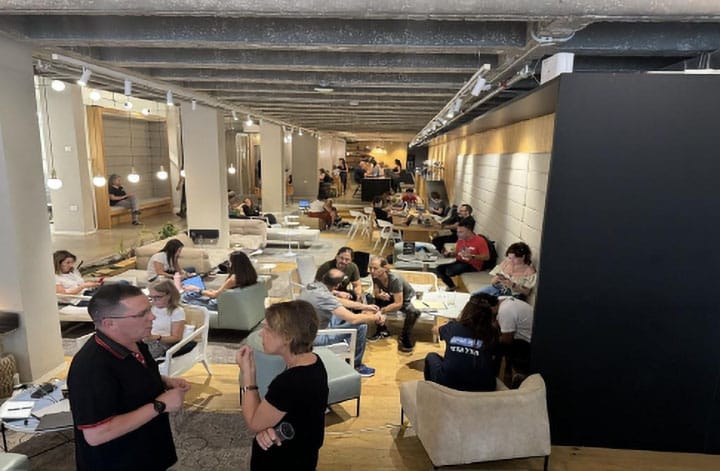
Hamal Ezrachi, Tel Aviv (Civilian “War Room”)

But so was the determination and courage.

On Saturday night, I left Jerusalem to visit my dear friends, Adi and Itzik. Adi, more sabra than not in her usual emotional demeanor, cried as soon as she saw me. “I’m so glad you came to see us,” she said. “Anachnu mispacha,” I said, we are family. This is what family does. We are there for each other, especially in the difficult times.

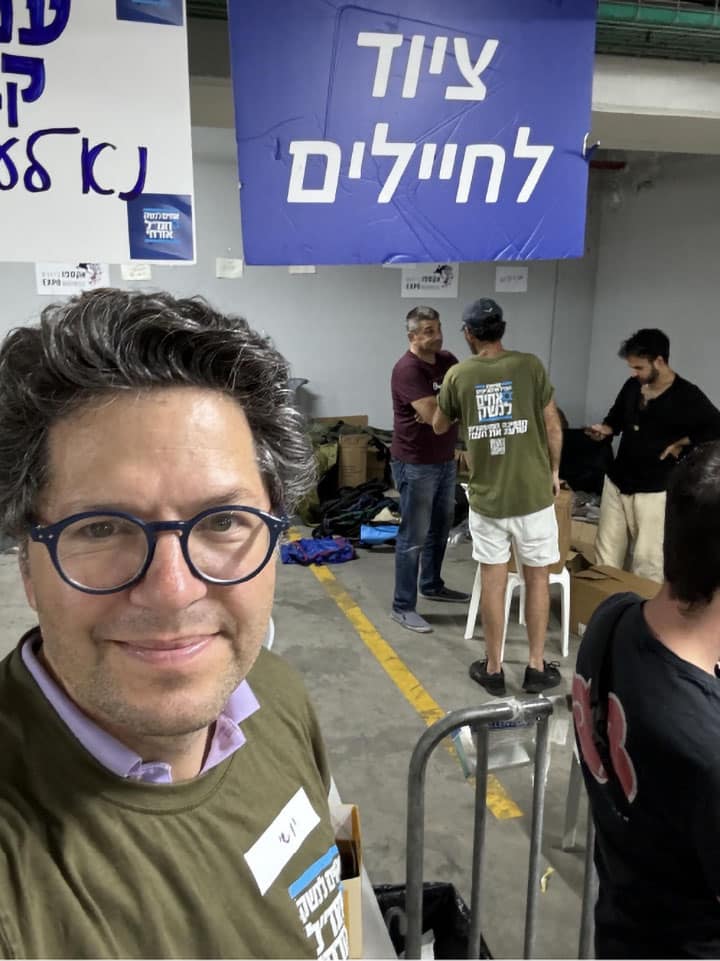
For over 41 weeks in 2023, an Israeli group called Achim L’Neshek (Brothers in Arms) was the driving and organizing force behind the massive protests against the judicial reform agenda of the current government. On October 7, their mission—and considerable organizational skills—pivoted to organizing a nation-wide response.

Rabbi Yoshi and Rafi Bielasiau (Brothers and Sisters for Israel)

Creating a new non-profit called Brothers and Sisters for Israel, the leadership has mobilized the entire country. From providing food, clothing, strollers and cribs to the families who have had to evacuate the south and now the north, to enlisting high-tech CEOs and engineers to use A.I. to try to identify everyone who was kidnapped as well as the Hamas terrorists who perpetrated the massacre, to sourcing supplies for the I.D.F., the all-volunteer organization was an absolute inspiration. I’m working with them now to find ways to source an additional 8,000 sets of body armor that are desperately needed by the army and I want our Wise community to help. We will let you know as soon as we have the details of the project; I know our community will meet the challenge.

I won’t mince words: The atmosphere here is somber. The entire nation has experienced a terrible, terrible trauma. Every single Israeli knows someone or knows someone who knows someone who was murdered, kidnapped or wounded. To add to the pain, they have witnessed the same pictures and videos and comments on social media that we’ve seen. It feels like much of the world is, at best, apathetic and unmoved by our pain, and, at worse, actively blaming us for a barbaric massacre of which we were the targets.

The entire nation has experienced a terrible, terrible trauma.

And, at the same time, there is astonishing courage and resilience. Tens of thousands of Israelis are toiling every day on behalf of their fellow citizens, many of whom are complete strangers. But they know—and we know, too—that we have a shared history and a common destiny. Now is the moment to step up for people and our homeland. Kol Yisrael arevim zeh l’zeh—we are responsible for one another.

Am Yisrael Chai: Our People lives and endures.

To support Rabbi Yoshi’s tzedakah work in Israel, make a donation to www.Kavod.org and note “Emergency Relief for Israel.”


Message From Israel Read More »

The Death of Jewish Idealism?

Perhaps the best title ever for a Jewish Journal column appeared in the aftermath of the October 7th massacre. A piece by Kathleen Hayes about being sickened by the reaction from self-identified “progressives,” was titled “I Was You, ‘Defender of the Palestinians,’ and Now I Want to Puke.”

While many Jews have undoubtedly been disappointed, it seems that younger generations have felt more acutely this betrayal from those who claim to care about human rights. I bet that those my age already suspected that a number of the groups we have supported with our time and money would run and hide when we needed them most, or worse, openly side with those whose goal is our annihilation. My children and their peers hoped we were wrong.

In a New York Times story, “On Israel, Progressive Jews Feel Abandoned by Their Left-Wing Allies,” Jews reported being horrified that their “friends” would reflexively join the global outrage over Israel’s “disproportionate” response to the monstrous terrorist attacks, while denying the fact that there was terrorism at all.  

I was so sad to read the quotation from Los Angeles Unified School District board member and congressional candidate Nick Melvoin that appeared below the headline: “I am in such a state of despair – in my generation, we have been warned how quickly people would turn on us and we just thought no way.”

While I don’t worry about seasoned leaders like Melvoin, I do fear that some young Jews will become jaded, abandoning important causes that so need their advocacy.  It is essential that we make the distinction between organizations and the ideas they promote.  

Just because a Black Lives Matter group adorned their message criticizing Israel with a depiction of a terrorist on a hang glider doesn’t mean their anti-racist cause is unjust. The same for pro-choice groups that complain about Israel’s supposed “colonization” but don’t decry the abysmal state of women’s rights in the areas about which they purport to care. How many of us working on environmental issues cringed when we saw Greta Thunberg’s social media post imploring the world to speak up for justice and freedom for Palestinians, without acknowledging the atrocities perpetrated by Hamas?  Still, our commitment to combat climate change should be immutable. There is also the perplexing existence of a group named Queers for Palestine. Their naivety should never call into question our work on behalf of LGBTQ+ dignity and rights, nor lead us to abandon our hope for a two-state solution in the Middle East.  

In short, let’s not reduce our efforts to repair the world because some of the worthiest causes are associated with less than worthy individuals and groups.

At the same time, let’s not get fooled again.  When we do something virtuous, it should not be with the belief that we are developing allies who may one day come to our defense.  Keep those expectations low.  If our alleged friends rise up in our support, let’s be pleasantly surprised, not disappointed when they don’t.  

We should do what is right for one essential reason – we are Jews.  It reminds me of the hierarchy of charitable giving as enumerated by Maimonides.  While providing charity that carries with it self-interest (letting the recipient know the donor’s identity, for example) is a virtue, it isn’t as laudable as bestowing charity without recognition or obligation.  If we don’t expect anything in return, we are less likely to feel betrayed.

I was recently struck while reading the parsha Noach (Noah) that he was a changed man after the flood.  Noah, selected by G-d because he was a righteous person who was above reproach, was broken by the devastation he witnessed.  He appears to have found refuge in the bottle, rather than in his faith or in his family.

Having our eyes opened to the reality that so many will turn on us or remain silent when it is expedient for them to do so, should not leave us so cynical that we reject the causes that define who we are.

We too have seen unspeakable horror, but we must retain our humanity and our values.  Idealism is a great virtue. Having our eyes opened to the reality that so many will turn on us or remain silent when it is expedient for them to do so, should not leave us so cynical that we reject the causes that define who we are.


Morton Schapiro is the former president of Williams College and Northwestern University.  His most recent book (with Gary Saul Morson) is “Minds Wide Shut:  How the New Fundamentalisms Divide Us.”

The Death of Jewish Idealism? Read More »

Oakland Teacher’s Union Calls Israel “Apartheid State,” Accuses Israeli Leaders of “Genocidal Rhetoric” Toward Palestinians

The teacher’s union in Oakland, CA is under fire over its statements on the Israel-Hamas war referring to Israel as an apartheid state and accusing Israeli leaders of “genocidal rhetoric” toward the Palestinians.

KRON4 reported that on Friday, the Oakland Education Association (OEA) wrote in a since-deleted Instagram post, “We, the members of OEA, express our unequivocal support for Palestinian liberation and self-determination. We condemn the genocidal and apartheid state of Israel. We call for an immediate ceasefire and the end of all U.S. military aid to Israel.”

The OEA later posted on Facebook that the union had “passed a resolution in response to student activism around the conflict in Israel and Palestine. A post on our Instagram on Friday evening did not accurately represent our original resolution … We take responsibility and are learning from this harmful mistake.” The OEA added: “We are committed to continuing the conversation within our union as we engage in our democratic processes. Our union unequivocally condemns anti-Semitism and Islamophobia. We call for the release of hostages held by Hamas. We mourn the loss of life, and we add our voices to a growing collective calling for a ceasefire.”

The union proceeded to provide the full text of the resolution in the Facebook post, which states that the OEA mourns “the tragic loss of both Palestinian and Israeli lives these past weeks” and denounces “the 75 year long illegal military occupation of Palestine.” “The Israeli government created an apartheid state and the Israeli government leaders have espoused genocidal rhetoric and policies against the people of Palestine,” the statement continued. “As educators of a diverse community here in Oakland, including those with family and friends directly impacted, our conscience demands that we say clearly that OEA calls for a ceasefire and an end to the occupation of Palestine.”

Anti-Defamation League (ADL) Central Pacific Region Director Marc Levine sent to a letter to Oakland Unified School District (OUSD) Superintendent Dr. Kayla Johnson-Trammell on Monday, stating that the OEA had “endorsed a dangerous and false account that ignored entirely the atrocities’ of Hamas terror attack on Israeli civilians on October 7, while embracing an offensive narrative that will serve to isolate and target OUSD’s Jewish students, families and teachers.” Levine acknowledged that while the statements in question have “since disappeared and/or been updated … the pain, fear, and concern caused by the original statement is still reverberating in the community.”

Additionally, Levine noted that the OEA’s statements had linked to “lesson plans and curriculum” that are “laced with anti-Israel bias.” Levine concluded his statement by urging the OEA to “retract its statements and issue an apology that clearly acknowledges the harm it caused” and called for the district “to issue a statement making it clear that OEA’s statement does not reflect the values of the district and take any remedial action necessary.”

Asked by the Journal for comment on Levine’s letter, a spokesperson for OUSD referred the Journal to a Monday statement from the district that stated in part: “OUSD disavows the various polarizing statements on the conflict issued by organizations in the OUSD community this past weekend. During these heartbreaking times, we are focused on supporting all members of our community affected by this human tragedy.”

Megan Bacigalupi, a Jewish parent with two children in OUSD, told KRON4: “For the Oakland Education Association, which again, represents thousands of teachers, many of whom are also Jewish, who are teaching Jewish students, to say something that wasn’t just anti-Israel, it was antisemitic, it worried a lot of parents like myself about how our children are going to be treated and perceived in the classroom.”

Bacigalupi, who co-founded California Parent Power, also criticized the district’s statement for failing to mention the OEA by name. “We have to be very clear where we draw the line when something is antisemitic and I wish that the district had done that more profoundly,” she added.

Sara Holderfield, a teacher’s union representative for Chabot Elementary School in Oakland, told KTVU that she wouldn’t have approved such a divisive statement and that the union should “should be focused on keeping our students and staff safe and providing an excellent education for all students … We have no business taking a stand on complex political issues that touch the lives of so many in our community.” She also urged the union to retract its “dangerous message” and scrub any reference to anti-Israel teaching material.

The OEA did not respond to the Journal’s requests for comment.

Oakland Teacher’s Union Calls Israel “Apartheid State,” Accuses Israeli Leaders of “Genocidal Rhetoric” Toward Palestinians Read More »

November Clean Speech Campaign: Mindful Speech to Unite and Heal

Starting November 1, members of Jewish communities across North America are invited to participate in the “Clean Speech Challenge.” 

Founded by Rabbi Raphael Leban, executive director of the Jewish Experience in Colorado, the Clean Speech Challenge is a 30-day educational and awareness campaign to strengthen unity and respect within and beyond the Jewish community.

“Over the past decade we experienced a terrible disintegration in civility and public discourse and in our healthy relationships personally,” Leban told the Journal. “The way we speak to each other is both the problem and the solution.” 

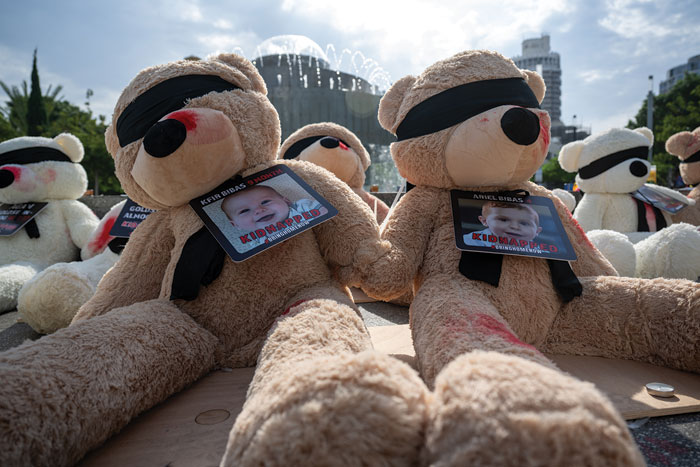
As Jewish communities around the country continue to grapple with the war in Israel, and the loss of more than 1,400 lives and 200+ hostages taken by terrorists, many are finding ways to unite and heal and try to make a difference.

The month-long campaign, Leban explains, is both a response and an opportunity to make the world a better place. 

The month-long campaign, Leban explained, is both a response and an opportunity to make the world a better place. “This campaign is particularly timely and important right now,” he said. “We need to be extremely united as a people while under attack from our enemies.” 

He added, “In addition, the world needs to see the beauty of a healthy Jewish community, particularly at a time when antisemitism is at a shockingly high level all around us.”

Launched by Leban in Denver, Colorado, in 2019, the Clean Speech campaign was a response to mounting concerns regarding the increasingly confrontational discourse among communities and online platforms. Since its inception, more than 60,000 individuals have taken part throughout North America.

According to the organization, participant surveys reveal that 72% of respondents witnessed a significant transformation in their communication patterns, while 98% acknowledged that the campaign’s teachings have had a lasting impact on their speech. Plus, more than 90% expressed eagerness to join future campaigns.

This year, more than 200 Jewish organizations and schools, across the spectrum of affiliations, plan to participate; Clean Speech expects to reach more than 60,000 people. While anyone, anywhere, can sign up online, there will be campaigns run in New York City, Denver, Cincinnati and Santa Barbara. Ottawa, Canada, will run their campaign in December, and Toronto, Cleveland, St. Louis, New Jersey, Dallas, Los Angeles and the United Kingdom will run campaigns in early 2024. 

“Although we are outraged and heartbroken with the atrocities committed on our brothers and sisters, we are also galvanized in solidarity as a Jewish community to defend, support and encourage each other with honor and respect” Leban said.  

Starting November 1, participants in the Clean Speech campaign will receive daily two-to-three-minute minute videos, based on timeless biblical wisdom. These videos offer everyday insights and tips on how to speak with respect to others. The hope is to erase gossip, slander and criticism.  

“Instead of watching graphic, violent videos of terrorists bent on destruction and death, our campaign offers a very different kind of video,” Leban said. “One that gives a positive message and tools for changing the way we speak to one another.” 

Leban believes the exercise of learning for two minutes daily consistently for one month will help to “lock in real change in the way to speak to each other. Our data shows that if someone participates in the campaign consistently, spending just two minutes a day for 30 days, they can genuinely and successfully upgrade their speech habits. The relationships with people all around them will thereby be improved, whether at home or at work.” 

He continued, “If as a community, we embrace the lessons of Jewish mindful speech successfully we can elevate and upgrade our communal discourse affecting everyone in the community and ultimately the world.”

The Clean Speech Challenge is free and open to all. For more information and/or to sign up, go to CleanSpeech.com.

November Clean Speech Campaign: Mindful Speech to Unite and Heal Read More »

Ten Days in a Jerusalem Hotel Lobby

Many people have written about their experiences in Israel over the past several days, hoping to share a sense of the gravity of the situation and to express the pain and anguish of recent events. I, too, was in Israel when the war broke out, but my personal experience was not remarkable. It mirrors that of everyone else in Jerusalem over the holiday and the days that immediately followed. But this story is not about me. I want to tell a different story.

Because our flight home to Los Angeles was canceled twice, and my husband and I had nowhere else to stay, we booked ourselves into a hotel near Jerusalem’s central bus station until we could secure flights back to L.A. As it turned out, that would take another nine days. When we first arrived at the hotel, it was a ghost town. Most of the holiday guests had already fled or taken refuge elsewhere. All that remained were a handful of people awaiting flights and some Christian pilgrims.

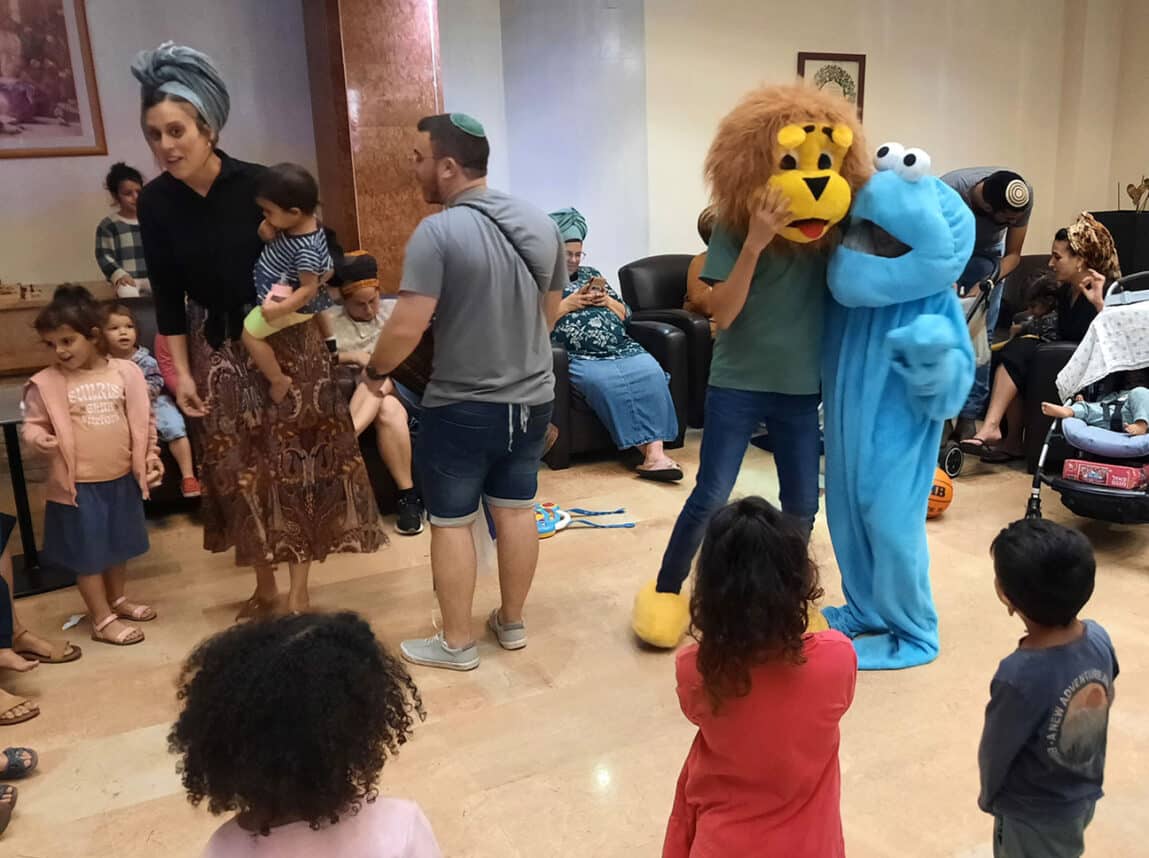
All of that changed the following day. Israeli families began to arrive in the lobby with their children. It was clear that these families were residents of communities in the south. Whole towns had been evacuated to Jerusalem for their safety. More evacuees arrived the next day. Suddenly the hotel was no longer empty but filled with families, parents, grandparents and lots and lots of children: children filling the lobby with playing, climbing, laughing, screaming, singing, rolling about on scooters and hitting me in the head with soccer balls (all is forgiven).

For the first week, most of these evacuees were from a community called Bnei Netzarim, which lies south of Gaza along the Egyptian border. Bnei Netzarim is a religious community founded in 2010. It was established primarily by former residents of Netzarim, one of the Jewish settlements in Gaza in the bloc known as Gush Katif, which was dismantled in the wake of Israel’s withdrawal from Gaza in 2005. Now they were forced to abandon their homes once again and come to Jerusalem.

While these families had experienced a harrowing few days before their arrival in Jerusalem, their spirit seemed quite positive. Many were extremely grateful to be somewhere that offered a quiet respite from the constant sirens and rocket attacks in the south. The children and teens were together with their friends, and with no school, they could play and hang out all day.

Immediately, help poured in as well. Volunteers appeared, ready to play with the kids and run activities.  Boxes of food and toys arrived every day from different parts of Israel. Donations of clothing appeared and were organized to supplement the few things the families were able to bring. Entertainers came: Amateur clowns fashioning balloon animals, musicians, that guy who makes giant soap bubbles for kids’ birthday parties. Rabbi Dovid Grossman of Migdal Ohr, the famed “Disco Rabbi” came to offer words of strength to the community and to sing and dance with them. Multiple concerts broke out over the course of our stay.

Shabbat in the hotel was a special experience. The community of Bnei Netzarim attempted to recreate its regular communal Shabbat observance in the hotel synagogue and dining room. Kabbalat Shabbat with its fervent singing and words of Torah was stirring. The hotel dining room took on a camp atmosphere for Shabbat meals. In the afternoon, people learned Torah together and enjoyed the quiet of Shabbat.

On Sunday, a regular workday in Israel, the community of Bnei Netzarim arranged to begin a few hours of schooling for their children during the day. More refugees arrived at the hotel, this time from Sderot.  The hotel worked hard to accommodate the new arrivals with rooms and extra dining space. It was now hard to imagine the hotel ever being empty.

Over the course of the 10 days we were there, I had the privilege of getting to know a few of the people who had been displaced from the south and hearing their stories. Miriam and her husband were originally from the United States but made Aliyah years ago. When their growing family made housing in Jerusalem prohibitively expensive, they visited the community of Bnei Netzarim and fell in love. They loved the community and suburban feel of the environs. Miriam exudes tremendous faith in God and found purpose in supporting others. She made a point of listening to the stories of other women, helping them to give voice to their pain and concerns.  

On a typical Shabbat, Miriam leads a small English-language shiur on the teachings of Rabbi Sacks. In the rush of the evacuation, she understandably forgot her regular materials. Miriam was upset, especially as that Shabbat marked the beginning of the new Torah reading cycle with parashat Bereishit. But on Friday, Miriam and her family visited an old friend in Jerusalem they had not seen in years. He had only one English book in his collection, a book by Rabbi Sacks, which he happily lent to her. “It was a miracle,” Miriam said, beaming in the glow of God’s grace. According to Rabbi Sacks, the story of the Garden of Eden relates how God establishes His personal relationship with humanity. Knowing that God cares for humanity gave Miriam strength, and despite the tension, anxiety, and uncertainty of her situation, Miriam sought to share that strength with others.

Jacqueline, a grandmother from Sderot, was staying in Yavneh with her son on Shabbat when the initial assaults took place. This kept her out the worst violence, but she was not allowed to return home and, as a result, she had only the few things she had packed for the day. She had been wearing the same housedress for days straight. Social workers from Jerusalem interviewed her and made arrangements to get her new clothes. Mostly, Jacqueline was thankful to have people with whom to talk. Even though Jacqueline was physically safe, the war was taking its toll. Watching video footage of events drained her strength. She confided that she took the suffering she saw to heart, and it paralyzed her. “I have no strength,” she kept telling me. The one thing she was able to do with enthusiasm was prayer, to which she devoted passionate concentration.

Ruth, a teacher from Bnei Netzarim, turned the tables on us, making sure we had everything we needed. She invited me to lectures, offered to host my son for Shabbat, and generally included us in the community. She exuded calm and kindness throughout. Ruth told me the history of Bnei Netzarim and its origins. Ruth showed me a picture of the interior of her home in Bnei Netzarim. Her son, who was deployed to the south, had opened it up to house himself and a bunch of his fellow soldiers. The floor of her living room was covered with mattresses, and she took pride in knowing that these defenders of Israel had a place to rest and shower between deployments.

Many people outside of Israel feel frustrated because they do not know how to help. Of course, we can donate money and material, engage in political activism, write letters to editors, write letters to soldiers, and more. But it often feels insufficient. I saw that many Israelis share that frustration. Those not called up to serve in the military often feel they are not doing their share. On Shabbat, the rabbi of Bnei Netzarim addressed that very concern. Our task, he said, was to learn Torah. Even setting aside the spiritual and redemptive power of Torah learning, his message is an important one. We must engage in Jewish continuity: Praying in synagogue, attending classes, and engaging in community events. This is precisely what our soldiers are fighting to preserve, our right to live as Jews. We owe it them to do so.

I can do one more thing. When I discovered that Ruth and I both taught high school Tanakh and Jewish law, I knew that she would understand when I told her, “I see everything that’s happening here, and I have to tell your story to my students.” I could listen to those displaced by this war and to bear witness to their story. For nine days, I lived with and shared the experiences of some of the most vulnerable Israelis, people who were forced to abandon their homes and rely on the charity of others. Yet these people are also some of the most resilient and kind people I have ever met. They reflect the greater Israeli mindset, hurt and shaken, but determined and filled with humanity despite the inhumanity of the enemy. May God watch over them and over all the people of Israel.


Sheila Tuller Keiter is currently a member of the Jewish Studies faculty at Shalhevet School. 

Ten Days in a Jerusalem Hotel Lobby Read More »

Bulletproof Israel Sending Aid and Support from Los Angeles

A day after Israel experienced the devastating terror attack, a group of seven friends gathered in Los Angeles to explore ways they could help. Within a few days, their numbers had grown to a dozen and later to 25 people. Together, they established “Bulletproof Israel,” a nonprofit organization dedicated to aiding Israel in times of crisis.

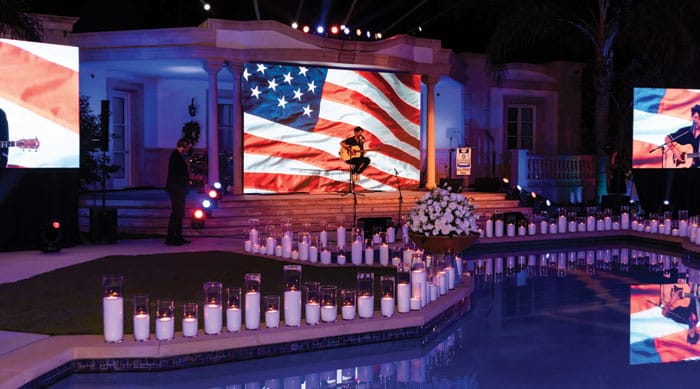
On Tuesday, October 17th, they organized a fundraising event at the Beverly Hills home of Albert Alkoby. The event saw a turnout of 300 people, including some well-known actors such as Emile Hirsch and Israeli actress Swell Ariel Or, famous for her role in “The Beauty Queen of Jerusalem.”

The entrance to the picturesque backyard was transformed into a display of posters featuring the images of children, men and women who had been kidnapped by Hamas.

Actor-comedian Elon Gold hosted the event, which commenced with the singing of the national anthem “Hatikva” and a moment of silence to honor the 1,400-plus victims of Saturday, October 7. Survivors of the massacre, as well as family members of those who lost their lives, addressed the guests directly from Israel.

Zehava and Shahaf Ben Simon, the mother and sister of Adar Ben Simon, an IDF soldier who tragically lost her life, shared poignant memories of the 20-year-old who was stationed at the Zikim base when she was killed by Hamas. Shachaf recounted the last communication with her sister, saying, “Adar wrote to me and described everything that was happening there, how they were under attack. I told her to ‘stay safe,’ but it was evident that she couldn’t; she had to defend herself and her fellow soldiers. After a fierce firefight, where they were outnumbered both in terms of manpower and ammunition, they fought heroically for about four minutes. During this time, they moved the wounded to safety and took the place of inexperienced soldiers, effectively preventing the terrorists from breaching the base. They saved the lives of both soldiers and civilians who were inside the base.”

“We lost Adar, but life goaes on, even though it will never be the same.“ –Zahava Ben Simon

Zehava added, “At 7:15 am, I called Adar and I could hear her last words. She said she couldn’t talk and promised we would speak later, but that never happened. Later, the base commander revealed that if Adar and the other soldiers hadn’t thwarted the terrorist intrusion, they would have reached Kibbutz Zikim and even Ashkelon and its northern regions. Despite all the challenges, I know that Adar would have done it again and been proud of her accomplishments. We lost Adar, but life goes on, even though it will never be the same.”

One of the victims at the Re’im music festival was Avi Sasi, a Los Angeles resident who was on vacation in Israel with his family when tragedy struck. His daughter, Danielle Sasi, who was with him along with other family members and friends, shared her harrowing experience. She said, “We were a group of seven at the festival. Around 6 a.m., I told my father that I had to return home to my baby. However, he insisted that we dance ‘just one more dance.’ At around 7 a.m., I noticed fireworks in the distance, and my father immediately told me to start running.

Danielle and her father sought shelter with a group of 40 people, but Hamas threw a grenade inside, resulting in many casualties, including her father. She and other survivors resorted to covering themselves with blood from the bodies around them and pretended to be deceased. They remained in that position for several hours until help arrived.

Artist Tomer Peretz, 41, a Los Angeles resident for the past 18 years, was in Israel for a family visit when the conflict began. As an IDF veteran with two years of service in Gaza, he didn’t hesitate to join ZAKA, a voluntary organization specializing in collecting bodies after terror attacks in Israel and identifying the victims. 

Peretz shared his firsthand experiences of the horrors he encountered shortly after the massacre. He said, “We witnessed the sight of women dying in the streets, individuals shot in the face and left unrecognizable, and burnt bodies. I keep hearing stories that there were no beheaded babies—well, are you f—ing kidding me? I saw a baby with an axe embedded in his brain, and there were many beheaded babies. We had to collect body parts after Hamas had mutilated them. Many people were subjected to torture before their deaths, with fingers and other body parts severed. At one point, someone handed me a small plastic bag containing the remains of a burnt baby, and one of the volunteers recited the Kaddish prayer over it.”

Peretz was involved in collecting bodies both at Kibbutz Be’eri and at the festival site, and he noted that the smell of blood was unforgettable. He remarked, “The stench was so overpowering that it could be detected from miles away. No mask could shield you from it.”

Photo by Magic Pix

Actor Nathaniel Buzolic, known for his role in “The Vampire Diaries,” is not Jewish but has shown strong support for Israel. He faced ongoing attacks from people who are pro-Palestinian on social media. Despite this, the Australian actor remained steadfast in his defense of Israel on Instagram. The efforts to silence him eventually succeeded, leading to the closure of his Instagram account. 

Buzolic claimed that Instagram had censored his post exposing atrocities against Israel and said, “Israel is fighting two wars, one against Hamas and the other for public opinion. I only shared real-time footage that has been circulating on social media.”

Furthermore, not only Instagram but also TikTok took action against Buzolic. TikTok alleged that he had shared false information and removed a video he posted, featuring an Israeli child kidnapped by Hamas and taken to Gaza. 

“Hamas and pro-Palestinian propaganda is very good at manipulating social media,” he said. “They know all the tools, techniques and I think the American people need to sit back and realize that this is not grandmas in Texas who are reporting my accounts, but these are groups of people who know that the battle that’s being fought on the ground in Israel, is also in information war.”

Dimitri Kermani, a co-founder of Bulletproof Israel, spoke to the Jewish Journal about the overwhelming support from Jewish communities in the U.S. However, he also cautioned donors to be diligent when sending donations to the IDF, as many items often fail to meet the IDF’s standards. He explained, “People purchased items such as bulletproof vests and ceramic plates with the noble intention of protecting Israeli soldiers, but upon reaching Israel, these items often fell short of IDF requirements. This resulted in millions of dollars going to waste.”

It’s advisable to send money donations or check with the IDF first before purchasing items intended for the use of soldiers. 

While Bulletproof Israel, as a non-profit organization, cannot purchase military equipment, it can allocate funds for other items to support the IDF and those affected by the war. Kermani said, “We can provide medical equipment, tourniquets, first aid kits, and support community rebuilding efforts. Our focus will be on various relief efforts.”

Kermani, like many those involved in the effort to raise money for Israel, said that he hardly slept since the horrific attack on Israel. “We share one heart, and when one of us suffers, we all grieve together. This tragedy deeply impacts our hearts and souls and we’ll do anything we can to help Israel from here.” 

For more information: https://bulletproofisrael.org/

Bulletproof Israel Sending Aid and Support from Los Angeles Read More »

The List

It’s hard to keep them all straight in my head. It’s a gruesome list.

Terrorist attacks.
Suicide bombings.
Military operations and wars.

It’s a list that I imagine every Jew keeps somewhere in their consciousness.

Some of the dates and events happened long before we were born, but we still recall them each year on Tisha b’Av or Yom HaShoah.

Expulsions.
Inquisitions.
Pogroms.
Shoah.

There’s also the personal list, the ones we witnessed firsthand or read about as they unfolded over the course of our own lifetimes.

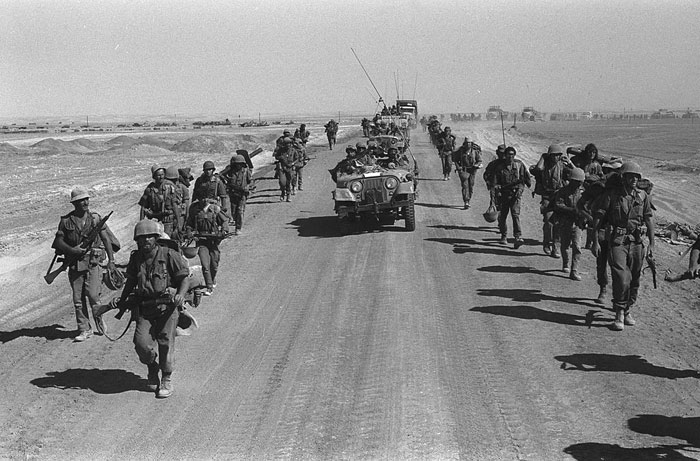
I don’t remember the Yom Kippur War but I was alive then and my first visit to Israel was just a few years away. I moved there to live and study in 1992 and had the opportunity to add what was at the time a hopeful memory to the list: The beginning of the Oslo accords. I remember watching the infamous handshake on the White House lawn on television, imagining a very different future than the one we are experiencing right now.

I visited Israel in the bloody month of March 2002, during the second intifada. I recall sitting outside with friends in the courtyard of the Inbal hotel when we heard an explosion. We would later learn that the Cafe Moment, a place I had visited many times when I was a graduate student, had just been blown up by a suicide bomber.

I was there leading a congregational trip just a few days before war in Lebanon broke out in 2006. Immediately after, I composed a song with my friend, Rabbi Ken Chasen, about our shared responsibility, the way all Jews are connected, our obligation to worry about, support and care for each other.

When we made Aliyah in 2009, we lived through occasional terrorist attacks and military operations. I remember one day taking my middle daughter, Ariela, for a bike ride just a mile or so from our home in Jerusalem. We stopped at a little restaurant for a cold drink and a snack. There was a television inside that was tuned to breaking news about a bus stop that had just been blown up by a terrorist. She saw the images and asked what had happened. I said a person filled with hatred tried to hurt other people, but that she shouldn’t worry because it was far, far away. I had momentarily forgotten that my eight-year-old was fluent in Hebrew. She saw the scroll at the bottom of the screen and said, “But it says it happened in Yerushalayim — that’s not very far away.”

I was there in the summer of 2014 when three teenage boys were kidnapped and murdered by Hamas terrorists, which led to a seven-week war in Gaza.

And I remember precisely where I was five years ago when I heard about the attack on the Tree of Life synagogue, October 27, 2018. Today we recall the 11 souls who were murdered for the simple fact that they were Jews, gathered together in prayer in their synagogue, a place that is supposed to be a sanctuary of peace.

I’m sure we all know exactly where we were when we first became aware of the horror on October 7, 2023. In the subsequent days, we learned more and more of the painful details of the barbarism and inhumanity of the terrorists. And since then we’ve seen both the compassion and, more painfully, the apathy and even condemnation of the world in our moment of greatest need.

It hurts my soul to acknowledge that the above is but a partial list of the violence that has been perpetrated against the Jewish people just in my own lifetime. 

It hurts my soul to acknowledge that the above is but a partial list of the violence that has been perpetrated against the Jewish People just in my own lifetime. I didn’t mention Buenos Aires in 1994 or Jersey City and Poway in 2019.

And now we are witnessing — certainly not for the first time but, arguably, most insidiously and pervasively—is the utter hatred for Israel and, yes, for Jews, on display on so many college campuses here in America.

But lest we sink into despair, we must remember that, despite it all, Am Yisrael Chai: the Jewish people — miraculously and perhaps improbably — lives, endures, and even thrives.

If there is a silver lining in a moment like this it is the deep appreciation I feel right now for the gift of being part of a people, a family — Am Yisrael. Here’s just two artifacts of that miracle.

On my way to Israel where I’ll be, God willing, by the time you read this, a friend reached out and asked if I could bring some materials for reservists who lacked basic supplies (how that’s even possible is important to explore, but for another time). I said that of course I’d help — happy to bring as much as the airline would permit. Within a few hours I was on a text chain with Yonatan, a fellow Jew who had sprung into action to help source backpacks, knee pads, whatever was needed. He personally delivered four bags of supplies to me in New York as I was en route to Israel. We met outside my mother-in-law’s apartment building when he came to drop off the bags. Inside each bag was a note in Hebrew to the customs officials in Israel explaining what the supplies are for, along with a stack of beautiful cards written by Jewish day school students here in New York.

And then on Wednesday, I received a text from my niece, Emma, who has been studying in Israel for the last few months. A friend of hers asked if she knew anyone coming soon who could bring materials for her future brother-in-law and his friends who had just been called up for reserve duty. She put me in touch with her friend’s cousin, Naomi, who explained the situation. Naomi’s brother was supposed to get married just a few days after October 7th. The wedding was, of course, postponed. Her brother was called up to the reserves. Same story — basic gear is in short supply. She and her friends sprang into action and have already managed to send 190 tactical vests, 124 sets of ceramic plates (for the body armor) and 112 Kevlar helmets to Israel.

It hurts my soul to picture the headlamps, knee pads, hydration back-packs, and — yes — bulletproof vests that I’m bringing to Israel on the bodies of my fellow Jews, members of my family, Am Yisrael, as they embark upon the most dangerous and frightening mission one could imagine: Infiltrating that spider web of tunnels built by the terrorists for the sole purpose of abducting, torturing, and murdering our people. These strangers who aren’t really strangers — they’re my mishpacha, after all — will risk their lives to save those who were abducted, including, God willing, Hersh, the son of my friends Jon and Rachel. They will risk their lives to ensure that all those who perpetrated this evil, all those who planned it, executed it, and supported it, are brought to justice.

May they be spared injury or harm. May they be successful in their mission. May those who are in captivity come home safely and speedily. May our students on college campuses here in America know compassion, support, and love instead of apathy, indifference, and hatred. And may we, in the days, months and years to come, find many more reasons for hope, many more episodes that we will look back upon decades from now and say: “I remember precisely where I was when I heard that peace had finally been achieved in the Middle East! I remember the exact moment when the world declared in one voice that Jewish lives matter just as much as everybody else’s.”


Rabbi Yoshi Zweiback is the Senior Rabbi of Stephen Wise Temple in Los Angeles, California.

The List Read More »

Israel’s Claims to Its Land

In these weeks when Jews all over the world are worried about the future existence of the State of Israel, let alone its safety and flourishing, and when some claim that Israel is a colonial power that is usurping the right of Palestinians to their land, the philosopher in me wants to zoom out to ask this question: How does any nation have a right to its land?

I am going to suggest that there are four grounds that nations use in their self-understanding of why they rightfully occupy their land, grounds that other nations recognize as well in respecting each nation’s sovereignty over its land. For each of these grounds, I will give some examples from around the world, and then I will apply it to Israel. Interestingly, in some form all four of these grounds are illustrated in the stories in Genesis we are reading in the synagogue at this time of year.

War

The American Revolution and the revolutions of South American countries against their Spanish and Portuguese rulers are some examples of how nations establish sovereignty over their land. This is mirrored in Genesis 14, in which Abram has to wage war to defend his hold on the land. Interestingly, in doing so he redeems Lot from captivity, an especially poignant part of the story for the current Israel-Gaza conflict.  

Israel has unfortunately had a surfeit of experience of having to establish or reenforce its claim to its land through war, from its War of Independence in 1948 to the current conflict.

God gave the Jews this land 

This gift to Abram and his descendants, Isaac and Jacob, is first announced in Genesis 12 and repeated many times thereafter.  In similar fashion, the Japanese believe that the gods granted them the land that they occupy.

This is a powerful justification for Jews to live on the Land of Israel for religious Jews and for many Christians, especially Evangelical Christians. When I first began formulating this essay, I thought that Muslims would disagree, based on the Koran. I Googled “the Land of Israel in the Koran,” however, and found a talk by Sheikh Dr Muhammad Al-Hussaini in London, in which he points to Sura 5:20-21:

“Give heed, O believers! For Moses said to his people: O my people! Remember with reverence the grace of God upon you when He appointed prophets among you and made you sovereign over yourselves. Moreover, He gave to you what He has not given to anyone else. O my people! Enter the Holy Land that God has decreed for you to enter, and do not turn away from this battle in retreat, for then you shall turn back from the faith itself as losers of an everlasting Paradise.”

Sheikh Al-Hussaini then asserts “that the traditional commentators from the eighth and ninth century onwards have uniformly interpreted the Koran to say explicitly that Eretz Yisrael has been given by God to the Jewish people as a perpetual covenant. There is no Islamic counterclaim to the Land anywhere in the traditional corpus of commentary” (https://www.thejc.com/judaism/all/what-the-koran-says-about-the-land-of-israel-1.8278). Mohammed many times urges his followers to fight for Mecca (Makka in many translations), but never for Jerusalem or Israel. The only way in which Hamas and other Muslims can justify taking it away from Jews is to claim that they are evil sinners who must be punished, but for the Koran and its official interpreters, God gave the Land of Israel to the Jews.

International agreement 

This is how Canada gained its independence — through the Constitution Acts from 1867 to 1982 — and it is how many nations gained independence after World War II, when colonial powers handed over sovereignty to the local communities in India, Pakistan, and many countries in Africa. In the same way, the British abandoned their rule of Israel and its neighbors in 1948, turning it over to what, according to the United Nations resolution of November, 1947, was supposed to be two independent Jewish and Arab states between the Mediterranean the Jordon River. In at least somewhat similar ways, the Torah records in Genesis 13 the division of the land between Avram and Lot to settle the conflict between their shepherds and, in Genesis 21:22 ff, the agreement between Abraham and  Avimelekh to settle the conflict of their clans over their wells of water.  

Long-time Residence 

This is the self-understanding of the Japanese, Chinese, Russians, and many African tribes as to why they rightfully occupy their land: It has been theirs from ancient ancestors to now. This is the claim that especially secular Israeli Jews use, and so it is no accident that they (and some religious Jews too) are keenly interested in archaeology to prove the claim of the ancient Israelites on the Land of Israel, and it is also the reason that the biblical stories of the conquest of the land in the Torah and in the books of the Former Prophets are taught in secular Israeli high schools. It is also the motivation of the claim that even though Jews did not rule that land for many centuries, there were always Jews living there, and Jews prayed three times daily for their return to the land of their ancestors.

In sum, the claim of Jews to the Land of Israel is grounded in all four of these factors. That said, as Americans, Central and South Americans, Australians, and New Zealanders must deal morally with the claims of those native to those lands before the current majority arrived there, and for cogent humanitarian, political, security, economic, and other pragmatic reasons, contemporary Israelis must find a way to negotiate peace with the Muslims who lived there before the modern Jewish return to the land and their descendants, as difficult as it has been to find a partner for peace among successive Palestinian representatives.  We all hope and pray that there be peace there, and may it be soon.


Rabbi Elliot Dorff, Ph.D. is the Rector and Distinguished Service Professor of Philosophy at American Jewish University.

Israel’s Claims to Its Land Read More »