fbpx

October 4, 2023

Machines, Machines Everywhere

A funny thing happened on the way to Whole Foods. 

Or should I say, a funny thing happened in the parking lot at the West L.A. Whole Foods while I was on my way to return Amazon packages. 

Previously, this particular Whole Foods branch had designated a counter inside the store and, more importantly, a human being, to help customers with their Amazon returns. In hindsight, I now realize that we customers were spoiled by this human-to-human exchange. 

I should have known something was awry when I entered the store and noticed a long line of visibly disgruntled people in the parking lot. Some were juggling multiple packages, others were begging their toddlers for five more minutes of waiting patiently in line, and some grimaced as though they would rather have had a lobotomy than wait in such a humid, smog-filled environment. In its defense, Whole Foods tried to make things more comfortable by setting up a giant floor fan near the line, but it only blew more hot air into faces that were already red with anger.

As I continued to walk and juggle my packages, I noticed that most of the grimaces were directed at a narrow machine. I walked a few feet closer, and to my horror, there it was: an automated Amazon returns kiosk, in all its terrible, efficient glory. 

I had an immediate, visceral reaction — my heart sank to my feet. And that reaction alone should tell readers something about what happened next, and the price we often pay when we replace humans with machines. 

The couple at the front of the line spoke to each other in another language (I couldn’t hear them well), then tried to return their packages using the automated system. I felt a lump in my throat when I saw the woman choose the unhappy face icon when the screen asked how she rated her experience. That icon matched the faces of everyone ahead of me, and everyone behind me. 

One woman had an oversized package that wouldn’t fit in the latch door of the kiosk. She entered the store and spoke with a Whole Foods representative, then yelled, “Please, this is ridiculous! Today is my last day to return this!” 

An elderly woman in front of me took her turn, but didn’t know what to do when the machine prompted her to place her item in a plastic bag. A few bags were hanging from the kiosk, but they couldn’t be removed. Two other women behind me tried to help her yank out a bag, to no avail. 

The three of them looked like a plastic bag search team. I walked inside for help, only to be told by a representative that the machine that had asked us to use a bag didn’t require any bags. 

When it was my turn, I fumbled with my phone because the kiosk camera couldn’t read my return QR codes. I looked at the long line of weary faces behind me and worried I looked inept; I hadn’t felt so rushed since I was in high school and, during a heat wave, my mother sent me to buy a watermelon right before Shabbat began.

I struggled to force the camera to read QR codes for three separate return items. For the last one, I hurriedly placed a sticky return label over a hole in the bag the item came in, only to realize the tear was still there. I felt another lump in my throat as I panicked that the package would fall out in transit and I wouldn’t receive my money back. I looked behind me and swore I could feel the piercing rage of 20 angry eyes.

I felt terrible holding up everyone in line, and in truth, I don’t often force others to wait when I’m dealing with a cashier. I’ll admit that when it’s the two of us (me and a cashier), I’m less stressed because there’s always someone else whom irate customers behind me can blame for slowing things down. But that day outside Whole Foods, it was me versus a machine. And flesh-and-bone, inefficient human that I am, I believe I lost.

My experience taught me that when left to fend for themselves using an automated kiosk, customers were slower, confused and less efficient.

How ironic that the decision-makers at Amazon thought the returns process could be more efficient if a human was replaced by a machine. My experience taught me that when left to fend for themselves using an automated kiosk, customers were slower, confused and less efficient. 

Granted, not everyone seemed to loathe the machine as much as those who stood in line with me; some people seemed to have a perfectly easy user experience. I should note that most of those satisfied customers were young, bearded tech-bros in their 20s, who didn’t have fidgety children standing next to them. 

The Whole Foods anecdote raises an important question: What are we losing for the sake of efficiency? And how soon before we stop being shocked or dissatisfied, and instead, become inured by the soulless normalization of machines, machines everywhere?

I anticipate that by the time my young children are adults, cashiers will be quaint and antiquated, like the milkmen who used to deliver products to homes or the gas station attendants of yore. I can almost hear my wide-eyed future grandchildren ask me, “Grandma, were there really human cashiers and conveyor belts when you were alive?” To which I’ll respond, “Yes, children. And drones didn’t simply drop off your eggs or cantaloupe from ten feet above.”

Each time I contemplate setting up an Amazon account for my parents, I remember that they belong to a different generation that only experienced human-to-human interaction; that English isn’t their first language; and that my mother still uses a flip-phone. I can’t even imagine how someone like my cute, little mother would try to use a kiosk at Whole Foods; she still fondly recalls the old rotary phones back in 1980s Iran. 

But it’s amazing how, when placed in front of a machine, people will cling to the better angels of their human nature. I loved how so many of us worked together that day to help each other use the automated kiosk. We listened to others’ anger and frustration, thereby sharing in very real, human moments together. 

In hindsight, I realize that people weren’t angry with me for taking a few extra seconds to return my packages that day; they were irritated because they no longer had access to a human being and a two-way, human exchange. For many of us, such a thing is not only more familiar; it’s more reliable. 

Last week, I returned to Whole Foods, confident that I’d have an easier time with the machine because this was the new normal, and I’d have to adapt quickly. And it was precisely that thought that both comforted me, but also made me a little sad. 

To my delight, there was a sign on the kiosk: “Machine out of order. Please see cashier inside.” With a large grin on my face, I stood in line inside and when it was my turn to return my items, I looked the cashier in the eyes, smiled and said in earnest, “You don’t know how happy I am to see you.”


Tabby Refael is an award-winning writer, speaker and civic-action activist. Follow her on X and Instagram @TabbyRefael

Machines, Machines Everywhere Read More »

The Wrong Way to Count Antisemitic Incidents

The recent wave of bomb threats against synagogues seemed to represent another surge in antisemitism in the United States. But now it appears that the perpetrator’s motives had nothing to do with antisemitism.

So should the threats still count as “antisemitic incidents”? The Anti-Defamation League thinks so. The FBI thinks otherwise.

Police in Peru traced the approximately 150 emailed bomb threats to one Eddie Manuel Nunez Santos, 33, of Lima.

According to the FBI, Santos’s modus operandi was to ask teenage girls whom he contacted over the internet to send him explicit photographs of themselves. When they refused, he circulated bomb threats that included their phone numbers. The threats were emailed not just to synagogues, but also various school districts, hospitals, and other institutions.

Something similar happened seven years ago. In late 2016, some 163 bomb threats were made against Jewish institutions around the United States. Initially it seemed the threats were antisemitic; but before long, it was determined that 155 of the threats were made by a mentally unbalanced Israeli teenager, and the other eight were made by an African-American journalist who was harassing his Jewish ex-girlfriend.

The FBI defines a hate crime according to the motive of the perpetrator, so it did not consider any of the 163 threats to be antisemitic. The ADL, by contrast, included all 163 in its 2017 tally of antisemitic incidents, a tally that was much larger than the previous year. The ADL blamed the increase on “the 2016 presidential election and the heightened political atmosphere,” although there is no evidence the Israeli teenager had America’s election in mind.

Aryeh Tuchman, associate director of the ADL’s Center on Extremism, told me at the time that the ADL was categorizing the threats as antisemitic incidents because they had “a major terrorizing effect on Jewish communities.”

According to that criteria, the ADL would have to include as “antisemitism” every instance in which a Jewish person reported feeling “terrorized,” even if the perpetrator was a fellow-Jew, such as a jilted business partner or an angry ex-spouse.

In February 2017, around the same time as those 163 bomb threats, nearly 200 headstones were overturned in a Jewish cemetery in St. Louis. The perpetrator and motive were not immediately established. ADL’s regional director said, “We don’t call something anti-Semitism until we really know it’s anti-Semitism.”

ADL national headquarters, however, continued calling it antisemitism even after the perpetrator’s rather different motive was revealed. In 2019, the cemetery culprit pleaded guilty to charges of institutional vandalism, explaining that he acted in a drunken rage; an FBI spokesperson said the vandal would have charged with a hate crime if there was evidence of antisemitism, but no such evidence was found. Nevertheless, the incident is to this day classified by the national ADL as antisemitic.

So when the Peruvian pornography-solicitor last week was revealed to be the culprit in the recent wave of threats against synagogues, I contacted the ADL to ask if it intends to include those 150 threats in its tally of antisemitic incidents for the year 2023.

I thought perhaps after the experience of 2016-17, the ADL might have reconsidered how it classifies incidents that at first appear to be motivated by antisemitism but then turn out not to be. But the ADL is sticking to its position. “Yes, we will log these as antisemitic incidents,” Aryeh Tuchman wrote me this week.

That will certainly add to the ADL’s final count of antisemitic incidents in 2023. But will it represent an actual increase in antisemitism?

According to the ADL’s statistics, the number of antisemitic incidents has fluctuated wildly during the past decade. It decreased by 19% in 2013, then rose by 21% in 2014. It rose again in 2015, but only by 3%. There were big increases in 2016 (34%) and 2017 (57%—but that includes those bomb threats and cemetery vandalism). Then it dropped again, in 2018, by 5%. It rose by 12% in 2019, then fell by 4% in 2020.

The past two years have seen large increases—34% in 2021 and 36% in 2022. What is unclear is how much of the increase is due to more reporting of incidents, not more antisemitism; and how many of the incidents fit the ADL’s definition of antisemitism but not the FBI’s.

This is the time of year, around the Jewish high holidays, when our email boxes are filled with fundraising appeals from Jewish organizations—at both ends of the political spectrum—that portray contemporary political or social circumstances in the most dire language. Perhaps the Jewish community would be better served by a more sober analysis of how to define antisemitism, even if the result may not benefit some interested parties.


Dr. Medoff is founding director of The David S. Wyman Institute for Holocaust Studies and author of more than 20 books about Jewish history and the Holocaust. His latest is America and the Holocaust: A Documentary History, published by the Jewish Publication Society & University of Nebraska Press.

The Wrong Way to Count Antisemitic Incidents Read More »

Learning to Accept Help

I sat at our friends’ table the second night of Rosh Hashanah, closed my eyes and cried. I had been suffering from an awful migraine for the past 48 hours. I couldn’t sleep. I couldn’t see straight. I threw up. And on Saturday morning, when I was two blocks away from synagogue, I felt so weak that I had to turn around and walk 20 minutes back to my house with my two daughters in the stroller. 

My oldest daughter, who is 3, yelled “I want to go to shul!” and started crying. 

“I do too, honey,” I said, the tears streaming from my eyes. “I wish I could take you.” 

I’d never missed shul on Rosh Hashanah. I hardly missed shul anytime. But I was in such pain that I needed to sleep. I ended up staying in bed most of the day. 

By the time we got to my family and I got to our friends’ house, it felt like someone was jackhammering my brain. I was afraid I was going to have a stroke. 

“I have to go home,” I told my husband, Daniel. “I can’t stay here. I’m hurting so bad.”

“Let’s ask for help,” he said. “And if that doesn’t work, then we can go.”

“No,” I said, tearing up. “It’s so embarrassing.”

“No, it’s not. Here, I’ll ask. Don’t worry.”

When our friends, who were prepping the food, came over to the table, Daniel told them what was going on and asked if there was anything they could do. “We’re going to help,” they said. 

One of them immediately brought me a cold seltzer in case I was dehydrated. Another one massaged my shoulders so that I wouldn’t be so tense. And another brought me a different migraine medicine from the one I was taking. 

I took two pills. And after just 10 minutes, I felt nearly 100% better.

“See?” Daniel said. “You just have to learn how to ask for help.” 

I was so touched how everyone rallied together to take care of me. And I knew that Daniel was right.

I usually keep to myself because I don’t want to inconvenience anyone. As a child, when I spoke up, my teachers wouldn’t listen or worse, they’d yell at me. One time, in the second grade, as my teacher was washing my hands, I yelped and told her the water was way too hot. 

“No, it’s not,” she said, and continued to wash my hands even though it was scalding. 

Sometimes, when I was in a tense situation as a kid, I’d joke around, but the adults in the room wouldn’t take kindly to it. They’d tell me to stay out of it or be quiet. 

From these experiences, I learned to keep everything inside. I tried to be independent and take care of myself and go unnoticed. 

This Rosh Hashanah, I saw that old habits die hard. I was giving into them again, and it took a horrible migraine and love from my husband and friends to snap me out of it. 

I thought about how it’s important to accept help from others – and from Hashem. We need to open ourselves up to receiving His love and support. The more we ask for it and accept it, the more we will receive it. I pray constantly for help. All the time, Hashem answers my prayers. I know He’s listening and giving to me.

Needing help is not a sign of weakness. In fact, when you ask someone for help, you are giving them the opportunity to do a mitzvah. 

Needing help is not a sign of weakness. In fact, when you ask someone for help, you are giving them the opportunity to do a mitzvah. 

This new year, I hope to be better at accepting help from others, like I do from Hashem. I learned this crucial lesson over the High Holidays – and it’s one that I won’t soon forget. 

Have you learned to accept help? Email me your story: Kylieol@JewishJournal.com.


Kylie Ora Lobell is the Community Editor of the Jewish Journal.

Learning to Accept Help Read More »

The Race After Feinstein

In the days after Senator Dianne Feinstein’s death, the California political community’s attention has been divided between commemorating Feinstein’s remarkable career and speculating about who Governor Gavin Newsom would appoint as her replacement. The mourning had not yet concluded on Sunday night, when word of Newsom’s selection of former union leader and Democratic fundraiser Laphonza Butler as the state’s new Senator became public. But in all the commotion, an obscure but critically important aspect of California election law which could greatly impact next year’s Senate race in which Californians will pick Feinstein’s more permanent successor has been almost completely overlooked. As a result, the chances of Representative Adam Schiff’s election now appear greater than ever.

Shortly after appointing then-Secretary of State Alex Padilla to Kamala Harris’ Senate seat, Newsom promised that if Feinstein stepped down before her term ended, he would appoint a Black woman to replace her. The immediate media dustup focused on Feinstein’s understandable unhappiness that the governor was speculating openly about the prospect of her incapacitation or death. But Newsom’s commitment seemed like an easy one to fulfill, as either Representative Karen Bass of Los Angeles or Barbara Lee of Oakland would be a natural fit. But Bass decided to run for L.A. mayor, a position which she has now held for less than a year. Lee is now a candidate for Feinstein’s seat, meaning that her appointment would have created a major advantage for her in the race.

A few weeks ago, Newsom made another promise, that he would not appoint a Senator who would run in next year’s election, explaining that he did not want to take sides in the primary. Lee and other Black leaders were furious, arguing that fulfilling his earlier commitment with a one-year placeholder appointment would be an insult to their community. But Newsom’s selection of Butler, currently the head of EMILY’s List, will likely allow him to escape any significant ongoing damage. Butler will be California’s first LGBTQ Senator, and also brings strong pro-choice, and pro-labor credentials to the table. While Newsom backed away from his commitment to stay out of the primary a few hours before word of Butler’s appointment leaked, it’s difficult to see her seeking reelection. So the appointment allows the governor to shore up his support with several key Democratic constituencies, and he will probably avoid much criticism from Lee’s supporters given Butler’s strong relationships in state party circles and great respect among Black community and political leaders.

But let’s get back to Schiff and the campaign. Californian law requires that upon the death of a sitting Senator, the governor’s appointment will only serve until the next general election, at which point a special election would take place. But because Feinstein’s seat was already up next year, the regular election would take place at the same time. For most of us, it means that we will vote twice for Senator both on the primary and general election ballot next year, once to select a candidate to serve between the November election and the start of a new Congress in January and once to fill the full six-year term. 

But in addition to the formality of that dual vote, two separate Senate elections means that fundraising limits for the race have now doubled. In congressional elections, donors are limited to a total of $6,600 in contributions to a single candidate. But because two elections are taking place simultaneously, generous donors are now free to give up to $13,200. For Schiff, who has almost 500 contributors who have given at that level, that could mean a windfall of more than $3 million. Porter has only 47 such donors and would realize a much smaller gain.

Butler’s appointment will drive headlines in the days ahead and greatly benefit Newsom politically. But Schiff may end up as the long-term winner.

Schiff and Porter are running neck-and-neck in early polling, but Schiff maintains an almost 3-1 fundraising advantage. While money will certainly not be the only determinant in this race, campaigning in a state the size of California is extraordinarily expensive. Butler’s appointment will drive headlines in the days ahead and greatly benefit Newsom politically. But Schiff may end up as the long-term winner.


Dan Schnur is the U.S. Politics Editor for the Jewish Journal. He teaches courses in politics, communications, and leadership at UC Berkeley, USC and Pepperdine. He hosts the monthly webinar “The Dan Schnur Political Report” for the Los Angeles World Affairs Council & Town Hall. Follow Dan’s work at www.danschnurpolitics.com

The Race After Feinstein Read More »

Three New Views of Ecclesiastes

“To the making of many books there is no end, and much study is a weariness of the flesh” said Ecclesiastes [Kohelet in Hebrew], traditionally believed to be King Solomon, sometime before his death circa 931 BCE. “If that’s the case, here are three new commentaries on Ecclesiastes,” Koren Publishers said in 2023 CE. 

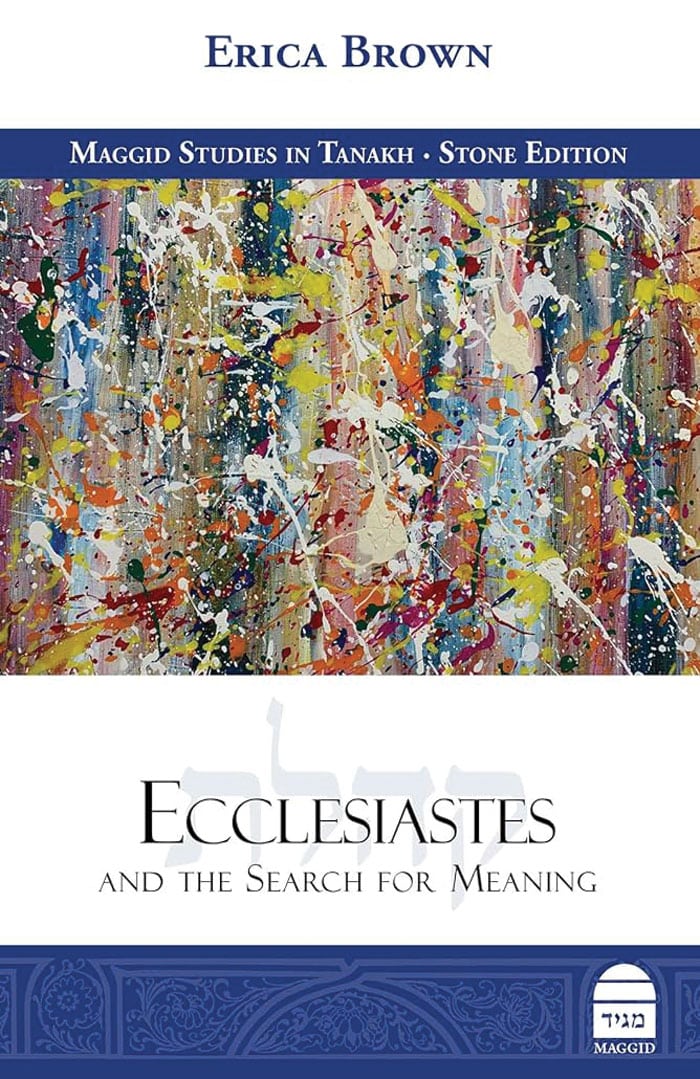
David Curwin’s “Kohelet: A Map to Eden: An Intertextual Journey,” Erica Brown’s “Ecclesiastes and the Search for Meaning,” and Asael Abelman and Jonathan Grossman’s Hebrew language “Ecclesiastes: A Crack of Light” all offer different, and complementary, analyses of the notoriously morose and challenging book, read by many Jewish communities throughout the globe during the Shabbat of Sukkot.

Curwin is an independent scholar who has published in Tradition and Jewish Bible Quarterly.  His commentary is produced in conjunction with Rabbi David Fohrman’s Aleph Beta, a nonprofit media company that produces videos and books utilizing a literary approach to the Bible, and has the breezy, accessible tone that is the organization’s trademark. To Curwin, the key to understanding Kohelet lies in the very beginning — of the world, that is. 

Stressing Ecclesiastes’ mournfully repeated lament that “all is hevel,” usually translated as “fleeting breath,” Curwin sees a callback to Abel [Hevel in Hebrew], the slain brother of Cain in the book of Genesis. As Curwin argues, “Kohelet can be read as Adam reflecting back on the tragedies of his life.” Thus Ecclesiastes 2:5’s “I made gardens and orchards for myself and planted them with every kind of fruit tree” is an allusion to the Garden of Eden, tilled by Adam. The eighth verse of chapter 10, “he who breaches a fence, a snake may bite him” references the snake who tempted Adam and Eve into tasting the forbidden fruit. And Kohelet’s morose observation that “Man [adam] has no power over the life-breath … no one rules on the day of death” is, as Curwin argues, Adam’s tragic admission that he “had no power over the life-breath; he could not save Hevel on the day of his death.”

In this reading, the book’s ending, “The final word: it has all been said. Fear God and keep His commandments! For this is the whole of man [adam]” is not, as modern scholars have suggested, a pious insertion by a later redactor uncomfortable with the author of Ecclesiastes’ seeming lack of faith and commitment to the commandments amidst his dozen chapters of cynical observations that the wise and wicked end up with the same deathly fate. Rather, it is an intra-biblical interpretation of the Cain and Abel story. As Curwin puts it: “Adam is looking back, saying if he had feared God and followed his commandments” not to eat from the tree of knowledge, the tragic downfall of his fratricidal sons would never have happened.

While Curwin focuses on Ecclesiastes’ ties to the tree of knowledge, Abelman of Shalem and Herzog colleges and Grossman of Bar-Ilan University focus on treatises of Wisdom. Both within the Hebrew Bible and in the corpus of ancient Near Eastern traditions, numerous texts, from Egyptian writings on Maat — perceived to be the order of harmony that governed the world — to Aristotle’s “Nicomachean Ethics,” to the Bible’s own Book of Proverbs with its aphorisms such as “Let the wise hear and increase in learning, and the one who understands obtain guidance” and “He who gathers in summer is a prudent son, but he who sleeps in harvest is a son who brings shame” claimed to explain the hidden rules for life under the heavens. The prudent would prosper. The morally just would merit justice in return. 

To these polestars, Ecclesiastes says “feh!” 

Rather, Solomon, speaking from experience, retorts, “I saw under the sun, in the place of justice, that wickedness was there; and in the place of righteousness, that wickedness was there.” “I praised the dead that are already dead more than the living that are yet alive.” “The fates of both men and beasts are the same: As one dies, so dies the other.”

Much of Ecclesiastes’ statements, in Abelman and Grossman’s view, are assembled teachings (Kohelet means “the Assembler”) swirling around the philosophical winds of his era. Some are cited because he liked them, others in order to disagree with them. 

Deuteronomy’s urging to swiftly fulfill vows made to God is cited with approval. From the pagan myth of Gilgamesh and Enkidu’s friendship comes the gleaning “two are better than one … If either of them falls down, one can help the other up.” But to Proverbs’ offering “For wisdom shall enter into thy heart, and knowledge shall be pleasant unto thy soul,” Kohelet counters “in much wisdom is much vexation; and he that increaseth knowledge increaseth sorrow.” While Job’s perspective that it is better to have never been born at all pops up amidst the musings, it is negated by Solomon’s personal opinion that better than being enraged at having been born, “enjoy life with the wife you love. Enjoy every day of your short life.”

When there is no Maat-style manual for life, then, when chaos — the authors’ preferred translation for “hevel” — so often gets in the way of coherence, how should one proceed with living? Thousands of years before Sartre, Nietzsche, Freud, Camus and countless others unpacked the meaning of existence, Kohelet came to his conclusions: Love the one you’re with. Find joy in whatever you have at that moment. Obey God’s commandments. 
Abelman and Grossman present Ecclesiastes’ ending with a parable: “Imagine you were afflicted by a strange disease. It was decreed that you would forget whatever you read the second you finished reading. You wouldn’t remember any lessons, how it forged your skills, the drama that the characters experienced and the emotions you felt following their journey … You could read the same thing two or three times, and each time would feel as new. Would you stop reading? We presume you would want to read whatever gives you pleasure during those moments. Not for whatever supposed life lessons you would gain — rather, for the excitement that the book would give you during the moment of reading itself. For Ecclesiastes, this is life.”

Like Moses’ speech on the eve of his people’s entry into the Promised Land, Ecclesiastes is the handing over of recommendations and legal injunctions meant to guide the coming generation after the prior one passes away. 

For Erica Brown, the Vice Provost for Values and Leadership at Yeshiva University, Ecclesiastes is an exercise in meaning-making. Meditating on the book’s major themes, informed by learned discussions of diverse thinkers Tolstoy and Chekhov, Montaigne and Maimonides, the modern organizational psychologist Adam Grant, the poet Amanda Gorman, and countless others, Brown reads the biblical book as an ethical will. Like Moses’ speech on the eve of his people’s entry into the Promised Land, Ecclesiastes is the handing over of recommendations and legal injunctions meant to guide the coming generation after the prior one passes away. 

Extracting major themes from each of Ecclesiastes’ chapters, she offers both a helpful summary of contemporary scholarship and her own keen insights. As a representative sample, in her reading of Chapter 2, titled “Does money matter?” she notes that “in Kohelet, money is not used, it is discussed.” It is “an inheritance, a nuisance, and a means to purchase pleasure or power. It is more often a source of anxiety and heartache than it is worth.” Utilizing Marinus van Reymerswale’s 16th century painting “The Money Changer and His Wife,” Tevye’s “If I Were a Rich Man” from “Fiddler on the Roof,” The New York Times’ ethicist Kwame Anthony Appiah, Adam Smith’s “The Wealth of Nations” and Maimonides’ teaching that a Torah sage should be “stringent with himself in his accounting” and not overly demanding of people who owe him loans, Brown offers a prism through which to ponder Kohelet’s accumulation of wealth: “I gathered me also silver and gold, and treasure such as kings and the provinces have as their own … And I hated all my labor wherein I labored under the sun, seeing that I must leave it unto the man that shall be after me.” Mind the gaps, Brown keenly observes, writing, “One wonders what Kohelet might have thought about other, positive uses of money like giving charity, supporting one’s family, or engaging in business with honesty and integrity. This we will never know.”

We read the book over Sukkot, Brown argues, because, after the personal transformation we experience on Rosh Hashana and Yom Kippur…  “a new person needs a new home.” 

We read the book over Sukkot, Brown argues, because, after the personal transformation we experience on Rosh Hashana and Yom Kippur, of contemplating the “crushing pain and soaring joy” of the High Holy Day season, and of the nature of life itself with its ever-changing seasons washing away our breath’s fleeting contributions and accumulations, “a new person needs a new home.” That home, the sukkah, in its spareness, ensures that we bring into its makeshift walls only that which provides this simple structure with the simple satisfactions life makes room for. “You can bring in it only that which you truly need and those who truly mean the most to you.” 

To the 19th century Polish sage Rabbi Naftali Zvi Yehuda Berlin, the possibility that the author of Ecclesiastes perceived the making of many books to be a negative pursuit couldn’t possibly be. Rather, in Rabbi Berlin’s reading, cited by Abelman and Grossman, what King Solomon actually meant was the opposite of the verse’s plain meaning. “If one wants to offer innovative insights [chidush] and glorify the Torah, one should be conscious of two matters,” Berlin writes in his commentary the “Haamek Davar.” “The first is that because there is no limit to the writing of books, you should write down each and every insight you have … and the second is, since ‘much study is a weariness of the flesh’ you should speak often with those ‘weary of flesh,’ namely your students,” those who strenuously force you to sharpen your thinking.

In Koren’s threefold cord of commentaries on Kohelet, seasons of students have been given interpretive riches with which to sharpen their thinking as they turn the pages of the musings of a monarch from millennia ago — about life, its limits, its possibilities, and what truly matters under the sun.


Rabbi Dr. Stuart Halpern is the Senior Adviser to the Provost and Deputy Director of the Straus Center for Torah and Western Thought at Yeshiva University.

Three New Views of Ecclesiastes Read More »

Israel’s Rising Right and Shrinking West

Earlier this month, President Joe Biden met with his Israeli counterpart—notably not at the White House, but at a New York hotel adjacent to the UN, and surrounded by protesters. And on September 22nd, as Prime Minister Benjamin Netanyahu addressed the UN General Assembly, the largest protest against his administration took place steps away in Dag Hammarskjold Plaza, attended by both Israelis and Americans.

Israel’s relationship with its most important ally is quickly cooling, to the point where even the foreign press has picked up on it, with Le Monde calling Netanyahu’s recent U.S. tour “painful.” But what’s notable about the latest strain on U.S.-Israel relations is the fact that Jewish Americans, historically a support base, are now at the forefront of the criticism.

At the center of these protests is Netanyahu’s decidedly right-wing plan for judicial reforms. Back in July, the Knesset ignored months of mass protests to pass a new law stripping the country’s Supreme Court of its ability to veto governmental decisions. Next steps include giving the executive branch greater control over judicial appointments and removing independent legal advisers from government ministries. It is a plan that inevitably heralds a constitutional crisis, insomuch as a country without a written constitution can have one. When you have retired military major generals and former special forces members weekly joining hundreds of thousands of individuals in the streets of Tel Aviv, you realize this is a moment of true reflection and unrest that is pulling at the core of the country’s ideals.

Regardless of how the matter is resolved, these past months of growing conservatism in Israel have created a chasm between the country and its American supporters. This group was once able to point to shared democratic values as a reason for the two countries’ special relationship—Israel is the largest recipient of U.S. foreign aid, it was the first country to be designated a major non-NATO ally (MNNA), and has even benefited from U.S. protection on the UN Security Council—but in recent years that reasoning has worn thin.

Regardless of how the matter is resolved, these past months of growing conservatism in Israel have created a chasm between the country and its American supporters.

The country that once made Tel Aviv Pride a global destination has rolled back its recognition of LGBTQ rights. Same-sex marriage is still illegal, though those married abroad enjoy legal recognition thanks to a 2006 Supreme Court ruling. The growing Orthodox right-wing has managed to impose sex segregation in public spaces, with reports emerging of female bus drivers being accosted for doing their jobs and of political parties issuing de facto bans on women running for office. The World Economic Forum’s most recent Global Gender Gap Report saw Israel fall in the ranks from 60th to 83rd place, right below Lesotho.

Perhaps nothing illustrates the clear gap in values between Jewish Americans and the current Israeli government than the visit of Finance Minister Bezalel Smotrich to the United States earlier this March. His visit was met with a boycott and a letter of condemnation from a coalition of 145 Jewish American leaders, citing “views that are abhorrent to the vast majority of American Jews, from anti-Arab racism, to virulent homophobia, to a full-throated embrace of Jewish supremacy.”

Israel has to remember that Americans as well are witnessing  the rise of far right extremism here at home. Antisemitism has increased every year since 2015 and spiked alarmingly during the Trump administration, with no signs of abating. Even without Trump, the Republican Party has drifted further right, with two U.S. Representatives recently  taking speaking roles at white nationalist conferences. Rather than taking a stand against the rising tide of U.S. antisemitism, Netanyahu has been all too happy to bolster his strongman image, at the expense of Jewish Americans who have to live with the consequences.

This is not to say that there’s an irrevocable break between Israel and its supporters abroad. There are those who take a non-partisan stance, and Orthodox conservatives in the U.S. generally approve of Netanyahu and his right-wing coalition. But roughly 70 percent of Jewish Americans identify with the Democratic Party, and for them, this moment in Israeli politics is a watershed moment. In addition to worrying about the country’s future, they are also questioning the country’s creation. Dr. Shaul Magid of Dartmouth’s Jewish Studies Department framed it in this way: “The fundamental question all of us have to confront is: Is this government an aberration, or is this government a logical outcome of what’s been going on for the last 50 years?”

For a state so reliant on foreign aid and public opinion, both of which have been bolstered by Jewish Americans in the United States, alienating them to this extreme is yet another blemish on the Netanyahu administration. It remains to be seen if his positioning will impact the once intractable support for the Jewish state in the U.S.


Seth Jacobson is the founder and principal of JCI Worldwide, a Los Angeles-based communications and research firm. He spent several years in the Carter and Clinton administrations in positions focused on economic development, foreign policy, and media relations. He is a frequent lecturer on policy and public affairs at Pepperdine University and UCLA.

Israel’s Rising Right and Shrinking West Read More »

Sharon Osbourne On Whether Roger Waters is Antisemitic: “Is the Pope a Catholic?”

Sharon Osbourne weighed in on the allegations that former Pink Floyd frontman Roger Waters is antisemitic. When asked if she thinks that Waters is an antisemite, she replied: “Is the Pope a Catholic?”

Osbourne appeared in a Thursday segment on TalkTV discussing the Campaign Against Antisemitism’s (CAA) recent documentary “The Dark Side of Roger Waters” that features two former associates of Waters alleging that the former Pink Floyd bassist has made antisemitic remarks. Osbourne, who is Jewish, said, “I know him [Waters]. I know his reputation that precedes him in our industry … he laughs, he’s always telling jokes about Jews, always making comments about money, the cliché old-time opinion.”

Osbourne then claimed that no one under the age of 40 would recognize Waters and proclaimed that Waters should “live in an old people’s home and leave the Jews alone.”

After TalkTV presenter Kevin O’Sullivan said that he has many Jewish friends “who believe wholeheartedly that Roger Waters is 100% a disgraceful antisemite,” Osbourne replied: “This has been going on for years.”

Journalist Afua Hagan later asked why Waters has “managed to get away with this for so long.” TalkTV broadcaster J.J. Anisiobi replied that “unfortunately antisemitism isn’t taken as seriously as other forms of racism.” Osbourne concurred, saying: “Nobody cares except Jews.”

Freelance journalist James J. Marlow posted on X, formerly known as Twitter: “As someone who worked in two of the UK’s most famous studios from 1979-85 as a sound engineer and we had engineers working on the Wall album and their tour, Roger Waters had some seriously [sic] issues with ‘Jews’. So @MrsSOsbourne words are of no surprise at all.”

The CAA documentary featured interviews from legendary producer Bob Ezrin, who co-produced Pink Floyd’s 1979 album “The Wall,” and Norbert Statchel, a former saxophonist for Waters. Ezrin alleged in the documentary that Waters once conjured up a ditty that referred to Pink Floyd’s agent Brian Morrison as a “f—ing Jew”; Statchel alleged that Waters mocked his grandmother, who died during the Holocaust, and that Waters once complained about “Jew food” while at a restaurant in Lebanon. The documentary also claimed to have obtained emails from Waters suggesting to his team that, for his 2010 tour, he use the words “dirty kyke” on his inflatable pig, though ultimately the idea was scrapped after Waters’ lighting director, who is Jewish, objected to the use of the word.

Waters responded to the allegations in the documentary in a statement on his website by accusing the CAA of “waging partisan political campaigns against critics of the state of Israel” and claimed that the emails obtained by CAA were taken out of context. “The offensive words I referenced in quotes in an email 13 years ago, were my brainstorming ideas on how to make the evils and horrors of fascism and extremism apparent and shocking to a generation that may not fully appreciate the ever-present threat,” Waters said. “They are not the manifestation of any underlying bigotry as the film suggests. Quite the opposite. I have been trying to expose the evils of fascism ever since learning of my father’s death fighting fascists in World War II.”

As for the allegations put forth by Ezrin and Statchel, Waters said he couldn’t remember what he said several years ago and admitted that he could be “mouthy and prone to irreverence.” “If I have upset the two individuals who appear in the film I’m sorry for that,” Waters said. “But I can say with certainty that I am not, and have never been, an antisemite – as anyone who really knows me will testify. I know the Jewish people to be a diverse, interesting, and complicated bunch, just like the rest of humanity. Many are allies in the fight for equality and justice, in Israel, Palestine and around the world.” He concluded his statement by calling the CAA documentary “a flimsy, unapologetic piece of propaganda that indiscriminately mixes things I’m alleged to have said or done at different times and in different contexts, in an effort to portray me as an antisemite, without any foundation in fact.”

The CAA responded to Waters’ statement with a post on X noting that Waters had replied “at the start of a two-day Jewish holy period when we cannot answer, having waited over three weeks since we invited him to reply to or dispute any of the allegations in our documentary.” Waters’ statement was published on Friday, when Sukkot started; Waters had claimed in the statement that the CAA had given him seven days to reply and he chose not to because he thought the questions were being asked in bad faith. He added that he decided to respond with his statement once the allegations became public.

“He can’t remember what he did or didn’t do,” the CAA wrote on X. “It just wasn’t memorable for him. But he says that if he did call his former agent a ‘f***ing Jew’, or mocked the grandparents of his Jewish saxophonist who were murdered in the Holocaust, or anything else that his former associates say he did, it was just ‘irreverence’ — Roger being ‘mouthy’. Nevertheless, he knows for certain that he never did anything antisemitic, and the idea of writing ‘Dirty k*ke’ on an inflatable pig above his concerts was actually a way of protecting Jews from fascists. In fact, some of his friends are Jewish, and the only problem Roger has with the Jews is that we don’t know how to recognise or define antisemitism, but he’s generously willing to correct us. The real victim here is Roger, pursued by a conspiracy run for the benefit of you-know-which-country.”

“We see you Roger,” the CAA added. “You’re as predictable as you are contemptible.”

Sharon Osbourne On Whether Roger Waters is Antisemitic: “Is the Pope a Catholic?” Read More »

The Uyghur Genocide and Sukkot

The Sukkot festival celebrates the fall harvest and is a time of joy in the Jewish religion. Interestingly, though, when the farmers in ancient Israel brought their offerings of first fruits to the temple, they were required to recite a proclamation that briefly told the story of the Exodus, starting with how the Jews went down to Egypt where they were enslaved by the Egyptians, after which the Lord heard their cries of pain, and with an outstretched arm and signs and wonders brought them out of slavery to a land flowing with milk and honey.  This proclamation appears in the book of Deuteronomy (26:5-9) and is a central text in the Passover Haggadah.  

Rabbi Chaim Steinmetz noted recently that the obligation of Jews to remember their enslavement, and even to speak about it “in a loud voice,” as they are told to do in the Talmud, is something that sets them apart from the ancient Pharaohs and modern-day dictators like Vladimir Putin and Xi Jinping, who exaggerate their victories and hide their defeats since they don’t want to show any sign of weakness.  By contrast, Jews believe that remembering their enslavement and how they were ultimately redeemed is a source of strength and wisdom.

The great 12th century philosopher Maimonides explained that the shared lesson of the two holidays of Passover and Sukkot is that we ought to remember our worst days in times of prosperity and good fortune, since this will help us appreciate G-d’s gifts and “learn the importance of a modest and humble life.” It will also help keep us grounded in reality and grateful for our good fortune, which we should understand as a blessing in a world where there is so much suffering — past and present.      

Remembering their enslavement in Egypt also helped Jews become resilient and able to survive 2,000 years of exile and persecution. During the two millennia of Jewish exile, many all-powerful rulers and the empires they towered over disappeared and turned to dust, like the statue of Ozymandias decaying in the desert that is the subject of Shelley’s famous poem by that name. Ozymandias is the Greek name of Ramses II, the Pharoah who ruled over Egypt during the Jewish Exodus.  

Rabbi Steinmetz reminds us that Natan Sharansky was a prisoner in one of those empires, the now-defunct Soviet Union, and that he wrote in his memoir, “Fear No Evil,” that he survived in the gulag by telling himself that history did not begin with the birth of the Soviet regime.  “You’re continuing an exodus that began in Egypt,” he continuously repeated to himself. “History is with you.”  

Sharansky has not been silent about current crimes against humanity, especially the genocide that the Chinese totalitarian regime is currently committing against the Muslim Uyghur people. “The free world cannot stay silent about China’s horrific persecution of its Uyghur minority,” Sharansky said in a message to a demonstration organized on September 28 in front of the Chinese Embassy in Washington by congregants of Adas Israel and other synagogues in the city. “The Chinese regime, in fact, has put Uyghur people into the biggest concentration camp that exists today in the world. I know firsthand the power of outside support to those standing bravely against totalitarian regimes.”

As Sharansky said, the free world must not stay silent in the face of China’s terrible repression of the Uyghurs.  We must stand in solidarity with their struggle to survive. 

As Sharansky said, the free world must not stay silent in the face of China’s terrible repression of the Uyghurs. We must stand in solidarity with their struggle to survive.  Even small acts of support are of great importance, like the demonstration at the Chinese embassy that coincided with the start of Sukkot or the “Ushpizin”
 poster produced by the Uyghur Crisis Response Team at Adas that names prominent Uyghur prisoners who become symbolic guests when the poster is hung in the sukkah.  Such acts have a power that should not be underestimated since they will resonate in the hearts and minds of Uyghurs and give them fortitude.

May our Uyghur brothers and sisters find hope in the Jewish story of struggle and faith.  May they become more resilient in their suffering.  And may they draw upon their own history, which began long before Xi was born, to deepen their conviction and unbending faith that they will outlive this modern Pharoah and the cruel system he leads. 

May this be so — and may the Uyghur people live.


Carl Gershman retired in 2021 after 37 years as the Founding President of The National Endowment for Democracy.  He is a member of the board of the Uyghur Human Rights Project and a senior fellow at the Raoul Wallenberg Centre for Human Rights. This article is based on the address he delivered at the demonstration on September 28 in front of the Chinese Embassy in Washington.

The Uyghur Genocide and Sukkot Read More »

The Biden Administration National Strategy to Counter Antisemitism Reaffirms its Use of the IHRA Definition

Last Thursday the Biden Administration announced that as part of implementing its National Strategy to Counter Antisemitism, eight more federal agencies have now officially adopted the Marcus Policy under Title VI of the Civil Rights Act, and will be making use of the International Holocaust Remembrance Alliance (IHRA) Definition of antisemitism in order to better protect the Jewish community. Also Thursday, the State Department re-affirmed that in order to fight antisemitism we must define it, and that IHRA is the right definition to help combat antisemitism.

By way of background, in the United States, Title VI of the federal Civil Rights Act of 1964 requires all recipients of federal funding to ensure (and annually affirm) that their programs and activities are free from harassment, intimidation and discrimination on the basis of race, color and national origin. Notably, the Act does not give the Department of Education’s Office for Civil Rights (OCR) jurisdiction to investigate religious bias, and so until 2004, OCR typically did not investigate complaints about antisemitism. The problem with that is simple: Judaism is not just a religion, and Jewish identity in particular can be multifaceted, incorporating aspects of religion, race, culture, national origin and ethnicity.

In a groundbreaking September 13, 2004 Dear Colleague letter, then Deputy Assistant Secretary of Education for enforcement Kenneth L. Marcus issued a series of policy statements announcing that OCR would henceforth investigate antisemitism complaints, to the extent that they implicate ethnic or ancestral bias. The logic behind the policy clarification was clear: much of the hatred embodied in antisemitism (and the same is true for Islamophobia) has nothing to do with specific religious practices, and everything to do with ethnicity or ancestral bias. To put it in practical terms, people very rarely hate Jews because they do or do not light Shabbat candles on Friday evenings. They do, however, often hate them for their racial or national origin identity, especially when that involves a real or even just a perceived connection to the State of Israel.

As the Marcus Policy directive explained, “[g]roups that face discrimination on the basis of shared ethnic characteristics may not be denied the protection of our civil rights laws on the ground that they also share a common faith.” The legality of the policy was obviously correct, and built on precedential application of other civil rights statutes. See, for example, Singer v. Denver Sch. Dist. No. 1 (D.Colo.1997), dealing with Section 1982 claims. Since that time, the Marcus Policy reasoning has been amplified by the U.S. Commission On Civil Rights, and confirmed in court both in regard to Title VI cases (See T.E. v. Pine Bush Cent. Sch. Dist., [S.D.N.Y. 2014]) and in the Title VII context as well (see Bonadona v. Louisiana Coll., [W.D. La. 2018]). While the Supreme Court has not yet weighed in on the specific issue, the Court has twice held that other statutes that were similarly intended to protect  identifiable classes of persons who are subject to intentional discrimination “because of their ancestry or ethnic characteristics” included Jewish people—whether or not they would be classified as a race in terms of modern scientific theory (see SAINT FRANCIS COLLEGE, et al., Petitioners, v. Majid Ghaidan AL–KHAZRAJI, etc., 481 U.S. 604 [1987] and Shaare Tefila Congregation v. Cobb, 481 U.S. 615 [1987]). Nor was this ever, in any way, a partisan issue. On October 26, 2010, the Obama Justice Department released an opinion letter confirming the legal correctness of the 2004 Policy.

There was, however, one additional problem for OCR; because Jewish identity and the corresponding manifestations of antisemitism are so multifaceted, without a standard definition to use as a reference, it was still too easy for antisemites to hide behind this vagueness, commit horrible acts that targeted Jews, and then claim their actions were not antisemitic because they were not based on this or that particular characteristic. That led to an equal protection problem that still lingers to this day, and is a contributing factor in the high rates of antisemitic incidents we are currently seeing.

That led to an equal protection problem that still lingers to this day, and is a contributing factor in the high rates of antisemitic incidents we are currently seeing.

In order to correct this problem, on December 11, 2019, the Trump Administration announced an executive order codifying the (now longstanding) Marcus Policy that, for the purposes of Title VI discrimination claims, Jewish students are protected against antisemitism. The Order also clarified that when evaluating these claims, the Department should consider the International Holocaust Remembrance Alliance’s (IHRA’s) definition of antisemitism. The United States had already been using IHRA for a while; the Definition was incorporated as a guide by the U.S. State Department as early as 2007, unofficially adopted in 2010, and formally adopted in 2016  after it was officially accepted by a plenary meeting of the then-31 countries in the IHRA (including the US). Over the last two decades, the IHRA definition has proven to be an essential definitional tool used to determine contemporary manifestations of antisemitism and is in use by dozens of countries and 1100+ other entities worldwide. While the Definition makes clear that criticism of Israel similar to that leveled against any other country cannot be regarded as antisemitic, it also includes useful examples of discriminatory anti-Zionism that can cross the line into antisemitism.

Again, none of this was partisan; there are very few things that the Bush, Obama, Trump and Biden administrations all agree on, but the use of the Marcus Policy, and the IHRA definition, are two of them.

The Executive Order on Antisemitism (reaffirmed by the Biden administration) already applied to any agency within the entire federal government that made use of Title VI. Until now, however, only the Department of Education had been explicit in how they intend to use Title VI to protect Jewish people who are targeted for their shared ancestry, race, national origin and ethnicity. As of September 28, however, the Departments of Agriculture, Health and Human Services, Homeland Security, Housing and Urban Development, Interior, Labor, Treasury, and Transportation have all committed to the same. Just a short while later that same morning, Ambassador Deborah Lipstadt, the Special Envoy on Antisemitism, released a report confirming that from the perspective of the United States government, combating antisemitism begins with doing what the U.S. and many others have already done: embracing and applying IHRA.

When the National Strategy document was originally released, there was some legitimate concern that its very acknowledgement of the existence of other (unaccepted) definitions of antisemitism could lead to some confusion about the near-universal acceptance of IHRA. This was despite the fact that the plan was clear that the United States uses only IHRA, and that the other definitions were wrong on key points. The rollout, however, has been remarkably consistent, and it is a relief to see that with antisemitism surging to unprecedented levels across America, the Biden administration is serious about delivering the “most ambitious, comprehensive effort in our history to combat antisemitism in America,” and that instead of seeking to appease those who would undermine this effort by watering down what counts as antisemitism, it continues to unequivocally endorse the IHRA definition in a responsible, whole-of-government way.


Dr. Mark Goldfeder is Director of the National Jewish Advocacy Center.

The Biden Administration National Strategy to Counter Antisemitism Reaffirms its Use of the IHRA Definition Read More »

What is “Generations Membership?” A Synagogue Success Story

The holidays are nearly behind us, but their purpose is to look forward. For leaders in synagogues as this very busy (membership) time concludes, ask yourself two questions: is our congregation growing or declining…and are we getting older or younger? Savvy synagogue leaders know that the future of their congregation crucially depends on recruiting and retaining a cohort of young members. Would offering free membership do the trick? The answer is surprising.

By most measures, Beth Tzedec Congregation in Toronto, Canada, is a thriving synagogue, one of the largest in the Conservative Movement. And yet, of the 1,740 households at the beginning of 2022, only 26% of members (404) were under the age of 40. The leadership of the synagogue understood something had to be done to avoid “ageing” out.

The congregation decided to embrace the principles and strategies of Relational Judaism. Senior Rabbi Steven Wernick invited me to share with the congregation my research on synagogues and other organizations that had “put people first” as the core of engagement efforts, the board and staff adopted Relational Judaism and The Relational Judaism Handbook as a “community read,” and, after a full year of study and debate, a bold plan emerged to focus on targeting young professionals and families with young children. The new initiative called “Generations Membership,” combined the offer of complimentary dues with a significant investment in building relationships both among the young adult cohort and with the synagogue itself.

The first year (2022-23) results were nothing short of phenomenal. The congregation welcomed 550 new households with adults under the age of 40. You read that correctly. The ”0” after the “55” is real. The intended result was achieved: with fully 42% of the 2,290-member congregation was now under the age of 40.

There is an ongoing debate about the efficacy of offering “free” anything to what some have called “the entitled generation:” free Birthright Israel trips, free PJ Library books, and such. The theory of “free” is that eliminating or lowering the financial barriers to affiliation, there is a better chance of recruiting people. Chabad is perhaps the best example of this approach and there is no denying their success. The critics argue that those who join “for free” will not stick around very long. That, of course, will be true if the second, more important part of the strategy – the labor-intensive relational engagement work – is not well implemented.

 Beth Tzedec was prepared for the relational engagement effort. A fulltime engagement director was hired and the existing family education position was increased. All of the new members were invited for a “coffee conversation,” not to “sell” the congregation, but rather to hear the person’s story, to uncover their passions and talents, and to invite them to consider joining a small group of friends with similar interests. Despite the extraordinary numbers, 40% of the new members participated in these one-on-one conversations in the first year. Attendance at monthly gatherings designed for the cohort increased dramatically. When surveyed, attendees said the number one reason for joining was their desire for “community.”

Critics also wonder if these “newbies” will stick around after the first year. An astounding 84% of the total eligible households under the age of 40 renewed their membership for 2023-24. Plus,183 new Generation Members have joined so far this year, leading to the expectation that the total number in the young people cohort will exceed 954.

 What happened this year when 94 new Gen-member households aged out? As of Yom Kippur, 50% have renewed their membership and began paying regular dues. The congregation expected 30%.

 The success of the Generations Membership initiative has brought new energy and new commitment from the synagogue leadership and its members. In addition to the current staff, the congregation this year hired an additional engagement director specifically dedicated to working with this cohort in anticipation of broadening and deepening the relational effort.

The elders looked around and were thrilled to see so many young people. The message: we have a future. The result? The best annual fundraising appeal in the history of the congregation. 

The financial impact of the Generations Membership initiative has also been significant. The congregation calculates that offering complimentary membership and adding the FTE salaries for the engagement staff resulted in a total expense of $300,000. This amounts to an investment of $325 per household. Yet, the enthusiasm generated by the program is indisputable. The elders looked around and were thrilled to see so many young people. The message: we have a future. The result? The best annual fundraising appeal in the history of the congregation – $500,000. The previous high mark was $127,000.

 In short, the congregation has radically transformed its demographics, increased engagement, and positioned the synagogue for a bright future. As Rabbi Wernick reported to the congregation, “Our approach to Relational Judaism has infused everything we do here. If biblical Judaism was about tamay and tahor – spiritual purity, and rabbinic Judaism was about mutar and assur – permitted and forbidden, then the emerging Jewish future is about relationships and shelaymut – wholeness.  That’s our Beth Tzedec mission.”


Dr. Ron Wolfson is Fingerhut Professor of Education, American Jewish University, author of Relational Judaism.

Rabbi Steve Wernick is Senior Rabbi, Beth Tzedec Congregation, Toronto, Canada

What is “Generations Membership?” A Synagogue Success Story Read More »