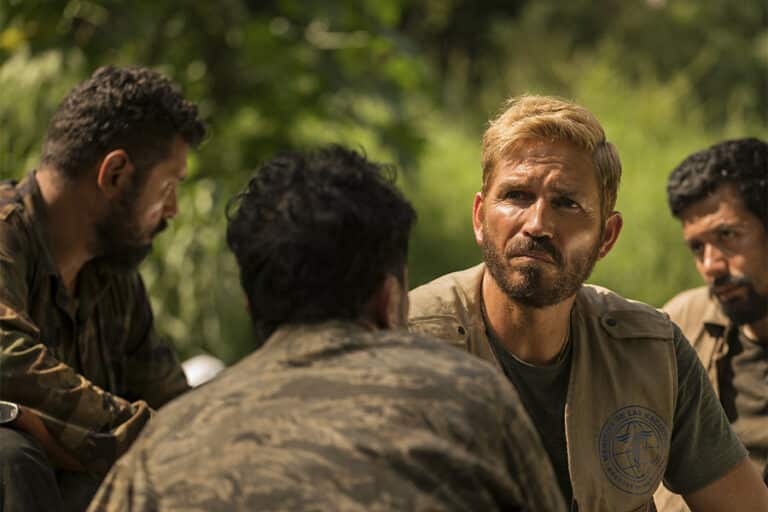
There are few things in life that are more heart-wrenching than the notion of children being sexually abused. It wasn’t easy, but I’m glad I sat through “The Sound of Freedom,” an extraordinary film that exposes the modern-day evil of child sex trafficking. The film tells the true story of Tim Ballard, a fearless former Homeland Security agent who goes off on a harrowing journey to rescue trafficked children in third-world countries.
It’s a thriller with a deep soul and a haunting cause. There are scenes that are painful to watch: how two siblings are whisked away from their father through trickery; the kids’ screams as they’re locked in a cargo ship; the threats of beatings; the sense of total helplessness.
As I often do, after seeing the movie I went looking for the New York Times review. I counted 65 movie reviews for the month of June, but none for “The Sound of Freedom.” Oddly enough, except for Variety, I couldn’t find any reviews in The Washington Post and other mainstream publications.
I won’t speculate about the reasons for this oversight, but I do hope the media will catch up and cover this film. It deserves to clean up at the Oscars.
These abused children who are suffering in the darkest corners of society don’t have a powerful lobby in Washington. If “we the people” don’t rise up and make noise, who will?
As I sat riveted throughout the film, looking at a horror that is happening in our time, I couldn’t help thinking about The 1619 Project, that Pulitzer-Prize winning initiative by The New York Times. The initiative aims to reframe the history of America based on the year when slavery arrived on our shores. But I wondered: If slavery is so important to The Times, why have they not launched The 2023 Project to combat slavery that is plaguing our world right now?
The 1619 Project highlighted a slavery that is thankfully in our past. The horrific images of Black slaves that forever poisoned that time in American history are now only in books and movies. While the Project argues that racism is still prevalent in America, and people must better understand its roots, it doesn’t argue that the slavery of 1619 is still with us.
There is, however, a slavery that is still with us, and it comes in many forms.
“The United States is one of the most advanced countries in the world yet has more than 400,000 modern slaves working under forced labor conditions,” according to Andrew Forrest, founder of the Walk Free Foundation, which publishes the Global Slavery Index. “This is a truly staggering statistic and demonstrates just how substantial this issue is globally. This is only possible through a tolerance of exploitation.”
Within the broad web of modern-day slavery, perhaps no sub-group is more haunting than child sex trafficking, as you can see in “The Sound of Freedom.”
The U.S. State Department is well aware of the devastating impact of child sex trafficking, as it says on its website:
“Sex trafficking has devastating consequences for children, including long-lasting physical and psychological trauma, disease (including HIV/AIDS), drug addiction, unwanted pregnancy, malnutrition, social ostracism, and even death.”
It’s estimated that 2 million children are trafficked each year. According to Save the Children, children make up 27% of all human trafficking victims worldwide, and two out of every three identified child victims are girls.
We’re fortunate that a thrilling movie exists that can break open this cause. This is a crisis that receives a stunning lack of attention. I get hundreds of emails every week about anti-Semitism and climate change and trans rights and police violence and countless other causes, but never any on the scourge of child sex trafficking.
These abused children who are suffering in the darkest corners of society don’t have a powerful lobby in Washington. They don’t have a “Project” named after them. If “we the people” don’t rise up and make noise, who will?
Maybe by the time you read this, The Times will have reviewed “The Sound of Freedom.” In any event, if the paper is serious about combating slavery and teaching it in the schools, it shouldn’t settle for only the year 1619.
There’s another year that demands our attention: 2023.
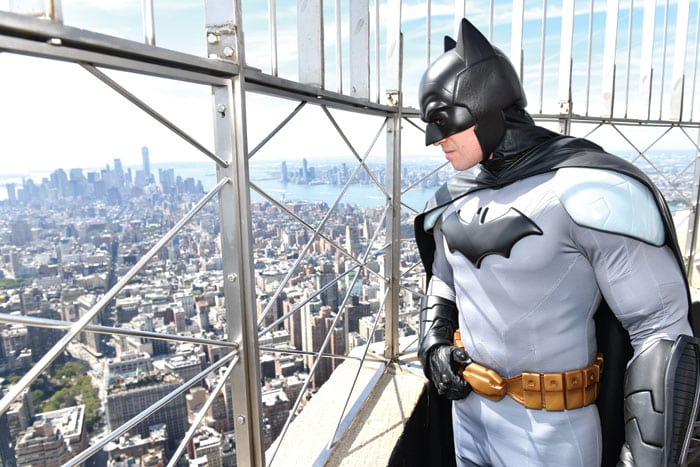
When I was a kid in the ’90s, “Batman: The Animated Series” played every day after school from 1992 to 1995. It was a dark but beautiful show and nearly each episode began with an ominous warning that something bad was about to happen in Gotham City. Some episodes began with an innocent person walking alone on a street or in an alley before being attacked; other episodes began with a nefarious crime being committed (the perpetrator always got away, at least in the beginning).
I’ve been living in Los Angeles for over 30 years, and as much as I’m still hooked on this town, sometimes I feel as though I live in a Gotham City of sorts, an out-of-control metropolis where it’s getting harder to feel safe anywhere.
To put it bluntly, I’m often afraid of those in the city’s homeless population who may be so mentally unstable or reacting badly to drugs that they may turn violent.
Some of that has to do with the disturbing uptick of robberies in L.A., coupled with worry that our law enforcement is being spread dangerously thin. But today, I mostly lament that much of L.A. is morphing into a chaotic Gotham City. To put it bluntly, I’m often afraid of those in the city’s homeless population who may be so mentally unstable or reacting badly to drugs that they may turn violent.
Recently, two male friends were enjoying a walk at 4 p.m. at the intersection of La Cienega Boulevard and Cashio Street when they were attacked by a homeless man. Fortunately, they were carrying a walking stick and were able to defend themselves. My friends told me that they were “shaken up” but that the attack made them feel more compassion for “women, children and the elderly” as they walk LA’s streets each day.
I used to think my friends used a walking stick to help with, well, walking. Only now do I realize that it can serve a double purpose of self-defense.
Another friend was recently sitting at the wheel of her car, waiting for a red light to turn green on Hilgard Avenue in Westwood Village. She noticed a homeless man at a bus stop, talking to himself and visibly agitated. My friend felt safe because she was two vehicles away from him and the light would change at any second. Suddenly, the man jumped up from the bench, ran up to my friend’s car and threw a huge rock against her front windshield.
And then, there’s the attack that I witnessed with my own eyes last week on La Cienega Boulevard and 18th Street, as I drove south to the 10 freeway. The notification I received on my Citizen app half an hour later didn’t do justice to what I saw and experienced. That description read, “Police are responding to a report of multiple victims from vandal breaking windshields.” But here’s what I witnessed:
As I drove on La Cienega, I noticed small encampments on the sidewalk to my left and to my right. And then, I saw that a dangerously agitated man was hitting and punching cars in bumper-to-bumper traffic. Then, the lanes of cars parted as drivers quickly maneuvered around the violent man. Suddenly, he ran toward a car being driven by a woman and began hitting and punching the hood. She couldn’t move forward because he was standing in front of her car and she didn’t want to run him over. The poor woman was trapped.
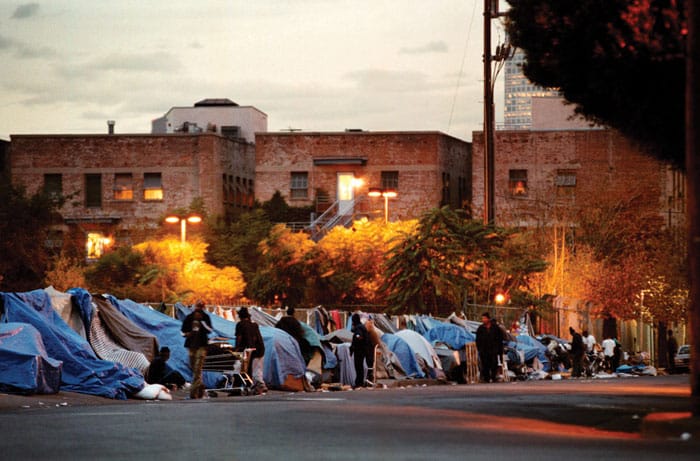
Night falls on a “crack alley” in Los Angeles, CA. (Photo by David McNew/Newsmakers/Getty Images)
Suddenly, he climbed the hood of her car, quickly crawled closer and began jumping violently on top of her windshield, cracking it into what seemed like a thousand pieces.
I had slowed down in the lane next to the woman. For a few seconds, she seemed paralyzed. I’ll admit that I felt paralyzed, too. I couldn’t believe what I was seeing. Though her window was up, I could tell she was screaming and terrified, in utter fight-or-flight mode. If the man had broken through her windshield, I believe she may have been killed.
And then, I witnessed a sight I had previously seen only in action films: Desperate, the woman suddenly stepped on the gas, forcing the man, who was still standing and jumping on her windshield, to lose his balance and fall on top of the cracked windshield that separated him from the woman. He held onto the windshield with both hands and legs as she frantically drove down La Cienega Boulevard.
I’ve seen a lot of memorable sights on La Cienega, including the burning and looting of businesses during the 1992 LA riots, and the looting of a shopping center that is located at the intersection where the incident I am describing took place.
Yes, I’ve seen a lot happen on La Cienega, but I’ve never seen a terrified woman drive full speed ahead with a violent man holding onto her windshield. But this was no Hollywood action film; it was a modern-day Los Angeles nightmare.
She turned suddenly onto 18th Street and came to an abrupt stop at the intersection. The man fell onto the asphalt and passerby stood back and gasped. The woman drove down 18th Street with a shattered windshield and what I imagine to be a level of trauma that seemed so unjust and random.
As I watched, the scene became even more unbelievable, as the man, seemingly uninjured, immediately stood up from his fall, scowled, and ran into La Cienega traffic again and chased down other cars. I hit the gas and sped away as if the T-1000 polyalloy assassin was chasing my car in the famous scene from “Terminator 2: Judgment Day.”
It’s safe to say that my account of the incident differs slightly from the Citizen app’s description of a “vandal breaking windshields.”
I realize that I’m only sharing anecdotes here and not offering a more comprehensive investigative report. And of course, not all homeless Angelenos are violent. That’s an important given. But our homelessness crisis has swelled into a humanitarian issue that needs much tougher action by elected officials to make public safety a priority, without forgetting appropriate compassion for those on the streets. Last Thursday, the Los Angeles Homeless Services Authority released its annual point-in-time count, which revealed that homelessness has increased by 10% in the county (and nine percent in the city). The count, which was conducted in January, reported 75,518 homeless persons, including those living in RVs, cars, tents or interim housing.
But the most shocking revelation of the count was that since 2015, homelessness has increased by 80% in the city (and 70 percent in LA county).
Sadly, violent attacks as a result of LA’s troubling homelessness crisis are happening more often in my beloved city, but for some reason there’s something about La Cienega Boulevard that reminds me of the streets of Gotham City.
I spend a lot of time near La Cienega because it’s close to many kosher markets and restaurants. Two weeks ago, as soon as I entered the intersection at La Cienega and Pico Boulevards, three agitated, homeless men were running through traffic. Two of them were approaching cars; the third approached a bus full of passengers and began throwing random items at it. It’s important to note that several schools are located within a few blocks of this area.
So, is it the new normal for LA drivers to find a way to maneuver around unsettled, potentially-violent homeless persons in the street during rush hour traffic?
When I first learned how to drive, my driving instructor (and the DMV handbook) prepared me for various unexpected scenarios: a kid suddenly chasing his ball down a residential street as my vehicle was approaching; a mother pushing a stroller as the light was turning red and I needed to make a turn; a jaywalker illegally crossing several lanes, just as the light turned green and I had the right of way.
Maybe I’m forgetful, but I don’t recall receiving any driver’s education training on how to maneuver around volatile homeless persons in traffic lanes, some of them clearly hallucinating in the middle of the street. Can I return to the Department of Motor Vehicles in Santa Monica, which issued my first driver’s license, and request to enroll in a new, special class called, “How to Drive in a Virtually Unrecognizable L.A. in 2023”?
As if my new sense of fear of driving through L.A. streets wasn’t bad enough, there’s also the persistent challenge of homeless encampments throughout the city. Next week, I’ll describe how these encampments have deteriorated a sense of public safety and quality of life for me and so many others. This includes an encampment on my street that the city will not clear, despite repeated pleas and requests from residents.
I crave this mythic hero not because I’m souring on the City of Angels, but because I love it so much that I feel ultra protective.
I have one request from readers between this week and the next: If you know the whereabouts (and have an email address) for Batman, please send his information my way. I crave this mythic hero not because I’m souring on the City of Angels, but because I love it so much that I feel ultra protective.
Tabby Refael is an award-winning writer, speaker and weekly columnist for the Jewish Journal of greater Los Angeles. Follow her on Twitter and Instagram @TabbyRefael