fbpx

May 31, 2023

Judi Leib: Whisk in the Southern, Cooking Fearlessly and Pound Cake

“Be fearless in the kitchen,” Judi Leib, creator of the Whisk in the Southern blog, told the Journal. “If you can read a recipe you can cook.”

Leib got her love of cooking from the women in her family.

“My mom was a very good cook, but didn’t like to cook, and my godmother was a fabulous chef, and loved to cook and teach,” she said.

Leib has been cooking since the age of two.

“My mother will tell you that she came into the kitchen one morning, and there was a cast iron skillet with a dozen broken eggs in it,” Leib said. “She was screaming, ‘What are you doing?’ And I was like, ‘I’m making breakfast.’”

A trained chef, Leib has combined her mom’s Southern roots (her mother’s family is from Georgia) with her Southern California upbringing for her own delicious spin.

“Southern food has a reputation for maybe not being the healthiest,” she said. “But here we are in California with all this wonderful fresh fruit and produce.”

One way Leib meshes both “souths” is to turn a fried chicken recipe into a baked chicken. Leib marinates it with buttermilk and seasonings overnight. But instead of cooking it in oil, she puts it in the oven.

“I happen to love being from the South,” she said. “I love red velvet cake. I love pancakes. I think pound cakes are the greatest thing in the world, because they’re so easy and you can do so many things with them.”

Leib’s pound cake uses pineapple juice. “It doesn’t really taste pineapple-y, but there’s a freshness and a sweetness to it,” she said. Get her pound cake recipe below.

When asked to share some of the cooking secrets trained chefs know, Leib said you can simplify a fancy recipe or fancy up a simple one.

Leib recalls the encrusted Chilean sea bass with fresh herbs and lemon beurre blanc, served at a Bar Mitzvah many years ago.

There are a couple different ways you can recreate it without going to a lot of trouble.

“You could put some lemon slices over that Chilean sea bass, add butter, wrap it up in parchment paper and bake it,” she said. “Super easy.”

You could also take the fresh herbs, mix it into panko breadcrumbs and crust the sea bass before you cook it.

“There’s always a way to take a simple recipe and just notch it up a little bit,” she said.

A gadget Leib uses for almost everything is her rasp, aka microplane. It’s a thin, long, almost knife-looking grater, which she uses for lemon zest, ginger, nutmeg, cinnamon, chocolate, parmesan cheese, everything.

What else do trained chefs know?

“I tell people, read your recipe all the way through before you ever get started,” she said. “Make sure you have all of your ingredients and all of your equipment ready to go before you start a recipe.”

There’s nothing worse than getting halfway through a recipe, and realizing you need more of an ingredient than you actually have.

When you take your time with recipes, it shows. For instance, if it says to knead the dough for challah for 8 to 10 minutes, then knead it for 8 to 10 minutes.

“I think patience really makes a big difference in food, if for no other reason, stress comes through in your recipes,” she said.

The difference between baking and cooking is that with cooking you have a lot more freedom to try new things or make corrections.

“IIf it’s too salty, add a potato,” she said. “If it’s too fat, add an acid.”

When you’re baking, there’s a lot less forgiveness. You need to be true to the recipe, but you can also do things like add chocolate chips to banana bread.

Remember …

“Everything just takes practice,” Leib said. “You need to be willing to make mistakes.”

Explore Whisk in the Southern.

For the full conversation, listen to the podcast:

Watch the interview:

sbossert/GETTY IMAGES

Aunt Rosie’s Pound Cake

In Aunt Rosie’s pound cake recipe, she uses pineapple juice for the liquid. You don’t really taste the pineapple. You can use any other juice or buttermilk too.

Equipment

1 10″ Tube Pan

Ingredients

1 cup unsalted butter, at room temperature

2 cups granulated white sugar

5 large eggs, at room temperature

2 cups all-purpose flour

1 tsp. kosher salt

5 Tbs. pineapple juice

Instructions

  1. Preheat oven to 325°
  1. Cream together butter and sugar. You are looking for it to be light in color and fluffy.
  1. Add eggs, one at a time, beating well after each addition.
  1. Whisk flour and salt together.
  1. Add flour, in thirds, alternating with pineapple juice. Always start and finish with your dry ingredients.
  1. Do not overmix. Just let the flour barely incorporate. Finish mixing with a spatula, by hand.
  1. Grease and flour a 10″ tube pan. Pour batter in and set on a baking sheet.
  1. Bake for 50 minutes to an hour.
  1. Let cool for 10 minutes in the pan. Then invert and let fall naturally out of the pan.

Debra Eckerling is a writer for the Jewish Journal and the host of “Taste Buds with Deb.Subscribe on YouTube or your favorite podcast platform. Email Debra: tastebuds@jewishjournal.com.

Judi Leib: Whisk in the Southern, Cooking Fearlessly and Pound Cake Read More »

Rosner’s Domain | The Time Travel Loophole of Homesh

In March, a strange act was exercised by Israel’s government: it raises the possibility of canceling past events by making decisions in the present time. Naturally, it also raises quite a few reflections on the concept of time, the ability to travel back in time, the possibility of changing the future through a journey to the past.

Apparently — it’s possible. All of the above is possible. Proof: on Sunday night, a convoy of mobile homes was making its way in Samaria. Yeshiva students ceremoniously built a permanent residence for their place of study in Homesh in the West Bank, thus, undoing a component of the 2005 plan of “disengagement”. Israel is not (yet?) returning to the evacuated Gaza strip, but it is giving license to settlers to reestablish a permanent residence in northern Samaria, approved by Defense Minister Yoav Gallant. 

You are probably familiar with the paradox of traveling back in time, which physicists and philosophers have grappled with: what if you traveled back in time and accidentally (or intentionally) ran over your grandmother’s mother when she was young, so your grandmother was never born, and therefore neither was your mother, and therefore neither were you — But wait, you’re the one who ran over grandma’s mother … how can all this be?

This is what the government and the settlers are doing: they travel back in time to run over their grandmother. In the specific case of Israel, the cancellation of disengagement is the running over grandmother. Let’s play out the paradoxical scenario: if there was no disengagement, the IDF would still be in Gaza, and so would the settlers. Hamas would not come to power, Gilad Shalit would not be taken hostage, and therefore would not have to be released, there would be no Operation Protective Edge. The Kadima party would not be established, nor decline. Ariel Sharon would remain Likud chairman, and so on.

Of course, if it turns out that it works, that it’s really possible to undo past events, it would be a shame not to cancel other troubling events. The potential is endless, and only humorless Americans can’t see it. When the Knesset canceled disengagement, the Biden administration summoned the Israeli ambassador, Mike Herzog, for a serious talk. The Washington fools can’t keep up with Israeli innovation. They thought that the fact that disengagement had already happened made it a fait accompli. Or maybe they just got scared: If Israel has such technological edge up its sleeve, that could undo the past, what else could it undo — the Louisiana Purchase (1803)? the surrender at Appomattox (1865)?  

More seriously, the official reestablishment of the Homesh Yeshiva (there were impermanent tents, now there’s license for more) should be addressed by looking at it three different ways. The first is the issue of price: how much would this cost in diplomacy and blood? International condemnation is a given. But Israel isn’t worried about condemnation (the international community can blame itself for such indifference – Israelis got immune to it by being exposed to loads of unfair and imbalanced condemnation). It is only worried about practical consequences. And about the possibility of violence. If Homesh becomes the trigger of violent response, some Israelis are likely to raise the question of benefit and reward.

A second issue is the one of psychological bandage. Israel’s right was traumatized by disengagement and is constantly looking to reverse its consequences. Some rightists dare to dream about returning to Gaza, but such move would not get the nod from most Israelis. A return to Homesh? That’s easier, both operationally and politically. If this serves to heal the right from its disengagement obsession, that could have a certain benefit. Alas, it is more likely to increase the appetite of those wanting to undo the past, rather than satisfy their hunger.

At some point, someone must address the question of endgame by explicitly explaining how an arrangement that includes a Jewish State and alongside it a few million Palestinians might look like.  

Then there’s the third issue — the long-term plan of the hard right. A return to Homesh is supposed to be a prelude for more settlement in more distant places. It is supposed to be a prelude for continuing a process whose end-goal isn’t clear. True, a two-state solution is not in the offing. True, the Palestinians can’t be trusted to keep a secure territory. True, Samaria is part of the ancient Jewish homeland. And yet, at some point, someone must address the question of endgame by explicitly explaining how an arrangement that includes a Jewish State and alongside it a few million Palestinians might look like.  

A return backward in time does not provide a clue. A return to Homesh does not provide a clue. In fact, it makes the future a tad more mysterious, and hence frightening.

Something I wrote in Hebrew

Another day, another attempt by the government to pass a decision that is unfathomable. Here’s what I wrote:

In a proposed government decision, that the Attorney General opposes, state offices will be required to give “significant weight to the values of Zionism … first and foremost in the areas of settlement and in the provision of benefits to those who served in the army and security forces or in civilian national service … this, without deviating from the principles enshrined in other basic laws”. Well – what does such decision mean? What are “benefits,” what is “preference,” and how can these be given “without deviating from the principles of other basic laws”? Above all: What are the “values of Zionism”?

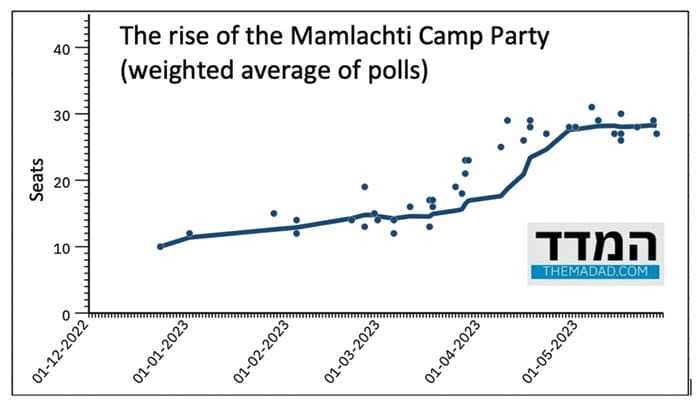
A week’s numbers

A reward for being moderate, polite, uncontroversial, calm – amid Israel’s chaos. 

A reader’s response:

Responding to something I wrote about the power of ultra-Orthodox parties in Israel, Fabian Pascal has this to say: “the problem is the fractured nature of Israeli society and the electoral system that reinforces it which induces a secular coalition to give in to blackmail to get and stay in power”.


Shmuel Rosner is senior political editor. For more analysis of Israeli and international politics, visit Rosner’s Domain at jewishjournal.com/rosnersdomain.

Rosner’s Domain | The Time Travel Loophole of Homesh Read More »

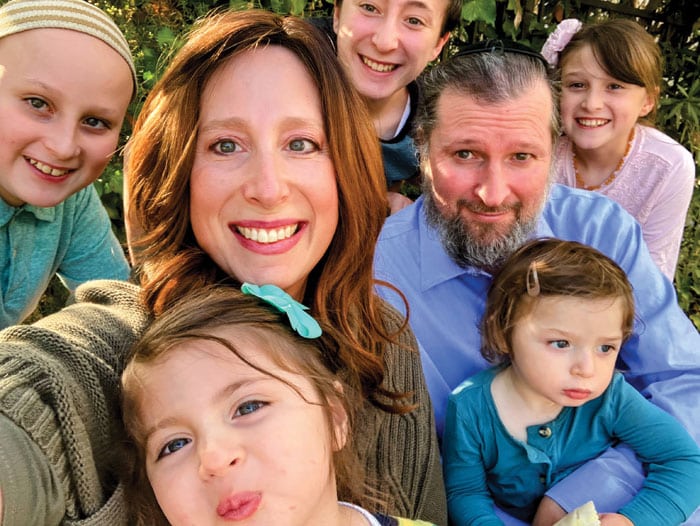
Local Father Reflects on Miraculous COVID Recovery and the Lessons He Learned

In the summer of 2022, when it seemed like the world had entered a post-COVID period, Rafael Gutiérrez was in a coma, battling the disease and fighting for his life.

After sending his children to a summer camp where safety protocols weren’t in place, the local father of five contracted COVID. He experienced shortness of breath and was intubated three days later. He then fell into a coma. 

“The doctors called my wife every day to say that I was failing and to get ready for my departure,” Gutiérrez, who lives in Thousand Oaks, said. “There was not even a 1% chance of survival.”

Gutiérrez, 48, was in a coma for 40 days, followed by 67 days in the ICU. During his time in the ICU, he changed his Hebrew name from David Rafael to Haim David Rafael, as is the custom when a Jewish person is sick. His family, friends and members of the community prayed and took on more mitzvot to bring about Gutiérrez’s speedy recovery.

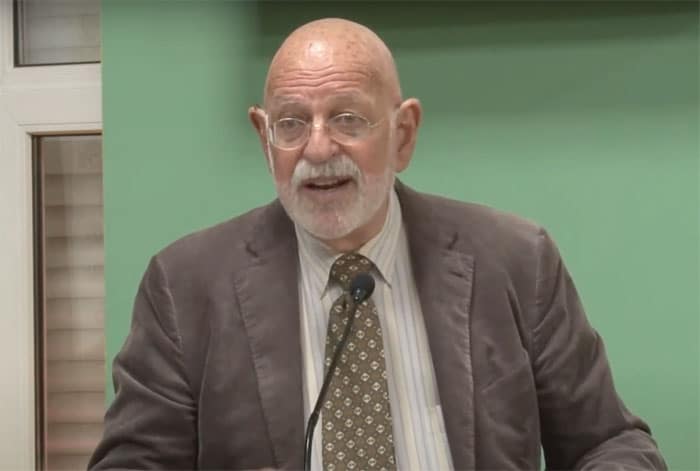
“Many people from diverse groups prayed for me, like Chabad Hasidim all around the world and yeshiva students from Los Angeles, New York and New Jersey,” he said. “A secular Persian Jewish doctor in Los Robles was key to my survival, and two Persian Orthodox Jewish doctors literally saved me. People gave charity and said Tehillim. The community gave lots of love to my family, and multiple Chabad rabbis got involved.”

In the end, the medical treatments came out to millions of dollars. Gutiérrez believes that God performed an open miracle and saved him. 

In the end, the medical treatments came out to millions of dollars. Gutiérrez believes that God performed an open miracle and saved him. 

“Despite all the treatments the doctors and nurses gave me, we realized the hand of Hashem, which was beyond science, saved me, and the doctors stated that emphatically,” he said. 

Today, Gutiérrez is still on the road to recovery, with only 56% lung function. But he is thankful to be alive. He wrote a book about his experience, “Voiceless: A Story of an Unquestionable Miracle When Science Despaired. A Catharsis Post Pandemic,” which was published last September. It details how everyone’s good deeds and love contributed to his miraculous healing. This is his second book; his first one, “Never Judge a Book by Its Cover: Practical Lessons I Learned From the Disabled” is about how he was a caregiver for a young man with autism and Down syndrome when he first moved to the United States. 

On a day-to-day basis, Gutiérrez, a former executive for Spanish television networks in Latin America, works in finance and runs Issachar Dov Outreach, a nonprofit that provides free career counseling and temporary aid to Jews who immigrate to the U.S. from Latin America, Israel and Europe. 

Looking back at his experience, Gutiérrez has learned to appreciate when life is going well for him. Being sick put everything into perspective. “It was a call to action to avoid taking bodily functions, people and things for granted,” he said. He also feels a tremendous amount of gratitude that the community did good deeds in his honor, and that he is still alive and able to carry out his mission in life. “One more good deed is worth more than we can imagine,” he said. “I have a huge desire to help others and enrich their lives. I increased the amount of prayers and studying I do. Being able to see the real truth about this world humbles you.” 

Now, he has words of wisdom for other Jews, no matter what their situation:

 “Speak to Hashem every moment you can,” he said, “and especially speak with gratitude.”

Local Father Reflects on Miraculous COVID Recovery and the Lessons He Learned Read More »

A Brighter Future at Pali High

In our increasingly polarized society, antisemitism is unfortunately flourishing – even on high school campuses. In February, I wrote an article, “Hope for a Brighter Future at Pali High,” about how Palisades Charter High School, part of the Los Angeles Unified School District, was responding to the many acts of antisemitism on our campus. I described how our high school administration ultimately agreed to partner with the Simon Wiesenthal Center’s Museum of Tolerance in an educational training program designed to reduce antisemitism and discrimination on campus.

I am pleased to report that my hope for a brighter future at Pali High was not just a dream, but is on the way to becoming a reality. 

Pali High is certainly not alone in the fact that its Jewish students and faculty have experienced antisemitic incidents. But Pali High has been unique in its response, driven by a few highly motivated students and faculty and a progressive school administration that genuinely wants to improve the campus climate. I am pleased to report that my hope for a brighter future at Pali High was not just a dream, but is on the way to becoming a reality. This has been achieved due to the courageous leadership of the high school’s principal, Dr. Pamela Magee, and her supportive administrative team that includes the school’s Diversity Director. 

In recent years, Pali High has been defaced multiple times with swastikas and anti-Jewish imagery. Jewish students have been subjected to antisemitic comments and slurs from some of the faculty and other students who don’t seem to understand what it means to respect another’s identity. One faculty member made a horrific comment in class that Kanye West was right to praise Hitler. And another denied Jewish students the right to participate in a diversity program on campus because “Jews don’t experience discrimination in America.” Really? These antisemitic incidents underscored the reality that at least some of our faculty and staff were seriously misinformed about Jewish history and antisemitism and needed professional education about diversity, inclusion, and tolerance. 

The Simon Wiesenthal Center’s Museum of Tolerance seemed to be the answer, so we arranged for the Simon Wiesenthal Center to curate a program for the school’s faculty and staff to oppose racism, bigotry, discrimination, and antisemitism. Over the past three months, groups of 25 Pali High faculty and staff have been bussed every week from campus to the Museum of Tolerance for all-day training sessions about the dangers from all forms of bigotry and discrimination. Michael Mashbaum, a faculty member who stood up against the antisemitism on our campus and was instrumental in helping to launch this program, recently participated in one of those training sessions. He shared with me his deep appreciation for what Pali High has done, which will  benefit students for years to come. He told me how proud he was that our high school has lived up to its reputation as an inclusive institution that truly values the diversity and personal histories of all students and faculty. 

Remarkably, all 200 Pali High faculty and staff, including security guards, kitchen staff, and the janitorial team, have now attended a full day of training at the Museum of Tolerance. Next month, a Wiesenthal Center program facilitator will come to campus to recap the training sessions and reinforce the lessons learned. Pali High has embraced this powerful educational initiative and plans to continue the programs into the next school year. The school administration is committed to ensuring that our faculty and staff are properly trained in matters of antisemitism and the Holocaust, racism, xenophobia, and all other forms of intolerance. 

As the Jewish students’ representative to our high school’s Justice League, I can confirm that it was the unique combination of respectful advocacy by Jewish student leaders and a concerned faculty member that led our school administration to launch this program to educate our educators about antisemitism and intolerance, which will be a positive force for good on campus. This pioneering program is the first of its kind in the Los Angeles public school system, and I call upon the LAUSD Board and all community leaders to applaud the Pali High administration for implementing this important educational program. 

I believe that Palisades Charter High School will serve as a shining example that inspires other schools to embrace similar programs to substantially improve the climate on campus for all students, and I know we will have a brighter future because of it.


Joseph J. Karlan is a graduating Senior at Pali High/

A Brighter Future at Pali High Read More »

Mel Brooks Appears at LA Jewish Film Fest Opening Night, Gene Wilder Documentary Premieres

After four long years, the Los Angeles Jewish Film Festival (LAJFF) returned on May 18th with a star-studded opening night at the Saban Theatre in Beverly Hills, highlighted by an appearance by the legendary Mel Brooks. 

While there’s no doubt that all 1,000 people in the sold-out theater were ecstatic to see the 96-year-old showbusiness legend, the night wasn’t about Brooks. The documentary “Remembering Gene Wilder” was making its world premiere, and who better to introduce it than his best friend and collaborator for over 50 years, Mel Brooks.

“It’s such a pleasure to be here. And at my age, it’s a pleasure to be anywhere.”
– Mel Brooks

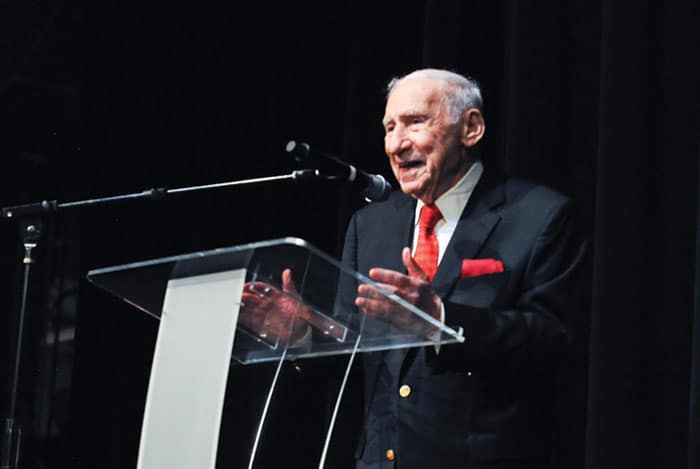
Brooks was introduced by LAJFF director Hilary Helstein before the screening; after a standing ovation, Brooks, wearing a red tie, white shirt and dark suit, emerged from stage right. “I heard you,” he told the crowd with a smile, gesturing for them to sit down. “It’s such a pleasure to be here. And at my age, it’s a pleasure to be anywhere. Gene was an exceptional person. He was a very dear friend. He is the only actor that I ever met that waited in a scene with another actor — waited to understand the other actor and respond … Gene listened to the other actor. He was very humble and sweet and down with it.” 

Brooks then read a letter from Wilder to the late choreographer and director Jerome Robbins. Robbins directed Wilder (along with Brooks’ future wife Anne Bancroft) in the 1963 Broadway production of Bertolt Brecht’s “Mother Courage and Her Children”: 

“Dear Jerry,

“When we worked together, it was the best of times, it was the worst of times. But I’m more grateful to you now than I ever could have conceived I could be. I’ll tell you why: One, if you hadn’t miscast me in ‘Mother Courage,’ I wouldn’t have met Anne Bancroft. Two, if I hadn’t met Anne Bancroft, I wouldn’t have met Mel Brooks. Three, if I hadn’t met Mel Brooks, I would probably be a patient in some neuropsychiatric hospital looking through the bars of a physical therapy widow and making wallets.” 

Brooks continued, “I think what you’re going to see tonight, you won’t forget. It’s beautiful and it tells the story of a very special human being who, as far as I’m concerned, is a talent who will be around forever. So thank you for coming.”

The Journal took an informal survey of the boldface names in attendance about their favorite Gene Wilder film. 

Julie Nimoy, producer of the documentary (and daughter of actor Leonard Nimoy), said “Young Frankenstein.”  

Barry Pearl, who played Doody in the 1978 film version of “Grease,” said both “Young Frankenstein” and “Blazing Saddles.” Actress Amy Yasbeck Ritter said the same before reflecting on what struck her most about Wilder as a performer.  “Just the sweetness of his face, of his countenance in repose, and then all of the different degrees,” Yasbeck Ritter told the Journal. “Somehow, he could make his face do all the stages of grief and then go back to comedy. A physical comedian isn’t always falling down the stairs or hanging from clock towers, sometimes it’s just the littlest thing in the face or the eyes.” Comedian Elon Gold, after doing an impersonation of Wilder, called him one of the funniest yellers of all time.

Those who grew up watching 1971’s “Willy Wonka & the Chocolate Factory,” were excited to see two of Wilder’s co-stars from the film, Dr. Peter Ostrum (who played Charlie Bucket) and Paris Themmen (who played Mike Teevee) who paid tribute to Wilder. “Right away you could tell, this was going to be a good experience to be with him,” Ostrum told the Journal about filming “Wonka” in Munich. “He was going to be my co-star for the next four months.” Themmen shared a memory with the Journal where as an adult, he approached Wilder at a charity event. Wilder looked at him, now all grown up, and said, “oh you were a brat” before signing a poster for his former co-star.

“If you can’t laugh, you can’t live. I think Gene’s motto was somewhat that, and also to be loved. And to love someone else is the greatest gift.”
– Karen Wilder

Karen Wilder, who was married to Gene from 1991 until his death from Alzheimer’s Disease in 2016, spoke to the Journal about traveling around the world with her late husband for book tours and fan events and what struck her most. “Every ethnicity, every age group came,” she told the Journal. “And it was such a wonderful experience. It didn’t matter how old, it didn’t matter what your religion or politics were, they loved his movies and he made them laugh. Everybody talked about the joy he brought. People like Bill Moyer said (when he had his heart attack), everyone should laugh, so he watched ‘Young Frankenstein!’ It helped. If you can’t laugh, you can’t live. I think Gene’s motto was somewhat that, and also to be loved. And to love someone else is the greatest gift.” 

Karen Wilder shared that after his passing, some of her late husband’s ashes were spread at his former home in Connecticut, some spread in Rancho Valencia, and some are always with her in a locket she wears around her neck every day. 

“He was a wonderful human being, he was a shining light for a lot of people,” Karen Wilder said. 

After the screening, the Journal spoke with LAJFF director Helstein for reflections on the evening. 

“It was really sad for the past four years where we were all locked up and cooped up, and the only thing that kept us going was film and television,” Helstein said. “Film has changed in a lot of ways, but tonight there were over a thousand people in there. Being back in theaters, it’s all about being connected.” 

Plans for the 19th iteration of the LAJFF in 2024 are already underway.

Mel Brooks Appears at LA Jewish Film Fest Opening Night, Gene Wilder Documentary Premieres Read More »

The Man Whom So Many of Us Forgot to Thank

I should have done it. I should have helped organize an event to honor Bruce Leimsidor for his 20 years of service as director of HIAS (formerly the Hebrew Immigrant Aid Society) in Central Europe between 1982-2002. I even knew what I would say during the event: 

“Hello, everyone. And hello, Bruce. My name is Tabby Refael and HIAS saved my family and me, and most of our relatives, from the clutches of the merciless regime in Iran after the 1979 revolution. On behalf of my family and my community of hundreds of thousands of Iranian Jews around the world, including nearly a quarter-million in Israel and over 80,000 in the United States: Thank you. Thank you, Bruce, and please forgive us, because for over 40 years, we did not properly thank you. If, today, we live in freedom and fulfillment, it is primarily thanks to you.” 

I should have finalized that event. But I didn’t, because I figured there would be plenty of time to complete the task. And then, in April, Leimsidor passed away.

He died in Italy at age 80, and his funeral was held in the Jewish Ghetto of Venice on April 19. 

As HIAS director in Central Europe, Leimsidor was based in Vienna. During that time, he helped tens of thousands of Jews, mostly from Iran, the former Soviet Union and Eastern Europe (and a small number from Syria, Iraq, Afghanistan and Ethiopia) who had one commonality: They had suddenly found themselves as refugee applicants who desperately needed to develop claims for entry to countries in the West. Back then, the State Department had one overseas processing office that covered U.S. refugee admissions through Central Europe, and it was HIAS. 

I don’t know how Leimsidor or his staff did it. I’m not referring to navigating the bureaucracy and red tape of asylum laws, or working at desks piled high with thousands of paper files and applications. That was hard enough.

But I’m referring to the fact that Leimsidor documented thousands of human rights abuses and acts of discrimination, often in vivid, disturbing detail. He needed to make cases for these Jews and present them to immigration authorities. At its height, HIAS in Central Europe was presenting cases for up to 3,000 clients per month. “The people [Jews in Iran] who are leaving now had really, really tried to stay,” Leimsidor said in a November 1986 interview with The New York Times, adding that two-thirds of Jewish refugees from Iran had been tortured or physically mistreated. “The people who are coming out now have really suffered.” 

HIAS is the world’s oldest refugee protection agency. Since its inception in 1881, it has helped resettle over 4.5 million people, including historian and political theorist Hannah Arendt, former Secretary of State Henry Kissinger, actress Mila Kunis, Google co-founder Sergey Brin and WhatsApp co-creator Jan Koum. Emma Lazarus, whose poetic words grace the Statue of Liberty, was a refugee caseworker. Born in the U.S., she worked for the Hebrew Emigrant Aid Society.

One former HIAS recipient who has never forgotten the organization’s life-saving work is Mandana Dayani, one of the subjects of my cover story in this week’s issue, which profiles Dayani and actress/activist Debra Messing. HIAS rescued Dayani and her family from Iran when she was a little girl and helped resettle her in the U.S. 

Today, Dayani is a force of nature. An attorney and entrepreneur, she has been a fearless civic action and Jewish activist, and creator and co-founder of I Am a Voter, a non-partisan civic engagement organization. Dayani is a testament to the extraordinary capabilities of a young girl or woman if she is extracted from a tyrannical theocracy and offered a chance to live up to her potential in freedom and dignity. 

Many Jews have heard of HIAS, but few knew about Leimsidor. I asked Mark Hetfield, president and CEO of HIAS, about Leimsidor’s legacy. “Bruce Leimsidor was an amazing intellectual,” he told me. “He was a humanitarian, and at a key time in European history, was the steward of one of HIAS’ greatest achievements — helping Jews and other religious minorities on their first stop, in Vienna, Austria, on their journey from totalitarianism to freedom.”

For over a decade, Leimsidor taught European asylum law and international relations at Ca’ Foscari University in Venice. Concurrently, he was counselor for asylum affairs in the Venice municipality asylum seekers’ program. Before moving to Venice, he served as a senior resettlement expert at the United Nations Human Rights Council’s central resource center in Nairobi, Kenya.

I want to work with various Jewish communities, including Iranians and those from the former Soviet Union, to plan a tribute event for Bruce Leimsidor in LA this year.

Leimsidor wrote numerous op-eds and scholarly articles and was an academic and a visiting lecturer worldwide, including in Russia and Ukraine. He was disturbed by Russia’s war in Ukraine, but last April, he wrote in Ytali (Ytali.com), a Venice-based newspaper, that his sympathies for Ukraine were complex and limited due to that country’s collaboration with the Nazis during World War II. “Some of my extended family were burnt alive in their local synagogue by Nazis and their Ukrainian collaborators,” wrote Leimsidor. 

Most of the HIAS recipients who Leimsidor helped in Vienna did not stay in touch with him. But one former refugee who made it a point to cultivate a friendship with him was Pooya Dayanim, a Los Angeles-based liaison between Iranian Jews and various governmental and nongovernmental entities. Dayanim first met Leimsidor as an 11-year-old Iranian Jewish refugee in Vienna, where he and his family were processed in 1984-1985. “It was the height of the Iran-Iraq War,” Dayanim told me, “and when we arrived, there were 120 Iranian Jews whom HIAS was helping in Vienna. When we left, there were about 2,700.” That number nearly doubled between 1983-1987.

As a child, Dayanim viewed Leimsidor as a “tall, intimidating man.” But as the former became more active in advocacy on behalf of Iranian Jews, he visited Vienna as an adult and developed a meaningful connection with Leimsidor, who had saved him and his family. 

During his trips to Vienna, Dayanim would always meet with Leimsidor and ask him about the status of Jewish refugees from Iran. By the late 1990s, the number of Jews fleeing Iran had dwindled significantly. Dayanim cites that 95% of those who left the country did so between 1980-2002. 

“I really admired him,” said Dayanim, who stayed in touch with Leimsidor through long-distance phone calls and facsimiles. “He was a liberal Jewish humanist; a philosopher who was devoted to tikkun olam. He spoke many languages; a true man of the world,” Dayanim said. In a tribute to Leimsidor last month, Ytali called him a “global citizen.”

I asked Dayanim if Leimsidor ever expressed hope that those he helped would officially recognize his life-saving work. “He wished that the Iranian Jews who were resettled in America would have checked on HIAS and its later efforts for Iranian Jews more,” he said. Dayanim then asserted, “Our community in the U.S. should have given large financial contributions to HIAS whenever possible.” I am in complete agreement with Dayanim. 

“Bruce would have appreciated being recognized,” said Dayanim, who, before the pandemic, spoke with Leimsidor about a possible event in Los Angeles to singularly recognize his contributions. But then, the pandemic began. “It was going to be a night of recognition,” said Dayanim. “And we would have taped Bruce’s oral history about our community. He was looking forward to it.” 

I remember discussing such an event with Dayanim and our mutual friend, Sam Yebri, co-founder and former president of 30 Years After. Though HIAS, as an organization, has been recognized at L.A. events in the past, I will always regret that I didn’t help bring an event that would honor Leimsidor to life. 

As a former child refugee, I’ve found that many of us do not wish to look back at the past. There are some who are even repelled by the idea of being reminded that they came to this country as refugees. 

But if anything, we refugees should wear our past as a badge of honor, because it shows precisely how far we have come. “Bruce devoted his life to marginalized people,” said Dayanim. “Those of us who were in Vienna, especially, will always remember that tall, very well-dressed, classy man. Our lives were in his hands. Our community could have done better to have recognized him.”

I want to work with various Jewish communities, including Iranians and those from the former Soviet Union, to plan a tribute event for Bruce Leimsidor in L.A. this year, and to also ensure that more stories and initiatives are devoted to this selfless man whom we should have thanked decades ago. Please, join me.


Tabby Refael is an award-winning, Iranian American Jewish writer, speaker and civic action activist. Follow her on Twitter and Instagram @TabbyRefael

The Man Whom So Many of Us Forgot to Thank Read More »

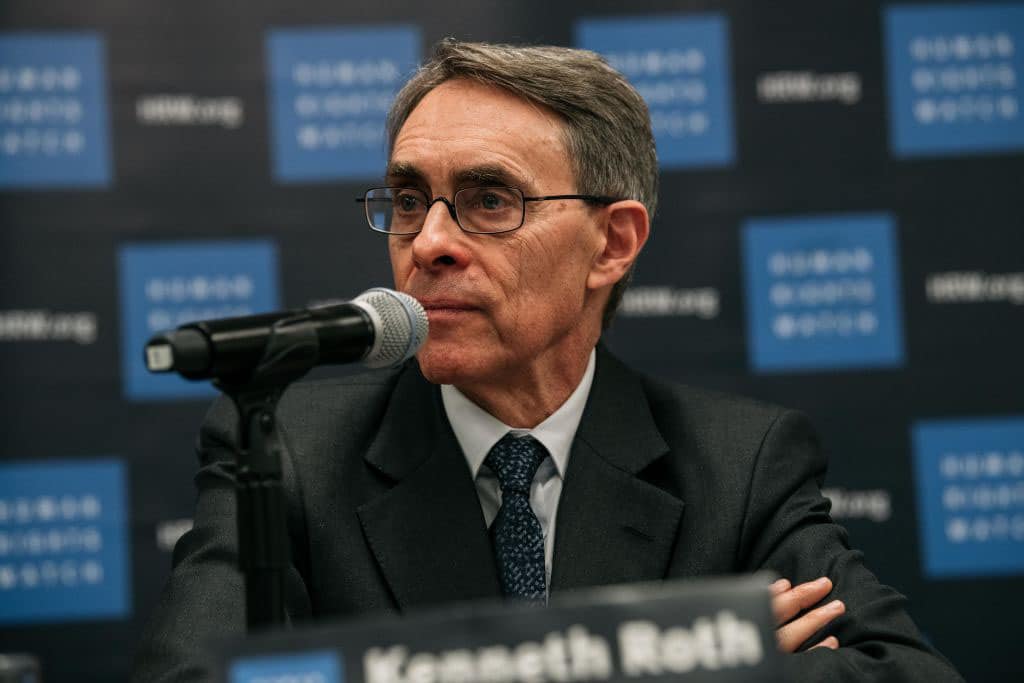
Letter to Ken Roth: Demonizing Israel by Exploiting the Holocaust

Your latest diatribe on Israel, published in Deutsche Welle (“Opinion: Reassessing the approach to Israel”), continues the deceitful assault on the legitimacy of Jewish self-determination. Following your practice for over twenty years, you deploy your father’s experience as a Jew in Nazi Germany (until 1938) as a shield against scrutiny and criticism. Artificially invoking the language of morality, universal human rights and international law, you continue to pervert these fundamental principles.

As a Jew and an Israeli, whose parents, grandparents, aunts, uncles and cousins also “experienced” the inhumanity of the Nazis (unlike your father, many did not survive), I find your exploitation of the Holocaust to be regrettable and worse. The use of Deutsche Welle, the state-owned German media platform funded by the federal tax budget, is particularly repugnant.

Under your leadership, Human Rights Watch (HRW) was at the forefront of the campaigns to weaken, isolate, and ultimately dismantle Israel as a Jewish state. The objects of your rage are not policies in the territories under Israeli jurisdiction since the 1967 war (the “occupation”); nor do you demonstrate any concern for Palestinians, whose leaders are corrupt dictators and terror leaders. Instead, under the label of human rights, your goal is to erase my country – where some 8 million Jews have made homes and chart our own destinies, like the citizens of 190 other independent countries.

As demonstrated at the infamous antisemitic 2001 UN Durban Conference, you and HRW are leaders in attacking the national liberation movement of the Jewish people, including the current “Israel apartheid” campaign, which is an extension of the abhorrent Soviet-led 1975 UN General Assembly resolution demonizing Zionism as racism. After the demise of the Soviet empire, you and HRW adopted the same language and mechanisms. Among many blatant examples throughout the past two decades, in 2017, you endorsed an article titled, “Birds of a feather: White supremacy and Zionism,” which declared that “White supremacy and Zionism are two of a kind.” When HRW’s founder Robert Bernstein denounced you in the New York Times and elsewhere for abusing the organization and human rights in the campaign to turn Israel into a pariah state, he was referring to these actions.

Your Deutsche Welle piece repeats the blatant distortions and exploits the suffering of South Africans under the real apartheid. In contrast to this sophistry, the campaign to brand Israel an “apartheid” state has no foundation under the façade of international law. The clear objective is to eliminate Israel as a Jewish state, which would return the Jewish people to the status of statelessness and vulnerability.

In contrast to your “apartheid” refrain, mentioned six times in this essay, you somehow fail to mention 75 years of Palestinian and other terror attacks even once. You conveniently erase the tens of thousands of rockets aimed at Israeli children and families – each is a war crime. You pretend to recognize Israel’s need for a formidable military, but the flood of condemnations during the 30 years in which you led HRW prove those sentiments to be a fig-leaf to cloak your obsession. At HRW, you employed a series of fellow haters to write fake “reports” and press releases promoting boycotts (BDS) singling out Israel, and targeting Israel’s banks, athletic clubs, Airbnb and Ben & Jerry’s. Through repeated and false allegations of war crimes, your team also lobbies for arms embargoes and indictments of Israeli officials at the International Criminal Court (ICC).

In the spirit of Soviet agitprop, you write “Netanyahu and his ilk have constructed a state that is strong,” – another cheap shot to malign 75 years of Israeli independence. Netanyahu was born 18 months after Israel’s founding in May 1948. His predecessors constructed a safe haven for millions of Jews, including many who survived or escaped the Holocaust, and their descendants, with the strength necessary to withstand continuous assaults. And you also know but refuse to acknowledge over one million non-Jewish citizens – Christians, Muslims, Druze, and others, including judges, doctors, soldiers, police officers, political leaders, and in countless other roles. No Ken, there is no apartheid – it is malicious “fake news” (modern antisemitism).

You then pretend to speak for Jews through Deutsche Welle, proclaiming from your faux human rights pedestal that Israel is “not good for the Jews of the world,” as if you have any connection with this community. In fact, your actions as head of HRW during the past 30 years have clearly been “not good for the Jews of the world,” to understate the reality of the pain you have inflicted. On your lengthy watch as a self-proclaimed high priest of human rights, HRW systematically ignored antisemitism, as in the 2022 World Report (covering 2021) with no mention of attacks against Jewish targets in the US. (In case you missed it, the Anti-Defamation League reported 2,717 antisemitic incidents in 2021 – the highest total since the organization began tracking in 1979. In 2021 (2,024 incidents) the World Report also made no mention of antisemitism. Mr Human Rights Ken Roth heard nothing, saw nothing and said nothing. And, unsurprisingly, your essay in Deutsche Welle has no mention of antisemitism.

Instead, and hiding behind “your father’s experience in Germany in the 1930s,” your behavior has actively contributed to and amplified anti-Jew hatred. In 2006, after Israel responded to a Hezbollah attack that killed a number of civilians and kidnapped the bodies of two soldiers, you referred to the counter-attack as “An eye for an eye – or, more accurately in this case, twenty eyes for an eye – may have been the morality of some more primitive moment…” Beyond displaying your ignorance of 2000 years of Jewish texts, you echoed some key themes of theological antisemitism and delegitimization of Judaism. The same is true for your July 2021 tweet, blaming the victims (Jews and Israel for hate: “The surge in UK antisemitic incidents during the recent Gaza conflict gives the lie to those who pretend that the Israeli government’s conduct doesn’t affect antisemitism.” You eventually deleted the post, claiming you were merely “misunderstood.”

In contrast to the pretense of concern for the welfare of the Jews of the world, you also agitate vocally against acceptance of the working definition of antisemitism adopted by the International Holocaust Remembrance Alliance (IHRA), which, many believe, will help to protect Jewish communities. Your twitter feed has numerous examples, including denouncing the German parliament (Bundestag) for supporting a resolution that cites this text in declaring the BDS movement to be an expression of antisemitism. And following the January 9 2015 assault on a kosher supermarket in France, during which four Jews were murdered and several held hostage, the French Minister of Justice endorsed a “systematic, adapted and individualized” approach to combating antisemitic and other types of hate speech, and speech glorifying terrorism. HRW responded with two publications accompanied by a June submission to the UN Human Rights Council asserting, without any evidence, that such measures are “likely to have a chilling effect on freedom of expression in France, weaken[s] its credibility as a country that stands up for freedom of expression and set[s] a dangerous example for governments that are quick to use counterterrorism laws to silence their critics.”

I do not claim to understand the reasons for the personal agenda that is responsible for at least 30 years of loathing. Millions of Jews, including the post-Holocaust generations whose parents and grandparents learned the lessons of the “experience as a Jew in Nazi Germany”, struggle with the responsibilities of self-determination, and ongoing threats of annihilation. In contrast, you have chosen to pursue obsessive hatred, demonization and antisemitism. Essays manipulating the language of human rights will not change this legacy.


Gerald M Steinberg is professor of political science at Bar Ilan University and president of NGO Monitor.

Letter to Ken Roth: Demonizing Israel by Exploiting the Holocaust Read More »

CUNY Denounces Anti-Israel Commencement Speech As “Hate Speech”

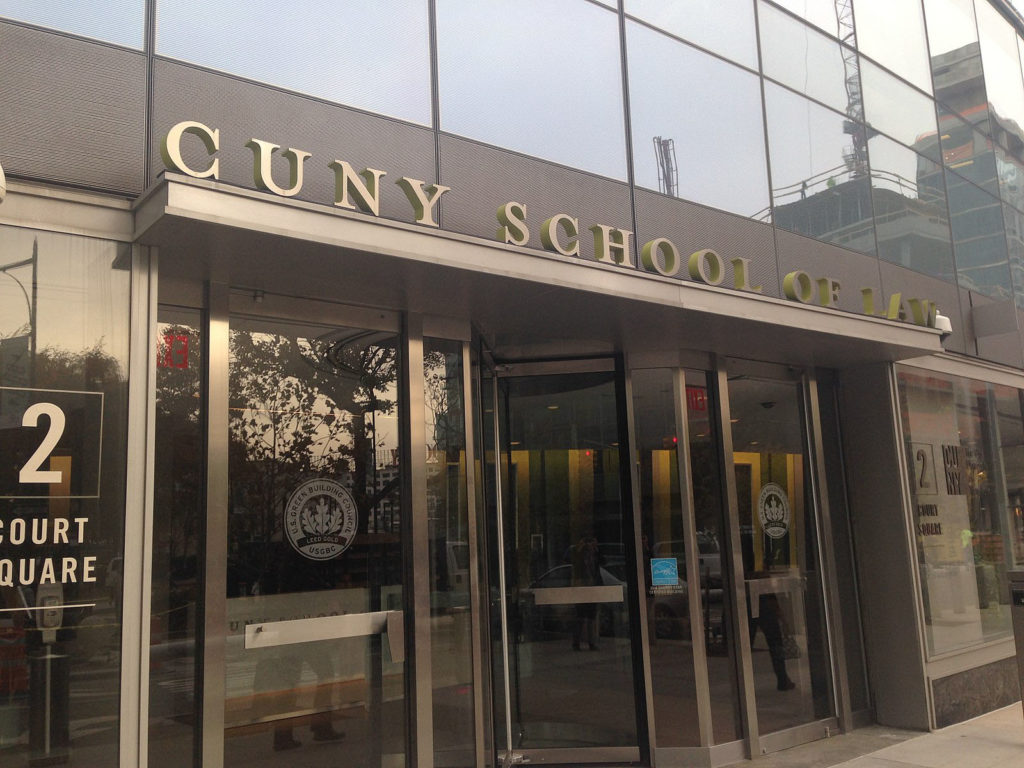
The City University of New York (CUNY) issued a statement on May 30 denouncing an anti-Israel speaker’s CUNY School of Law commencement speech on May 12 as being “hate speech.”

The speech, delivered by Students for Justice in Palestine (SJP) activist Fatima Mohammed, featured her applauding CUNY Law’s faculty and students for endorsing the Boycott, Divestment and Sanctions (BDS) movement “as Israel continues to indiscriminately rain bullets and bombs on worshippers, murdering the old, the young, attacking even funerals and graveyards, as it encourages lynch mobs to target Palestinian homes and businesses, as it imprisons its children, as it continues its project of settler colonialism, expelling Palestinians from their homes, carrying [out] the ongoing Nakba, that our silence is no longer acceptable.” Mohammed also criticized “CUNY central” for their partnership with “with the fascism [New York Police Department], the military, that continues to train [Israeli Defense Force] soldiers to carry out that same violence globally.” Mohammed also alleged “that daily, brown and black men are being murdered by the state at Rikers” and “that there are Palestinian political prisoners like HLF in U.S. prisons.” HLF is an apparent reference to the Holyland Five, the five leaders of the now-defunct Holy Land Foundation for Relief and Development who were convicted in 2009 of providing material support to Hamas.

“May we rejoice in the corners of our New York City bedroom apartments and dining tables, may it be fuel for the fight against capitalism, racism, imperialism, and Zionism around the world,” Mohammed said.

Mohammed’s speech was closed to the press, and CUNY Law eventually released the entirety of the speech to the public on May 25 after pressure from both pro-Israel and pro-Palestinian groups, according to The Times of Israel. The speech resulted in backlash from several public figures, including New York City Mayor Eric Adams (D), who tweeted the speech consisted of “words of negativity and divisiveness.” Representative Ritchie Torres (D-NY) tweeted Mohammed’s speech was “anti-Israel derangement syndrome at work.” Former New York Republican congressman and gubernatorial candidate Lee Zeldin called for CUNY’s taxpayer funding to be revoked “until the administration is overhauled and all Jewish students and faculty are welcome again.”

CUNY Chancellor Felix V. Matos Rodriguez and the Board of Trustees said in their statement, “Free speech is precious, but often messy, and is vital to the foundation of higher education. Hate speech, however, should not be confused with free speech and has no place on our campuses or in our city, our state or our nation. The remarks by a student-selected speaker at the CUNY Law School graduation, unfortunately, fall into the category of hate speech as they were a public expression of hate toward people and communities based on their religion, race or political affiliation. The Board of Trustees of the City University of New York condemns such hate speech.” They added that Mohammed’s speech was “particularly unacceptable at a ceremony celebrating the achievements of a wide diversity of graduates, and hurtful to the entire CUNY community, which was founded on the principle of equal access and opportunity.”

Reactions to CUNY’s statement on Mohammed were mixed. Representative Josh Gottheimer (D-NJ) lauded CUNY’s statement for “calling out the speaker’s remarks as hate speech.” “However, I am appalled that, earlier this month, the CUNY Law School faculty council approved an anti-Israel resolution supporting the Boycott, Divestment and Sanctions (BDS) movement. BDS is as an antisemitic effort to punish the Jewish state,” Gottheimer said in a May 31 statement. “We need to address the use of antisemitic tropes, including those masquerading as anti-Israel sentiment. I remain committed to taking all measures necessary to protect students against hate, discrimination, and bigotry — especially Jewish students who face a barrage of antisemitism on their university campuses.”

Some Jewish groups also praised the statement. “We thank @CUNY for condemning the hateful remarks at the recent CUNY Law School graduation and for making the critical distinction between free speech and hate speech — and we urge CUNY to establish guidelines ensuring future speakers don’t espouse hate,” United Jewish Appeal (UJA)-Federation of New York tweeted.

“The Chancellor and Trustees of @CUNY are correct,” Democratic Majority for Israel tweeted. “While free speech must be protected, this address was hate speech and should be condemned, as they do. Thank you for this forthright statement.”

The Jewish Community Relations Council (JCRC) of New York tweeted that while CUNY was correct to refer to Mohammed’s speech as “hate speech,” the group is “disappointed [CUNY] didn’t call it out for what it was: Antisemitism. Once again, we urge @CUNY to revise its commencement speech guidelines before next year’s graduation.”

Others questioned the timing of the statement and if there would be any accountability.

“Rather than offering the unconvincing hate/free speech distinction, this statement simply should have condemned the sentiments as unacceptable for a CUNY graduation ceremony,” Brooklyn College, which is under the CUNY umbrella, and CUNY Graduate Center Professor KC Johnson tweeted. “The timing of the statement also suggests that the public *release* of the CUNY Law video rather than the contents of the student’s speech was the key motivating factor here.”

“It’s been almost three weeks since a hate speech was given at the @CUNYLaw graduation ceremony,” Kiryas Joel School District Superintendent Joel M. Petlin tweeted. “This @CUNY statement is not a response to the reprehensible speech. It’s a reaction to the publicity that was generated by @nycmayor, @RitchieTorres, @tedcruz & a @nypost front page.”

New York City Council Member Ari Kagan tweeted, “So, @CUNY finally admitted that it was a state sponsored hate speech. What about accountability? Did CUNY staff review these prepared remarks? Why not? What are the consequences for a hateful speaker & for CUNY staff that allowed hate speech at graduation? We still need answers!”

Yad Yamin’s New York affiliate tweeted to CUNY, “There are reports that you had a copy of the speech prior to its reading. Why did you remove the video of the speech? What about all the college administrators on the stage that clapped & cheered at the end of the speech?! Will they be sent [for] ‘diversity training’?” CUNY Professor Jeffrey Lax said on Newsmax earlier in the day that he had heard from a source that CUNY Law did receive a draft of Mohammed’s speech beforehand and that the school is claiming it was later changed. The CUNY Law Student Government, which is defending Mohammed, tweeted that the “speech that was submitted and approved at all levels of CUNY administration.”

As for the deans and administrators clapping, The New York Post reported that CUNY Law Dean Sudha Setty was among those clapping to Mohammed’s speech, and that she “was behind the establishment of the ‘Antiracism and Cultural Competency’ graduating requirement for the university’s students.”

CUNY and CUNY Law did not respond to the Journal’s request for comment asking for a response to Yad Yamin’s tweet.

The CUNY Law Student Government defended Mohammed by tweeting: “What a cowardly and shocking statement given that just last summer in a recorded city council hearing [CUNY]’s legal team said if a student spoke in support of the KU KLUX KLAN they would allow it because of the first amendment. THE KU KLUX KLAN!!” They added that CUNY’s statement was a “bad attempt to backtrack on a [CUNY] admin approved speech, from a student elected speaker (hence the resounding applause while she said it) directly speaking to the accomplishments of the class of 2023 in passing a BDS resolution, that CUNY faculty joined in passing.” “Shame on [CUNY] central to surrender to right wing extremists while the brave young woman who said that speech, a speech that says nothing the United Nations hasn’t said already, faces death threats,” they wrote.

A couple of Jewish groups defended Mohammed in response to the CUNY statement.

“Further evidence that CUNY administration will gladly imperil students and alumni in order to pander to the most cynical reactionaries (ie. @NYCMayor),” CUNY Law’s Jewish Law Student Association tweeted. “We proudly support Fatima!”

Jews for Racial & Economic Justice similarly tweeted, “A university should be supporting their student who’s being targeted in right wing media, the mayor, and multiple members of congress. CUNY should be standing up for Fatima, despite disagreement or discomfort. Instead they’re throwing her to the wolves. Utterly shameful.”

The Foundation for Individual Rights and Expression (FIRE) issued a letter to CUNY expressing concern over the university’s statement saying that hate speech “should not be construed with free speech,” arguing that CUNY still has a “constitutional obligation to not punish students for what it considers to be hateful expression.”

CUNY Denounces Anti-Israel Commencement Speech As “Hate Speech” Read More »

Do Jews Get to Define Antisemitism? Yes and No

Prominent voices in the Jewish community confidently pronounce: “Only Jews get to define antisemitism.” Popular Jewish writer Sarah Tuttle-Singer, for example, tweeted (before later removing), “Here is a complete and comprehensive list of the people who get to decide what is or isn’t anti-Semitic: 1. Jews.” 

In an article in the San Diego Union-Tribune titled “Jews get to Define Antisemitism,” Micha Danzig asserted that “what is surprising is how many people give credence to such arguments to those telling Jews they don’t get to define Jew-hatred … It would not be tolerated for anti-Asian hate, anti-Muslim hate or anti-Black hate. And it shouldn’t be tolerated for antisemitism.”

It’s legitimate for Jews to insist on a major role in defining antisemitism as a matter of government policy, and illegitimate for us to demand that everyone agree with us. 

So do Jews really get to define antisemitism? Yes and no. In the immortal words of Bill Clinton, “It depends on what the meaning of the word ‘is’ is.” Or in this case, it depends on what the meaning of the word “define” is. It’s legitimate for Jews to insist on a major role in defining antisemitism as a matter of government policy, and illegitimate for us to demand that everyone agree with us. 

In one sense of the term “define,” Jews ought to have a major say in how government agencies define antisemitism. Originally adopted in a plenary in Bucharest, Romania in May 2016, the IHRA definition of antisemitism has become the dominant conception in much of the world and certainly the most widely held by Jewish institutions. IHRA holds that “antisemitism is a certain perception of Jews, which may be expressed as hatred toward Jews. Rhetorical and physical manifestations of antisemitism are directed toward Jewish or non-Jewish individuals and/or their property, toward Jewish community institutions and religious facilities.” 

In its contemporary examples of antisemitism, the IHRA definition upholds Natan Sharansky’s three Ds: Demonization of, Delegitimization of and Double standards toward Israel, which can, taking into account the overall context, be deemed forms of antisemitism. Some progressive Jewish groups object to these examples and have offered up different definitions. They fear that hawkish Jews will use the globally accepted definition to shut down critiques of Israeli policy.

Indeed, some activists have applied the IHRA definition haphazardly, typically labeling any critique of Israeli policy as antisemitic because, the accuser determines, it represents a “double standard,” which IHRA suggests can, in extreme cases, be antisemitic. The authors of IHRA clearly have a high bar in mind for establishing a double standard. The definition explicitly states that criticism of Israeli policy is not antisemitic. Thus lambasting every critique of Israel as an antisemitic double standard is a distortion, not an application, of IHRA.

Certainly, the IHRA definition was developed not to regulate public discourse, but to track and monitor antisemitic acts. Indeed, it was devised in part because European governments often failed to treat horrendous and vicious acts of anti-Zionism, often directed at Jewish communities in their countries, as a form of antisemitism, and thus failed to protect their Jewish communities against violence.

Furthermore, governments need a definition for the purpose of determining the motives of hate crimes and systematic harassment of Jews on campus in line with Title VI of the Civil Rights Act. Without a definition, the courts, for example, would not be able to determine if the antisemite who yelled “Zionists are pigs” when vandalizing a Jewish Community Center committed a hate crime punishable by enhanced penalties. Absent a clear understanding of what constitutes antisemitism, the courts would treat the hate crime against the JCC no more severely than spray painting “Johnny Loves Suzy” on the underside of a bridge. 

One would think that the dominant if not unanimous view of the Jewish community would be factored in by governments seeking such a definition. And it’s perfectly legitimate for Jewish organizations to push their favored definition as long as it’s not used as a cudgel to silence dissent, a point I’ll return to shortly.

When some Jews make the claim that only Jews get to define antisemitism, however, they mean something entirely different than the adoption of an official government definition. They mean that no one else except Jews has standing to publicly air a perspective of what constitutes antisemitism. According to this line of thinking, non-Jews who have never experienced antisemitism should sit down and shut up, and allow Jews to school society on antisemitism. Such outlandish claims simply mimic the fashionable progressive discourse that insists that only oppressed groups with “lived experience” should be able to define the discourse on race in society. 

As tempting as it may be to establish the same “right” for Jews, we should resist doing so. Insisting on such a prerogative to dictate how others think and talk is not only spurious and highly illiberal; it’s also dangerous for Jews because it reinforces a line of thinking that’s often weaponized against us. Once you stipulate that minority groups get to define the bigotry against them, what’s to stop radical voices from making absurd and incoherent demands at odds with Jewish interests and values? 

For example, if only racialized minority groups (typically DEI professionals and political activists who often don’t represent a consensus in their own communities) get to define racism for society, and these voices claim that “Racism equals prejudice plus power,” a common refrain in progressive circles, then all those who accept the lived-experience-trumps-all philosophy must now defer to this definition of racism. 

The prejudice plus power definition of racism would mean that Jews, a group deemed powerful, cannot be victims of racism, and groups deemed powerless cannot be guilty of racism. In this conception, Jews are a powerful group with no legitimate gripes. Acceding to such a definition of racism effectively marginalizes Jewish claims of antisemitism.  

Moreover, why should anyone be expected to outsource their thinking to anyone else? We live in a free society where people are allowed to hold and articulate their own views and no one gets to define anything for others. We should not want to be bound by a discourse in which we must defer to others and others must defer to us.

While such thinking comes from the left, it’s frequently Jews on the political right who draw from the progressive playbook and weaponize IHRA to silence alternative views. Indeed, Jews who accuse IHRA’s opponents of antisemitism are engaging in a form of cancel culture, based precisely on the same suppositions that radical leftist voices use to silence opposition to their dogmas. Ironically, there’s nothing in IHRA itself that would justify calling anyone who disagrees with the definition an antisemite. Proponents of an alternative definition of antisemitism have every right to advocate for their position and should not be demonized for doing so.

There’s nothing remotely unfair or illiberal when the IHRA definition wins out, as it did in the recently released White House national antisemitism strategy.  

By the same token — and a point often lost upon IHRA’s critics — Jews who do support the IHRA definition have every right to push vigorously for government adoption of their preferred definition of antisemitism and urge governments to ignore competing definitions. Government policy is not like public discourse with multiple voices. Very often contests to set government policy are winner-take-all: Only one definition of antisemitism will be adopted, and the others will be set aside. There’s nothing remotely unfair or illiberal when the IHRA definition wins out, as it did in the recently released White House national antisemitism strategy.  

Nor does the IHRA definition, used properly, suppress free speech. Kenneth Marcus, who served as Assistant Secretary for Civil Rights at the U.S. Department of Education and has done as much as anyone to advance IHRA on the American front, states in no uncertain terms that IHRA “does not generally ban, regulate, restrict or punish, all activities that may be described as anti-Semitic within the Definition’s meaning.” Marcus continues, “The E.O. (Executing Order issued by the Trump Administration invoking the use of IHRA in Title VI cases) protects free speech by directing its usage only as a means of discerning intent.” 

In other words, the proper use of IHRA is not to prosecute those who engage in antisemitic speech or force everyone to sing from the same song sheet about antisemitism, as much as we might wish we all would, but to aid governments in determining antisemitic intent.

So, yes, Jews should have a major role in “defining” antisemitism as government policy, and no, we don’t get to insist that everyone accept our views.


David Bernstein is founder of the Jewish Institute for Liberal Values (JILV) and author of “Woke Antisemitism.”

Do Jews Get to Define Antisemitism? Yes and No Read More »

Herzl, Past and Future

A society uncertain of its present and its future will certainly look backward at times. The past is often glorified, romanticized and sometimes weaponized on ideological lines to attack those who desire a different future, and the future will be endlessly pontificated over and proselytized to fit an infinite number of narratives. Obviously, I am talking about Israel here, a country in which it feels like each and every citizen has a different view of how the state came into being, what is the state of the country today, and what lies in store in the coming years. A central figure in these discussions, whom I have written about many times, is Theodor Herzl,  called “the spiritual father of the state” by Israelis. It is my full intention to keep writing about Herzl, simply because, as I have discovered, Israelis can’t seem to stop talking about him. Every day there is a new opinion column, a new sign at a protest march, a new drink named in his honor at the juice stand on Bograshov Street, or a new piece of art for the public to enjoy. 

One such piece of art is “Theodor,” a Hebrew opera currently playing at the Israeli Opera House that I had the privilege of attending this past week. In “Theodor,” the audience is invited to view critical years in Herzl’s life, beginning with his induction into a German nationalist fraternity when he came of age, only to be excommunicated when he expressed disapproval at his brothers’ eulogy for the deeply antisemitic composer Richard Wagner. We see Herzl grapple with the implications of the Dreyfus trial several decades later in Paris, we see his short-lived idea of mass converting all the Jews to Christianity, and finally we see the deeply personal anguish that led to Herzl writing his seminal pamphlet that officially launched political Zionism, Der Judenstaat.” 

The reason I was so thoroughly intrigued by this production was because it deeply humanized a figure who is almost myth-like in the Israeli and wider Jewish imagination. There is a scene in the first act where a disgruntled and estranged Herzl wanders through a seedy neighborhood in Paris and is tempted to pay a pimp for his daughter’s services. It’s dark stuff. But the founder of the state was reported to be miserable with women and lonelier than what could be considered bearable, so in my opinion the scene is as necessary as it is scandalous. 

But that wasn’t all. At the end of “Theodor,” when Herzl gets the final burst of inspiration to pen his dream for a renewed Jewish civilization in Eretz Yisrael, he sings in melodic Hebrew:  “Every man will be as free and undisturbed in his faith or his disbelief as he is in his nationality. And if it should occur that men of other creeds and different nationalities come to live amongst us, we should accord them honorable protection and equality before the law.” 

The crowd around me burst into thunderous applause at this line. I smiled, reminded of when I used to sit in Broadway shows in New York, and the same reaction commenced when an actor sang a line like “Immigrants, We Get the Job Done.” As I have mentioned, the likeness of Herzl remains political, and reliably fashioned to become the poster child of varying ideologies within Israel. The left cherry-picks lines from “Der Judenstaat” and “Altneuland” to bolster and validate their own beliefs while the right does the same. 

Another artistic endeavor is a new book called “Herzl’s Vision Today,” a compilation of essays on how Herzl would perceive life in Israel based on his 19th-century vision, featuring words from such esteemed figures as Yossi Klein Halevi and Yosef Abramowitz (whom I interviewed on Herzl’s legacy several months ago). Halevi and Abramowitz both clearly see Herzl’s vision unfulfilled by Israel’s continual struggles with liberalism, pluralism and democracy. “A first step would be amending the Nation-State Law to affirm Israel’s dual identity, as a Jewish and democratic state,” Halevi recommends. “For their part, Arab citizens need to reconsider the wisdom of electing representatives who allow right-wing demagogues to delegitimize the Arab community.” In his following essay, Abramowitz writes of one visit to Herzl’s grave in Jerusalem with his daughter Ashira, while a debate raged in the Knesset just a short walk north of them. The argument was over allocation of electric resources for Israel’s Arab sector, and overseeing the proceedings was Mansour Abbas, then the leader of the first Arab party to be in a governing coalition, sitting below a portrait of Herzl himself. 

“Ashira and I approach the grave and place the phone with the live Knesset debate onto the grave,” Abramowitz pens. “Mansour Abbas, from the Speaker’s chair, not only declares victory by a vote of 61-0, but calls up MK Iman Khatib-Yasin for closing words, which she delivers in Arabic, wearing a hijab. Herzl appreciates the sweet drama, the attempt to right a social wrong against Arab citizens. With the historic vote done, we turn off our phones.” 

Feeling inspired and politically validated (a dangerous combination if there ever was one), I was excited to sit down with Carol Manheim, the publisher of “Herzl’s Vision Today,” to get some further insight on the themes in her book. But curiously, Manheim directed me away from most political questions, and instead focused my attention on the art that is sprinkled around the essays. And perhaps she was right that I was focusing too much on written messaging and not enough on the work of the artists she had made an effort to include. Upon closer inspection, one piece, “Theodor Herzl in Yoga Tree Position” by Itamar Tal, made me feel like the founder of the state could be one of my neighbors in the hipster Tel Aviv neighborhood of Florentin. Another picture, “Herzl and Anne” by Drora Weitzman, shows a pair of retro glasses, with a portrait of Herzl in one lens and Anne Frank in another. It made me question whether Herzl truly represented ideological squabbles in the Jewish community, or rather the stories we all treasure of destruction and rebirth. Yet another image, designed by the famous Israeli illustrator Kariel Gardosh, shows a portrait of Herzl, with two men on either side of him: a man dressed in modern clothes holding scissors to Herzl’s beard, and another in Hasidic dress placing a yarmulke on Herzl’s head, which instantly made me feel pensive regarding the current tension in Israel between the secular and the observant.

The pictures stirred my interest in the persuasions and passions behind each of their artists, which made me more interested in Herzl himself. 

“Art can tell us a lot,” Manheim says to me. “Art can tell us more about what people are thinking at this moment than words can. Art can make people interested in subjects that they didn’t know they were interested in.” I then asked her: “Why was it so important for you to include art in a book about Herzl? The essays about technology, Israel’s wine industry, Israeli cinema, and the rights of the Arab minority can surely hold their weight alone, no?” She responded, as she prepared a plate of whipped hummus and crackers, “The art was not necessarily meant to complicate the essays. I included it because I love art and people are surrounded by art every day, all day. It makes us more interested in things.” Manheim was right. The pictures stirred my interest in the persuasions and passions behind each of their artists, which made me more interested in Herzl himself. 

There are certain to be more Herzl-centered endeavors by Israelis in the coming weeks and months. The Bauhaus Center in Dizengoff Square is already showcasing an exhibit on Manheim’s book with various Herzl-themed trinkets in the window (including an enormous pastel pink bust of him that I very much want.) Plays, operas, visual art, essays and books, protests and demonstrations, and even the series that I’ve been writing on Herzl, reveal a deep and unshakeable fascination with the founder of the state among Jews and Israelis. I was at first tempted to think much of this was inherently for the purposes of scratching a political itch, and perhaps in many cases this is true, but this week I also learned that Herzl’s story doesn’t need a contemporary hook to draw otherwise nonchalant stragglers in. He can pack an opera house and fill a library regardless. Israelis find themselves in an era of uncertainty, and in such times, there is comfort in that famed, tormented soul who foresaw our hardship but decided it was worth it.


Blake Flayton is the New Media Director and Columnist for the Jewish Journal.

Herzl, Past and Future Read More »