fbpx

May 31, 2023

Biden’s Plan to Protect Jews

In politics, the timing of when you choose to say something can be just as important as what you say. That’s why politicians often release unhelpful information on a Friday afternoon, when voters are less likely to be paying close attention to the news before heading into a weekend. The only better way to bury a story is to go public just before a national or religious holiday, when the audience’s time away from current events coverage will be even longer.

President Biden deserves significant credit for developing a national strategy for combatting antisemitism. But the plan was made public on Erev Shavuot, greatly diminishing the likelihood that most of the Jewish community would hear the news. The announcement was also made as the nation was preparing for Memorial Day weekend and when the national press corps was preoccupied by the deadline for raising the government’s debt limit. Unless the president’s advisors had waited until the day before Rosh Hashanah or the morning of Super Bowl Sunday, it would have been difficult for them to do anything more to avoid attention any further.

The release went as they hoped, causing barely a ripple in the news pond. Jewish media rushed out their stories before shutting down for the holiday. Most mainstream news organizations also did abbreviated coverage and were unable to provide follow-up analysis or context until the following week. (As of the time this article was submitted, the Los Angeles Times had not covered the story at all.)

Why would the White House not want to highlight such an important proposal?  It laid out an impressive set of security-related goals, including additional funding and law enforcement support for synagogues, parochial schools and other religious nonprofit organizations, and better coordination for reporting and preventing hate crimes between agencies at different levels of government. It also included an array of more amorphous but commendable education and awareness initiatives designed to take on the daunting task of changing public attitudes.

All in all, it’s a respectable collection of ideas, the type of thing that a president should feel comfortable bragging about. But Biden and his advisors knew that the growing divide within the Democratic Party over issues relating to Israel and the Middle East could overshadow the announcement, specifically the ongoing debate over the definition of antisemitism. At a time when the White House could ill afford a public fight with either Jewish leaders who aggressively defend Israel from criticism or progressive detractors of the Jewish state, they scheduled the release for a time when they knew it would not attract a great deal of public attention.

In the weeks leading up to the plan’s announcement, Jewish advocacy groups and other Democratic-aligned organizations spared no effort to influence the White House on which definition of antisemitism should be employed. The standard outlined by the International Holocaust Remembrance Alliance (IHRA) has already been adopted by the U.S. State Department, as well as forty other countries around the world. But opposing voices fought to convince Biden’s advisors that an alternative definition should be used instead, one that asserts a much weaker link between anti-Zionism and antisemitism.

The White House ultimately tried to have it both ways, elevating the IHRA definition while recognizing that other standards also exist. 

The White House ultimately tried to have it both ways, elevating the IHRA definition while recognizing that other standards also exist. Given that a strategy to protect Jews that does not enjoy unified Jewish support is unlikely to succeed, this something-for-everyone approach is probably the best that Biden could do. But it did not spare the president from criticism from both sides of the debate, ensuring that the positive aspects of the proposal would be eclipsed by our internal argument.

Biden’s plan is not perfect, but it contains some valuable ideas that will aid in the fight against antisemitism. However, his strategy also reminds us of the limits of what sort of cultural and attitudinal changes can be accomplished through government action – there’s no way to legislate against hate. And most importantly, it should force us to realize that resolving these divisions within our own community is not the president’s responsibility — but our own.


Dan Schnur is a Professor at the University of California – Berkeley, USC and Pepperdine. Join Dan for his weekly webinar “Politics in the Time of Coronavirus” (www.lawac.org) on Tuesdays at 5 PM.

Biden’s Plan to Protect Jews Read More »

The Fine (and Easy) Art of Squeegee Painting

An art technique that is very popular on social media right now is squeegee painting. The videos I see on Instagram are absolutely mesmerizing. Random dots of paint are squeezed onto a white piece of paper, and then a squeegee spreads the paint into psychedelic patterns. After watching the videos, I decided to try it myself, and lo and behold, it really does work. It’s also a little addictive, so expect to spend hours with your paint and squeegee.

Your resulting artwork will be good enough to frame as is, or cut it up into smaller sections to make greeting cards, bookmarks or collages.

What you’ll need:

White paper
Acrylic paint in squeeze bottles
Squeegee (I bought one on Amazon)

1. Cover your work area with newspapers. This project can get messy. Place a blank piece of paper on top of the newspapers.

2. Squeeze small dots of various colors all over the paper.

3. Position the squeegee at the top of the paper and move it down while pressing it against the paper. Hold the top of the paper with a finger to keep it steady.

4. Your work of art is done instantly. Now let’s make more! 

The Fine (and Easy) Art of Squeegee Painting Read More »

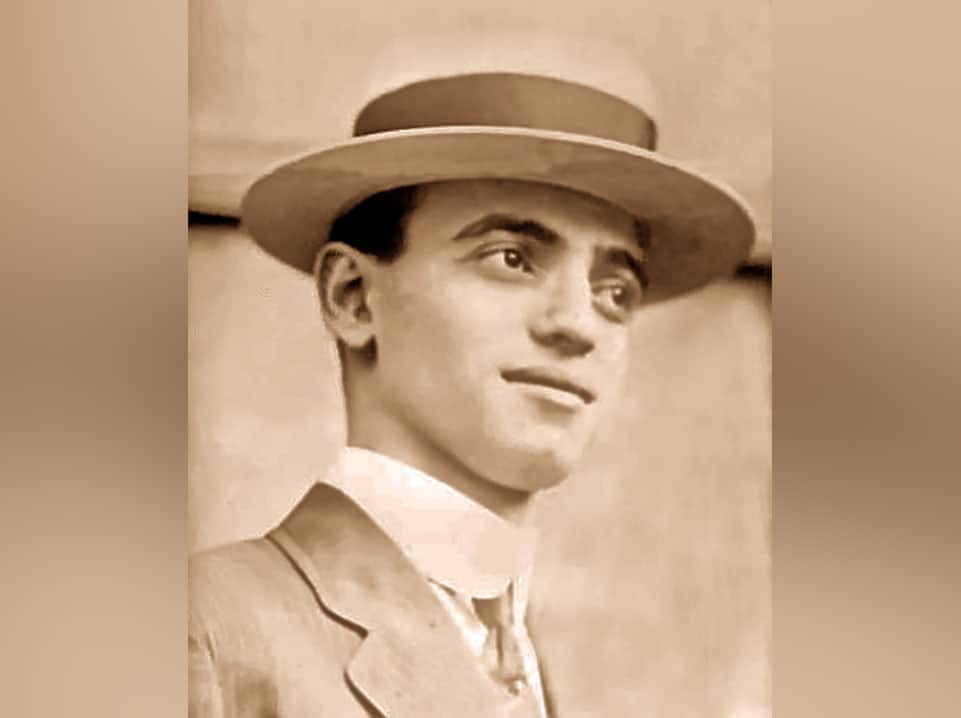
Leo Frank and the Parade of Horribles

In the languid Deep South in the year 1913, an energetically nervous, former Brooklyn Jew, Leo Frank, skipped out on the Confederate Memorial Day Parade and went to work at the pencil factory he managed, instead. Among Atlantans, a mere 50 years after the War of Northern Aggression, even relocated Yankees were expected to mark the solemn day with respect.

Leo Frank, however, was no son of the Antebellum South. He scoffed at the tarnished Confederate cause and didn’t see the point of a parade memorializing a lost war. In Georgia, he was very much a gefilte fish out of water.

Frank’s absence from the parade would prove fatal. He was falsely accused of murdering and sexually assaulting one of his female employees, a 13-year-old child. (Evidence suggested that the crime was actually committed by a Black janitor.)

Convicted by a jury comprised entirely of southern whites who were very much not his peers, Frank pursued his appeals in both state and federal courts to no avail. Even the Supreme Court turned him down. (Incongruously, the case is still under review.)

The agrarian South was receiving its comeuppance against the industrial North—but with an improbable strawman: a slight New York Jew who studied engineering at Cornell and came to represent yet another indignity and upheaval to the southern way of life.

There was but one unexpected act of divine providence in Frank’s favor. All of America was watching, observing from a distance Jim Crow-justice being applied to a Jew. Petitions were signed, and calls for a new trial came from all corners of the country—even from the notorious antisemite, Henry Ford, himself.

Faced with national scrutiny and familiar northern meddling, Georgia’s governor commuted Frank’s death sentence. The locals were none too pleased, however. Informal, extrajudicial lynch laws were long in existence, for this very purpose: enabling angry mobs to sidestep the rule of law and take justice into their own hands. A “Vigilance Committee” of prominent Georgians (rednecks can be found in all professions) seized Frank from his jail cell and hanged him from a tree.

Improbable as it may sound, this tragic tale has been adapted into a thoughtfully entertaining and fortuitously timely Broadway musical, “Parade,” starring Ben Platt as Leo Frank, currently playing to sold-out audiences and well-deserved critical acclaim.

Given these harrowing true events, with its lingering Civil War legacy, bitter southern resentments, and shocking antisemitic implications, it is a wonder the story is not better known. (Hollywood took a stab in 1937 with “They Won’t Forget.” Jack Lemmon headlined a two-part TV miniseries in 1988.)

“Parade” uncovers many layers of the grim tale—the shady politics and legal failure—in two acts with pathos and wit, succeeding as an American tragedy set to music. Indeed, the production fills the stage like a Southern opera—the other side of the street from George Gershwin’s “Porgy and Bess”—a Grand Guignol spectacle with the unflinching ambition to borrow from even the austere shadows of minstrel and vaudeville.

Projected onto the stage’s backdrop are actual photographs and frontpage newspaper headlines that serve as a relentless carousel of poisonous, crowd-whipping propaganda. With “Driving Miss Daisy’s” Alfred Uhry responsible for the book, and with music and lyrics supplied by Jason Robert Brown, “Parade” was first mounted nearly 25 years ago, but to far less fanfare (although both Uhry and Brown received Tony Awards).

That was a different moment in America—pre-9/11, pre-War on Terror, pre-Great Recession, pre-COVID. Today, in the aftermath of the George Floyd killing and with hate crimes against Jews dispelling the woke myth of an all-encompassing white privilege, the consequences of violent prejudice and appalling injustice is not confined to any one region, or lost on anyone paying attention.

To prove the point, on “Parade’s” opening night of previews, neo-Nazis protested outside the theater. So much for New York being a Jewish town and Broadway theater a singular Jewish avocation. A century and a decade later, Leo Frank was being denied exoneration, all over again.

At the time of Frank’s trial, the Dreyfus Affair in France—the zayde of all blood-libelous show trials—was freshly on the mind of world Jewry. You know you’re the world’s punching bag when both Paris and Atlanta, during roughly the same time period, yet separated by an ocean of regional and cultural differences—and a large body of water, too—played host to trumped-up charges and rigged outcomes against two very different Jews.

The streets of each city pulsated with antisemitic fervor, the public spectacle of local citizens mocking the fate of two sacrificial Jews conjoined by one immutable, tribal trait.

Jew-hatred is such Manna from the Universe—easily adaptable, arising everywhere, transcending all differences, even the clashing dialects of France’s snooty language and America’s southern drawl.

What happened to Leo Frank was an alarming, although perhaps unsurprising, wake-up call: the Land of Dixie, et tu, might be too treacherous for Jews. Before the lynching, it was difficult to know.

For decades southern Jewry practiced their faith like obedient Episcopalians. Soon after the Leo Frank verdict, half of Georgia’s 3,000 Jews left the state altogether. The Great Migration of southern Blacks to the urban North, apparently, was replicated by a much smaller Jewish exodus.

Leo Frank’s lynching can be credited with inspiring two distinct Jewish movements: the instantaneous creation of the Anti-Defamation League; a half century later, an army of Jewish northerners, linked by the symbolic evil of a noose, joined Martin Luther King’s crusade to bring civil rights to the South.

“Parade,” set in King’s hometown, a city that was considered progressive for its day, gives audiences a glimpse into the creepy antisemitic canards that were inveighed against Frank—southern style. A prim modest man of moral rectitude, he was accused of lascivious behavior and sexual perversion. They prejudged him on account of his habitual handwringing. Blamed him for having bulging eyes. Jewish money from a cabal of scheming financiers was said to be behind his defense.

These provincial Georgians didn’t succumb to the superstitions of Jews with horns and stripes. They didn’t have to. Frank was already perceived as the perfectly demonized southern stand-in for Shakespeare’s Shylock and Dickens’ Fagin.

And they showed him the ultimate in southern hospitality by treating him like yet another variety of “Strange Fruit” hanging from a blood-soaked tree.


Thane Rosenbaum is a novelist, essayist, law professor and Distinguished University Professor at Touro University, where he directs the Forum on Life, Culture & Society. He is the legal analyst for CBS News Radio. His most recent book is titled “Saving Free Speech … From Itself.”

Leo Frank and the Parade of Horribles Read More »

SB_logo2

“No Abs, No Cindy.” ft. Cindy Seni

After a brief hiatus, the schmuckgirls are back with an episode you won’t want to miss! Libby shares about her experience at a content creator event and upcoming celebrations for the big 25. Marla gives some big updates in the dating department and the two discuss dating a nice guy vs. the right guy. She also talks about her recent trip to Spain with Olami, meeting Jews from all over the world. The girls then bring in the first guest in their series of bringing on the cast of Jewish Matchmaking, the amazing Cindy Seni!Starting off, Cindy discusses how rockets flying into Israel affect dating and how it forces people to get creative when you can’t always go out but also don’t want a date at home. They also discuss Aleeza’s term “mystery in your history” about whether there might still be a connection in Cindy’s past. Cindy then shares about her experience moving to Israel and the girls talk about how Americans and Israelis feel about living in each other’s countries. Cindy then talks about how she first got acquainted with Jewish Matchmaking, whether she had been into reality tv prior to the show and her previous experiences with matchmaking. She also discusses working with Aleeza and what she’s taken away from her experience on the show. The girls also talk about the importance of the show as a way to portray Jews in a positive light as well as their connection to Israel. They end with a game of “Aleeza Approved or Bye!” You can find Schmuckboys on Instagram @schmuckboysofficial and Cindy @israelwithcindy. Send all your dating questions, stories, advice to schmuckboysofficial@gmail.com


“No Abs, No Cindy.” ft. Cindy Seni Read More »

Marvelous May: Memorable Journeys and Momentous Moments

Marvelous May News 2023 with Lisa Niver & We Said Go Travel:

Thank you to Travel Classics Ireland and Tourism Ireland!

A giant thank you to Maren Rudolph for creating and running this amazing conference and to Ruth Moran and Fallon Griffin and the entire Ireland team for an amazing event and tour. Go raibh maith agat Paula Carroll, Niall Rochford, Regina O’Donoghue and the entire team at Ashford Castle, I absolutely loved being back again! Want to see more about my adventures? Enjoy my 73 VIDEOS– Below is one of my favorites with Ireland School of Falconry and Inca & Tommy! My first visit to Ireland was also a memorable journey–I have big news about where you can read more about it coming soon!!!
After the conference, I went with my travel writing friends to Northern Ireland. One of the highlights was THE LOST VALLEY
I just found out that We Said Go Travel was listed #8 in 2022 for BEST ONLINE TRAVEL MAGAZINES and WEBSITES!! Thank you to Nomad Revelations and João Leitão. IN CASE YOU MISSED THIS NEWS: Some highlights:: I am honored to be #11 on the Best Travel and Lifestyle Blogs List! Thank you Afluencer for naming me the #3 Top Travel Influencer for 2023! Thank you Feedspot for naming me #21 on your 30 Best Jewish Book Blogs and Websites. My website is now available on Google News! I was honored to be a speaker EIGHT times at the Travel & Adventure Shows in 2023! I spoke in FOUR cities: Los Angeles, Chicago, NYC and Dallas!

Thank you to The Travel Mom, Emily Kaufman, for inviting me to #CAMPTRAVELMOM in San Diego! I loved it!

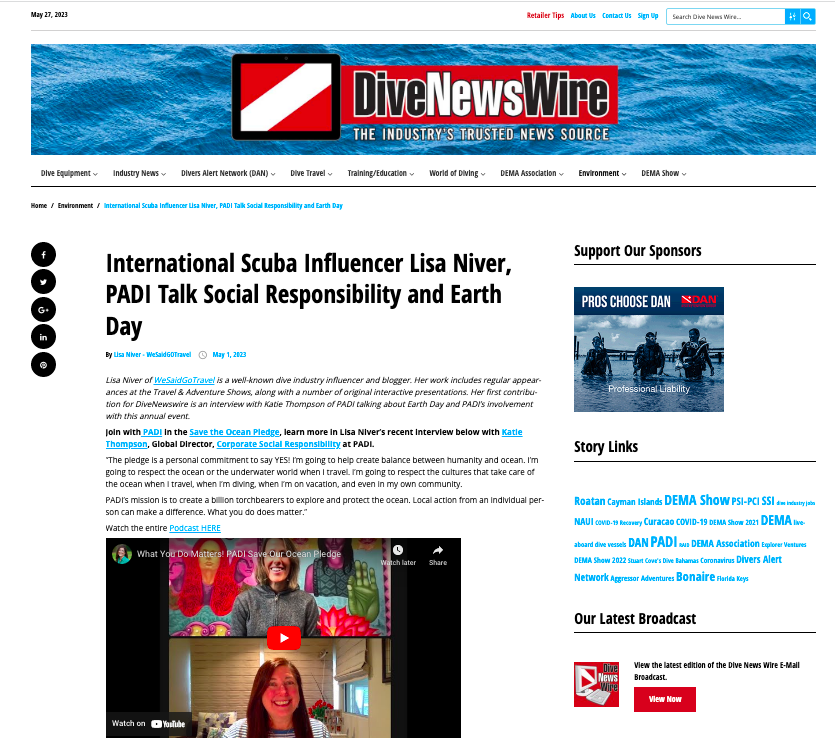
Thank you to Scott Jones from DiveNewsWire for sharing my podcast about PADI for EARTH DAY! I am honored to be part of this incredible publication that focuses on my passion of scuba diving!

Thank you Debra Eckerling for celebrating my mother and her recipe for Mother’s day in your print Jewish Journal article on FOOD and FAMILY!

THANK YOU for watching my podcast! It has now been seen and heard in 31 countries on 6 continents!

USA 🇺🇸 Canada 🇨🇦 Ireland 🇮🇪 UK 🇬🇧 Italy 🇮🇹 India 🇮🇳 Singapore 🇸🇬 Australia 🇦🇺 New Zealand 🇳🇿Switzerland 🇨🇭 Hong Kong 🇭🇰 France 🇫🇷 Latvia 🇱🇻 Philippines 🇵🇭 Netherlands 🇳🇱 Japan 🇯🇵 Fiji 🇫🇯 Portugal 🇵🇹 Kenya 🇰🇪 Mexico 🇲🇽 Guatemala 🇬🇹 Germany 🇩🇪 Uruguay 🇺🇾 Bangladesh 🇧🇩 Spain 🇪🇸 Panama 🇵🇦 Thailand 🇹🇭 Uganda 🇺🇬 UAE 🇦🇪 Greece 🇬🇷 South Africa 🇿🇦

New PODCAST episodes: Walking with Andrew McCarthy and Saving our Planet One Lionfish at a time with Alex Fogg

WATCH my podcast, “MAKE YOUR OWN MAP: Are YOU ready to be BRAVE?” on Spotify, Apple Music, Amazon Music, YouTube PodcastGoogle Podcasts, Audible, Anchor, PandoraiHeart Radio

WHERE CAN YOU FIND MY TRAVEL VIDEOS?

Here is the link to my video channel on YouTube where I have NEARLY TWO MILLION views on YouTube! (now at: 1,870,000 views) Thank you for your support! Are you one of my 3,940 subscribers? I hope you will join me and subscribe! For more We Said Go Travel articles, TV segments, videos and social media: CLICK HERE

Find me on social media with over 150,000 followers. Please follow  on TikTok: @LisaNiver, Twitter at @LisaNiver, Instagram @LisaNiver and on FacebookPinterestYouTube, and at LisaNiver.com.

My Podcast: “Make Your Own Map!”

Fortune Cookie SAID:

“Embrace the Unseen, Wanderer, for Travel Unfolds the Extraordinary.”

“Enthusiasm is infectious, stimulating and attractive to others. People will love you for it.”

I loved hula-hooping all over Ireland and at Camp Travel Mom in San Diego! So many memorable journeys! THANK YOU for all of your SUPPORT!

Marvelous May: Memorable Journeys and Momentous Moments Read More »