fbpx

April 28, 2023

A Leap into the Absurd: Israel at 75

From the moment the United Nations declared the end of the British Mandate, there was enormous fear and worry among the Jews who lived in the Yishuv, the Jewish community of Mandatory Palestine. They were overjoyed that the U.N. had authorized a Jewish State, but frightened that the neighboring Arab countries would attack and push the Jews into the sea.

Marie Syrkin, who visited the Yishuv in 1947, captured the mood in her poem David:

Suppose, this time, Goliath should not fail;
Suppose, this time, the sling should not avail
On the Judean plain where once for all
Mankind and pebble struck, suppose the tale
Should have a different end: the shepherd yield
The triumph pass to iron arm and thigh,
The wonder vanish from the blooming field,
The mailed hulk stand, and the sweet singer lie.

“Suppose the tale should have a different end.” This possibility was frightening then, and the counterfactual is still too painful to imagine now. But at the time, disaster seemed like the most probable outcome.


Right before the declaration of the State of Israel, David Ben Gurion asked Yigael Yadin, the head of the Haganah, whether his troops could withstand the impending attack. Yadin responded: “If I wanted to sum it all up and be cautious, I’d say that at this moment, our chances are about even. If I wanted to be more honest, I’d say that the other side has a significant edge.” A CIA analysis came to a similar conclusion, saying that initially, the Jewish soldiers would hold off the Arab armies, but “as the Arabs gradually coordinate their war effort, the Jews will be forced to withdraw…and having been drawn into a war of attrition, will gradually be defeated.” The situation for the nascent State of Israel in 1948 was quite bleak. Ben-Gurion himself noted in his diary that after the Declaration of Independence, he felt like a mourner at a wedding. Everyone else was celebrating, but he could only think about a possible military collapse.

Just a few years after the Shoah, the haunting possibility of a potential sequel hovered in the air. The Jewish future seemed depressing. Worried about continued antisemitism, some European Jews began to deny their identity and became crypto-Jews. Faith felt like a farce; even the man in the street was saying “God is dead.”. It was certainly questionable whether the Jewish people, which had just lost 1/3 of their population in a horrific genocide, would be able to continue for much longer. And now they would take on Goliath, and declare a State of Israel?

It was an absurd decision, by an absurd people, at an absurd time.

Zionism never made much sense. This vision of return, in which, after 2,000 years of exile, a beleaguered and scattered people overcome multiple obstacles to reestablish their homeland, was akin to a science fiction fantasy. In 1895, when Herzl wrote “The Jewish State,” the possibility of that actually occurring seemed less likely than spaceships colonizing Mars.

But what happened in 1948 was part of a tradition of impracticality that has marked Zionism from the very beginning.

Zionism was a leap into the absurd. Rabbi Joseph B. Soloveitchik, in his 1978 essay Catharsis, explains what this phrase means:

There are situations in life with which clear-cut logical processes and utilitarian approaches fail to cope, while the sudden spontaneous leap into the absurd (to use a Kierkegaardian phrase) may save man when he finds himself in utter distress. This non-rational and impractical action is heroic….

Rabbi Soloveitchik sees Jacob’s wrestling match with the angel as a prime example of this:

Jacob had emerged victorious from a most awesome encounter; he had held fast his mysterious foe, through a night of sorrow, fear and loneliness, until the new day dawned. Was Jacob’s victory something to be expected; could it have been predicted logically? Was he certain of victory? Of course not. He was alone, weak and unarmed, a novice in the art of warfare. His antagonist was a powerful professional warrior.


Why did Jacob not surrender to the foe who attacked him in the dark? Jacob acted “absurdly,” and contrary to all rational practical considerations.….He, who had displayed so much business acumen and the keenness of a pragmatic mind during his long sojourn in Laban’s household, suddenly, in the darkness of a grisly, strange night, made the leap into the “absurd.” He refused to yield to a superior force and declared war upon an invincible enemy. ….With daybreak, the helpless, lonely, non-logical Jacob found himself, unexpectedly, the victor, the hero. The impossible and absurd had triumphed over the possible, and logical: heroism, not logic, won the day.


Is this merely the story of one individual’s experience? Is it not in fact the story of Knesset Israel, an entity which is engaged in an “absurd” struggle for survival for thousands of years?


Jewish history is one unending leap into the absurd.

Generations of preachers saw Nachshon ben Aminadav as the paradigm of one who makes this sort of heroic leap. The Talmud (Sotah 37a) says that after the Exodus, the Jews stood on the shore of the Red Sea, afraid to go forward. Nachshon jumped into the water, and only then did the water split.  In sermon after sermon, Nachshon has been held up as an example of courage and commitment.

But if you think about it, the Jews of 1945 showed greater heroism. Nachshon was making a leap from faith; he had seen God’s miracles in Egypt, and could trust that another one would occur. Not so the post-war Jewish community, who had seen the horrors of the Holocaust. Yet they continued forward against all odds, in an attempt to reverse two millennia of persecution and exile. This truly was a leap into the absurd.

The concept of a leap into the absurd is based on one simple idea: change requires one to imagine the impossible, and then create it. One must take leave of the tried and true without being certain what will happen next. And that is what happened 75 years ago with the founding of the State of Israel.

After the Holocaust, many survivors chose to go to Israel. The journey wasn’t easy. At border crossings and ports of entry, police and military authorities would turn back refugees who didn’t have the proper travel papers; and even if one managed to make the journey, entry into the British Mandate was restricted. An underground called the Bricha (literally “flight”) mushroomed overnight, organized by the soldiers of the Jewish Brigade, representatives of the Jewish Agency, and the survivors themselves.  Over three years, the Bricha smuggled as many as 300,000 people into the British Mandate.


The refugees found multiple different ways to make their way to Israel. Between May and September 1947, as many as 8,000 refugees, men, women, and children, hiked through the Krimml Pass, which runs between Austria and Italy and is 12 miles long and 8,642 feet high. They did so under the cover of darkness, in conditions that would challenge even expert mountain climbers. (An Austrian organization, Alpine Peace Crossing, holds a yearly hike and seminar in tribute to these refugees.) These stories, like the Bricha itself, are astonishing. As one survivor put it, when she initially heard about the Bricha she thought it “was something sort of unbelievable….How could it be possible?”

Once the survivors got to Israel, they joined the Haganah and fought in the War of Independence; nearly 22,000 of Israel’s soldiers at the time were Holocaust survivors. This too boggles the mind; to join the battle against Goliath after surviving the Shoah is truly a leap into the absurd.

Eliezer Ayalon was one of those soldiers. His entire family perished in the Treblinka extermination camp, and he had survived five different concentration camps. He arrived in Israel at age 17. A short while later, he was part of the 16th Brigade of Jerusalem and fighting in the War of Independence.

Years later in an interview, he reflected on his life in Israel. He said:

So here I am right now, I have two married children, five grandchildren and one great-grandson. Three generations born and raised from the ashes of the Holocaust. Today I am the happiest man in the world.

Eliezer and others like him have built families, communities, and a remarkable country.

But in 1945, all this seemed impossible. Back then, it was difficult to even imagine Israel surviving; yet today, she is a country of nearly ten million people, and a cultural and economic success. It’s absurd, isn’t it?

Happy birthday Israel!


Rabbi Chaim Steinmetz is the Senior Rabbi of Congregation Kehilath Jeshurun in New York.

A Leap into the Absurd: Israel at 75 Read More »

Be Holy – The Holy Order of the Six-Pointed Star – comments on Torah Portion Kedoshim

I’d like to introduce you to the Holy Order of the United Israelite Fellowship of the Six-Pointed Star (grateful nod to Leonard Cohen, who would have liked this idea).

First, what is Holy? Let’s think of a person committed to holiness, as our Torah portion calls on us “to become holy.” A holy person acts differently from people not committed to holiness. A holy person might end up separated a bit from people who don’t think about the sacred. A holy person is committed to sacred knowledge-  and ends up knowing things that one who does not study it, does not know.

A holy person observes practices derived from this sacred knowledge and ends up knowing the world differently from a person who does not study or practice. A holy person is connected to something far beyond this mundane level. A holy person might seem at times to be connected to that unseen realm even more than they are connected to this ordinary realm.

When God said to the Israelites in our portion, Kedoshim Tihiyu, “Be holy,” the people of Israel were called into being to form a new holy order, the United Israelite Fellowship of the Six-Pointed Star.

Anyone could join this Holy Order, as long as they accepted the yoke of study and practice of holiness, to each one’s ability. As members of this order, we are given a moral behavioral code, a code of honor, and a spiritual code, to establish a relationship with the Source of Holiness. We work to be kind to each other, to help each other, to strengthen each other.

A few of the rules of the Holy Order are given in our Torah portion and in other Torah portions:  Revere your parents, don’t worship idols, leave harvest gleanings to the poor and strangers, don’t steal, don’t deny the truth, don’t swear falsely by the Divine name, don’t cheat others, don’t rob, pay your workers on time, don’t curse the deaf, or put stumbling blocks before the blind – you shall revere God. No perversion in justice: don’t favor the poor or honor the great, but judge with righteousness. Don’t gossip, don’t stand idly by in the blood of your neighbor, don’t hate others in your heart.  Make sure to hold others accountable, otherwise you share in their wrongdoing. Don’t take revenge or bear a grudge against the others in the Holy Order, or people in general, for that matter. Love each other as yourself.

When you sign up for this United Israelite Fellowship of the Six-Pointed Star, you get your own set of tassels, made of pure white strands of cotton, attached to a shawl. These tassels are tied into special symbolic knots. The knots we will explain to you. You’ll wear this shawl and tassel (called a tallit) every day, even if just for a few moments.

You will attach a little container, with some holy words written inside, to your doorposts and your gates. We’ll show you.

You’ll eat a certain way, and mark time a certain way. You’ll engage in daily rituals, uniting head and heart, uniting thinking and feeling, uniting intellectual and physical power, dedicating it all to the Holy God who has called you into holiness.

You’ll be told the sacred stories, and you should know them well.  We will set times for gatherings (even online nowadays) – you should study and attend.

You’ll rest once a week, connect (even online) with other members of the Holy Order, discuss and teach the nature of this order, understand its rules and stories, and contemplate together the Divine Source of Holiness.

Not every practice of mind, soul, or spirit will mean as much to you as another, but you’ll try out a variety of the practices and find the ones that sing directly to your soul. You’ll work this path with all your heart, soul and might. Take it seriously. A lot of effort has been put into forging this path and keeping it alive. The dedication of prior generations is both astounding and heart wrenching. It is yours now. Honor it. Earn it.

And you will learn that part of the founding self-understanding of this Holy Order is a story of liberation from slavery and a story of the revelation of the rules of the Holy Order. You will study the connection between the liberation and the revelation.

Here is the warning:  You will encounter a force within you that does not want to measure up to the demands of this Holy Order. This force will call you to become cynical of the beliefs and ornery to each other. In fact, one reason this order was established was to expose that hidden force of resistance to what is good and true and bring that force out into the foreground. That hidden force plots and plans in places deep in the inner chambers of human beings. That hidden force ruins lives and can ruin everything. We are dedicated to taming that destructive force.

That hidden force is terrified of this Holy Order. We are in constant battle with that destructive force. You’ll discover that we are a Holy Order of spiritual warriors. We’ll teach you how to fight the hidden force of resistance to all that is true and good, but you’ll have to train. In fact, much of what we do is train. You’ll see.

We have alliances with many other holy orders, dedicated both to paths of peace, as well as to spiritually fighting resistance to what is right, true and beautiful. We offer what we know to anyone, including any other Holy Order.

What do you get out of it?  A life of holiness with other seekers and spiritual warriors of the Holy. If you think you measure up, contact a member of the order and they’ll sign you up and walk you through it.

You only will have to promise to be “always faithful” to the teaching of the Holy Order.

Be Holy – The Holy Order of the Six-Pointed Star – comments on Torah Portion Kedoshim Read More »

PJ Library’s Israel Trail Hub Engages Families

In honor of Israel’s 75th anniversary, PJ Library launched a fun, activity-filled online hub on April 25 and 26. Full of resources and activities, the Israel Trail Hub is designed to help families explore the land of milk and honey and connect with their Jewish roots. 

“For so many communities, Israel is a lightning rod,” Simon Klarfeld, director of content for PJ Library, told the Journal. “We developed the hub to be something families can partake in together, perhaps sparking future conversations.”

 PJ Library, a free program funded by the Harold Grinspoon Foundation, offers engaging storybooks and activities that provide enjoyable and easy ways for families to connect with Jewish life. 

The Israel Trail Hub include virtual tours of Jerusalem on YouTube, Israel-centric picture book recommendations for younger kids (for instance, “3 Falafels in My Pita” by Maya Friedman, “The Colors of Israel” by Rachel Raz and “Everybody Says Shalom” by Leslie Kimmelman), an Israeli music playlist and more. There’s also a Historical Timeline of Israel, which highlights key moments in history that parents can use to initiate discussions. “Our incredibly talented team developed what I think has been a real contribution to Israel engagement,” he said. Klarfeld said children can learn how to make hummus (recipe below) and they can follow a tutorial to make their very own Israeli flags for their own Independence Day celebration. “We also invite families to enjoy popular Israeli foods in their own home, from pomegranate juice to shakshuka,” Klarfeld said.

“We developed the hub to be something families can partake in together, perhaps sparking future conversations.”
– Simon Klarfeld

The hub is a great way for families to engage, play and celebrate Israel.  “It became blatantly clear, as we developed both the game and the hub, that communities generally would be incredibly hungry for this kind of positive resource, especially for this age group,” Klarfeld said. “PJ Library is synonymous with a positive family experience, and this hub is no exception.”

For PJ Library subscribers, there’s the Israeli Trail board game (for four- to eight- year-olds), which emphasizes the land, people and culture of Israel. They used the real Israel National Trail, which runs from the very north of Israel to the bottom most point. “I’ve walked many parts of it,” Klarfeld said. “It takes months.”

For non-subscribers, other activities include “Questions Children Ask About Israel” and downloadable DIY Memory Cards. 

PJ Library’s books have become favorites of kids from birth through age 12, whether the stories serve as first introductions to Jewish values and culture or inspire families to create new Jewish traditions at home. Each month, more than 680,000 books are delivered to families worldwide. 

The Israel Trail Hub is now a permanent fixture of PJ Library online. Learn more at pjlibrary.org/israel.

PJ Library Family Activity: Make Hummus

Hummus is a staple of Israeli cuisine and a favorite snack of many PJ Library characters. Looking for an easy family activity? Try making some hummus! Once you’ve made your own, you may never go back to the store-bought kind.

5 tablespoons tahini
3 tablespoons water
6 tablespoons lemon juice
16 ounces/450g canned chickpeas, drained
½ teaspoon salt
1 or 2 cloves garlic

  1. Blend tahini, water and lemon juice in a food processor or blender.
  2. Add chickpeas, salt, and garlic and pulse ingredients until incorporated, then blend until smooth.
  3. Dip veggies, bread or whatever you like.

TIP: Don’t have a blender? Use a whisk to mix your tahini, water and lemon juice. You can smash your chickpeas with a fork or potato masher.

PJ Library’s Israel Trail Hub Engages Families Read More »

“O’Kelley Legends: 2e Behind the Scenes” Is a Gift

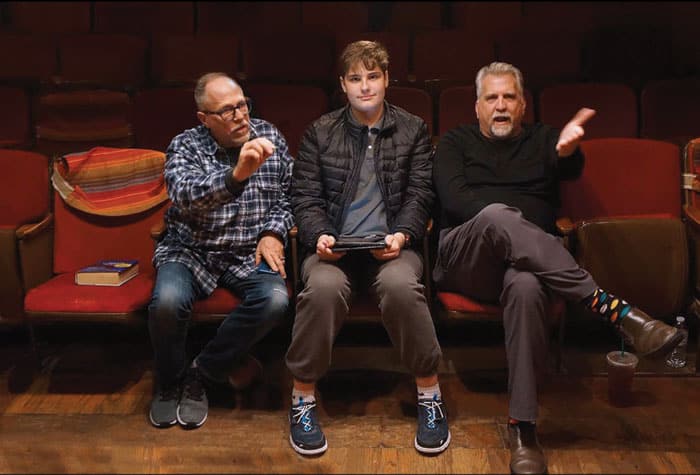
Fun, funny and real, “O’Kelley Legends: 2e Behind the Scenes” is a gift to the twice exceptional, the neurodiverse and the community at large. Twice exceptional (2e) stands for gifted with disabilities or learning differences.

“My hope was to inspire and empower other families of neurodiverse individuals to follow their child’s lead by embracing their differences and celebrating their strengths,” director Harri James O’Kelley told the Journal.

The documentary follows 13-year-old Jordan O’Kelley, who is gifted and autistic, as he adapts his own book into a monologue show/fundraiser. He wrote a humorous book of short stories, “O’Kelley Legendary Legends of Legend,” to get out of doing homework in 4th grade. He created the fundraiser, which was his mitzvah project, to benefit the nonprofit organization SENG (Supporting Emotional Needs of the Gifted). 

Jordan feels doing mitzvah is an idea central to being Jewish, so this was in alignment with his own Jewish values. 

“While attending a SENG annual conference, I had the chance to meet the founder of the organization, Dr. James Webb,” Jordan O’Kelley, now 18 and a senior at California State University Los Angeles, told the Journal. “Our conversation was short, but inspiring. Soon after that, he passed away, and I decided that I wanted to do something in his memory.”

Jordan’s mom, Harri, came up with the idea to film the show’s prep and production. Jordan’s father, Brian, and twin sisters, Macey and Rachel (who were 12 at the time and are now 16), and Harri served as producers. The documentary was filmed over four days in January and February 2019; the performance was on February 17, 2019.

“The production was a wonderful opportunity for me to take a leadership role for the first time, and to figure out what I’m good at and what I like to do,” Rachel O’Kelley, who considers herself quiet and shy, told the Journal. “The documentary has become a time capsule of my middle school years that I really enjoy coming back to and reflecting on.”

The film chronicles the process of creating a successful, neurodiverse-friendly theater experience from casting, through rewriting, rehearsals and the performance. “My thought was to capture for parents the importance of mentorship for 2e children while creating a monologue show in a supportive environment,” Harri said.

Much of the cast is twice exceptional. With a home movie feel, “O’Kelley Legends” shows how important it is for “2e” individuals to have mentors and family supports, including “Mime as Therapy” sessions, as well as mentorship in acting, casting, directing and producing from industry professionals. 

“To me, the documentary was an opportunity to be a part of something fun with my family,” Macey O’Kelley told the Journal. 

She said it was also a chance to give people a better idea of what it’s like to be friends with or be a 2e student or to just be a kid with varied strengths and weaknesses.

Jordan said that despite having ASD (Autism Spectrum Disorder), and generally not getting much out of most social interactions, he loved being around so many fun and enjoyable people during the production.

“You can see it in the film, I’m having the most fun when I’m talking to [casting mentor] Mark Tillman, giving a speech or making conversation with some of my peers,” Jordan said. “As for the most challenging aspect, a lot of the process could be pretty overwhelming. This was especially true whenever we would enter a new phase of production; it always took me a few hours or even days to get into the swing of things before I felt comfortable giving directions.“

Jordan hopes those watching the film get a sense of what 2e individuals are like, what they are good at, what they struggle with and how to accommodate them. 

Jordan hopes those watching the film get a sense of what 2e individuals are like, what they are good at, what they struggle with and how to accommodate them. 

“Further, I hope that these ideas might be applied to everyday life, and that maybe some 2e people in society will feel more seen and accommodated as a result,” he said. 

Siblings Jordan, Rachel, & Macey O’Kelley (L to R) speaking after a screening of “O’Kelley Legends” at Cal State LA’s Autism Awareness Week, April 7, 2023.
Photo by Harri James O’Kelley

Over the last year-and-a-half, the 67-minute documentary has been shown at more than 20 festivals, starting with the Awareness Fest at L.A. Live on October 23, 2021, and was a finalist or winner in eleven of them. The O’Kelleys are continuing to screen the film and do Q&As on college campuses and educational conferences. 

“Working together as a family on this has been one big teachable moment for me as a parent and a spouse, and it was especially gratifying to see our kids grow through this process,” Brian O’Kelley, who also edited the film, told the Journal. “We recently did a Q&A after a screening at CSULA for Autism Awareness Month, and I was so proud of the way Macey, Rachel and Jordan spoke about their experiences putting on the show and making the film, and the way they connected with the audience.”

Adds Jordan, “Going from festival to festival and conference to conference showing the documentary with my family has been a real treat, and getting the chance to make a real difference in the world of 2e advocacy is very meaningful to me.” 

“O’Kelley Legends” illustrates what’s possible when a family works together to bring a heartfelt project into the world. 

“O’Kelley Legends: 2e Behind the Scenes” is available on Amazon Prime, Tubi and InfoBase. The next L.A. screening is in the beginning of June at Loyola Marymount University.

“O’Kelley Legends: 2e Behind the Scenes” Is a Gift Read More »

Josh Stehle Is a Superhero Expert

You don’t need superpowers to be a superhero.

“I am a Superhero Expert” by Josh Stehle looks at autism from the point of view of a younger brother, who sees his older, autistic brother, Zach, as his best friend and personal superhero. 

“[Zach] knows everything there is to know about superheroes, the studios who create them and the worlds they live in,” motivational speaker Josh Stehle, 21, told the Journal. “Stacks on stacks of comic books fill his bookshelves and surround his bed, and he never goes a day without reading his favorite issues.”

While Josh knows little about conventional superheroes, compared to his brother, the term “superhero” means more to him than just characters on a page. 

“In many ways, I think that Zach is a superhero, not by his unique and amazing traits, but by the way he sees the world,” Stehle said. “Zach is the kindest person on earth, and he’s always trying to help people and make their days just a little bit better.” 

This is in spite of the fact that Zach will never see most of the people he helps again and that they may be biased against Zach simply because he’s autistic.

Zach and Josh Stehle
Photo by Monica Pica, “Creative Stages, Photography by Monica”

“It doesn’t matter to Zach,” Stehle said. “He’s selfless. He just wants to make the world a better place … And isn’t that what superheroes do?”

“I am a Superhero Expert” provides an emotional glimpse into the challenges people with autism face, while highlighting the indescribable beauty they bring to the world. 

Told through the eyes of bonded siblings who communicate through pop culture, this memoir offers a new perspective on how fictional tales about powerful heroes transcended the page and screen. They taught the Stehles about love, family and brotherhood.

Stehle wrote the first version of his book as a college application essay, and the idea stuck with him. 

“It was only 600 words or so, but it laid the foundation.” Josh said. 

The essay “worked.” Stehle, who attends West Chester University in Pennsylvania, originally intended to pursue a college, and eventually a professional, basketball career.

“Two years later, my dream of playing in the NBA came to a screeching halt when I realized that I was too slow, too unathletic and frankly, not good enough at basketball to ever make it,” he said. 

As his time as an athlete was coming to an end, Josh realized he had a great idea for a book.

“I just felt like I had so much more to say,” he said. 

When most people meet Josh, they don’t realize he’s Jewish. 

“I am a 6’5”, blond-haired, green-eyed, former basketball player,” he said. “I don’t necessarily ‘look’ Jewish. Unfortunately, though, this means that people around me haven’t always edited their words.”

He has faced inadvertent antisemitism on multiple occasions. Josh is proud of who he is, and is not shy about speaking up.

“Being Jewish has made me more aware of similar mistreatment of a wide range of minority groups, including those on the autism spectrum. And it’s given me the confidence to write what I believe in.”
– Josh Stehle

“Being Jewish has made me more aware of similar mistreatment of a wide range of minority groups, including those on the autism spectrum,” Josh said. “And it’s given me the confidence to write what I believe in.” 

When Josh was growing up, he associated being Jewish with going to Hebrew school and synagogue, and celebrating holidays. 

“At the time, I was adamant that I absolutely did not need Hebrew school and instead should have been allowed to stay at home and sleep in,” he said. “My young mind was convinced that attending another day of school was, frankly, unnecessary. I didn’t fully appreciate the importance of Hebrew school until years later.”

For Josh, the Jewish holidays meant lots of food, good stories and that his grandparents were coming over.

“After losing my grandparents when I was only nine, our holiday celebrations were smaller,” he said. “But there was still the usual homemade challah, matzah ball soup and [the familiar] roasted chicken.” 

As the years passed, these moments remained as the vehicle that brought his family together. “All of the holidays I’ve celebrated with my family, all of the synagogue services I attended with my community and even those Hebrew school days when I fell asleep at my desk reading worksheets and handouts have made me proud of who I am,” he said.

April is Autism Acceptance/Appreciation Month. Stehle hopes “I am a Superhero Expert” can contribute to spreading the message of autism awareness, inclusion and acceptance.


Follow @joshstehle on Instagram or @thestehle.bros on Instagram and TikTok.

Josh Stehle Is a Superhero Expert Read More »

Israeli Whisky Is Now the Best Single Malt Whisky in the World

Israel is known for many things. “Silicon Wadi” is the Silicon Valley of the Middle East. Tel Aviv is the vegan capital of the world. Some of the best TV shows come out of the country.

Tel Aviv’s M&H Distillery recently won the coveted single malt whisky award for its Element Sherry Cask at the prestigious World Whiskies Awards 2023 competition in England.

And now, it’s also home to the best single malt whisky in the world. Tel Aviv’s M&H Distillery recently won the coveted single malt whisky award for its Element Sherry Cask at the prestigious World Whiskies Awards 2023 competition in England. It was also named “Distiller of the Year” and “Craft Producer of the Year” in “The Rest of the World” category of the same competition.

M&H, which stands for milk and honey, is Israel’s first whisky distillery, and the only one that has won awards. Entrepreneur and investor Gal Kalkshtein started the brand, which produces kosher whisky that’s sold in 40 countries around the world.

“We’ve always wanted to make the best whisky in the world, and we’re thrilled that our whiskies have received unprecedented international acclaim,” said Kalkshtein, who is founder of GKI Group and owns more than 16 companies. “This is only the beginning for us.”
Kalkshtein started M&H in 2013 after he began brewing beer at home with a friend. He received guidance from the late Dr. Jim Swan, a world-renowned master distiller from Scotland. 

“We realized it might be fun to distill whisky,” Kalkshtein said. “I gathered a few people in the alcohol industry and asked their thoughts on opening a distillery in Israel, a country with no distilling history. People told me it was impossible, so I decided to make it happen.”

The company offers private and group tours as well as workshops at the visitor center. It produces a variety of products, including the M&H classic whisky, which uses bourbon casks and special red-wine STR (shaved, toasted and re-charred) casks, a whisky called Apex Dead Sea, which is sweet with French vanilla and mocha, notes of cigar box and a refreshing hint of spearmint, and an Art & Craft series featuring whisky from chocolate beer, barley wine and stout beer casks. The Apex Dead Sea won the gold medal at the Frankfurt International Trophy 2022. While M&H was launched in 2013, they didn’t start selling their whisky commercially until the end of 2019. 

The secret to good whisky, according to Kalkshtein, is the hot and humid climate in Israel. 

“It aids in rapid maturation and flavor extraction,” he said. “It enables us to experiment and obtain results relatively quickly. We love to experiment and use any and all casks we can find.”

Since starting M&H Distillery, Kalkshtein has seen other distilleries pop up around Israel, which could help it become known as a whisky-producing country. 

“I hope we can inspire them all to produce the highest quality whisky possible and establish a quality section of Israeli whisky,” he said. 

Winning the award is not only great for M&H Distillery; it’s also a positive for the country as a whole. 

“It puts Israel in a good position, in my opinion,” said Kalkshtein. “Israel is already known for its high-tech industry and innovations. This is yet another example that anything is possible if we set our minds to it and put all of our hearts, minds and efforts into it.”

Israeli Whisky Is Now the Best Single Malt Whisky in the World Read More »

SWU Marks Yom Hashoah, OU Announces New Board, Greenblatt Joins JCPA

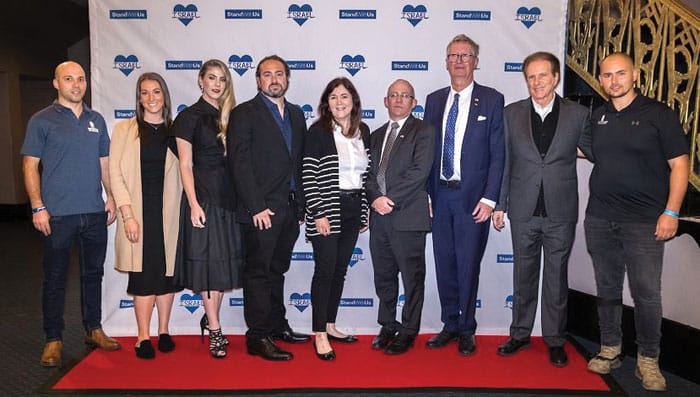
Pro-Israel education organization StandWithUs held a candle-lighting ceremony, film screening and timely Q-and-A during a recent event commemorating Yom HaShoah (Holocaust Remembrance Day).

 “Remembering the Holocaust is a priority to each one of us in this room tonight,” StandWithUs CEO Roz Rothstein said during the April 17 program at the Saban Theater in Beverly Hills. “We are all here together to remember, to share our grief, to learn something new, to be inspired, and hopefully to recommit to sharing information about the Holocaust with others, to help fight the dangers of ignorance.”

At the start of the evening, Rothstein and other community leaders lit six candles for the six million Jews murdered during the Holocaust; one candle for the non-Jews who perished; and one for those who Rothstein described as “victims of Palestinian terrorism.”

Nearly 400 attendees attended the program, held in partnership with Temple of the Arts, the Consulate General of Israel in Los Angeles, the German Consulate General Los Angeles, Holocaust Museum LA and Brothers for Life.

“Memories fade,” Temple of the Arts Rabbi David Baron said, “and we cannot allow the memory of the six million to ever fade from our consciousness and memories.”

  Former Israeli soldiers from Brothers for Life, an organization pairing injured IDF soldiers with newly wounded combat veterans, participated. Additional speakers included Consul General of Israel in Los Angeles Hillel Newman and Consul General of Germany in Los Angeles Stefan Schneider. Musician Jenna Parris performed “Eli, Eli,” followed by Hatikvah.

The candle-lighting was followed by a screening of the 2020 feature film, “Resistance,” starring Jesse Eisenberg in the true World War II story of Marcel Marceau, a French-Jewish mime who joins the resistance and smuggles Jewish orphans over the Swiss border, saving dozens of young lives. 

A post-screening Q-and-A featured “Resistance” writer-director Jonathan Jakubowicz and producer Claudine Jakubowicz. Seated onstage with StandWithUs Los Angeles Executive Director Erinn Alcabes, the filmmaking duo discussed contemporary antisemitism in the United States, with Jonathan Jakubowicz pointing to hateful statements from rapper Kanye West as evidence that Jew-hatred continues among the mainstream today. 

 Thus, he said, it’s important to support organizations committed to combating antisemitism, including StandWithUs.

During the Q-and-A, Maya Werthein, a senior at YULA Girls High School and a StandWithUs Kenneth Leventhal high school intern, asked how she and her peers could proactively resist antisemitism. 

 The answer, Claudine Jakubowicz said, was simple: embrace your Jewish heritage and be proud of who you are. 

On Yom Hashoah, it was an appropriate message for anyone of any age.

Marking Holocaust Remembrance Day, Roz Rothstein, CEO of pro-Israel group StandWithUs, leads a candle-lighting ceremony to memorialize the victims of the Shoah and terrorism in Israel. Courtesy of Jc Olivera/StandWithUs

The Orthodox Union (OU) has named Los Angeles community member Moshe Sassover to its board of directors.

Sassover was among 14 new OU board members from across the U.S. and Canada elected to a two-year term. 

“The OU extends its heartfelt congratulations to Moshe Sassover and all of our new board members on joining this important journey with the OU,” OU President Mitchel Aeder said. “These individuals, who reflect the breadth of our community, were chosen for their dedication to communal service, and I look forward to working together to help the OU achieve our many goals.”

Professionally, Sassover is on the executive committee of a real estate investment firm. He is active with Young Israel of North Beverly Hills, the Jewish Federation of Greater Los Angeles, AIPAC and Cedars-Sinai Medical Center, among other communal organizations. 

The OU, founded in 1898, is the largest Orthodox umbrella organization in the country and the self-described voice of American Orthodox Jewry. 


Jason Greenblatt. Courtesy of Wikipedia

Former White House Middle East Envoy Jason Greenblatt has joined the Jerusalem Center for Public Affairs (JCPA) as its senior director of Arab-Israel diplomacy.

Greenblatt — who was a senior member of the White House team during the Trump administration and helped broker the historic Abraham Accords in 2020 that lead to normalization agreements between Israel, the UAE, Bahrain and Morocco — joins the JCPA at a watershed moment for the institute; it just hosted the first Arab-Israel-Africa security conference.

“We are honored to welcome Jason to the Jerusalem Center for Public Affairs as a senior member of our team,” JCPA President Dan Diker said. “Jason brings with him a wealth of experience and close relations with Arab states across the region, including some without normalization agreements with Israel.” 

Greenblatt, for his part, expressed excitement about the new role.

“The Jerusalem Center for Public Affairs is not just a think-tank, it’s a ‘do-tank,’” he said. “I am proud to join JCPA as senior director for Israel-Arab diplomacy building on the work I was privileged to do while serving as White House Middle East envoy.”

SWU Marks Yom Hashoah, OU Announces New Board, Greenblatt Joins JCPA Read More »

The Unforgettable Flavor of Preserved Lemon

The first time I tasted Rachel’s riff on Israeli salad, I was blown away by the intense citrusy tang that accompanied every bite. I grew up eating Israeli salad all the time. It’s a labor of love to chop the bright peppers, the crisp Persian cucumbers, the deep green grassy Italian parsley, the sweet, spicy red onions and the juicy red tomatoes. The dressing is a generous pour of extra virgin olive oil, fresh lemon juice and kosher salt. It tops the list on my every Shabbat menu and I serve it to my family and my friends whenever I can. I call it a vitamin pill in a bowl. 

Rachel’s salad included all these classic ingredients, as well as creamy avocado and hearts of palm. But there was something else I was tasting—a wonderfully mellow, deep lemony flavor. Rachel’s salad had little slivers of preserved lemon rind and that made all the difference.

Originally lemons were pickled so they could be enjoyed out of season. But they soon became an indispensable ingredient in Moroccan, North African and Middle Eastern cuisine. 

Originally lemons were pickled so they could be enjoyed out of season. But they soon became an indispensable ingredient in Moroccan, North African and Middle Eastern cuisine. 

Rachel’s mother Rica showed me that preserved lemons are so simple to prepare. The lemons are washed and quartered lengthwise three-quarters of the way down, with kosher salt packed in between each piece. 

The lemons sit in the brine and can be used about four weeks later. This fermentation process softens the lemon rind and creates a condiment with a complex salty, sour, umami flavor. 

—Sharon

I learnt from my mother to have several jars of lemons in my refrigerator, all at different stages of fermentation. I do this so I never run out. The lemons can be used up to a year if they are stored in a tightly sealed jar. But truly, the lemony flavor is so addictive and there are so many uses for them, that they never last that long. 

The easiest way to use preserved lemon is to finely chop the rind and put it in a salad. You can also blend some of the lemon rind and pulp into dressings and aiolis. Use them to whip up a fresh, fabulous vinaigrette with olive oil, Dijon mustard and red wine vinegar. 

I use the lemon rinds in my Moroccan fish and in my olive chicken. There is nothing better to balance the rich flavors of meat and lamb tagines and stews. Anywhere you want to add lemon flavor that sends the dish to a different level. 

We hope you take the 15 minutes to brine some lemons and leave them in your refrigerator until they are ready to use. 

Then add this magical ingredient into your recipes for amazing flavor. 

You’ll thank us!

—Rachel 


Preserved Lemons

18 lemons, washed and dried
1 cup kosher salt

Remove the stem of the lemon. Quarter the lemon lengthwise, with two cuts three-quarters of the way. Make sure that the lemon stays intact.
Stuff all sides of the lemon with a generous amount of salt and squeeze lemon closed.
Place lemon inside a 1-liter glass jar with an airtight lid. Repeat the salting process, then push down each lemon. Add more lemons until the jar is full.
Add the juice of 2 lemons.
Seal jar tightly and shake contents. Leave on countertop.
The following day, add several more lemons. Repeat the following day, until the jar is full and no more lemons can be added.
Shake daily so that the brine coats the lemons.
After one week, place jar in the refrigerator.
Lemons will be ready to use in three weeks.

Israeli Salad with Preserved Lemon

4 Roma tomatoes, diced
3 Persian cucumbers, diced
1 red bell pepper, seeded and diced
1 orange bell pepper, seeded and diced
1 small red onion, finely diced
1 avocado, diced
1 bunch Italian parsley, finely chopped
2 green onions, finely sliced
1/2 rind of preserved lemon, minced
1/3 cup extra virgin olive oil
2 lemons, juiced
1/4 tsp kosher salt

Place tomatoes, cucumbers, bell peppers, onion, avocado, Italian parsley, green onions and preserved lemon in a bowl.
Just before serving, pour olive oil and lemon juice over the vegetables, then sprinkle the salt over the salad.
Toss well.
Blend any leftovers to make a gazpacho.


Rachel Sheff and Sharon Gomperts have been friends since high school. They love cooking and sharing recipes. They have collaborated on Sephardic Educational Center projects and community cooking classes. Follow them on Instagram @sephardicspicegirls and on Facebook at Sephardic Spice SEC Food.

The Unforgettable Flavor of Preserved Lemon Read More »