fbpx

February 17, 2023

Shooting in Pico: Miracles, Questions, Falsehoods

A shooter tried to kill Jews in Los Angeles and failed. We are left with some difficult questions.

We were shaken in Los Angeles by something horrible.

Two men on their way from synagogue, on the mornings of Wednesday, February 15th and Thursday, February 16th, respectively, were shot on the streets of Pico Robertson. Miraculously neither was killed. But it easily could have ended with two funerals, grieving families, or worse.

At least one Jewish school went on lock down. Police combed the area. Neighborhood patrols like LA Shmira and Magen AM multiplied their efforts. All Jewish institutions enacted safety precautions. 

When the first news of the shooting on Wednesday arrived, it was accompanied by a statement saying there was no evidence that the shooter targeted Jews. Some Jewish groups repeated and sent out the initial police statements that Jews were not necessarily being targeted.

Even when the second shooting occurred on Thursday morning, the community was also advised that they may be independent incidents, and not necessarily targeting Jews. 

Neither the first statement, nor the second statement seemed accurate.

I am reminded of the words of my favorite fictional detective who said, “There is no such thing as a coincidence.” Two mornings, two Jews shot near houses of prayer. No, this wasn’t gang related warfare spilling over. Someone was out to shoot Jews.

Thankfully, less than twelve hours after the second shooting, the suspect was in custody. The LAPD had worked with federal and regional partners to locate and arrest him. The official statement said “he had animus” towards the Jewish community. He had targeted Jews.

Why were we so lucky?

Let’s be honest with ourselves. We are very fortunate. If the suspect had wanted to, he could have killed a lot of Jews. So why didn’t he? How are we so lucky? We may never know.

I’m not a security expert, and his attack will be reviewed by security teams here and nationally, by local and federal agencies. However, based on what we do know, it seems that the perpetrator wanted to kill Jews, but didn’t want to be a martyr for a cause. He was arrested without incident, meaning that he didn’t have a death wish. 

It’s a miracle that more Jews were not shot and that no one died. The suspect was arrested with a rifle and a handgun. Unreal.

I am very grateful to the LAPD for their work in apprehending the suspect, elevating the shooting to the Major Crimes division and assigning many resources and detectives to the case. 

Some serious questions after the attack

In the wake of this terrifying antisemitic attack on our community  — our most local encounter with the gun violence scourge in our country — I am left with a lot of questions:

Were early threats ignored? Someone wrote on a WhatsApp chat, which was widely circulated, that a man matching the shooter’s description had made threats against his Jewish classmates. Were those threats ever reported or investigated?   

Why did Jewish groups quickly repeat something that was not true? When the police report that a Jewish person was shot outside a house of prayer, but say there is no evidence it was hate motivated, why are Jewish organizations quick to repeat that information? That information was false, and could have led to more Jews being shot.

Why didn’t Mayor Bass come to Pico? The Mayor tweeted that she was “monitoring the situation” while condemning the targeting of the Jewish community. After the suspect was arrested the mayor’s office issued a wonderful letter of support for the Jewish community. It would be better for the Mayor come to Pico to show her support for the community, than tweet about it. 

Why don’t we have better security surveillance in Pico? Jewish groups have lobbied to have surveillance security cameras installed along Pico and in high traffic Jewish areas. Could this be the time when there is enough public and private support for this critical security measure?

Why haven’t the LAPD opened a presence in the heavily Jewish area of Pico or Hancock Park allowing for immediate response? The idea was floated in 2005 after a bomb plot was foiled by the FBI. Maybe the shooter could have been caught after the first incident. 

Lastly, why aren’t we more shocked when a Jew gets shot? It may be that humans have a psychological defense mechanism which allows us to continue to operate under enormous pressure. While we know that there was a killer on the loose, our minds come up with all kinds of reasons why we should not be concerned. Unless you know the person shot, it didn’t affect you personally, so it’s possible for our minds to just say, “oh that’s terrible. So many people are getting shot these days.” And then finish our lunch.

The Torah Warns us About Falsehoods

We learn in the Torah, “Keep away from anything false. (Ex. 23:7)” I want to add to this, a false sense of security, a false sense of detachment, and the very consequential danger of passing on false reports.

This time we were very fortunate. Falsehoods didn’t lead to anyone being killed. We cannot depend on miracles the next time.

May God protect us from those who seek to do us harm, may we merit to be saved from the plots of the evildoers, and may we seek to turn away from falsehood and detachment and seek truth.

Shooting in Pico: Miracles, Questions, Falsehoods Read More »
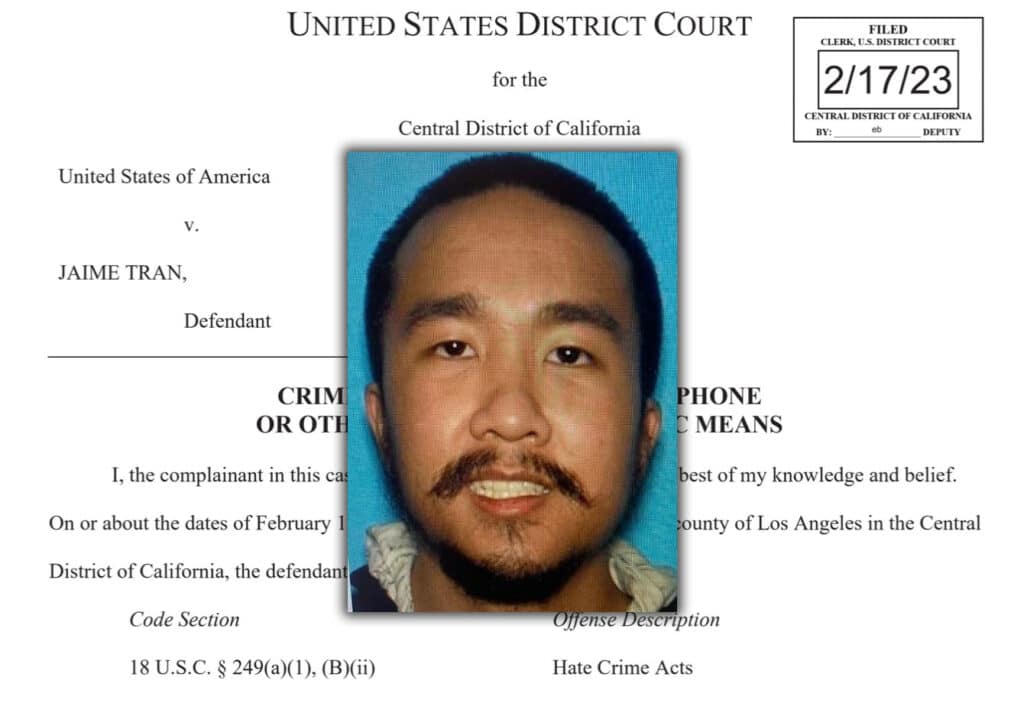
Pico Shooting Suspect Has a “History of Antisemitism,” according to Federal Complaint

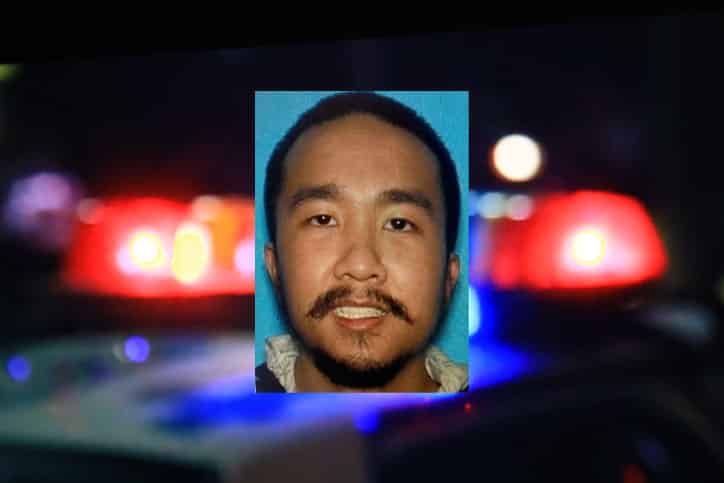
A federal complaint was released on February 17 detailing federal charges against Jaime Tran, 28, who is suspected of being behind both shootings in the Pico-Robertson area on February 15 and 16.

The complaint, filed by Special Agent Cody Bescript, alleges that Tran “intentionally shot Victim-1 at close range as Victim-1 was leaving religious services at a synagogue in Los Angeles, California. Victim-1 was dressed in a manner that visibly identified his Jewish faith, specifically, a black jacket and a head covering. Victim-1 survived, but sustained a gunshot wound to the lower back.”

On the next day, according to the complaint, Tran “intentionally shot Victim-2 at close range as Victim-2 was leaving religious services at another synagogue, just one block from where TRAN shot Victim-1 the day before.”

“Like Victim-1, Victim-2 was dressed in clothing that visibly identified his Jewish faith, again a black jacket and a head covering. Victim-2 survived, but sustained a gunshot wound to the bicep.”

Tran has admitted to the shootings in a recorded interview, adding that he searched Yelp for a kosher supermarket. Once he found the market, he chose his victims based on their “head gear.” He also said he was homeless and had been living out of his car for the past 12-14 months; he obtained the guns from an unknown person in Arizona.

Tran has a history of antisemitism, the complaint alleges, citing an instance in which a former classmate of Tran’s, simply known as M.N.H., received multiple antisemitic phone calls and texts from Tran from August-November 2022. Tran had been expelled from dental school in 2018. Some of the antisemitic text messages from Tran highlighted in the complaint include:

  • “F–king Jew. Piece of shit Jew. F— YOU JEW. JEWBAG JEWBAGEL JEW.”
  • “Someone is going to kill you, Jew. Someone is going to kill you, Jew. Someone is going to kill you, Jew. Someone is going to kill you, Jew.”
  • “F—ing b—- Jew. Your mom is a slutty whore, your sister is a man, and your dad sucks dick for a living. Burn in an oven chamber you b—- Jew.”

The last text included a picture of a gas chamber, per the complaint.

Tran sent multiple emails to former classmates blaming vaccine mandates and lockdowns on “Iranian Jews” and referred to “Persian Jews” as being “primitive” and “narrow minded” who “scrap nickel and dimes” and “never donate to any charities.”

Additionally, Tran sent multiple emails to former classmates toward the end of 2022 blaming COVID-19 vaccine mandates and lockdowns on “Iranian Jews” and referred to “Persian Jews” as being “primitive” and “narrow minded” who “scrap nickel and dimes” and “never donate to any charities.” “Going forward, I hope you all spread the word to your loved ones about the origins of COVID,” he wrote in one email. “I tagged the Iranian Jew, such as [M.N.H.], and his associates in this email so you could ask them about it. I also hope they quit putting tabs on me to the Jewish community and creeping on all of my socials.”

In another email Tran accused the “Persian/Iranian Jew of the Class of 2020” of fabricating COVID-19 and basing it on an “anesthesia incident that I had with” a couple of former classmates. He also sent a picture of a flyer stating, “EVERY SINGLE ASPECT OF THE COVID AGENDA IS JEWISH.”

He also sent a picture of a flyer stating, “EVERY SINGLE ASPECT OF THE COVID AGENDA IS JEWISH.”

According to a senior source, Tran could face up to life in prison. He is expected to have a hearing today, per the source.

“Over the past two days, our community experienced two horrific acts we believe were motivated by antisemitic ideology that caused him to target the Jewish community,” United States Attorney Martin Estrada said in a statement. “It is important, especially in one of the most diverse areas in the world, that we celebrate our differences, and stand together to oppose acts of hate.”

Donald Alway, Assistant Director in Charge of the FBI’s Los Angeles Field Office, also said in a statement, “In addition to targeting innocent people with violent physical attacks, these crimes instill fear in the community. There is no place in Los Angeles and, indeed, the United States of America, for fear to control communities and to intimidate people of faith. Law enforcement will work together to prevent hate crimes, whether they be civil liberties violations or acts of terror. On behalf of the FBI, I wish a full recovery to the victims who were senselessly attacked for their faith, as well as peace to the Jewish community.”

“Blaming Jews for disease and plague is a historic antisemitic trope,” Robert J. Williams, Finci-Viterbi Executive Director of the USC Shoah Foundation, said in a statement to the Journal.

“The charging document for the shootings of two Jewish men details the actions of an individual with a deep hatred for Jews whose antisemitism motivated him to violence,” Anti-Defamation League Los Angeles Regional Director Jeffrey I. Abrams said in a statement to the Journal. “It simply doesnt get any scarier or more dangerous for the Jewish community. We are grateful that the immediate terror of this incident is behind us but recognize that antisemitism continues to take hold of our community.”

American Jewish Committee Los Angeles Regional Director Richard S. Hirschhaut said in a statement to the Journal, “The Federal complaint against shooting suspect Jaime Tran reveals a litany of disturbing social pathologies, underpinned by vitriolic conspiracy theories about Jews, and Persian Jews in particular. That Tran was able to spew such hateful and threatening invective, targeting former classmates and others with impunity, begs the question of why there was no meaningful intervention before he ultimately acted upon his violent intentions. The all too often lethal combination of mental illness, easy access to guns, and hate is a toxic mix and increasingly tragic refrain that must be addressed in our society.”

StandWithUs CEO and Co-Founder Roz Rothstein, the daughter of Holocaust survivors, said in a statement to the Journal, “It is horrifying that once again, classic antisemitic troupes spewed by a deranged man escalated to violence against the Jews he collectively blames for Covid 19 and financial losses. Scapegoating Jews for one’s frustrations is a classic antisemitic tactic that we must, as a society, identify and reject as the bigotry it is. It is miraculous that his violent assaults did not result in greater tragedy. StandWithUs thanks the police for their diligence in capturing him. There were obvious red flags in Tran’s texts and behavior, a reminder that the Jewish community has to exercise active caution and serious prevention. We need to be diligent in recognizing these signs, never to ignore them and always report them to school administrations and law enforcement.

“Blaming Jews for disease and plague is a historic antisemitic trope,” Robert J. Williams, Finci-Viterbi Executive Director of the USC Shoah Foundation, said in a statement to the Journal. “The shooter claiming Jews were responsible for COVID is just the latest version of the same lie. These events remind us why it’s so important to combat disinformation.”

Read the full complaint here.


This is a developing story.

Pico Shooting Suspect Has a “History of Antisemitism,” according to Federal Complaint Read More »

There Must be Justice in the World

“An eye for an eye.” Critics cite this Biblical punishment to indict Judaism for being an unforgiving, legalistic religion. This verse has become theological shorthand for a rules-obsessed religious outlook that is heartless and harsh. In many instances, this critique morphs into anti-Semitism; when Shakespeare’s Shylock craves a pound of flesh, he echoes centuries of anti-Jewish polemics about “an eye for an eye.” And to this day, critics of Israel invoke “an eye for an eye” to describe Israeli actions, a trope inextricably intertwined with antisemitic slanders of the past.

The roots of this allegation are found in the New Testament, in the Sermon on the Mount. In it, Jesus teaches his disciples that they should reject “an eye for an eye”: You have heard the law that says the punishment must match the injury: ‘An eye for an eye, and a tooth for a tooth.’ But I say, do not resist an evil person! If someone slaps you on the right cheek, offer the other cheek also. …. Love your enemies, bless them that curse you, do good to them that hate you, and pray for them which despitefully use you, and persecute you… In this passage, the New Testament roundly rejects an eye for an eye; but at the same time, it shackles Judaism to this barbaric practice.

But that is not what Judaism teaches. Jewish interpreters are adamant in declaring that “an eye for an eye” is not meant to be understood literally. The Talmud offers a half a dozen arguments to prove that the text must mean monetary compensation; Benno Jacob argues, that by definition, the Hebrew word “tachat” in this verse can only mean an actual repayment. On a practical level, it would seem impossible to implement the punishment of “an eye for an eye” in a fair manner; removing an eye, (certainly, in ancient times,) would result in a disproportionate injury, and could even end up killing the accused.

One could stop the discussion here by saying that in practical terms, “an eye for an eye” is essentially fiction. But there are lessons to be learned from the literal interpretation of the text as well. How one understands “an eye for an eye” relates to a much larger question: what is justice?

For many Christian readers, the Sermon on the Mount teaches that one must pursue the exact opposite path from “an eye for an eye.” Pope Francis, in a 2013 sermon, explains that this a rejection of human conceptions of justice:

If we live according to the law of “an eye for an eye, a tooth for a tooth”, we will never escape from the spiral of evil. The evil one is clever, and deludes us into thinking that with our human justice we can save ourselves and save the world! In reality, only the justice of God can save us!

To do good to them that hate you is the very path to redemption; and that requires an emphasis on transforming criminals.

Without question, any discussion of crime and punishment must consider the importance of rehabilitation. As the Talmud (Berakhot 10a) puts it, Judaism also hopes to uproot sins and improve sinners. To this end, reformers endeavored to turn prisons into penitentiaries, places where criminals would repent from their crimes. Educational and work opportunities were provided to prisoners to help them rebuild their lives, and over the years, some excellent programs have found significant success. Love does make a difference, and encourages people to change. But when taken to an extreme, the path of love fails; replacing the local police force with a cadre of social workers will only lead to more crime. Love can never replace justice.

For this reason, “an eye for an eye” deserves a second look.

There are many rabbinic thinkers, including Maimonides in the Guide for the Perplexed, that find lessons in the literal meaning of “an eye for an eye.” Rabbi Moise Tedeschi, in his Hoil Moshe, explains that “an eye for an eye” was meant to be understood literally during Israel’s early history. The former slaves struggled to build a civil society, and it was a time of chaos; harsh punishment was necessary to instill a sense of law and order. It is only later, at a time of greater stability, that “an eye for an eye” could be interpreted as a monetary payment. In other words, “an eye for an eye” was a type of martial law, and only intended for a short period of history.

This interpretation highlights the importance of deterrence. Crimes must be punished as a warning to others; without severe punishments, society will dissolve into anarchy. At times, extreme measures are necessary for the greater good, even if they are as brutal as “an eye for an eye.”

But the most significant lesson of “an eye for an eye” is that punishment is part of the pursuit of justice; and in the case of a bloody assault, retribution is required. Rabbi Ovadiah Seforno writes that “an eye for an eye” is what ought to be the judgment against the offender, if we were to apply the principle of the punishment fitting the crime in all its severity. There is a profound injustice in allowing someone who assaulted his neighbor to pay his way out of the crime. Emanuel Levinas points out, this justice based on peace and kindness… leaves the way open for the rich! They can easily pay for the broken teeth, the gouged-out eyes, and the fractured limbs left around them. The world remains a comfortable place for the strong,… Yes, eye for eye. Neither all eternity, nor all the money in the world, can heal the outrage done to man. It is a disfigurement or wound that bleeds for all time…

“An eye for an eye” is, in the end, a theoretical proposal. Ultimately, all physical punishments were abandoned and considered cruel; they were replaced with incarceration, which matches the severity of corporal punishment without inflicting any physical pain. But the lesson of “an eye for an eye” remains; justice demands that evildoers be punished, and a society that indulges criminals is itself criminal. When writing about how it is critical for a sovereign to pursue “the equalization of punishment with the crime”, Immanuel Kant explains:

(Punishment) ought to be done in order that every one may realize the desert of his deeds, and that bloodguiltiness may not remain upon the people; for otherwise they might all be regarded as participators in the murder….

It is easy to diminish justice; it is the gruff, offputting, hard-edged counterpart of love. But love doesn’t conquer all; you need to have order and civility first in order for love to flourish. And that is impossible without justice.

Lenn Evan Goodman begins his book On Justice with the following anecdote. As a child in Los Angeles, he had a Hebrew school teacher, Dr. Lubliner, who, when he rolled up his sleeves on hot days, exposed a pale blue tattooed number on his forearm. Dr. Lubliner was a man of great dignity and learning. He had much to teach, but almost never spoke about the Holocaust.  But one time, in a tangentially connected discussion, Dr. Lubliner interjected: “I believe there’s justice in the world…there must be justice.”

Goodman adds that another time he arrived at Hebrew school early, and saw Dr. Lubliner silently saying the Mincha prayer. At that moment Goodman thought to himself: “if a man like that can believe in God, so can I.”

Love may be transcendent, but that is not enough on its own. To believe in God is to believe in the possibility of ending the rule of evil, and that all wickedness will vanish like smoke.

There must be justice in the world too.


Rabbi Chaim Steinmetz is the Senior Rabbi of Congregation Kehilath Jeshurun in New York.

There Must be Justice in the World Read More »

Sources: Pico Shootings Suspect Identified as Jaime Tran

The suspect who was arrested on February 16 in the Pico shootings case has been identified as Jaime Tran, according to a senior source familiar with the matter. The source told the Journal that the suspect’s name will be confirmed in a briefing later on February 17. The Los Angeles Police Department (LAPD) could not confirm the identity of the shooter, and referred the Journal to the FBI. The FBI Los Angeles bureau did not immediately respond to the Journal’s request for comment.

According to the Los Angeles County’s Sheriff Inmate Information Center, Tran is 28 years old and initially held on $2 million bail; after a hearing on February 17, a judge ordered that Tran be held without bail.

Siamak Kordestani, West Coast Director of the European Leadership Network, tweeted that records show that Tran appeared to have been previously arrested in July on felony charges in Long Beach; he asked Los Angeles District Attorney George Gascon’s office what happened to the case. Gascon’s office replied to him on Twitter by saying: “Suspect was charged with felony possession of a firearm on school grounds in July 2022. At the time of that filing he had no previous criminal record & LADA was not made aware of any allegations of threats against the Jewish community.” In a later tweet, Gascon’s office said that Tran’s bail was set at $30,000 and he posted bond; Tran is scheduled to appear in court again on the matter on February 28.


The LAPD announced the arrest of the suspect on February 17, having tracked him to Riverside County and finding multiple pieces of evidence connecting him to the shooting, including a rifle and a handgun. The matter is being investigated as a hate crime.

The suspect was arrested in connection with two shootings on Pico Boulevard on Feb 15 and 16 that injured two Jewish victims.

This article has been updated.

Sources: Pico Shootings Suspect Identified as Jaime Tran Read More »

Israeli Rescue Worker Tells TML of Hunting for Survivors in Quake-stricken Turkey

To read more articles from The Media Line, click here.


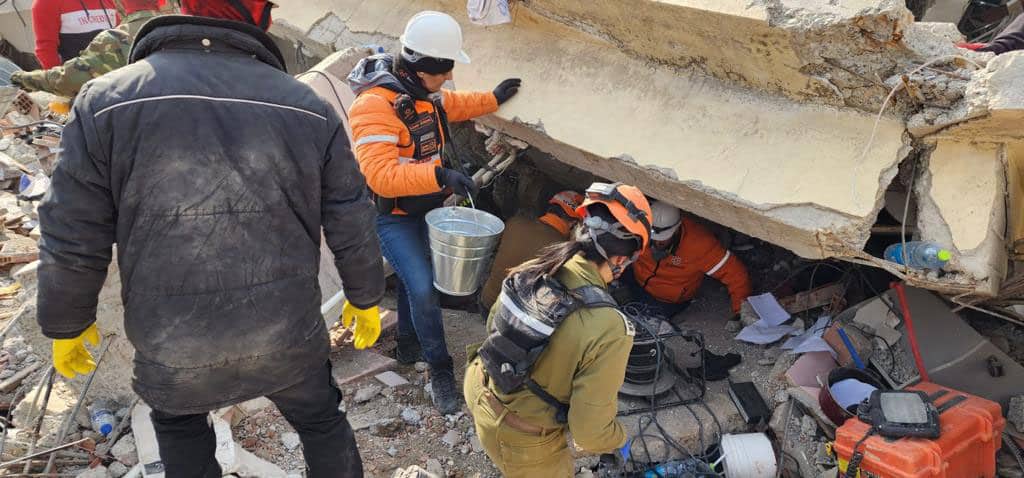
In the aftermath of the massive earthquakes that hit Turkey and Syria last week, the global community and international agencies rushed to offer assistance with search and rescue efforts and aid for survivors. Among those countries was Israel, which dispatched more than 450 people to join aid efforts in Turkey, including members of the United Hatzalah (United Rescue) volunteer emergency medical service organization.

Volunteers, including members of the United Hatzalah team, get oriented to the site of a collapsed building in Kahramanmaraş, Turkey. (Courtesy/United Hatzalah)

The Hatzalah team of 25 people, including medical professionals, search and rescue experts and engineers, arrived in Turkey a day after the first earthquake. They were dispatched to Kahramanmaras, close to the epicenter, where they remained for almost one week, rescuing survivors trapped under the rubble and offering support to those anxiously awaiting news of their missing loved ones.

Aerial view of the stie of a collapsed building in Kahramanmaraş, Turkey. (Courtesy/United Hatzalah)

Linor Attias, a senior official for United Hatzalah and a member of the search and rescue team, spoke to The Media Line about her time in quake-stricken Turkey, including the adrenaline-inducing highs and the heartbreaking lows.

United Hatzalah volunteers head to a collapsed building in Kahramanmaraş, Turkey. (Courtesy/United Hatzalah)

Israeli Rescue Worker Tells TML of Hunting for Survivors in Quake-stricken Turkey Read More »

Judicial Reforms: A Brief Guide for the Perplexed

I joined some 100,000 Israelis last week at a massive demonstration in Jerusalem protesting the moves underway to change the structure of Israel’s system of government. Fortunately, the atmosphere was peaceful- almost festive in fact- but the reality is that Israel is now undergoing one of the most consequential crises in its history. Ironically, this crisis is totally internal. After 75 years, the State of Israel may have reached the point of needing to define its own version of democracy. I will try to unpack the issues in the spirit of a “Guide to the Perplexed” but in a brief and admittedly incomplete format.

  1. The Israeli Constitution. Simply put, there isn’t one. Instead, there are a series of what are defined as “Basic Laws”.  Basic laws were thought to be a substitute for a unified constitution. The idea was that they could be legislated in stages, over years, and would ultimately come to serve as the equivalent of a single document. However Basic Laws can be adopted or annulled by a simple majority of the Knesset, in some cases an absolute majority (61 out of 120), and in other cases simply based on who happens to be in the plenum.
  1. The Supreme Court and the Knesset. The bulk of Israeli law was inherited from the British Common Law system, and the authority of judges reflected that of the British system. Noticeably absent from the British system is the right of judicial review, i.e. the ability of the Supreme Court to overturn laws passed by the Knesset. (Actual, judicial review doesn’t appear in the U.S. Constitution either). Until 1992 the Israeli Supreme nevertheless chalked up an admirable record in protecting basic human rights, which could be attributed to the enormous respect accorded it by both the public and the elected officials, who rarely challenged its decisions. However, the Supreme Court refrained from overturning legislation passed by the Knesset, thus respecting the latter role as the representative of the electorate.
  1. The Judicial Revolution. In 1992, the Knesset passed a Basic Law known as “The Law of Human Dignity and Freedom”, which included the rights of liberty, dignity, freedom, property and movement from and to Israel. In an unprecedented way, Chief Justice Barak’s Supreme Court used provisions of this Basic Law to retroactively annul laws passed by the Knesset that were seen to conflict with any of these provisions, in other words the right of Judicial Review. In addition, the court began to apply the concept of “reasonability” as grounds for annulling legislation. All this this was possible because of the lack of a formal constitution and the very high public standing of the court.
  1. Consensus- there simply isn’t one. Those political leaders who ignore the value of public consensus risk the very future of their nations. We should remember that it was only through the consensus achieved by the founding generation of Israelis with the support of the great majority of Jews around the world that the State of Israel came into being in the first place.  For many Israelis, Aharon Barak’s “Judicial Revolution”, which is the terminology used by Barak himself, ushered in a welcome era in which the Supreme Court could and did impose its philosophy of law and its self-described identity as the representative of the forces of “enlightenment” in order to protect Israel against the disruptive intrusions of politicians. Internationally, the Israeli Supreme certainly became one of the most respected courts in the world. However, these same “constitutional” developments did not reflect a national consensus. Many voices argued that the “Judicial Revolution” was actually an undemocratic encroachment on the “will of the people” by an unelected elite whose views on fundamental issues were out of sync with those of most Israelis. To make matters worse in their eyes, the system of appointing judges for many years gave disproportionate weight to the Chief Justice and other members of the sitting court, so that those who saw themselves as the “defenders of liberty” came to be described by many others as an “arrogant, self-perpetuating judicial elite”.  Hence the passions that have overflown during the past few weeks from the chambers of the Knesset to the streets of Israel.
  1. The Knesset and the Executive Branch are virtually the same. In the Israeli parliamentary system, the Knesset is elected by popular vote and in turn appoints the members of the government. Theoretically, the government is beholden to the public via the fact that it receives its mandate from the Knesset. However, in fact the situation is actually reversed. Since there are no regional constituencies, members of the Knesset are almost totally beholden to their parties for their political survival. Some parties, including those in the “center”, the Arab parties and the ultra-Orthodox, have no primaries at all. Others, like the Likud, do have primaries but in reality, the standing of an individual member of Knesset is determined by the party leadership. Thus, in the current debate there really are only two branches of government, the Executive qua Legislature and the Judiciary.
  1. What ever happened to Checks and Balances? Given the lack of a constitution and the very deep divisions within Israeli society, neither side of the political spectrum has placed the concept of checks and balances at the top of its agenda. The “Judicial Revolution” may have ridden roughshod over the prerogatives of the Knesset, but the current response threatens to institutionalize a tyranny of the elected majority and in the name of that majority to abandon any pretension of achieving national consensus on the definitions of democracy, human rights and the “rules of the game” of the political system.

Given the lack of a constitution and the very deep divisions within Israeli society, neither side of the political spectrum has placed the concept of checks and balances at the top of its agenda.

  1. Where are we now? As I write this, the new Minister of Justice (Yariv Levin) and the Chairman of the Knesset’s Constitutional Committee (Simcha Rothman) are attempting to pass legislation that will not only overturn the “Judicial Revolution” but will clarify the relationship between the Legislature and the Judiciary in a way that will theoretically make it possible for the Knesset to appoint ministers with virtually no limitations on their power. The laws envisioned will prevent the Supreme Court from applying its concept of “reasonability” to annul Knesset legislation and will allow the government, through its automatic Knesset majority, to appoint Ministers, to pass both regular and Basic Laws with virtually no limitations. Although the proposals envision a formal recognition of the authority of the Supreme Court to annul legislation, they also envision an override provision that will allow a simple majority of Knesset members to override the authority of the Supreme Court regarding legislation and appointments.
  1. Is there a way out? There are many complicated alternatives, but the simplest one could be the following: Recognize the right of the elected Knesset to appoint the members of the Supreme Court, and then allow the judges independence regarding the interpretation of Knesset legislation and the right of judicial review in accordance with the one document that remains a matter of national consensus- the Declaration of Independence.

There is still some hope that the present uproar will actually lead us to a better place.

President Herzog has called for a hiatus in the legislative process in the interest of uniting the entire public around a compromise position. So far, his appeals seem to have fallen upon deaf ears, but there is still some hope that the present uproar will actually lead us to a better place, a place on national consensus that can bridge the some of the gaps between different parts of Israeli society and give us the strength and unity for the many other challenges that will certainly come our way. Let’s hope so!


Yitzhak Sokoloff is an Israeli political analyst and educator and the founder of Keshet Educational Journeys.

Judicial Reforms: A Brief Guide for the Perplexed Read More »

L'dor V'dor with shanni and david Podcast

From Comedy Festival to Shootings on Pico

In this latest episode of L’Dor V’Dor, Shanni and David go through an eventful week, from the Chosen Comedy Festival to the shootings on Pico to the eerie wonders of Chat-Gpt to why Jews are so obsessed with food to a crucial Zoom debate on judicial reforms this Sunday to a recap of the print issue, and lots more!
Topic List:
  • The shootings on Pico
  • The Chosen Comedy Festival
  • Chat GPT
  • The Jewish obsession with food
  • “Crashing” and “The Good Place”
  • This week’s print issue

From Comedy Festival to Shootings on Pico Read More »

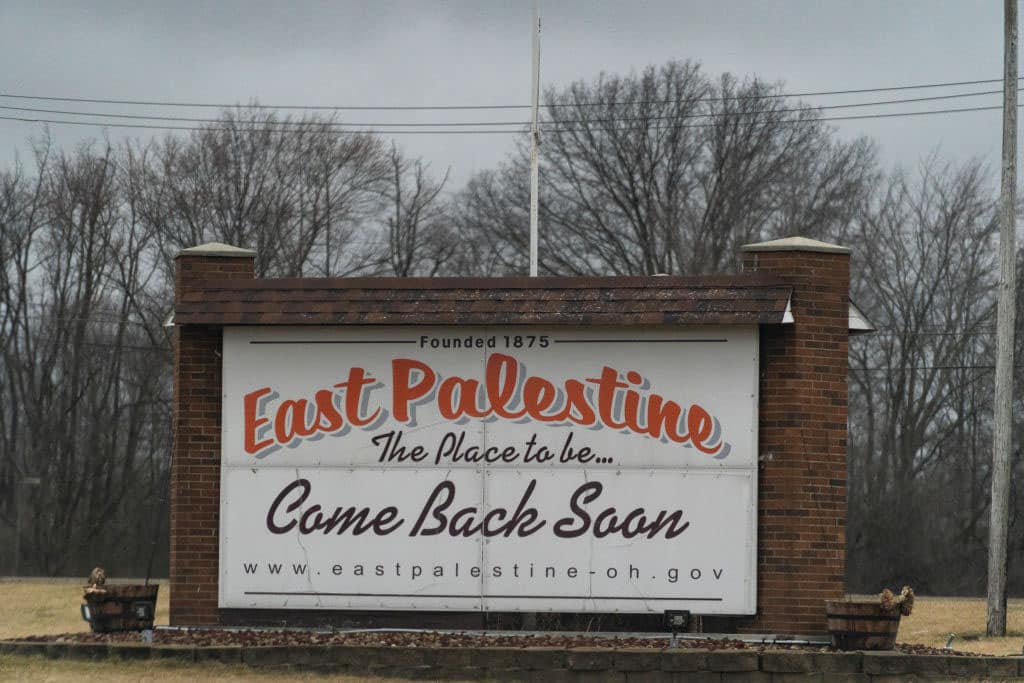
Why That Ohio Town Is Named “East Palestine”

A toxic spill has drawn the nation’s attention to the little town of East Palestine, Ohio, just as another tragedy, the explosion of the space shuttle Columbia in 2003, turned the nation’s gaze upon the town of Palestine, Texas, where much of the debris landed.

The tragic spotlight now shining on Ohio’s “East Palestine” naturally leaves some people curious as to why it has such as unusual name. The answer is that it’s not a very unusual name at all.

Elsewhere in Ohio, there are towns named Hebron, Gilboa, Canaan, and Shiloh (two of them, in fact). There’s even a Sodom, which was given its name after a prohibition advocate, disappointed at the small turnout for his lecture in 1840, jokingly compared the locale to that infamous biblical center of sin.

In Texas, in addition to Palestine, there are towns named Hebbronville and Joshua. There is a Hebron in North Dakota and a Sinai in South Dakota, a Jerusalem in Arkansas, a Jericho in Vermont, a Bethlehem as well as a Nazareth in Pennsylvania, and a Zion in Maryland. Nearly every state has one or more towns named after biblical sites or individuals. Altogether, there are more than 1,000 biblically-named towns from coast to coast.

Towns such as East Palestine, Ohio, were established by 19th-century religious Christian settlers; they chose those names to express their spiritual attachment to the land and people of the Bible. When they thought of Palestine, they recalled the Jewish kingdoms and temples of ancient times, as well as the events surrounding the origins of Christianity in the Jewish town of Bethlehem. In their prayers, they prayed for the return of the Jews to the Holy Land, which they understood to be inextricably linked to the coming messianic age.

The area that became East Palestine was originally known as Mechanicsburg. There are a number of towns in the U.S. that were originally settled by mechanics of various types. But in the case of Ohio, “Mechanicsburg” was changed in 1836 because—according to an early history of the region—“the wife of Dr. Robert Chamberlin desired a more euphonious appellation and desired it [be] called ‘Palestine,’ the quiet beauty of the little town, and the earnest, virtuous, simple life of its people suggesting to her a name recalling holy memories.”

Since there already was a town named “Palestine” in the western part of the state—likewise founded by religious Christians who wanted to infuse their town with “holy memories”—government officials, in assigning the new post office, added the prefix “East.”

That early account of East Palestine’s founding was published in 1905, when it was common for a married woman’s name to be hidden behind that of her husband. But a historical marker in front of the log house where the Chamberlins once lived tells us that the name of the doctor’s wife was Rebecca—an appropriately biblical name for a woman who took her Bible seriously.

Not surprisingly, numerous churches quickly sprung up in East Palestine and its environs. Lutheran and Reformed congregations established the Salem Church, choosing a name derived from “Jerusalem.” Evangelical Lutherans founded the St. Paul’s Evangelical Lutheran Church, while Methodists originally held their services in a local school—the separation between church and state was still rather fuzzy in those days—before eventually erecting their Methodist Episcopal Church. East Palestine also had a United Presbyterian Church and, later, another house of worship with a biblically-inspired name, the Zion Evangelical Lutheran Church. 

When America’s religious Christian settlers thought of the Holy Land, they thought of the Hebrew bible and the area’s 3,000 years of Jewish inhabitation, not the Koran or the more recently-arrived Arab residents of the area.

 When America’s religious Christian settlers thought of the Holy Land, they thought of the Hebrew bible and the area’s 3,000 years of Jewish inhabitation, not the Koran or the more recently-arrived Arab residents of the area. They thought of the many Jews who appear in the accounts of the birth of Christianity (including its founder), texts that do not mention any Palestinian Arabs.

Certainly Americans were aware that there were Arabs living in Palestine in the 19th century. Mark Twain, for example, had mentioned them in his account of his visit to the Holy Land, The Innocents Abroad (1869). So had Herman Melville in his famous Clarel: A Poem and the Pilgrimage in the Holy Land (1876).

But it was common knowledge that the Arab population of Palestine was relatively small and unsettled, and that the Arab residents of 19th-century Palestine regarded themselves as part of southern Syria, not as a separate nationality. H. Allen Tupper, Jr. wrote in the New York Times in 1896, after having “ridden on horseback more than four hundred miles through Palestine and Syria,” that virtually the only local people he encountered were “merchantmen with their long camel trains” and “wild Bedouin tribes” that “reside in one locality not more than two months.”

Today’s residents pronounce East Palestine “Palesteen,” but the original settlers undoubtedly pronounced it the more common way. Because it was the Holy Land, with its deep Jewish roots, that burned bright in the hearts and prayers of the founders of the many biblically-named towns across America. And it is for the same reason that Bible-believing Christians today—probably including more than a few residents of East Palestine, Ohio—constitute one of the major sources of pro-Israel sentiment in the United States.


Dr. Medoff is the author of more than 20 books about Jewish history and Zionism, including The Historical Dictionary of Zionism [with Chaim I. Waxman].

Why That Ohio Town Is Named “East Palestine” Read More »

Is This What Redemption Looks Like?

In a column I wrote a few weeks ago, I addressed the pain that sometimes accompanies the experience of prayer in a broken and unredeemed world. “​​It is frustrating to pray for the same things three times a day and not to get them,” I wrote. “It is frustrating to want a better world and not to have one.”

Today, I would like to take a different approach to this same issue, entertaining the idea that the requests we make in our prayers actually have been answered, especially those expressions of national longing for redemption that have animated the Jewish soul throughout history.

We pray for the ingathering of exiles, the rebuilding of Jerusalem, the return of Davidic rule, the restoration of the Temple service, and for peace. Is it really possible to say that these prayers have not been answered? After all, here we are—an ingathered Jewish people in a rebuilt and thriving Jerusalem in a sovereign Jewish state where Jewish religious practice and learning flourish. As for peace, we enjoy that too, in a relative, if not an absolute way.

If this isn’t enough for us, I can’t imagine what could ever be.

Then again, it isn’t enough, and the dominant feelings in Israel at this moment in history are anger, fear and resentment.

This is not because we are ungrateful. Our reasons for dissatisfaction are utterly legitimate. There remain societal inequalities, wars, internecine power struggles, and an unresolved conflict with the Palestinians. Moreover, the classic signs of Jewish redemption—the Temple service and a Davidic monarchy—have yet to materialize.

And so we have a difficulty—our prayers have been answered, but it doesn’t look or feel the way we imagined that it would. As Saint Teresa of Ávila said, there are more tears shed over answered prayers than unanswered ones.

Many religious Jews resolve this difficulty by referring to the state of Israel as the “first flowering of our redemption,” the first step in a process that will conclude with the coming of the Messiah and the end of history, war and strife.

This allows Jews to recognize with gratitude the significance of our historic moment, and yet preserves the Messiah as he who, in the words of philosopher Yeshayahu Leibowitz, is always on his way but who never arrives, perched eternally on the ever retreating horizon where we humans mount our most beautiful hopes.

And yet, by claiming that the Messianic process has begun, this shimmering vision is dragged—albeit partially—into the morass of the present, where it becomes distorted. Take, for instance, the idea of the Third Temple. For millennia, the restoration of the Temple on the Temple Mount has been central to the Jewish vision of future redemption, tied to notions of universal peace and accord. When this dream is brought into reality, however, it becomes political. Third Temple activists in Israel believe that a Jewish state ought to be building a Temple on the Temple Mount in the here and now, an idea with terrible implications for the Muslim holy sites on the Temple Mount. By forcing this dream into our waking reality, these activists have debased it. It is no longer a symbolic light, but an abhorrent form of fundamentalism.

And yet, by claiming that the Messianic process has begun, this shimmering vision is dragged—albeit partially—into the morass of the present, where it becomes distorted.

Another way to resolve the difficulty posed by the simultaneous sense of redemption and brokenness in our midst is to hold like Shmuel, the Talmudic sage who suggested that perhaps our expectations of redemption are unrealistic.

In the Talmud, Shmuel says that there is no difference between this world and the Messianic world (B. Talmud Shabbat 151b). It will not be, as perhaps one might think from the words of Isaiah, a preternaturally blissful utopia in which wolf lies down with lamb. Rather, according to Shmuel, the only change will be the release of the Jewish people from foreign subjugation. He bases this on a passage from Deuteronomy: “for there will never cease to be poor ones in the land” (15:11).

In other words, there will still be work to do in the age of the Messiah. Even in a redeemed world, there will be iniquities and inequities that require our concern and our action. As it is also written in Deuteronomy, “there shall be no needy among you” (15:4). Even though we know that this work of perfecting the world will never be complete, we will not be free to desist from it.

This has a ring of truth to it. The question is, do we want our idea of redemption to have a ring of truth? Is it better to let the vision of future perfection warm us like a flame in the long winter of history? Or is it better to accept redemption when it comes, as Shmuel would recommend, letting go of perfection so that we can get on with things—taking care of people in need and working to improve our lot without reference to unattainable utopias?

I continue to waver on this issue. The machlokets, disputes, that we carry on within ourselves are destined to endure—enlivening us as we pray, knowing not whether we are saying please or thank you.


Matthew Schultz is the author of the essay collection “What Came Before” (2020). He is a rabbinical student at Hebrew College in Newton, Massachusetts.

Is This What Redemption Looks Like? Read More »