fbpx

January 9, 2023

Education Dept. Delays Regulation Codifying IHRA for a Year

The Department of Education’s Office of Civil Rights (OCR) announced on January 4 that they are delaying a regulation codifying the International Holocaust Remembrance Alliance (IHRA) definition of antisemitism for civil rights investigations for at least another year.

The Algemeiner and Politico both reported on the delay of the regulation, but noted that OCR Assistant Secretary for Human Rights Catherine Lhamon wrote in a letter that “the rise in reports of anti-Semitic incidents, including at schools, underscores of addressing discrimination based on shared ancestry and characteristics.” 

Kenneth L. Marcus, who founded the Louis D. Brandeis Center for Human Rights Under Law and served as the Assistant Education Secretary for the Office of Civil Rights during the Trump administration, told Politico that while he was “disappointed” at the delay, he was “pleased” that Lhamon is utilizing the “bully pulpit” to fight antisemitism on campuses. Marcus also pointed to the fact sheet released by OCR explaining that students are protected under Title VI of the Civil Rights Act as further evidence that the Biden administration has embraced IHRA “very much an active part of policy” even if OCR hasn’t officially codified it. 

Conference of Presidents of Major Jewish American Organizations Chair Diane Lob and CEO William Daroff similarly said in a statement they were “heartened” that Lhamon “used the release of the fact sheet as an opportunity to confirm their commitment to enforcing the previous administration’s Executive Order on Combating Antisemitism, which incorporates the IHRA definition.” “We note our disappointment in the 12-month delay in the Department of Education’s promulgation of long-promised regulations to combat antisemitism, but in the interim look forward to engaging with the Department on other efforts to combat antisemitism in academic setting,” they later added.

The OCR regulation codifying IHRA was initially scheduled to go into place in September 2020, but was delayed until the following January due to a backlog at OCR. The subsequent Biden administration then delayed it again for January 2022, and then to the following December before the January 4 announcement. 

In a December 28 Journal op-ed, Marcus stressed the need for the Biden administration to utilize IHRA for civil rights investigations because prior to the definition “OCR was long rudderless in its efforts to address a form of hate which it simply did not understand. And absent such a formal definition, the agency was unable to handle systemic campus anti-Semitism cases for nearly a decade and a half following the initial 2004 guidance.” Current OCR guidance includes IHRA.

“President Biden has correctly identified the seriousness of confronting anti-Semitism,” Marcus wrote. “Now his administration needs to deliver a strong regulation to ensure, in his words, that evil will not win and hate will not prevail.”

Education Dept. Delays Regulation Codifying IHRA for a Year Read More »

The Invisible Jews

Should I start with the good news? Okay.

If you are a secular Jew who does not wear religious symbols, skullcaps and attire, isn’t walking toward a synagogue or waving an Israeli flag, and does not live in predominately Jewish neighborhoods in either New York City or London, chances are pretty good that you won’t end up as a statistic in the escalation of antisemitic hate crimes. (If you live in Paris or Stockholm, however, and you’re Jewish, it doesn’t matter what you’re wearing. You can dress like Dua Lipa, and the restive mob of Muslims who are on the lookout for anyone who might be Jewish will probably see through your disguise.)

Here’s the bad news: The overall number of antisemitic assaults has more than doubled in New York City, with Jews serving as the intended targets of 60% of all hate crimes. It does not apply to all Jews equally, however. According to a year-end report prepared by Americans Against Antisemitism, relying upon data supplied by the New York City Police Department, 94% of the reported incidents of violence between 2018 and 2022 were committed against Orthodox Jews, primarily in the neighborhoods where Hasidic Jews live.

Statistically speaking, a secular Jew can walk most city streets like an upright Episcopalian.

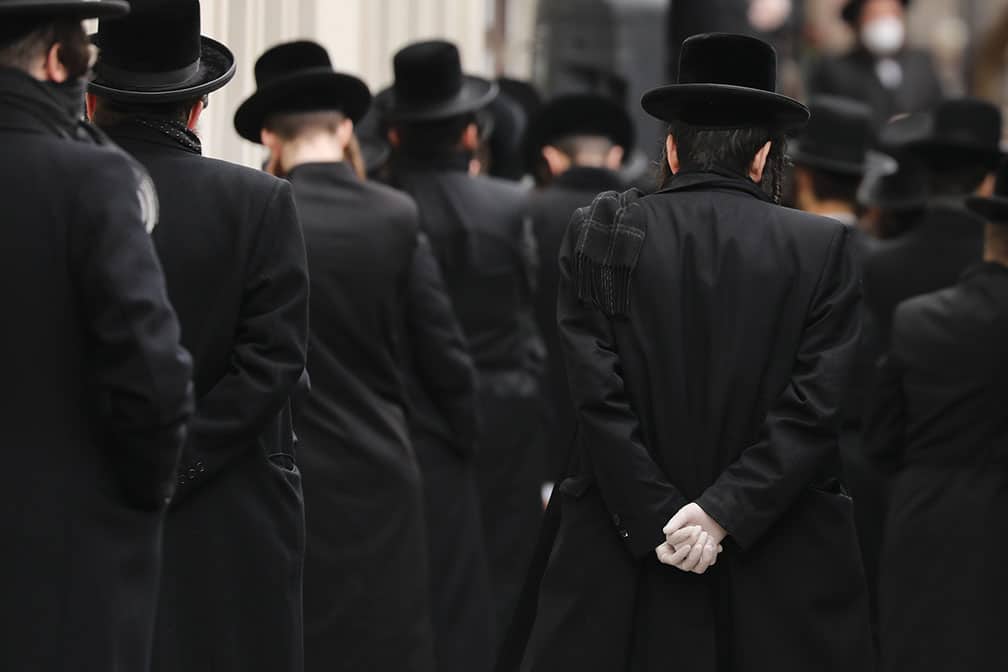
Religious Jews do not have the same luxury, however. Their dress may be modest, but it is also dangerously conspicuous. The sidelocks, long black coats, wigs and headscarves are obligatory. Hasidim live in free societies, but due to the frayed social fabric of the moment, they are un-free to go about their lives with any assurances of safety.

A tale of two Jewish communities: the vast majority ensconced within the population, while the rest, more devout, are mere sitting ducks.

But here’s the most alarming trend, unsurprising perhaps given the implicit marching orders of social media influencers such as Kanye West and Kyrie Irving: 97% of the perpetrators of these assaults against Jews are young persons of color, the vast majority of whom are African-American.

The religious Jews of London do not fare much better, although the overall levels of hate crimes are more widely dispersed within all minority groups. But the perpetrators of those crimes happen to be Muslims.

So much for white supremacy.

This surely comes as news to many, including the mainstream media, which rarely if ever deems violence against Jews newsworthy. They are nothing but forgotten footnotes in the larger story of spiking crime. It is, after all, politically incorrect to cast aspersions on communities of color. And since the overwhelming number of victims of these attacks are Hasidic, who are odd curiosities and cultural eyesores to most American Jews, no one seems to be paying attention and absolutely no one—least of all Jews—is sounding the alarm.

And it’s not like we haven’t been warned. Three years ago, before the pandemic, during Hanukkah in Williamsburg, Crown Heights, Borough Park, and Monsey, New York, and Jersey City, New Jersey, Hasidic Jews were killed, beaten, had their teeth smashed and faces slapped, eggs thrown at their children, wigs ripped from their heads, and a brick hurled through the window of a Hasidic girls’ school. Most of the assailants were Black, and the stories were grossly underreported.

Sure, there was a protest march over the Brooklyn Bridge, but it was sparsely attended, and solidarity from other minority communities was almost nonexistent. Jews, if they marched at all, marched alone.

No surprise there. As a substrata of American Jewry, the Orthodox are mere afterthoughts—even to Jews, who do not believe they are the Keepers of this particular set of Brothers. Far too many regard Hasidim as the “Deplorables” of the tribe, the outlying unvaccinated whose children are not even proficient in reading and math.

As a substrata of American Jewry, the Orthodox are mere afterthoughts—even to Jews, who do not believe they are the Keepers of this particular set of Brothers.

These invisible Jews, ironically, have become easy targets of hate. Theirs is the misfortune of sticking out even amid all that insularity. Hunted by Jew-haters, and haunted by the indifference of their landsman.

Jewish leaders have forsaken them, as well, but no more so than they have the general Jewish population. Elected officials and legacy organizations have been no-shows to the travails of secular Jewry, too. The failure of Jewish leadership is an old story, however. The organized Jewish-American community was fast asleep during the Holocaust, and they are no more alert today.

It doesn’t help that religious Jews tend to vote Republican, and were reliable Trump supporters. In the eyes of many, their shtetls are tantamount to Red States. Existing as they do on the wrong side of the political and cultural divide, there are few takers who feel responsible for their rescue.

That’s not something to be proud of. The out-casting of the Hasidim is unbecoming of Jews. And it’s not like the community has no capacity to stand up for each other.

Soviet Jewry, for instance, three million who fell on the wrong side of the Iron Curtain, was once as mysterious and forgotten as American Hasidim are today. In 1966, Elie Wiesel coined them as the “The Jews of Silence”—casualties of the Cold War, pawns on the stalemated chessboard of realpolitik.

But a grassroots movement of Jewish college students—the Student Struggle for Soviet Jewry—fresh from protesting against racial segregation, decided it was time to galvanize on behalf of the intrepid Jewish refuseniks of the Soviet Union. Yet another group, the Jewish Defense League, its members carrying baseball bats and pipe bombs, took a more militant approach in demanding the freedom of fellow Jews with whom they had very little in common.

For over two decades, largely without the assistance of mainstream Jewish organizations, Russia’s Jews slowly were allowed to emigrate until the Iron Curtain itself collapsed.

Brash Jewish leadership took other forms, too. The ADL, for instance, was once unapologetically in the corner of American Jewry and the State of Israel. Its former National Director, Abe Foxman, openly declared war against Mel Gibson after his drunken antisemitic rant. Nowadays, in response to far worse behavior, the ADL will, at first, accept a check and a perfunctory apology from Kyrie Irving. Gibson’s career never recovered. Irving, meanwhile, is back on the hardwood scoring buckets, despite his excuses holding no water.

And the Hasidic Jews who live in the same borough as the Barclays Center may be paying the price.


Thane Rosenbaum is a novelist, essayist, law professor and Distinguished University Professor at Touro University, where he directs the Forum on Life, Culture & Society. He is the legal analyst for CBS News Radio. His most recent book is titled “Saving Free Speech … From Itself.”

The Invisible Jews Read More »

What Israeli-Americans Might Understand More Than Others

Within the Jewish community, American Jews are typically known to experience the paradox of the comfort that comes with assimilation, and increasing hate crimes. Israeli Jews are known to have the freedom of Jewish self-determination and insulation, but with constant threats of terror and enduring warfare from their neighbors. What Israeli Americans may have that the latter two groups generally don’t is a more nuanced perspective of these collective realities, and the global Jewish community at large should heed their voices.

Israeli immigrants and their children in the United States comprise roughly ten percent of the American Jewish community today. These children recall the severity of stories about the Yom Kippur War, the Second Intifada and Saddam’s SCUD missiles. They also grow up learning the history of Jews who made their way to the United States pre- and post-Shoah, facing institutional discrimination like immigration and enrollment quotas, denial of employment opportunities, and KKK lynchings. But they’re also able to consciously bridge the recent experiences of Pittsburgh, Jersey City, and Colleyville with the ongoing Palestinian terror coming from the West Bank and Gaza Strip in a way that may be sharper than Jews who’ve known just one place. Israeli-Americans and their children may arguably better grasp the nuances of antisemitism, which has become politicized and increasingly diverse in sources.

Understanding the past and present matters for our future. When it comes to confronting internal challenges, such as how American politics may affect one-half of world Jewry in Israel and Israeli politics the other half in America and beyond, Israeli-Americans can serve as a balancing factor. Take, for example, former President Donald Trump’s repeated use of the antisemitic loyalty canard, his encouragement of the rioters of the Capitol on January 6, 2021, or his continuing affiliations with mogul and antisemite, Kanye West. Prior to these events, many young Israeli-Americans already understood (like most Jewish Americans) that President Trump was a severely polarizing figure who alienated many other communities of color that will soon be the majority U.S. electorate. Israelis, on the other hand were largely blinded by President Trump’s countless pro-Israel policies, many still viewing him as a messianic figure, without acknowledging how he threatened bipartisanship for the U.S.-Israel relationship and tried to destroy solidarity between Jews and other minorities in America more than his predecessors.

With regard to the new far-right government elected recently in Israel, many Jewish Americans are troubled by the aggressive posture of Prime Minister Binyamin Netanyahu in diplomacy with U.S. Democrats, without understanding how ongoing Palestinian terror despite countless Israeli peace offers has been the nail in the coffin for a Palestinian state (and much of the Israeli left) for years. Moreover, Jewish Americans are fearful that Israeli hawkishness will alienate American voters and sabotage the liberal basis that unites them with their non-Jewish American allies—some even asserting that antisemitic hate crimes are escalating under the excuse of Israeli governmental behavior. Israeli-Americans have taken a keen and steady approach, leading many efforts toward U.S. anti-BDS legislation and introducing IHRA and Holocaust education bills to address Jewish security in both Israel and America. They also comprehend the complexity and depth of Israeli policymaking in a dangerous region and are better equipped than many Jewish Americans to explain the strong emphasis on security with personal stories.

On the reciprocal end, American-Israelis and many other olim chadashim have unique potential to see where Israel is lacking in development and directly contribute to producing that change—including on populism and religion and state. A growing number are voluntarily serving in the Israel Defense Forces and making aliyah, returning to Israel as active citizens and organizing to combat polarization and extremism from both political aisles. Having experienced alienation for their Jewishness and Israeliness, Israeli Americans and American Israelis know that empathy is the key ingredient to any successful means of political discourse, particularly in a country as diverse, traumatized and divided as Israel.

The most sensitive but also most urgent question facing the common Jewish future is the question of identity. From the lessons of Hanukkah to the Holocaust, identity has become synonymous with the security and freedoms that Jews enjoy. As the only Jewish and democratic state and permanent refuge for Jews, the consolidation over disputed land (and religious authority for its Jewish citizens) are thus matters concerning the future of all world Jewry. Constructive criticism from Israeli Americans can better inform conversations on these issues and shouldn’t require anyone’s permission.

Constructive criticism from Israeli Americans can better inform conversations on these issues and shouldn’t require anyone’s permission.

As explained prior, the long-standing rightist political trend in Israel is well-founded. However, will Israel actually secure its Jewish character by hastening de facto unilateral annexation of the West Bank (Judea and Samaria)—absorbing millions of hostile neighbors in long-designated future Palestinian territory? Israeli Americans living outside this “End-of-Days” feverish hype might remark that it is not as promising as the tactical and consultative turn of early Zionist pioneers, who made great strides by appealing to the world through speech and secured development. In fact, it might severely downgrade Israel’s military, strategic and diplomatic advances by eliminating Palestinian autonomy for good. The sacrifice of more lives cannot guarantee these aspirations and ensure that the Palestinians comply. If Israel expels the Arabs, Israel would simply be exporting the launching pad beyond its border, as in the 1970s with the PLO in Jordan and Lebanon.

And on religion and state—is it sustainable and moral to have a growing sector of Israel’s population (haredim) willingly out of the workforce and conscription, while limiting the personal status liberties of secular and non-Orthodox Jewish Israelis? Again, in each of these existential cases, Israeli-Americans might have the insight and audacity to say no and provide alternative compromises. (The safest Jewish answer in uncertainty is that if Mashiach is to come, let him come in peace, not through war and theocratic coercion.)

Multiple truths stand from these realizations. Israeli-Americans may have a higher level of experience with both Israeli and American society and politics. When it comes to the experience of hate, all Jews are targets of Zionophobia and antisemitism, and at large must have the right to define the distinct hate that we experience for broader public understanding. However, one need not have a certain identity in order to have valuable insights or legitimate perspectives in one’s commentary—including on internal Jewish-American or Israeli affairs. Believing otherwise is an inherently limiting and fallacious concept. On any issue pertaining to any group, we could all learn from one another with empathy, regardless of our innate identities.

Simultaneously, what Israeli Americans may have to offer is a new political consciousness and force in the Jewish community that bonds common concerns to catalyze uncomfortable but necessary change, wherever Jews live. The hybridity of Israeli-Americans can teach us to recognize the inherent ties each of us bears to our respective struggles and seize our common Jewish future together.

Note: The views expressed in this article are solely the author’s and do not reflect the views of his employer, the IAC.


Justin Feldman is the Senior Program Manager of the Israeli-American Council (IAC) Mishelanu. You can follow him on Twitter @eishsadehy.

What Israeli-Americans Might Understand More Than Others Read More »