“I ask everyone here to open your heart and create space—space to speak up for your brothers and sisters in pain and fear,” said Grammy Award Winning Songwriter Autumn Rowe to a packed and star-studded crowd of entertainers and industry executives at Creative Community for Peace’s 4th Annual Ambassadors of Peace Awards Gala on October 26th in Beverly Hills.
Rowe – one of the evening’s honorees – grew up in the South Bronx in a Black Jewish family and is a well-known activist in the fight against racism and antisemitism in the entertainment industry. She powerfully captured the attention of the attendees, challenging them to act in response to rising anti-Semitic sentiment.
“I ask that when you hear stereotypes casually mentioned in rooms, whether they are antisemitic, racist, sexist, or in any way hurting a collective group of people, find the courage to say, ‘Hey, that’s actually not true and quite hurtful, and here’s why…’”, she said.
In recent years, Creative Community for Peace (CCFP) has emerged as Hollywood’s homegrown, go-to resource on issues related to anti-Semitism and the cultural boycott Israel. Whether artists are carelessly sharing antisemitic memes on social media or musicians are boycotted for performing in Israel, CCFP has worked closely with entertainers and their management to step in and support artistic freedom, build cultural bridges and counter BDS.
With the confluence of entertainment leaders and creative artists addressing antisemitism on that very day, the event felt more like an emergency meeting than a mere celebration of ambassadors of peace.
One of the honorees this year was actor and comedian Eugene Levy, known for his acclaimed roles in “Schitt’s Creek,” “American Pie,” “Best in Show” and “A Mighty Wind.”
Levy spoke to the attendees about the lessons he learned encountering anti-Semitism early in life, when he ran for class president of his high school in Hamilton, Ontario. During his campaign, someone crossed out his last name on all of his campaign posters and etched the word “Jew.” The young Levy would then address the incident with poise in a speech to the student body—by calling out the unknown vandal to look in the mirror, and then asserting his own pride in indeed being Jewish. Levy subsequently won the election.
“What I took away from that as a 17-year old was, wow, if you can actually get people to a point of feeling shame for their own despicable thoughts and actions or for following the despicable thoughts and actions of others, then that can be a giant first step in turning heads and eventually eradicating hatred and bigotry,” Levy said.
Levy spoke with the Journal about the importance of the work CCFP is doing.
“Well, you just have to look around, see where we are in the world, see where this country is, see what’s going on in Europe—antisemitism on the rise, racial hatred, bigotry is on the rise,” Levy told the Journal. “Everything is peaking. We’re in a lot of trouble unless we find a way of addressing it. This is one way of addressing it. Positive things can be done when people work together.”
Autumn Rowe told the Journal that despite the tense climate, the CCFP event gave her hope.
“If we all just do like 5% better, I feel like we’re going to make a huge impact,” Rowe said. “We have to have these conversations. Even if they’re difficult, as to why these things are hurtful.”
Other Ambassador of Peace honorees that night were David Dedeck (Global Co-Head of Music at United Talent Agency), Brandon Goodman and Danny Rukasin (co-founders of Best Friends Music), and Darren Star (creator and showrunner for “Emily in Paris,” “Beverly Hills 90210” and “Sex and the City”).
Several honorees from the previous three years were in attendance, including Diane Warren (13-time Academy Award-nominated songwriter), Ben Maddahi (Senior VP of A&R at Columbia Records & President of Unrestricted), Aton Ben-Horin (Global Vice President, A&R, Warner Music Group) and Traci Szymanski (President of Co-Star Entertainment).
The leaders of CCFP had some of the most fiery words of the evening.
“If you’re an artist, we encourage you to go perform in Israel,” said CCFP director Ari Ingel. “It is literally where Jews, Arabs, Muslims, Christians, Druze, black, white, all come together to watch their favorite bands and to support their favorite teams—to bond. And they can walk in the shoes of artists like Paul McCartney, One Republic, Alicia Keys who brought a message of peace with them.”
David Renzer, co-founder of CCFP (and Former Chairman/CEO of Universal Music Publishing), spoke directly about Kanye West’s anti Semitic remarks.
“We support every entertainer’s right to free speech, but no one has a free pass to target and demonize a minority group with such malice,” said Renzer. “We are gravely concerned about the impact of these statements and how they will affect [Kanye’s] fans, particularly young people. At the same time, we hope this could be a moment that ultimately creates better awareness about the dangers of antisemitism for Ye’s fans and other entertainers.”
CCFP co-founder Steve Schnur (also Worldwide Executive and President Music at Electronic Arts) implored the crowd not to stay silent.
“Hate is no longer staying silent, neither can we,” Schnur said. “For the sake of our industry, our integrity, and the very survival of our shared humanity, speak up. March if you’re asked. Scream if you must. Link arms and stand your ground. Be a loud voice. Be the change.”
A reporter once asked Michal Shahaf, a digital and social entrepreneur, if she was hoping that her unique social-musical initiative, Koolulam, would bring peace to the world.
Shahaf, Koolulam’s co-founder and CEO, said her ambitions were more modest than that.
“I laughed and said, ‘Unfortunately, no, but what we are trying to do is inspire people,’” Shahaf recalled. “This inspiration can manifest in a lot of different ways. One person looks and changes his mind about Israel. Another person might want to initiate this kind of event in his community. And another person smiles who wasn’t supposed to smile that day.”
For the past several years, Koolulam has been bringing unexpected smiles to large groups of people by staging mass singing events. Under Koolulam’s direction, groups of non-professional singers from all walks come together to form a collaborative musical creation featuring an original three-part vocal arrangement.
Think of it as a flash mob, but with singing instead of dancing.
Previous crowds orchestrated by Koolulam have included Matisyahu’s “One Day,” Imagine Dragon’s “Believer” and Bob Marley’s “One Love.”
The performances have been captured in online videos that have garnered millions of views.
“We feel privileged we have the ability to show another face of Israel from what people have seen throughout the world,” Shahaf said in a recent phone interview from her home in Ramat Golan.
On Dec. 15, Koolulam is performing at the Saban Theater in Beverly Hills, marking the group’s first appearance in Los Angeles.
Koolulam – which combines the word, “kululu,” an Arabic expression for
“happiness,” with “kulam,” the Hebrew word for “everyone” – was founded in 2016. It’s led by Shahaf as well as Israelis Ben Yaffet and Or Taicher.
At Koolulam events, Yaffet appears onstage with a band. With his long, brown curly locks, he’s the face of Koolulam. He is also creative and musical director. Taicher serves as artistic director.
Yaffet typically spends less than an hour training the audience how to sing the song. For those who’ve never sung publicly before, the experience can be intimidating, Shahaf says.
“The biggest challenge for people participating for the first time is to let themselves free and let themselves go and really sing. But I can tell you, one of the most beautiful things I see at our events is how people come in, and how they go out,” she said. “When they come in, they’re suspicious, distant, closed. And when I see them at the end of the event, they’re hugging, dancing, and singing together.”
In 2019, marking Breast Cancer Awareness Month, Koolulam led more than 2,000 men and women in singing “Let’s Get Loud” by Jennifer Lopez. Somehow, a video of the performance reached the pop star, and Lopez contacted Koolulam about using the group’s unique arrangement for her then-upcoming 2020 Superbowl halftime performance.
Of course, Koolulam gave Lopez their blessing.
“This song is very close to our hearts,” Shahaf said.
Koolulam had originally planned to come to Los Angeles in 2020, but COVID-19 derailed their plans. Like many organizations, the pandemic forced Koolulam to pivot. The group began sending at-home tutorials for participants to use in recording themselves singing sections of a song. With this method, Koolulam created a video collage of people singing the soaring Coldplay ballad, “Fix You,” with 5,000 participants from 66 countries taking part.
This type of bridge-building work is familiar terrain to Koolulam. In 2018, in honor of a historic visit to Israel by a Muslim religious leader from Indonesia, the group staged a performance of Bob Marley’s “One Love.” 1,000 Jews, Christians and Muslims sang the uplifting reggae song in Hebrew, English and Arabic at the Tower of David in Jerusalem.
“We use the platform of Koolulam to promote social agendas, and when we want to bring a specific social agenda, we think about the lyrics and song that will best describe that agenda,” Shahaf says. “The song is becoming the script of the event.”
From left: Koolulam co-founders Or Taicher, Michal Shahaf and Ben Yaffet. Courtesy of Koolulam
Next year, Koolulam is participating in a two-year study, funded by the Templeton Foundation, that’ll measure the effect of religious and spiritual activities on people’s lives.
Koolulam is one of 12 groups participating in the study, which is being led by Shira Gabriel, a professor of psychology at the University of Buffalo.
Shahaf has observed the psychological effect singing in large groups has on people. The experience, she said, can be transformational.
“Music is an international language, and it has the ability to cross borders, cultures and religions,” she said. “At a Koolulam event, participants – it doesn’t matter who they are, which God they believe in, or who they are going to sleep with at night. All that matters is they want to be part of this mission, this group and bring their voice to this group. And to go through this process together.”
America has long played an indispensable role in not just supporting Israel militarily but also in providing the country critically necessary political support in often antagonistic international bodies, where the one Jewish state is badly outnumbered by its many adversaries. On numerous occasions, the United States has cast the lone veto in the UN Security Council against a hostile resolution. Without the U.S., Israel would be badly isolated in the world. Its pro-Israel posture is predicated on public support for the Jewish state, which appears to be waning in key sectors of the public. Understanding the now potent ideological forces at work undermining this support for Israel is crucial if we are to stem the tide. These impulses are not isolated, but instead are part of a larger sorting trend in the nation today.
For decades, in the conflict between Israel and the Palestinians, the American public has sided with Israel. In fact, in recent years it has done so by rather hefty margins. Consistent with many earlier surveys over the years, the 2022 Jewish Institute for Liberal Values (JILV) survey of likely voters in the U.S. found that Israel sympathizers out-number Palestinian sympathizers by almost a 2:1 ratio, or 39% to 21%, to be exact. And if we focus upon those with strong feelings—those who strongly favor Israel or strongly favor the Palestinians—the pro-Israel advantage in the American public grows to nearly 3:1 (22% for Israel vs. 8% for the Palestinians).
Adding to this narrative, pro-Israel profile feelings emerge from another key question in the JILV survey. The question asked about competing images of Israel, giving respondents two dramatically opposing choices in how to characterize Israel in its conflict with the Palestinians. Respondents could choose to see Israel as “an occupier and a colonizer using modern military power to attack defenseless Palestinian civilians to steal more indigenous Palestinian land.” Alternatively, the likely voters could choose the pro-Israel option: “Israel is a sovereign nation which has the right and the obligation to defend itself from terrorists intent on killing civilians.” So, is Israel seen as an occupier and colonizer or as a nation defending itself?
Once again, the results favor Israel by a 2:1 margin. As many as 51% see Israel as sovereign with the right to defend itself from terrorists, while just 22% see Israel as an occupier and colonizer attacking defenseless Palestinians.
But while the overall margins certainly speak to widespread support for Israel in the American public, a closer look points to long-term trends that are not at all reassuring to pro-Israel supporters. Specifically, generation-related variations contain some rather dramatic differences between older and younger generations of Americans, best illustrated by the many sizeable gaps between Boomers, now age 58-76, and Millennials, those between 26 and 41 years old.
A Generational Shift in the Works?
Among the Boomers, on the who-do-you-favor question, Israel sympathizers outnumber Palestinian sympathizers by over 4:1 (52% vs. 12%). But among the Millennials, Israel sympathizers and Palestinian sympathizers are almost equal in number (31% vs 29%). A 40 point pro-Israel margin among the Boomers drops to a two point pro-Israel advantage among the Millennials, amounting to a 38 percentage change in one generation, consistent with wider trends in America political culture.
Just as the balance of Israeli vs. Palestinian sympathies have shifted, so have the contrasting images of Israel. Among the older crowd, Israel-as-sovereign outnumbers Israel-as-occupier by a 6:1 ratio (66% vs. 11%). But among the younger generation, the gap narrows considerably to 41% vs. 33%, amounting to a net change of 47 percentage points from the Boomer to the Millennial generation.
In short, in light of the inevitable process of generational succession, the U.S. is rapidly shifting its sympathies away from Israel and beginning to view Israel less favorably.
In short, in light of the inevitable process of generational succession, the U.S. is rapidly shifting its sympathies away from Israel and beginning to view Israel less favorably. The patterns here help explain why the college campuses (filled with 18-24-year-olds) seem so markedly unfamiliar to the current students’ parents and grandparents. Indeed, the youngest adults, Gen Z, move even further away from Israel than the slightly older Millennials.
The Power of “Woke” Culture, or Progressively Distant from Israel
In good measure, the shift among the younger Americans can be attributed to recent currents in political and cultural identities. Being left or right, progressive/liberal or conservative is of far greater consequence today than in recent decades. Identity politics has become hugely salient in terms of thinking about power and social organization and has reorganized and shaped how many Americans see themselves and interact with others. And, today, attitudes toward Israel are most certainly tied to political/cultural identities and, more specifically, the rise of “woke” culture, as some call it.
Asanka Ratnayake/Getty Images
Support for Israel is a potent and troubling example of how identity politics has played out in the past half century. Specifically, at one time—certainly in the ’50s, ’60s and ’70s, if not later—Israel was more popular among American liberals than conservatives. Images of kibbutzim, democratic socialism, the Histadrut (Israel’s AFL-CIO) and American folksingers visiting and supporting Israel all contributed to Israel’s special standing among American liberals. But at some point, the political alignment with Israel changed. Today we are in a situation where the right is far more pro-Israel than the left as the 2022 JILV survey clearly documents.
Take variations in Israel-related views by party affiliation as one key piece of evidence. Among Republicans, Israel sympathizers lead Palestinian sympathizers by an overwhelming margin of more than 4-to-1 (54% to 13%). Even among independents we find a strong lead for Israel. But among Democrats, Israel sympathizers trail Palestinian sympathizers by seven points: 25% vs. 32%. In short, the net difference in Israel and Palestinian sympathies between Republicans and Democrats amounts to a whopping 48 percentage points. (Incidentally, the JLIV results for partisan differences among likely voters largely parallel those reported by Gallup in March 2022 for all Americans. For Gallup the net difference between Republicans and Democrats was even larger—62 percentage points, suggesting that the JILV survey may actually understate the partisan gap in Israel support.)
Of course, with partisan differences so pronounced it is no surprise that political ideology also sharply differentiates the public with respect to Israel-related attitudes. Indeed, Israel-related attitudes vary dramatically with political ideology, that is, seeing oneself as liberal, moderate or conservative.
Conservatives overwhelmingly sympathize with Israel over the Palestinians (60% vs. 11%). Liberals, for their part, less often sympathize with Israel and more often sympathize with the Palestinians (26% vs. 35%). And the few self-defined progressives among likely voters are almost as lopsidedly pro-Palestinian as conservatives are pro-Israel (18% favor Israel vs. 67% who favor the Palestinians).
In line with these patterns, by more than 4-to-1, conservatives see Israel as a sovereign democracy rather than as an occupier (66% vs. 15%). Among liberals, the two images are almost tied (39% vs. 32%), and among progressives, the image of Israel as occupier (46%) clearly outpaces the idea that Israel is a sovereign nation with the right to defend itself (29%).
To further examine these issues, we turn to the related matter of “woke” culture. Recent years have witnessed the rise of a “woke” ideology alongside and in consort with shifting and polarizing political identity.
We define woke culture as an ideological predisposition to see the world as divided between the powerless and the powerful, the oppressed and the oppressors, and to attribute disparities among peoples and groups to perceived power differentials, and to assign moral superiority to the oppressed. Woke culture tends to claim that the oppression/oppressed binary is the only acceptable explanation for why some groups of people thrive more than others in our society, and harshly condemns any and all other explanations (hence the term “cancel culture”). Woke culture has its roots in post-modern thought beginning in the late 1960s, which slowly but surely gained the upper hand in Humanities departments in many universities. Postmodern thought holds that knowledge is not objective but is socially constructed to maintain oppressive systems of power. In this view, knowledge—what people think they know about the world—is constructed by powerful forces in society in ways that benefit the powerful.
We define woke culture as an ideological predisposition to see the world as divided between the powerless and the powerful, the oppressed and the oppressors, and to attribute disparities among peoples and groups to perceived power differentials, and to assign moral superiority to the oppressed.
According to postmodern theory, oppressive power systems permeate every nook and cranny of society but are hard to see because they are so deeply embedded in our lives. Victims of oppression, postmodernists argue, have sole authentic insight into these hidden forces and are thus uniquely qualified to define and comment on them for the rest of society. In this framework, knowledge is tied to identity and an individual’s perceived position in society in relation to power. While such a worldview may seem entirely esoteric, it has “escaped” the academy and become a pervasive belief system evident in numerous American institutions, from scientific publications to legal bodies to institutions promoting fine art and poetry. And it is profoundly impacting our politics.
We measured woke ideology by drawing upon and combining five questionnaire items that tap into different features of woke culture. The five areas are: favoring Critical Race Theory, favoring Diversity, Equity and Inclusion, seeing gender as fluid rather than fixed, viewing People of Color and LGBT individuals as having too little power, and seeing white people as benefiting from privilege. Depending on the respondents’ cumulative score, we divided them into four groups ranging from “low” (23%) to “very high” (14%).
The results for woke ideology and Israel-related views mirror those for political ideology and partisanship. Among those who score low, Israel sympathizers outpace their pro-Palestinian counterparts by 7 to 1 (56% to 8%). The pro-Israel balance diminishes with each increase in wokeness, such that in the top woke category, Israel sympathizers trail Palestinian sympathizers (25% vs. 31%).
We see similar variations along the woke spectrum with respect to images of Israel as a sovereign nation defending itself against terrorists vs. as an occupier. Among the low-woke group, Israel sovereign nation beats occupier by a 7 to 1 ratio (70% vs. 10%); among those scoring very high on the woke index, images of Israel as a sovereign nation defending itself actually trail those of Israel as occupier (32% vs. 36%). Once again, high-woke vs. low-woke are dramatically different with respect to views of Israel, Palestinians and their conflict.
Putting all this together, the more woke one is, the less likely they are to hold pro-Israel views.
Putting all this together, the more woke one is, the less likely they are to hold pro-Israel views.
And wokeness is not merely correlated with Israel-related attitudes; it plays an important role in shaping those attitudes. A statistical analysis we undertook showed that party affiliation per se (Republican, Independent or Democrat) makes little difference in Israel-related attitudes once we control for political identity (conservative, moderate, liberal, progressive) and woke ideology. But, that said, political identity and woke ideology are about as equally as powerful in predicting pro-Israel feelings. Political identity matters, but so does woke ideology.
The Tide is Turning—Ominously
The long-standing widespread support for Israel in the American public is clearly at risk. As we have seen, pro-Israel attitudes are less frequent among younger likely voters than their parents’ generation. And we’ve seen that with respect to pro-Israel attitudes, Republicans surpass Democrats, while conservatives out-score liberals and progressives, and low-woke exceeds high-woke individuals.
The long-standing widespread support for Israel in the American public is clearly at risk. As we have seen, pro-Israel attitudes are less frequent among younger likely voters than their parents’ generation.
What’s more, the very groups that are associated with lower levels of support for Israel are also the groups that are more populous among younger than among older adults. While Republicans outnumber Democrats by more than 2:1 (49% vs. 20%) among Boomer voters in the JLIV survey, the reverse is true among Millennials (27% vs. 49%). Similarly, among Boomers in the sample, conservatives hold the lead over liberals by a wide margin (52% to 16%), while the reverse is true among Millennial likely voters (27% vs. 47%). And we see a similar pattern with respect to those low or very high on the woke index: 34% vs. 8% among Boomer likely voters, and 10 vs. 20% among the Millennials.
On all three measures, younger (Millennial) likely voters are far more left-leaning than older (Boomer) likely voters. And given the tendency for Democrats, liberals/progressives, and highly woke people to score lower on Israel support, we can readily anticipate further erosion in Israel support in the years to come, as generational succession inevitably unfolds.
The Broader Context: Sorting and Polarization
Putting all this together, what the JILV survey powerfully documents is a troubling phenomenon that has pervaded the larger American political system today: namely political sorting. In its most basic form, political sorting, which is often confused with polarization, is a fairly new phenomenon and is where ideological and attitudinal positions no longer vary but are expected to align to particular liberal or conservative attitudes. The result today is that Democrats are more uniformly left-leaning and Republicans are more uniformly right-leaning than they were decades ago. Both the left and the right promote packages of ideas and attitudes that must be adopted wholesale if one is not to fall into disfavor. Today, dissent and divergence become almost impossible if one is to avoid adverse social consequences and possibly real professional ramifications as well. And for macro-political development, as Democrats are more habitually liberal and Republicans become more conservative, compromise and bipartisanship becomes harder to achieve. This is exactly what is happening with respect to Israel and ideology and represents an existential threat to the Jewish community and American support for Israel as well.
Both the left and the right promote packages of ideas and attitudes that must be adopted wholesale if one is not to fall into disfavor.
The recent uproar at Berkeley Law School is a case in point. Nine student groups at the law school banded together to amend their bylaws so as to exclude any Zionist speaker from ever speaking at the law school. That Women of Berkeley Law, the Asian Pacific American Law Students Association and the Law Students of African Descent felt compelled to join forces with the Middle Eastern and North African Law Students Association in this endeavor, illustrates how powerful this ideological sorting can be. Under the guise of intersectional solidarity, groups that have nothing to do with the Middle East conflict institute a litmus test that permanently excludes the vast majority of Jews who believe Israel has the right to exist as a Jewish state. To be part of the community of the good is to expel people with improper beliefs.
More specifically, to understand sorting what is critical to understand is that the electorate has not changed significantly in the aggregate as generations have aged in and out, but voters have sorted. Consider that in the 1990s there were many pro-choice and pro-immigration Republicans and pro-gun Democrats. These variations have disappeared with issues all lining up on the left or right such that if you are a Democrat, you have to believe and promote a particular agenda wholesale and thus one can predict an individual’s political positions based on partisanship alone. Thus, the United States is experiencing increased partisan polarization now even though Independents have grown as a share of the electorate while the number of partisans has shrunk
Turning to the JILV survey itself, support for Israel has become part of the larger political sort of the American public. Today, vast majorities of Republicans support Israel, while Democratic backing is much lower. To be on the left these days means that one cannot support Israel and be ideologically pure; backing Israel is a conservative value and that line cannot be crossed in the ideologically sorted world of today. Thus, it is also the case that those who score lower on the woke scale are appreciably more aligned with Israel than those who are highly woke. Attitudes toward Israel are now part of the liberal or conservative packages that partisans must uniformly adopt, constituting a new norm in American politics evident in the data here. As Abrams and Wertheimer pointed out, sorting has become so deep that it has influenced views and sharply divided Americans on ideas as varied as the nuclear family, the structure-enabling philanthropy and, of course, the police and justice systems.
To be on the left these days means that one cannot support Israel and be ideologically pure; backing Israel is a conservative value and that line cannot be crossed in the ideologically sorted world of today.
Moreover, views toward religion, tradition and history have become part of the story now. To be liberal today means real disdain for people of faith and their rights to religious liberty including support for Israel, while conservatives take the exact opposite approach. As Zaid Jilani has written with respect to race, the vision of the now sorted left is one where, “America isn’t a land of opportunity. It’s barely changed since the days of Jim Crow. Whites, universally privileged, maintain an iron grip on American society, while nonwhites are little more than virtuous victims cast adrift on a plank in an ocean of white supremacy.” The emergent narrative and anti-racist policy positions are now stories, “where whites are the villains and minorities are the victims” making “honest discussion of why homicide is the leading cause of death for young Black men … off limits” for instance. The JILV data show the exact same trend with respect to Israel; support for Israel, even with its faults and complex narratives, is simply on the wrong side of the story and cannot be supported if you are on the liberal side of things.
Given the growth of woke culture and the inexorable sorting process in American political life, friends of Israel must ask themselves some tough questions: Should they continue to focus attention on progressives with deeply held woke commitments who seem to be sorting themselves out of support for Israel, or seek to strengthen support among those who don’t share those ideological commitments and are more inclined to support Israel? To what extent should friends of Israel continue to focus efforts on making Israel’s case in the public realm, and to what extent should they join forces with others in opposing the ideology that gives rise to the growing antipathy toward the Jewish state?
Now is a good time to rethink the mainstream Jewish posture in American politics.
Samuel J. Abramsis a professor of politics at Sarah Lawrence College and a nonresident senior fellow at the American Enterprise Institute. Abrams is currently on the Board of Directors of FIRE.
David Bernstein is the founder of the Jewish Institute for Liberal Values (JILV.org) and author of “Woke Antisemitism: How a Progressive Ideology Harms Jews.”
Whomever is handling publicity for Adolf Hitler these days is, admittedly, doing a nice job. After all, since 1933 the world’s most notorious homunculus has always been treated like an unmentionable monster, a historical leper, incurably too far gone for spin doctors.
And yet, Hitler has never received this much favorable attention—arguably not since he was Time Magazine’s Man of the Year in 1938. Alt-right fan boys are “Sieg Heiling” him from the hinterlands of America. Black Hebrew Israelites are combing through “Mein Kampf” for helpful Jew-hating tips.
There’s the documentary touted and tweeted by Kyrie Irving, which, among other blood libels, denies the reality of Hitler’s most appalling achievement: the elimination of two out of every three European Jews. An Illinois congresswoman praised him in 2021. Kanye West celebrated this past Thanksgiving by announcing that he likes Hitler and loves Nazis.
Get ready for goose-stepping as the latest cardio-fitness trend.
Suddenly, Hitler has a Favorability Score the envy of Harvey Weinstein, Bill Cosby and Jeffrey Epstein combined!
How is it conceivable that of all people, Hitler and his Master Race delusions are receiving a pop-cultural makeover? Hitler is suddenly kosher for non-Jews, no longer demonized by everyone, but now lionized by far too many. Less than 80 years since he succumbed to cyanide in that Berlin bunker, Hitler has improbably become resurrected—mentioned favorably, even by famous people.
Since the Golden Age of cinema, Nazis have been the proverbial bad guys—worse than black-hatted cowboys or mobsters toting Tommy Guns. It used to be the case that when you saw the uniform of the Brown Shirts, Storm Troopers or the dreaded SS, you knew instantly who the movie hero needed to vanquish—and in a hurry.
This was true in romance fare like “Casablanca,” or high-octane action flicks like the Indiana Jones franchise, or revenge-porn such as “Inglorious Basterds,” or in the heavies in Marvel’s “Captain America” and “Wonder Woman.” When Charlie Chaplin turned his lovable Tramp loose against the Teutonic despot in Germany, he spoofed the Fuhrer as a psychotic, narcissistic buffoon in “The Great Dictator” (1940). So unlikable and un-bankable were the Nazis that Mel Brooks wrote a satirical movie, and then a play, about a Broadway musical, “Springtime for Hitler,” that was sure to fail.
Indeed, Hitler was so diabolical that he himself was usually not depicted in films. Sure, his handiwork and henchmen were on the screen, but he was in the shadows, rarely given an opportunity to step in front of the camera. He was simply too despicable, too dark for the spotlight, too inhuman for flesh and blood treatment.
Indeed, in the rare occurrence where he received top billing—the television mini-series, “Hitler: The Rise of Evil” (2003), the films, “Max” (2002) and “Der Untergang” (2004)—critics, Jewish groups and audiences largely rejected these productions precisely because they sought to humanize Hitler, make him more sympathetic and kindhearted in his treatment of children, secretaries and even dogs.
Notably in these more Hitler-friendly times, “Jojo Rabbit” (2019), a satirical comedy in which Hitler is portrayed as the imaginary friend of a boy in the Hitler Youth, the Third Reich is deemed no worse than the Proud Boys or Oath Keepers. The film earned three Academy Awards, including one for Best Picture.
What is the meaning of this madness?
For one thing, standards for nearly everything have collapsed. Inflammatory, guttural language is splashed around like holy water. Not a day goes by when an innocuous faux pas isn’t mischaracterized as an indictable offense. Half the population believes the other half are morally defective. Language loses all meaning when charges fly so effortlessly.
Moreover, it doesn’t help when ordinary political discourse is so coarsened that opponents are casually referred to as “evil” and led by generic “Hitlers.” When the truly vile is trivialized and monsters are normalized, the hierarchies denoting the “worst-of-the-worst” topple over into an all-purpose, indistinguishable villainy. Evil is suddenly relativized, the kind of banality Hannah Arendt got wrong—Adolf Eichman and Hitler, most assuredly, were in a league of their own.
When the truly vile is trivialized and monsters are normalized, the hierarchies denoting the “worst-of-the-worst” topple over into an all-purpose, indistinguishable villainy.
Hitler’s manifesto, “Mein Kampf,” entered the public dolman in 2016. It sells briskly and might also explain how Hitler’s persona and worldview penetrated the public sphere.
And then, of course, there’s Donald Trump, an authoritarian by nature who admires political strongmen. Trump was no Hitler no matter how much his political enemies sought to draw the comparison, but the demagoguery, mass rallies and even his attacks on the press were straight out of Hitler’s playbook. The “fake news” of today was Hitler’s lügenpresse (lying press). The only difference is that Trump was largely right about the Fourth Estate that reports on the news today.
Early on, Trump seemed reluctant to criticize the more violent factions of the extreme right. He claimed not to know who David Duke was. During a debate he directed the Proud Boys to “stand back and stand by.” His reaction to the fascist side of the Charlottesville rally was tepid, at best. He obtusely, if not disingenuously, ignored that some of his supporters wished to reenact Hitler’s Beer Hall Putsch, which, tragically, is what the riotous elements of January 6th resembled most.
We have now reached a new low point. Trump incongruously invited Kanye West (”Ye”) and Holocaust denier Nick Fuentes to Thanksgiving. Imagine if had dined with someone who openly declared that Black Americans were never enslaved in the United States, that the southern plantations were, in actuality, winter colonies for vacationing African Americans?
To deny the Holocaust is the “N-word” for Jews. Breaking bread with Hitler lovers and Holocaust deniers is breaking a bond with the Jewish people. Worse still, rather than apologize, Trump is now lashing out at Jews for their “lack of loyalty” toward him.
He is, and remains, a man of such incomparable thin skin. So needy of flattery, he would deny no one an audience if it resulted in a compliment.
This time he made a serious mistake. Despite what Ye might think, Jews don’t hand out blank checks. Trump’s unprecedented support for Israel is greatly appreciated, but it does not render him immune from charges of complicit antisemitism. There is no lifetime exemption from justified criticism and outrage, especially when he exercises such poor judgment in composing a guest list.
Trump’s self-destructive impulses prevented him from regaining the White House in 2020. All he had to do was keep his mouth shut. In 2024, it might come down to his failure to do the same thing with his front door.
Thane Rosenbaum is a novelist, essayist, law professor and Distinguished University Professor at Touro University, where he directs the Forum on Life, Culture & Society. He is the legal analyst for CBS News Radio. His most recent book is titled “Saving Free Speech … From Itself.”
One verse, five voices. Edited by Salvador Litvak, the Accidental Talmudist
When Midianite traders passed by, they pulled Joseph up out of the pit. They sold Joseph for twenty pieces of silver to the Ishmaelites, who brought Joseph to Egypt.
– Genesis 37:28
Kylie Ora Lobell Community Editor at the Jewish Journal
Whenever I hear the story of Joseph, I think of the phrase, “Why do bad things happen to good people?”
Joseph was an incredible person and yet, his brothers tried to kill him. Then, he was sold into slavery and imprisoned and faced a number of other challenges. In the end, though, because he was taken to Egypt, he saved his family and everyone around him from starvation.
Joseph forgave his brothers for what they did to him because he saw that it was all part of God’s plan. Sometimes in life, we can see why bad things happen to us. Challenging and traumatic events may make us stronger or change our worldview for the better or enable us to fulfill our ultimate purpose. Joseph could clearly see that.
Sometimes in life, we cannot see why bad things happen to us. After this event, why were the Jews enslaved in Egypt? Why did the Inquisition and the Holocaust and Pogroms happen? Why is antisemitism on the rise today? The true test is believing in God’s plan even when we don’t know what it is.
Hopefully, it will be revealed to us when Moshiach comes or when we go to shamayim when we are 120+, God willing. For now, we have to be like Joseph: Try to see the bigger picture and have faith in God that everything is for the good.
Rabbi Elchanan Shoff Rabbi, Beis Knesses of Los Angeles
Twenty silver coins. Midrash teaches that Yosef was sold for exactly the price of 10 pairs of shoes, which 10 brothers involved in the sale purchased immediately. This is quite perplexing.
Yosef was magnificently beautiful, brilliant, capable; presumably the most eligible 17-year-old slave around. The price seems low. This price almost seems specifically designed in order to purchase shoes. Either way, what is the lesson of the brothers going to purchase shoes?
As if that were not enough, the story following the sale of Yosef is the story of Tamar, where brothers and family married their deceased brother’s wife in a ceremony much like levirate-marriage later mandated by Torah. When a brother doesn’t choose to marry and care for his late brother’s wife, a halitzah ceremony happens, where he takes off his shoe!
Grandfather Yitzchak opted into Avraham’s values, Yishmael did not. Their father Yaakov opted in — Esav didn’t. They understood that Yosef didn’t belong. They saw him turning Yaakov against them, trying to be the chosen one. They determined that excluding Yosef was right! But they accepted the obligation to make up for their fallen brother, so they donned shoes – the very opposite of the biblical expression of taking off shoes, expressing a lack of inclination to compensate for one’s brother’s shortcomings. They thought they were doing the right thing.
Let’s make sure we don’t satisfy ourselves that “we are doing the right thing” when we dismiss our brothers completely due to a perceived shortcoming.
Rabbi Aryeh Markman Executive Director, Aish LA
The sale of Yosef teaches us a secret of the continuous success of the Jewish People. Joseph was sold three times. His trail was untraceable.
While anyone else would be despondent, Joseph’s outlook was unshakable. He understood that all the events of one’s life are managed solely by G-d for one’s benefit. He did not become depressed and embittered, blaming the world for his problems (listen up, Ye). Rather he sought to make the best of his present situation.
The Torah teaches us that our difficulties are opportunities for greatness. So many parts of our lives are not the way we want them to be, but G-d purposely makes it that way for us to grow. Maybe we have to recalibrate our definition of greatness, rather than fame and fortune, to be about having rock solid positivity when confronted by seemingly unscalable challenges.
A few years ago, three yeshiva boys in Japan were jailed on false charges that they had knowingly smuggled in marijuana. The last one of them, Yaacov, was finally transferred to a prison in Israel to serve out the rest of his sentence after 1,743 days in a Japanese penitentiary. While incarcerated in Israel he single-handedly revived Judaism in the prison, starting a minyan and Torah study. Despite the extent of his depraved suffering in Japan, he utilized his imprisonment during the prime of his life for personal growth and to inspire others. Joseph will rule Egypt, not in spite of his slavery, but because of it.
Benjamin Elterman Screenwriter, Essayist, Bnei Mitzvah Speech Consultant
Who pulled Joseph out of the pit? The surface reading implies the Midianites were the ones who not only lifted Joseph out of the pit, they were the ones who sold him! It’s only when you look at Rashi that he says “they pulled him out of the pit” means the brothers. If the brothers are the ones who, in fact, sold Joseph, why does the Torah obscure it?
On the surface, the brothers thought they were doing the right thing. They believed that Joseph was their family’s Esav, a wicked son their father was blind to recognizing. But deep down the brothers knew they were wrong to sell him. So when considering the matter in their own minds, they may have viewed it as if someone else was carrying out the sale.
When we commit acts we know are wrong, we often do things that separate us from reality. We rationalize the facts, turn blind eyes, blatantly ignore warning signs, and we will almost certainly put the blame on other people. I believe the text is communicating the brothers’ states of mind as they commit one of the biggest mistakes in the Torah. When you feel whole, connected, and at peace, you are the most confident in your identity. But when you make a big mistake, not only is it difficult to own up to, it can be even hard to look at yourself in the mirror.
Rabbi Michael Barclay Spiritual Leader, Temple Ner Simcha www.NerSimcha.org
“Just because there are cherry blossoms after a blight, let us not credit the blight for the blossoms.” These words of Robert Bly z”l must be remembered when looking at this verse so that we do not make the mistake of substituting popular “inclusiveness” for faith in God.
After almost being killed by his brothers, Joseph is sold to Ishmaelites, who take him to Egypt to begin a journey that ultimately saves his family, brings the Hebrews to Egypt, and sets the stage for demonstrations of God’s greatness through the exodus and ultimate revelation at Sinai. In the context of the greater story, it is clear that this temporary slavery would be necessary for Joseph to fulfill his destiny. It is an example of how God’s designs are always perfect, and encourages us to increase our personal faith and relationship with the Divine.
Sadly, this verse has also been co-opted by those who preach “inclusiveness” over Jewish pride as “proof” that all Jews owe Ishmaelites and their descendants a debt for our very existence, since they saved Joseph. But just because Ishmaelites were used by God does not mean they should be credited with Joseph’s survival and success any more than the blight should get credit for the blossoms. They were only the tools God used to set the stage for Joseph’s rise and the coming greatness that would bless the Jewish people.
This verse once again demonstrates that God always has, and always will, look out for the Jewish people; and will use whatever tools needed for that Divine purpose.
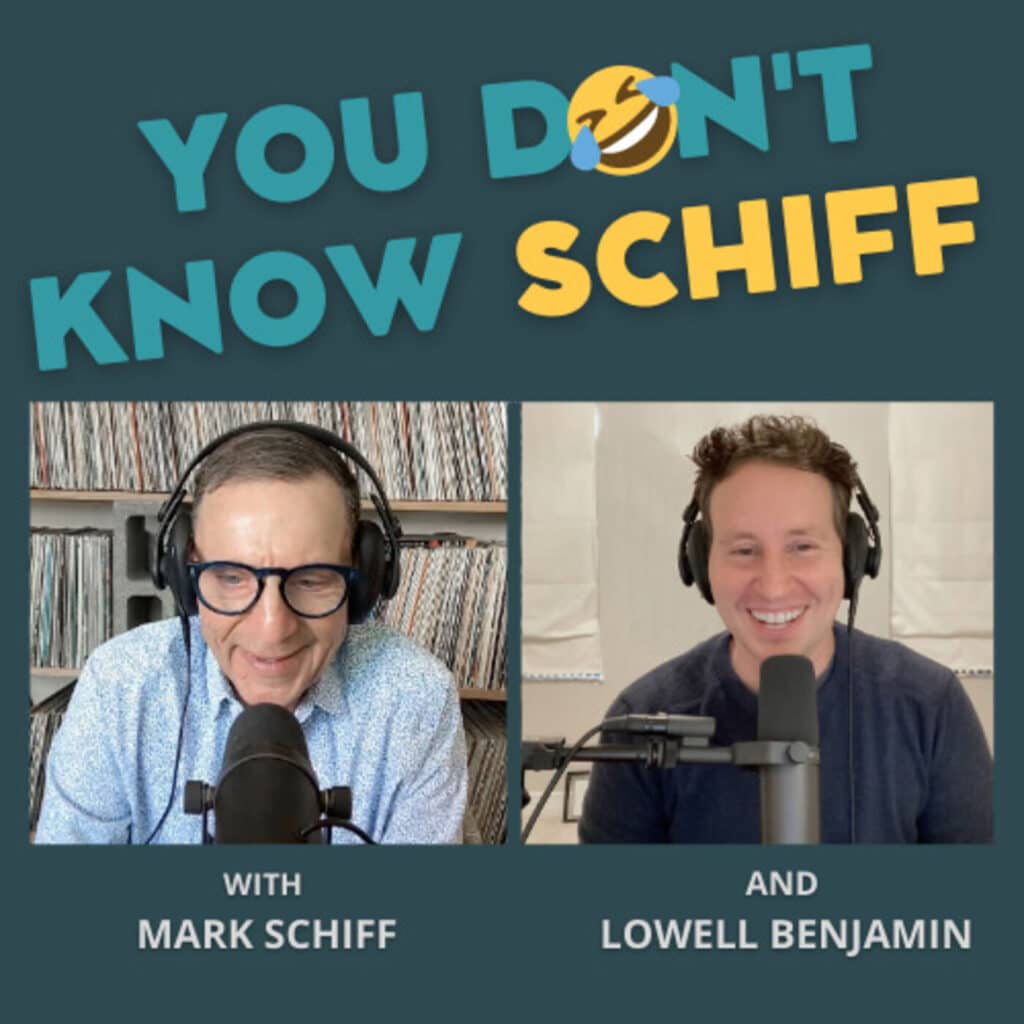
Please join Mark and Lowell in this fantastic, unique episode of “You Don’t Know Schiff” live at the Improv as they get to know the entertaining, insightful and always funny comedian, podcast host and Southern California’s former favorite weatherman on NBC for 39 years, Fritz Coleman!
Starting out in the Navy, which led to a chance to work as a disc jockey for many years, Fritz was always open to following unexpected opportunities and making the absolute most of them. The guys chat about his start in entertainment, being on “The Tonight Show with Johnny Carson”, his path to finding a career in anchoring the weather, and much more!
Various Jewish groups have criticized the FBI’s latest hate crimes report over a lack of data collection.
The Anti-Defamation League (ADL) noted on their website that the report documented 7,263 hate crimes in the United States in 2021, the third-highest recorded in a decade. But the ADL noted that there was a 22% decline in the number of reporting agencies and that most of California and all of Florida did not provide any data to the FBI, nor did New York City and other large cities.
According to NBC News, the Department of Justice has claimed that the reason for these reporting deficiencies is because the FBI switched to a new procedure for reporting the data and many states and reporting agencies did not switch to the new procedure by the FBI’s deadline for the data. Consequently, the report makes it seem like the number of hate crimes in the country declined from 2020 to 2021.
“Hate crimes tear at the fabric of our society and traumatize entire communities,” ADL CEO Jonathan Greenblatt said in a statement. “The failure by major states and cities across the country to report hate crime data essentially – and inexcusably – erases the lived experience of marginalized communities across the country.” He called on Congress “to make it mandatory for state and local law enforcement agencies that receive federal funding to participate in the FBI’s hate crime data collection efforts.”
Kenneth L. Marcus, who chairs the Louis D. Brandeis Center for Human Rights Under Law, said in a statement that the report was “essentially useless” for giving the false impression that antisemitic hate crimes declined in 2021. “The problem is so bad that record-high levels of anti-Semitism appear in the official data as actual declines, because major jurisdictions didn’t formally report it,” Marcus said. “This massive failure has undermined the purposes of hate crimes data precisely when we most need the data. If the FBI doesn’t quickly correct this problem, congressional committees will need to ask some serious questions.”
The American Jewish Committee also urged Congress to fix the hate crime reporting deficiencies.
The FBI released its 2021 Hate Crimes Report today.
It shows a gross lack of reporting on hate crimes in cities across the country.