fbpx

November 22, 2022

Just Kidding? Racist Presidential Humor, From FDR to Trump

Twice in recent weeks, former president Donald Trump has made derogatory joking references to Asians. He is not the first president to have used racial or ethnic minorities as the butt of his jokes—and not the first to have avoided any serious political consequences for doing so.

In a September 30 tweet, Trump derided his own former Secretary of Transportation, Elaine Chao, who was born in Taiwan and is the wife of Senate Majority Leader Mitch McConnell, as “his China loving wife, Coco Chow!” On November 11, Trump tweeted about Virginia Gov. Glen Youngkin, “Young Kin (now that’s an interesting take. Sounds Chinese, doesn’t it?).”

Trump is not the first president or ex-president to have indulged in sophomoric racist humor. Richard Nixon and Lyndon Johnson were reported—after they had left office—to have told jokes that included harsh ethnic stereotypes. Ronald Reagan, when he was president, was caught in an “open mic” moment, joking about Irishmen and Italians.

As a young man, Harry Truman once shared with his future wife a joke involving “a n—— and a Chinaman.” Woodrow Wilson, as president, was notorious for telling racist jokes about African-Americans, sometimes with a faux accent, even at events such as Princeton University alumni dinners.

President Franklin D. Roosevelt hissed through his teeth in mocking imitation of Japanese speech patterns, in a 1942 conversation with the journalist Quentin Reynolds. That same year, FDR’s assistant, William Hassett, recorded in his diary a joke the president told him about the Japanese being the offspring of a Chinese emperor’s daughter and a baboon.

FDR also had a penchant for anti-Jewish “humor.” His grandson Curtis told Roosevelt biographer Geoffrey Ward that he recalled “hearing the president tell mildly anti-Semitic stories in the White House,” in which “the protagonists were always Lower East Side Jews with heavy accents.” FDR also once joked that relatives might suspect his fifth child was Jewish, in view of the baby’s “slightly Hebraic nose.”

At the Yalta conference in 1945, Roosevelt shared an “I don’t want them and you wouldn’t either”-type joke with Soviet leader Josef Stalin: when FDR mentioned he would soon be seeing Saudi Arabia’s king, Ibn Saud, Stalin asked Roosevelt if he intended to make any concessions to him; the president replied “that there was only one concession he thought he might offer and that was to give him the 6 million Jews in the United States.”

That remark was recorded in the official transcript of the conversation, but the State Department suppressed it for several decades for fear it would harm Roosevelt’s image if the public knew what he said about Jews.

As public disapproval of racism has intensified over the years, there have been consequences—in a few instances—for telling racist jokes. Agriculture Secretary Earl Butz was forced out in 1976 after word leaked of a crude joke he told about African-Americans. In 1983, Secretary of the Interior James Watt resigned after telling a harsh ethnic joke about “a black, a woman, two Jews and a cripple.”

However, the resignations of Butz and Watt were exceptions, not the rule, when it comes to consequences for public figures indulging in racist humor. Those who manage to avoid the prolonged glare of news media attention often are able to avoid paying a price for their bigoted words.

James Jones continued in his position as national security adviser in the Obama administration even after telling an unflattering joke about Jewish merchants in 2010. Rebecca Erbelding, a staff member at the United States Holocaust Memorial Museum (and adviser to the recent Ken Burns film on the Holocaust), has tweeted jokingly about the allegedly distinctive nature of Jews’ noses—not unlike FDR’s “joke” about “Hebraic noses”—but the museum has not required her to apologize.

“Just kidding” should not be an acceptable excuse when it comes to public figures making derogatory references to ethnic or racial minorities. There need to be meaningful consequences which will clearly establish that in contemporary American society, racist humor is no laughing matter.

Just Kidding? Racist Presidential Humor, From FDR to Trump Read More »
The forest can’t be seen for the beetles

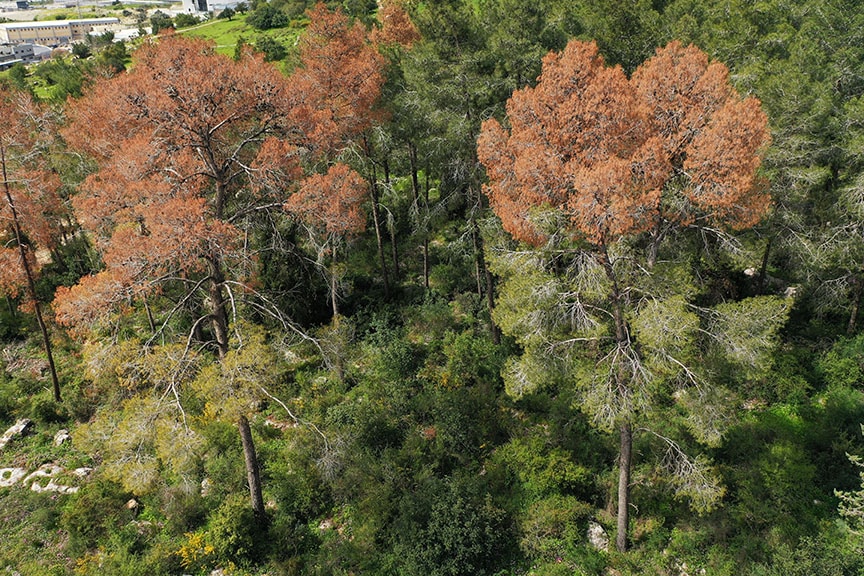
The seemingly serene forests of Israel now serve as battle arenas; in one corner stand the pines: dozens of meters tall, with a life expectancy of more than a century, and weighing dozens of tons. Crawling in the other corner are the bark beetles (Scolytinae): looking like hairy balls of chocolate, up to 4 millimeters in size.

For many years, the healthy pines protected themselves by secreting sticky resin, but the Climate Crisis is changing the grounds on which this balanced war has been waged. The trees are becoming weaker against the attack of the beetles, and if the attacks of the beetles become more intense, the whole forest might be at risk. Should we bid farewell to our pines?

Not if the foresters of the JNF (Jewish National Fund, HaKeren HaKayemet LeYisrael) have anything to do about it: a new study published in Forest (Ya’ar), a journal of the JNF, offers a way to help the trees: “trap trees”, which are attractive yet extremely poisonous for the tiny pests. A win for the pine forests, perhaps?

Infiltration

In Israel, three species of bark beetles pose a threat to the trees, while being friendly to one another. Their attack has three prongs, one for each species: one species of beetles attacks the lower and broader parts of the tree, another is in charge of the central parts of the trunk, and the remaining species takes part by going for the younger and higher parts of the tree.

Later, an adult beetle enters the bark and creates in it a small hole called a “mating chamber”. After mating, the females dig – starting from that chamber – tunnels, which are called “galleries”. Eggs are then laid along the galleries, and when they hatch, the larvae dig in other directions, while feeding off the tree.

The number of galleries starting at the mating chamber reflects the number of females that came out of it, which helps researchers distinguish between the three species of beetles: one of them is monogamous (one female for each male), another is bigamous (two females for each male) and the third species is polygamous (multiple females for each male).

As mentioned before, healthy trees can defend themselves by secreting resin which prevents the beetles from digging into it. That is why the beetles would normally play an important ecological part: they mainly attack old or sick pines, and through the tunnels, other creatures – such as worms and fungi – may enter the tree and start decomposing it.

A young pine tree that was attacked by Pityogenes calcaratus. Photo by Omer Golan

The problem begins when the bark beetles reproduce in an unbalanced manner, due to improper conditions in the forest, such as fires or problematic weather. In such conditions, the beetles can defeat even relatively healthy trees, and they might even threaten the very existence of the forest.

Foresters fight back

The aforementioned new study examined a way to mitigate the damage caused to the forest by the beetles. “We focused on where there was drought and where trees died – we assumed those places are very likely to be attacked by beetles,” says Omer Golan, director of the JNF Afforestation Division Forest Health and Protection Department, who headed the research.

The means used by the researchers is called “trap trees”: a healthy and intact tree, that the researchers had its outer bark removed, sprayed its trunk with agricultural-grade insecticide which would permeate into it, and hung a specifically designed bait doused with a pheromone (a volatile chemical secreted by some creatures) which would attract the bark beetles. “It is a chemical which weak trees release naturally when they are in distress, and it lets the beetles find them,” explained Golan. “The trap trees have the beetles attracted to the bait and try to enter the tree, but then insecticide kills them. That is how we get rid of the larger and more problematic populations of bark beetles.”

Beat out beetles

When the researchers compared plots treated with trap trees with the control plots – using both aerial photography and ground-level patrols – they saw that the trap trees reduced the mortality rate of the pines around them. Additionally, more than 90% of the trap trees survived the mass attack by the beetles.

“Initially, I was very skeptical about the trap trees,” recalls Golan, “but when the statistics came in, I was positively surprised. This method, which requires one tree for about a third of an acre, is certainly effective in dealing with an attack by bark beetles.”

The forest needs us

As previously mentioned, the climate crisis tips the balance in favor of the beetles and against the pines: according to the researchers, the coming decades will see summers in the middle east becoming longer by 50%, the winters – shorter by 56%, and when compounded by the global temperature rise and the ever-increasing frequency of droughts – pines will become weaker, all the while the number of the bark beetles will increase, and the battle will be determined. “Trees are going to be exposed to extreme conditions more than they ever were, and that makes them more vulnerable to beetle attacks,” explains Golan.

According to him, trap trees might be an efficient solution to the problem. “Trap trees are another means for protecting the forest,” concludes Golan. “We can’t afford to neglect forests, for both ecological reasons, as well as our ability to visit them. If not for us doing what it takes to protect them, they will just disappear.”

This article was prepared by ZAVIT – The News Agency of the Israeli Society of Ecology and Environmental Sciences

The forest can’t be seen for the beetles Read More »

Los Angeles Jews Honor Muslim Scholar of Moroccan Jewry

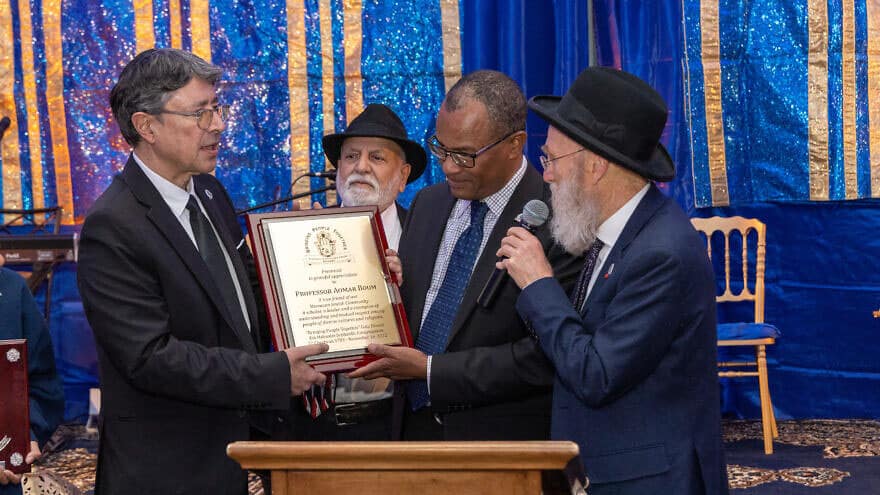
With the red carpet rolled out and Moroccan music filling the Em Habanim synagogue in Los Angeles last week, more than 400 of the city’s Moroccan and Sephardic Jews gathered to honor Moroccan Muslim anthropologist Aomar Boum for his two decades of promoting Moroccan Jewish history and encouraging warm relations between Jews and Muslims.

“Dr. Boum has been the champion of bringing different people, particularly Jews and Muslims, together with a sense of mutual respect and also helping to keep alive the ancient history of Morocco’s Jews at UCLA,” said Em Habanim’s Rabbi Joshua Bittan.

Jewish community activists at the event said they were not surprised that Boum was the head of UCLA’s Sephardic Studies program, because of his extensive knowledge and the international impact his work has on interfaith relations.

“For years when many people had been saying that the Jews and Muslims will never get along, Aomar has been challenging them and saying no,” said Jonathan Bass, an L.A. area Jewish activist. “He has been on the cutting edge of a new world movement that promotes love and tolerance for all of God’s children through his work which shows the past historical evidence of the close cooperation between Jews and Muslims.”

Boum said he first became intrigued with Morocco’s Jews 22 years ago when he began researching his doctoral thesis that examined the views and interactions Muslims living in small villages in the country’s south had with Jews.

“In my research I found that over four generations, the Muslims in these small Saharan villages, who had no media exposure and had shared a closeness with the Jews in trying to survive in that desert environment, had no conflict with Jews,” he said. “Also, in Morocco we’re very fortunate to have a political system and culture that has promoted tolerance of all groups, including the Jews that have lived in the Moroccan desert since the destruction of the Second Temple.”

Boum said his academic work showing the historically close ties between Jews and Muslims in Morocco has influenced officials in the country to include Moroccan Jewish history in the textbooks and curriculum for students of various ages.

“I personally believe that the study of Morocco’s Jews can allow the next generation living in Morocco to learn how important the Jewish community’s contributions have been to the nation over the centuries,” he said. “It also allows Jews today to realize that there are Muslims who have lived side by side with them in peace.”

Boum said he is working on a book about the experiences of the Moroccan Jewish community living in Los Angeles and another about the late King Mohammed V’s relationship with Jews during the Second World War.

In recent years, he has written extensively in academic journals about the Holocaust’s impact on the Jews of North Africa. His fictional graphic novel for young adults about the experiences of a Jew who fled Nazi Germany for North Africa will be published next year in English, French and Arabic.

When asked about the impact of the Abraham Accords peace deal between Morocco and Israel in 2020, Boum said the initiative has indeed increased direct business, tourism and academic ties between the two nations but it is not seen as anything out of the ordinary for many Moroccans.

“In Morocco the Abraham Accords are not really seen as a normalization of relations with Israel, but instead they are seen as a continuation and strengthening of ties between Morocco and its Jewish community that have been around for quite some time,” he said.

The evening honoring Boum was filled with displays of affection for Morocco from the Em Habanim congregation. Not only were traditional singers and musicians from Morocco on hand performing Arabic songs, but the flag of Morocco was on display along with the American and Israeli flags, as was a photo of the current monarch, King Mohammed VI.

After all three nations’ national anthems were played, Bittan recited a Hebrew prayer of well-being for the king.

“The current king of Morocco, his late father and his grandfather have all shown great kindness to the Jews of Morocco and created an environment of relative peace for the Jews there, so our community has always prayed for them,” said Bittan. “Unlike the Jews in other Arab and Islamic countries, we, the Jews of Morocco, did not experience extreme antisemitism, so we have a lot of pride for our Moroccan heritage.”

In 2019, L.A.-area Moroccan Jews honored Mohammed VI with an event titled “Salute to Morocco: Honoring a Dynasty of Tolerance.” That occasion featured a rare appearance by Princess Lalla Hasnaa, the youngest sister of the king, and nearly 50 delegates from Morocco, said Bittan.

Local and California state elected officials who were on hand for last week’s event said Boum had made a unique contribution towards bringing about positive interfaith dialogue. They presented him with multiple proclamations in recognition of his efforts.

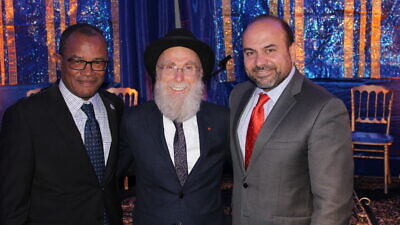
From left:  Dr. Aomar Boum, Rabbi Joshua Bittan and California Assemblymember Adrin Nazarian. Photo by Karmel Melamed.

“In every major shift or change in a society, there is always one person who works day in and day out to find a common denominator that brings different people together, whether they are heads of state or everyday citizens. We in L.A. are very fortunate to have someone like that in Aomar Boum,” said California State Assemblymember Adrin Nazarian.

Also present was Driss El Yazami, the Muslim president of the Council of Moroccans Living Abroad, a Moroccan government organization, who presented Boum with an award on behalf of Morocco’s current Jewish community.

“Aomar has brought great pride to all of Morocco as an ambassador of peace with his important research into Moroccan Jewish history. He genuinely deserves these honors and many more,” said El Yazami.

Los Angeles Jews Honor Muslim Scholar of Moroccan Jewry Read More »

Complaint Filed Against Berkeley Law Over Student Groups Barring Zionist Speakers

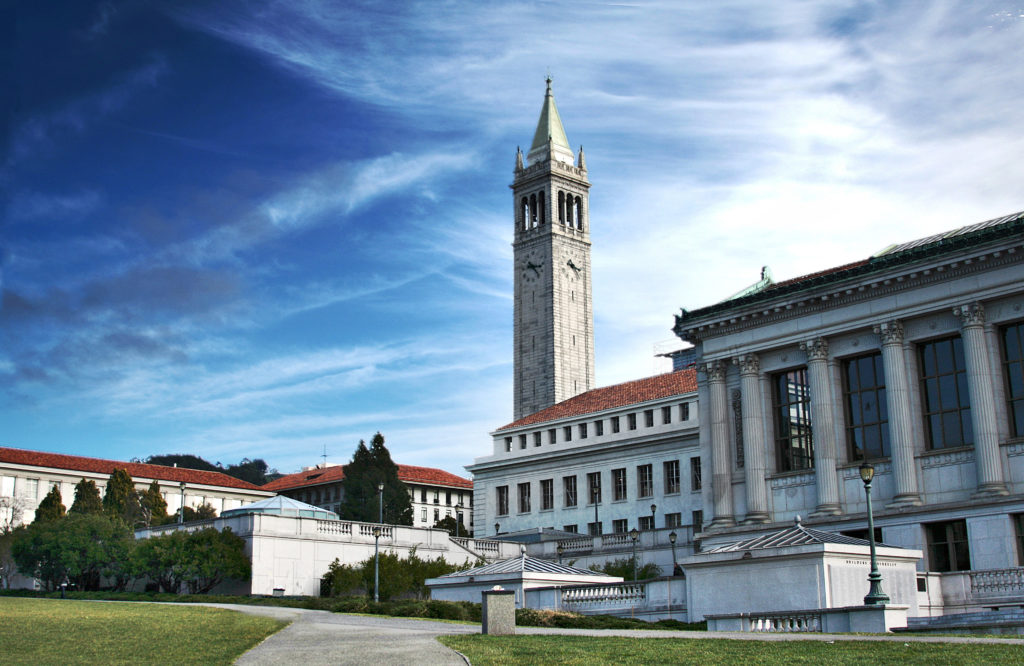
A legal complaint has been filed against UC Berkeley Law School over nine student groups passing bylaws barring Zionist speakers from coming to campus.

The complaint was filed by attorneys Gabriel Groisman and Arsen Ostrovsky, the latter of whom heads the International Legal Forum. The complaint, which was sent to the Department of Education’s Office of Civil Rights (OCR), alleged that Berkeley Law is in violation of Title VI of the Civil Rights Act for failing to take action against the student groups.

“Although we acknowledge that Professor Erwin Chemerinsky, Dean of Berkeley Law School, has condemned the adopted by-law, describing it as ‘very troubling’ and noting that according to their framing, he too would be banned because he supports the existence of the State of Israel, he has neither called for their revocation, nor has he taken any meaningful action in response to this egregious act of discrimination, as required under Title VI of the Civil Rights Act,” the complaint, which was obtained by the Journal, stated. “Moreover, incredulously, Dean Chemerinsky has repeatedly stated that ‘only a handful of student groups out of over 100 at Berkeley Law did this.’ It is unfathomable that a similar statement would ever be made that ‘only a handful’ of student groups banned speakers of any other ethnic, religious or racial group. Yet such blatant discrimination directly targeted against Jews is being excused, justified and mainstreamed.”

The complaint called anti-Zionism “the most common form of antisemitism on US college campuses today.” “Anti-Zionism is the denial of Jews their inalienable and collective right to self-determination, as expressed in the connection to their ancestral homeland, the Land of Israel, which for the overwhelming majority of Jews, forms an integral part of their identity,” the complaint stated. “In fact, the University of California Regents have declared ‘anti-Semitism, antisemitic forms of anti-Zionism and other forms of discrimination have no place at the University of California’ calling on University leaders actively to ‘challenge anti-Semitism and other forms of discrimination when and wherever they emerge within the University community.’ By effectively saying ‘Zionists are not welcome,’ these student groups—and by extension Berkeley, from its failure to act—are excluding, marginalizing and silencing Jews, and contributing to the creation of a hostile environment for Jewish students, faculty and staff, in circumstances were antisemitism, including on campus, is already at record high levels across the United States.”

The complaint concluded with a call for such bylaws to be rescinded and for Berkeley Law to ensure that no university funding goes to any student groups with these bylaws.

“The groups that have implemented this discriminatory policy attempt to hide their discrimination against the Jewish community by excluding ‘Zionists,’” Groisman and Ostrovsky said in a statement. “This thin veil is completely transparent as Zionism is an integral, indispensable and core element of the Jewish identity. There can be no equivocation: anti-Zionism is antisemitism. And, by effectively saying ‘Zionists not welcome,’ these student groups—and by extension UC Berkeley Law School—are excluding, marginalizing and silencing Jews, and only exacerbating what is already a deeply hostile environment for Jewish students, faculty and staff. 

“We are confident that the US Department of Education will conduct a full investigation of the matter and will ultimately either invalidate the discriminatory bylaws or prohibit the University from continuing to fund and host organizations that engage in such blatant discriminatory conduct which is violative of Title VI of the Civil Rights Act,” they added.

A spokesperson for the Berkeley Law told the Journal that the campus doesn’t usually comment on OCR matters.

Complaint Filed Against Berkeley Law Over Student Groups Barring Zionist Speakers Read More »

you-dont-know-schiff

Talking Schiff with Mark & Lowell #12: Space Travel

How much money would you have to pay these two Jews to get on a rocket to Mars? We all know the answer, but join Mark and Lowell anyway this week for a delightful discussion about outer space, Disneyland and other terrifying places.

Mark’s books are available for purchase!
“Why Not: Lessons on Comedy, Courage, and Chutzpah” is NOW AVAILABLE!
Click on these links to buy:
Amazon
Barnes & Noble
Books-A-Million
Bookshop.org

Mark’s first book “I Killed: True Stories of the Road from America’s Top Comics” is a great way to hear fantastic inside  stories from some of the best comedians of our generation.

Please follow “You Don’t Know Schiff” so you don’t miss out on any exciting episodes. Click here to subscribe on Apple Podcasts (and please leave us 5 stars and a positive review – your support means the world to us and it helps us get discovered by new listeners):

Your hosts:
markschiff.com
Twitter: @markschiff
Instagram: markschiff1
 

Lowell Benjamin
Twitter: @lowellcbenjamin
Instagram: @lowellcbenjamin


Talking Schiff with Mark & Lowell #12: Space Travel Read More »

Talking Schiff with Mark & Lowell #12: Space Travel

How much money would you have to pay these two Jews to get on a rocket to Mars? We all know the answer, but join Mark and Lowell anyway this week for a delightful discussion about outer space, Disneyland and other terrifying places.

Mark's books are available for purchase!
“Why Not: Lessons on Comedy, Courage, and Chutzpah” is NOW AVAILABLE!
Click on these links to buy:
Amazon
Barnes & Noble
Books-A-Million
Bookshop.org

Mark's first book “I Killed: True Stories of the Road from America's Top Comics” is a great way to hear fantastic inside  stories from some of the best comedians of our generation.

Please follow “You Don’t Know Schiff” so you don’t miss out on any exciting episodes. Click here to subscribe on Apple Podcasts (and please leave us 5 stars and a positive review – your support means the world to us and it helps us get discovered by new listeners):

Your hosts:
markschiff.com
Twitter: @markschiff
Instagram: markschiff1
 

Lowell Benjamin
Twitter: @lowellcbenjamin
Instagram: @lowellcbenjamin

Talking Schiff with Mark & Lowell #12: Space Travel Read More »