fbpx

October 18, 2022

The Making of a Chef: Ori Menashe’s Road to Middle-Eastern Cuisine

Don’t ask Ori Menashe about his hummus unless you have time. He has given it some serious thought. With the memory of the famed Abu Hassan in Jaffa as his lodestar, Menashe has been working on his garbanzo dip since 2018, when he opened Bavel in downtown Los Angeles. Recently, when he had the time to tinker with the dish that former Los Angeles Times critic Jonathan Gold called “magnificent” he increased the cooking time and added a few tricks to deepen the flavor.

“Now it reminds me of Israel,” said a smiling Menashe, when we gathered with his wife and partner Genevieve Gergis at their new restaurant Saffy’s in East Hollywood. Located on a desolate strip of Fountain Avenue near the big blue Scientology compound, Menashe’s new upscale casual restaurant was a huge hit from opening day. Fans of his two highly-rated downtown restaurants Bestia and Bavel lined up to try the chef’s version of Middle-Eastern street foods like kebabs, falafel and shawarma served with the team’s usual finesse and Genevieve’s sophisticated desserts.

A fan of Menashe’s since 2012 when he opened Bestia, an Italian restaurant located on a dark street in the newly gentrified Arts District, I remember wondering why he wasn’t cooking something closer to his heart back then—something more Israeli. At the time, he said LA wasn’t ready. He said that Angelenos loved pasta and that Italian was a familiar, comfortable cuisine. I hoped he was simply waiting for the right moment. Ten years and several Ottolenghi cookbooks later, the complex foods of Turkey, Morocco, Israel, Egypt, Persia and Lebanon are woven into menus all over the world. And Saffy’s is a “blockbuster” according to the Los Angles Times.

“School was too slow,” says Menashe, who explained that learning on the job and not following the rules has served him well in terms of creativity. “As a result, our food tastes different.”

At 41, the LA-born, Israeli-raised chef is soaring, but it wasn’t always a straight shot. After completing his military service in Israel, while spending a sabbatical year in South America, he started cooking in order to feed his friends, a role he had seen his father play in a home that highly valued eating together. When he decided to pursue a career in LA he enrolled in culinary school but after two weeks he quit. “School was too slow,” says Menashe, who explained that learning on the job and not following the rules has served him well in terms of creativity. “As a result, our food tastes different.”

He learned on the job at La Terza, a popular Italian restaurant that would give him a mentor, Jason Travi, and a wife, Genevieve Gergis, whose roots are Egyptian. Genevieve, a French horn player, was the restaurant’s hostess. They fell in love over a steak dinner, served by Menashe in the restaurant kitchen the night before New Year’s Eve, a singularly crazy night for a first date.

Today, with three major restaurants to run and eight-year-old daughter Saffron to raise, the tasks are divided: Ori is the chef and Genevieve is interior designer and head of a pastry department of 16 pastry chefs. Like her husband, Gergis is self-taught and if you ever tasted her desserts, you’ll agree that school is overrated. Her husband kvells, “She is the real talent.”
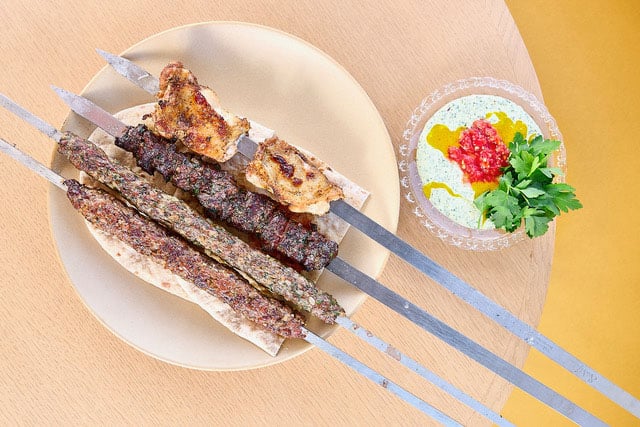
Skewers at Saffy’s (Photo copyright Joseph Weaver)

In the notoriously difficult restaurant business, the young couple are riding a wave, but the last few years have been tumultuous. The lease for Saffy’s was signed three weeks into Covid, back when optimistic people thought that the pandemic would be a short blip. When the world stopped, their two upscale restaurants closed and then reopened with a fixed price dinner for takeout. Two years later, after delays in permitting and construction, Saffy’s opened just as pandemic life normalized and folks were eager to dine out again.

Menashe is upbeat about the current Los Angeles dining scene. “The culture changed here. Why do you think so many chefs are coming to LA? It used to be restaurants were for special occasions; now more people are dining out all week long.” Something you might notice if you try to get into his restaurants on a Thursday night.

As for the future, the couple has plenty of plans. They hope to have Saffy’s open for lunch soon—with a Tunisian tuna sandwich that I can’t stop dreaming about. Next door, a small café is already serving coffees, teas, breakfast pastries, cookies and two breads—a buckwheat sourdough and golden challah.

Meanwhile the chef keeps tinkering. Recently, when he set up a fermentation lab at home to work on his pita, he learned that by extending the fermentation time to 72 hours, he could make a moist, cakey, cloud of a bread that, when served hot at Bavel, is ethereal. The memory of it makes me want to toss out all those pale, store-bought imposters in my kitchen and drive downtown immediately.

The Making of a Chef: Ori Menashe’s Road to Middle-Eastern Cuisine Read More »

Satirical Semite: Queen Meghan

The Jewish festive season is now over, and during the last few weeks we’ve had royal celebrations, commemorations and near-beheadings. As a Jew I’ve celebrated the Shabbat “Queen” (as we do, once a week) and proclaimed God as King on Rosh Hashanah. On Yom Kippur I prayed to avoid the biblical punishments and not get strangled, whipped or stoned, although there was probably no shortage of synagogue attendees in Los Angeles who were completely stoned on Yom Kippur. As an Englishman I also mourned the passing of the Queen and the installation of the King, but then a new horror came to mind: the realization that Prince Harry is now fifth in line to the British throne, which means that there is the outside chance there could one day be a Queen Consort Meghan Markle. Instead of singing God Save the Queen, we’ll be singing God Save Us All.

It’s unlikely this dystopian nightmare would come to pass. While nobody would be strangled or stoned, in Queen Markle’s marriage, many think that the ginger-haired Prince Harry is the one who is truly whipped.

The UK media has been unforgiving, and repeatedly violated a rabbinic commandment of calling people by nicknames, even though they are not obligated to keep them. We regularly read of “The Ginger Whinger and Me-Again” or “The Duke and Duchess of Netflix.” After her various fibs to the British Press, Piers Morgan named her “Princess Pinocchio.”

American friends sometimes say “I’m on Team Meghan,” but in the UK that sounds as relevant as saying “I’m on Team King George III.” The British can be snobbish, and this isn’t a game of baseball.

I’m sure that Harry and Meghan are nice enough in private, and the great British public had nothing but love for them in the early days. The love affair was over in March 2021 when the couple did their infamous interview with Oprah, where Meghan accused Princess Kate of making her cry, Prince Harry denounced his father King Charles and brother Prince William and accused them of being trapped in their roles, and they both threw a string of other accusations at his family. It was all pretty awful, especially after the way it began.

Everything was going well back in 2018. We loved Meghan, celebrated our first mixed-race member of the Royal Family, and welcomed our first Los Angeleno to join the House of Windsor. We felt a bit sorry for her since her estranged father couldn’t join the wedding, and were happy that the then-Prince Charles walked Meghan down the aisle at her wedding. We enjoyed photos of the Queen welcoming Doria Raglan, Prince Charles’ African-American mechatainsta who once worked as a social worker in Silverlake, East LA. There is no English word for the Yiddish machatainsta, which means your child’s mother-in-law. Similarly there isn’t a Yiddish equivalent for the Oxford English Dictionary, usually called by its acronym “the OED,” although the Oxford Yiddish Dictionary would appropriately be referred to as “the OY’D.”

What would it look like if you didn’t have a monarchy? The answer is simple: America.

A proverbial elephant sits in the room, with a big question about whether it is better to have a republic or a monarchy. What would it look like if you didn’t have a monarchy? The answer is simple: America. Would you rather have an unelected, permanent Queen with an elected Prime Minister, or blend the two systems and have a King Trump, Prince Pence, King Biden and Queen Consort Kamala? God Save the Kings!

Although there is a caveat. Despite the bad-mouthing, despite the looming threat of Prince Harry’s forthcoming tell-all lashon hara-fueled biography, despite his not showing up for his late grandfather Prince Philip’s memorial service, the British public still love them, a bit like you love your slightly-annoying cousins who make bad decisions, but feel sorry for them because you know they had a rough childhood.

We felt teary-eyed last month on seeing Harry and Meghan walk alongside William and Kate to look at the floral tributes a few days after the Queen’s passing. King Charles even included a loving tribute to Harry and Meghan during a speech following his mother’s death.

Some are born great, some have greatness thrust upon them, and others leave Los Angeles to marry a British prince. Despite everything, there is one thing we all still want to see: a happy Hollywood ending.

Satirical Semite: Queen Meghan Read More »

Temple of the Arts Yom Kippur, L.A. Federation Sukkot Launch Event

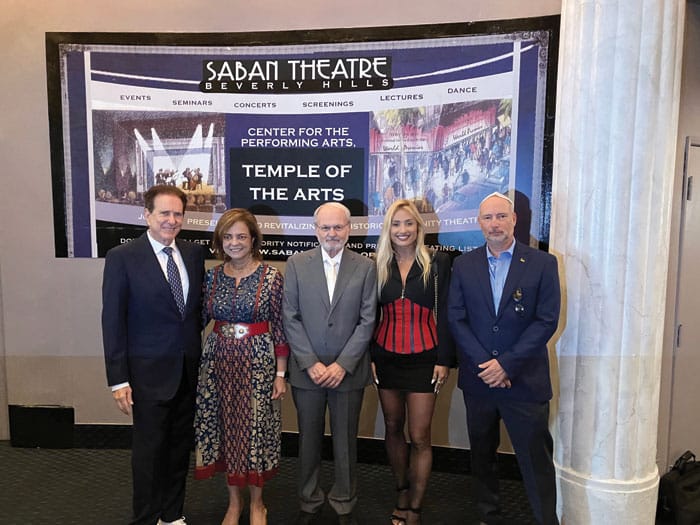
A number of influential, high-profile guests participated in Temple of the Arts’ recent High Holy Days services at the Saban Theatre. 

Actor and comedian Tiffany Haddish was a guest of Daphna Ziman, founder and chairwoman of Justice for Women. Haddish was there to pray with Ziman for Justice For Women, a global initiative dedicated to eradicating human trafficking and violence against women and children.

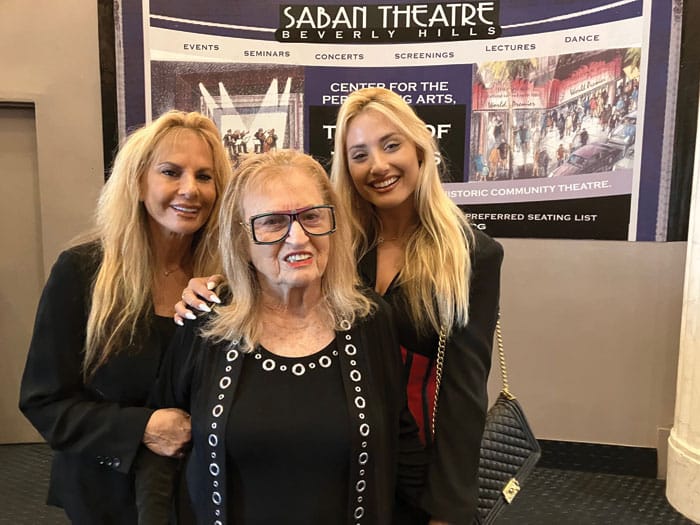
Three generations (from left): Michelle Tucker, Lilly Schmidmayer and Montana Tucker attend Temple of the Arts services. Photo by Steve Moyer

Academy Award-winning composer A.R. Rahman attended services as a guest of renowned Hollywood acting coach Bernard Hiller. Actress, singer and TikTok sensation Montana Tucker also turned out. Tucker shared memories of her moving visit to Auschwitz with her mother, Michelle, to witness firsthand where her 94-year-old grandmother, Lilly Schmidmayer, a Holocaust survivor, once was interned. 

Judea Pearl, father of the slain Wall Street Journal reporter Daniel Pearl, sang a song in memory of his late son, and TV personality Mary Hart and Yiddish performer Mike Burstyn were among the service readers.

On Yom Kippur, activist Moti Kahana shared how he is currently bringing life-saving food and fuel to Ukrainian farmers; Zionist Organization of America President Morton Klein enlightened attendees on the persistent attacks against Israel in the United Nations, the General Assembly and the Security Council; and bestselling author Anita Moorjani discussed her journey from cancer to near-death to healing. 

 “My guests have incredible stories of courage, humane decency and perseverance,” Temple of the Arts Rabbi David Baron said. “Each of their stories exemplifies the strength of the human spirit, which can serve as examples to enlighten and encourage all of us.”

Temple of the Arts is an arts and entertainment-industry congregation in Beverly Hills.


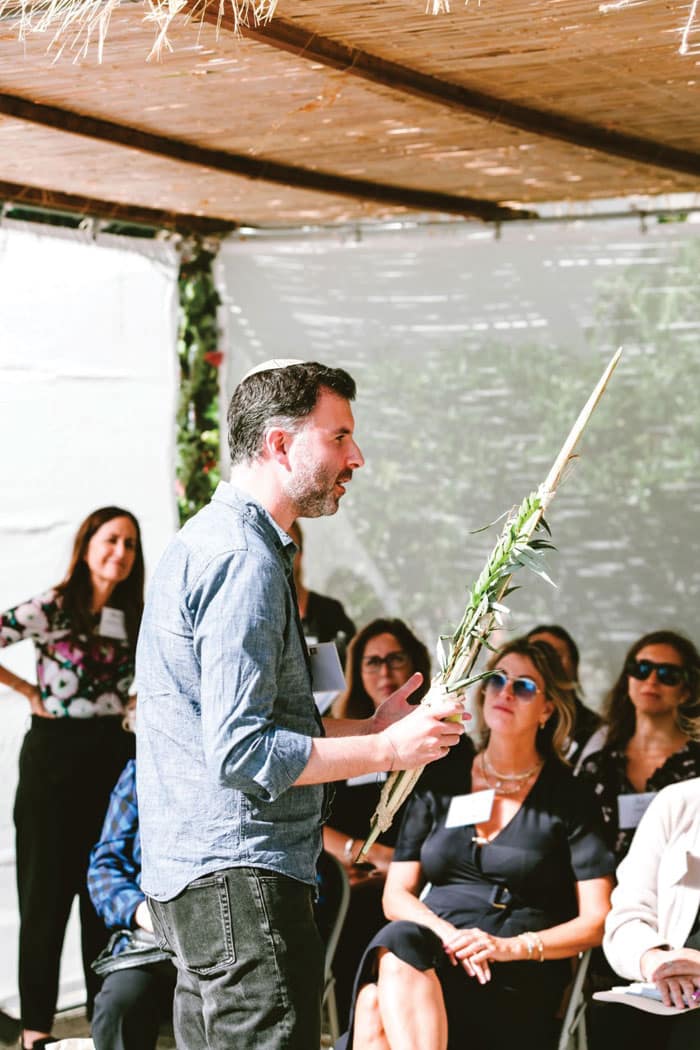
The Jewish Federation of Greater Los Angeles held a Sukkot-themed event to announce a civic partnership with four local nonprofits. Courtesy of the Jewish Federation of Greater Los Angeles

On Oct. 12, the Jewish Federation of Greater Los Angeles held a kickoff Sukkot event that served as a launch for a partnership with four new nonprofit organizations in Los Angeles.

“We founded our civic partnerships program to support organizations across Los Angeles that do vital work to address disparities and serve their communities’ greatest needs,” L.A. Federation President and CEO Rabbi Noah Farkas said. “These organizations have the infrastructure to address homelessness and affordable housing, voter rights, community service, and access to education – issues that our Federation cares deeply about and are dedicated to helping solve.”

The Federation’s new civic partners are: Homeless Outreach Program Integrated Care System (HOPICS), Catalyst California (formerly Advancement Project California), Fulfillment Fund and the SoLA | Can Foundation. 

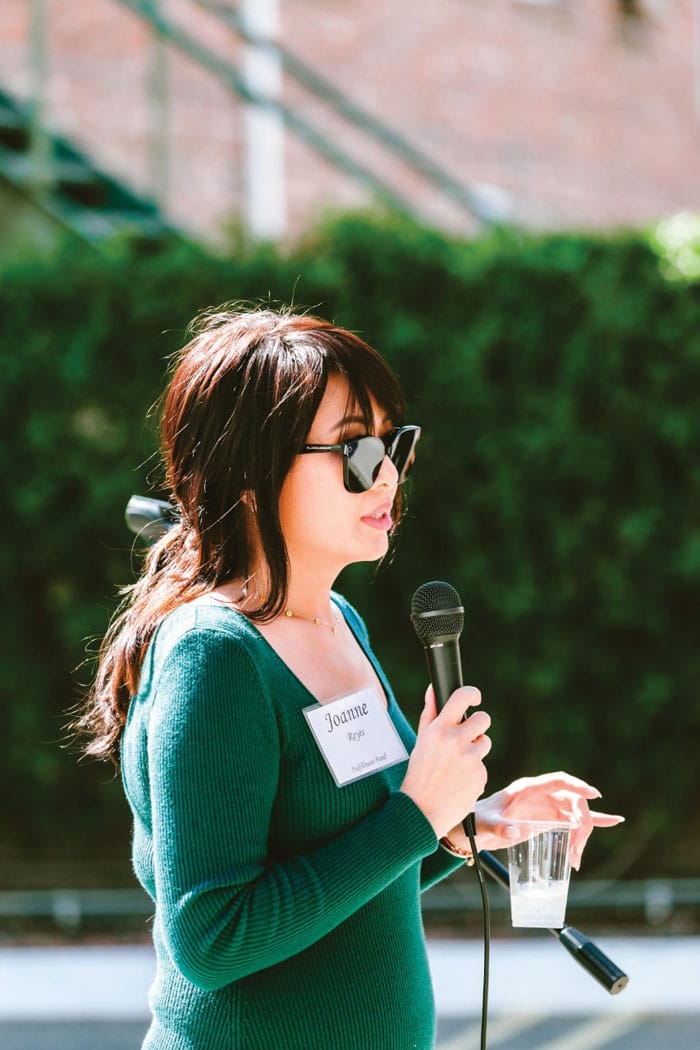
Joanne Reyes, CEO of the Fulfillment Fund, a college access and college success nonprofit. Courtesy of the Jewish Federation of Greater Los Angeles

Over the next 12 months, the Federation and these partner organizations will work together to create educational opportunities to engage their communities and will convene four expert-led roundtable conversations to dialogue around programs, local issues, and bridge-building, according to Federation leadership.

Attendees at the Sukkot-themed launch party included Joanne Reyes, CEO of the Fulfillment Fund; Curtis Silvers, executive vice president at Los Angeles Brotherhood Crusade; and David Bocarsly, executive director at the Jewish Public Affairs Committee of California. 

Temple of the Arts Yom Kippur, L.A. Federation Sukkot Launch Event Read More »