fbpx

September 15, 2022

The Dreyfus Pivot: Herzl Confronts Jew-Hatred on the March

Editor’s note: Excerpted from the new three-volume set, “Theodor Herzl: Zionist Writings,” edited by Gil Troy, the inaugural publication of The Library of the Jewish People, to be published this August marking the 125th anniversary of the First Zionist Congress. This is fifth in a series. 

In late 1895, while Theodor Herzl steeped himself in writing his often overlooked play, The New Ghetto, reporters broke the story of Alfred Dreyfus, a French-Jewish officer arrested for espionage. Herzl downplayed Dreyfus’s Jewishness at first. Nevertheless, on January 6, 1895, Herzl’s dispatch described the painful ceremony stripping Dreyfus of his rank – as the patriotic, betrayed Dreyfus cried, “You are demoting an innocent person. Vive La France!

Then, Herzl reported, as Dreyfus marched away with his buttons and insignia cut off and his sword broken, “he reached a line of officers who roared at him: ‘Judas! Traitor.’” The mob, watching the scene, “shouted from time to time: ‘Death to the traitor!’”

Alfred Dreyfus
Gerschel/Getty Images

Four years later in 1899, in his unpublished essay “On Zionism,” written for the North American Review, Herzl updated, simplified, and Zionized his story. By then, the Dreyfus affair had become a cause célèbre and the novelist Emile Zola had written his famous essay “J’Accuse.” Seeking to dramatize his own conversion and illustrate Zionism’s allure, Herzl reported hearing the mobs cry, “Death to the Jews.” Only then did he say, melodramatically, “What made me a Zionist was the Dreyfus trial.” 

In fairness, while he may have been simplifying his life story, Herzl was not making anything up. Other reporters record the crowd in 1895 denouncing the Jews explicitly. 

In spring 1895, the victory of Karl Lueger and his antisemitic Christian Social Party in the Viennese municipal elections probably unnerved Herzl more personally. This was Vienna, his adopted hometown, which symbolized the liberal-democratic German future. Lueger’s populist demagoguery would inspire the phrase that “antisemitism is the socialism of fools.” Herzl was starting to see just how many fools surrounded him in supposedly enlightened Europe. That spring, enlightened France again disappointed with a two-day parliamentary debate about “the Jewish infiltration.”

Jew-hatred was on the march.

In his diaries, begun, as he wrote “around Pentecost, 1895,” a Christian holiday because he lived on Christian time, Herzl recalled how unnerved he was in 1882 when he read Eugen Dühring’s 1881 Jew-hating diatribe, “The Jewish Problem as a Problem of Race, Morals and Culture.”  “As the years went on,” he noted, “the Jewish Question bored into me and gnawed at me, tormented me, and made me very miserable.” Herzl admitted toying with the idea of “getting away from it,” but he insisted: “I never seriously thought of becoming baptized or changing my name.”

“Above all, I recognized the emptiness and futility of efforts to ‘combat antisemitism.’ Declamations made in writing or in closed circles do no good whatever.” 

In Vienna, Herzl apparently was visibly Jewish, but somehow in Paris he noticed, “here I pass through the crowd unrecognized.” The result was a more sobering conclusion about Jew-hatred: “Above all, I recognized the emptiness and futility of efforts to ‘combat antisemitism.’ Declamations made in writing or in closed circles do no good whatever.” No matter how many petitions are signed or committees are struck: “Antisemitism has grown and continues to grow – and so do I.” Eventually, Herzl would outgrow his naïve faith in assimilating, seeing those efforts as futile too.

Herzl spent 1895 churning, thinking, refining his ideas. Ironically, a Jew-hater, Alphonse Daudet, impressed by Herzl’s analysis of the Jewish Question, advised Herzl to “look at Uncle Tom’s Cabin” and write a novel bringing alive his ideas. Instead, Herzl drafted a lengthy letter to the super-philanthropist Baron Maurice de Hirsch, then pitched the idea of a Jewish state to Hirsch – who was unimpressed. 

Yet Herzl’s appeal was impressive. He was realizing that national identity – and national renewal – required a revival of the Jewish body and Jewish soul. To achieve that, Herzl proposed pragmatic steps and symbols – accompanied by speculative leaps. Writing to Baron Hirsch, on June 3, 1895, Herzl insisted a flag was not just “a stick with a rag on it. … With a flag one can lead men wherever one wants to, even into the Promised Land. For a flag men will live and die; it is indeed the only thing for which they are ready to die in masses, if one trains them for it; believe me, the policy of an entire people – particularly when it is scattered all over the earth – can be carried out only with imponderables that float in thin air.” Toggling between the hard-headed and the ethereal – “Dreams, songs, fantasies, and black-red-and-gold ribbons,” Herzl noted, after all, “What is religion? Consider, if you will, what the Jews have endured for the sake of this vision over a period of two thousand years. Yes, visions alone grip the souls of men.”

It’s remarkable. In the seven months from November 1894 to June 1895, from the end of writing The New Ghetto to the start of this conversation with Baron Hirsch, Herzl discovered hope – HaTikva – which not coincidentally is the name of the Zionist anthem. If for years Jews survived thanks to leaps of faith, Herzl would now free Jews with his leap of hope. 

This geyser of optimism could not have been tapped from the press. Newspapers were filled daily with more and more sobering stories about Jew-haters killing Herzl’s parents’ dream of full acceptance. Instead, this infectious wellspring of hope for his downtrodden people came from deep within Herzl’s Jewish soul, his thwarted European aspirations, and his unique personality. But, unlike his neighbor Sigmund Freud, who saw dreams as every individual’s “royal road to the conscious,” Theodor Herzl turned his dreams into the Jewish people’s populist path to liberation.


Professor Gil Troy is the author of The Zionist Ideas and the editor of the three-volume set, “Theodor Herzl: Zionist Writings,” the inaugural publication of The Library of the Jewish People, to be published this August marking the 125th anniversary of the First Zionist Congress.

The Dreyfus Pivot: Herzl Confronts Jew-Hatred on the March Read More »

How Do We Save a Vanishing History?

What do you get when you cross Henry Fielding’s “The History of Tom Jones, A Foundling” (a picaresque novel about an orphan, with a twist ending), Israel Zangwill’s iconic play “The Melting-Pot” (a love story between a Jew whose family was murdered in a pogrom and a Gentile whose father ordered the pogrom), and “Schindler’s List” (in which a German plays the role of savior for Jews destined for death at the hands of the Nazis)? Throw in a bit of fairy dust, and you have Kristin Harmel’s latest bestseller “The Forest of Vanishing Stars.”

Let me begin by saying that I really wanted to love this book. Too little has been written about, as history book writer Rebecca Frankel recently called them in The New York Times, “the forgotten Jews of the forest.” Harmel’s “vanishing stars” indeed represent a history that has nearly vanished, lacking the meticulous records that Nazis kept of the concentration and death camps. 

Commemorating the stories of these forgotten Jews is very personal for me. Like the Jewish characters in Harmel’s novel, my grandparents resided in that area of Poland/Ukraine/Belarus that came under Soviet rule at the start of World War II — the first blow to the Jewish community — and then the Nazis as of June 1941. Like Harmel’s characters, my grandparents were forced into ghettoes. They escaped to the forest. The Nazis, meanwhile, rounded up their family members and shot them into mass graves. Of almost 20,000 Jews in Lutsk, where my grandmother lived, only 150 remained by the time the Soviets returned to liberate the forest Jews in 1944; my grandmother was among them. My grandparents stayed alive by hiding in empty barns and under the protective cover of the trees, begging or stealing food from farmers. They were not organized partisans, or vengeance-driven, gun-wielding fighters, like the Bielski brothers portrayed by Daniel Craig and Leiv Schreiber in the film “Defiance” (a source Harmel relies on heavily). More like the majority of Jews who fled to the forest from ghettoes, the Jews about which Harmel writes, they were simply trying to survive.

But if I came to this novel looking for a realistic historical account, I did so in error. Although well-researched, “The Forest of Vanishing Stars” is a book that, at heart, aims to entertain readers. Take Harmel’s heroine: Inge, a young German woman, is depicted as a character straight out of a fairy-tale. She has “hair, the color of the deepest starless night,” that “tumbled down her back”; lips “the startling red of corn poppies”; mismatched eyes, “one twilight blue and one forest green”; and skin “impossibly white.” On the inside of one wrist, she has a dove-shaped birthmark, “a sign [she] was special, that she was fated for something great.” As an infant, Inge is kidnapped by Jerusza, an ancient witch-like Jewish woman who becomes her stepmother and spends the rest of her days giving her young ward a vast education that includes a range of European languages, knowledge of religious texts, woodworking skills, and all the ways to kill an enemy. Even after Jerusza dies, the heroine feels her protector’s spirit guiding her, a bit like Obi-Wan Kenobi with Luke Skywalker. 

Inge shares her stepmother’s magical powers; in fact, perhaps hers are stronger. She sees glimpses of the future, knows when danger is near. Jerusza’s lessons, along with her own supernatural extras, allow Inge, who is renamed Yona (the Hebrew word for dove), to be in the ideal position to save the influx of Jews whom she discovers are running into the woods. They come from Mir, from Volozhin, from Lida; from all around the edges of the Nalibocka Forest, Jews are seeking a safe haven, as it becomes readily apparent that to stay in the ghetto is to die.

Throughout “The Forest of Vanishing Stars,” Jews, and some non-Jews, come under Inge’s care. Not every one of Inge’s forest-dwellers accept the heroine’s help immediately. Some of the female Jews are jealous of Inge/Yona’s beauty; some of the men resent her leadership. But all of them are wise to listen to her, and most of them are thankful that she is there to save them. “We should all be kissing the ground you walk on,” one tells her. And another says, “Yona, you saved us. You are a true gift from God.”

They died when they contracted typhus. They died of starvation. They died of exposure. A little magic would have been nice.

The sad reality, and I think one of the reasons that I struggled with this book, is that the historical Jews didn’t have a savior that looked like Snow White and possessed supernatural powers to teach them how to survive in the forest or warn them when danger was coming; they had to figure it all out on their own. And whether or not they learned which berries were safe to eat or how to build a shelter underground, many, many died. (To be fair, a good number die in the book, too.) They died because they were caught by the Nazis. They died because they were caught by Nazi collaborators. They died when they contracted typhus. They died of starvation. They died of exposure. A little magic would have been nice.

That said, I can certainly see how Harmel’s novel has widespread appeal. It’s sad but uplifting. It has a beautiful, good-hearted heroine, and anyone reading the novel — Jewish, not Jewish, whatever — can imagine that if they were in her shoes, they too would act virtuously and save all the people they could save. The novel has romance, high drama and a lot of action. It’s fast-paced. It has magic. It does what fiction can do: tell a better than story than the real one.

It’s not true that “The Forest of Vanishing Stars” is just there to entertain. It absolutely educates as well. In fact, it’s a mark of good historical fiction when a novel can do both. 

And it’s not true that “The Forest of Vanishing Stars” is just there to entertain. It absolutely educates as well. In fact, it’s a mark of good historical fiction when a novel can do both. So, while this novel is not quite my taste, I can’t help but tip my hat to the author for putting the spotlight on “the forgotten Jews of the forest” and telling a Holocaust story in a way that is fresh, different and exciting. 


Karen E. H. Skinazi, Ph.D, is Associate Professor of Literature and Culture and the director of Liberal Arts at the University of Bristol (UK) and the author of Women of Valor: Orthodox Jewish Troll Fighters, Crime Writers, and Rock Stars in Contemporary Literature and Culture.

How Do We Save a Vanishing History? Read More »

Meet Ruth Banarer, the 99-Year-Old Torah Reader

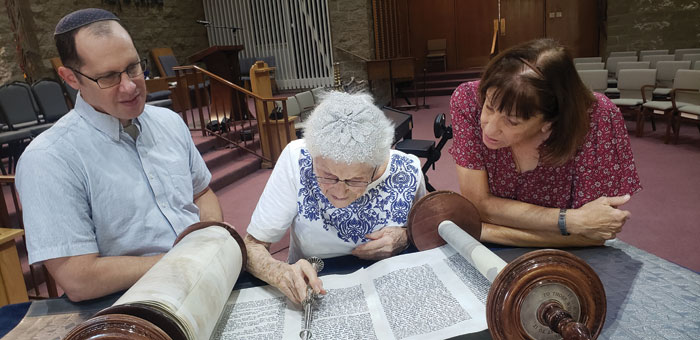
If you think it’s remarkable that a 99-year-old woman reads the Torah in synagogue each year on the anniversary of her bat mitzvah, wait until the backstory is unveiled.

On a recent morning, around a table at Temple Ramat Zion in Northridge, Ruth Banarer recalled when she became interested in Hebrew.  

When her younger brother Herbert was training for his bar mitzvah, a rabbi came to their Glendale home every week after Shabbat to teach her brother and several of his friends. Ruth, at 16, was a welcome participant. This was 1939. The decades sped by without further exploration of Hebrew … until a short while after Ruth’s husband of 55 years, Norman Banarer passed away. That’s when a seemingly minute event forever altered the lives of Ruth and her daughter, Janice Banarer, for the better.

Ruth and Janice had been living together since Norman’s death, having purchased a home in a Northridge neighborhood not far from the Conservative shul Ramat Zion.  One day, while out on a walk, Janice came across a sign that caught her attention. It was for an open house at Ramat Zion, and declared “Same Management For Over 5,700 years.” 

“I thought that was pretty good,” she said to herself, and later told her mother and explained how deeply the sign had affected her.

Everything began to fall into place. “For my 60th birthday,” Janice said, “I decided that I wanted to learn Torah.” Before Ramat Zion, “we never had belonged to a synagogue,” Janice said. Her timing was fortuitous. Rabbi Ahud Sela had recently arrived at Ramat Zion. 

Entering the large Devonshire Boulevard synagogue was a revelation for both Banarer women. “When I came in, everybody welcomed me with open arms,” Janice said. Her new friends were knowledgeable in Judaism, and that encouraged her further. “I really wanted to learn my heritage. I wanted to be bat mitzvahed, because I never had been …  I was so envious of everyone in the synagogue,” she said. “They had had lives in synagogues since they were little. They knew all about this and that. I really wanted to learn and be part of it.”

At that moment, fate seemed to be knocking on the door of the Banarer women … if only there were enough time. Ruth was in her late 80s and had been suffering from circulatory problems in both legs. Eventually, her right leg was amputated below the knee.

This accelerated Janice’s desire to have a bat mitzvah before her mother would become homebound, or worse. “At her age,” said Janice, “we thought, what is going to happen? Will she wither and die?”  

Ruth said doctors “tried everything” to resolve the circulatory problem. “I had a little machine that would pump my legs,” she said, but nothing made a significant difference. Years later, the woman who turned 99 on Sept. 15 shrugs off the missing limb. “It’s not so bad,” she said.  

Following the amputation, doctors told the Banarers it would take a year to heal. That did not stop Ruth from driving. Outfitted with a left foot pedal, she drove until a few years ago. She stopped because “there are too many crazy people out there.” 

“We were not sure if she was going to be okay,” Janice said, which made her desire to be bat mitzvahed even more urgent. But there was a shul problem. When she asked Sela if her learning could be sped up, he said no, but not quite flatly. “We are going to have an adult b’nai mitzvah class next year,” he told Janice. “Can you hold out until then?”

The rabbi remembered Janice anxiously responding, “I don’t know if I have until next year.” After explaining about her mom’s aging and uncertain health, the rabbi agreed to one-on-one lessons. “I told her, though, it would be harder to do on her own,” he said. With steely strength, Janice was determined to conquer. “I said, ‘I really would like to do it now.’ So Rav Sela took me on. It was quite a task because I knew nothing.” 

A lifelong musician, Janice wanted to become bat mitzvah to mark her 60th birthday — and she did. First, though, Sela attached a condition. “He agreed to take me on if I would be the poster child for next year’s b’nai mitzvah class,” Janice recalled.

At her 2012 bat mitzvah at Ramat Zion, Janice announced that there was going to be an adult b’nai mitzvah class and more. She had decided to take the class again “because my mom was going to take it with me.”

These days, Janice reads the Torah regularly at Ramat Zion, and she is part of a leining (reading)  group known as the “Yad Squad.”  Ever since her bat mitzvah, Ruth has been reading at least once a year, sometimes more, around her birthday on September 15.

A decade ago, when Ruth was learning to lein, “some of the younger women in the class were struggling to keep up with her,” Sela said. “This 89-year-old was leading us in the race to become a bat mitzvah. We were not concerned about Ruth having any trouble leining on the day of the b’nai mitzvah.”

“Mom has leined a segment of the Torah portion every year since her 89th birthday.”
– Janice Banarer

Janice seconded the motion. “Mom has leined a segment of the Torah portion every year since her 89th birthday,” she said. “She has a good singing voice and she is good at the tropes.” Janice will be called to the Torah on Yom Kippur. She will read the first parsha, and Ruth will read the second.

Has the 99-year-old been practicing?  “Of course,” Ruth said, with a smile. How often? “Usually, when I get up in the morning, before breakfast, after breakfast. Maybe in the afternoon if I don’t have anything else to do.”

Janice helps coach her mom. “She learns it, too,” she said, with a friendly glance across the table. “And not just phonetically. She practices regularly.” With a friendly, maternal smile, Ruth cracked, “and she corrects me, too.” Next, it was Sela’s turn: “Without any research, I am proud to proclaim Ruth as the oldest active Torah reader in the world.”

In 1923, Ruth Banarer was born between Rosh Hashanah and Yom Kippur, near the present-day site of Cedars-Sinai Hospital, to a father from Bessarabia (modern day Moldova) and a mother from a long-since obliterated city outside of Kiev. She grew up all across the Los Angeles area during the peak years of the Great Depression. They moved to wherever her father could find work, including Long Beach during the major 1933 earthquake.

 Throughout her long life, Ruth also has been an award-winning artist. These days she takes abstract art and exercise classes at Pierce College.

Janice said, “Mom is our secret treasure.” 


Find out more about Ruth and her artwork on her website, RuthBanarer.com.

Meet Ruth Banarer, the 99-Year-Old Torah Reader Read More »

Compassion and Medical Fashion

My patients sometimes comment on the notion that doctors’ education neglects the study of nutrition. But while they are quick to point out this gap, they seldom mention an issue that is given far less attention: fashion! 

Despite growing up with a mother and two sisters who often dressed to make a statement, it’s hard to imagine anyone less fashion-oriented than me. My distant memories include dreaded shopping expeditions with my mother who would select an absurd item of clothing and proclaim it “just what they’re wearing.” My retort, probably as soon as I could speak, was, “who are ‘they’ and why should I care?” Then and now, my usual fashion statement could be issued by a political spokesperson: “no statement at this time.”

Despite my fashion allergy, patients occasionally comment favorably on my apparel, typically a tie that complements a shirt. I usually respond by inquiring about whether their ophthalmology care is up to date. When truly cornered, I’ll pipe up with something like, “Sometimes one hits the ball even while swinging with the eyes closed.“

Given this attitude, recently I was surprised to discover myself opining publicly on doctors and fashion. My medical group had asked those of us with three decades of tenure to offer lessons gleaned from thousands of hours of patient care. Charitably, they allocated twenty minutes.  

Not surprisingly, there has been research that shows that patients prefer doctors to dress somewhat formally and wear a white coat. But the pandemic, whose influence seeps into every corner, altered that dynamic. Doctors doing video visits could now dress however they pleased, at least from the waist down. I’ve taken advantage of this, too, and on video visit days, I’ll wear jeans with a long-sleeved shirt and tie. As informality spreads like a virus, we now see doctors in the office either dressing like they would at home or wearing surgical scrubs.

How difficult is it, I asked my colleagues, to take the few extra minutes to reassure those who might care? That’s not fashion, it’s compassion.  

I would concede to my less formal colleagues that down-home attire would not offend long-term patients whose confidence is long established. But new patients make judgments based on the first visit. For male physicians, wearing a tie reflects an understanding that patients feel more at ease with someone who looks “on their game.” Particularly for seniors, that traditionally translates into wearing a tie. How difficult is it, I asked my colleagues, to take the few extra minutes to reassure those who might care? That’s not fashion, it’s compassion.  

Of course, women are off the hook on the tie issue. But professional attire still matters for anyone in healthcare. 

Scrubs? There are three reasons to wear them. In the operating room, ordinary clothing generates airborne contaminants, so scrubs are required. In an emergency department, clothes may get stained from procedures. But neither issue applies to outpatient primary care. I suspect that patients realize that primary care doctors wear scrubs because it’s more comfortable to work in pajamas. Although they make dressing easier, scrubs also contribute an aura of urgency and time constraints appropriate for an emergency department. Outpatient care should be more about deliberation. We may not need a pipe and tweed coat, but a long sleeve shirt and tie, or the female equivalent, makes sense.   

As a confession, I wear a white coat only for photo ops or special circumstances. The Almighty set my thermostat a bit high and with the extra layer I rapidly over-heat. I recently assisted in a clinic administering Evusheld, an injectable medication that protects immune-suppressed patients from COVID. As the patients didn’t know me and with the benefit of some extra “cooling time” I donned a white coat even though it felt like a Marcus Welby Halloween costume.  

A week after the talk for my colleagues I observed no discernible difference in their dress habits. They would probably change ingrained personal habits only for mortality risk or a threat to compensation. And probably not in that order. But that’s OK. After over three decades, I’m used to people not taking my advice. It’s an occupational hazard, both the patients’ and mine. I’ll continue to plod along as a slightly formal medical dinosaur and plan to hang up my stethoscope, tie and bullhorn at the same time.


Daniel Stone is Regional Medical Director of Cedars-Sinai Valley Network and a practicing internist and geriatrician with Cedars Sinai Medical Group. The views expressed in this column do not necessarily reflect those of Cedars-Sinai.

Compassion and Medical Fashion Read More »