fbpx

August 24, 2022

david suissa shanni suissa podcast

“Palestinians Can Be As Successful as Israelis”–Jason Greenblatt

Listen to the full episode on any of your favorite podcast platforms!

Former peace envoy Jason Greenblatt discusses his new book, “In the Path of Abraham,” including the inside story of the Abraham Accords and why the Palestinian conflict is so intractable.

Follow David Suissa on Facebook, Twitter and Instagram & Shanni Suissa on Instagram, Twitter and TikTok.

You can check out Shanni’s new show here!

example one
example two
example two

“Palestinians Can Be As Successful as Israelis”–Jason Greenblatt Read More »

The Jewish and Intellectual Origins of this Famously Non-Jewish Jew

Editor’s note: Excerpted from the new three-volume set, “Theodor Herzl: Zionist Writings,” the inaugural publication of The Library of the Jewish People edited by Gil Troy, to be published this August marking the 125th anniversary of the First Zionist Congress. This is second in a series.

Theodor Herzl was born on May 2, 1860, in Pest, Hungary, across the River Danube from Buda. The second child and only son of a successful businessman, Jakob, he was raised to fit in to the elegant, sophisticated society his family and a fraction of his people had fought so hard to enter. But it is too easy to caricature his upbringing as fully emancipated and assimilated. His paternal grandfather, Simon Loeb Herzl, came from Semlin, today’s Zemun, now incorporated into Belgrade. There, Simon befriended Rabbi Judah ben Solomon Chai Alkalai. This prominent Sephardic leader was an early Zionist, scarred by the crude antisemitism of the Damascus Blood Libel of 1840, inspired by the old-new Greek War of Independence in the 1820s – and energized by the spiritual and agricultural possibilities of returning the Jews to their natural habitat, their homeland in the Land of Israel. It is plausible that the grandfather conveyed some of those ideas, some of that excitement, to his grandson.

Still, the move from Semlin to Budapest, from poverty to wealth, from intense Jewish living in the ghetto to emancipated European ways in the city, placed the Herzl family at the intersection of many of his era’s defining currents.

The 1800s were years of change – and of isms. Creative ideas erupted amid the disruptions of industrialization, urbanization, and capitalism. Three defining ideologies were rationalism, liberalism, and nationalism – with each one shaping the next. The Age of Reason, the Enlightenment — science itself — rose thanks to rationalism. Life was no longer organized around believing in God and serving your king, but following logic, facts, objective truth. The logic of reason flowed naturally to liberalism, an expansive political ideology rooted in recognizing every individual’s inherent rights. Finally, as polities became less God-and-king-centered, nationalism filled in the God-sized hole in many people’s hearts. Individuals bonded based on their common heritage, language, ethnicity, or regional pride – and needs. 

Ideas are not static. In an ideological age rippling with such dramatic changes, the different isms kept colliding and fusing, like atoms becoming molecular compounds. Some combinations proved more stable – and constructive – than others.

Liberalism combined with nationalism created Americanism, the democratic model wherein individual rights flourished in a collective context yielding the liberal-democratic nation-state. An offshoot of liberalism emphasizing equality more than rights fused with rationalism and created Marxism, although Karl Marx admitted his theories could only be enacted with irrational terror. Marxism with that violent streak, drained of liberalism, became communism, while a hyper-nationalism, rooted in blood-and-soil loyalty, and the kind of Marxist rationalism and totalitarianism also drained of any liberalism, created Nazism.

It is too easy to caricature [Herzl’s] upbringing as fully emancipated and assimilated.

A similar impressionistic summary of the Jewish experience would track how the nineteenth century’s ideological clashes shaped the major movements and institutions still defining Judaism, from the Reform movement to Zionism, from the modern synagogue to the State of Israel. Judaism and rationalism set off the explosion of scholarship – the Wissenschaft – while Judaism mixed with liberalism triggered the Reform and Conservative movements’ theological inventiveness. In response, ultra-Orthodoxy emerged, hostile to change – essentially subtracting liberalism from Judaism. Modern Orthodoxy synthesized, accepting some liberalism in Judaism and eventually Jewish nationalism without too much rationalism. And, thanks to Herzl and others, the compound of Judaism and liberalism and nationalism yielded Zionism.

The actual historical process was much messier. It began with the great double-edged sword of European Emancipation. First in the West, then in the East, some Europeans welcomed Jews with equal rights and extraordinary opportunities, liberating many to move to the cities – and for a few to succeed on legendary scales. Moses Mendelssohn (1729–1786), the Herzl of the Haskala – Enlightenment – was a Jew who as a philosopher dazzled Berlin. But, unlike Herzl, Mendelssohn was so fluent in Judaism and Hebrew that in 1783 he started translating much of the Bible into High German, adding commentary sporadically too. Mendelssohn epitomized the Haskala ideal of being a full, functioning, literate Jew in the house and a full, functioning, popular man on the street. And, unlike Herzl, Mendelssohn was ugly, infamously so, a walking ghetto stereotype with his crooked back and hooked nose.

Mendelssohn was accepted. Jews, however, realized that Europe’s embrace often came at a cost: Jews had to be willing to give up their Jewishness, to fit in so much that many lost their way. Mendelssohn had six children who survived into adulthood – only two remained Jewish. Most disturbing, the Jewish rush into modern European society triggered a backlash, an updated, racist Jew-hatred that became increasingly potent as nationalist demagogues blamed the era’s problems on Europe’s traditional scapegoat, the Jews.

Rather than being welcomed smoothly into European life, most Jews felt mugged by modernity.

Rather than being welcomed smoothly into European life, most Jews felt mugged by modernity. The complex realities never matched the euphoric hopes of the maskilim, the Enlightened Reformers, that their people would “awake” from their ghetto-imposed long “slumber,” as the Russian-Jewish maskil Y. L. Gordon would write in Hebrew in 1866. 

Developing Mendelssohn’s vision as the pioneering Jewish modernizer, Gordon celebrated the essential bargain Jews like Theodor and his parents accepted. The deal was: “Be a man when you wander outside and a Jew when at home.” In Herzl’s household – like so many other bourgeois Jewish homes – the success in looking normal on the streets came at a high Jewish cost, even at home.

For Herzl and his family, Middle European Jews caught in the middle, every educational choice became a marker. Were you looking backward to your traditional past or forward to your enlightened future? Initially, Herzl’s parents, Jakob and Jeannette née Diamant, tried doing both. When their son was eight days old, they initiated their son Theodor into the great identity juggle by giving him a Hebrew name – Binyamin Ze’ev. 

Ultimately, then, Binyamin Ze’ev Herzl was far more rooted in Judaism – and the Jewish struggle of the nineteenth century, than most legends acknowledge.


Professor Gil Troy is the author of The Zionist Ideas and the editor of the three-volume set, “Theodor Herzl: Zionist Writings,” the inaugural publication of The Library of the Jewish People, to be published this August marking the 125th anniversary of the First Zionist Congress.

The Jewish and Intellectual Origins of this Famously Non-Jewish Jew Read More »

The Teddy Bears of Redemption

I couldn’t help myself. On my first day of school in America, I snuck into my first grade classroom during recess at Horace Mann School in Beverly Hills and, little by little, began pulling off a giant sticker of a teddy bear from the wall. But when I noticed there was nothing beneath the sticker (and that I was pulling off a sizable amount of paint), I stopped and quickly tried to repair the damage. When the sticker wouldn’t adhere back to the wall, I panicked, pulled a wad of gum from my mouth and used it as temporary glue. Then, the bell rang and dozens of eager first graders walked back into class.  

Why had I suddenly turned into an elementary school vandal in the very country that had saved me by granting my family and I protected refugee asylum? It was simple: That morning, when I entered my adorable new classroom, I was astonished to find giant stickers of teddy bears, rather than ominous portraits of national leaders, on the walls. 

Back in post-revolutionary Iran, I was accustomed to huge, terrifying pictures of the country’s Islamist leader, Ayatollah Ruhollah Khomeini, in my classroom. You know, the same antisemitic, violence-preaching mastermind of the 1979 Iranian Revolution who, in the late eighties, infamously issued the assassination fatwa against author Salman Rushdie, complete with a $3 million reward.

Once in America, I still had a hard time believing that a classroom was a safe place, especially given that I had suffered physical abuse from teachers and administrators back in Tehran.

Once in America, I still had a hard time believing that a classroom was a safe place, especially given that I had suffered physical abuse from teachers and administrators back in Tehran. That probably explains why I didn’t trust that teddy bear wall decor in Mrs. Sadlier’s first grade classroom in Beverly Hills. 

Something was wrong. That bear must have been covering a portrait of someone sinister. Was it “President Boosh,” as my mother called him in her Persian accent? I probably should mention that it was September 1989 and we had only arrived in America three months prior. 

That first day of school, I must have been the most distrusting, cynical first-grader Mrs. Sadlier had ever met; I even rejected a charming bag of something I later learned was called “gummy bears” that she gently offered because I worried the woman was trying to poison me. 

And one day, when I accidentally lost my way in the large elementary school corridor after needing to use the restroom and re-entered her class after 20 minutes, I was prepared for Mrs. Sadlier to lower the boom. That meant that I expected her to order me to put out my hand, palm-side-up, so that she could mercilessly slam a wooden ruler against it, as I had often experienced back in Iran. But as I inched my way into the classroom, Mrs. Sadlier simply walked up to me, spoke something in English that I couldn’t possibly comprehend, and proceeded to offer me yet another small bag of gummy bears. 

What kind of a teacher was this, who rewarded tardiness with gelatinous candy? And more importantly, what kind of a country was this “Amreeca,” as my father called it?

As the days and weeks progressed, I developed a small obsession with Mrs. Sadlier based wholly on wondrous disbelief that a teacher could be kind to me. Plus, I adored her big, gray hairdo, uniquely enthusiastic voice and best of all, her inimitable perfume, which she wore every day. I never did discover the name of that perfume, but I know I’ll never forget its scent. 

Still, there were days when I cursed being in Mrs. Sadlier’s class because I just couldn’t keep up with the American-born kids and their fluent English, Guess jeans and fabulous, neon-colored Lisa Stanley-designed homework folders. One particularly awful morning, I tried my luck at Persian-to-English telepathy when I sensed that Mrs. Sadlier was going to call on me to answer a question in English that I didn’t understand; I actually attempted to send her a telepathic message that begged her to call on someone else, because I was so overwhelmed at the sight of four letters she had written on the chalkboard: “A-S-I-A.”

Naturally, given my luck, she called on me. 

I was mortified at the sight of a word with so many vowels. Ironically, it was the name of the continent I had recently escaped. 

But then something amazing happened: Mrs. Sadlier asked me to draw what I later understood to be an animal from that continent. She pointed to a picture of a large, majestic tiger in a book. Then she pointed to me, smiled and said, “You.”

That was my first moment of redemption in an American classroom. And if this leaves you cynically shaking your head, that’s truly a sad testament to the wokeism and inappropriate politicization of classrooms across this wonderful country today. 

The truth is that when I first entered this country, I felt so small and meek, because I understood reality: To be a penniless child refugee who didn’t even speak English in Beverly Hills, no less, was a nearly insurmountable challenge. In fact, it was an all-out liability. But there was Mrs. Sadlier, who knelt down beside me and saw within me a tiger, when all I saw within myself was a mouse.

I’ve been blessed with many life-changing educators in America, but in hindsight, my first grade teacher may have been the most important educator of my life.

I’ve been blessed with many life-changing educators in America, but in hindsight, my first grade teacher may have been the most important educator of my life. Let’s face it: I was so traumatized and distrusting when I began school in this country that the first teacher to whom I was assigned could have really broken me. Or, in the case of Mrs. Sadlier, truly redeemed me. 

My eternal gratitude to my own teachers over the years motivated me to jump at the chance to compile this week’s cover story, which asks community leaders to share memories of a particular teacher that shaped their lives. But my loving obsession — yes, I was slightly obsessed — with so many of my teachers in America has also inspired me to devote a series of columns to these wonderful educators. This column is a love letter to Mrs. Sadlier and my first grade classroom; future columns will be devoted to other individual teachers and grade levels. 

Thanks to Mrs. Sadlier (and a healthy, daily dose of ESL, also known as “English as Second Language” classes during schooltime), I grew more fluent in English as each day passed. And then, one December afternoon, as I sat in ESL and watched a fellow Iranian first grader enjoy the taste of his snow-white Elmer’s glue paste, I had an epiphany. When ESL ended, I snagged the bottle of paste and re-entered Mrs. Sadlier’s class. 

The meek mouse that had marred my self-perception was gone. I may not quite have morphed into a tiger yet, but I understood my own potential. And I trusted and loved Mrs. Sadlier enough to rectify my original sin. 

When Mrs. Sadlier dismissed the students for the day and left the class herself, I stealthily re-entered the classroom before the custodian locked it and walked straight up to the giant teddy bear sticker I had tried to peel back months earlier. I pulled off my wad of gum, opened the bottle of Elmer’s paste and applied it to the back of the sticker with my fingers. I then adhered that smiling teddy bear back to the wall, comforted by the realization that no one was out to get me.

The next morning, I greeted Mrs. Sadlier in English and, after reading all of the vowels on the chalkboard correctly, happily accepted a bag of colorful gummy bears.


Tabby Refael is an award-winning weekly columnist and an LA-based writer, speaker and civic action activist. Follow her on Twitter @TabbyRefael

The Teddy Bears of Redemption Read More »

The Check’s Not in the Mail—a Bank Failure Saga

Last November my husband, Jeff, mailed a payment to one of his vendors. We soon learned that the check had been pinched in the mail and cashed at a local bank. Jeff sent another payment through Zelle, and we no longer send any checks in the mail.

To our surprise, our bank, “Bank A,” didn’t refund the stolen money—more than $2,600.00. In contrast, they had been very good about covering any losses from a compromised credit card. They now claimed they could do nothing until the bank that had cashed the check did their own investigation, which might take up to ninety days. This seemed outrageous, but we had our lives to live. We waited.

The months ticked by. Fall turned to winter; winter turned to spring; spring burst into summer. Jeff’s repeated inquiries with Bank A over the phone and in person yielded a big fat nothing. Instead, they continued to point the finger at “Bank B,” which was clearly flummoxed by the intricacies of this deeply complex “investigation.” Promises by Bank A to escalate the matter were so much dust in the wind. By the way, these two banks are among the largest in the country, each with trillions in assets. I was reminded of the famous government argument to bail out large corporations during the 2009 recession, because some companies were just “too big to fail.” Now I began to wonder, perhaps some companies were just too big to succeed.

Now, older and I hope wiser, I chose not to let the bank saga rob me of my menuchat hanefesh—my emotional tranquility. It’s just too valuable. In a way, I felt this situation was a test.

After nine months, I gave myself permission to become angry. I have never reacted well to situations where I am ignored, stonewalled, dismissed, patronized, or otherwise given the bum’s rush. In cases like this over the years, I’d raise my voice and speak very harshly, enjoying my ability to rake someone over the coals but also knowing that anger is a really bad middah (character trait) and that I needed to tone it down. Now, older and I hope wiser, I chose not to let the bank saga rob me of my menuchat hanefesh—my emotional tranquility. It’s just too valuable. In a way, I felt this situation was a test.

Still, we had banked with Bank A for more than twenty years, and it was time to push harder after nearly a year of polite but pointless inquiries. Just short of a “make my day” mindset, I strode into a local branch, metaphorical guns blazing. I demanded to speak to the manager, who came out from her office, looking alarmed. She invited me to sit down in an outer cubicle, clearly not wanting to be locked up with an unknown and possibly dangerous customer in her private office. Through nearly gritted teeth I said, “I’m not leaving until I know you have done something to help me with this case. The bank’s behavior has been appalling.” My anger was real, but I watched my tone. It wasn’t easy. 

After hearing me out, she reached “Mary” from the corporate office. Mary assured me that this was now marked an URGENT situation, and with satisfaction, I jotted down my newly issued case number, as well as Mary’s phone number and extension. Mary invited me to call if I needed any further help and promised I’d hear from someone within a week. 

I did. Another lackey from corporate called singing the same chorus: they could do nothing without hearing from Bank B. This was so insulting that I hung up on her. Yes, that was rude and I shouldn’t have done it. Following that, Bank A sent us a letter saying that if Bank B didn’t conclude their investigation within another ninety days, they would close our case and we would not recover our money. Say what? So much for the URGENT tag on the file folder. I left three messages with Mary. She never called back.  

I decided to explore possible legal remedies. This was no longer about the money; it was about my refusal to let this King Kong of a financial institution treat us so shabbily. Fortunately, in my research I learned about the Comptroller of the Currency, a government agency that oversees the nation’s banks, where I could file formal complaints. I loved the threatening-sounding name of the agency, went online, and got busy writing my carefully documented complaints against each bank. A friend of mine who is a local business attorney helpfully showed me that on page eighteen of their own checking account customer agreement, Bank A was violating their implied promise to protect clients in a circumstance like this. This was duly noted in my complaint. A few days after filing, my complaint against Bank B was rejected, as we were not their customers (and never, ever will be). But—voila! Within a few days, Bank A bolted awake from their customer service coma, suddenly dancing as fast as if someone were aiming a six-shooter at their Ferragamo loafers. We received a new letter from them, sourly announcing the return of our stolen funds. They offered no apology for their lack of responsiveness or our inconvenience.

At long last. At the point of a government gun.

We’ve all faced situations like this, where we as individuals are stopped by an Iron Curtain of a soulless bureaucracy (large or small), one that refuses to listen to us, refuses to use common sense or to right a wrong. We feel demeaned when we are treated as if we don’t exist or don’t count. And when we have been loyal customers for many years, this treatment only adds insult to injury. 

I believe in fighting the good fight, in forcing people to be accountable, and I encourage others to take reasonable measures toward that end. But as I’ve learned from long experience, while I cannot control any institution’s inept or crooked behavior, I can control how much I’ll allow it to leach from my menuchat hanefesh. That belongs to me and will always be preciously guarded.


Judy Gruen’s most recent book is The Skeptic and the Rabbi: Falling in Love with Faith.

The Check’s Not in the Mail—a Bank Failure Saga Read More »

The Netanyahu Autobiography: Early Review

Benjamin Netanyahu is about to publish a book. “Bibi: My Story”. It will be a good book. I will surely read it (and to make it clear: I have not yet read it). 

And how do I know it will be good? Because its author is a thinker and a writer. Netanyahu has already written books. They were good and interesting. Maybe even important.

It will also be a bad book. At least, it will not be the best book Netanyahu could write. 

And how do I know that? I know that politicians rarely write good books. And even fewer of them do so when they are still in office or running for office. That is, when the book is not a concluding chapter of a career, but rather another stepping stone. Unless Netanyahu decided to retire and didn’t tell us (and some might suspect that deciding to write a book could mean such subconscious decision), his forthcoming book is an intermediate stop on a political path that is still ongoing. In that case – his considerations as a political leader will outweigh his considerations as a book writer. And that’s a recipe for a bad book.
Politicians, senior officials and leaders often write books. Most of them don’t have many readers. Most of them are an unnecessary burden. They only serve to prove that doing things and narrating things are not the same. Politics is a profession with high return for subterfuge and small reward for soul-searching. Writing good books is a mirror image of politics: a small return on subterfuge and a high return om soul-searching. Even for the most talented of leaders such acrobatics is not easy. Read Winston Churchill’s World War II memoirs. The writing is masterful, but the level of accuracy in describing the historical narrative is debatable. When writing these volumes Churchill still had scores to settle and political ambitions to consider. If even for him — the most talented leader, the most original thinker, the most proficient writer — it was not easy to write a book as wonderful as he could write, what can we expect from lesser leaders?

It is much more difficult for them. You want an example? Here’s one: Hillary Clinton’s autobiography is boring and bland and tedious throughout. It is also very long, because brevity is also a trait that is difficult for politicians to master. Look at the book written by former Israeli Prime Minister Ehud Olmert. Had he accepted the good advice of his editors, he would have shortened it by half, and perhaps have a half-decent book. But he did not. 

Back to Clinton: she wrote the book when it was still clear that she intended to try and become president of the United States. This required her to do several things: 1. Not to say things that would offend her voters. 2. To glorify her past whether she deserves glory, or rather deserves condemnation. Clearly, Clinton has an interest in writing books (she recently published a thriller) and may have wanted to write a good book. But even if she wanted to — she couldn’t. Not because of lack of talent. She could not write a decent book because she was still a politician. It is very difficult to write a good autobiography when the professional future of the politician is still ahead of him. And it is very difficult to write an autobiography that is honest and introspective, when your whole life is training in hiding, covering up, pretending.

Exceptions? There are of course a few exceptions. Barack Obama wrote a fascinating book about his life. That was before he became president, and before he had the time to ruin his talent by being a politician. Of course, it was a calculated book, designed to help him become president, and therefore not always accurate, and sometimes vague. But Obama wrote about his life as a young man. And wrote about them in a way that fit the narrative he wanted to market to Americans. Most other autobiographical outliers are the books by leaders who wrote when their career was behind them. Harry Truman’s book about his presidency is a fascinating book. The book by General and President Ulysses S. Grant — the hero of the American Civil War — is a masterful book. Perhaps the best ever written by an American president. Grant wrote near the end of his life. His family benefited from the royalties.

There are readers who have no choice but to read the autobiographies of leaders. It is impossible for an Israeli historian, or political journalist, not to read David Ben-Gurion’s writings. But we have to admit: historians who wrote about Ben-Gurion, after reading his diaries and books, summarized his life in a more interesting way.

It will be interesting — and frustrating. Netanyahu is still too busy to write the really good book he can write.

This is the category to which Netanyahu’s book will probably also belong. Read and wonder about accuracy. Read and regret what is missing. Read and get disappointed. It will be interesting – and frustrating. Netanyahu is still too busy to write the really good book he can write.

Something I wrote in Hebrew

When the spiritual leader of the Haredi-Sephardi Shas party died earlier this week, I wrote about the difference between Ashkenazi ultra-Orthodox Jews and Sephardic ultra-Orthodox Jews:

The most striking difference is in the family circle. Those who have relatives with whom they are in contact and who have different attitudes, different types of lifestyles – will learn to respect what is different. Thus, it is of great importance that the Sephardic ultra-Orthodox know secularists closely – in their family circle – much more than the Ashkenazi ultra-Orthodox. About half of the Sephardic haredis have secular relatives – with whom they are in contact. The situation of ultra-Orthodox Ashkenazis, Lithuanians and Hasids is distinctly different. Only one-in-five has secular relatives with whom he keeps in touch. Either there is no secular family, or if there is one, and there is no contact.

A week’s numbers

Sephardi Haredis are different (see the text above).

A reader’s response:

Send me questions – I like answering questions (rosnersdomain@gmail.com). Here’s one from Elly Zohar: “Do you think the Heredi parties could decide to go with Gantz and not Netanyahu this time?” Answer: Not really. Longer answer: Haredis have constituency, and it is the most rightwing constituency of all parties. 


Shmuel Rosner is senior political editor. For more analysis of Israeli and international politics, visit Rosner’s Domain at jewishjournal.com/rosnersdomain.

The Netanyahu Autobiography: Early Review Read More »

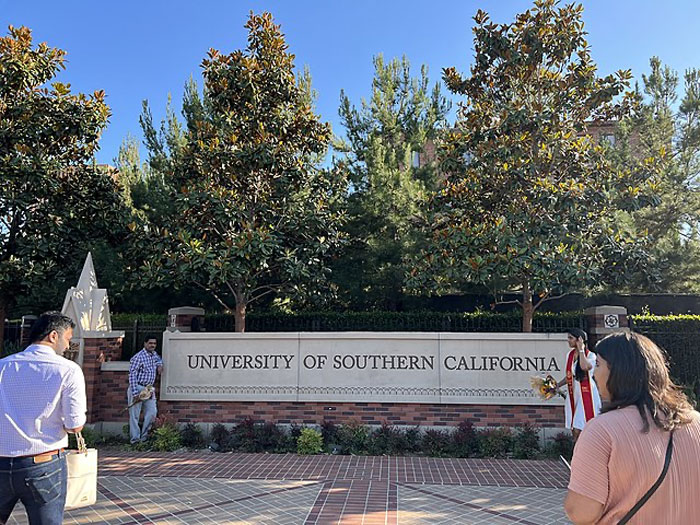
USC Hillel Vandalized

The University of Southern California Hillel building was vandalized on the morning of August 23.

The Journal obtained an email sent out by the Hillel to the rest of the community explaining that “a window next to our entry door facing University Walk had been shattered” during the previous evening. “The building was not occupied when this occurred,” USC Hillel Executive Director Dave Cohn wrote in the email “At this time, we do not yet know the motives or identities of any involved, and are not yet prepared to characterize the incident. We do not know whether the damage was accidental, a random act of criminal vandalism, or if it specifically targeted our facility. That said, within a half hour of opening our building this morning we were working closely on-site with the USC Department of Public Safety to begin an investigation.” Cohn added that they “are reviewing security footage and will ensure that every measure is taken to prioritize the safety and security of our students and our Hillel.”

The university said in a statement to the Journal, ““We are aware of the incident. The USC Department of Public Safety (DPS) is taking it very seriously. DPS, in partnership with Hillel, will ensure that every measure is taken to protect the safety and security of our students and our community. If anyone has any information about the incident, please call DPS at 213-740-6000.”

Jewish groups condemned the vandalism.

“Though we are waiting for more information on this incident at USC Hillel’s office, we view this act of vandalism with great concern, as acts of antisemitism are on the rise in our communities, including on college campuses,” Anti-Defamation League Los Angeles Regional Director Jeffrey I. Abrams said in a statement. “From 2020 to 2021, we saw a 41% increase in antisemitic incidents across Southern California, and a 34% increase nationwide. Nationally, antisemitic incidents on college campuses rose 21%. We are grateful to the USC Department of Public Safety for its quick response and await their investigative findings.”

American Jewish Committee Los Angeles Regional Director Richard S. Hirschhaut similarly said in a statement to the Journal, “Given the climate of intolerance and hostility toward Jewish students on many college campuses these days, it is chilling that a projectile would be hurled through a window at USC Hillel. Such physical assaults are unacceptable, and the perpetrators must be held accountable for their violent and dangerous criminal act. Ironically, this vandalism comes at a moment when USC is examining its campus climate, especially the protection of its Jewish student population, head on and with refreshing, unvarnished honesty. That is the backdrop in which this abhorrent act occurred. May it be an aberration.”

StandWithUs CEO and Co-Founder Roz Rothstein also said in a statement to the Journal, “StandWithUs condemns the recent criminal act of vandalism carried out against USC Hillel. We are grateful to USC’s Department of Public Safety for their rapid response in investigating if this was a random act of vandalism or was motivated by antisemitism. We support USC Hillel and students who are negatively impacted by this crime regardless of its nature.”

Simon Wiesenthal Center Associate Dean and Director of Global Social Action Agenda Rabbi Abraham Cooper was more critical of USC. “Will there be accountability—ever––at USC for anti-Semitism?” he said in a statement to the Journal. “There was a reason USC was listed in SWC 2021 Top Ten Anti-Semitism list. There is a reason why the US Department of Education was compelled to launch an investigation. It is not too late for the University’s top leadership to finally treat anti-Semitism with the same degree of concern and action when other minorities are concerned. Not only students but outstanding Jewish professors at USC expressed their concerns and fears directly to the University President. What has changed? If today’s vandalism is any indication, not much.”

Judea Pearl, Chancellor Professor of Computer Science at UCLA, National Academy of Sciences member and Daniel Pearl Foundation President, noted in a tweet that the vandalism occurred the same day as the Advisory Committee for Jewish Life at USC sent a memorandum to USC President Carol L. Folt with their recommendations for dealing with antisemitism on campus. “It’s much better than expected, for it mentions anti-Zionism 12 times,” Pearl tweeted. “However, instead [of] declaring anti-Zionism an unacceptable form of hate, it recommends: ‘Acknowledge explicitly that anti-Zionism can sometimes be experienced as antisemitism in responding to issues and incidents.’ In other words, the committee acknowledges explicitly its commitment to remaining as vague and inexplicit as possible in order to keep the ‘committee’ in session, and resist defining anti-Zionism as an assault of one’s identity. Sad.”

Stop Antisemitism tweeted that “antisemitism is skyrocketing on American college campuses” and encouraged students and recent graduates of college universities to give them input on an upcoming report on “the safest schools for Jewish students.”

USC Hillel Vandalized Read More »

When Jew Hatred is Relative

There’s an old joke about two guys on a camping trip who see a bear heading in their direction. The first guy starts to panic, but the second guy calmly begins to lace up his sneakers.

First guy: “Are you crazy? You can’t outrun that bear.”

Second guy: “No, but I can outrun you.”

The point is that everything is relative. 

In a week during which Palestinian Authority President Mahmoud Abbas once again attempted to minimize the horrors of the Holocaust, we were reminded that even the so-called “moderates” in the Palestinian leadership are not that moderate. It’s all relative.

His shameless insults reminded us that the path to peace is far more complicated than either the Abraham Accord advocates or J-Streeters would have us believe.

When Gaza erupted in violence earlier this month, we saw that despite all the problems with Hamas, they are still not as radical as Islamic Jihad. Over years of fitful peace negotiations in the region, we have accepted that Abbas is more pragmatic than Hamas’ leaders. And last week, during Abbas’ news conference with German Chancellor Olaf Scholz, we re-learned an old lesson that in the Middle East, the most reasonable leaders aren’t very reasonable at all.

Abbas, who took over for the less moderate Yasser Arafat in 2005 and has cancelled presidential elections for the past thirteen years in order to remain in office, has been attempting to diminish the import and impact of the Holocaust for his entire adult life.

He wrote his doctoral thesis on the premise of a partnership between Zionists and Nazis and arguing that the number of Jews who perished in the Holocaust was vastly overblown. Over the years, he has repeatedly made the case that “only” a few hundred thousand Jews were killed and that the six million figure was concocted for public relations purposes. Just four years ago, Abbas claimed that Jews in Europe were massacred for centuries because of their “social role related to usury and banks.”

Such is the state of moderation in the Middle East.

Scholz did not exactly cover himself with glory, remaining silent through the remainder of the news conference after Abbas’ slurs and then shaking his hand afterward before eventually criticizing Abbas several hours later. He has been condemned in Germany and abroad for not speaking out more quickly. The fact that German law actually forbids Holocaust denial heightens Scholz’s embarrassment even further.

Yet the German leader’s reaction underscores the tenuous nature of Israel’s relationships with many European countries, and reinforces the importance of strengthening ties with its Arab neighbors. It also reminds us of the scope of the challenge that those of us who want to achieve peace in the Middle East still face. Israel’s improved relationships in the region certainly provides greater security for its people. But while praise for these efforts is entirely justified, Abbas’ hate-filled remarks are a testament to the obstacles to peace that still lie ahead.

In the three-dimensional chess game that is Middle Eastern geopolitics, other events occurred last week that could have a greater impact on Israel’s future than Abbas’ insults. While the most “reasonable” of Palestinian leaders was blaspheming the memories of six million dead Jews, Iranian negotiators were withdrawing a key demand from the negotiations over that country’s nuclear capabilities. Iran’s decision to drop the requirement that their Revolutionary Guard Corps be removed from the State Department’s terrorist organization blacklist makes a final deal slightly more likely and accentuates the mutual animosity toward Iran that binds Israel to a growing number of Arab states.

If Abbas is a moderate, permanent friendships in this dangerous neighborhood are still a long way off.

Henry Kissinger famously said that there are no permanent friends or enemies, only interests. So the juxtaposition of the negotiations with Iran and Abbas’ ugly revisionism provides a cautionary note that the stronger relationships between Israel and some of its neighbors does not reflect an eradication of age-old antisemitism in the region but rather the current and perhaps temporary confluence of goals against a common threat. If Abbas is a moderate, permanent friendships in this dangerous neighborhood are still a long way off.


Dan Schnur is a Professor at the University of California – Berkeley, USC and Pepperdine. Join Dan for his weekly webinar “Politics in the Time of Coronavirus” (www/lawac.org) on Tuesdays at 5 PM.

When Jew Hatred is Relative Read More »

Curiosity Can Change Our Communal Discourse

Throughout these past months as I have been reciting the Kaddish in memory of my dear mother, I have been reflecting on her life and the values she instilled in me and my siblings. One of her defining attributes – cited by many, and especially needed in today’s day and age – is sakranut, curiosity. 

Growing up, and continuing throughout adulthood, whenever we would discuss something, Mama would always present the other side of an argument, decision, idea, etc.  Some might call that “playing the devil’s advocate,” but really it was far from anything devilish; my mother challenged us to expand our horizons and to always consider and value other perspectives, experiences, or thoughts. This practice, unfortunately, appears to be lacking in much of our society today.

She would have really enjoyed a symposium I was recently privileged to attend, which focused on ”viewpoint diversity” in our community today.  Convened by the Maimonides Fund, colleagues from across the Jewish communal landscape learned from each other and from respected thought leaders as we considered the increasing polarization of civic – and communal – debate.

Rabbi David Wolpe, senior advisor at Maimonides Fund and Max Webb Senior Rabbi at Sinai Temple in Los Angeles, anchored the discussion in core Jewish values, including machloket l’shem shamayim – argument for the sake of Heaven.  As a people, we have spent thousands of years discussing and debating everything, and, most importantly, learning how to listen and respect each other’s opposing viewpoints. The Talmud itself embodies this as each page is filled with different and almost always conflicting opinions and interpretations of each line, phrase, and word.

Haidt observed how social media has destroyed our ability to see the other side and to open our minds to opposing points.

Jonathan Haidt, Professor of Ethical Leadership at New York University’s Stern School of Business and noted co-author of “The Coddling of the American Mind:  How Good Intentions and Bad Ideas Are Setting Up a Generation for Failure,” commented on the changing culture on college campuses and its effect on mental health.  He observed how social media has destroyed our ability to see the other side and to open our minds to opposing points of view. 

I participated in several small-group discussions exploring the growing challenge in Jewish communal organizations, where we strive to balance multiple stakeholders with multiple perspectives in increasingly divided communities.  How can we discuss Israel in a constructive way with diverse points of view?  How do we best respond to antisemitism in the context of protected speech, especially on college campuses today?

As a society, we seem to have become so mistrustful and polarized we miss the gray and nuance.  We have forgotten how to have constructive conversations.  We seem unable or unwilling to respect individuals when we might disagree with their positions.  

Unfortunately, this lack of civility has also been part of our Jewish history. A few weeks ago on Tisha B’Av, we mourned among many tragedies, the destruction of Jerusalem due to sinat chinam (baseless hatred) between our brothers and sisters, who abandoned a basic tenet of Judaism: respecting diversity in civil discourse.

I feel fortunate to see some signs of hope in my daily work.  At Jewish camps across North America, the observance of Tisha B’Av helps convey critical lessons in character development, where chanichim (campers) and madrichim (counselors) create intentional communities away from home each summer.  By fostering an environment of belonging, diversity, learning, and curiosity, Jewish camps help to model our collective Jewish future.

We will soon enter the final month of the Jewish year – Elul.  We begin our preparations for Rosh Hashannah and a fresh start with renewed positivity and possibility.  We all need relief from the negativity, polarization, and exhaustion of our current civic debate.  Perhaps we can commit to changing its tone and tenor and enter a period of renewal, comfort, and growth.  

Each morning during Elul, we will sound the Shofar as a spiritual wake-up call, challenging us to look inside ourselves, to consider how we can change, learn, and grow.  How?  Let us bring the joy and spirit from Jewish camps – and the spirit of curiosity that is my mother’s legacy.


Jeremy J. Fingerman is the CEO of the Foundation for Jewish Camp.

Curiosity Can Change Our Communal Discourse Read More »

Why Teachers Can’t Be Activists

We all have teachers who made indelible impressions on us. As I consider the teachers who shaped my own life, I realize these were the educators—from school, college and graduate school—that made it possible for me to be fully human: to think and ask questions, to always remain curious, and to continually ask whether there is another interpretation. 

They gave me a gift. They gave me permission to think for myself, even if that meant disagreeing with them. They taught me how to think, not what to think, and gave me the skills to cultivate a vibrant capacity for pursuing inquiry rather than ideology. 

I remember that one of my favorite teachers would often shift his opinion based on a point made by a student. These were magical moments: the student teaching the teacher. And later when I became a literature professor, I always told my students on the first day: Don’t be afraid to disagree with me or with your peers; we learn only through dialogue, and you might even change my mind about something.

Were all my teachers like this? No. But the ones I remember and respect, the ones who I credit with so much of who I am now and what kind of teacher and person I became, are the ones I’ve described here, and in retrospect I realize they were from across political and ideological spectrums. It didn’t matter whether they were liberal or conservative, Democrat or Republican; I learned from all of them because they didn’t impose anything on me. They encouraged me to look for truth, to consider various approaches, and to be fearless when expressing my views.

Over the past few years it seems that what I considered ideals for a teacher are now seen as dangerous. It’s dangerous to let children, adolescents and young adults think for themselves or ask too many questions. It’s dangerous to allow them to form their own opinions that may deviate from the politics of their teacher or institution. They should vote the same, feel the same about every issue from how to fight racism to how to define a woman to the limits of abortion, and they should become activists in all segments of their lives. They should chant and adopt mantras that prove their allegiance to the political activism they are being taught.

Type the phrase “teaching and activism” into your search engine and you’ll see just how much of an industry it’s become. 

Some schools (especially in Los Angeles) have actually reconfigured their curricula to be activism- rather than academics-based (never mind that in many of these—often private—schools children consistently perform academically under the national average). These schools offer training sessions for teachers to instruct them in how to bring political activism into the classroom. Type the phrase “teaching and activism” into your search engine and you’ll see just how much of an industry it’s become.

In some cases, the rationale sounds noble. Proponents of activism in the classroom say they want to teach students a sense of responsibility and to engage with issues of social justice. But these are the precise values that get lost when teachers bring political activism into the classroom. Instead of developing a true sense of ethical responsibility, which, in the words of philosopher Emmanuel Levinas means truly “seeing” the face of the other human regardless of who he is or what he thinks, we are ushered into the space of the political. For Levinas, this political space can never be ethical. It can never be a place where ethical responsibility flourishes. Political activism in the classroom extinguishes the fires of both free expression and compassion. It is selfish, seeking to fulfill its own agenda rather than empower original thinkers. It undoes and unravels all of the critical values that teaching is meant to convey.

Indoctrination is not education. An activist in the classroom is not a teacher. Students look to teachers to help them navigate the world and to think critically. But when partisan political opinions infiltrate the space of learning, the power of critical thought and free expression has been diminished and the educational space ceases to exist at all.


Monica Osborne is a former professor of literature, critical theory, and Jewish studies. She is Editor-at-Large at The Jewish Journal and is author of “The Midrashic Impulse.” Twitter @DrMonicaOsborne

Why Teachers Can’t Be Activists Read More »

The Canadian, All-American Girl Who Moved to Israel

On June 5th, 2021, Nicole Raviv stood before an audience of hundreds at the New York Islanders Stanley Cup playoffs. As she had done many times before, she began to sing the national anthem, only to discover her microphone was blown out due to technical difficulties. A true professional, she kept singing, and soon enough, the fans joined in with her. Raviv’s performance — the booming sound of thousands singing the Star-Spangled Banner —quickly went viral on sports-centered social media. Later, the performance was covered by The New York Post, The Daily Wire, Fox News, 12 News and Newsday. 

“In that moment,” says Raviv, “It didn’t matter if you were a Republican or a Democrat. We were all here watching hockey. At the time, we were debating whether to sing the national anthem before sports games. But this was a moment of unity that changed the energy in the room. Of course, we were going to sing it.” The Islanders went on to win that game, and perhaps it was sports superstition that compelled the team management to ask Raviv to do the same thing at future games, to in some way get the audience belting “Oh say can you see…” along with her. Raviv began pointing her microphone toward the stands each time she sang. The audience kept joining in, and the Islanders kept winning. 

The mainstream media spread Raviv’s name far and wide, and the Jewish journalism world quickly seized on the opportunity to highlight a display of heartwarming patriotism from a girl with an Israeli name who proudly wore a Hamsa necklace during her performances. The Jerusalem Post and Jewish Insider broke the news that America’s new sweetheart was in fact in the process of moving to Israel. 

Raviv spent her childhood in Montreal, the daughter of Israeli parents who had immigrated before she was born, her mother the child of Holocaust survivors. “My parents met on stage — my dad sings and my mom acts, so performing is in my bloodline.” Raviv went on to study musical theater in college, and after years of attempting to “make it” as a vocal performer in New York City, she was brought on in 2019 as the national anthem singer for the New York Islanders. She dabbled in singing for the NBA, NFL, and soccer as well. “It was ironic that here I am, Canadian and Israeli, and I get my start in this world singing the American national anthem, but I guess that works,” she quips. 

Raviv eventually decided to make aliyah because of her strong family connection to Israel. “I always knew, in the back of my head, that I would end up in Israel, I just didn’t know when,” she admits. As her career grew in New York, she was brought further and further into the Jewish community, making appearances at Israeli consulate events and high-profile events within the Jewish corporate world. This only strengthened her ever-present desire to return to the homeland. “In my late-twenties, my husband and I realized that if we didn’t do it now, it would be very unlikely that we would ever do it,” Raviv explains. “I felt like I had conquered New York, and Israel was the next level, a place where my musical spirit can truly thrive.”


Raviv believes that to improve her craft and to better connect with audiences, she must be in a place, in a region, in a culture, in a language that “makes her soul happy.”

Raviv believes that to improve her craft and to better connect with audiences, she must be in a place, in a region, in a culture, in a language that “makes her soul happy.” Throughout her time in New York, she was always attempting to add Middle Eastern influences into her music, which usually fell short due to lack of competent musicians and understanding of the style. In Israel, however, her creative expression can run wild. “I find that by singing in Hebrew, I’m able to emotionally connect more to my craft, something in me opens up when I sing in the language of my people.”  Raviv will be performing in a new play at Habima Theatre in just a few weeks called “Ida,” which tells the story of Ida Nodel, a Soviet Zionist activist and refusenik, and is also in the process of crafting a new Hebrew musical about the life story of King David, which is set to run in Israel before it hits Broadway most likely next year. Just a few months into her new residency, she has even learned to sing in Arabic, a challenge she calls thrilling due to the beauty and mysticism of the Islamic world’s music.

Clearly, there were plenty of pull factors to Israel, but there were also push factors as well. Raviv noted how the environment in the United States is pressuring more Jews to move to Israel regardless of whether their soul is attached to the land or not. 

Her performance at the 2021 Stanley Cup playoffs came on the heels of the previous May, when Israel erupted into a war with Hamas. “People at the time were taking their mezuzahs off their doors. My husband worked in the Diamond District where fireworks were thrown at Jews. I would go perform, and there were people, fellow Jews, working with me who told me not to wear my jewelry on camera . . . my Magen David or Hamsa. I told them no. If I have this platform, I am going to be loud and proud.” Jewish sports fans flooded Raviv with support for representing the tribe with confidence. The positive feedback only strengthened her resolve to live among Jews in a Jewish nation for the rest of her life. 

Raviv and I later discussed why Jewish people in the arts continually shy away from standing, publicly, in solidarity with the Jewish people. This is in stark contrast to artists in the Black and LGBT communities, who tend to be unabashed in their support for causes and issues that concern their communities.  During, for example, a war in Israel or during a wave of antisemitism in the United States, a majority of Jewish artists fall silent. “In the arts, there are certain social pressures to distance yourself from your Judaism just because of the environment you’re in and the opinions of your fellow artists,” she explains. “The arts can pressure you to put on a face or a fake persona to sustain a career.” 

There is something special about Raviv’s story — of descending from victims of the Holocaust and making the move to Israel to succeed in the arts but having the pivotal moment of fame being an expression of American unity. It is often discussed that our society is too polarized, that it is on the cusp of tearing itself to shreds over conflicts of identity, which always pose a danger to Jews. That Raviv can bring an entire stadium together to honor national camaraderie while proudly wearing Judaism on her sleeve is a salute to the continued prosperity of both peoples: Americans and Jews. When America is strong, the Jews are strong.


Blake Flayton is New Media Director and columnist for the Jewish Journal.

The Canadian, All-American Girl Who Moved to Israel Read More »