fbpx

August 10, 2022

Summer Camp Welcomes Ukrainian Refugees

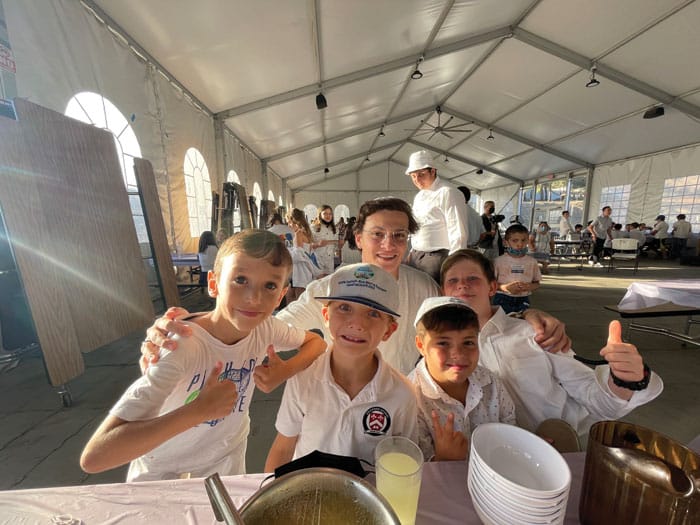
The Jewish Federation of Greater Los Angeles and the Shalom Institute partnered to send Ukrainian refugee children to an overnight Jewish summer camp in Southern California. 

From Aug. 2 to 14, nearly 30 refugee children, ages 8-17, many of them separated from fathers who are fighting in the current war in Ukraine, enjoyed a respite from recent harrowing experiences. They took part in normal summer camp activities including archery, arts-and-crafts, mountain biking, animal education, swimming, waterslides, basketball and soccer.

Camp Gesher, annually supported by the grantmaking Genesis Philanthropy Group, was designed for Russian-speaking Jewish children living in North America.

At no cost to their families, the children attended Camp Gesher, the signature program of the Shalom Institute. Camp Gesher, annually supported by the grantmaking Genesis Philanthropy Group, was designed for Russian-speaking Jewish children living in North America.

The Jewish Federation of Greater Los Angeles and the Shalom Institute raised over $80,000 to sponsor 29 Ukrainian Jewish refugee campers at Camp Gesher, along with four staff members and several mental health professionals, according to Bill Kaplan, executive director at the Shalom Institute.  The campers came from Los Angeles, Ventura County, Orange County and San Diego, Kaplan said.

Camp Gesher Director Lena Geller was instrumental in bringing Ukrainian children to the camp. In March, she reached out to Kaplan and asked to travel overseas to support relief work serving Ukrainian refugees.

“She called, saying the JDC [Joint Distribution Committee] was asking for volunteers at the border. She said, ‘I would really love to go.’ She was there for 11 days and was really impacted by the experience,” Kaplan said. 

She took part in a volunteer mission with the JDC on the Polish-Ukrainian border. Alongside volunteers from around the world, Geller provided comfort, guidance and hope to those in the war-torn region. When she returned, however, she realized she wanted to do more to help. 

“It became clear to me that my job helping refugees from my Ukrainian homeland was not over with just that trip,” she said. “What became abundantly clear is that we have an opportunity to make a difference in the lives of Ukrainian refugees here in the United States, especially children. These children need love, community, kindness, and happiness — all of which can be provided with an experience at Camp Gesher this summer.”

The Shalom Institute’s campaign for a Ukrainian refugee camper fund garnered support from 33 individual donors. 

Among those that stepped up was the Jewish Federation of Greater Los Angeles. Since Russia began its invasion of Ukraine earlier this year, the L.A. Federation has fundraised to support Ukrainian families, and when the Shalom Institute contacted the Federation to support its work, the Federation was happy to assist. 

“When it became clear the war in Ukraine was becoming a more protracted experience, the Federation shifted into thinking, ‘How do we create opportunities – fun opportunities – for refugee families here in the U.S., Israel and Europe?” Rabbi Noah Farkas, president and CEO of the L.A. Federation, said in an interview. “‘How do we do that in a way that feels right to us, meets our mission and has impact that is necessary?’” 

Camp Gesher is currently the only summer camp in North America for Russian-speaking Jewish families. Every year, approximately 140 kids attend the camp, held at the Gold Creek Center in Lake View Terrace, CA. This year will be extra meaningful. 

“Our Federation was determined not just to help these children escape the war, but [also] committed to helping them in the long-term by making sure they were able to begin new and better lives wherever in the world they settled,” Farkas said. “When we received the request from our cherished partners at Shalom Institute, we knew this was a wonderful and powerful way to help accomplish that.”

Kaplan echoed a similar sentiment. 

“They basically said, ‘It’s our moral obligation to provide this.’”

Summer Camp Welcomes Ukrainian Refugees Read More »

The Orthodox Community Must Invest in the Arts

When I was in seminary in Israel, one of the girls I was in school with gave a presentation about her former life as a ballet dancer. She talked about how far she got in an extremely competitive industry. She was accepted into a prestigious dance company and performed at large theaters on the weekends. She showed us one of her beautiful routines. 

But she told us that as she became more religious, she didn’t have opportunities to dance anymore. She loved being Orthodox, but she had to give up what she loved. She couldn’t follow her dreams.

Her story was incredibly relatable. My husband Daniel started becoming more religious as I went through an Orthodox conversion process. Daniel was a stand-up comedian on his way to big things. He was a huge hit on “This American Life,” which 2.2 million people tune into every week, and he was performing on the road for thousands of people when he opened for Ralphie May. 

Slowly, religious observance started to interfere with Daniel’s career. He realized that if he was going to become an observant Jew, he had to immerse himself in Shabbat. Being on the road and performing in comedy clubs was not conducive to that lifestyle. While he continues to pursue his art, this puts him at a major disadvantage. 

Like the ballet dancer, my husband found there was no arts infrastructure set up in the Orthodox community as an alternative. There are a few understandable reasons why. 

Many Orthodox people don’t watch TV or movies or listen to secular music, and they don’t want to engage with it in any way. Also, living an Orthodox Jewish life is very costly, and you have to work a job where you’ll make enough money to support your family. In my community, we take Torah learning very seriously, and the arts may seem like a frivolous waste of time. 

As a writer, I fully believe in the power of the arts. They can, at the very least, make someone feel less alone. When I read Kurt Vonnegut and Joan Didion and David Sedaris, I stopped feeling like an outsider. I was inspired to follow my passion. 

On a broad scale, the arts can transform society and change the course of history. The photo of a Saigon execution shocked the nation and helped end the Vietnam War. Billie Holiday’s recording of “Strange Fruit” became the anthem for the anti-lynching movement throughout America. There are countless examples you could find.  

On a personal level, art can calm you down and help you feel connected and happier. You are channeling holiness when you create.

When we step away completely from the arts and pretend the media doesn’t exist, we don’t have any representation. The writers and producers tell stories about us without knowing us.

The fact is that my Orthodox community cannot afford to disengage with the arts. We are portrayed negatively in the media with shows like “Unorthodox” and “My Unorthodox Life.” When we step away completely from the arts and pretend the media doesn’t exist, we don’t have any representation. The writers and producers tell stories about us without knowing us. This can lead to a number of negative repercussions, including antisemitism. 

I absolutely believe we can participate in the arts and still stay true to our Torah values. It’s not so black and white. 

Fortunately, there are a lot of Jewish organizations that support the arts. Unfortunately, few of them are Orthodox. 

We need arts funding in the Orthodox Jewish community. This could include grants and fellowships for all different kinds of artists. We should make sure there are more art classes in religious schools and children are encouraged to express themselves through art. Every child doesn’t have to follow such a narrow path and go into a “safe” career. Creativity should be celebrated. One artist could change the world. 

My hope is that this piece will reach the influencers in our community, like teachers and parents who also believe in the arts. I hope we can cultivate and nurture creative expression in children and adults. And as a writer, I hope my fellow artists read this and know just how much I value the holy work they do.


Kylie Ora Lobell is the Community Editor of the Jewish Journal. Want to reach me? Please send me an email at KylieOraLobell@Gmail.com.

The Orthodox Community Must Invest in the Arts Read More »

I Love Lucy

I’ve been married for over 32 years. It’s a good marriage and my wife delivered us three wonderful boys. My wife is the best. When I was out of work, she supported us. When I was sick and in the hospital, she was there as both my wife and my advocate. 

But then out of nowhere, it happened. Unexpectedly, I met another woman. And as in most of these cases out here, in typical LA fashion, my new love is a much, much younger model than my wife. Her name? Lucy. 

I was smitten and in love from the moment I laid eyes on Lucy. I remember a rabbi telling me, “Love, at first sight, is generally not real.” He compared it to some guy who comes to a Chabad class and the next week he comes back wearing a black hat and the beginnings of a beard and says he wants nine children. It rarely, if ever, takes. I understand what the rabbi’s saying, but this is different. I am totally in love with Lucy. Every time I see her, I am stopped dead in my tracks, and all I think is, “I love Lucy.” 

We met less than two weeks ago at my son and daughter-in-law’s house. Figures, right? I already made her my screensaver.  

I know what you’re thinking: This guy is an idiot. This guy is insensitive on every level. This guy is out of his mind. Well, I’m not. I know what love is, and this is love.  This is Shakespearean.

After seeing Lucy for the third time, I went to my wife and told her what I was feeling. We have that type of relationship where we tell each other almost anything. 

After seeing Lucy for the third time, I went to my wife and told her what I was feeling. We have that type of relationship where we tell each other almost anything. As I started talking, she said, “I can tell something is going on with you. What is it?” I dug deep into my front pocket, pulled out my phone, showed her my screen saver, and said, “I love Lucy. I can’t stop thinking about her.” She said, “I love her too. She’s wonderful. Thank God for her.”   

If you haven’t yet guessed, Lucy is our new grandchild. Lucy is also a girl. There has not been a girl on my side of the family for over 100 years. We had three boys. My parents just had me. And my father came from four boys. None of them had girls.  When having children, the rule is you get what you get and love what you get. 

My wife has been the perfect mother to our boys. She cheered at all the soccer, basketball, and baseball games. She made multiple trips to Dodger Stadium every season. However, she did draw the line at going to mud wrestling. She made sure our home was a loving place. 

Underneath it all, I know she would have loved a little girl. But it was not meant to be … until now. Finally, the spell is broken, and she’s got a granddaughter.  

Within the first day or two of Lucy’s arrival into this world, the Amazon packages started piling up. Several new pink and red dresses are now hanging from the treadmill and Peloton bike. Coming home from visiting Lucy, my wife remarked that when she changed Lucy’s diaper, she did not have to worry about being squirted on. 

Last Shabbos, my son Jacob and I walked to the shul where he and his wife Anna were throwing a kiddush to celebrate Lucy’s arrival. I was called to the Torah for the Third Aliyah. When the baal Korea (reader of the Torah) finished, the place erupted in song and dance. Mazel tov after mazel tov. There I was, standing at the Torah, surrounded by tremendous love. I had the thought that this probably made God happy. 

My wife and I have both lost our parents and grandparents. These are the times when you miss them the most. When you wish they could share these moments of great joy. It’s nice to share miracles with other people. 

When stepping down from the bima, I shook more hands than a politician vying for reelection. Back at my seat, my son Jacob and I hugged. After taking it all in I realized not just our family, but everyone else who sees our new granddaughter says, “I love Lucy.”


Mark Schiff is a comedian, actor and writer, and host of the ‘You Don’t Know Schiff’ podcast.

I Love Lucy Read More »

The Shortest War

Just in case you missed it, there was a war in Israel last weekend. 

Because the hostilities lasted such a short time, and the number of casualties was relatively low, the conflict received a fairly small amount of media attention outside of the region. But the missiles flying between Israel and Gaza were still a stark reminder that for all the diplomatic and economic progress that has occurred between the Jewish State and many of its Arab neighbors in recent years, the path to actual and sustainable peace in the Middle East is still a long way off.

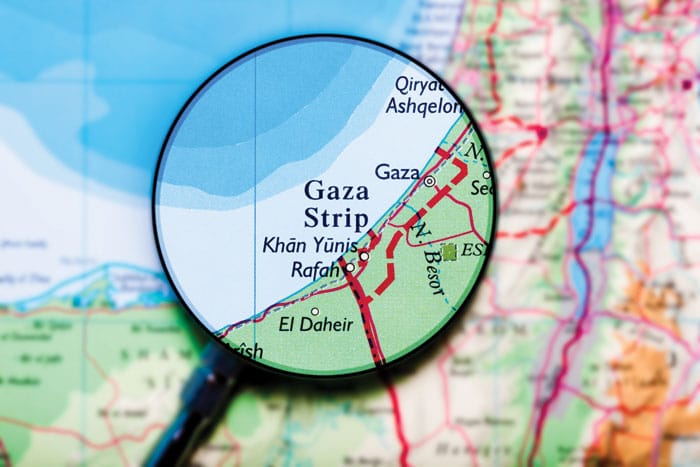
Unlike last year’s war with Hamas, the 2022 version was provoked by the Palestinian Islamic Jihad (PIJ), Gaza’s smaller, older and weaker terrorist organization. After Israeli security arrested a senior Jihad leader earlier in the week, Mossad agents picked up warnings of an imminent PIJ attack against Israeli civilian targets. On Friday afternoon, Prime Minister Yair Lapid and Defense Minister Benny Gantz authorized missile strikes on Jihadi military instillations. By Sunday night, a ceasefire was in effect, and the weekend war had concluded before most of the world had noticed that it had begun.

Just because the conflict was fleeting doesn’t mean that there weren’t valuable lessons to be learned from what had – and hadn’t – occurred. 

But just because the conflict was fleeting doesn’t mean that there weren’t valuable lessons to be learned from what had – and hadn’t – occurred. Most notable was the wise decision of Hamas to stay out of the fight. Because Hamas is not only a terrorist group but also a governing entity, their leaders have begun to understand that they have some responsibility for the lives and well-being of their constituents. Since the conclusion of last year’s 11-day war, Israel has increased the number of work permits for Gaza residents that allow them to enter Israel for jobs. Hamas realized that joining the jihadists’ latest battle would cause much of that Israeli economic support to disappear, and so by staying on the sidelines, they were able to maintain job opportunities and economic growth possibilities for Gaza residents. 

Most of Israel’s neighbors came to similar conclusions, deciding that their own long-term interests precluded a more aggressive response toward Israel’s military engagement. Egypt, Jordan and Qatar brokered the ceasefire, and all but one of the countries that joined the Abraham Accords refrained from criticizing Israel about the conflict. The threat posed by Iran has convinced many of Israel’s long-term antagonists that cooperation of Israel is necessary to protect against the Iranian menace, and the lack of public reaction throughout the Arab world throughout the three days of missile strikes was conspicuous. 

However, the war with Islamic Jihad did have significant repercussions on Israel’s domestic political landscape. Lapid, who has less military experience than any leader in the nation’s history, leaned heavily on Gantz throughout the conflict, staying close publicly and privately to the respected former general. Lapid also scored a major public relations victory by getting former Prime Minister Benjamin Netanyahu to join him for a security briefing on the situation, which gave Lapid significant credibility both on military matters and as a political unifier. Both will serve him well when Israeli voters go to the polls again later this fall.

But the most remarkable aspect of Israel’s latest war is how unremarkable it was. Unlike last year’s battle with Hamas that roiled both Israel and the broader Middle East, this conflict with Islamic Jihad seems to have had almost no impact on the international geopolitical landscape at all. The vaunted Iron Dome defense system intercepted almost every PIJ missile strike, with the few that were not shot down landing in less populated areas. There were no Israeli deaths and only a few dozen injuries that resulted from the attacks.

More than forty Palestinians died over the few days, and while most were jihadist terrorists, there were several civilians killed as well (mostly by errant PIJ missiles). There will always be terrorists willing to sacrifice innocent lives to achieve their goals, and the Middle East has more than its share of such zealots. But even if we pay them little attention, the sobering reality is that they are not going away.


Dan Schnur is a Professor at the University of California – Berkeley, USC and Pepperdine. Join Dan for his weekly webinar “Politics in the Time of Coronavirus” (www/lawac.org) on Tuesdays at 5 PM.

The Shortest War Read More »

Lithuania’s Family Secret

Silvia Foti grew up hearing praises of her grandfather. Jonas Noreika — known affectionately as “General Storm” — is still hailed in Lithuania as a war hero and anti-Soviet partisan who fought for Lithuania’s independence at the height of World War Two. One can find streets and schools named after him there, and songs of his bravery are still sung in Foti’s childhood neighborhood of Marquette Park, Illinois, which at one point was dubbed “Little Lithuania,” due to its high immigrant population. “My grandfather, even though I had never met him, I was raised to love him,” Foti says. “I heard nothing but wonderful things about him.” 

This would explain Foti’s shock, while writing a biography about Noreika’s life, when she discovered her grandfather was neither hero nor liberator, but rather a Nazi collaborator responsible for the death of thousands of Jews. 

The Lithuanian community of Marquette Park had originally bestowed the responsibility of telling Noreika’s story onto Foti’s mother. Unfortunately, she fell ill early on in her research, and before her death, entrusted the task of completing the biography to her daughter. Given that Foti grew up speaking Lithuanian as a first language, attending Lithuanian-Catholic school on Saturdays, and was involved in Lithuanian organizations on the weekends, she was committed to telling the story of such a nationally renowned figure at the request of her community. It was only when her grandmother passed away several months later when she began to suspect things were not as they seemed. 

“She told me to not write the book,” Foti confides. “She told me to just let history lie, that there was no reason to dig around. I was stunned by it … I did not know why she said that. She then turned around in her hospital bed and just stared at the wall.” 

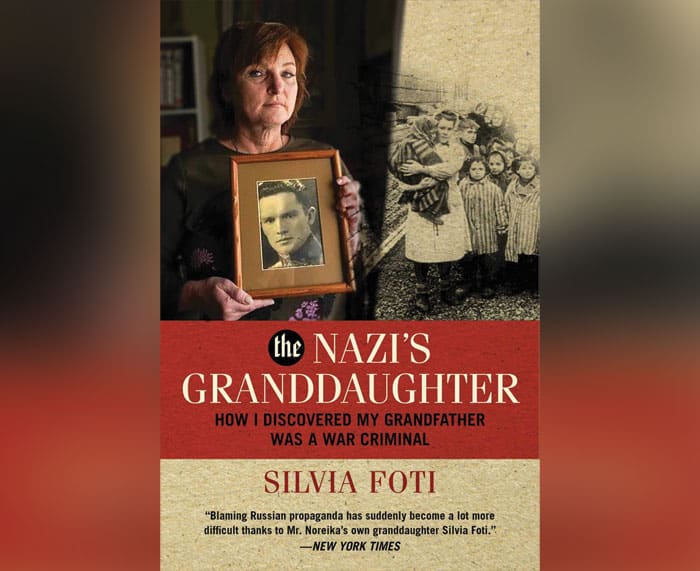
Despite her grandmother’s parting wishes, Foti did write the book after twenty years of “psychological challenges.” Foti recalls that in the first 10 years of her research, she was still in “a state of denial.” Yet finally, what was meant to be a glistening portrayal of a man who stood up to foreign invasion and totalitarianism became instead “The Nazi’s Granddaughter: How I Discovered My Grandfather Was A War Criminal,” a documentation of Jonas Noreika’s supervision of the deportation and extermination of up to 15 thousand Lithuanian Jews. 

Foti told her family story in Vilnius last month at a seminar titled “Learning from the Past, Acting for the Future — Teaching about the Holocaust and Human Rights,” organized by the Olga Lengyel Institute for Holocaust Studies and Human Rights (TOLI). The event, TOLI notes, came on the heels of a newfound national reckoning in Lithuania over its Nazi-collaborationist past. It also corresponded with the sentencing of Lithuania’s oldest concentration camp guard at the age of 101.  

Noreika was a “very ambitious” man from the start. “Everyone always said that he was a wonderful speaker, that he could inspire crowds with his words,” Foti recounts. In childhood, she learned that her grandfather, at the ripe age of 30, was instrumental in liberating west Lithuania from the Soviets in 1941. But this was also the beginning of the German occupation, the consequences of which Foti was never taught in school. “We learned about Siberian camps, and we learned about the evils of communism, but we never were told about the Holocaust in Lithuania. I didn’t even know there was a Holocaust in Lithuania. We were never told about the Jews, other than that Lithuania was very welcoming to the Jews. By the time I started drafting this book, imagine my embarrassment.” 

Eighty percent of the Jews in Lithuania, more than 200 thousand, were killed in the span of six months, from June to December of 1941. The murders were carried out primarily by the Einsatzgruppen, the mobile killing units of the SS, but also by Lithuanian collaborators. At the time, Noreika was governor of the Siauliai region, appointed to the position by the German high command. During his time in office, the Jews of Plunge, Telsiai and Siauliai were all murdered and their communities were destroyed. Even though the entire area was under German occupation, Noreika was still “top desk”— carrying out orders and making decisions for his country. “It took a genocide machine to kill all those Jews,” Foti points out. “There were steps that needed to be taken to destroy them: identifying the Jews, transferring the Jews, leading them to the mass graves, translating documents for the Nazis. Of course, Lithuanians helped with this.”  

Eighty percent of the Jews in Lithuania, more than two-hundred thousand, were killed in the span of six months, from June to December of 1941.

She continues: “At the time, propaganda was so strong, that it became common knowledge in Lithuania that every Jew was a communist. And eventually, that turned into the belief that Jews as young as children were communists. That gave the Germans and the Lithuanians, but mostly the Lithuanians, a license to kill them as a form of revenge. This was all hidden from me.” 

Lithuanians pedestalize Noreika using the justification that “he himself never pulled the trigger against Jews. They think only the one who shot a Jew is guilty,” Foti explains. Also, because when the Nazis began to lose the war, many Lithuanian leaders and intellectuals, including Noreika, were thrown into German concentration camps. It would appear that vengeance against the Soviets and victimization under the Nazis is a perfect resume for a lionized national hero. 

Six weeks into his German imprisonment, however, Noreika and his rank were granted the position of “honorary prisoners” by Heinrich Himmler and were subsequently treated much better than other political captives. “They got their own barracks with only thirty-six men in each. They got their own beds, sheets, blankets, pillows, and new uniforms. They could write and receive letters and packages. They did not have to work but could if they wanted to stave off boredom.” Foti speaks with humor in her voice, amused at the absurdity of Lithuanians conflating her grandfather’s experience with that of Jews in Auschwitz. “By concentration camp standards,” she says, “he was living as an aristocrat.” 

In January of 1945, Noreika was released, only to be recaptured by the Russians and executed in a KGB prison in 1947. 

Hearing Noreika’s story in full is uncomfortable, but fascinating. “The Nazi’s Granddaughter,” rather than just being a historical account, contains explicit themes of betrayal and guilt that weigh heavily on a “proud Lithuanian, and Lithuanian nationalist’s conscience,” as Foti describes herself. I ask Foti how the Lithuanian community both abroad and at home has responded to her work. “Not well,” she answers, without much hesitation. “They’re very angry at me. They’ve called me a traitor. They haven’t read the book, they don’t want to read the book, they wouldn’t touch it with a ten-foot pole.” Even members of Foti’s own family will not read her book. “It’s kind of traumatic for this community to own up to what was done,” she adds remorsefully. Surprisingly, Lithuanians in Lithuania have reacted more positively than Lithuanians in Chicago. “The response is better there than here. Here, Lithuanians feel they need to prove their patriotism, part of a sort of long-distance nationalism,” Foti hypothesizes. “Whereas in Lithuania, the people feel less need to prove something to their country.”

Despite the piqued interest in a shameful past, press for Foti’s book in the mother country has been limited, perhaps a warning that the Eastern European proclivity to deny participation in Nazi atrocities, from Hungary to Poland, is far from vanquished. Lithuania’s Genocide and Resistance Research Centre (LGRRTC) has officially denied the claims that Noreika participated in the Holocaust, arguing instead that Noreika misunderstood the purpose of Jewish ghettos in Lithuania and actually helped to save Jews. But Foti is fighting back. Despite a lawsuit against LGRRTC on the basis of Holocaust denial being scrapped by Lithuanian courts, she is focused on educating the public. “My grandfather could be the doorway to having a conversation more honestly about Lithuania’s past,” she explains. “Nobody asked me permission to put up the plaques honoring him or the schools named after him. They should be removed and renamed, to honor someone who saved Jews, maybe someone recognized by Yad Vashem.” 

Toward the end of our call, Foti and I discussed my own family, which hails from Lithuania, specifically from the village of Tryškiai, located in the very region supervised by Noreika during World War II. Though my family fled to the United States at the turn of the twentieth century and fortunately did not bear direct witness to the horrors of the Holocaust, it was nonetheless chilling to be speaking with the descendant of a man who helped annihilate the civilization from which I trace my bloodline. 

Hearing from Lithuania’s Jewish community and from Lithuanian Jews in the Diaspora like myself has completely changed Foti and her sense of self identity. “I did not expect the Jewish community to embrace me as much as they did, but I’m so overwhelmed by their positive intentions,” she says. “There is something about the Jewish nation that holds Jewish life so sacred, and I think my book serves as a memory to Jewish life. That is why I feel I have been received so well, even as a perpetrator’s granddaughter.” She continues: “God’s hand is behind us in this work. And we all have the same God.” 

“The Nazi’s Granddaughter: How I Discovered My Grandfather Was A War Criminal” is a story of one family’s secret and one country’s shame. It is an important piece of literature in Holocaust education, as it offers the perspective of a descendant, not of the victim, but of the victimizer. Knowing more of these descendants and working with them to bring about change is an inspiring way forward.


Blake Flayton is New Media Director and columnist for the Jewish Journal.

Lithuania’s Family Secret Read More »

Antisemitic Graffiti Found on Maryland Bike Trail

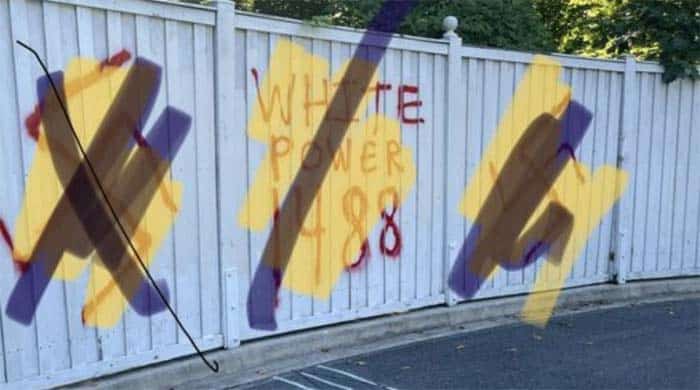
A slew of antisemitic graffiti was found on a bike trail in Maryland on the morning of August 7.

Along the walls of the trail were swastikas and the words “white power” spray-painted in red. The number “1488” also appeared under the “white power” scrawl, which Stop Antisemitism noted is a neo-Nazi code. The “14” is a reference to the white supremacist slogan “We must secure the existence of our people and a future for white children” and the “88” is short for “He*l Hitler,” as “H is the eighth letter of the alphabet,” Stop Antisemitism tweeted, referring to the graffiti as “atrocious.” Police told Patch that an investigation is ongoing.

Local politicians condemned the graffiti. Montgomery County Executive Marc Elrich said in a statement that he is “saddened, upset, and, quite frankly, disgusted over the racist vandalism” at the trail. “As we have in the past, we will organize, unite, and fight back against xenophobic behavior,” he added. “The Montgomery County government will be working with the impacted community and organizations. We will continue to support all efforts, to bring peace, inclusion, and respect to all of our ethnic, racial, and faith communities in wake of this attempt to spread hate in our County.”

 Maryland State Delegate Ariana Kelly tweeted in all capital letters: “HATE HAS NO PLACE IN OUR COMMUNITY.”

Jewish groups also denounced the graffiti. “We are deeply disturbed to learn about this antisemitic graffiti that was discovered at Bethesda Trolley Trail,” Anti-Defamation League Washington D.C. tweeted. “There is no place for this hateful antisemitic and white supremacist vandalism in Maryland or anywhere else.”

Associate Dean and Director of Global Social Action Agenda at the Simon Wiesenthal Center Rabbi Abraham Cooper also said in a statement: “The stain of blatant Jew-hatred from social media to vile graffiti to the streets of our communities continues unabated. We urge law enforcement to redouble their vigilance and urge our neighbors in demanding action from our elected officials to prioritize fight against anti-Semitism and bigotry.”

B’nai Brith International tweeted: “This act of vandalism is part of a larger, alarming trend in anti-Jewish hate crimes across the U.S. & again shows why tackling #antisemitism through education is key.”

Antisemitic Graffiti Found on Maryland Bike Trail Read More »

Jewish Groups Commemorate Anniversary of Sbarro Bombing

Various Jewish groups issued tweets and statements commemorating the 21st anniversary of the Palestinian terror attack at a pizzeria during the Second Intifada.

Author Aviva Klompas tweeted that the bombing occurred at the Sbarro pizzeria in Jerusalem, killing 15 people––including two Americans––and injuring 130 others. The terrorist had packed “nails, nuts, and bolts [in the bomb] in order to maximize casualties,” Klompas wrote. She then noted that Ahlam Tamimi, a Jordanian national, was sentenced to multiple life sentences for being the mastermind behind the bombing, but Tamimi was released in 2011 as a part of a prisoner swap to free Gilad Shalit, the Israel Defense Force (IDF) soldier who was kidnapped by Hamas for five years. “Ahlam was deported to Jordan on her release and received a hero’s welcome,” Klompas added. “Unrepentant of her crimes, she became a popular television broadcaster and public speaker, boasting of her role in the Sbarro attack.” Jordan has continually rebuffed the United States’ efforts to extradite Tamimi.

Simon Wiesenthal Center (SWC) Associate Dean and Director of Global Social Action Rabbi Abraham Cooper said in a statement: “[Twenty] years ago, 15 innocents were murdered, 130 maimed, by Palestinian terrorists in heart of Jerusalem at Sbarro Pizzeria during lunch time. SWC urges US demand extradition of Ahlam Tamimi, from Jordan for her role in the mass murder which included US citizen Malki Roth. Never forget never forgive. Please President Biden and Secretary Blinken, please bring justice to the Roth family.”

Both StandWithUs Israel Executive Director Michael Dickson and Creative Community for Peace Executive Director Ari Ingel that the Palestinian Authority has funneled more than $1 million to the terrorists behind the bombing and their families.

The American Jewish Committee tweeted: “On August 9, 2001, a Palestinian suicide bomber attacked the Sbarro pizzeria in Jerusalem, killing 15 people, including seven children. Today, we remember these precious souls and the thousands of other victims of terrorist attacks. May their memories be a blessing.”

Jewish Groups Commemorate Anniversary of Sbarro Bombing Read More »

Rosner’s Domain: An Already Forgotten Gaza Eruption

If you want to know how short it was, let me tell you about my son. Last Saturday morning, he was a happy tourist in Crete. At evening, he flew back to Israel and hurriedly packed a bag. On Sunday he was in Gaza. Well, near Gaza. In uniform. On Monday he was getting anxious to head back home. 

Operation Breaking Dawn in Gaza started and ended in three days. Last Sunday night, it was over, and if you haven’t noticed it, or already forgot about it, you should not feel guilty. Most Israelis have also forgotten about it by now. And one would hope most Gazans have too (a note of caution: I write this on Tuesday — and it is still true unless the ceasefire didn’t hold. 

Why was it necessary? The short answer is simple: Because when it comes to Gaza, once in a while there is no other choice but to send a reminder that Israel is watching. The longer answer is somewhat boring: because Islamic Jihad was going to launch an attack on Israelis and Israel decided to preempt the attack — and counterattack. 

It was a decisive success, and it was short, and thus the list of casualties is also short. No Israelis were seriously hurt, and the number of Palestinians killed is relatively low. By the way, most of them — including children — were killed by misfires of Islamic Jihad operatives. Gazan terrorists killed Gazans, then and American legislators saved Gazans. Yes, American legislators. Not the progressives who keep hammering Israel for whatever it does, but rather the moderates and conservatives who have the wisdom to fund Iron Dome. Thanks to Iron Dome, no Israeli was killed during Breaking Dawn. Thanks to Iron Dome, few Gazans were killed by Israel. When Israelis aren’t killed the government isn’t under pressure, the military isn’t under pressure, and a military operation can be handled with calm and poise. This saves lives, including Gazan lives.

Politicians and workers can go back to normalcy, yet Gaza remains. It remains not just an unresolved challenge; it remains a challenge for which no one seems to have an idea for resolution. 

On Monday morning the operation was over, and the politicians were back at work trying to score points as Election Day nears. In Gaza, workers whose livelihood depends on getting to workplaces in Israel were also getting ready to go back to normalcy. That’s the normalcy in between military eruptions, as neither Israelis nor Palestinians presume that Breaking Dawn was the last violent conflict in Gaza. Politicians and workers can go back to normalcy, yet Gaza remains. It remains not just an unresolved challenge; it remains a challenge for which no one seems to have an idea for resolution. 

Try to imagine Gaza’s future — is there a way for you to feel hopeful about its future? Try whatever “what if” scenario that comes to mind. Can you think about something that is both realistic and optimistic? Hamas clings to power, Israel isn’t in the business of going back into Gaza, Egypt is ready to mediate but isn’t taking responsibility for Gaza, the Palestinian Authority is too weak and incompetent to take over Gaza, and the international community has lost interest, and for good reason. There are bigger, more pressing issues to worry about (such as world war because of Taiwan), and there are problems as big where acting could make a difference (such as food shortages in East Africa). Gaza is a problem from hell: not urgent enough to be first priority, not simple enough to be resolved as a secondary priority.

A few weeks ago, before the operation, I visited the home of historian Anita Shapira for a long interview about books and ideas. She is a young 82-year-old sage of Zionist and Israeli history, and at one point in our interview she said she hopes that “one day” the Israeli-Palestinian conflict will come to a conclusion. “Can you imagine how this will happen?” I asked her. “No,” she said. She can’t. You’re a historian, I reminded her, as if she needed reminding, so you know that often such conflicts only end when catastrophe strikes. “Yes, that’s true,” she said. Then she started talking about the expulsions of ethnic Germans from the former German territories transferred to Poland, Russia and Czechoslovakia after World War II. And make no mistake. Shapira was not hinting that expulsion is the way forward. She was hinting that there’s great danger that tragedy is the way forward.

Something I wrote in Hebrew

In preparation to the primaries in Likud and Labor that took place earlier this week I wrote this:

Next week we will talk about primaries. We will talk about them much more than necessary. The political system is a producer of exciting events, and the media is the echo chamber of these events. How important are they really? Less than a Maccabi Haifa soccer match against the team from Belgrade that will decide whether Haifa advances to the Champions League. It seems to me that it is quite clear what is more exciting. On the one hand, Maccabi Haifa in the Champions League, on the other hand, MK Naama Lazimi in fourth or fifth or sixth place in the Labor primaries. Nobody cares, except close friends and family. 

A week’s numbers

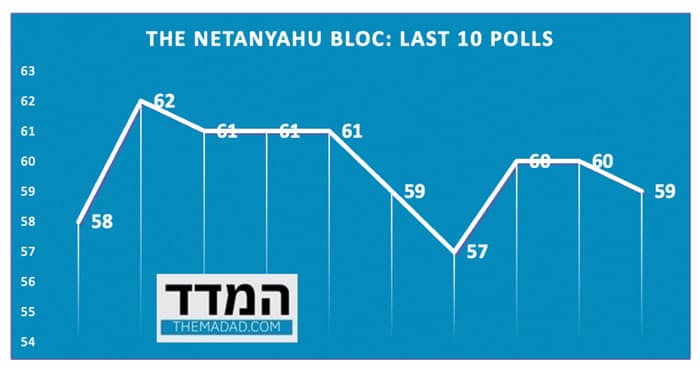
All eyes should be on this graph: Whether the Netanyahu bloc (Likud, Zionist Religious, Shas, UTJ) gets to 61 is the most important question of the fifth round, and it is a close call.

A reader’s response:

Dan Elgar wrote: “I found your description of Israeli polarization highly disturbing”. My response: Ditto.


Shmuel Rosner is senior political editor. For more analysis of Israeli and international politics, visit Rosner’s Domain at jewishjournal.com/rosnersdomain.

Rosner’s Domain: An Already Forgotten Gaza Eruption Read More »