fbpx

May 13, 2022

Gimpel the Fool, Don Quixote and the Haggadah

Bashevis Singer’s Gimpel, unlike Cervantes’ Don Quixote,
is Ashkenazi, not Sephardi. Both were rather weird,
Don Quixote, windmills facing, wears a gentile goatee,

Gimpel, fooled by facts of Jewish history, by it queered.

Don Quixote, unwise hero, at windmills wants to tilt,
Gimpel we laugh at is a fool, like one of the Haggadah’s
sons who asks, “What’s this?” not sharing his bad brother’s guilt,

a man of whom dissenters of his views are not discarders.

Gimpel’s author won for stories that he wrote the Nobel,
two years before Bellow, who translated Gimpel’s Yiddish.
Haggadah’s fourth son, since he asked no questions, just like Job‘ll

deserve it too, the master of the stiff lip–very British.

Too late for him to win this prize, just like the afikomen,
which like the festive sacrifice we don’t eat after midnight.
Those questions we can’t answer we must guard like noble yeomen,

protecting them from answers that are hardly ever right.

The distinguished Bible scholar, Nechama Leibowitz, famously once said, discussing Rashi’s commentaries on the Bible: “Every statement is the answer to a question. The question every statement evokes is: ‘What is the question?’”

In a Tikva podcast on 5/10/22 Ruth Wisse pointed out the strange coincidence that Saul Bellow translated into English Isaac Bashevis Singer’s Yiddish story Gimpel the Fool two years after Singer published it, and won the Nobel Prize for Literature precisely two years after Singer won his. Quoting the first line of Bellow’s Herzog, “If I am out of my mind, it’s all right with me, thought Moses Herzog,” she commented that this echoes the first line of Gimpel the Fool, “I am Gimpel the Fool. I don’t think myself a fool, on the contrary.”

Gershon Hepner is a poet who has written over 25,000 poems on subjects ranging from music to literature, politics to Torah. He grew up in England and moved to Los Angeles in 1976. Using his varied interests and experiences, he has authored dozens of papers in medical and academic journals, and authored “Legal Friction: Law, Narrative, and Identity Politics in Biblical Israel.” He can be reached at gershonhepner@gmail.com.

Gimpel the Fool, Don Quixote and the Haggadah Read More »

Cropped shot of a man placing a white rose on a grave

Against Death: The Story of a Sacred L’Chaim

Years ago, I was asked to officiate at a funeral for a Holocaust survivor. In meeting with his children, I learned that after moving to Canada he had intermarried; and even though they, the family, were not Jewish, it was important to them that their father have a Jewish funeral. Right before the service, the family asked if I could add a “friend” to the list of speakers; as it turned out, this “friend” was the family’s pastor. The pastor (along with the man’s son) gave speeches about how the deceased was in a better place, and we should be happy that now he was in heaven. During my own concluding remarks, I gently explained that in the Jewish tradition, we have a religious obligation to mourn, because Jews consider death to be a tragedy; we take very little comfort in otherworldly realities.

I reacted that way because I couldn’t stomach such a rosy depiction of death being offered at the funeral of a Holocaust survivor, a man who had struggled so valiantly to survive. And while I still stand by what I said then, my words were an oversimplification given that the Jewish tradition includes much debate on this topic.

Death is the focus of the beginning of this week’s Torah reading. A Kohen is forbidden to come in contact with a dead body, which is impure. At the same time, the Kohen is obligated to bury those in his immediate family, a law that Maimonides considers to be the source of the obligation to mourn close relatives. But why do we consider a dead body to be impure? Why is there an obligation to mourn for a relative who dies?

In an article entitled “I Will Make the Unclean Spirit Vanish From the Land,” Rabbi Benayahu Broner, the Rosh Yeshiva of Yeshivat Hesder Tzefat, compares the views of Rabbi Samson Raphael Hirsch, Rabbi Abraham Isaac Kook, and Rabbi Joseph Ber Soloveitchik on this subject. These three important thinkers take very different positions on the Jewish attitude toward death.

Rabbi Kook takes the view that death is an illusion; true life exists in another realm, in the next world. In his characteristically flowery prose, he explains that this is why kohanim are prohibited from coming into contact with dead bodies:

“Death is a false vision … what humans call death is only the strengthening of life and its power. It is because of the endless absorption in pettiness …[that causes] one to depict this strengthening of life in a sad and dark way, which one calls ‘death.’ The Kohanim are raised up in their holiness, [and held back] from hearing this falsehood …[and they can do so] only by averting their eyes from the spectacle which brings these deceptive impressions to the soul.” This is why the Torah says regarding the Kohen: “He shall not go in where there is any dead body,” and “he shall not defile himself for any [dead] person among his people.”

In other words, the Kohen is forbidden from coming into contact with a corpse because death represents a false consciousness, one that distracts from the truth of eternal life. Elsewhere, Rabbi Kook endorses the view of Maimonides, that the primary purpose of the mourning rituals is catharsis, for the mourner to achieve calmness and closure. He explains Maimonides as saying that mourning is only accepted by the Torah as a concession to the weakness of human character, to help one overcome emotional pain, but a person who knows the truth would not grieve.

In short, Rabbi Kook sees death as the passage of an individual to a better place, the very same idea that disturbed me at that funeral.

Rabbi Hirsch focuses more on the psychological aspects of death and mourning. He neither romanticizes death nor bewails it; instead, he is primarily concerned whether grief will distract one from their divine mission. He explains that mourning needs to be carefully managed. Confronting a dead body weakens man’s resolve. Death is fundamentally a loss of control and freedom, and a person in contact with a dead body might become passive and lose hope. (This is similar to the view of Rav Yehuda Halevi in the Kuzari). Extreme grief can lead one to depression. He notes that the Hebrew word for mourning, “evel,” sounds similar to the Hebrew words for fool, “evyl,” and darkness, “aphel.” Mourning can bring gloom and cloud one’s vision, and cause the mourner to lose sight of their purpose. According to Rabbi Hirsch, our mourning rituals are designed to allow emotions to be expressed and lessons to be learned, without distracting from one’s ultimate mission. Kohanim must avoid death completely because they are educators and have a responsibility to teach others how to proceed with their mission in the face of death. To Rabbi Hirsch, death and mourning are obstacles to personal growth that need to be dealt with thoughtfully.

He explains that mourning needs to be carefully managed. Confronting a dead body weakens man’s resolve.

In sharp contrast to the previous views, Rabbi Joseph B. Soloveitchik sees death as the opposite of holiness. Judaism, he declares, has “a negative attitude towards death”; the laws of impurity make it clear that death defiles anything sacred. In Jewish law, life is the paramount value, and one can violate the entire Torah in order to save a life. He attacks the view that death represents salvation from a broken world; if death were truly a “better place” for the deceased, he asks, “Why mourn and grieve for the departed? Why rend our garments, sit on the floor, and say ‘Barukh dayyan emet?’” The laws of mourning make it clear that one must view death as an unalloyed evil, an affront to all mankind. We must battle fiercely against death. This is why Halakha obligates us to heal the sick and extend life. To Rabbi Soloveitchik, death is not deliverance; on the contrary, it is the destroyer of life and the enemy of everything good.

In Jewish law, life is the paramount value, and one can violate the entire Torah in order to save a life.

I have always been drawn to Rabbi Soloveitchik’s views regarding death and mourning, and remember giving my very first sermon on this topic. And I believe that there has been a shift among rabbis in the last century regarding death. Unlike 100 years ago, very few would embrace Rabbi Kook’s views today. This is due in large part to the Holocaust. In the Warsaw Ghetto several rabbis, including the world renowned scholar Rabbi Menachem Zemba, said that Jews would no longer aspire to be martyrs, to die “al kiddush Hashem.” Instead, they would now pursue “Kiddush Ha’Chayim,” “the sanctification of life.” Rabbi Yitzchak Nissenbaum, one of the prominent religious leaders in the Warsaw Ghetto, said: “This is a time for sanctifying life … the enemy is demanding the Jew’s body, and the Jew is obligated to defend it, to protect his life.” After the Holocaust, everything changed; death was an unambiguous instrument of evil. It was now time to cherish life and sanctify it.

My late friend Jack, who was a Holocaust survivor, taught me how to cherish life. After the war, he toiled and struggled to rebuild his life, pouring himself into his family, his community and his business. When we would be at a celebration together, Jack would go to the bar with his friends (many who were survivors as well), and have a drink. Jack would say l’chaim, to life, with a special twinkle in his eye; he had gone through so much, and here he was! Those l’chaims were filled with love, laughter and joy, and made a profound impression on me. They were a sacred embrace of life, a small moment that made the world a better place. L’chaim!


Rabbi Chaim Steinmetz is the Senior Rabbi of Congregation Kehilath Jeshurun in New York.

Against Death: The Story of a Sacred L’Chaim Read More »

German Airline Lufthansa Apologizes for Barring Passengers from Boarding Flight, Doesn’t Mention That Passengers Were Jewish

The German airline Lufthansa issued an apology after more than 100 Jewish passengers were barred from boarding a flight to Budapest, but the apology was criticized for not mentioning the passengers’ Jewish identity or antisemitism.

The airline’s statement, published on May 10, stated: “While Lufthansa is still reviewing the facts and circumstances of that day, we regret that the large group was denied boarding rather than limiting it to non-compliant guests.” The passengers had been prevented from boarding the flight after one or two passengers had refused to wear a mask on the preceding flight from New York. “We apologize to all the passengers unable to travel on this flight, not only for the inconveniences, but also for the offense caused and personal impact.” Lufthansa added that the airline has “zero tolerance for racism, anti-Semitism and discrimination of any type.”

As the Journal previously reported, a video circulating on social media showed an apparent representative from the airline telling a Jewish passenger who was questioning her as to why they couldn’t board the flight that “one” passenger didn’t wear a mask on the flight, so “everyone has to pay for a couple.” When pressed by the passenger, the representative said that it was “Jewish people … who made the problems.”

Jewish groups criticized the apology.

“This non-apology fails to admit fault or identify the banned passengers as Jews,” the Anti-Defamation League tweeted. “It also refers to them as a group, even though many were strangers. They had one commonality—being visibly Jewish.”

The American Jewish Committee also tweeted, “Lufthansa’s ‘apology’ makes no mention of the fact that it was Jews specifically who were denied boarding the plane. @Lufthansa, you say you have ‘zero tolerance’ for antisemitism. Confronting your staff’s discrimination will be a first step in living up to that claim.”

The Simon Wiesenthal Center tweeted that Lufthansa’s apology was “not good enough” because there has been “no accountability for @Lufthansa representatives who created this fiasco.” “What steps is Lufthansa taking to train their employees to ensure such insulting behavior toward religious Jews won’t be repeated?” the Wiesenthal Center asked.

StandWithUs CEO and Co-Founder Roz Rothstein similarly tweeted that Lufthansa needs to “do better” and “run sensitivity training for all staff.”

Stop Antisemitism tweeted that Lufthansa “discriminated against Jews like [their] Nazi founder, Kurt Weigelt, did 80 years ago.” They called for the airline to terminate every employee “involved [in the incident]and issue an apology where you actually address the group you humiliated and discriminated against because this ‘apology’ is pathetic at best!”

Human rights lawyer Arsen Ostrovsky, who heads the International Legal Forum, tweeted that the apology was “weak” because the airline “couldn’t even mention the passengers were Jews. Also missing is what steps will [be] taken against the Lufthansa employee/s involved.”

Former New York Democratic Assemblyman Dov Hikind tweeted that the Jewish passengers barred from the flight will be filing a lawsuit against Lufthansa.

German Airline Lufthansa Apologizes for Barring Passengers from Boarding Flight, Doesn’t Mention That Passengers Were Jewish Read More »

Midsection of woman reading book against black background

Holy Texts

A poem for Shavuot by Emily Stern


My friend keeps a Thich Nhat Hanh book on his nightstand.

I brought it downstairs this evening to read aloud for fun- while he cooked for us- I enjoy and looked forward to expanding consciousness, hearing wise metaphors, connecting through love, sharing a meaningful moment, and whatever else I hoped for.

So I read it in an animated, overly dramatic voice to entertain

and he was taken aback.

Feeling mocked, he snapped, “What if someone read Torah that way?”


Oh Torah? Oh, haha, no, you see,

She is devoured by us like we are crazed dogs

digging through dirt to gnaw at her bones.

Somehow, everyone knows this is code for praise.


We encourage children to swing

from her branches,

She gives us life,

and we stretch the ducts of her breasts

‘till her skin is raw, and she overflows.


Her lovers

agonize over the layers of meaning

in every movement, blink, glimmer of ink,

making up stories, she must be… what I think…

in the depths of her waters, we  s i n g  while we sink.


She’s a mountain tempting us to be as high as we are, a well as deep,

she may never really be known or seen.

She is child; she is pure.

She is broken; she is wrong.

She is perfect; She’s unfolding.

She is everything we are.


“I am sorry for not treating your sacred text mindfully,” I looked down with tears

my mind blazing with black and white photos of the Torah being burned.


Wearing your finest dress to play hopscotch

turns it the most special day.

Let’s not keep Spirit in the museum,

to appreciate from afar.

Use me. Live through me.

Take me for this ride if you…

Please?


Holy Texts Read More »

david suissa shanni suissa podcast

Can you grow sustainable, delicious meat in a lab?


Listen to the full episode on any of your favorite podcast platforms!

In conversation with Yaky Yanay, CEO of Pluristem Therapeutics, an Israeli biotech firm that is pioneering cell technology, with applications for medical care and creating food products like sustainable, lab-grown meat.

Follow David Suissa on Facebook, Twitter and Instagram & Shanni Suissa on Instagram, Twitter and TikTok.

You can check out Shanni’s new show here!

example one
example two
example two

Can you grow sustainable, delicious meat in a lab? Read More »

Voting Is a Civic Duty. Here’s Your Handy Voting Guide

Voting is the most effective way to make change by electing or voting out the people who create and implement the laws that impact you. The ballot has gotten a lot thicker since California residents voted to line up all elections to coincide with the Federal schedule. 

Here are some dates and information regarding June 7, 2022 Election Day:

1. Want a reminder to VOTE each election? Sign up here: https://couragecaliforniainstitute.org/voter-tools/

2. Last day to register to vote in this election is May 23, 2022. Not sure if you are registered or want to register? Visit: https://registertovote.ca.gov/

3. Need Voting Help? (800) 345-VOTE (8683)

4. Polling locations are open from 7:00 a.m. to 8:00 p.m. to vote in person or turn in a vote by mail ballot

5. All registered voters will receive a VBM (Vote by Mail) ballot to the address they are registered to with the State. Ballots should arrive the week of May 9, 2022. Didn’t receive it or need help with how and when to vote? Visit: https://lavote.gov/home/voting-elections/voting-options/vote-by-mail/how-to-vote-by-mail or call 800.815.2666

6. Need a ballot in another language? Visit: voterstatus.sos.ca.gov.

7. Return ballots by mail, to a secure drop box at a public location or on election day to a polling place. After returning your ballot, track the status here: WheresMyBallot.sos.ca.gov 

8. In the primary election on June 7, 2022, voters will choose which candidates will move on to the general election on November 8, 2022. State, County and City elections are non-partisan so regardless of a registered party the two top vote winners will move onto the general election in November. In some cases, this might mean two members of the same party competing.

9. Individual names you can vote for in some cases will depend on which districts you live in. To locate information on the voting ballot unique to your address visit: http://votersedge.org/

Statewide Offices On All Ballots

United States Senator- Two senators are elected from each state, regardless of state population, guaranteeing each state equal representation. Senators are elected for six-year terms. The Senate tends to respond more directly than the House of Representatives to issues of national, rather than local, concern, though both houses of Congress participate in all aspects of legislation and policymaking. The Senate has the exclusive right to try cases of impeachment, approve presidential appointments, confirm treaties, and elect a vice president if no candidate receives a majority from the Electoral College. The vice president serves as presiding officer of the Senate.

*There are two contests for the U.S. Senate on this ballot due to Kamala Harris becoming Vice President of the United States. You can vote for both contests. One for a 6-year term ending January 3, 2029; and one for the remainder of the current term ending January 3, 2023.

Find Information Here on the candidates: https://ballotpedia.org/United_States_Senate_special_election_in_California,_2022

Governor – The highest elected official in California. Oversees most state departments and agencies. Prepares annual state budget. Approves or rejects new state laws. 

Lieutenant Governor – Next in line: Becomes Governor if the elected Governor leaves office. Has a tie-breaking vote in the State Senate. Serves on boards and commissions. 

Secretary of State – Head of elections and record keeping: Coordinates statewide elections and oversees election laws. Also keeps records about new corporations and businesses and other state databases. 

Controller – The state’s bookkeeper: Keeps track of how the state’s money is spent. Issues most checks from the state and manages collection of money due to the state. Reports on finances of state and local governments. 

Treasurer – The state’s banker: Manages the state’s investments and assets. Coordinates the sale of state bonds.

Attorney General – The state’s top lawyer: Makes sure laws are enforced the same way across the state. Manages the state Department of Justice. Oversees sheriffs and district attorneys. 

Insurance Commissioner – Insurance overseer: Manages the state Department of Insurance. Enforces laws that insurance companies must follow. 

Superintendent of Public Instruction – Head of public schools: Manages the state Department of Education. Provides leadership and assistance to all public schools in California. Enforces education regulations.

Candidate Statements for Statewide Offices can be found here: 1) https://voterguide.sos.ca.gov/candidates/

2) https://votersedge.org/ca/en/section/2022-06-07/los-angeles-county/overview

Los Angeles County Offices on All Ballots

LA County Assessor– Officer of the government of LA County that is responsible for identifying all taxable property in the County, except for state-assessed property, to inventory and list all the taxable property, to value the property, and to enroll and collect fees for all the property on the local assessment roll.

LA County Sheriff– A Police force serving LA County that is the largest Sheriff’s department in the United States. The department’s three main responsibilities entail providing patrol services for the 153 unincorporated communities of Los Angeles County, California and 42 cities, providing courthouse security for the Superior Court of Los Angeles County, and the housing and transportation of inmates within the county jail system.

Los Angeles City Offices on All Ballots

Mayor– The Mayor is the head of City government and more than any other City official, is held responsible for the conduct of City affairs.  As the executive officer of the City, the Mayor submits proposals and recommendations to the Council, creates the annual budget, approves or vetoes ordinances passed by the Council, and enforces the City’s ordinances. 

City Controller– the Controller has responsibility for serving as the auditor and chief accounting officer of the City. The Controller is required to exercise general supervision over the accounts of all officers and departments of the City.

City Attorney– serves as legal advisor to the Mayor, City Council, and all City boards, departments, officers and entities. As the City’s general counsel, the City Attorney provides advice and opinions on matters of municipal concern, examines contracts and ordinances as to form and legality.

List of Los Angeles City candidates: https://clerk.lacity.org/sites/g/files/wph1491/files/2022-03/Certified_list_of_Candidates_Final.pdf

For all candidates for Los Angeles County please visit: https://votersedge.org/ca/en/election/2022-06-07/los-angeles-county

 Propositions and Measures of Interest by City

LOS ANGELES CITY

Measure BB — Allows the City to award bid preference to a bidder located in Los Angeles City

Shall the City Charter be amended to allow the City, on a competitive bid contract, to award a bid preference to a bidder located in the City of Los Angeles?

Beverly Hills City

L – Term Limit Measure: Shall an ordinance be adopted by the City of Beverly Hills to establish a total three term limit during one’s lifetime for the offices of City Councilmember and City Treasurer in the City of Beverly Hills?

MANHATTAN BEACH CITY 

A – INITIATIVE ORDINANCE TO PROVIDE SUPPLEMENTAL FUNDING FOR MANHATTAN BEACH UNIFIED SCHOOL DISTRICT. Shall a measure imposing an annual flat tax of $1,095.00 on each real property parcel within the City of Manhattan Beach, and adjusted annually for inflation, for a period of twelve years, thereby generating an estimated $11,000,000 to $13,000,000 annually for investment in education, with an oversight committee and exemptions for (1) low-income individuals and (2) seniors who use their property as a principal residence, be adopted?

TORRANCE CITY 

SST – Torrance Public Safety/Essential Services Measure. To maintain city services such as fire/paramedic/public safety/9-1-1 response, safe schools; protect local drinking water sources/ coastal waters from pollution; keep parks/ public areas safe/ clean; repair streets/potholes; prevent thefts/property crime; maintain senior services; and address homelessness, shall the City of Torrance ordinance be adopted establishing a ½¢ sales tax for general government use, generating approximately $18,000,000 annually until ended by voters, requiring public spending disclosure, independent audits, all funds locally controlled?

Judges of Different Levels of the Bench:

For more information review the Los Angeles County Bar Associations review of qualified candidates for judge: https://www.lacba.org/docs/default-source/committees/judicial-elections-evaluation/2022/jeec-2022-final-report.pdf

DISTRICT SPECIFIC OFFICES: Depending on which Federal, State, County or City Districts you live in you may see the following on your ballot:

To locate information on the voting ballot unique to your address visit: https://votersedge.org/ca/en/election/2022-06-07/los-angeles-county.

United States Congress member– The duties carried out by a Member of Congress are understood to include representation, legislation, and constituent service and education, as well as political and electoral activities.

State Assembly and Senate

The upper house of the California State Legislature is the State Senate and the lower house being the California State Assembly California State Senators each represent more people than California’s members of the House of Representatives. State legislators are responsible for changing existing laws and making new laws for the state of California and its residents. No matter where you live in California, you are represented by one State Assembly member and one state senator. Every legislator has a staff that helps them stay connected to the residents of their district and helps residents access services. Legislators play a huge role in advocating for public services and protections, like minimum wage; deciding whether services are privatized, such as health care; and determining funding priorities that directly influence your local public school’s budget.

Districts for State Senators on some ballots– 20th, 22nd, 24th, 26th, 28th, 30th, 34th and 36th.

Districts for State Assembly Member on some ballots– 34th, 39th – 44th ,46th, 48th, 49th , 51st – 57th, 61st , 62nd , 64th – 67th and 69th.

LA County Supervisor– The Board of Supervisors is in charge of both the legislative and executive operations of the all of Los Angeles County and its 10 million residents. They oversee County departments, such as the Sheriff, LA County Fire, Health Department, Children and Family Services and more. They hold the ability to make laws that govern the county, provide support for residents and manage the County of Los Angeles budget.

Districts 1 and 3 will be on some ballots.

Los Angeles City Councilmember– The LA City Council is the governing body of the City, except as otherwise provided in the Charter, and enacts ordinances subject to the approval or veto of the Mayor. It orders elections, levies taxes, authorizes public improvements, approves contracts, adopts traffic regulations and provides support navigating City services to residents.

Districts 1,3,5,7,9,11,13,15 will be on some ballots.

Los Angeles Board of Education

Districts 2, 4 and 6 will be on some ballots.

CA State Board of Equalization (BOE) – Established under the California Constitution to regulate county assessment practices, equalize county assessment ratios, and assess properties of intercounty railroads. In subsequent constitutional and statutory amendments, the Board was directed to administer tax, fee, and appellate programs to support state and local government. Today, the BOE focuses on its Constitutional responsibilities: Property Tax, Alcoholic Beverage Tax, and Tax on Insurers.

Districts 1 and 3 will be on some ballots

Voting Is a Civic Duty. Here’s Your Handy Voting Guide Read More »

close-up of mans hands using screwdriver to break into car

To Catch a Thief

I have an extraordinary amount of symmetry in my life: I had a flat tire on the 101 freeway and met the first love of my life.  Check. I snuck into 20th Century Fox studios and walked off the lot with a job on my favorite television show (“Moonlighting”), kicking off my entire career. Check.  Years ago, I walked into a job interview and walked out a Jew. Check. 

I also came to realize that symmetry is a two-way street – it can inexplicably intertwine with someone else’s life with equally dramatic results. There’s a reason why “It’s A Wonderful Life” is one of my favorite films. 

If you’re like me, you have a mental “Shabbos to do list” every Thursday. I’m such a perfectionist that I dropped my car off at the mechanics so I could pick it up Friday morning while my challah was rising. Even my car was ready for Shabbos.  

True to form, the mechanic calls at 10:30 AM, “I replaced your fuel filter and I want to run it for a couple of minutes to make sure there is no more gas leaking. You can pick it up in a half of an hour.” 

Ten minutes later at exactly 10:40, I get another call from the mechanic.

“I’m so sorry to tell you this but your car was just stolen. I’ve already called the police.”

“Are you kidding me? I mean, you’re kidding me, right? “

He wasn’t kidding. 

I went about the rest of my day the best I could.  I’d mutter to myself, It’s just a thing, right? I’ll survive. No one was hurt. It’s a thing. 

When I ran across the street to get something from the market, a homeless woman was sitting right in front of the door. I was two steps past her when I turned around and handed her a twenty-dollar bill. Don’t judge me too harshly, but my first thought was if I do this mitzvah, maybe G-d will give me my car back. 

Five minutes before Shabbos rolls in, I get a call from a detective in L.A. County. It turns out that shopping malls scan your license plate for stolen vehicles. My crackerjack car thief wasn’t so crackerjack.  They arrested him sitting in my car. Hallelujah! 

When I picked up my car from impound, I perused the arrest report and noticed the name of the perp who stole my car. Like any self-respecting victim, I googled him. 

I picked up the phone immediately and called Detective Dan, who was assigned to my case. 

“Did y’all know that the guy who stole my car is wanted for questioning in the murder of a cop? You know this, right? I’m just double checking.” 

“I don’t think it’s the same guy. My entire computer screen would light up like a Christmas tree if there was a warrant out for him,” he said.

“I defer to you, but I want to point out that every detail fits – his name, his age and hometown.”

“I really don’t think it’s him,” he said. 

About one month later I get a call erev Shabbos.

“This is Detective Dan. Do you remember me?”

“Of course, I remember you.”

“I just called to thank you,” he said.

“For what?” I asked. 

“The man who stole your car was indeed the same man we were looking for in connection to the murder of a police officer. When I hung up with you, I wondered, could she be right? I did some digging and over the course of the last four weeks, we got the evidence to convict him. He is going away for life. We also notified the victim’s longtime partner on the police force. He teared up when we told him that the murderer was in custody. “

“I’m Jewish. We believe everything happens for a reason, Detective Dan,” I said.

It’s as if G-d whispered, “I’m going to borrow your car for the weekend and we’re going to catch a killer.” You know what? Anytime Hashem. Anytime.

It’s as if G-d whispered, “I’m going to borrow your car for the weekend and we’re going to catch a killer.”

You know what? Anytime Hashem. Anytime.


Christine Sheaks is a Film Producer and currently finishing her memoir, “A Wandering Shiksa.”

To Catch a Thief Read More »

Sulam Chi, a Kabbalah and Tai Chi Movement That Connects to the Divine

One day, while living in Brookline, Mass., Levi Ben-Shmuel was flipping through his local adult education course catalog. It was there he saw a 10-week course on Tai Chi, a Chinese martial art that incorporates meditation and defense training. Intrigued, he signed up to learn under Tai Chi Master Vincent Chu. 

The first meeting with the master’s father, Grandmaster Gin Soon Chu, changed Ben-Shmuel’s life. “He gave a dramatic demonstration of using chi, the life force energy present in all of creation, in a martial arts exercise,” Ben-Shmuel said. “After seeing what he could do with this energy, I was committed to learning how to work with chi as a martial artist.”

Consequently, while Ben-Shmuel was becoming immersed in Tai Chi, he went to Israel for the first time. There, he had another revelation after feeling the divine presence in Jerusalem. 

“During my first visit to the Kotel on a Friday night, I deeply felt my connection to the Jewish people and the land of Israel,” he said. “I knew I would return to Israel one day and spend a significant amount of time there.”

That was the summer of 1991, and Ben-Shmuel’s three-week vacation in Israel turned into 10 years. He became a dual citizen of Israel and the United States and legally changed his name to his Hebrew name. He also studied under a Kabbalah teacher, Hadassah Ben-Yishai, who taught him about how to have a close connection with God. She used the Kabbalah’s Tree of Life as a primary teaching tool to develop a relationship with the Almighty.

“The love affair she had with God was intoxicating to be around,” he said. “I knew I wanted to experience this love myself. She quickly guided me to my own experience of the unconditional love God has for me and each and every one of us.”

After learning this, Ben-Shmuel, along with another student, was inspired to create Sulam Chi, a Jewish movement exercise that incorporates the 10 energies of the Tree of Life.

“I used my background in Tai Chi to intuit movements that correspond to the energy centers called sefirot,” he said. “The sefirot are mapped to our bodies. While doing Sulam Chi, you focus on the part of your body linked to each sefirah.”

Today, Ben-Shmuel, who lives in Los Angeles with his family, teaches Sulam Chi online and in person. The class, which is a complete mind, body and spirit exercise, incorporates meditation and prayer in motion. No background in Tai Chi or Kabbalah is required, and it’s ideal for all ages and levels of fitness. It only takes a few minutes to do it in a small space. 

“Given the levels of stress, anxiety and overwhelm of our times, Sulam Chi is an efficient exercise that quickly and easily brings people back into balance through relaxing the body, calming the mind and reconnecting them to their souls,” he said. 

Ben-Shmuel is confident that especially during these tumultuous times, practicing something like Sulam Chi and embracing a Higher Power not only have the power to provide stability, but to also give people a moment of peace.

“The gift of knowing that God accepts you as you are and loves you unconditionally is priceless.” – Levi Ben-Shmuel

“The gift of knowing that God accepts you as you are and loves you unconditionally is priceless,” he said. “In these days of uncertainty, rapid change and deep divisions, keeping this knowing close to your heart is a foundation you can count on to navigate your life and thrive.”

Sulam Chi, a Kabbalah and Tai Chi Movement That Connects to the Divine Read More »

Milken School’s 30th Anniversary, Netflix Comedians, Kol Ami Gala and ‘Fiddler’ Documentary

On May 1, nearly 1,000 community members, including parents, alumni, alumni parents and supporters, joined together at Warner Bros. Studios in Burbank to celebrate Milken Community School’s 30th Anniversary.

The gathering honored Ken and Wendy Ruby, Nurit and Rich Robin, and Vivienne Friedman. 

Highlights of the evening included a performance by students from Milken’s Koleinu choir, live music performed by 10-piece band Traffic Jamm, dancing, food performance stations, exploring the backlot that was home to many favorite shows and movies, including “Gilmore Girls” and “Ocean’s 11,” a video highlighting Milken’s proud 30-year history, as well as videos paying tribute to the evening’s honorees. 

Along Reunion Row, a section of the venue, over 300 alumni gathered to reminisce about their Milken days and create new memories as they sipped “Milken Margaritas” and feasted on kosher short ribs, sushi and shawarma. Those who graduated from Milken in the nineties mingled with young adults who graduated as recently as 2015. 

From left: Milken Board Chair Lise Applebaum, Milken honoree Vivienne Friedman and Milken Head of School Sarah Shulkind. Courtesy of Milken Community Schools

Another highlight of the sold-out event was hearing powerful and inspiring words from Head of School Sarah Shulkind about Milken’s bright future. She spoke about how successful Milken has been in providing tuition assistance to students in need.  

“There is unbelievable momentum at Milken,” Shulkind said. “Our applications doubled in one year from more than 40 feeder schools city-wide. Our enrollment is up 15%. Now more than ever, with the rise of antisemitism, we need to raise children who are proud to be Jewish and who are proud of and connected to Israel. That is why Milken is investing significant resources to continue leading in this area.”

The evening also launched a fund, The Rabbi Isaiah Zeldin Endowment for Children of Milken Alumni, raising over $500,000 during the program’s paddle raise.


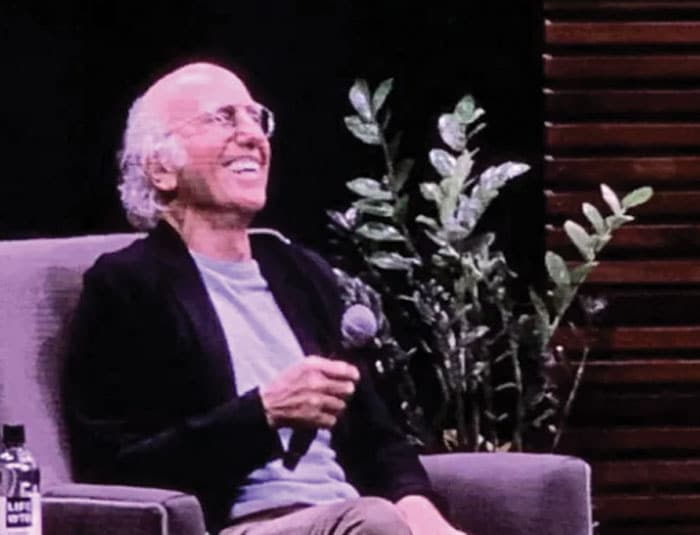
Larry David appears at the Netflix is a Joke festival. Photo by Daniel Lobell.

Member-of-the-tribe comedians Larry David and Adam Sandler were among those who participated in the “Netflix is a Joke” festival to talk about their careers in comedy. 

Appearing on May 2 at the Greek Theatre in a live conversation with producer-director Robert Weide, David covered “Curb Your Enthusiasm,” “Seinfeld” and laughing at his bar mitzvah’s haftorah portion.

On May 3, comedians Dana Carvey and David Spade interviewed Sandler at the Wiltern.


From left: Rabbi Denise Eger; Jeffrey Wortman and Peter Balderas, recipients of John Altschul Leadership Award; Dr. Nancy Cohen, recipient of Spirit of Kol Ami Award; and Peter Mackler, president of Kol Ami. Photo courtesy of Congregation Kol Ami

Congregation Kol Ami held its 29th annual gala at Playa Studios in Culver City. 

The gathering on May 1 raised more than 90,000, including money for SOVA.

“It was wonderful to celebrate 29 years of Congregation Kol Ami by coming back together in person as a community,” Kol Ami Rabbi Denise Eger said. “Our honorees Dr. Nancy Cohen and Mr. Jeffrey Wortman and Peter Balderas have volunteered their time and resources for our synagogue. Their leadership has been exemplary, and their neshamot filled with chesed.”


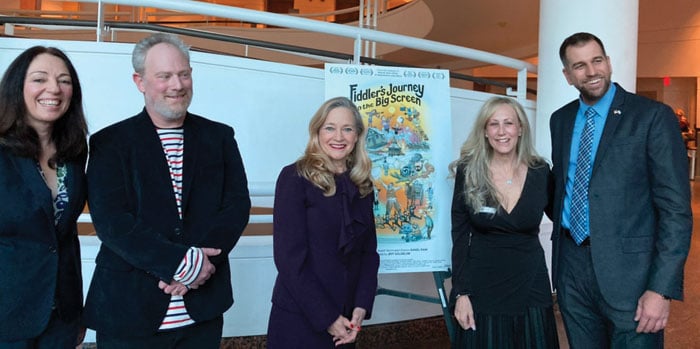
From left: Sasha Berman, producer; Daniel Raim, director; Museum of Tolerance Director Liebe Geft; LAJFF Director Hilary Helstein; and Jonathan Bar-El, consul of public diplomacy at the Consulate General of Israel. Courtesy of the Los Angeles Jewish Film Festival.

On April 25, the Los Angeles Jewish Film Festival, in partnership with the Consulate General of Israel in Los Angeles, the Museum of Tolerance and Jewish Story Partners, held the Los Angeles premiere preview screening for the new documentary film, “Fiddler’s Journey to the Big Screen,” at the Museum of Tolerance. 

A post-screening panel included the film’s writer-director Daniel Raim, producer Sasha Berman, co-writer Michael Sragow and actress Michèle Marsh, who played Hodel in the motion picture, “Fiddler On The Roof.” 

Hilary Helstein, director of the Los Angeles Jewish Film Festival, moderated. 

More than 200 excited audience members were in attendance.

The film explores how the experience of making “Fiddler” deepened Norman Jewison as an artist and revived his soul. Drawing on behind-the-scenes footage and never-before-seen stills, the film offers original interviews with Jewison, Topol (Tevye), composer John Williams, production designer Robert Boyle, lyricist Sheldon Harnick, film critic Kenneth Turan, and actresses Rosalind Harris, Michèle Marsh, and Neva Small (Tevye’s daughters).

The film opened in Los Angeles theaters on May 6. 

Milken School’s 30th Anniversary, Netflix Comedians, Kol Ami Gala and ‘Fiddler’ Documentary Read More »