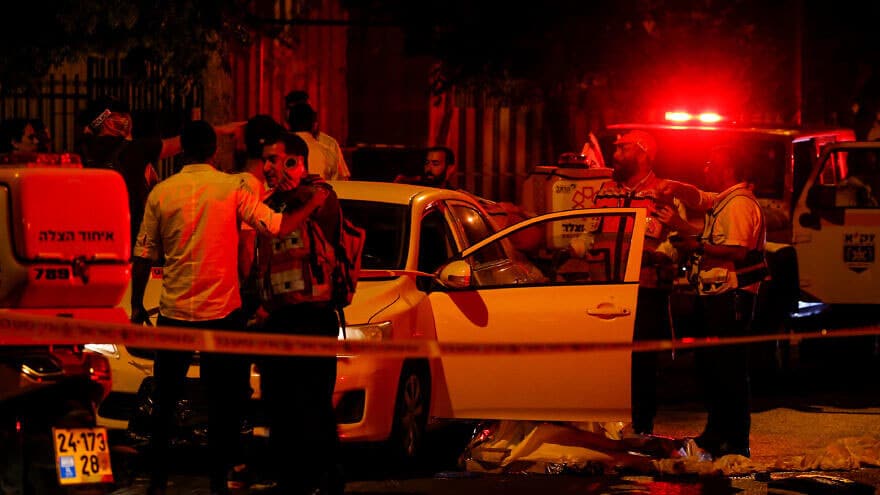
Security forces are searching for the attackers who killed three Israelis and injured at least four people, two critically, in the central Israeli city of Elad, not far from Petach Tikvah. The attack on Thursday night came as celebrations for Yom Ha’aztmaut, Israel Independence Day, were winding down.
“Unfortunately, three people who we performed CPR on have been pronounced dead,” said Moshe Sa’adon, a volunteer EMT with United Hatzalah and head of Elad Hatzalah, who was one of the first emergency-service personnel on the scene. “We also treated two people in serious condition, one person in moderate condition and a number of people lightly injured.”
Also treating patients is Magen David Adom. Director general Eli Bin tweeted: “At the moment, reports indicate six victims in serious condition. Many MDA teams are at the scene treating the victims at this moment.”
One of the victims who was killed was reported as being a man in his 40s. A witness at the scene heard shouts of Allahu Akbar during the attack, according to Israeli media.
The suspects, who attacked people in the city’s central park by Ibn Gvirol Street, were believed to be armed with an ax and perhaps a firearm. With the aid of at least one helicopter, security forces are searching the area for the assailants. Elad Mayor Yisrael Porush told residents to stay inside while security forces were operating.
Jewish groups worldwide immediately responded to the news, offering prayers and support.
“When will the hatred and violence end?” said a tweet from the Friends of Simon Wiesenthal Center in Canada. “We are sickened to learn of yet another suspected terror attack in Israel, which has taken the lives of three people and injured several others. Our thoughts are with the victims and their loved ones.”
Agudath Israel of America tweeted that it is “horrified by the news of a terror attack in Elad, Israel. We are praying for the victims and their families.” They followed up that tweet with the text of Psalm 130, which many recite in times of trouble.
Stand With Us tweeted: “At least three innocent people were murdered in tonight’s deadly terror attack in Elad, central Israel, #Israel, and at least 3 more are left fighting for their lives, as Israelis were celebrating Israel’s Independence Day. May their memories forever be a blessing.”
Rabbi Abraham Cooper, associate dean and director of global social action at the Simon Wiesenthal Center in Los Angeles, said: “No current peace partner in Holy Land. Palestinian leadership continues to praise and support terrorists, and reward them and their families for murdering and maiming Jews. It will stop when the world holds [Palestinian] leadership accountable for their incitement and support for terrorism.”
In many ways, Moms are the center of the family, and in the Jewish world, they are known to be primarily responsible for the spirituality of their home. Jewish mothers, with help from the fathers, care for their children, oversee their education and make the holidays and Shabbat special.
“We all know that if the mom isn’t inspired, it’s unlikely that Judaism will be happening in the home. The question is, ‘Who’s taking care of mom?’”– Rebbetzin Chana Heller
Sometimes, however, their efforts aren’t recognized. “Moms are kind of the forgotten demographic in the Jewish world,” said Rebbetzin Chana Heller of Aish Los Angeles. “We throw lots of money in the direction of our kids. But we all know that if the mom isn’t inspired, it’s unlikely that Judaism will be happening in the home. The question is, ‘Who’s taking care of mom?’”
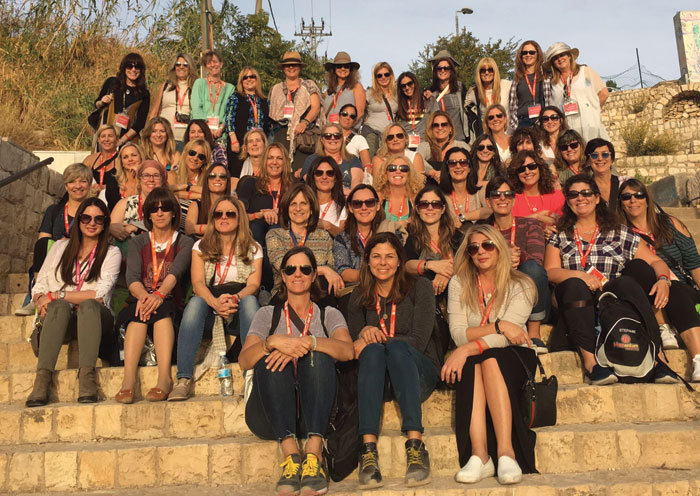
In 2011, a group of Jewish women, including Heller, got together and decided they would fulfill this need. Their goal was to send Jewish mothers who didn’t have a strong connection to their spirituality to Israel on group trips. There, they would learn about the land and Torah, bond with one another and come back with the motivation to explore their Jewish roots.
These women called their program the Jewish Women’s Initiative, and they send 46 moms to Israel every year for an eight-day trip. The group tours places like Tel Aviv, Jerusalem, Masada and the Dead Sea, and takes classes on a variety of subjects.
“We focus on personal growth and being the role models we want to be for our families and communities,” said Heller. “We learn the deeper meaning of Jewish holidays, mitzvoth and Jewish spirituality in general.”
Sharon Shenker (left) and Chana Heller
Heller, along with Aish LA’s Sharon Shenker, founded JWI together and act as co-directors of the highly subsidized program. In addition, Aish partners with Lori Palatnik’s Momentum organization to help provide funding. The participants pay for flights, tips, a refundable deposit and for COVID testing, while everything else including hotels, group transportation and many meals are covered through JWI/Momentum.
JWI is now accepting applications for the next trip, which will take place October 31 through November 7. Applicants are interviewed and the final scholarship awards are going to be given out the first week in June. Jewish moms in Los Angeles with at least one child under 17 years of age can apply, and preference is given to moms who have never visited Israel before. The program is highly competitive; for the 45 spots that are available, there are 90 to 130 applicants.
Mothers who have gone on the program come back home and feel inspired, as well as start engaging with their Judaism in more meaningful ways as well.
“They learn and grow together, and the women inspire one another to bring Jewish values to their families, plan bar mitzvah or family trips to Israel, celebrate Shabbat on whatever level they are able and much more,” said Heller. “Our philosophy is baby steps add up to growth and change. It’s never all or nothing with us.”
After her trip, one mother joined a temple, started having Friday night dinner with her family and sent her child to a religious school, while another feels more in touch with the Holy Land.
“JWI has been super fun and inspirational,” said participant Sheri Weinstein. “I am forever grateful that I got to go on the Momentum trip in 2016, since it has forever changed my life. Not only do I have new amazing friends, [but] I also have a stronger connection to my Jewish roots and Israel.”
Bryna Hornstein, who also went on the trip, said JWI “has helped me explore my Judaism on a deeper and more spiritual level. It has helped guide me through good and bad times. The connections of like-minded Jewish women are invaluable.”
To ensure that the women stay connected and continue their education, Aish requires that they participate in an 18-month follow-up program after the program ends. And while Aish is an Orthodox institution and the trip organizers are also Orthodox, Heller said that it’s not about women becoming frum.
“Moms from all streams of Judaism come together to dialogue about the things that are most important to them,” she said. “An added bonus is the unity that is created. Reform, Conservative, Orthodox or unaffiliated, we are all Moms who want to connect our kids to their heritage and continue the mission of the Jewish people.”
When Wendy Tirsch’s water broke at 26 weeks, she was terrified. She was pregnant with triplets – two boys and a girl – and didn’t know if they were going to survive.
“The neonatologist came into my hospital room and gave us the percentage of the likelihood of everything that could go wrong with 26-week preemies, starting from brain bleeds and working his way down the body,” said Wendy.
The hospital wasn’t expecting Wendy to deliver immediately, so when it was time for her emergency C-section, the doctors, nurses and staff rushed in. There were a total of 21 people in the operating room.
The triplets, named Jacob, Hannah and Zachary, were born within two minutes of each other. They weighed just over one-and-a-half pounds, and they were whisked away to the NICU before Wendy or her husband, David, could hold them.
“A few hours after the babies were born, the neonatologist gave us an update,” said Wendy. “He said they were tiny and fragile but miraculously healthy. Within 24 hours, they were taken off ventilators and put on CPAP machines for oxygen.”
There were constant ups and downs. Sometimes, the babies would stop breathing or their bellies would become distended. Their heart valves weren’t closing properly. One baby was aspirating with every swallow.
While every day brought different challenges, after two-and-a-half months in the NICU, Wendy and David were able to bring their triplets home on Thanksgiving Day.
“By the grace of God, we avoided all major complications and defied all the medical statistics,” said Wendy. “We stayed positive throughout it all, spending all day, every day with the babies. The NICU team was phenomenal and became like family. We talked about them coming to our b’nai mitzvah one day.”
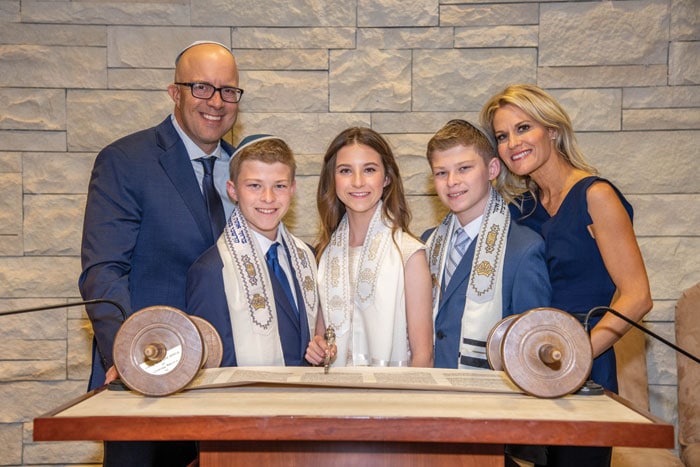
That day came this past March, when Jacob, Hannah and Zachary celebrated their b’nai mitzvah at Congregation Or Ami in Calabasas. The triplets, who are involved in the youth group at the synagogue, read Exodus 38:21-40:38. Each one chanted 12 different verses within their parsha.
“The main nurses were at our b’nai mitzvah and have said that in 35 years working in the NICU, our triplets are the biggest success story they’ve seen.”– Wendy Tirsch
According to Wendy, she and her husband fulfilled their dream of having the NICU staff there, too. “The main nurses were at our b’nai mitzvah and have said that in 35 years working in the NICU, our triplets are the biggest success story they’ve seen,” she said.
The services were incredibly touching – Wendy and David had a hard time getting through their speeches because of the tears and laughter that came out.
“Watching [our children] on the bimah was unbelievable,” said Wendy. “We are so proud of the young men and woman they have become. They chanted beautifully and were so well-composed. The service was emotional, and family and friends were crying tears of happiness throughout.”
Now, reflecting on the challenging birth experience, Wendy has advice for other parents who are experiencing the same struggles: stay positive, and don’t give up hope.
“We had a rule that we were always positive in front of the babies,” she said. “We showered them with love and attention and wanted them to feel our confidence. Get involved in their day-to-day care. Take advantage of the expertise of the NICU staff. Babies in the NICU have different needs than healthy babies. Ask questions, be your baby’s advocate and know that you’re not alone in your journey.”
It was obvious that the Tirsch family was not alone in theirs; they had help from above, too.
“We absolutely believe God was watching over our family, not just because we are blessed with three healthy, gifted, athletic kids, but also because of the strength we were given throughout the entire process,” said Wendy. “There is no way we would have gotten through this without each other, our amazing medical team and knowing God was by our side, guiding us through the process.”
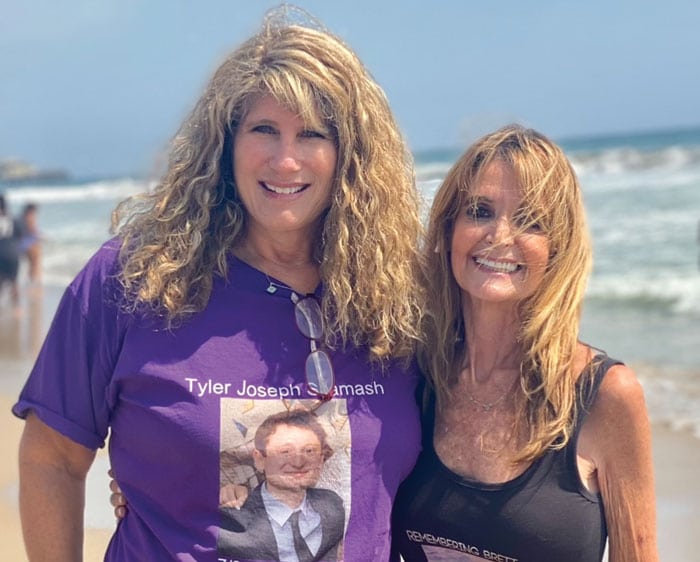
Juli Shamash and Debi Nadler met and bonded after the most tragic of circumstances. Shamash’s 19-year-old son Tyler died in 2018 while Nadler’s 28-year-old son Brett died six months earlier. Both had overdosed on drugs.
To help work through their grief, Shamash, a resident of Beverlywood, and Nadler, who lives in Las Vegas, became part of the online Grieving Mom Community. Upon learning of Shamash’s son’s death, Nadler reached out to her, and the two learned that their sons lived across the hall from one another at the same Los Angeles treatment center. Although the moms were in different cities, they decided the best way to deal with their common despair was through action.
Starting in 2019, they organized walks to bring awareness to the drug epidemic fueled by the massive influx of Fentanyl. They named their walks Drug Epidemic Awareness Walk Across America, which drew hundreds of participants and spread to every state.
It wasn’t long before they knew they needed to formalize by creating a 501(c)(3) organization, and they rebranded as Moms Against Drugs (M.A.D.). The mission of M.A.D. is to promote drug abuse awareness, overdose prevention, provide resources and support to other moms who want to put on awareness events in their neighborhoods. Right now, they’re trying to raise money to further their efforts.
“Most of our work is being funded by the two of us and from donations from friends and family,” Nadler said. “We are working for free from our hearts to try to save others. We don’t like asking grieving mothers for money, but I’ve spent about $200,000 on rehab for my son and $48,000 on my son’s funeral. I sold everything I own. If we can get more funding, we can do much more.”
M.A.D. focuses their efforts on Fentanyl, which the group says is the leading cause of death for Americans ages 15-24.
M.A.D. focuses their efforts on Fentanyl, which the group says is the leading cause of death for Americans ages 15-24. What makes the Fentanyl issue so dire is how it targets a younger and younger age group. According to M.A.D., Fentanyl is being sold where kids are: On social media apps such as TikTok, Snapchat and Instagram. It is often disguised as Xanax, Percocet, OxyContin, Adderall and cannabis.
In addition to organizing and coordinating visibility walks in cities across the country, Shamash and Nadler do speaking engagements, promote educational materials for schools and come up with creative ways to raise awareness.
When COVID-19 struck, a major walk they planned had to be cancelled. So, they pivoted and created a “Light Our Country Purple” campaign, since the color purple commonly signifies overdose awareness.
“We worked with local and state governments and private [industries] to turn landmarks across the country purple for one day,” Shamash said. “We got many landmarks in the country to turn purple. In LA that included City Hall, buildings, water fountains, the pylons at LAX, you name it.”
At the same time, the moms wanted to enhance visibility by erecting billboards warning of the dangers of Fentanyl. “When I spoke to the LA Health Department, I said, ‘You’re spending all this money on COVID radio ads and bus ads, why aren’t you doing more to warn kids about pills and cocaine laced with Fentanyl?’” Shamash said. “They told me that ad campaigns are planned two years in advance and there is a lot of bureaucracy involved. I told them kids are dying now. I knew we had to find a faster route.”
It was then that Shamash spoke at Harvard-Westlake School. After her talk, a father in the audience approached her and gave a very generous donation and said he wanted the money to go to billboards in LA. The first billboard appeared on Barrington Ave. and Olympic Blvd. in West LA.
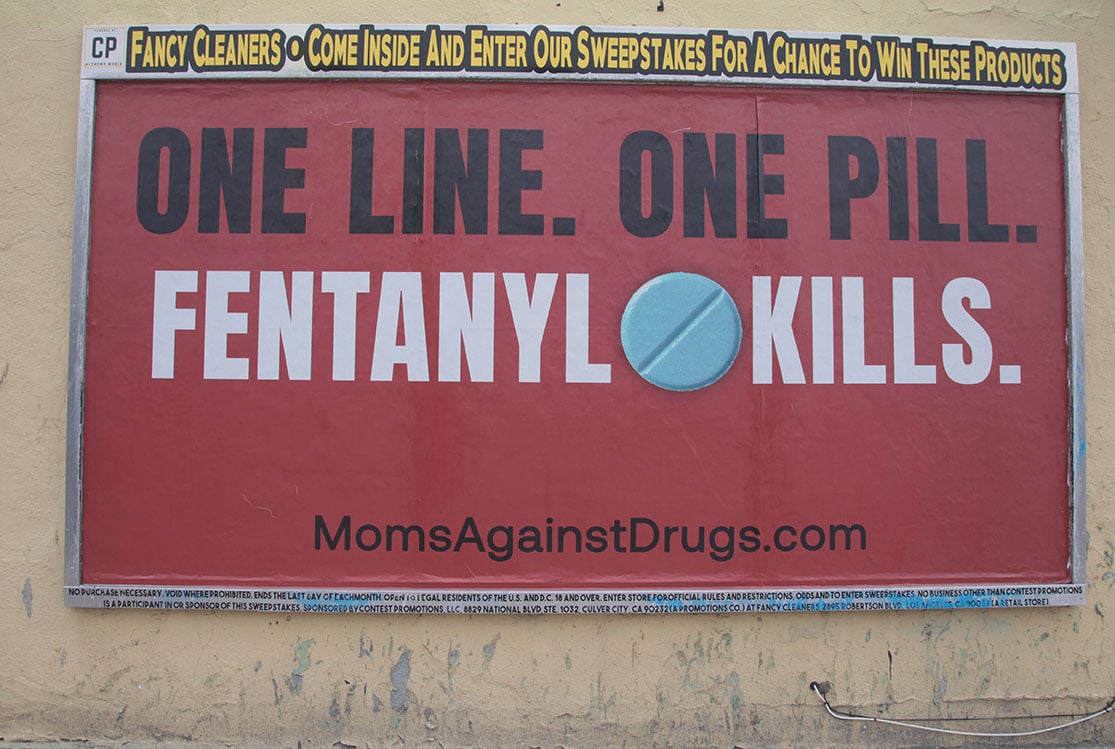
“Next, we installed two billboards on the side of a store next to Hamilton High School with the message ‘ONE LINE. ONE PILL. FENTANYL KILLS,’” said Shamash. “While kids are usually looking down on their phones, when they leave school the billboards are right there and they are going to see them.”
Photo by Harvey Farr
Shamash and Nadler also knew they needed to reach youth where they spend most of their day – in school. They enlisted the help of a friend and created a Fentanyl drug awareness school curriculum.
“I went to LAUSD to try to get them to add our one-day lesson plan, but they were not very receptive,” Shamash said. “When we approached the private schools, YULA, Shalhevet, Milken, Crossroads, Harvard-Westlake and others, they were very open to using the materials in the classroom.”
Being Jewish, Shamash and Nadler knew working with the Jewish community was important. Although both talk publicly about their sons’ struggles, they found that in the Jewish community, there is a lot of shame surrounding drugs, and many don’t want to discuss it.
“That’s why we’re trying to be so open, walking with banners with the faces of all the kids who have died so moms can see that other moms are going through the same thing,” Shamash said.
The moms are quick to point out that while they are the heart and soul of M.A.D., their drug awareness movement also receives the support of dads. “But it is different,” Shamash said. Nadler added, “We carried our kids. We birthed our kids. We’re the nurturers.”
Both Shamash and Nadler say they receive thousands of messages from mothers who are experiencing the same challenges with their kids that they both did. “When speaking with other moms who are undergoing similar situations with their kids, you automatically become bonded,” Shamash said. “It’s like a club nobody wants to be in.”
“If there is one message we want to convey to every family, it simply is: ‘Never say, ‘Not my child.’” – Juli Shamash
“We are just a normal West LA family,” she continued. “There is no reason my child should have been an addict. You just never know. If it happened to us, it can happen to anyone. If there is one message we want to convey to every family, it simply is: ‘Never say, ‘Not my child.’”
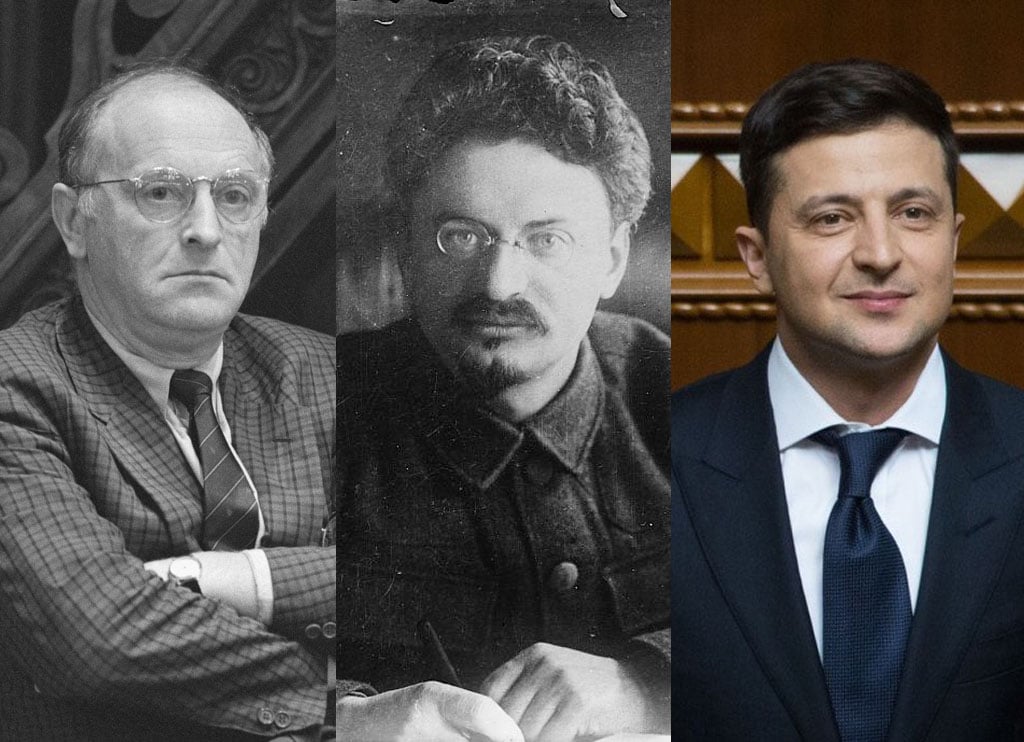
Nobel laureated Joseph Brodsky wrote “Farewell,”
Ukrainians quitting, calling them kholkols, a racial slur.
It thus implied the Russian poet thought of them less well
than does another Jew, Zelensky, who seems to prefer
Ukrainian identity not just as Russian, unlike Brodsky,
but as Jewish.
In Hebrew there are two connotations
to kalkel, qalqel, “provide” and “ruin!” These men like Trotsky
ignored their Jewish roots, preferring shoots of alien nations,
providers, using Joseph’s maverick paradigm:
to be appreciated for the favors they bestowed
on aliens, with Jewish identity the enzyme,
enabling programs of non-Jewish nations to download.
***
In “Russia’s Long Disdain for Ukrainian Nationhood: Even Russian liberals and dissidents have traditionally shared Putin’s view that Ukraine has no distinct cultural identity,” WSJ, 4/28/22, Yaroslav Trofimov writes:
As a young poet in the Soviet Union, Joseph Brodsky was persecuted by the authorities before escaping to the U.S. in 1972 and going on to win the Nobel Prize in literature. In Soviet-era Kyiv, Ukrainian intellectuals used to trade coveted samizdat reprints of Brodsky’s poems, reciting them at clandestine gatherings.
But the affection wasn’t mutual. At a reading in 1992, less than a year into Ukraine’s existence as an independent nation, Brodsky offered a new poem titled “To the Independence of Ukraine.” “Farewell khokhols,” he intoned, using a racial slur for Ukrainians. “We’ve lived together, now enough. Wish I could spit into the Dnipro river, perhaps it would now flow backwards.” Brodsky went on to predict that when the ungrateful Ukrainians were wheezing on their deathbeds, they would surely revert to reciting the verse of the classic Russian poet Aleksandr Pushkin, rather than the “lies” of their own national poet, Taras Shevchenko.
The idea that Ukrainians aren’t a real people and that Ukrainian nationhood is an artificial construct has long been mainstream in Russian culture, literature and politics—including among liberal luminaries like Brodsky, who died in 1996. President Vladimir Putin’s views on Ukraine, which he expounded in an essay last year that was read to Russian soldiers preparing for the invasion, are no outlier. They follow a lengthy tradition that helps to explain the continuing support for the war among Russia’s citizens.
Christopher MacLachlan points out in The Spectator, 4/9/22 that the Russians call the Ukrainian invaders “orcs.” (“Why are Ukrainians calling Russian invaders ‘orcs’?”):
Ukrainian victims of Russia’s war have taken to calling their invaders ‘orcs’. The word is familiar to JRR Tolkien readers as the name given to the monstrous anthropoids in his epic novel ‘The Lord of the Rings’. In all Tolkien’s stories of the wars in Middle Earth, orcs are violent, destructive and untrustworthy, wreaking wanton havoc wherever they go. It is not hard to see why the people of Ukraine use this name for the invaders of their land.
But although Tolkien made the word his own, its origins are, as he acknowledged himself, much older. Orcs first appeared in a tenth-century glossary written in Old English (Anglo-Saxon) and, more famously, in line 112 of the Old English poem Beowulf: ‘Eotenas ond ylfe ond orcneas’.
In both cases, the word appears as an item in a list of the names of creatures. In Beowulf, it can be translated as ‘ogres and elves and monsters’. But apart from that context there is little to explain what orcs were (or are). One possible clue linguists have picked up on is that ‘orcneas’ combines the word ‘orc’ with another word ‘neas’ that seems to mean ‘corpses’. The Hebrew word כלכל means “provide” and the Hebrew word קלקל means “ruin.” I am sure Brodsky was unaware of either meaning whether he described the Ukrainian’s as “khokols.”
Gershon Hepner is a poet who has written over 25,000 poems on subjects ranging from music to literature, politics to Torah. He grew up in England and moved to Los Angeles in 1976. Using his varied interests and experiences, he has authored dozens of papers in medical and academic journals, and authored “Legal Friction: Law, Narrative, and Identity Politics in Biblical Israel.” He can be reached at gershonhepner@gmail.com.
The name Recha Freier may not sound familiar. But it should.
Recha Freier was the visionary that began the Youth Aliyah movement to Israel. In 1931, she was approached by a group of Jewish boys that had been let go from their jobs in Berlin. It was clear they were fired because they were Jewish. Freier saw the writing on the wall and began to pursue the building of a pipeline, an avenue leading teenagers and young adults to the land of Israel. A land where they could flee discrimination, create community, belong, and feel at home. Child by child, teen by teen, Freier might have felt the impact of her endeavors. However, at the onset, she probably did not realize how vital her services would be needed in just a few years.
Between 1939 and 1941, Recha Freier was successful in saving and relocating almost 10,000 Jewish children to the land of Palestine. 10,000 Jewish children that would have certainly perished if left in the hands of Nazi Germany. In 2003, the Youth Aliyah German Committee stated, “It was the vision of Recha Freier that not only enabled the rescue of so many children of the Holocaust—the darkest hour of mankind—but also created a unique network for the problems confronting Jewish children during the following decades.” Out of the pitch of night, the horrors of humanity, Freier refused to succumb and instead, brought light to the hands of those fumbling and lost.
Yom Haatzmaut emerges out of Yom Hazikaron, the two woven within each other. We mourn the fallen, those that give their lives to protect our Holy Land. And then moments later, we sing. Celebrating the promise of tomorrow, our hearts still wrenched with tears and grief. Israel’s history is built upon those that understand success is achieved if someone is willing to see through the shadows. Israel is the home of the bearers of light.
Darkness exists in many shapes and sizes. But the miracle of Israel is proof enough. Be the one to light the match. Looming darkness stands no chance against burgeoning hope.
Shabbat Shalom
Rabbi Nicole Guzik is a rabbi at Sinai Temple. She can be reached at her Facebook page at Rabbi Nicole Guzik or on Instagram @rabbiguzik. For more writings, visit Rabbi Guzik’s blog section from Sinai Temple’s website.
To the 12 year-old girl who was raped and is pregnant. Hineinu.
To the expecting parents who heard silence instead of a heartbeat on the sonogram. Hineinu.
To the couple and their surrogate, who after months and months of IVF became pregnant with quadruplets … and they needed to make the painful decision to reduce. Hineinu.
To the woman who is carrying her brother’s seed following incest. Hineinu.
To the pregnant mother of seven children who can barely put food on the table and must decide which child won’t get breakfast today. Hineinu.
To those who care about their right to chose. Hineinu.
And to the mothers, daughters, fathers, sons, sisters, brothers …. To all the loving people who truly believe in freedom.
Heneinu, Hineinu, Hineinu.
We are here. We stand with you. We hold you. We embrace you. At this moment, or at any moment in time, you are not alone, because reproductive freedom is a human right, and we stand as one.
The claim by Russia’s foreign minister that Hitler was secretly Jewish, and therefore Jews themselves are to blame for the Holocaust, may be the weirdest slur ever regarding the Nazi genocide.
But what makes it scary is that Sergey Lavrov is not the only one who has said it.
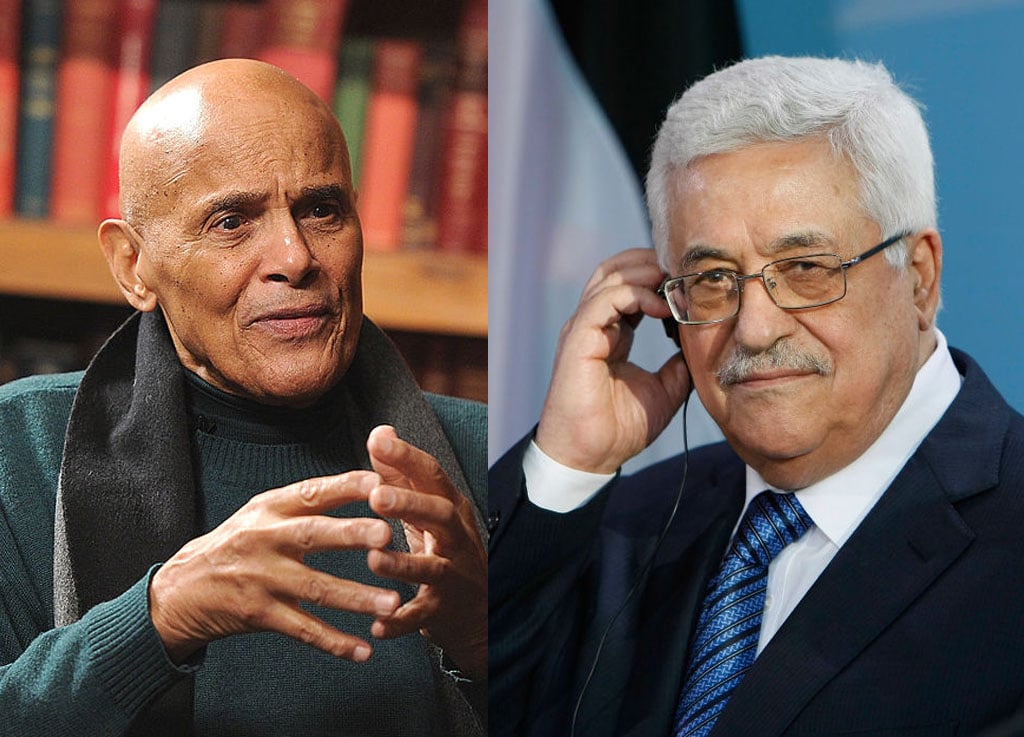
Foreign Minister Lavrov made his claim in the context of trying to prove that Ukrainian President Volodymyr Zelensky could be a Nazi even though he’s Jewish. “In my opinion, Hitler also had Jewish origins, so it doesn’t meant absolutely anything,” Lavrov babbled. “For some time we have heard from the Jewish people that the biggest antisemites were Jewish.”
Similar hogwash has been heard from, of all people, Harry Belafonte, the renowned entertainer. It happened during an August 2005 interview, in which Belafonte called President George W. Bush a racist. The interviewer asked about the fact that African Americans held prominent positions in the Bush administration. Belafonte responded: “Hitler had a lot of Jews high up in the hierarchy of the Third Reich. Color does not necessarily denote quality, content, or value.”
Neither Lavrov nor Belafonte set out to rewrite the Holocaust. Their goal was to smear a particular political leader, and they chose to distort the Holocaust as a way of making their point.
Their goal was to smear a particular political leader, and they chose to distort the Holocaust as a way of making their point.
The same cannot be said of Mahmoud Abbas, head of the Palestinian Authority. For Abbas, revising the Holocaust is not an incidental point of some argument; it is precisely his intention. Abbas hopes that claiming that the Jews caused the Holocaust will somehow undermine Israel.
In his 1983 Ph.D. dissertation-turned-book, titled “The Other Side: The Secret Relations Between Nazism and the Leadership of the Zionist Movement,” Abbas wrote that David Ben-Gurion and other Zionist leaders “collaborated with Hitler” and wanted the Nazis to kill Jews because “having more victims meant greater rights and stronger privilege to join the negotiating table for dividing the spoils of war once it was over.”
According to Abbas, the “real” number of Jews murdered in the Holocaust was “much lower” than six million and might well have been “below one million.” But that dastardly Ben-Gurion somehow managed to trick the entire world into believing a number 600% higher than the real death toll, the PA chairman insisted.
Asked about his Holocaust writings in a January 2013 interview with a Lebanese television station, Abbas replied: “I challenge anyone to deny the relationship between Zionism and Nazism before World War II.” He added that he has written “seventy more books that I still haven’t published,” which, he says, would prove his claims.
Although none of those books has been published, Abbas has continued to make the allegations in his speeches. Recall Abbas’s notorious April 2018 address, in which he said the Jews brought the Holocaust upon themselves by engaging in “usury and banking” practices that provoked their persecutors.
Similar assertions appear regularly in the newspapers, television programs and social media postings of the Palestinian Authority and its largest faction, the Fatah movement.
A columnist for the PA daily newspaper Al-Hayat Al-Jadida wrote in 2015 that Zionist leaders in Europe during the Holocaust “increased the Jews’ suffering and abuse in order to take advantage of the world’s compassion for them.” A video on the Fatah website in 2019 declared that “the rich Jews” in Europe “traded in the blood of their own people, enjoying their weakness, and creating ties with those [Nazis] who burned them, in order to turn them into a tool of production and to accumulate wealth.” These are just two of many similar examples that Palestinian Media Watch has located.
When a Hollywood celebrity makes a ludicrous remark, it’s easy to shrug it off. After all, how much does it really matter if a singer or actor has some crackpot belief?
But when the foreign minister of a major country spouts such lies, it’s much more troubling. However, if he’s the foreign minister of a regime that already regularly spreads all kinds of obvious lies for political purposes, it may not seem so significant that he has added one more idiotic falsehood to his repertoire.
The Holocaust lies told by Mahmoud Abbas, however, have serious potential consequences. He is seeking to harm Israel’s image, by portraying its founders as mass murderers, and he is trying to persuade the masses of Palestinian Arabs that Israel is an evil entity that deserves to be eradicated.
So while Russia’s foreign minister richly deserves the condemnations that have rained down upon him for profaning the memory of the victims of the Holocaust, it is important to bear in mind that the comment by Sergey Lavrov is only the latest manifestation of a bigger and more serious problem.
Dr. Medoff is founding director of The David S. Wyman Institute for Holocaust Studies and author of more than 20 books about Jewish history and the Holocaust. His latest is America and the Holocaust: A Documentary History, published by the Jewish Publication Society & University of Nebraska Press.
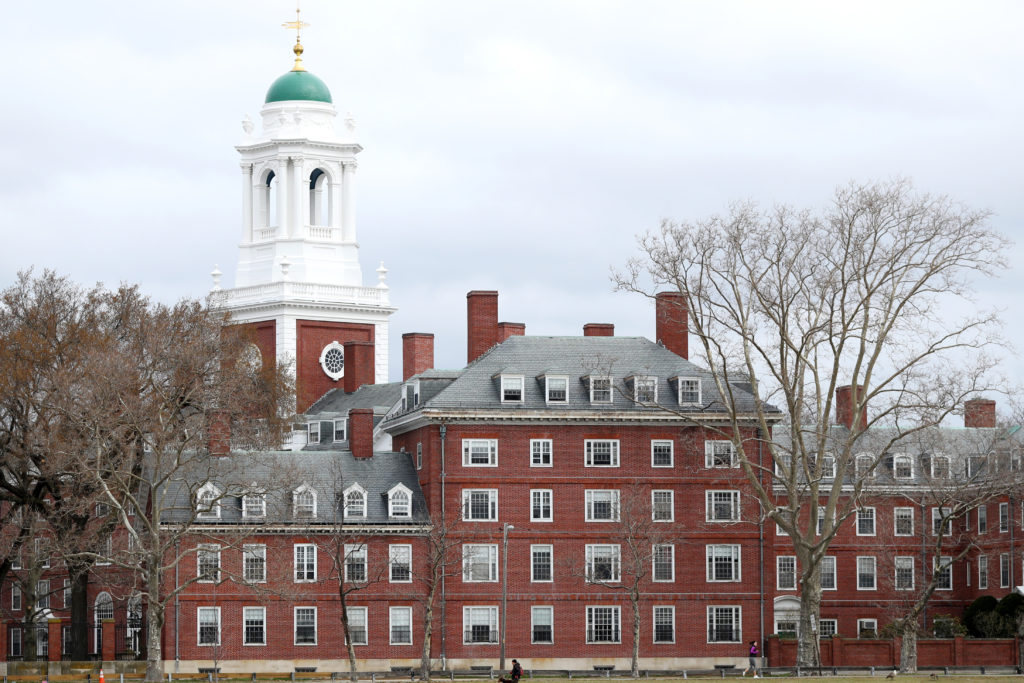
Former Harvard University President Lawrence Summers criticized The Harvard Crimson’s endorsement of the Boycott, Divestment and Sanctions (BDS) as being an example of antisemitism.
Writing in a May 3 op-ed for The New York Sun, Summers argued that while the Crimson––as well as the Palestine Solidarity Committee (PSC)––have every right to express their positions, they do not have “freedom from criticism or the right to have contemptible views treated with respect. [Academic freedom] is no shield against moral bankruptcy.” Summers pointed to prior instances of then-President Drew Faust condemning a campus satanic ritual mocking Catholicism as being “abhorrent” and the university accusing then-campus speaker conservative scholar Charles Murray as promulgating “racist pseudoscience.” Both cases were protected speech on campus.
“There is nothing ‘anti-First Amendment’ about calling out antisemitism,” Summers wrote. “Indeed not identifying and attacking antisemitism in our midst would be a major moral failing, especially when it comes in conjunction with proposals to instrumentalize the university by having it engage in antisemitism.”
Summers acknowledged that the Crimson’s editorial did condemn antisemitism and that criticism of Israeli policy or the Jewish state’s founding isn’t antisemitic in a vacuum; however, the BDS movement crosses the line into antisemitism because it singles out “the world’s only Jewish state for opprobrium in a way totally disproportionate to its deficiencies. How many members of the Crimson’s Editorial Board are aware that the BDS website points up ‘Western Academy’s Hypocrisy: Sanctions Against Russia but not Israel?’ Apart from raw animus against the Jewish State, how could any thoughtful person today regard Russia and Israel on the same plane when Russia is waging a war of aggression, murdering civilians, bombing maternity hospitals, and creating 5 million refugees?”
He later added: “In a world where women are stoned for showing their faces, where professors are jailed for teaching the wrong materials, where Muslims are placed in concentration camps and genocides continue, what can justify singling out only Israeli academics for boycott?”
Summers also argued that the BDS movement fits the International Holocaust Remembrance Alliance’s (IHRA) definition of antisemitism, specifically the movement’s double-standards against Israel, comparing the Jewish state to the Nazis, giving credence to Holocaust deniers and calling Israel “a racist endeavor.” “If the centerpiece of the BDS agenda is an academic boycott of Israel, how does this square with the First Amendment values the Crimson editorialists profess to embrace?” he asked. “If speech should not be silenced because views are problematic, how can it be right to stop scholars from publishing or teaching because they hold the passport of a country whose government is pursuing problematic policies? The further irony is that the majority of Israeli academics have opposed aggressive Israeli policies in the occupied territories.”
He concluded his op-ed with a call for “all members of the Harvard community, including its current leadership, to make clear their righteous opposition to BDS’s antisemitism and those organizations who support it.”
Summers also tweeted his endorsement of a letter to the editor written by columnist Ira Stoll, former president of the Crimson, excoriating the Crimson’s BDS endorsement. “How would students be supposed to study the history of Israel or the Middle East without interacting with any Israelis or without visiting Israel?” Stoll wrote. “It would be a less healthy Harvard. No Pfizer coronavirus vaccine — Israeli public health data was used to validate its use here in America. No life-saving Teva generic pharmaceutical medicines dispensed at Harvard’s teaching hospitals. It would be a less environmentally friendly Harvard. No chance of eating vegetables grown with water-saving Israeli drip-irrigation agricultural technology. No gas-saving self-driving cars equipped with Israeli Lidar technology.” He added that “months after diplomats from Israel’s Arab neighbors such as the United Arab Emirates, Morocco, Egypt and Bahrain showed up in Israel to deepen trade, security and people-to-people ties, the Crimson wants to revert to the bad old days of Arab rejectionism.”
Stoll concluded his letter to the editor by noting that the paper receive its funding from alumni donations. “We may ask ourselves why we’d volunteer anything — time, money, expertise — to fund an organization participating in a campaign to wipe the Jewish state off the map and to rid Harvard of any Israelis,” he wrote. “It’s certainly nothing I feel like I want anything to do with.”
Summers tweeted out a link to Stoll’s letter, calling it “brilliant” and “powerful” and that it makes the “case for boycotting funding of [the Crimson].”
Orlee Marini-Rapoport, the Editorial Chair of the Crimson, had previously tweeted that she is Jewish and that she is “proud” to be a part of the “thoughtful” editorial team. She re-tweeted a tweet from Crimson reporter Miles Herszenhorn replying to Summers’ tweet that read: “What makes journalism so powerful is that anyone can disagree with a newspaper’s editorial, write a response, and get it published in the same newspaper. But for @LHSummers, a former Harvard president, to advocate for boycotting funding of @thecrimson is weak.”
What makes journalism so powerful is that anyone can disagree with a newspaper's editorial, write a response, and get it published in the same newspaper.

 Los Angeles poet Rick Lupert created the Poetry Super Highway (an online publication and resource for poets), and hosted the Cobalt Cafe weekly poetry reading for almost 21 years. He’s authored 25 collections of poetry, including “God Wrestler: A Poem for Every Torah Portion“, “I’m a Jew, Are You” (Jewish themed poems) and “Feeding Holy Cats” (Poetry written while a staff member on the first Birthright Israel trip), and most recently “The Tokyo-Van Nuys Express” (Poems written in Japan – Ain’t Got No Press, August 2020) and edited the anthologies “Ekphrastia Gone Wild”, “A Poet’s Haggadah”, and “The Night Goes on All Night.” He writes the daily web comic “Cat and Banana” with fellow Los Angeles poet Brendan Constantine. He’s widely published and reads his poetry wherever they let him.