
Print Issue: Renewing Zionism | May 6, 2022
Print Issue: Renewing Zionism | May 6, 2022 Read More »

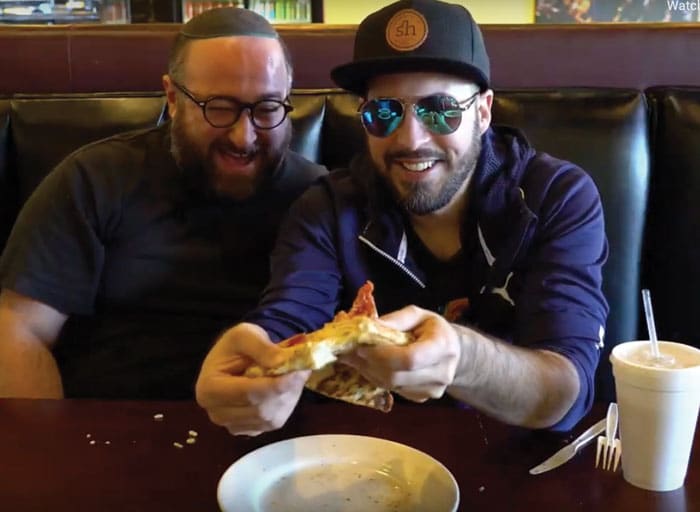
When Chaim Silverberg was growing up in a small town in Minnesota in the ‘90s, he didn’t have access to a lot of kosher food. Most of his friends didn’t keep kosher, either.
“I always loved food, and because I grew up kosher in a non-kosher neighborhood, we grew up cooking,” he said. “My mom is an incredible provider of food. We made everything, so it was hands-on. I was always jealous of my friends who grew up in neighborhoods with kosher food. When I heard kosher pizza delivery existed, it blew my mind.”
Today, Silverberg lives in Baltimore and is owner and proprietor of CWS meats, which is a boutique kosher meat company. But what he’s best known for is “Tripping Kosher,” his popular YouTube channel and Facebook page where he posts video of himself and his sidekick Judd Joffre going to kosher restaurants around the world.
“I want to present something that’s easily digestible with a smile.” – Chaim Silverberg
“We highlight the places we go to,” said Silverberg. “We don’t do reviews. If a dish isn’t good we just won’t put it in the video. It’s not necessary. The world is contentious and I want to present something that’s easily digestible with a smile.”
Silverberg was inspired to start “Tripping Kosher” after watching the chef and host Alton Brown on television for years.
“I was always a big fan of his,” he said. “He does food programming in a delightful fashion. There’s no negativity. He’s just there to tell you a great story about a restaurant.”
Silverberg followed Brown’s model when he began making videos. He eats the food and interviews the owner, producing a mini documentary about the restaurant.
One of the most popular videos on the channel is about the kosher use of cannabis, and features Orthodox rabbis talking about their foray into the cannabis industry. Recently, Silverberg and Joffre visited Los Angeles and made videos at Lenny’s Casita, Long Beach Beer Lab, La Gondola and Tierra Sur at Herzog Wine Cellars, where they toured the winemaking facilities and munched on lamb riblets.
To create videos, Silverberg and Joffre spend a few days in a location and try to visit as many restaurants as possible. This past winter, they spent 36 hours in Florida and went to 23 different eateries.
During the height of the pandemic, they stopped traveling and instead edited footage for over a year and a half. “Then, once the world opened up, we began running around again,” Silverberg said. “During a two-month period, I’m probably on a plane five times. But we’re always home for Shabbos.”
Some of the most creative foods include kosher Korean food in Monsey, Bukharian food in Scottsdale, Greek food at the Greek Jewish Festival in New York and the dairy and pareve treats at Long Beach Beer Lab, a kosher brewery, restaurant and bakery.
Some of the most creative food that Silverberg and Joffre have seen include kosher Korean food in Monsey, New York, Bukharian food in Scottsdale, Arizona, dishes at the Greek Jewish Festival in New York City and the dairy and pareve treats at Long Beach Beer Lab, a kosher brewery, restaurant and bakery.
“They are singular in the country and exemplary for what they are doing,” said Silverberg.
With “Tripping Kosher,” Silverberg wants to try great food and highlight innovative kosher restaurants for his community.
“[Our community] didn’t grow up watching regular TV,” he said. “They aren’t as jaded as the rest of us. They are getting a new medium of food blogs and self-produced content, like ours.”
He also strives to be an inspiration to other people in his world who may be thinking about creating their own content.
“We think frum Jews will start making quality, kosher television,” he said. “We’re hoping to set the example.”
Exploring the World of Kosher Food With “Tripping Kosher” Read More »
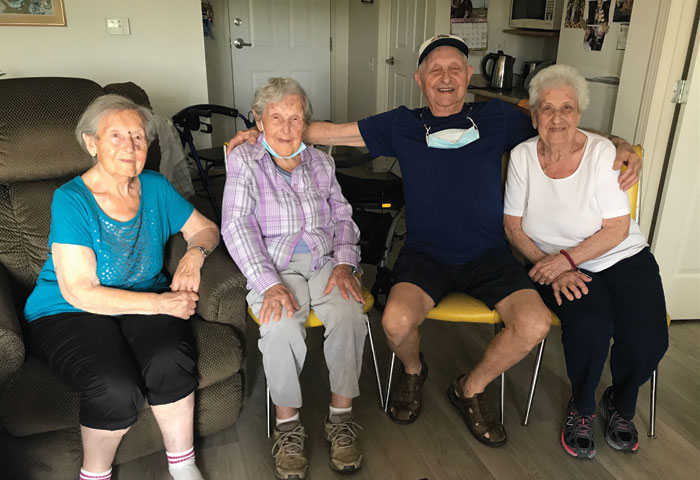
Sally (Fink) Singer still cries over the spilled milk. Yes, it happened more than 80 years ago. And at the age of 100, Sally knows that her siblings – Anne (99), Sol (97), and Ruth (95), who to this day remain inseparable – have long since forgiven her. But the pangs of guilt and hunger linger.
The spill happened in 1940 in a Siberian forced labor camp, where the family had been sent after they had fled Nazi-occupied Poland. Sally’s mother had traded a blouse for a pot of milk in a nearby village. The family had decided that rather than simply drink the milk, they would savor it slowly, letting it separate, then spreading the cream on brown bread or potatoes and sipping the sour milk or using it to enrich their watery soup.
But in the early morning darkness, as Sally groped for a pair of shoes under the bunk bed in the cramped room shared by the family of six, she knocked the pot over.
“I felt so guilty. Nobody told me anything, but I saw it in their faces. It was like I robbed my family of something so precious,” she said in a 1988 interview. Sally’s testimony is contained in USC Shoah Foundation’s Visual History Archive.
Sally’s siblings are now in the process of adding memories of their own to the Visual History Archive through the Last Chance Testimony Collection, USC Shoah Foundation’s race-against-time initiative, launched in 2019, to preserve the memories of the last remaining survivors of the Holocaust.
Sally Singer, Anne Novak, Sol Fink, and Ruth Zimmer, all of whom live in Winnipeg, Canada, are likely the oldest living set of Holocaust survivor siblings anywhere in the world.
Sally Singer, Anne Novak, Sol Fink, and Ruth Zimmer, all of whom live in Winnipeg, Canada, are likely the oldest living set of Holocaust survivor siblings anywhere in the world. They are certainly the oldest siblings recording their testimonies with USC Shoah Foundation.
“Having four siblings talk about their experience gives us an incredible chance to hear a story from different perspectives,” said Marilyn Sinclair, USC Shoah Foundation Next Generation Council Co-Chair. “We feel like we have found a treasure, that they are still sharp and eager to share their stories.”
Since October 2021, more than 50 new testimonies have been recorded and more than 750 others in existing Canadian collections have been identified. The recordings will be integrated into USC Shoah Foundation’s 55,000-strong Visual History Archive. Sinclair said the effort will continue as long as there are survivors who want to tell their stories.
In December 2021 Sol and Ruth recorded testimonies; Anne recorded hers last month.
Carol Sevitt, Anne’s daughter and a writing instructor, jumped at the chance to register her family for Last Chance Testimony interviews. “For the children, for the grandchildren, this adds more volume to the voices and to these stories,” Carol said.
Escape and then Arrest
The four siblings grew up in the town of Sanok in southeastern Poland with a younger brother, Eli, and their parents, Shaindel and Zecharia Fink, an Orthodox butcher. Within days of the German invasion of Poland on Sept. 1, 1939, the family fled to their grandparents’ home in Tyrawa Wołoska, 21 kilometers away. By the end of September, Tyrawa, on the other side of the San River, was under Russian control, and Sanok was held by the Nazis.
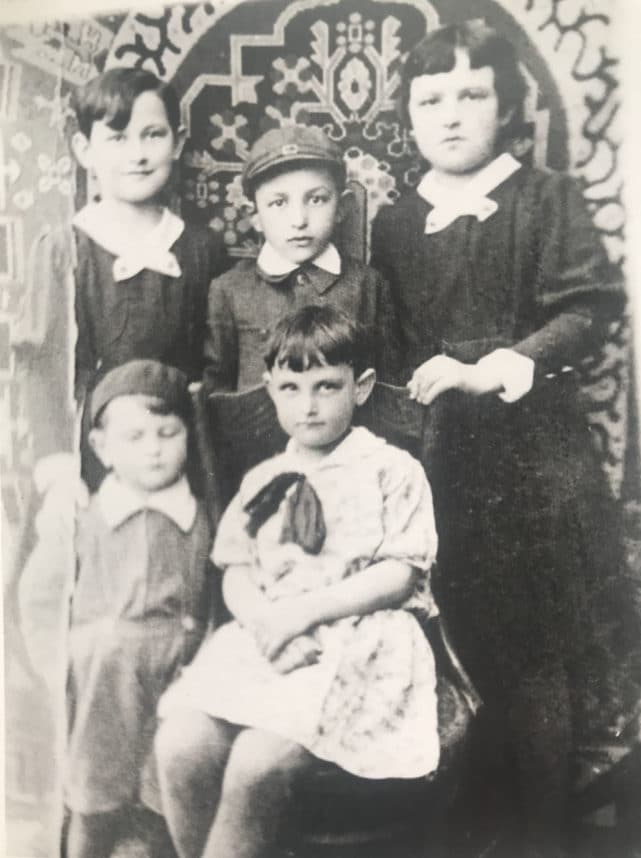
In 1940, authorities demanded that Polish Jews who had fled to Soviet territory declare whether they wanted to become citizens of the Soviet Union or return to German-occupied Poland. Zecharia stated that his family would prefer to go back to Poland.
But instead of sending Jews who had opted for repatriation back to Poland, Russian authorities arrested them. The family was arrested in the middle of the night in June 1940 and taken to the train station. As they waited in a cattle car, a friend spirited Eli, the youngest son, back to his grandparents’ house.
Shaindel, Zecharia and their four oldest children were forcibly transported east on the crowded train. “We kept asking, what did we do? What is our crime? Where are you taking us?” Sally said in 1988.
After a month of traveling, the family of six was discharged in the area of Novosibirsk in southwestern Siberia, then transported by truck into the deep forest. In the winter the family struggled to stave off frostbite; in the summer, they were eaten alive by mosquitoes. The hunger was debilitating and constant.
Safety in Siberia
In June 1941, Hitler broke his pact with Joseph Stalin and invaded the USSR. Russia joined the Allies, and as a result released its Jewish prisoners. The Fink family moved to the village of Suzun, just 12 kilometers from the camp.
They were given a cramped cottage with a small garden, and while food was still scarce, things were better. For the five years the family lived in Suzun, the Fink women were forced to work on the kolkhoz (communal farm) every summer.
The Fink cottage served as the village synagogue. A young man named Morris Singer regularly attended to say the Kaddish memorial prayer for his mother, and he and Sally struck up a romance. In 1945 the war ended, and in 1946 Russia and Poland came to an agreement to return refugees to their homelands. The Fink family walked 100 kilometers alongside a wagon packed with their belongings to a train station. Four weeks later they arrived in Wrocław (formerly Breslau), Poland.
While living in the far reaches of Siberia, the family had heard only scant reports of German atrocities, mostly from returning Soviet soldiers. Back in Poland they learned of concentration camps, mass executions, and death marches. Anne returned to Sanok, where former neighbors gave her devastating news: Eli, her grandparents and almost her entire extended family had been deported to concentration camps. Later, Anne and her siblings would learn that Eli, their grandparents and around 80 extended family members had been murdered in the Holocaust.
“As bad as Siberia was, we were in a very safe place,” Anne said in the recent interview. “Siberia was the only place that was not touched by war.”
Three Maidlech and Mr. Fix-It
After arriving in Poland, the family joined a stream of refugees crossing illegally into U.S-occupied Germany and arrived at a Displaced Persons camp in Neu Ulm. There, Sally and Morris Singer were married, and ten days later Anne married Oscar Novak.
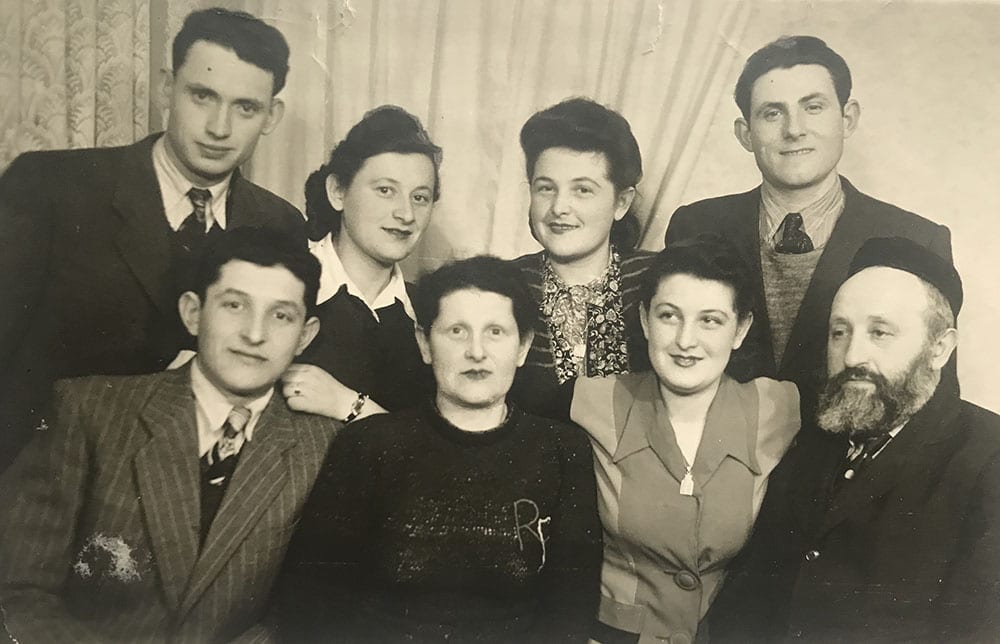
The three Fink sisters were and have remained extremely close. They vacationed together, retired to three adjacent condos in a shared hallway, and then a few years ago moved into the same Winnipeg assisted living facility. Today they still regularly get together with Sol and his wife, who live nearby, and with their children and grandchildren.
“These four people have not left each other’s sides for 90-some odd years,” said Zachary Zimmer, Ruth’s son, a professor of gerontology at Mount Saint Vincent University in Halifax, Nova Scotia. “I don’t doubt that the network they have is probably somewhat responsible for their longevity.”
That, and their determination to wring laughter and joy out of every moment. “We make ourselves busy,” Ruth said, listing the activities the sisters do together. “I have no time for oy vey.”
Julie Gruenbaum Fax, former senior writer for The Jewish Journal, is a writer and content creator for USC Shoah Foundation. She is working on a book on her grandparents’ Holocaust experience.
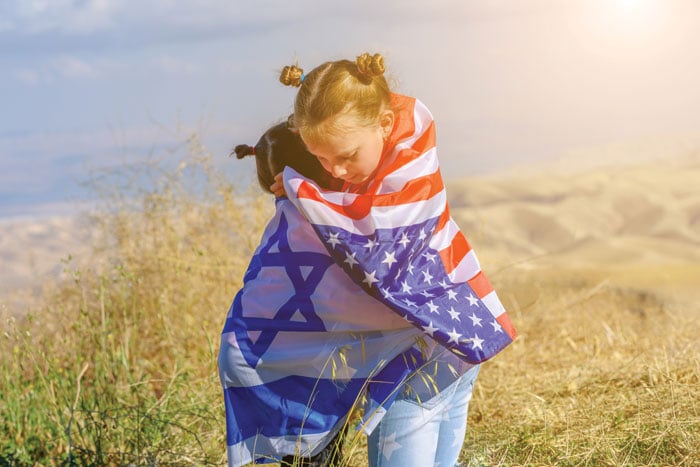
I had interesting conversations recently with leaders of two progressive, pro-Israel organizations in the wake of the renewed terror attacks in Israel. Because I believe in their love for Israel, the conversations made me reflect on how the two ideological camps — the Right and the Left — love Israel differently.
A crucial difference is that the Left tends to look inward when placing responsibility, while the Right tends to looks at external forces.
When the Left, for example, talks about making peace with the Palestinians, it focuses on what Israel does or fails to do. They will acknowledge the destructive actions of the other side (such as terrorism and the teaching of Jew-hatred), but by and large, the responsibility is on Israel.
The Right, on the other hand, treats things like Jew-hatred, rejectionism and the glorifying of terrorism as decisive factors that make any talk of peace moot. Even when it acknowledges Palestinian rights, the focus remains that Israel doesn’t have a partner for peace, and until it does, the pressure must be placed on Palestinian leadership.
Both camps claim the moral high ground: The Left claims the Jewish values of taking responsibility and pursuing peace and justice; the Right claims the supreme Jewish value of protecting life in the face of bloodthirsty and genocidal enemies.
Both camps claim the moral high ground: The Left claims the Jewish values of taking responsibility and pursuing peace and justice; the Right claims the supreme Jewish value of protecting life in the face of bloodthirsty and genocidal enemies.
Beyond the Palestinian conflict, the differences continue inside Israel. The Left will focus on Israel failing its responsibility to bring equality and justice to all citizens, while the Right will focus on what Israel is doing right under very difficult circumstances.
Take the recent terror attacks. Some of the perpetrators were Arabs enjoying the rights of any Israeli to roam freely in a democratic and open society. At such moments, the Right has little patience with the traditional Leftist complaints about more rights and equality for the Arab minority.
While the Left condemns the terror attacks, it remains undeterred in its search for peace and the creation of a more just society. Often, the Left will cite the violence itself as reason to double down on the need for conflict resolution and equality.
What further exacerbates the division is that the camps generally stick to their own. Time becomes the enemy: the more you hang out only with like-minded people, the more you will be likely to demonize the other side.
Yet another factor is body language. When the Left explains its relentless criticism of Israel as “tough love,” what the Right often sees is “love tough.”
“Love tough” is when you start by showing some understanding — “Israel faces dangerous enemies,” “Israel offers plenty of rights to its Arab citizens,” etc. — but then you add a “but” to deliver your real message: criticizing Israel. The Right believes that tough love should end on the love.
Can the Left and Right do things differently to reduce the animosity and mistrust? Perhaps.
The Left can do a better job of expressing its love for Israel, without taking for granted that people will always feel that love. The Left can also better recognize the harsh realities that limit Israel’s ability to create the Left’s ideal society.
The Right can better recognize that the Left wants what is best for Israel, even if sometimes they have to squint their eyes to see it.
Take the complex issue of the two-state solution. The Left’s belief that separating from the Palestinians will secure a Jewish and democratic future for Israel is perfectly legitimate. The problem, for many on the Right, is that it’s also a delusional pipe dream. The only way to narrow that gap is for each side to make a greater effort to understand the other side’s argument.
A good example of this approach is Israel’s improbable unity coalition that has governed the country for the past year. Rivals from across the political spectrum, including an Arab Islamist party, got together and realized that despite all their differences, they shared plenty in common. Yes, they first united over their common opposition to Netanyahu, but then got down to business and accomplished some real things for all Israelis.
Israel supporters don’t have to love Israel the same way, but we each can have, as Rabbi David Hartman once said, “a heart with many rooms.” As we celebrate Israel’s 74th birthday, that wouldn’t be a bad birthday present for the world’s only Jewish state.
Similarly, Israel supporters don’t have to love Israel the same way, but we each can have, as Rabbi David Hartman once said, “a heart with many rooms.” As we celebrate Israel’s 74th birthday, that wouldn’t be a bad birthday present for the world’s only Jewish state.
Loving Israel, from Left to Right Read More »
It’s the great Zionist anomaly of today: 74 years ago, in 1948, Israel was fragile, but the Zionist conversation was robust; today, Israel is robust — but the Zionist conversation has turned fragile.
The studies are chilling. Last year, an ADL and Hillel International survey found that 32 percent of Jewish students on campus experienced antisemitism directly, personally. Showing how antisemitism and anti-Zionism blur, one student reported: “I’ve had swastikas drawn on my notes, been called a ‘kike’ downtown … while I was wearing my hamsa. I’ve seen an increase in people making judgments about me for being Jewish due to the current political climate with Palestine.” Last semester began with the Heritage study explaining why universities ignore this oldest and most plastic of hatreds: because many of those tasked with fighting campus bigotry are anti-Jewish bigots. Examining the tweets of hundreds of university Diversity, Inclusivity and Equity administrators, Jay P. Greene and James D. Paul found that of 633 tweets regarding little Israel, 96 percent criticized the Jewish State. Yet 62 percent of the 216 tweets regarding China were positive. One DIE administrator liked this Tweet: “Y’all love to add the word liberal in front of the most evil things and it’s unhingedddd. Wtf is a liberal Zionist? What’s next? Liberal Nazi? Liberal colonizer? Liberal murderer? Liberal imperialist? Liberal fascist?”
For two decades, I have been trying to “take back” Zionism from its critics. Many advise me to retire the term, because the “Z-word” doesn’t poll well. But its unpopularity is due to a decades-long worldwide campaign of “Zionophobia.” Building on traditional antisemitism, this old-new hatred treats Israel as the Jew of the world, singling out one form of nationalism — Jewish nationalism — as unacceptable in a world still organized around hundreds of nationalisms, including Palestinian nationalism. Too many Blame-Israel-Firsters join the delegitimization derby, escalating from criticizing Israeli policy to rejecting Zionism.
I’m sorry. I won’t surrender. We cannot let our enemies’ enmity define us.
Retreating from “Zionism,” which has inspired millions over generations, just because it is under attack violates Zionism’s main mission of nurturing Jewish dignity. Such submissiveness disregards the feminist example of “taking back the night” and the African-American community’s defiant use of “the N-word” among insiders.
At the same time — without striking false moral equivalences — we must “take back” Zionism from some fans, too. Israel’s defenders sometimes become so defensive that they quash the open, critical discourse all democracies — and ideological movements — need in order to mature. Denying any wrongdoing, even any dilemmas, alienates Zionist critics of Israeli policy, polarizing the community unnecessarily. Those who let every conversation about Israel be about “the conflict,” pro or con, fall into the Palestinian propaganda trap. It was Yasir Arafat’s great conceit — he wanted it all to be about him and his people; but Zionism is about us and our people.
Zionism is not a monolithic movement marching in lockstep with the Israeli policy of the moment. Nor is it the insecure movement of yesteryear.
Zionism is more than Israel advocacy. This broad-based movement and values conversation does not belong to the Right or the Left. Zionism is not a monolithic movement marching in lockstep with the Israeli policy of the moment. Nor is it the insecure movement of yesteryear. Good Zionists do not need to negate the Diaspora or limit Zionism — that is, Jewish nationalism — to those who make Aliyah (move to Israel).
So foes have done great damage — while too many defensive friends have not helped. Even some Jews who accept the Zionist trinity of peoplehood, land and statehood recoil at the use of the Z-word. But if once-abandoned Jerusalem could be reclaimed, Zionism can be, too.
Zionists should follow their own playbook. The late-nineteenth-century Zionist revolution resurrected symbols and changed images, pulling off an epic Jew-Jitsu: Negatives became positives. From the new cult of the Maccabees to the rediscovery of Masada, Zionists scoured Jewish history, rediscovering muscular role models as a tikkun, a healing, to the internalized, debilitating, stereotype of the beaten, hunch-backed, European ghetto Jew. Today, the term “Zionism” needs a similar makeover.
Bypassing today’s polarization, we need a Zionist vision rooted in the past, relevant to the present, and inspiring for the future.
Bypassing today’s polarization, we need a Zionist vision rooted in the past, relevant to the present, and inspiring for the future. Zionism is more than pro-Israelism. Good Zionists do not have to approve of every Israeli government policy or any prime minister. But they do have to be open to tapping into the grand adventure of belonging to this extraordinary forever-people, the Jewish people, who remained tied to the same ancestral homeland that has been their anchor and compass for more than three thousand years.
If Zionist triumphalism overlooks Israeli imperfections, a creative, intelligent, supple Zionist conversation should acknowledge problems — and tap Zionist ideas to fix them. To a West increasingly skeptical about liberal nationalism, Zionism offers its constructive democratic nationalism —that nations should stand for something, bound by a sense of the past that enriches the present and builds a better future. To a West that increasingly misreads particularism as xenophobia, Zionism offers its understanding of particularist national identities as value anchors and launching pads for communal good works to benefit others. And to a West increasingly addicted to false choices, Zionist offers its mix of identity and freedom.
If we do it right, twenty-first century Zionism will be what it was for so many in the nineteenth-century — a solution to the Jewish Problem, tackling pressing communal problems while addressing individual needs.
If we do it right, twenty-first century Zionism will be what it was for so many in the nineteenth-century — a solution to the Jewish Problem, tackling pressing communal problems while addressing individual needs.
The “problem,” however, has evolved. This generation needs Zionism to help revitalize Judaism much more than we need a defense against antisemitism. And this generation needs Zionism to find community, meaning, a sense of purpose and perpetuity amid our increasingly individuated, selfish, throwaway and soul-crushing Western culture. True, Jew-hatred persists. And we should rally around the blue-and-white flag during times of trouble. But in going from Gevalt or Crisis Zionism to Identity Zionism, this marvelous, mystical and complex idea of Jewish nationalism helps make us better Jews and better people.
This is counter-cultural in many ways. Donald Trump’s populist nationalism soured many Americans on any nationalism. The word “nationalism” usually appears poisoned by descriptive “first names” like “white” or “extremist” or “xenophobic.” But nationalism is a neutral term. In the 1940s, Jews endured nationalism at its most xenophobic, bigoted and lethal, in the form of Nazism, while delighting in nationalism at its most inspiring, empowering and liberating in the form of Zionism. As an American historian, I cannot explain many of America’s greatest achievements, from winning World War II to creating the first mass-middle-class civilization, without crediting nationalism. Identity Zionism is not a self-absorbed nationalism knocking others down or building-up walls; it is a liberal nationalism that by building us up, individually and collectively, builds others up too.
Liberal nationalism infuses democratic ideals into people’s natural tendency to clump together with those like them. In the 1950s, the British philosopher Sir Isaiah Berlin described this constructive nationalism as “awareness of oneself as a community possessing certain internal bonds which are neither superior nor inferior but simply different in some respects from similar bonds which unite other nations.” Jews used to find one another — back when travel was a verb. We Troys called that “bageling”; when we found fellow Israelis, it was “kremboing,” referencing an Israeli sweet. The click wasn’t about looking down our noses at anyone else, but looking up at a seeming stranger in a strange land — and finding a shared language, common associations, that family feeling.
Today, this nationalist vision is not just politically incorrect: it’s thoroughly unfashionable. Young Americans’ “radical individualism,” creates what the sociologist Robert Bellah calls a “negative” process of “giving birth to oneself” by “breaking free from family, community and inherited ideas.” By contrast, the bar and bat mitzvah define maturation as accepting communal responsibilities, not shirking them. The Zionist reality demanding that young Israelis enlist in the army makes the communal commitments of national service the defining step toward adulthood.
Zionists get hit from both sides. Many liberal cosmopolitans brand any distinctions between humans as illegitimate, while favoring some nevertheless. Some categories are politically protected, immune from criticism, from feminism and LGBTQ identity to blackness and Palestinian nationalism. Some are not, especially Jewish nationalism, or Zionism. “Intersectionality,” allegedly emphasizing the shared pain of the oppressed, blocks Jews and antisemitism at the intersection, proving to be antisemitic. Calling Israel a bastion of “white privilege” ignores Israel’s delightfully-dizzying ethnic diversity, while arrogantly and crudely viewing Israeli society through an overly-simplistic American racial lens. These racial categories are sloppy and suspicious: Those who celebrate whiteness claim that Jews aren’t white; those who denigrate whiteness, claim that Jews are white.
Humans are tribal; distinguishing isn’t always discriminating. By definition, a community needs boundaries; otherwise there is nothing to belong to. Jews survived for millennia by having boundaries, preserving “our” people. Some white nationalists mischievously call themselves “White Zionists.” The Alt-Right activist Richard Spencer explains: “Jews exist precisely because you did not assimilate to the gentiles … I want my people to have that same sense of themselves.” When Spencer made this claim at Texas A&M University in 2016, a local rabbi sputtered, unable to explain the difference.
White nationalists seeking legitimization and anti-Zionist leftists seeking to delegitimize Zionism insisted the rabbi’s silence affirmed Spencer, exposing Zionism as “illiberal.” Actually, the rabbi’s silence reflected a scandalous educational failure on the part of his particular rabbinic seminary — and American Jewry. Today, many involved Jews can explain why Zionism is not racism and Israel does not practice South African apartheid, noting that the Palestinian-Israeli conflict is national, not racial, involving some dark-skinned Israelis and light-skinned Palestinians. Israel has no legislation based on race, meaning appearance, blood, presumed biology or skin color. Security-based distinctions may keep Israelis and Palestinians apart but that’s not apartheid, a race-based, skin-color-driven form of legal discrimination.
Walk down any Israeli street to see radical inclusion at work. Coming in all colors, Jews are united by common stories, values, and beliefs.
Walk down any Israeli street to see radical inclusion at work. Coming in all colors, Jews are united by common stories, values, and beliefs. The four-term New York Senator Daniel Patrick Moynihan explained that because Jews link peoplehood with religion, and that by converting religiously you join the Jewish people, Zionism was the least race-based and most biologically diverse form of nationalism.
Yet, in fairness to this rabbi, few American Jews could explain why Spencer’s “White Zionism” lie slurred Zionism as well as nationalism. Nazi Germany and apartheid South Africa discredited race-based nationalism, especially for whites. Zionism, however, sprouts from an ancient synthesis of ethnicity and religion that yielded a democratic state that, like America, is defined, yet porous. Jewish nationalism is as valid as the other identity cocktails underlying modern democracies. Many national flags have crosses or crescents because religion remains relevant, even for European democracies.
Zionism and white nationalism are forms of nationalism but are not the same: Ham and gefilte fish are both foods, but they, too, are not the same, and only one is kosher. Jewish nationalism revolves around life-affirming values and is intertwined with liberalism. Remove liberalism or nationalism from Zionism — and you don’t have Zionism anymore. Israel’s Declaration of Independence makes the duality clear.
A resurrected and refreshed Zionist conversation might help Jews see liberal nationalism as a constructive vehicle that can unite a divided community and make us more determined, more purposeful, and more fulfilled than we can be individually. That is why, with all due respect to President John Kennedy, I say, “Yes, ask what you can do for your country, but also ask what your country, our eternal homeland Israel, can do for you, for us.”
Zionism has always been countercultural. Before Israel’s establishment in 1948, the small, marginal Zionist movement had to convince the world — and the skeptical Jewish supermajority — of essential Zionist assumptions: Most dramatically, the European Enlightenment’s attempts to reduce Judaism just to a religion failed. We were always an “Oreo cookie” — both nation and religion corresponding to the cookie and the creme. Just as the synthesis itself makes the Oreo an Oreo, the mix makes Jews Jewish. That explains why the Jewish people always needed more than a synagogue as communal space; Judaism cannot be contained within four walls. As the world organized itself around nationalisms, Jews’ unique national-religious fusion earned them collective rights to statehood, somewhere.
The Land of Israel, Jews’ ancestral homeland, was the logical, legitimate and viable place to relaunch that Jewish national project. Even America, the land of promise, was not the same as the Promised Land. The Palestinians’ contesting land claims do not negate the Jewish title to Israel — other nations also have conflicting land claims without invalidating one another’s essential claims to nationhood. The United Nations does not seem concerned with any of these conflicts except for the one questioning the Jewish people’s longstanding ties to the Jewish homeland.
Without negating Palestinian claims, the Jews were making history on that land millennia before Mohammad established Islam. Jews are what the Canadian human rights activist and former Minister of Justice Irwin Cotler calls the original aboriginal people, still living on the same indigenous tribal lands, speaking the same language, developing the same culture, reading the same Bible. More broadly, nationalism isn’t an exclusive land deed; it’s an identity-building process based on a shared past or present, what Professor Benedict Anderson correctly called an “imagined community.”
Finally, restoring Jewish sovereignty in Israel was a pressing priority — to save the long-oppressed Jews and let them rejuvenate, spawning a strong, proud, idealistic New Jew.
After realizing this primal Zionist idea in 1948, Zionism evolved. The Jewish national liberation movement now sought to defend and perfect the state — understanding, as the Israeli author A. B. Yehoshua writes, that “A Zionist is a person who accepts the principle that the State of Israel doesn’t belong solely to its citizens, but to the entire Jewish people.” As Israel’s builders steadied the state, this second-stage Zionism revolved around the question, “What kind of nation should Israel be?” The great miracle was not just surviving in a sea of unneighborly hostility, but also creating one of the world’s few democracies. This achievement is particularly surprising considering that most Israelis hail from lands with autocratic political cultures. Israel’s communal unity and dynamic democracy reflect the legacy of Jewish life in exile, which fused communal solidarity with intellectual argumentation.
Zionophobes’ constant attacks distract from Israel’s dual mission: to save Jewish bodies and redeem the Jewish soul. As Israel’s first prime minister David Ben-Gurion said, “Israel cannot just be a refuge … it has to be much, much more.” When asked if Israel had fulfilled all of Zionism’s ideals, Ben-Gurion replied, “not yet.” This not-yetism is the catalyst for Zionist can-do idealism — and some Jews’ disappointment with Israel.
The latest Pew Research Study, “Jewish Americans in 2020,” offers two striking yet not surprising findings regarding younger American Jews. First, many of the youngest American Jews are “unaffiliated” and non-religious, seeing “themselves as Jewish for cultural, ethnic or family reasons.” Second, these “Jews of no religion,” a full and growing 41 percent of 18-to-29-year-old Jews, “feel they have not much or nothing at all in common” with the only other rapidly growing group of young Jews, Orthodox Jews, who constitute 17 percent of that cohort and also feel distant from fellows Jews across the religious spectrum.
No single-bullet cures exist, of course. And Zionism, which is a tradition-friendly initiative despite Israel’s cutting-edge liberal democracy, faces a hostile environment. American Jews, whose parents and grandparents were once more culturally conservative than the rest of American society, tend now to be far more liberal, less traditional and more universalistic than their American peers and their Israeli counterparts. Moreover, the systematic campaign to delegitimize Zionism has done great damage, just as conservative dominance of Israel electorally since 2001 — and the misleading interweaving of the ongoing Palestinian conflict into America’s racial reckoning — has tarnished Israel’s luster among the most passionately liberal Jews.
Nevertheless, Israel and Zionism have great potential to speak to non-religious Jews by emphasizing the national, ethnic and cultural parts of Jewish identity. Zionism could help the younger generation unite by celebrating their common heritage and shared peoplehood platform, regardless of theology.
Better dialogue and, ultimately, unity can be fostered due to a dramatic and often-under-appreciated change in Zionist ideology. Originally, most Zionists “negated the galut,” assuming that assimilation and antisemitism would end Diaspora Jewish life, leaving Israel as the only viable Jewish community. (Most American Jews paralleled that condescension by assuming that Israel’s Jews were on the brink of destruction, making American Jewry the future). Today, most mainstream Zionists embrace more of a partnership vision, understanding that each community has something to teach the other: Israelis may be great partners for Diaspora Jews in combating assimilation; Diaspora Jews are Israelis’ greatest partners in combating anti-Zionism.
Moreover, Israel still has a magic, illustrated by the great counterforce refuting most lamentations about the growing Israel-Diaspora gap: Birthright Israel. Young American Jews on those 10-day trips taste a thick, dynamic 24/7 Jewish experience qualitatively different from what they often perceive to be a thin, static, fragmented and denominationally-focused American Judaism. Seeing Jewish garbage collectors and police officers normalizes Jewish society, broadening the range of Jewish career paths and class stances, reducing the constant careerist pressure to be the next Zuckerberg, Spielberg or Justice Ginsburg.
Turning Israel into what the late Rabbi Jonathan Sacks aptly called world Jewry’s classroom, its living laboratory, demonstrates vibrant, thriving Judaisms in sync with the environment. In his 1994 classic, “Will We Have Jewish Grandchildren? Jewish Continuity and How to Achieve It,” Rabbi Sacks insisted that “Jewish life cannot be sustained without Israel at its core.” That is why, in a less menacing but spiritually more confusing 21st century, the Jewish State’s great contribution to Jewish life would shift: “Once, Israel saved Jews. In the future, it will save Judaism.”
Swimming in a pool of Jewish symbols, traditions, values and stories, Jewish pilgrims to Israel encounter an alternate universe that reveres the past, that seeks meaning beyond the material, that is more communal than individual and is more eternal than last week’s most forwarded YouTube video of cats frolicking. Israel proves Theodor Herzl right: Fitting in, not standing out, because you are Jewish is liberating.
Beyond that, Zionism answers some core ideological conundrums many American Jews don’t even know how to formulate. Zionism resolves the confusion whereby the Judeo-Christian connection in America makes many of these nonreligious Jews feel Jewish even while calling Judaism their “religion.” Zionism welcomes Jews through the peoplehood portal — remembering that Judaism is this unique mix of nation and religion, of peoplehood and faith. Zionism celebrates nationalism as a force for good, cherishes religion and tradition as valuable anchors, providing meaningful “software” of values and beliefs running on the “hardware” of belonging. And Zionism celebrates the virtues of having red lines to respect, as well as blue-and-white lines to affirm. It “rewards togetherness,” in the feminist writer Anne Roiphe’s lovely phrase, and benefits from solidarity — especially considering Israel’s difficult neighborhood.
With Judaism providing the background music to so much that is Israeli, with Israel instilling a strong sense of belonging in visitors, let alone citizens, American Jews encounter new ways of being Jewish. They see total Judaism, immersive Judaism, public Judaism. And, often without realizing it, they see a startling contrast, even with secular Israeli Jews who have figured out how to keep their kids and grandkids Jewish without being religious.
The need for American Jews as allies in that fight continues to offer nonreligious American Jews a passionate Jewish cause, a defining Jewish mission in their lives.
Finally, Israel reorients American Jews from Anatevka to Jerusalem, from what Irving Howe called yesterday’s “world of our fathers” to the lives of our brothers and sisters today. Israeli Jewish identity is about speaking Hebrew and eating cheesecake on the Shavuot holiday often overlooked in North America. It is also, when necessary, about fighting for and defending the state. The need for American Jews as allies in that fight continues to offer nonreligious American Jews a passionate Jewish cause, a defining Jewish mission in their lives. And judging by the fact that AIPAC’s pre-COVID Policy Conference was the rare business-style convention that many parents attended with their teenage and twenty-something children, Zionism offers a commitment, an anchor one generation can pass on to the next.
Beyond that, the excitement — and, to be sure, the frustrations — of working out Jewish dilemmas and governing problems in real time with high stakes to keep this grand Jewish national project alive and thriving, is a lot more compelling than humming “Sunrise, Sunset” as you enter your synagogue.
Even more surprising, unlike the media’s dystopic portrayal, Israelis are happy and fun-loving. Israel’s recent score of 11th on the world happiness index comes on the heels of reports about American mass unhappiness, especially in the “blue” upper-middle-class neighborhoods where many American Jews live. The findings that half of Yale’s undergraduates at some point in their four years will experience severe psychological distress goes far beyond the anxiety produced by the crazy pressure-cooker process of getting accepted. The anomie epidemic suggests a specific sort of soul sickness that an elite life increasingly stripped of community, tradition, nationalism, God, group responsibility and virtue produces. As the occasionally embattled Jewish state in an old-new land, Israel remains a Republic of Something, even as too many Westerners fear they live in a Republic of Nothing. The shared past, purpose and principles produce happier, more grounded, people.
The Zionist idea proved hearty and fertile, triggering Jewish civilization’s post-1948 renaissance. Zionism was the great miracle maker. It was one of the most remarkable progressive success stories of the twentieth century — an ism, that unlike Communism and Fascism, was rooted in the democratic, humanitarian, and egalitarian values of the center left and not only survived but thrived. It reestablished Jewish sovereignty in the Jewish homeland as Israel cumulatively welcomed three million refugees from the Holocaust, the Arab expulsion of the 1950s, Soviet persecution and Ethiopian dislocation. It returned the Jews to history, transforming the world’s perma-victims into robust actors on history’s stage, with rights and responsibilities. It established a Western-style democracy in the hostile Middle East with a significant minority of Arabs and a majority of Jews, mostly from undemocratic countries. It empowered women, from the female pioneers to one of the world’s first female prime ministers, Golda Meir. It started a Jewish cultural revolution: reviving Hebrew, modernizing the Holy Tongue into a language for blessing — and cursing. And while facilitating ultra-Orthodox and Orthodox revivals, it generated creative religious inspiration that revitalized Jewish life worldwide and offered the most viable home for perpetuating secular Jewish identity.
Today’s Israel is robust. These miracles have become routine realities in a high-tech, science and pharma behemoth; a breeding ground for do-gooding civil society NGOs; and a laboratory for creative Jewish living whose population has grown ten-fold, as its gross domestic product has multiplied thirty-fold — per capita.
Zionism’s Jewish dream-catching and wish fulfillment is rooted in four pillars — four “mems,” mem being the thirteenth letter of the Hebrew alphabet, the one associated with water and other essentials for life. We start with Masoret, the welcome chain of tradition. Humans want to be linked to somewhere and feel deeply connected, implicated, a part of something rather than apart from everyone. We can’t just float around in cyberspace. The second mem is Moledet homeland, the space to live out our ideals, making tradition come alive. The Jewish ideal is lovely — whether or not you live in Israel, Israel can always live in you. The third mem is Musar, an ethic. We have a Zionist ethic, we have Zionist morals, including holding our army to those morals. Liberal nationalism cannot lift up our souls if our liberal nation doesn’t have a soul itself. The fourth is family, Mishpacha. Without that sense of love, without that sense of connectedness, without that glue, where are we, who are we?
The Zionist idea succeeded: It exists, it works. This is a project of the Jewish head, the Jewish heart and the Jewish soul. Today’s mission involves studying, questioning, dreaming and fulfilling different Zionist ideas. The challenge is to look back accurately, with a dash of romance, and to look forward creatively, with a touch of rigor, weighing what Zionism can mean and become, today and tomorrow.
Gil Troy is the author of nine books, including his latest, written with Natan Sharansky, “Never Alone: Prison, Politics, and My People.” This article is an abridged version of a pamphlet commissioned by the Academic Engagement Network, and reprinted with permission.
Identity Zionism: Seeking Zionist and Jewish Renewal Read More »

One verse, five voices. Edited by Salvador Litvak, the Accidental Talmudist
You shall not curse a deaf person. You shall not place a stumbling block before a blind person, and you shall fear your God. I am the Lord.
–Lev. 19:14
We live in a world that privileges power, money and fame. There is nothing wrong with these motivations. Yet, we know in our hearts that these values mean little if we are not also heeding the essence of this verse. At face value, the message is straightforward: we must do what we can to be kind and avoid undermining the dignity of a fellow individual at all costs.
When we examine this verse from the perspective of the neurodivergent individuals in our world, we know that the many stumbling blocks and curses are felt nearly every single day. We often see the curses and blocks: the stairs without a ramp nearby, the lecture without an ASL interpreter, and the school that will not allow the child to attend.
The many individuals I have the privilege of teaching, counselling and learning from have experienced a world with many stumbling blocks and curses. The people whose hearts are broken time and again see this verse and ask when they will no longer navigate such pain. We live in a world where our Torah can serve as a guide. We state this as an aspiration for ourselves and for building a world predicated on values, one in which reverence for the Divine means that we treat every individual with that same reverence and dignity. It is time that we live out this essence and build a world that privileges accessibility, inclusivity and equity, in other words, a world of our dreams.
The first two clauses are (punctuation notwithstanding) a parallel pair. In such parallels, the second line usually adds some “punch” to the first. What is alike about cursing the deaf and deliberately tripping up the blind, and what is different?
Both take unfair advantage of someone’s impaired perception to anonymously inflict harm that the victim cannot avoid. The difference? The deaf person may remain oblivious to the curses hurled at him, even afterward. The blind person, though, who stumbles on the impediment placed by the offender knows right away that something is amiss. He may even intuit, as he stumbles and perhaps falls, that his predicament is no accident but a nasty individual’s doing.
The B-intensifies-A pattern would make us think that the stumbling block is worse than the curse. But think again: The blind person knows he is in trouble without having to be told. One person alone is responsible. For the deaf person to know he’d been cursed, however, someone else would have to compound the damage by communicating to him what had been said to or about him. Completing that sin, then, requires an accomplice — and volunteers would be numerous.
The “stumbling block” prohibition has been interpreted metaphorically to ban acts that might entice others to transgress. The “cursing” half of the pair should be read the same way. Enticing someone else into completing the damage your behavior can cause is even more morally depraved than doing all the damage yourself.
Don’t curse someone deaf. But wait! They can’t hear, so what’s wrong?
Rashi explains: don’t curse anyone, even the deaf. It’s all part of Torah’s utopian revolution for former slaves: treat everyone with civility because all humans, however humble, have a God-given soul that demands respect.
But what if no one’s around to hear your curse? You’re just talking to yourself, right? No harm no foul. Ramban brings down where it’s wrong. Don’t forget the end of the verse, he cautions. “Fear your God, for I am HaShem,” because, Ramban adds, “God sees the secret things!”
This suggests an even more profound and mindblowing revolution wrought by Torah. Humans have a private interior territory – a realm of intention before action that includes our innermost discourses with and commentary to ourselves. The Divine has dominion over that sanctum, too. The deaf may not hear our curses, but we ourselves are always the first audience for our intentions and thus their first, maybe even their primary, victim. We are diminished (the Hebrew for “curse” carries the sense of “to make smaller”) by our grumblings, even if we only think them.
Let’s flip it. How healing and gracious would it be, especially for our relationship to our self, if we silenced the incessant babbling of the evil tongue in our heads and instead articulated, even inwardly, only the shining attributes and blessings of our loved ones or even strangers? What a sweet and healthy way that would be to live!
The Ramban says that we must not curse those who have no way of hearing. We must remember this when our grievances remain unanswered.
When Hashem tells us not to curse a deaf person, perhaps He is telling us to stop kvetching and simply accept others as they are.
Many people will never hear us, and continually cursing them will never help.
Rashi interprets the mitzvah “not to place a stumbling block before the blind,” as Hashem forbidding us from giving others misleading advice. Perhaps, however, Hashem also commands us not to mislead ourselves by relentlessly looking to point fingers when we feel frustrated and ill-treated.
So few others think as we think as we do and behave with the precise elements of consideration, warmth, and manners that we would like, we think with a sigh.
When we feel distressed, Hashem tells us, we must stop constantly cursing others for their “failings,” but rather look within, and ask ourselves, “What can we do better?”
We, perhaps, are the “blind people,” and the “stumbling block” is a large, bulky rock of blame that we continually choose to put in our own way. The boulder of blame that we place in front of us prevents us considering what we can do to positively contribute to every path we travel and every room in which we dwell.
By clearing our paths of that forbidden rock of blame, we can freely stride ahead and plant colorful blossoms of positivity along the way.
Why must we be told not to curse a deaf woman, or trip a blind guy? The message of the entire Torah, according to Hillel, is “Do not do to another what is hateful to yourself.” This would seem to include an imperative to show respect to the differently-a bled, especially since the Torah repeatedly exhorts us to be kind to those less fortunate. Does God think so little of us that He expects us to be cruel to people with profound physical challenges?
Rabbenu Bahya (Spain, 1255-1340) explains that it is actually God’s love for us that underpins this instruction. “The prohibition to curse the deaf is not based on the Torah’s consideration of the victim, rather it is for the protection of the person doing the cursing.” The theoretical deaf and blind victims are mentioned for our own benefit. If we insult someone who can’t hear us and therefore can’t be hurt by our words (i.e. a rude driver), we normalize the behavior and eventually will insult those who can hear, be hurt, and in turn hurt us. If we act in a way that could harm another under the cloak of invisibility, we will later harm those who see who we are and can punish us.
Just as we would be afraid to insult a person who can hear, or trip someone who can see, we should be afraid to insult the deaf or trip the blind. Bad behavior breeds bad behavior, and God hears and sees all.
Table for Five: Kedoshim Read More »
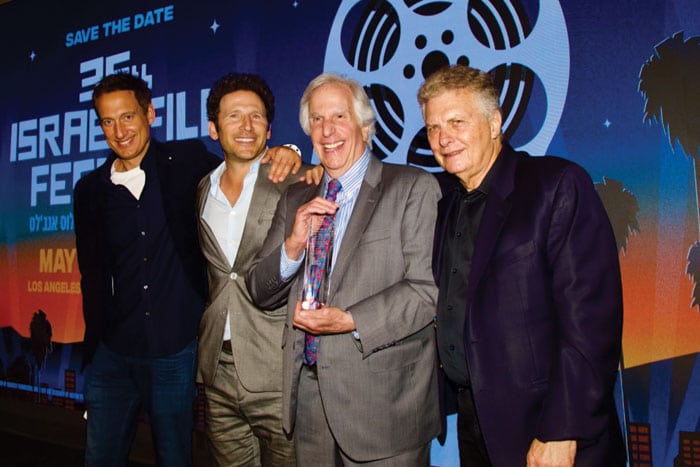
The 35th annual Israel Film Festival (IFF) held its sponsor luncheon at the Four Seasons Hotel in Beverly Hills on April 29.
The afternoon gathering honored real estate investor, philanthropist and Holocaust survivor David Wiener with the IFF Humanitarian Award and actor Henry Winkler with the IFF Career Achievement Award.
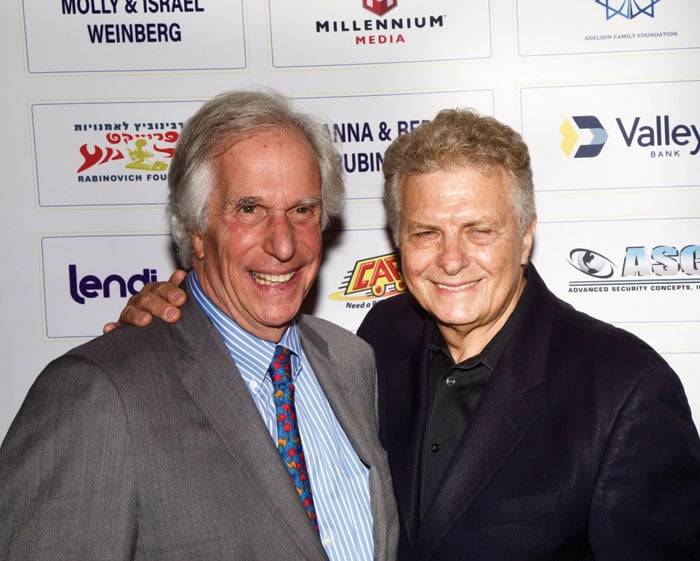
Winkler, known for his role as Arthur “Fonzie” Fonzarelli on the legendary television series “Happy Days” and more recently for his Emmy-winning stint on HBO’s “Barry,” was touched by the acknowledgment. Accepting his award before a crowd of family members, community leaders and others, he declared, “I am a proud Jew!”
The 76-year-old performer also spoke about time spent recently in Israel working on a new television show, having only kind words to say about the Jewish State.
Those in attendance included IFF Founder and Director Meir Fenigstein, who said he was pleased to bring back the festival after a nearly two-year hiatus caused by the pandemic. Other participants were Consul General of Israel in Los Angeles Hillel Newman; comedian Elon Gold, who emceed the program; and actors Don Most and Anson Williams, who both starred with Winkler on “Happy Days.”
Delivering the funny, Gold joked about those in the banquet room spreading both the love for Israel and the latest COVID-19 variant.
Singer Sharon Farber also turned out. During a rousing musical performance, Fenigstein, a musician in a previous life, accompanied Farber onstage while playing a percussive instrument.
Actor Mark Feuerstein and philanthropist-activist Daphna Ziman, respectively, presented Winkler and Wiener with their awards.
The luncheon was held a few days before the official kickoff to the Israel Film Festival, the largest showcase of Israeli entertainment in the United States, opens May 5 at the Saban Theatre in Beverly Hills and continues through May 26. During the three-week hybrid festival, Israeli feature films, documentaries and television series will show at various theaters across Los Angeles as well as online. For more information, visit israelfilmfestival.com.
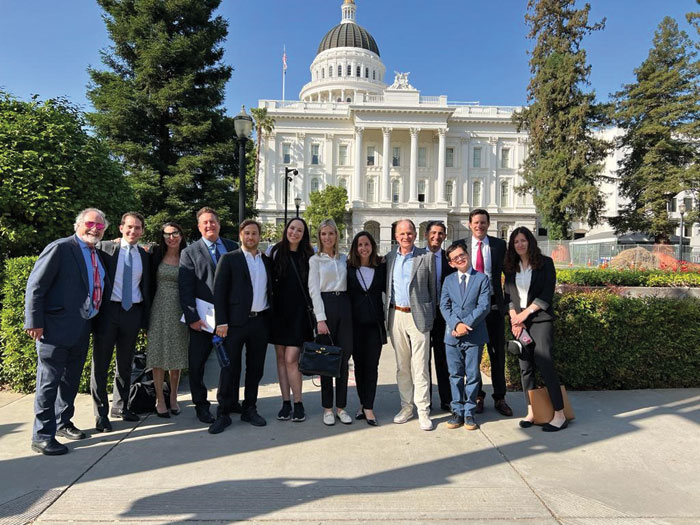
On April 27, 19 members of the Jewish Federation of Greater Los Angeles’ Real Estate and Construction (REC) Division and Real Estate Principals (RPO) traveled to Sacramento to advocate on critical issues facing the Jewish community.
The group focused their advocacy on the Nonprofit Security Grant Program, which provides critical assistance to nonprofit organizations at risk of hate-motivated violence to enhance physical security infrastructure as well as funding to support the rebuilding of camps and community centers destroyed by numerous California wildfires. These camps serve not only the Jewish community but many other diverse communities throughout the state.
According to the L.A. Federation, it was not lost on participants that this advocacy trip occurred on both the third anniversary of the tragic shooting at the Chabad of Poway in 2019 as well as on the eve of Yom Hashoah — these historical markers underscoring the importance of the legislative asks. While in Sacramento, the Jewish Federation leaders met with key legislators and decision makers, including California Legislative Jewish Caucus Chair and State Assemblyman Jesse Gabriel (D-Encino), and were hopeful that advocacy will translate into dollars for the California and Los Angeles Jewish communities.
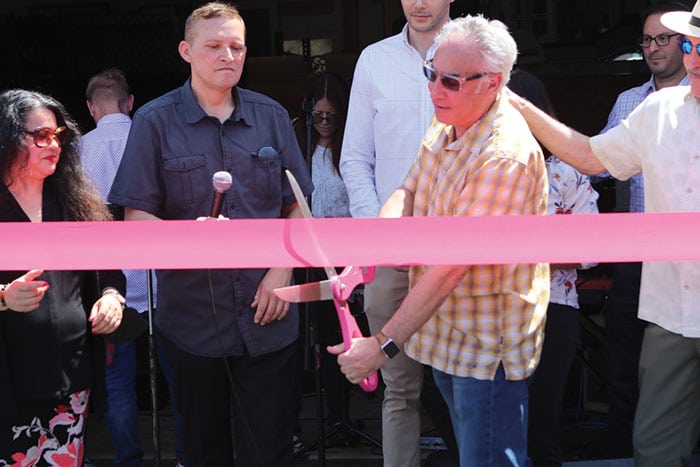
On April 24, addiction treatment center Beit T’Shuvah (BTS) hosted a grand opening ceremony for its new thrift store location.
The BTS Thrift store, formally located in Culver City, now stands at the corner of La Cienega and Pico and serves as a resource for the community. The ceremony was attended by those in the Beit T’Shuvah community as well as Mayra Guevara, deputy for constituent services for the City of Los Angeles, who led in the ribbon cutting for the event.
The thrift store has always been a community favorite shopping experience with items ranging from furniture, art, clothing and more while supporting the critical work at Beit T’Shuvah. The mission of Beit T’Shuvah is to save the lives of those wrestling with addiction by providing integrated care in a community setting regardless of one’s financial ability.
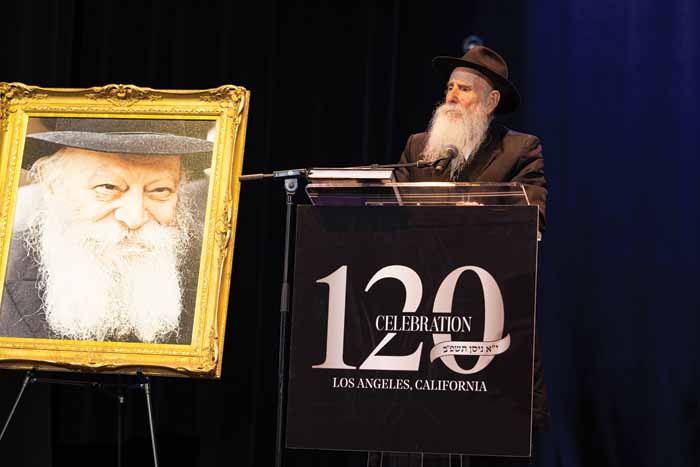
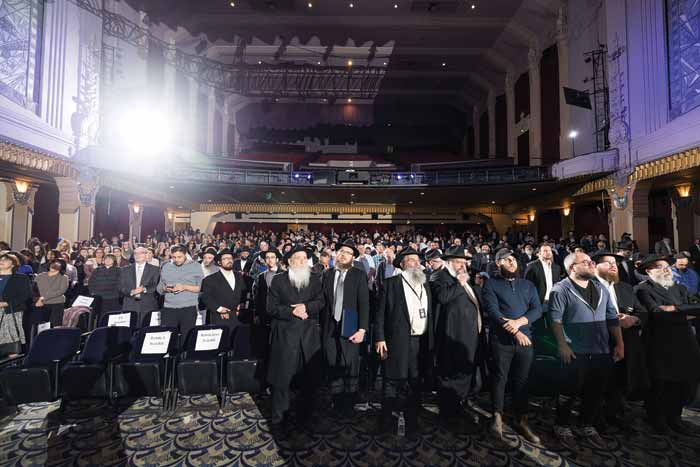
A few days before the start of Pesach, on April 11, supporters of Chabad West Coast came together at the Saban Theatre in Beverly Hills for a community farbrengen — or gathering — celebrating 120 years since the birth of the Rebbe.
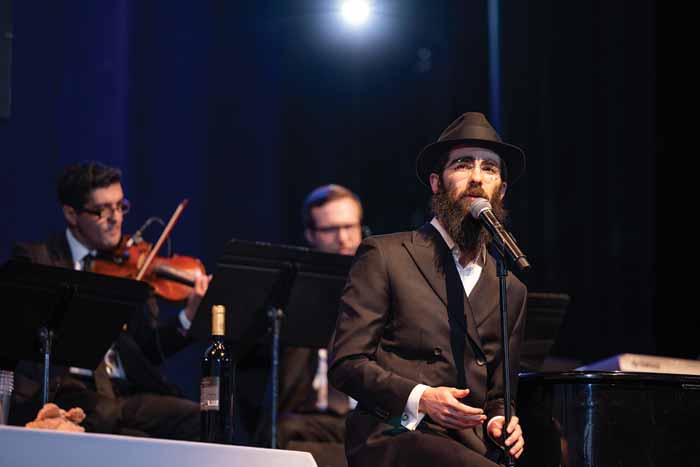
Before a packed house of approximately 1,500 attendees, Rabbi YY Jacobson of Monsey, New York appeared as the keynote speaker; Rabbi Mendel Kalmenson, author of “Positivity Bias: Practical Lessons for Positive Living based on the life and teachers of the Lubavitcher Rebbe,” offered words; and Hasidic performer Eli Marcus sang a musical tribute to the Rebbe.
In preparation for the holiday, organizers had boxes of handmade shmurah matzah brought into the lobby of the theater, and attendees were invited to take matzah and distribute it to the community. This was in accordance with “the Rebbe’s spirit of sharing the inspiration and turning it into action,” said Chaim Cunin, whose father, Rabbi Boruch Shlomo Cunin, is the leader of Chabad West Coast.
“This is the first such event we’ve had since COVID,” Chaim Cunin said in a phone interview. “The last time we were at the Saban was before COVID when Tzemach Cunin died. An indoor event of this kind was refreshing, and it was beautiful to see everybody coming together for such a special occasion. It was beautiful to see.”
The late Rabbi Menachem Mendel Schneerson, known by many simply as “The Rebbe,” was born on April 5, 1902. As the leader of the Chabad-Lubavitch movement, he was responsible for growing Chabad into one of the most influential movements in Judaism. According to Cunin, he wished that his birthday every year not be an occasion for giving him gifts but an opportunity to perform mitzvahs.
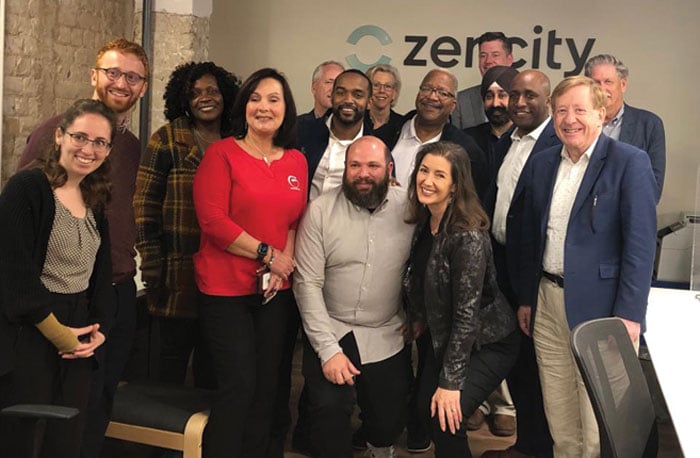
Advocacy group American Jewish Committee (AJC) hosted a delegation of U.S. mayors in Israel from March 27-April 2 as part of AJC Project Interchange.
Participating mayors included Oakland Mayor Libby Schaaf; Tampa, Florida Mayor Jane Castor; and Oklahoma City Mayor David Holt, who chaired the bipartisan mayoral delegation.
“AJC has worked closely with mayors and municipal leaders for decades on issues of mutual concern. As on previous mayoral visits to Israel with AJC, this group learned about Israel and engaged in fruitful exchanges with their Israeli counterparts on approaches to common challenges,” AJC Chief Field Operations Officer Melanie Maron Pell, who accompanied the delegation, said.
This year, the delegation visited localities throughout Israel and discussed best practices for managing COVID-19, urban revitalization and electric transportation, according to AJC.
Project Interchange is a nonprofit educational institute of AJC. For over 40 years, the initiative has brought more than 6,000 influential figures to Israel. The mayoral mission aims to enhance U.S.-Israel relations on the municipal level. This year’s delegation represented the second AJC Project Interchange group under the auspices of the Memorandum of Understanding between the United States Conference of Mayors and Israel, signed in 2019.
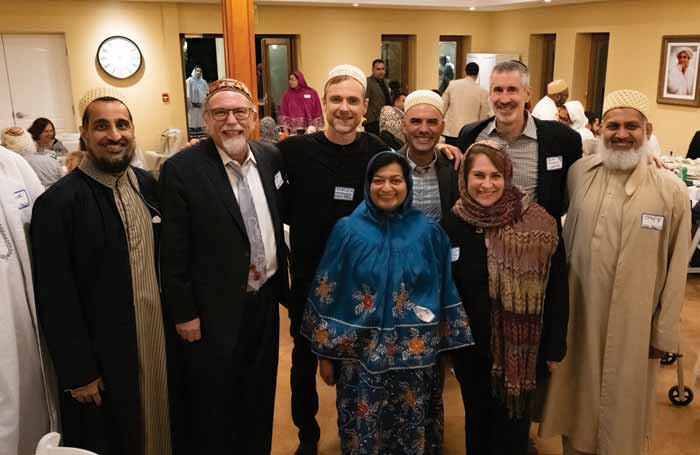
Two San Fernando Valley congregations — Temple Aliyah and Shomrei Torah Synagogue — participated in an interfaith event, celebrating how Passover, Ramadan and Easter all fell on the same dates this year. The confluence of holidays only happens every 33 years due to the different calendars.
Called “Holiday of Holidays,” the April 18 program was held at Ezzi Masjid, a mosque in Woodland Hills connected to the Dawoodi Bohras, a religious denomination within the Ismaili branch of Islam.
The West Valley Interfaith Council, consisting of Temple Aliyah, Woodland Hills Presbyterian Church, Ezzi Masjid and Shomrei Torah Synagogue, sponsored the event, with local Jewish leadership in attendance including Temple Aliyah Hazzan Mike Stein and Rabbi Stewart Vogel as well as Shomrei Torah Synagogue Rabbi Richard Camras.
“There has been an interfaith alliance between our Jewish, Christian, and Muslim neighbors in the West Valley for many years,” Stein said in remarks. “The exchange of ideas, customs and theology has brought us closer as a community and is the basis for cooperation and goodwill.”
Stein, who conceived of the program, said it was “based on my understanding of a similar event held originally in Haifa, Israel.”
Movers & Shakers: Celebrating 120 Years Since the Rebbe’s Birth, Valley Interfaith Event Read More »
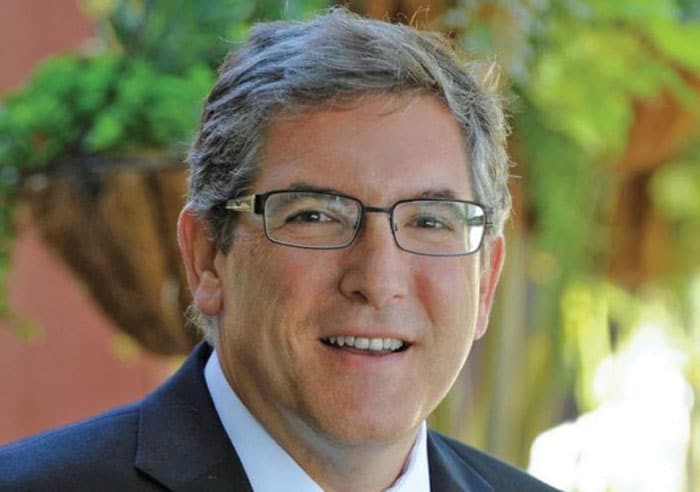
Rabbi Jon Hanish always wanted to be a filmmaker or a rabbi. Now, the former filmmaker and current rabbi of Kol Tikvah in Woodland Hills can say he’s gotten to do both.
The Louisville, Kentucky native, who was involved in the North American Federation for Temple Youth and B’nai Brith Youth Organization when he was growing up, earned an undergraduate degree in Comparative Religious Studies and Film History from Wesleyan University. He then went on to the USC School of Cinematic Arts, where he got a Master of Fine Arts.
“When I wanted to go to film school, all my friends said ‘Jon, you’re going to be a rabbi,’” Hanish said. “But when you get into USC film school or rabbinic school, you go to film school because it seems a lot more exciting when you’re 23 years old.”
In film school, Hanish would stay connected to his Judaism by attending events at USC Hillel and throwing Passover seders.
“I kept my involvement going,” he said. “Whenever my friends wanted to cast a rabbi in their films, they’d cast me, because I was the person who was the most knowledgeable about Judaism.”
After graduation, Hanish ended up working in the film industry for a number of years as an executive producer, writer and founder of a post-production facility. Though he enjoyed it, he knew when he was in his early 40’s that he wanted to finally pursue his interests in the rabbinate.
He was ordained at Hebrew Union College and worked as the assistant rabbi at Kehillat Israel in the Pacific Palisades. There, he first combined his love of storytelling with his passion for Judaism. Along with screenwriter Alex Litvak, he started a program that paired screenwriters with rabbis – the writers helped the rabbis format their sermons to make them more accessible to congregants.
“The rabbis put their egos aside and learned how to tell their messages more effectively,” said Hanish. “The writers learned more about Judaism and how difficult a rabbi’s job is.”
When he started at Kol Tikvah 11 years ago, he came up with other ways for people to express themselves through writing and storytelling. He currently runs a writers’ workshop for congregants to get together, put their thoughts on paper and give each other critiques.
“Writing is a great way to get people to share with one another,” Hanish said. “When you have an assignment, you have to write something, because you can’t show up to a workshop empty-handed. And when you share, you get emotional and technical responses. The comments for the classmates are powerful.”
Some of the writing that the congregants did ended up in a Yizkor book for the synagogue.
“We shared our experiences with mourning,” Hanish said. “People wrote poetry or little pieces of prose.”
In his own sermons, Hanish uses storytelling techniques he learned in film school and show business to reach his congregants. During the last High Holidays season, his eruv Rosh Hashanah sermon was a story he wrote.
“You can pull people together through a good story, whether you’re writing a screenplay or giving a sermon.”
“I also write things where I push people to take action,” he said. “And there are other times when I write things because I want people to reflect. You can pull people together through a good story, whether you’re writing a screenplay or giving a sermon.”
There is one major difference between his former and his current life, however: When the rabbi would write screenplays, one person might read it. However, with a sermon, he gets feedback from many.
“I see how people react,” he said. “I have a larger audience to share a sermon or an idea with.”
Whether he’s putting his thoughts on paper, running a writing group or giving a sermon, Hanish hopes he’s having an inspiring effect on people’s lives.
“The goal is to help people,” he said. “If I get the overall sense I’m helping my community, it’s not an end goal, but a continuous goal.”
Jewish Journal: What’s your favorite Jewish food?
Jon Hanish: Homemade gefilte fish. I make my own. When I serve it, people say, “Oh my gosh, this actually tastes good.”
JJ: What’s your favorite movie?
JH: “They Live by Night.” It’s film noir.
JJ: What does your perfect Shabbat look like?
JH: An evening where we have large numbers of people coming to the temple and we have to chase people away at the end of the night.
JJ: Where is the best place to hang out in LA?
JH: My garden in my backyard.
JJ: What are you growing right now?
JH: Tomatoes, cucumbers, squash, zucchini, potatoes, strawberries, bell peppers. You name it, I’m probably growing it.
Rabbi Jon Hanish, The Storytelling Rabbi Read More »