fbpx

April 27, 2022

Telling the Whole Story: Reflections on a Trip to the American South

Adapted from a sermon given at Temple Beth Am on March 26, 2022.

My first conscious engagement with the Civil War that I can remember was in 7th grade, when we were assigned the novel “Across Five Aprils.” My first conscious engagement with a Black African American was a girl named Crystal, who I learned later was bussed from an economically challenged New Haven neighborhood to my nearly all-white suburban elementary school in Woodbridge, CT. Having just returned from a fascinating, illuminating, crushing and in many ways extraordinary trip with Temple Beth Am to the American South, I am now, nearly 40 years later, reconsidering what those encounters with a war and with a person really meant — and how they were lacking.

I have not read “Across Five Aprils” since 7th grade, but I remember the plot to be about a family with sons who fought on opposite sides of the Civil War. As a 7th-grader, I was impacted by the poignancy of the narrative. But perhaps I was oblivious to the poignancy that should have suffused any study of that material. I remember it being a novel about brother against brother — a family divided, civil war as its own detached horror, one that puts one brother in a position to have to violate his family commitment in order to fulfill his military, national one. 

 As a sibling who loved my family, that story pierced my heart. And yet I have no recollection of the novel itself, or our discussion of it addressing the essential thing the war was about: the centuries-old dispossession, enslavement, dehumanization and brutalization of Africans ripped from their homes in order to serve white men in the New World. In Hebrew we would say ikar haser min hasefer. The main point was missing from the book. My first encounter with the Civil War was a story denuded of the principal incivility of the conditions that created that war. I wonder if your schooling was similar or different.

 I remember that Crystal stood out, because she was Black. She was, for most of us Woodbridge kids, the first Black person we had ever met. I never once thought about what that experience was like for her. If I am honest, there is a good chance I was unkind to her at some point, perhaps even in a way that would now be seen as borderline racist. Kids notice things. They are aware of obvious distinctions, and skin color is one of them. Kids say things. I am sure that was a part of what took place in that 3rd grade melting pot.

 But I don’t think it was the dominant thing that took place. For the most part, Crystal was a classmate of mine, nothing more or less. So my first encounter with race went right to the heart of the debate still raging today, when identity politics wage battle with forces that ask us to transcend race. Dr. King’s dream that his children be judged not by the color of their skin but the content of their character is wielded by both sides of this battle, with one saying that the conditions are not yet right, not yet a sufficient disassembling of the racist history and structures that formed the evolving United States of America, for us to think that we can be beyond race; and another side saying that the way to get beyond race is to get beyond race. 

 I think of myself in Mrs. Shapiro’s class at Beecher Road School. And Crystal. And our interactions. I didn’t really know enough to know what her dark skin said about her family’s history, about the very way her ancestors almost certainly arrived to these shores. Maybe that was how it should be, my innocent and also uninformed self essentially rejecting identity politics before the phrase became a phrase? She was just a classmate. Isn’t that the goal, Dr. King? Or maybe it was an erasure, as well: an unconscious erasure, but an erasure nonetheless, given that I looked at her face and skin and didn’t see shackles. I didn’t see her ancestors on a plantation. I didn’t see how parts of my white American comfort — which is due in many ways to the doggedness and vision of my own ancestors who came to these shores under great duress, and with great obstacles in front of them — were also due in some inherited way to the very healthy economy that has its origins in the oppressive labor of this young girl’s great-great-great-grandparents.

Race and American history are complex. This is what made our trip so difficult, and so important. It was spending Shabbat at a joyful, active Conservative shul in New Orleans. It was visiting and bringing life and song to old-but-nearly dying shuls in Natchez and Vicksburg and Selma. And it was opening our pores, as Americans and Jews, and letting the full story of the American south penetrate our consciousness with no barriers.

 That included the Whitney Plantation, which I liken to a visit to Auschwitz or Majdanek, telling the story of the place from the perspective of the oppressed and murdered, not of the “genteel” antebellum southerners. It’s a brutal visit, appropriately. And the trip included the Rosa Parks Museum in Montgomery, telling Rosa’s story of how a young woman who would not get up got so many others up in holy revolution.

 The trip included a visit to the Legacy Museum, from Slavery to Incarceration, alongside the National Memorial for Peace and Justice, colloquially referred to as the “Lynching Museum,” which tells a comprehensive and unvarnished story of the experience of slavery, the terrible inadequacies of Reconstruction, the era of Jim Crow and lynchings, leading to the Civil Rights movement and reinforcing how much of modern America, in ways we do not want to think about, are linked to this bloody and shameful history. 

 The trip also included a visit to the Old Oaks cemetery in Selma, home to the grave of a former U.S. Vice President, hundreds of Jews in their own section, the grave of at least one Black person, Benjamin Turner, who went from being a slave to being the first Black member of the U.S. Congress, and also to a Confederate Circle, with a tribute to Nathan Bedford Forrest, a co-founder and first Grand Wizard of the Ku Klux Klan, dozens of Confederate flags dotting the aesthetically beautiful cemetery, and plaques telling the story of the “war of northern aggression,” or the “war between the states,” alongside the need to preserve southern culture and sensitivities. 

 Again, our kaleidoscopic, magnificent, miraculous country, which fought and won a war to emancipate the slaves, and which remains a beacon of freedom in a world that seems to lack more of that freedom with every passing week — is a country that is fraught. And its history is painful to encounter, when all the prisms and -isms are stripped away, and all you have are the raw facts.

 As many of you know, I spend the overwhelming majority of my time from the pulpit teaching Torah, the tradition, and steering away from raw punditry. I am not a scholar of American history. I don’t return from this trip an expert in any of this. But I have been a solemn witness, and so I choose, today, to use this pulpit to share what it is that I witnessed, and share how a Jew who seeks wisdom in our ancient texts might continue to think about these very ideas.

What does Torah say about partial, sanitized narratives? What does Torah say about the pathway to learning and redemption? A lot, in fact.

What does Torah say about partial, sanitized narratives? What does Torah say about the pathway to learning and redemption? A lot, in fact. I would say that the Torah celebrates full, unedited stories of what actually happened. And the Torah would say that the pathway to liberation, reconciliation and growth goes through the darkest muck of history. 

The most dangerous rebellion against Moshe and God comes from Korach and his minions. The rebellion is put down. God’s authority is restored. The wicked get their due. But the story, in all its ugly brutality, is not forgotten. It is actually consecrated. God tells Moshe, as the embers of the conflagration representing Korach’s defeat are still smoldering, “et mahtot hahataim ha’eleh b’nafshotam va’asu otam riku’ei fahim tzipui lamizbe’ah, ki hikrivum lifnei adonai vayikdashu vayihyu l’ot livnei Israel.”  Those fire pans belonging to the sinners? Hammer them into sheets and put them on the altar. They are sacred. And they will serve as a reminder. The Israelites’ relationship with God will go right through the story of some Israelites’ rejection of God. The full story will be told. And the darkest parts of it will be adjacent to the holiest ritual place that exists. CTT: Critical Torah Theory, if you will.

 Earlier in the story we learn that parts of the mishkan, God’s home on earth, were made using the mirrors that Israelite women took with them out of Egypt. There are two main midrashic/interpretive thrusts explaining this detail. Some say these mirrors were holy, as it was with them that the women, even when enslaved, wooed their husbands by showing coquettish, teasing faces in the reflection, thus resisting the culture of death by eking out of it love and new life. Others say the mirrors were symbols of vanity, the very vanity of paganism that informed and undergirded the culture of slavery that trapped them. In that reading, it would have been a relief, an unshackling, to discard those freighted objects and build sacred life anew. But no. The symbols of their degradation become an essential piece of future sanctification.

 And in our parsha, Shmini, a similar theme emerges. I am so taken by a commentary on Shmini offered by Rabbi Aviva Richman of the Hadar Institute. She reminds us that while Shmini focuses on Aaron, and his role in the eight-day ceremony to consecrate the new tabernacle, the story does not take place in a vacuum. In fact, when did we see Aaron, Moshe’s brother, last? At the Golden Calf: the egel hazahav. Ever since we saw him carousing and sinning and sullying the name of God, he has been absent in the story — until he is invited to offer the inaugural sacrifice in the mishkan.

 And what is that sacrifice he is commanded to offer? An egel, of course. A calf. It’s as if to say that the proper performance of God’s will must evoke and remember, with haunting specificity, the most improper way a Hebrew ever related to God. This time, the structure and setting in which Aaron will make the sacrifice are exactly as God wants them to be. But as he stands in his public role, he is reminded with uncanny overlap of how derelict, how broken, how unforgivable and how damaging the path has been to this moment, including his direct role in it.

 I am challenged and inspired by this interpretation. The interpretation does not endlessly blame Aaron for the golden calf. He is, in this scene, a respected elder and leader, the father of every future priest. But it does implicate him in his past, and force him to reckon with it, without cleaning it up too much. 

 We Americans must go through yet more darkness to find our national light. As with all things reduced to slogans and acronyms, there is nothing simple about how history is taught in our country. Some folks see CRT (Critical Race Theory) for some of its glaring flaws, for ways in which it seems to suggest that every white person, no matter that person’s own origin story, is walking through American life as in a conceptual coffle, shackled to the sins of white men who led Black men, women and children in physical coffles, shackling them to slavery for generations. 

 Some folks see within CRT too many facile associations to the dangerous aspects of intersectionality, which inevitably makes an enemy of the Jew, the Israeli, the Zionist. But others say that the words themselves, “critical race theory,” ramifying way beyond the hackneyed initials, are about confronting our own history honestly, without defensiveness. Studying and teaching history this way is the ideological cousin to Korach’s fire-pans and idolatrous mirrors hammered into the mishkan, and to Aaron’s return to esteemed leadership being by means of his own tour through his devastating sinfulness.

 At the Whitney Plantation, I purchased the book “The Half Has Never Been Told.” It was written by Cornell professor Edward Baptist, and its title stems from a testimony offered by a former slave, Lorenzo Ivy, as part of a WPA program initiated by President Franklin D. Roosevelt to collect the narratives of former slaves before they were all deceased. There is a half of American history that still, to this day, among well-meaning, non-consciously-racist, generally ethical and compassionate and educated Americans, has never been told. This book, which is not without its controversy and critiques, tries to tell it. 

 I am only just diving into it, but one of its notions is worth sharing here, and that is the decades-old American fetishization of the notion that slavery was a uniquely southern, regional, parochial enterprise, disconnected from the larger arc of the evolution of the United States. Baptist makes the argument that, at the very least, no cotton garment, no tobacco product, no tea sweetened with sugar was removed, at any distance, from the scourge of chattel slavery, and that that association remains true today even as economies have been transformed and reborn.  

 But that’s just the beginning. In his words:

“The practices of white enslavers rapidly transformed the southern states into the dominant force in the global cotton market, and cotton was the world’s most widely traded commodity at the time. The returns from the cotton monopoly powered the modernization of the rest of the American economy, and by the time of the Civil War, the U.S. had become the second nation to undergo large-scale industrialization. In fact, slavery’s expansion shaped every crucial aspect of the economy and politics of the new nation, increasing its power and size…The idea that the commodification and suffering and forced labor of African Americans is what made the United States powerful and rich is not an idea that people necessarily are happy to hear. Yet it is the truth.”

 In other words, the very thriving and wealth of an America that was able to welcome and absorb so many of our own ancestors as they came searching for their own freedom from oppression was built, literally and figuratively, on the backs of those suffering indescribable oppression. That is not our fault. It is not our guilt. We were not the perpetrators. But we are inheritors. And we must, as Jews and Americans, gild our altars to God, goodness and freedom with those terrible truths.

We are a wonderful, admirable society. But we are not out from under that cloud. The DNA of our nation’s original sin remains in this organism.

We are a wonderful, admirable society. But we are not out from under that cloud. The DNA of our nation’s original sin remains in this organism. We can disagree as to the extent, but not, I don’t think, about the concept itself. 

 There is no way to wrap this up neatly. I am still in the nascent stages of digesting my own experience. I’m not even 50 pages into the first book I committed to read as a result of our shul trip. 

 Who knows? Perhaps “Across Five Aprils” is a wonderful historical novel, and goes deeper into the issues than I remember. Who knows? Perhaps Crystal has pleasant memories of elementary school, of being treated essentially as a classmate.

 Who knows? Perhaps the greatest honor I can give to the next Black or African American face I look into is to see them as I see myself, a human being, a child of God, an American, a person deserving of respect and love independent of skin color, ancestry and personal history. 

 And who knows? Maybe the greatest honor I can give to such a person is to look into his or her eyes, and discern the centuries of tears that accumulate in that person’s inherited memory, see not only that person, free by law and hopefully by circumstance, but also a descendant of slavery, lynching and disenfranchisement and never being quite allowed to just be — just as I want a non-Jew to see in my eyes not only a full human, but also the ashes of the Holocaust/Shoah, the suffering of the Inquisition, the misery and tragedy of the destruction of Jerusalem, the very heaviness of being a Jew that we claim as part of our inheritance.

Who knows, indeed? But in order to try to know, we have to listen. And explore. And study.  And be willing to build future sanctuaries and societies out of the instruments of the processes that once weighed them down, and whose stain remains visible. It is from such darkness, and only such darkness, that light will ever emerge. 

Shabbat Shalom


Rabbi Adam Kligfeld is the senior rabbi at Temple Beth Am. 

Telling the Whole Story: Reflections on a Trip to the American South Read More »
Alone in Yad Vashem

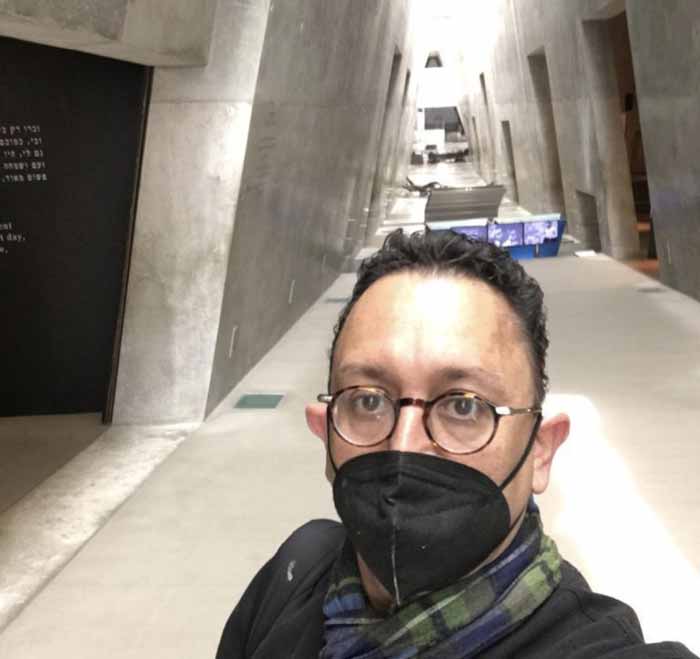
March 2, 2021 was my most surreal visit ever to Yad Vashem. I arrived in Israel two months earlier, just as the third Coronavirus lockdown took effect. I was visiting my son Ilan, who had recently completed his IDF service. My plan was to stay a few weeks, but due to the lockdown and airport closure, I had to extend my stay. 

As things in Israel transitioned from lockdown to gradual reopening, I saw advertisements announcing the re-opening of museums in Jerusalem. The Yad Vashem ad caught my eye, as this was a perfect opportunity to do something I had never done: visit Yad Vashem alone. From my first visit to Yad Vashem as a teenager through the numerous Israel trips I have led, I always visited Yad Vashem with groups. I wanted to experience this sacred space alone. 

I took a taxi to Yad Vashem. As my taxi pulled up to the entrance area, I felt a strange sense of emptiness. Absent from the parking area were the many tour group buses and taxis I am used to seeing there. My taxi driver said “you have the merit of being the client who brought me back to Yad Vashem for the first time in over a year.” 

I walked into the empty lobby, checked in, and proceeded to the outdoor area. I walked down that iconic bridge that leads you from the peaceful serenity of the Yad Vashem gardens into the disturbing universe of the Holocaust. Strict mask mandates were still in effect, and the guard outside reminded me of that.

As I entered the museum, I quickly understood why everything seemed so empty outside. Not one single visitor was inside. My wish to visit Yad Vashem “alone” was granted. Other than the guard at the entrance, I was literally all alone. 

The guard greeted me by saying “You are our very first visitor today. Barukh Haba (welcome).” With a sense of fear, awe and trembling, I began a lonely and frightening journey through the mazes and walkways depicting hell on earth. The first sound I remember hearing was the chilling sound of Nazi boots marching. Being all alone, I felt as if they were marching towards me. I beheld the thousands of horrific images of hatred and heard the traumatizing sounds of genocide against my people.   

I was struck by the image of a vaccination certificate from the Warsaw Ghetto. The certificate was emblazoned with a swastika. Listening to the narration, I heard the Hebrew term for vaccination certificate: Teudat Hissun. A surreal moment, as just the day before, I received my own Teudat Hissun from the Israeli Ministry of Health, attesting that I received two doses of the Pfizer COVID-19 vaccine. I took out my Teudat Hissun and looked at it. There was no swastika. Instead, there was the emblem of the State of Israel. Looking at the word “Pfizer,” it dawned on me that I received two doses of a vaccine produced by a company whose CEO, Albert Bourla, is the son of Holocaust survivors from Greece. My Teudat Hissun and COVID vaccinations suddenly took on a whole new meaning.

Walking all alone in the museum of the shadow of death, I heard more than the voices from the films and interviews. I heard haunting voices from our past. Six million voices, screaming to be heard, begging to be remembered. Voices of children, women, rabbis, poets, teachers, scientists, mothers and fathers. Voices of fear, terror, confusion and anguish. I heard them crying out to God — “Mima’amakim K’ratikha Hashem — Out of the Depths, I call upon You, God.”

As I came to the end of my lonely journey through Hitler’s inferno, I felt the spiritual urge to say Kaddish. But there was no minyan … or was there?  

As I came to the end of my lonely journey through Hitler’s inferno, I felt the spiritual urge to say Kaddish. But there was no minyan … or was there?  

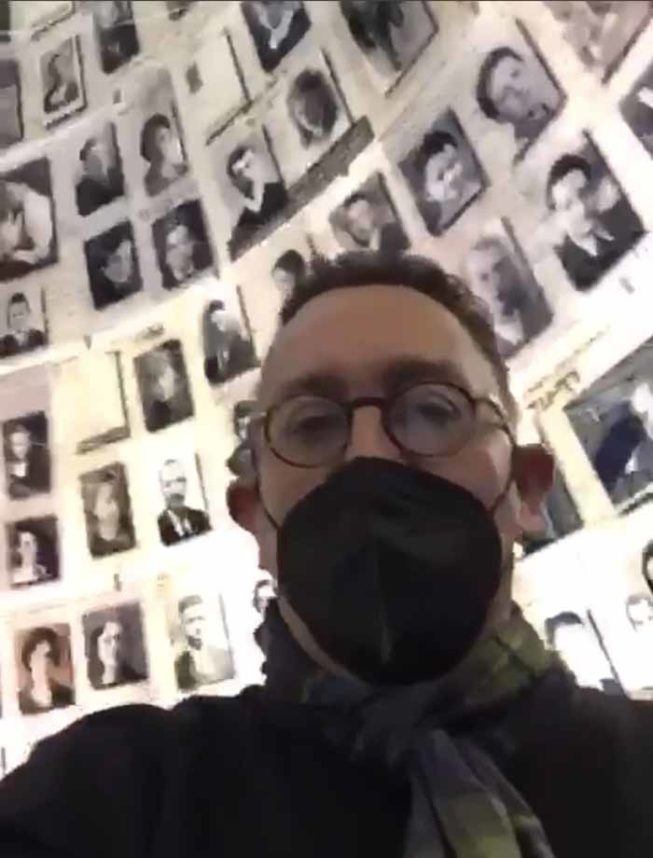
I reached the Hall of Names. Looking above me and all around, I saw thousands of photographs. For three long hours, I hadn’t said a word, but as I stood amidst this vast minyan of images and memories, I spoke my first words in Yad Vashem that day: “Yitgadal v’yitkadash shmeh rabba.” 

At that sacred moment, I no longer felt alone.


Rabbi Daniel Bouskila is the Director of the Sephardic Educational Center and the rabbi of the Westwood Village Synagogue.

Alone in Yad Vashem Read More »

Rosner’s Domain: Ideology or Stability?

At the end of May 1904, Winston Churchill switched sides. He was elected conservative, then crossed the line to become a liberal. If Israel’s Member of Knesset e is looking for inspiration, Churchill can set the example. 

Of course, Chikli is no Churchill, nor is Israel like Britain. And yet, the story of the MK and his party that made headlines in Israel this week is worth telling. It is a small story beyond which big questions about politics loom. 

In a nutshell: Chikli was a member of Yamina, Prime Minister Naftali Bennett’s party. He joined the party when it was a staunch member of the hardcore right, and couldn’t believe his eyes when Bennett decided to establish a coalition with the center-left. So Chikli decided to jump ship and voted with the opposition. For a year or so, the party was forgiving. But when another MK abandoned the party, Bennett decided to act: he asked that Chikli be formally tagged as an official “defector,” which would legally prevent the young MK from joining other parties in the next election. It’s a move of deterrence, to prevent other KM’s from toying with the idea of moving elsewhere.

Chikli’s case for defection is strong. But so is the case against him.  

Chikli’s case for defection is strong. Hence, he argued forcefully that the action taken against him was tenuous and illegal. 

The case of those who oppose Chikli’s move is also strong. Thus, the coalition pursued its case without regard to his complaints. 

This is where we begin a short yet serious discussion of the significance of Chikli’s move. Political gossip is important, but essence is more important. And the essence of this case stems from two questions: a party’s commitment to the platform it presented to the public, and the power of a lone MK. To these two questions, there is no clear legal answer. Therefore, the expected result of the process is a court case. When it gets there, Chikli will argue that a Knesset Member is committed to the ideological path of the party on whose behalf he was elected, not to the party’s political leadership. The law was intended to prevent MK’s from changing parties to get jobs or benefits, not to prevent them from doing what they promised the voters they’d do. And indeed, when Chikli ran in the last election he vowed that Yamina will not sit in a coalition with Meretz or Labor or other leftist parties. He did not change his tune since – the leaders of his party did. 

The main consideration that is at the foundation of the other side’s argument in this debate is the need for stability. If every MK is free to decide for himself, there will be chaos in the Knesset, and no coalition to speak of. In fact, Chikli’s opponents will present the current law as proof that the legislators understood the necessity to balance the need for stability and the need for ideology. The supposedly balanced law will be Chikli’s problem in court. It says that a faction of three MK’s is allowed to desert a party and join another party without penalty. So if a party has deviated from its ideology, there is a way for MK’s to respond appropriately, as long as they are not alone in arguing that the party no longer represents its voters. 

Does this mean Chikli’s case is a lost cause? Not necessarily. As mentioned, the law is not entirely clear. It only refers to MK’s who jump ship in return for some reward, which Chikli did not receive. The Knesset’s attorney has complicated the case, when he previously set a quantitative test for declaring an MK a defector. That is, how many times has he or she voted against his party’s position? But Chikli argues that this is the wrong test. How can we vote, he asks, if a party can say one thing on the eve of the election, and do the opposite the day after the election, and punish the one MK who is willing to stand his ground? 

This will be an interesting test for the court. This is also an interesting test for us, the voters. Even those amongst us who are not happy with Chikli’s decision should recognize that he has a strong case. Even those amongst us who are happy with Chikli’s decision should recognize that his censors also have a strong case.

Something I wrote in Hebrew

Following a Jewish Electorate Institute poll from which we learned that most US Jews support a return to the nuclear agreement with Iran, I wrote this:

We tend to attach undue importance to the influence of the Israeli prime minister on America in general, and on the public opinion of American Jews in particular. American Jews live in America, their political reference group is American, their main sources of information are Americans. When it comes to a big question like Iran, sympathy (for the Bennett government) or its absence (for the Netanyahu government) does not make a difference. Netanyahu – in his aggressive moves against the Obama administration – did not convince US Jews to support Israel’s stance. Bennett and Lapid – who decided to be polite with Biden – also did not gain the support of US Jews for Israel’s stance.

A week’s numbers

The war in Ukraine is still ongoing, and most Israelis would agree to take in refugees in significant numbers. 

A reader’s response:

Jennifer Templeton asked: “Is it really true what you wrote that many Arabs still deny the Jewish connection to Temple Mount?” Well – yeah. A poll proving it is here: https://jppi.org.il/en/article/index2020/.


Shmuel Rosner is senior political editor. For more analysis of Israeli and international politics, visit Rosner’s Domain at jewishjournal.com/rosnersdomain.

Rosner’s Domain: Ideology or Stability? Read More »

Jewish Stories, Pirate-Style: Meeting the Creators of a Swashbuckling Comic for the Whole Family

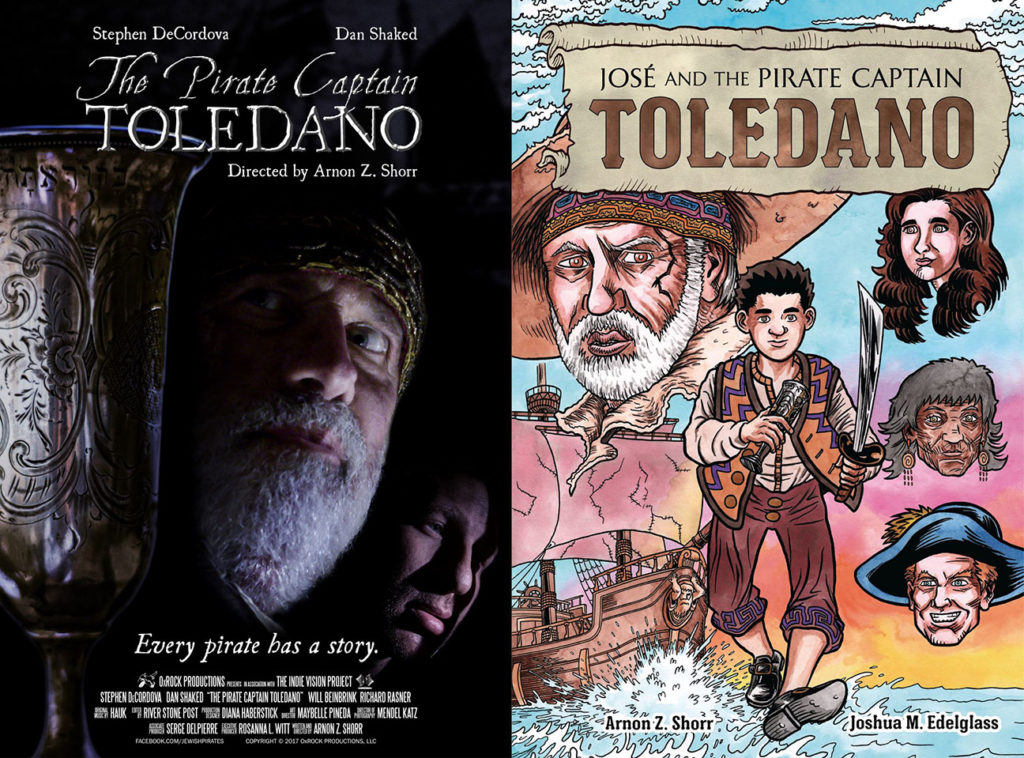
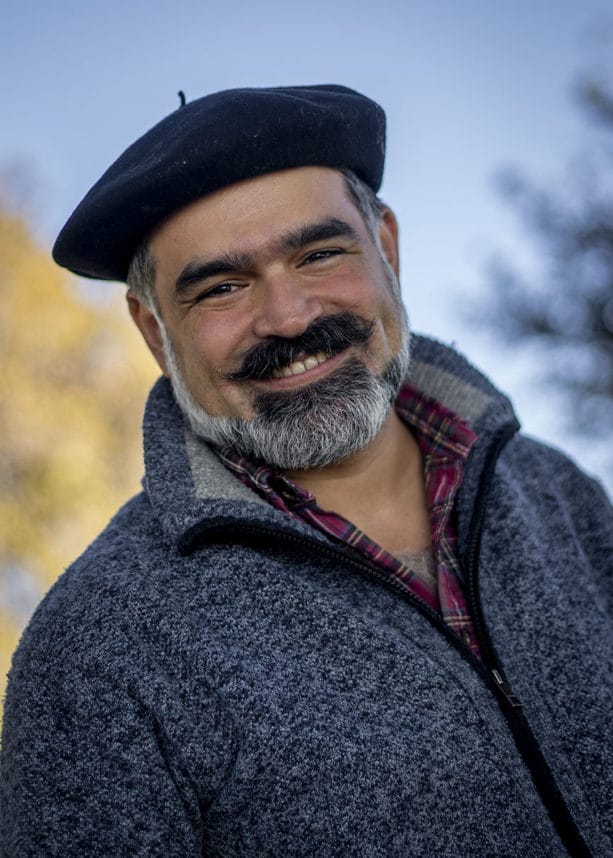
To know Arnon Shorr is to know someone who could easily be a character within one of his stories: A distinctive moustache, a stylish hat, and long, deep pauses before delivering fascinating soliloquies. When my wife and I found out our dear friend Arnon was trying to create his dream project, a short film about a 16th century Jewish pirate evading the Spanish Inquisition, we were excited to support it. The Pirate Captain Toledano started out as a crowdfunded passion-project and became an award winning short film, written and directed by Arnon in 2017.

When I found out that he was writing a graphic novel based on the short, I assumed it would be a straightforward adaptation. To my excitement, it turned out to be so much more. Set during the Spanish Inquisition, José and the Pirate Captain Toledano is the story of a young refugee and the connection he forms with a mysterious pirate captain. This high sea adventure, rife with hand-to-hand combat and ship-to-ship action, highlights a dark time in history when people took unusual paths to survive.

Arnon, Josh and Boaz enjoying themselves two hours into the zoom interview.

I had the pleasure of interviewing Arnon and his delightful illustrator Joshua Edelglass, and despite a background of comic book fandom, I still learned so much about the process. It’s my pleasure to share highlights from our fun and illuminating two hour conversation, where the three of us discussed this new release.

How did you two meet?

Joshua Edelglass

Joshua Edelglass – We have a little bit of a history. I’m Assistant Director of Ramah New England. We run a week-long program, a mini-camp where we bring in artists, musicians, sports coaches etc.  I forget who initially connected us, but about ten years ago I brought Arnon to camp as a filmmaking expert. He was a guest programmer for a week, where he ran programs for kids who signed up because they were interested in filmmaking – what we call an “expert-a-thon”. We’ve been in touch as friends ever since, and now we suddenly live near each other in the Boston area!

Arnon Shorr

Arnon Shorr – Actually Boaz, it’s similar to what I did for your nieces Eve & Ada. A few years ago when they came to town for a few days, if you recall I introduced them to different aspects of filmmaking.

I remember, and that was lovely! They’re both in Israel for seminary now. And Eve got in early to Princeton, maybe it’s thanks to your mini-camp!

AS – (Laughing) Print that rumor and the book will sell even better!

Yes, read the book and you get into the college of your choice, or your money back! What attracted you to this project, Josh? Was it the story itself, or working with Arnon?

JE – I sparked to the story immediately. I watched his short film and loved it. As Arnon was telling me about his visions to expand those several scenes into a much larger story, I just got really excited for it right away. Not only could I see it was a great narrative, but I easily saw it as a graphic novel. It’s highly visual, and I got excited to draw it. There’s also a second level that compelled me to work on this. I’ve been a freelance illustrator for about 20 years, and I’ve always been interested in comics and graphic novels. Over the last few years I’ve gained a thirst to go toward the graphic novel area. I was published in the Jewish Comix/Comics Anthology twice over the past five years. It was a mixture of famous collections of artwork from people such as Art Spiegelman, who wrote Maus, plus some original artwork from people like me.

Arnon, was Josh your only plan? Were you screwed if he said no?

AS – The way this developed doesn’t connect with the way that question is framed. What happened was that after each film festival screening, there was a Q&A, and the first question would always be, “Wow that was great, where’s the rest of the story?” And I would say, “Pirate movies are expensive, but if you pull out your checkbook”…and people would laugh. I started to wonder: all these people want to know what the rest of the story is – I should probably figure it out for myself! So I wrote out a few pages, a treatment, something where if lightning strikes a second time, this is the story I would want to tell. I knew it was very unlikely, so I started to think of other ways, other mediums to get the story out there. The idea of comics swam through my mind, and I thought, “This could be really interesting, what if this was a graphic novel”. But I had no idea how they are made, what the process is, how to do it – no idea. So I asked around for advice.

Around the time the second anthology that Josh was published in came out, I saw his post on Facebook about it. And I realized, “Oh my gosh, here’s this guy I’ve known for a decade, I had no idea that he illustrates comics”. I knew him as the camp guy.  So I reached out to Josh and said, “I’d like to pick your brains, I’m curious how comics work.” So we came very organically to the conclusion that we should try to see if we could get Toledano as a graphic novel off the ground. So the decision to make this book really emerged collaboratively out of a conversation that was more broadly about graphic novels in general, how they happen, what stories might work, and what the process looks like. So I was never actually considering other artists, because I didn’t even know where to begin; and Josh was really excited about it, so I decided let’s let Josh guide me through this…and it worked, and we have a book now!

I love that answer. What do you think you would have done if he didn’t offer to collaborate?

AS – I think I really needed a collaborator to get this done, even if I didn’t realize that right away. So in that sense I got really lucky, because it turns out Josh is an excellent collaborator. We’ve had a strong and enriching partnership over the last few years. I don’t know that I would have known that that’s what I needed, so who knows where this could have gone if not for this strange Facebook kismet that happened.

JE – I think we both got very lucky with our partnership.

When was this conversation that kicked off your collaboration?

AS – About three years ago.

When did you complete and send this off to print?

AS – We finished the vast majority of our work June 2021, and then last fall there was a little bit of back and forth about the overall design of the book and lettering, those sorts of things.

How big is the first run of printing?

AS – A lot bigger than I thought we would be. I don’t have hard numbers, but when we talked to publishers initially, we were told a typical first run might be about three thousand copies, and then they’d see how it goes. We already know it far exceeded that, but we don’t know the numbers. The publishers tend to be very protective of their hard data I’ve learned over time. Amazon and Barnes & Nobles and a bunch of others have thousands of copies sitting in their warehouses waiting for May 1st to start shipping copies as they are sold. It’s very exciting!

Wouldn’t it be cool to find someone who works in a warehouse, and have them take a picture of your inventory down the huge hallway next to the Ark from Raiders?

AS – If we can get that photo, I will happily Photoshop the Ark of the Covenant behind the books.

JE – I don’t want the photos of them in the Raiders warehouse; I want the photos of them on the trucks being delivered to places like the morning edition, hot off the presses!

Josh, you obviously watched the short film. Did you have to pore over it while illustrating to get the imagery right? Did the script from Arnon come first?

JE – One of the things we did first was put together a proposal to try to interest an agent and publishers. For that proposal, Arnon wrote things for them, and I illustrated five sample pages that I painted. To be ready for the pitch, we felt the easiest thing to do was to adapt two key sequences from the short film. I probably watched the video short four or five times to get in my head the visuals of the world. Some of the panels were invented from me, even though I was adapting the short film, but several of the panels we really wanted to specifically capture an exact moment from the film; so I would rewatch those scenes a bunch of times. And Arnon also had a bunch of tremendously helpful production stills from the movie. There were fifty photos just showing different props. I may have included just two or three of those props in my treatment, but just getting that sense was really helpful. Then when we were doing the actual book, I was working from the full script that Arnon wrote.

So by the time you started the book itself, Arnon had written the entire script.

JE – Once we connected with the publisher Kar-Ben, the first step was Arnon writing the script and getting their signoff. We wanted to be sure we were on the same page rather than waiting for edits on the story down the page. Then I was ready to start using the script to draw. At every stage I was drawing, every five or ten pages we would hop on the phone or Zoom, and we would ask each other questions and give each other feedback.

AS – It worked the other way too. I sent the script to Josh for his feedback before we sent it to the publisher. I wanted to make sure he liked the pages. Ultimately, I think the most important buy-in comes from the person you’re collaborating with. And then the next important step is from the publisher. If the person you’re collaborating with doesn’t like the story or dialogue, that needs to get worked out. I felt like Josh really gave me excellent notes, and made the story better.

JE – I think at every stage getting Arnon’s vision was so helpful. Both to clarify his original intention and his vision for the worldbuilding. He’s a great storyteller, so having him look at a panel or page, not knowing what’s in my head, and being able to tell me if my actions and movements from one panel to another captured things properly and clearly…it was incredibly useful. What’s in my head doesn’t necessarily translate to the reader. That back and forth really improved the project at every stage. And it was fun.

I asked a video game artist friend to glance at the artwork and give me his impression, and he was highly impressed by the detail and consistency of the faces, but mentioned that some of the color tones were similar between the characters and their backgrounds. Was this a deliberate choice?

JE – I love talking about this sort of thing. Everything I did was intentional. One of my favorite words is “intentionality;” I use it when training at camp. My number one goal is to ensure clarity. Number two is convey the intended mood. Number three is what action or emotion is called upon to move the plot along. I try my best to service all of these three things and goals that matter to me most. Arnon and I talked a lot about the colors. To have his eye as a filmmaker was very helpful for me. When you look at arc of the almost hundred pages of the graphic novel, the color can really distinguish the story. You see how the color tone on Captain Toldedano’s ship is different than the color tone from where José grows up in Santo Domingo, which is different from the color tone in the village. Some pages were intentionally more monochromatic, and some had different colors mixed in. Hopefully it enhances the story and doesn’t detract from it. Arnon, is there anything you’d like to add to that?

AS – Each panel doesn’t just exist in its own vacuum, it’s part of a narrative progression. Really it’s about what else is happening around this scene, and where it is in the overall story. How do these colors and shadings relate to move the story we are reading forward. One of the reasons I like this color progression is that it feels like we’re moving through something; it gives that sense of scope and movement and geography which I think is really important in a book like this. You want to feel like you’re on an adventure. The colors are one tool in a really big complicated toolbox that you can use to give that sense.

I’m assuming that when Josh is reading Arnon’s script, it doesn’t give directions for each specific panel laid out?

JE – Arnon did write his script in comic book format. It was a really nice combination of screenplay and comic book. His script divided each page into panels. And Arnon was wonderful when he told as we begun that this could be the starting point for my creativity. There are some pages in which what I drew was almost exactly the panel breakdown that he had written. And there were some pages in which I went a different direction. We talked about these things at every step of the process. I might ask him what he thought of us trying this or that, and we would see if it worked that way together. There was a scene right after José stows away in the pirate ship where we needed to convey the passage of time. Arnon gave suggestions of how to show that in his script. I wasn’t sure that it was going to work, and gave a suggestion, and Arnon wasn’t sure that that was going to work. We went back and forth until we got to the version in the final book that I hope did the trick. The end result is on page 30, something that was a synthesis of putting our two heads together.

Is there any talk of follow-ups/sequels/more stories in this universe?
AS – We dipped our toe into that conversation with our book agent, and she said to wait and see how the book is received first.

JE – Arnon does have a good pitch that I’d love to be able to start drawing with the same characters.

As you were writing, did you intend for this to be the end of the story?

AS – Yes. A good story has an end, but that doesn’t mean that it needs to be the end of the stories that take place in the world, with those characters. Yes the story ended, but there are plenty more narratives with these characters and within this world that can still be told. I always envisioned it that way. One story told about a set of characters in a world that’s very rich. My goal was never to tell parts of a story, it was to tell a complete story and have it feel satisfying, with it reaching a conclusion. But many characters are still alive, there’s more they can do, and yes it would be really fun to have a chance to bring them to life again.

JE – The best type of story leaves you feeling really satisfied at the end, but also wanting more, and I think we really achieved both of those goals.

You didn’t number this issue, but maybe that would have seemed presumptuous!

JE – If George Lucas can go back and add numbers to his original movies, so can we.

AS – This can become Episode IV!

When I watched the short film, I felt like Captain Toledano was the central character even if he arrives late in the story. In the graphic novel it’s clearly shown through the eyes of the teenager José. Why this choice?

AS – José is the same character as in the film, but appears a bit younger. In the film I imagined him as a teenager, but I admit he ended up a looking a bit older due to the casting. I always felt the story at its core was about people finding themselves. The captain’s journey is interesting in its own right, but in my mind it was really about a kid who’s trying to figure out who he is. The captain’s story is secondary. It stems from something personal to me. When I got married, my grandfather gave me a silver kiddush cup that had belonged to his grandfather. The cup connects me to my ancestors and my heritage in a very physical way. It originated most likely in the late 19th century with my grandfather’s grandfather, who was an Av Beit Din in a small town in what is currently Eastern Ukraine. (I have no relatives there that I’m aware of anymore). My family for the most part came to what was Palestine at the time, about 100 years ago.

I think a lot about that kiddush cup because my grandfather was fairly anti-religious. It had been used for generations, and suddenly wasn’t used anymore, except on Pesach for the seder.  It came to me, and I use it every Friday night, but I don’t know if I use the same kiddush melody that my great-great grandfather used. I don’t know if any of the traditions that I have parallel his, because there’s a break in that chain. So I’ve always been a bit of an explorer in the world of Jewish tradition, and I wanted to tell a story about this kid, José, who’s also exploring an identity that he’s been disconnected from.

JE – Earlier in the conversation you asked me what attracted me to the story earlier. It’s fun with the pirates and adventure obviously, but his passion and seeing these different layers of depth and meaning shone through so clearly. It really drew me in.

The protagonist José finds out he’s Jewish in the story, and his potential love interest Rosa is non-Jewish, like everyone in his surroundings. Were you trying to make a statement one way or another about the concept of intermarriage? 

AS – I wanted to dip a toe into that texture. First of all because I think it’s very real. This is a world where he doesn’t even know he’s Jewish, there’s a beautiful woman just a few years older than him; it makes sense. It brings up an interesting topic of identity, finding your tribe, and knowing where you are in a world where everyone’s different. How you embrace that difference, but still embrace tribalism (for lack of a better word) at the same time. I don’t address that question in this book, but I think it’s important to hint at some of the challenges and tensions that this creates. It’s one of the many stories that can be explored further in other books, should there be others. I didn’t want to just whitewash it, and pretend it doesn’t exist.

I went into this making a false assumption, that it would just be a direct adaptation of the short film, but was delighted to read a fresh and fun story that I not only enjoyed, but imagine kids loving. What is your actual target audience?

AS – I wrote this really for anybody out there who feels a little bit different. For anyone who’s not sure how to fit in, or whether they should fit in, or where to find their tribe. Ultimately it’s a story about that, learning to celebrate and elevate difference, rather than to run away from it. I was one of those many kids who, for whatever reason, you have a slightly different background, you come from a slightly different place, you have a slightly different way of looking at things, and you don’t know what to do with all of this. There’s a bit of fantasy in this book of that pirate ship out there, where everyone is different, and that’s the point. It’s for people out there who value difference, and who don’t try to make everyone the same, and don’t try to force everyone into a box, or get everyone to conform. They are who I’m hoping find the book most of all.

JE – I’ve loved comics since I was a kid. Many people still think of comics as just being for kids. The beauty of comics and animation is that it can be such a powerful storytelling medium for a breadth of ages. We really want a story that kids are going to love. We worked hard to make it accessible for kids, but also people of all ages to enjoy and appreciate it at their different levels.

Did the publisher want this to be for certain ages?

AS – The publisher didn’t recommend ages. They’re treating the book as a middle-grade – ages 8-12 – book. But really I think the book has a role to play in many different conversations. I’m hoping it will be well received beyond the demographic that’s being focused on.

How do budgets work when it comes to writing a book like this [versus a short film]?

AS – It’s a different concept. We put together the pitch, and used that to get a book agent. She submitted our pitch and got us our publisher Kar-Ben in January 2020. It was a standard book deal, getting us some money as an advance for our time we’d be putting into it, as I’d write and Josh would illustrate. Shortly after that, the pandemic hit, and I was scrambling to get things ready during the first months of lockdown. I basically hid in our walk-in-closest from the kids as I worked. The script was submitted to them and they had very few notes. Then Josh got started with the illustration process which was a few stages. First the pencil process, a quick way to get the layout of the imagery on the page for feedback, avoiding the detailed work. Again we got very few notes. Then inking, painting and lettering was done, a long process that took about a year. Then we delivered that to the publisher, they did their tweaks, and they designed the book. This meant figuring out the cover and how the title would appear. At this point our job is to help promote the book, while the publisher gets the book into bookstores and libraries.

Arnon Shorr hiding and writing in his walk-in-closet

When you premiered your movie you had some Q&As; are you planning something similar for the book launch?

AS – Yes. We’re starting to schedule some events. There’s a book launch event on May 1st in the Boston area, including a screening of the film, and we can do a book signing while there. I’ll be signing books at the American Library Association (ALA) conference in Washington DC this June. Our publisher’s parent company, Lerner Publications, invited me to sign books at their table at the conference. They put out hundreds of books each year, so to be one of the authors to represent them feels like a huge honor and really cool.

What are each of you working on next, other than promoting the book?

JE – We’re talking about our next projects beyond a Toledano sequel. There are three different story ideas we’re really excited about. We’re talking to our agent, and seeing what she thinks is the best one to move forward.

So you want to be a team like Garth Ennis and Steve Dillon (Preacher), famously connected collaborators?

JE – I think one of our biggest problems is trying to decide which one to choose next, but yes, they would each be collaborations together.

AS – Josh is an extremely detail-oriented person; you cannot get anything past him. So for example Josh did an initial round of lettering, but the publisher had to do their own typesetting, and Josh could identify if the font was even one point size off of what he thought it should be; so they couldn’t get anything past him. It’s one of the many reasons I’m glad to work with him, because he misses nothing.

J – And to their credit, they printed it flawlessly, on high quality paper, and I’ve gone through it a bunch and still found no mistakes.

Are all of these other story ideas Jewish in nature?

AS – There’s a range from some Jewish content, some that’s not explicitly Jewish, some for a younger audience, some for a YA audience. We’ll see what direction our agent thinks we should go, but we both like the idea of talking to a broader audience, and telling stories.

Do you expect mostly Jewish readers to be interested in this?

AS – I imagine this book being accessible to a very broad audience. I think the Jewish audience is a natural place to start. It isn’t Inside Baseball with things only Jews will pick up on – that was never my intention. I wanted to write a book that would tell a Jewish story, in a way that’s more broadly accessible. When I’ve explored Jewish narratives, it’s always something of interest to me to tell the stories that bring the Jewishness out. Not just Jewish stories for Jews, but stories that are broadly accessible.

You never know what might be accessible to a broader audience. It still amazes me that Seinfeld was something that people outside of New York or Jewish communities were able to appreciate.

AS – You think in terms of themes and emotions, rather than thinking in terms of text and a lesson. You think of what’s happy, what’s sad, what’s exciting; and if you have something that at its core is driven by an emotional journey, then, as we do in this book, you can pepper in Pirkei Avot or Talmud or Torah or Ladino or Jewish history. Whatever it is can work, as long as the core has that broader resonance.

JE – I think you see that in great stories in many different media. If the story feels true and the characters feel real and compelling, even something with a really specific subculture, such as the movie Coda, can be tremendously moving to a larger audience. Those details you learn can emotionally enhance the story. As Arnon said we didn’t want to create Inside Baseball, but whatever insider details we threw in had to be done correctly and accurately.

Anything you’d go back and do differently?

AS – That happens to me a lot with my movies, but hasn’t happened to me this time. I’ve read it multiple times, and it’s really satisfying to me, and I’m a proud book papa.

JE – Same with me, the publishers were wonderful, and we were able to make the book we wanted to make and I feel very lucky and grateful for that and proud of the finished book.

AS – I’ve flipped through the graphic novel dozens of times while I work, and it hasn’t ripped and it is holding up extremely well physically. So I’m really impressed by the quality of the final print.

Arnon, are you working on anything as a filmmaker again, or transitioning to graphic novel collaborations with Josh?

AS – Over the last three years since starting on this, I’ve also written several screenplays, some of which are in advanced conversations with producers to be made. Over the last month and a half I’ve also been working on writing a TV series, a pilot that expands on this story. My goal is to have something ready to go so that if the book is successful, I already have things written. I intend to start pitching it as soon as the book hits bookstores. I am still a filmmaker first. I think the cool thing is that I’m now also a graphic novel author. I really enjoyed the experience of writing it and collaborating with Josh. And I’m excited to write more books. But it’s an “also,” not an “instead.”

How are your families with your artistic careers? Are they supportive?

AS – My parents are really excited. They’ve been bragging about the book to everybody they meet, so that’s really fun. They’ve seen me work on it, and know I’ve been anxious about it for years; so I think they’re as excited about it as I am to see the light of day.

JE – Very similar answer for me. During the intense ten months I was working on this, there were countless late nights and weekends. I was working on it nonstop from September 2020 to June 2021. Like Arnon, it makes me happy to see how giddy and excited my parents are about this. They call me to tell me who they showed off the work to that day.

Have either of your family members been directly involved in your creative process?

AS – My wife Talia and I have three kids – Adir, Ilana, and Margalit. So that day I read the book and gave it to Adir, who is nine years old, and he sat on the sofa and read the book. It shot past his bedtime but I let him finish obviously. He closed the book and said “THAT WAS AWESOME”. That was our first review, and it was really an incredible feeling. We started the process when we got the book deal, and Adir was six at the time. I knew that by the end of the project he would be in the age bracket that the book was targeted for. And it’s the first time I’ve created something where the finished project matches the age and level of one of my kids; and that was a really cool journey.

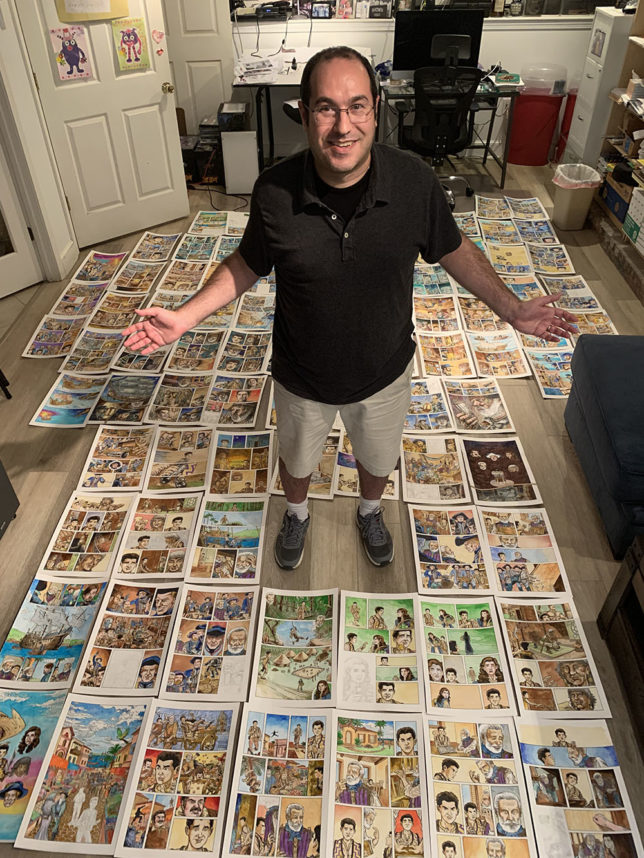
JE – For the year of working on this graphic novel, I had tables set up all over this room full of artwork, for ten months. I have fraternal twin daughters, Tahlia and Reya, who look and act very differently. Every day my daughters would come into the room, they are both into art, and they would ask questions about what’s happening in a panel, or the brush that I was using; it was a year of really fun conversations. Tahlia was curled up reading the book the first night, and I took a photo of her reading it that I cherish. Reya also read it, but I didn’t manage to snap a photo of that. They were excited that they were able to connect the images they’d seen over the past ten months or so, to the finished project. Knowing I’d be working on this for days on end, they thought that it was so cool which made me so happy.

Joshua Edelglass surrounded by his artwork

AS – It’s interesting. Your process is a lot more physical. For me it was sitting and typing on a computer screen, so whether I was writing a scene or crafting an email, or just wasting time on Facebook, everything looks the same from my family’s perspective.

JE – Yes, for them to see the arc from the pencil to the ink to the paints…because it took over a year, it was really cool for them to see that process. They both asked me to sign the book! I was so happy to!

So are they happy with your artistic career choices?

AS – My family has long ago realized they don’t have a choice in the matter. This is what I do!

JE – My daughters are asking why the next book isn’t done yet, they want more!

José and the Pirate Captain Toledano is widely available on May 1, 2022, and can be found for purchase on Amazon here. The movie short continues to be available on Amazon here.


Boaz Hepner works as a Registered Nurse in Saint John’s Health Center, and teaches COVID vaccine education throughout the hospital, and to the community at large. He grew up in LA in Pico/Robertson and lives here with his wife and daughter. He helped clean up the area by adding the dozens of trash cans that can still be seen from Roxbury to La Cienega. He can be found with his family enjoying his passions: his multitude of friends, movies, poker and traveling.

Jewish Stories, Pirate-Style: Meeting the Creators of a Swashbuckling Comic for the Whole Family Read More »

Freedom to Live

Last Thursday, April 21, 2022, the eve of the second festival of Passover, the eve of “Good Friday” for Christians, and during the Ramadan period for Muslims, a few demonstrators gathered in front of the building of the Israeli Consulate in Los Angeles. Watching, I asked myself how ignorant, misled or self-deluded people can be, even here in the United States.

The demonstrators in Los Angeles may have looked innocent and well-meaning, but their chants were far from that. They chanted “Long Live the Intifada,” which is a call for violence. They chanted “We don’t want Two States! We Want all 48!” and “From the River to the Sea Palestine Will Be Free,”—none of which support peace, co-existence and a two-state solution, but instead express the rejection of the existence of the state of Israel within any borders. They call for the elimination of Israel. Period. That is far from innocent.

If their demonstration is presumed to support the rioters at Temple Mount, then at the least they should understand what they are supporting.

The events at the Temple Mount were instigated by Muslim extremists, supporters of the Hamas terrorist organization and Islamic Jihad. They executed a hostile take-over of the Al Aqsa mosque, and then proceeded to block the freedom of worship of well-meaning Muslim people during the Ramadan. The rioters abused the sanctity of the mosque by using it as a base to incite violent riots. They desecrated the mosque by hoarding rocks, cinder blocks and weapons inside and then throwing rocks, fireworks and Molotov cocktails within the mosque and from the mosque to the courtyard of the Temple Mount. They endangered the safety of Muslims in the mosque and Jews at the Western Wall who wished to worship peacefully. The intention of the extremists was to inspire a spread of violence across the country.

Israeli law enforcement authorities were deployed. They waited with restraint until the end of the time of prayers, and only then did they enter the Temple Mount in order to disperse the violent outbreak, and allow freedom of worship at the mosque and at the Western Wall. They acted with the intention of restoring the sanctity of the mosque and reinstating law and order.

They acted with the intention of restoring the sanctity of the mosque and reinstating law and order.

Imagine if a violent extremist group raided a church or a synagogue anywhere in the United States, and acted violently in the same manner—hurling rocks and Molotov cocktails in a place of worship. In any such scenario, it would be regarded as the responsibility of the local law enforcement authorities to act immediately. It is even anchored in international law. Yet, that basic commitment to restore law and order, accepted globally, is questioned when it comes to Israel. Israel does not request any special favors. Israel only expects that it be judged by the same standard by which any other country would be measured.

In such a confrontation there is a physical front and a public relations front, and they are intrinsically linked and fuel each other. The blind support extended by Israel haters, intentionally or unintentionally, guarantees a win-win situation for the extremists.

Even if the rioters desecrate a sacred mosque, riot and rampage, intimidate and prevent fellow Muslim devoted worshippers from praying peacefully, throw Molotov cocktails, ignite fires on the Temple Mount, hoard rocks to pelt at Jews praying at the Western Wall—all of these actions will be disregarded and ignored. After all, there is a greater cause: defaming Israel. In serving that cause, the tables will be turned on the factual sequence of events and truth will be distorted.

After all, there is a greater cause: defaming Israel.

The Muslim extremist rioters know well in advance—even before they throw the first Molotov cocktail or smoke grenade—that they will receive the sympathy and solidarity of unwitting populations, the likes of which are the demonstrators in Los Angeles, and some media outlets.

Al Jazeera reported the events with the title “New Israeli raid at Al Aqsa mosque leaves Palestinians injured.” The Democracy Now site carries the title “Colonial Violence is the norm: Israel raids Al Aqsa Mosque.” The lack of context, in such misleading titles, guarantees a win-win situation for extremists.

If Israel refrains from responding, then the extremists enjoy a perception of victory simply from initiating the chaos and undermining Israel’s commitment to law and order. In this equation, if Israel responds with force, in order to preserve peace and order, then Israel will be immediately vilified and wrongly accused of instigating the events. That is the win-win situation for those who seek to destroy Israel, and it’s exactly what empowers them.

Wild unfounded accusations will be spread regarding Israel’s intention to desecrate the mosque, curb religious worship or change the status quo on the Temple Mount—none of which is true.

Israel has stated time and time again that it has no intention of changing the status quo on the Temple Mount in any way. Any misleading information contrary to that is disinformation. Many of the videos spread on social networks, depicting sinister Israeli intentions on the Mount or attacking innocent Palestinians are fake videos that do nothing more than feed anti-Israel sentiment.

Despite the violence and unrest by Hamas supporters, hundreds of thousands of Muslims prayed at Al-Aqsa mosque over the first two weeks of Ramadan, and more than 90,000 Muslim worshippers entered the Temple Mount for prayer, even on the day of the riots, fully exercising their right of freedom of worship at the Al-Aqsa mosque. This was guaranteed by Israel. Israel will always ensure the freedom of worship of all religions.

In leading up to these events, in a period of one week, Palestinian terrorists and rioters attacked Jews in prayer shawls walking to prayer, stoned buses carrying young Israeli children near the Western Wall and twice vandalized the Jewish site called Joseph’s Tomb. In the week before, they enacted four terrorist attacks that murdered 14 Israelis.

We should understand that this is an ideological battle in the Middle East. Those who support Israel, support co-existence, freedom of worship, freedom of the individual. The freedom to live. Those who support the Hamas activists, support chaos, death and devastation. Every individual should decide wisely which side they support.


Hillel Newman is the Consul General of The Consulate General of Israel in Los Angeles.

Freedom to Live Read More »

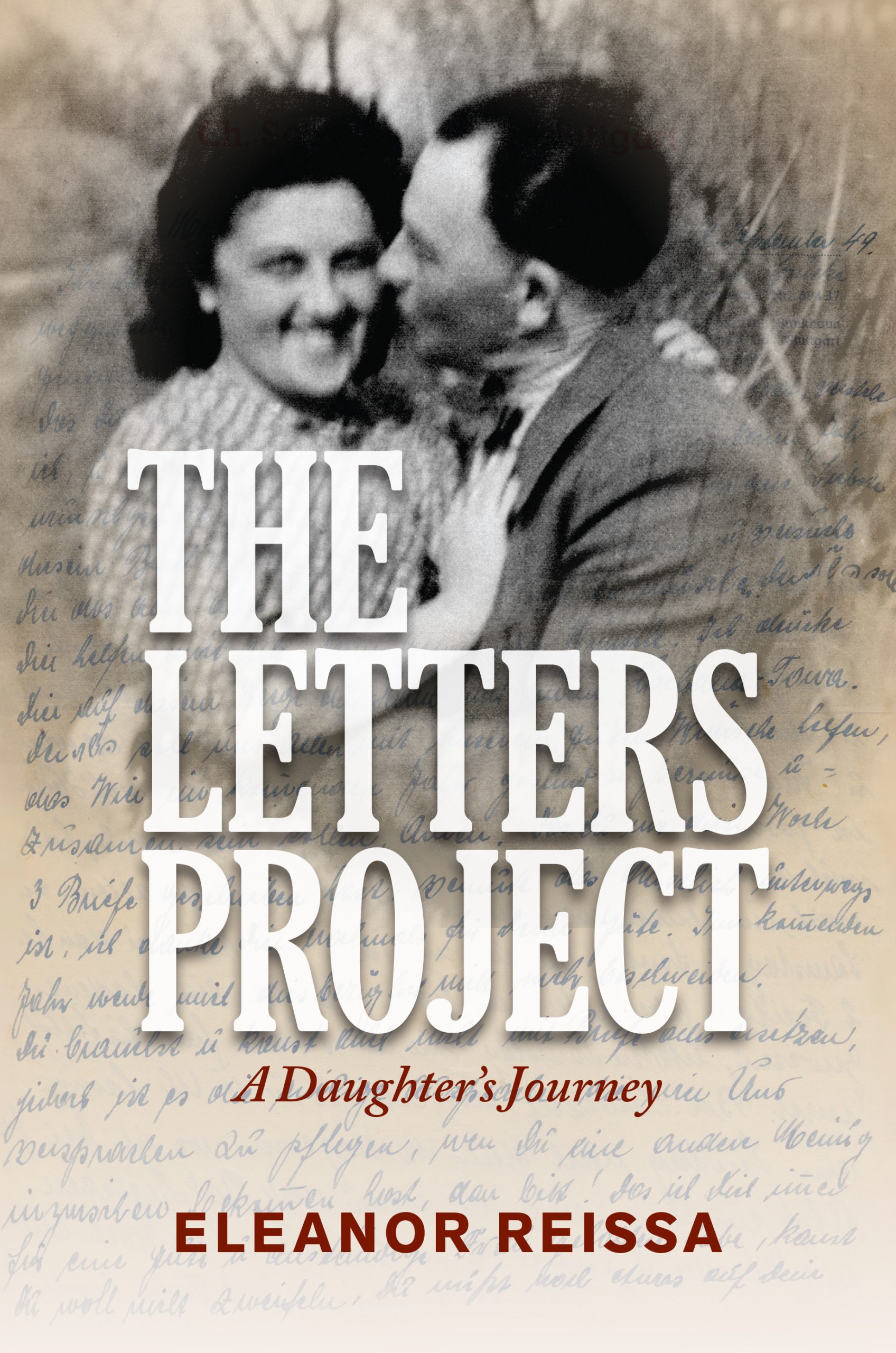
THE LETTERS PROJECT: A DAUGHTER’S JOURNEY


THE LETTERS PROJECT: A DAUGHTER’S JOURNEY

By Eleanor Reissa

The Letters Project is about big history, the Holocaust, but it is also an extraordinarily intimate personal narrative—a rare blend of informative, poignant, excruciating, startling, humorous, and ultimately inspiring storytelling. In 1986, when her mother died at the age of sixty-four, Eleanor Reissa went through all of her belongings. In the back of her mother’s lingerie drawer, she found an old leather purse. Inside that purse was a large wad of folded papers. They were letters. Fifty-six of them. In German. Written in 1949. Letters from her father to her mother, when they were courting. Just four years earlier, he had fought to stay alive in Auschwitz and on the Death March while she had spent the war years suffering in Uzbekistan. Thirty years later, Eleanor—a theatre artist who has been on the forefront of keeping Yiddish alive—finally had the letters translated. The particulars of those letters send her off on an unimaginable adventure into the past, forever changing her and anyone who reads this book. “‘The Holocaust,’ Eleanor Reissa writes in this unforgettable and courageous book, ‘is attached to me like my skin and I would be formless without it.’ A very personal story that begins with her discovery of some sixty letters written in 1949 is also a fundamental one of a woman trying to make sense of her life and family and of the shadows that go back before she was born. There is plenty of feeling and sentiment but it never feels sentimental. Her inimitable wit leavens the sadder scenes. This journey of discovery is riveting, told with tender insight, at times heartbreaking and at times heartwarming just like the Yiddish songs that have delighted Ms. Reissa’s audiences.” —Joseph Berger is a New York Times reporter and author of Displaced Persons: Growing Up American After the Holocaust

CLICK HERE TO BUY THE LETTERS PROJECT

 
The Letters Project is a wonderful book—funny, heartbreaking, and ultimately transcendent. Eleanor Reissa’s journey back into her family’s past makes for a gripping—and very human—international mystery. I highly recommend it.” —Tony Phelan, TV Showrunner for: Grey’s AnatomyDoubt, and Council of DadsEleanor Reissa has written a gritty, fearless yet funny memoir about herself, her family, and the Holocaust. Once I began reading it, I was completely swept away until the journey ended. I was moved by the power of this uniquely personal yet universal story.” —Julian Schlossberg is an American motion pictures, theatre, and television producer
https://posthillpress.com/book/the-letters-project-a-daughters-journey
Excerpt from the book: The Letters Project by Eleanor Reissa. Copyright © Post Hill Press 2022. I begin to walk down the very long hallway, slowly and deliberately, looking at those mighty iron doors on each side. Left foot, right foot. It is an effort to move my legs. I stop. I look. I listen. I am like Superman. I have x-ray vision. I see them. My family. I feel their lives here. Their breathing. From behind the doors and in the halls. They are flying all around, phantom shadows in the gray air. I hear babies crying and Yiddish and Polish and shouting and occasional laughter and the footsteps of the children, clopping, running, shrieking as children do, and fathers’ yelling and women weeping. A dream within a dream. I inhale them into the center of my soul. I swallow this fortress and I become the whale. Then I see my grandparents, my beloved grandparents, of blessed memory; the mourning in their eyes, so evident in the photos. And my mother, so young and beautiful. And my brother, such a skinny knobby-kneed little boy who had travelled hither and yon, from pillar to post, knowing more hardship than any young boy should ever know. I hear them and I see them all around me. I want to touch them. Maybe if I stand here a bit longer, they will materialize and come to me. That is my wish. And I am certain that they would be happy to see me too. I have never been more certain of anything in my life. I do not move. I will not leave. Oh my God, why would I ever leave this place? I want to be preserved here, happy to be like Lot’s wife. Frozen in time. I want to wait for them. I know they are here. I am submerged with the ghosts, and I want to swim with them forever. (pg. 82-83)

THE LETTERS PROJECT: A DAUGHTER’S JOURNEY Read More »

Intro to Nice Jewish Boys 101 ft. Jake Offy

The schmuckgirls are back this week and are excited because chametz is back on the menu and they’re bringing you the self-proclaimed Nicest Jewish Boy – Jake Offy. On this episode, Libby, Maxine, Marla, and Jake discuss how to be a NJB, whether nice guys really finish last, how to politely reject over the DMs, Jewish geography and more! And of course they end off with a fun game of “Cute” or “Cringe!”

Like what you hear? Follow @schmuckboysofficial on Instagram and TikTok. Submit your questions, comments, concerns, crazy date stories, and advice requests to schmuckboysofficial@gmail.com

Intro to Nice Jewish Boys 101 ft. Jake Offy Read More »

Can Israel’s Miracle Coalition Survive?

The war in Ukraine and the events on Temple Mount might have obscured the sad fact that the Israeli government, an improbable “unity” coalition formed more than a year ago, is now living on borrowed time. MK Idit Silman has pulled out of the coalition, leaving it with only 60 MKs. One or two more defectors might bring about the end of this government, and then Israel will be thrown into yet another election campaign, with all its schmutz, incitement, paralysis and waste of money, only to likely wind up with the same draw again.

Strangely enough, the current government, which brought to the table presumably impossible partners, has managed to function quite well. Of course, it did nothing on the most important thing – the future of the Israeli-Palestinian conflict – but frankly, being a government built on compromise between its diametrically opposed members, there was only so much it could do. The Palestinians, from their end, didn’t seem to help either, with incitement against Israel still going strong in their schools and media.

On the domestic front, however, the Bennett government made things happen. First and foremost, unlike the erratic and panic-stricken conduct of the Netanyahu government during the first COVID-19 year, which caused many businesses to collapse due to the lockdowns, this government managed to fight the plague while letting the economy and the people breathe. Furthermore, it seems that the ministers have been more interested in carrying out their duties vis-à-vis all the citizens rather than being invested in petty politics and in inciting against the people who didn’t vote for them.  Many people in Israel today will be sorry to see this government fall.

The current government, which brought to the table presumably impossible partners, has managed to function quite well.

American Jews should be praying for the survival of this government as well. Remember Netanyahu boasting six years ago about the Kotel agreement, which called for the construction of an egalitarian plaza at the Western Wall? Well, soon enough, under Ultra-Orthodox pressure, Netanyahu made yet another one of his many flip-flops, leaving non-Orthodox Jews and women as unwelcome guests at this site.

 This government, on the contrary, doesn’t include Ultra-Orthodox ministers. Instead, as Minister of the Diaspora it has Dr. Nachman Shai, who has intimate knowledge of the needs and concerns of American Jews. If Sallai Meridor, former Chairman of the Jewish Agency, once lamented the ease by which Israeli governments had been making decisions which hurt Diaspora Jews, today they have an advocate sitting at the government table and raising the alarm when necessary.

 Even more interesting is Minister of Religious Services, Matan Kahana, an Orthodox Jew, who has just released his plan to reform the conversion to Judaism in Israel, which has been traditionally under the authority of the Chief Rabbinate, now controlled by the Ultra-Orthodox. Kahana plans to delegate this authority to the city rabbis, some of whom are known to be more flexible. He argues that this would solve the problem of close to half a million Israelis, mainly immigrants from the former Soviet Union, whose Jewishness is not recognized by the state-controlled rabbinate. Kahana’s reforms unleashed a litany of venom against him from religious radicals, including death threats, but being a former fighter pilot in the IAF, he is not the man who would falter under pressure.  

I’m not suggesting here that Kahana’s current reform, which targets Israeli citizens only, might solve the problem of Reform and Conservative American Jews, whose conversions will still remain unrecognized by the Chief Rabbinate. But when was the last time you saw a move in the Israeli religious scene which was meant to make life for non-Orthodox Jews easier rather than more difficult? Given more time, Kahana, a proud representative of Zionist-Orthodoxy, who understands the importance of American Jews to Israel, might have more good news in his arsenal.

On Yom Haazmaut, in Israeli synagogues Ultra-Orthodox will again refrain from saying the Hallel blessing, because, they claim, the establishment of the state was not a miracle. In my humble opinion, the fact that Israelis could get their act together and form such a government is nothing but a miracle, and therefore we should all say the Hallel and pray for its survival, and American Jews should join in the prayers as well.


Uri Dromi was the spokesman of the Rabin and Peres governments, 1992-1996. 

Can Israel’s Miracle Coalition Survive? Read More »

A Peace of Matzah

Israel is real. I was reminded of this on the first night of Passover right at the moment in the Seder where you break the matzah in pieces and distribute it. The initial piece I broke off for myself was in the perfect shape of … the land of Israel.

All 16 present at the Seder marveled as I held up this unleavened, edible Israel in awe. Perhaps a sign from above? A reminder that G-d is as present in our lives today as he was when he took us out of Egypt and brought us to our promised land? Or just a ‘lucky break’?

I immediately began contemplating what this little piece of matzah in my hand represented.

All sixteen present at the Seder marveled as I held up this unleavened, edible Israel in awe.

From this huge, round matzah, I received my little share. A microcosm of G-d gifting the Jewish people our tiny but beautiful Israel from his perfectly round, stunning earth. I continued to reflect on the modern state of Israel and its willingness to give of itself in so many ways for peace. Only to be met with war and terror. 

History has shown our enemies are eventually banished from existence. This week we will be honoring Yom HaShoah and the memory of the six million lives murdered by those who put on display the opposite of a willingness to coexist, but rather, a murderous agenda of annihilation and genocide. They are gone. We are here. Here in the world and here in our land of Israel. 

Some say that Israel was a sort of consolation prize for our people coming out of the horrors of the Holocaust. I say: Israel has nothing to do with the Holocaust, and yet, everything to do with it. Nothing, because our return to Zion has been a part of our prayers and hopes long before a Nazi ever put on a pair of boots. Nothing, because the European genocide is only part of the story of Jews being globally persecuted and exiled, from the expulsion of the nearly one million Jews from Arab lands to pogroms, crusades and inquisition.

And yet, Israel has everything to do with the Holocaust because its very existence provides refuge and a safe haven for global Jewry, thereby enforcing and implementing our mantra of “never again.” 

I go to Israel at least once a year. I can’t wait to spend the holiday of Succot there in October. Whenever I go, I see with my own eyes an open, democratic and free society tirelessly striving and yearning for peaceful coexistence. What I see is diametrically opposed to the rhetoric I hear. Whether it’s falsehoods and misrepresentation that smatter much of the Hadid clan’s posts, or the modern libel of apartheid emanating out of the mouths of the duplicitous hypocrites at Amnesty International, or as I like to call them, ‘Am Nasty’.

Their lies and false narratives fly in the face of reality and truth. The fabric of Israeli society is one of plurality, diversity and multiculturalism. Israel has shown its willingness to live in peace and share our homeland with those who want to partake in its richness and holiness. Let this piece of matzah be a reminder and a lesson to all those filled with hate, to the ones shouting, “From the river to the sea” or to anyone calling for Israel’s destruction. You are not a peace partner. You are an enemy of peace. And you have one choice: Seek peace and coexistence or history will go against you.


Elon Gold is a comedian and actor who can currently be seen on the 11th season of ‘Curb Your Enthusiasm’ and at The Laugh Factory Hollywood on May 18th for Merry Erev Lag BaOmer. 

A Peace of Matzah Read More »

Mandy Silverman Talks Schlissel Challah and Her Origin Story

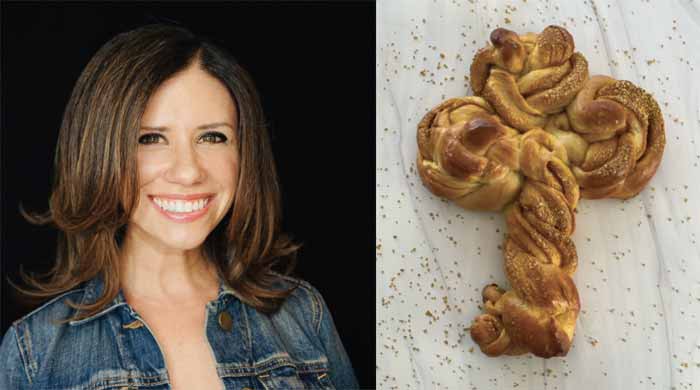
Making a key-shaped challah or a challah with a key baked into it for the Shabbat following Passover is a Hasidic tradition, dating back to the 18th century. This tradition is called “schlissel challah,” which signifies an increase in financial blessings.

“Schlissel key is just one of those customs that I had growing up that felt so wonderful to be able to continue on with my own family,” challah guru Mandy Silverman of Mandylicious told the Journal. “The key we use is the one my mother gave us the first schlissel key Shabbat after we got married.”

While some people just tuck the key anywhere in the dough, Silverman wraps hers in foil, tucks it into the dough by an end and then bakes it with a toothpick sticking up out of the key end, so she doesn’t lose track of it.

“Schlissel key is just one of those customs that I had growing up that felt so wonderful to be able to continue on with my own family.” – Mandy Silverman

Surprisingly, Silverman never made challah growing up. Even when she got married 22 years ago, she was scared to make challah and would only attempt it for holidays a few times a year. 

“It was very intimidating,” Silverman said. “Because it’s something that you grew up with, you feel like it has to be just like your mother’s or your bubbe’s or your safta’s or whoever it is. And if you can’t do it just like that, then it’s wrong.”

However, nine years ago that all changed when Silverman got a call. Her mother had been to a friend’s house for lunch, and when her host sliced the challah, honey came oozing out of it. Silverman’s mom asked her how she did that, but the woman would not share her recipe. 

So Silverman jumped into action. “Don’t worry,” she told her mother. She’d figure it out.

“It was probably foolish on many levels. Not only was I trying to learn how to make challah in general, I was trying to figure out how to stuff it with honey,” she said.

Silverman experienced plenty of honey-challah fails, but refused to give up. 

“I burnt it, it oozed out the bottom, [the honey] evaporated into the dough itself,” she said. “It was so heartbreaking, because it’s not like you’re making a pancake. If you mess up a pancake, it takes just a few minutes to make another one. Mess up a challah and it takes hours to bake another one.”

Silverman finally got the challah down, but decided to put a pause on challah with honey. Instead, she began stuffing them with different ingredients. Silverman started with salami, buffalo chicken (her husband’s favorite), caramelized onions and brisket, and created a special pumpkin spice, turkey-shaped challah in 2013, when Hanukkah and Thanksgiving overlapped. 

Silverman’s unique spin evolved into a business. She founded Mandylicious in 2013, and has created more than 350 unique challahs (in different shapes, flavors, colors and themes) and babkas. In addition to selling a rotating assortment of gourmet challahs locally (in Sharon, Mass., where she uses kosher and dairy-free ingredients and keeps a kosher kitchen), she teaches classes, shares recipes and tips and supports others who want to make their own challah.

“The most important part of my whole job is to make sure that people know that they can ask me any question and they don’t have to ever feel embarrassed or bad,” Silverman said. “They should always feel proud of themselves.”

As far as the honey challah is concerned, about a year after Silverman gave up, someone asked what led her to start making challah. This inspired her to try again. Two or three honey challah attempts later, she had mastered a recipe.

In her work, Silverman continues to make challah, she said, because it “is a tradition the Jewish people share. A tie that is global, generational and across all movements of Judaism. It is so rare to find anything in this religion that is so widely agreed upon. The opportunity to help people from all over the world become a part of this tradition is nothing less than an honor.”

Here is a simplified version of Silverman’s challah recipe. You can message her on the @MandyliciousChallah Instagram page for the complete recipe with all her tips.

Mandylicious Challah Recipe with Vegan Option

1 1/3 cup water
4 1/4 cup high quality bread flour
1/3 cup canola oil
Generous ½ cup sugar
4 large egg yolks
1 tablespoon instant yeast
2 teaspoons table salt Extra water and flour as needed for consistency

To make vegan: In place of egg yolks, increase water to 1 1/2 cups, & oil to 1/2 cup.

Directions:

  • Combine all the ingredients in a large bowl and knead for 5-7 minutes by hand or by using the dough hook in a stand mixer. If sticky, add flour, 1 tablespoon at a time; if dry, add water, 1 tablespoon at a time. The goal is to create a cohesive ball of dough that is not floury to the touch. Allow to rise in a large bowl, covered with a towel for 1 1/2 hours. 
  • Remove dough from bowl, and divide into six equal portions. On a floured surface, roll three portions into long ropes, then carefully braid together, then place on a greased loaf pan or greased cookie sheet. Repeat with remaining dough. Cover with a towel and let rise for an additional 20-30 minutes. Preheat oven to 350°. 
  • Brush with an egg wash (Vegan: use oil or melted margarine)
  • Bake for approximately 30-40 minutes or until golden brown.

Mandy Silverman Talks Schlissel Challah and Her Origin Story Read More »