fbpx

March 28, 2022

What No One Said About Will Smith’s Assault of Chris Rock: A Smack Hurts!

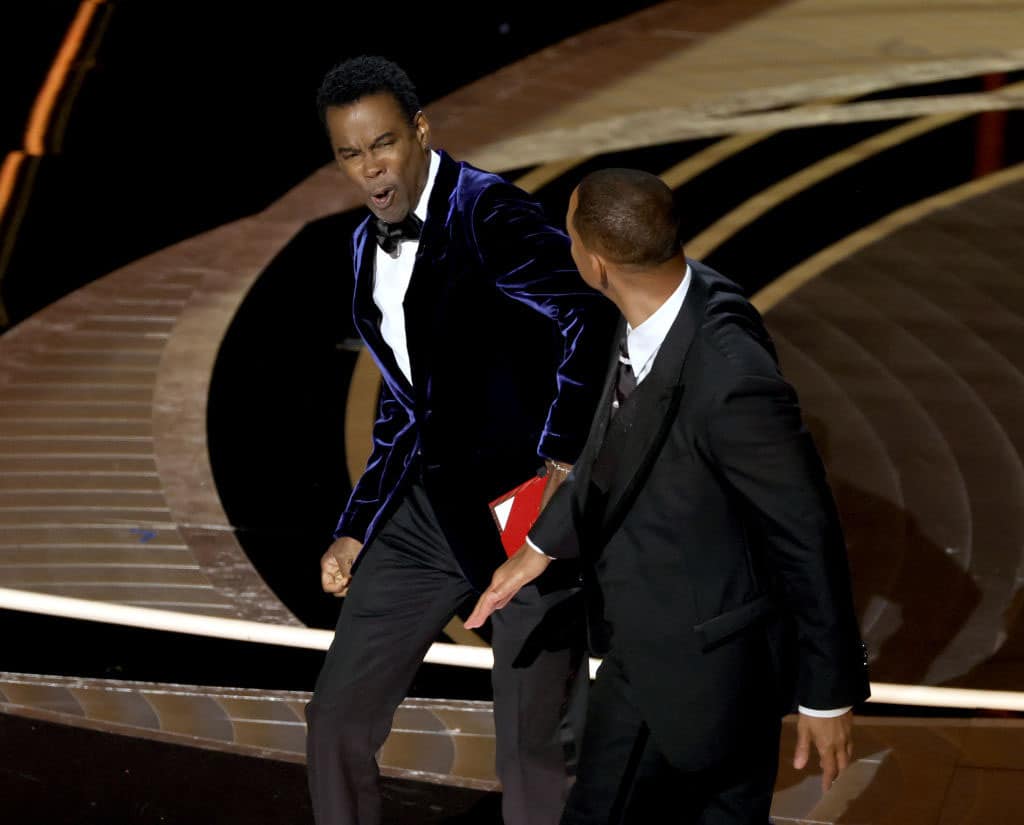
I was as shocked as anyone when movie megastar Will Smith walked on stage at the Oscars ceremony and smacked Chris Rock, who had made an unfunny joke about Smith’s wife.

But my shock continued when I saw the initial response from much of the entertainment community. A blizzard of tweets focused on the emotional context of the assault. Michaela Jae Rodriguez tweeted that “Sometimes human emotions happen. Sometimes human interactions happen. We can’t judge people based on their moments.”

Minnie Driver tweeted that “It was deeply personal. We were all privy to…emotions running really high. I really hope they will make up later. It’s hard to watch somebody’s pain like that.”

Of the numerous tweets I scrolled through, I couldn’t find one that spoke about…yes, the physical pain of getting smacked! I know that pain. I have ugly memories of a few fisticuffs in my childhood in Montreal with anti-Semites who didn’t enjoy seeing a yarmulke on my head on Shabbat.

I can’t speak for Chris Rock, but I can tell you that it hurt and stung to get smacked on the face– the way Rock got smacked by Smith. I’m not even talking about the public embarrassment in front of a global audience. I’m talking about simple physical pain.

Since the beginning of time, nothing has been more destructive to human societies than the crossing of that sacred red line when we violate other people’s bodies. Will Smith had every right to be angry and offended. He had every right to feel protective of his wife. But when he walked on that stage and assaulted Rock, he violated what I consider the most important rule in all of life: yell at me, scream at me, insult me—but don’t touch my body.

Since the beginning of time, nothing has been more destructive to human societies than the crossing of that sacred red line when we violate other people’s bodies. 

Our bodies are sacred. They are our most intimate possessions. They are the source of our deepest anxieties and our deepest pleasures. I’ve heard religious Jews say that their bodies are on loan from God, and while they’re here on earth, they have an obligation to care for it as well as they can before they “return” it.

We make a big deal about physical pain only in the extremes, as when people are murdered or raped. The value of the #MeToo movement is that it raised the bar—unwanted physical touching of any kind is unacceptable and may even be criminal.

The value of the #MeToo movement is that it raised the bar—unwanted physical touching of any kind is unacceptable and may even be criminal.

At the same time, there has been a significant raising of consciousness around mental health. Especially with the isolation forced on us by the COVID pandemic, emotional pain like depression, loneliness and other non-physical suffering have received major prominence, and for good reason.

Will Smith’s pain when he heard Rock’s joke was non-physical. It was emotional. He had different options to express that pain. He and his wife could have walked out. He could have spoken to Rock privately after the show. He could even have released a statement that Rock’s attempt at humor was deeply offensive to Smith and his wife.

He did none of the above. Instead, he went after Rock’s body.  If you’re one of the millions of Smith fans around the world, what kind of message does that assault convey? That if you’re really offended by a bad joke, it’s OK to hit the jokester?

If you’re one of the millions of Smith fans around the world, what kind of message does that assault convey? That if you’re really offended by a bad joke, it’s OK to hit the jokester?

Less than an hour after the assault, Smith gave his acceptance speech for winning the Oscar for Best Actor. His only reference to the assault was when he said, “I want to apologize to the Academy, I want to apologize to all my fellow nominees.” Not only did he fail to mention the victim, he failed to specify what he was apologizing for– the most important part of any apology (it took Smith and his PR team almost a full day to finally release a proper apology).

In his acceptance speech, he wove in some emotional words that tried to “explain” his lashing out, such as, “I’m being called on in my life to love people and to protect people and to be a river to my people.”

He recognized some of the challenges he’s faced: “I know to do what we do, you gotta be able to take abuse, and you gotta be able to have people talk crazy about you. In this business, you gotta be able to have people disrespecting you and you gotta smile and you gotta pretend like that‘s OK.”

A fateful hour earlier, when Smith heard a joke he thought was not OK, he decided to stop pretending. His mistake was that when he finally stopped pretending, he got up and went after Rock’s body– a universal sin that is never OK.

What No One Said About Will Smith’s Assault of Chris Rock: A Smack Hurts! Read More »
david suissa shanni suissa podcast

How Can One Man Create So Much Destruction?


Listen to the full episode on any of your favorite podcast platforms!

Does Vladimir Putin have any limits to the devastation he’s inflicting on Ukraine? Can Prime Minister Bennett help bring about a ceasefire? Is Zelensky the most popular man on the planet? Are we really done with masks? These and other hot topics on this week’s episode of Conversations with Shanni.

Follow David Suissa on Facebook, Twitter and Instagram & Shanni Suissa on Instagram, Twitter and TikTok.

You can check out Shanni’s new show here!

example one
example two
example two

How Can One Man Create So Much Destruction? Read More »

Brandeis Disassociates from MESA Following Passage of Pro-BDS Resolution

Brandeis University announced on March 24 that they are disassociating themselves from the Middle East Studies Association (MESA) after the organization overwhelmingly voted in favor of a resolution endorsing the Boycott, Divestment and Sanctions (BDS) movement.

In a statement, Brandeis said they condemn “MESA’s boycott of institutions of higher education in Israel.” “The resolution attacks the fundamental principles of academic freedom and association to which MESA specifically refers in its mission statement, and to which Brandeis is committed,” they added. “As a matter of principle, Brandeis University opposes academic boycotts of universities in any country. In light of this vote and the boycott, Brandeis dissociates from MESA and reaffirms our support for academic freedom.”

The Anti-Defamation League tweeted, “All institutional members of @MESA_1966 should follow the lead of @BrandeisU and dissociate after it ratified a #BDS resolution boycotting Israeli academic institutions. This resolution is antithetical to academic freedom & discourages productive dialogue.”


Associate Dean and Director of Global Social Action Agenda at the Simon Wiesenthal Center Rabbi Abraham urged all American universities to “sever ties with MESA” in a statement. “The hypocrisy and sheer lunacy of MESA’s vote is self-evident ,as it will surely extend to the fields of cancer, bio-medical and technological research – all fields which Israeli universities, faculties, and students—including Arab students—excel in,” Cooper said.  “It will also have a debilitating effect on Jewish and pro-Israel students already struggling against  BDS anti-peace activists who try to prevent pro-Israel speakers, events and other activities on campuses.”

AMCHA Initiative Director Tammi Rossman-Benjamin said in a statement to the Journal that they “strongly commend” Brandeis for taking action against MESA. “Other universities should follow Brandeis’ lead and immediately withdraw their membership from MESA, as well as establish clear and unassailable safeguards to prevent faculty from using their university positions and departmental affiliations to promote politically motivated advocacy and activism that undeniably hurts their own students and colleagues,” she added. “MESA members should be ashamed of themselves. What they did was to provide disciplinary legitimacy to the censuring, denigration, exclusion and silencing of pro-Israel students and faculty. Universities must make abundantly clear they won’t stand for such faculty abuse, which is a direct and major contributor to campus antisemitism.” AMCHA also noted in a tweet that five other universities have disassociated themselves from MESA as well.

Asaf Romirowsky, who heads Scholars for Peace in the Middle East (SPME) and the Association for the Study of the Middle East and North Africa (ASMEA) as an alternative to MESA, said in a statement to the Journal, “I applaud Brandeis University’s decision for condemning MESA’s boycott of institutions of higher education in Israel. And correctly stating that the resolution attacks the fundamental principles of academic freedom as such they are dissociating themselves from MESA . Further, I hope other universities follow suit. In particular [George Washington University], that houses MESA’s offices, should seriously consider what this endorsement of BDS means to a university that should be promoting discourse and an open exchange of ideas, not boycotting them.”

StandWithUs CEO and Co-Founder Roz Rothstein also said in a statement to the Journal, “We salute Brandeis for condemning and disassociating itself from MESA for supporting the antisemitic BDS campaign against Israel. MESA and its members have a responsibility to all American college students to provide factual education free from bias. By endorsing BDS, MESA has violated this. We call on more universities and MESA members to follow suit and disassociate themselves from the organization for discriminating against Jewish and Zionist students and faculty.”

Judea Pearl, Chancellor Professor of Computer Science at UCLA, National Academy of Sciences member and Daniel Pearl Foundation President, tweeted that while Brandeis’ decision is good, he wished “they would explain the move with a bit more compelling argument: BDS is an eliminationist movement, not simply one that opposes academic freedom.”

MESA did not respond to the Journal’s request for comment.

The resolution, which MESA members had been voting on from January 31-March 22, received 768 votes in favor and 167 against. The resolution accused Israeli universities of being “imbricated” in “systemic violations” against the Palestinians. The ADL tweeted that they were “appalled that MESA ratified a #BDS resolution boycotting Israeli academic institutions, undermining academic principles of dialogue & obstructing Israeli-Palestinian engagement. MESA-affiliated universities must disassociate from this biased action.”

Pearl tweeted that he was going to start taking “unilateral, one-man action” against MESA. “Now that MESA has turned Israeli students and academics into a disadvantaged minority, I am starting a ‘reverse discrimination’ program to assist them in any way I can,” he wrote. Pearl told the Journal that he plans to strengthen his current ties to Israel. 

“I have a visiting position in a Technion. My colleagues have a connection in various others universities,” Pearl said. “To strengthen [those ties] is very easy to do … if I spend two hours a week before, I’m going to spend four now. And if I have applications from Israeli scholars who want to come to UCLA, I will give preference [to them].” He added: “We need to help the disadvantaged. Nobody today thinks Israelis are disadvantaged, and that is the main uniqueness of the idea … and we need to make it visible.”

Brandeis Disassociates from MESA Following Passage of Pro-BDS Resolution Read More »